S5:E63🎙️ LIVE with LtCol Kevin M. Schmiegel, USMC (Ret.)
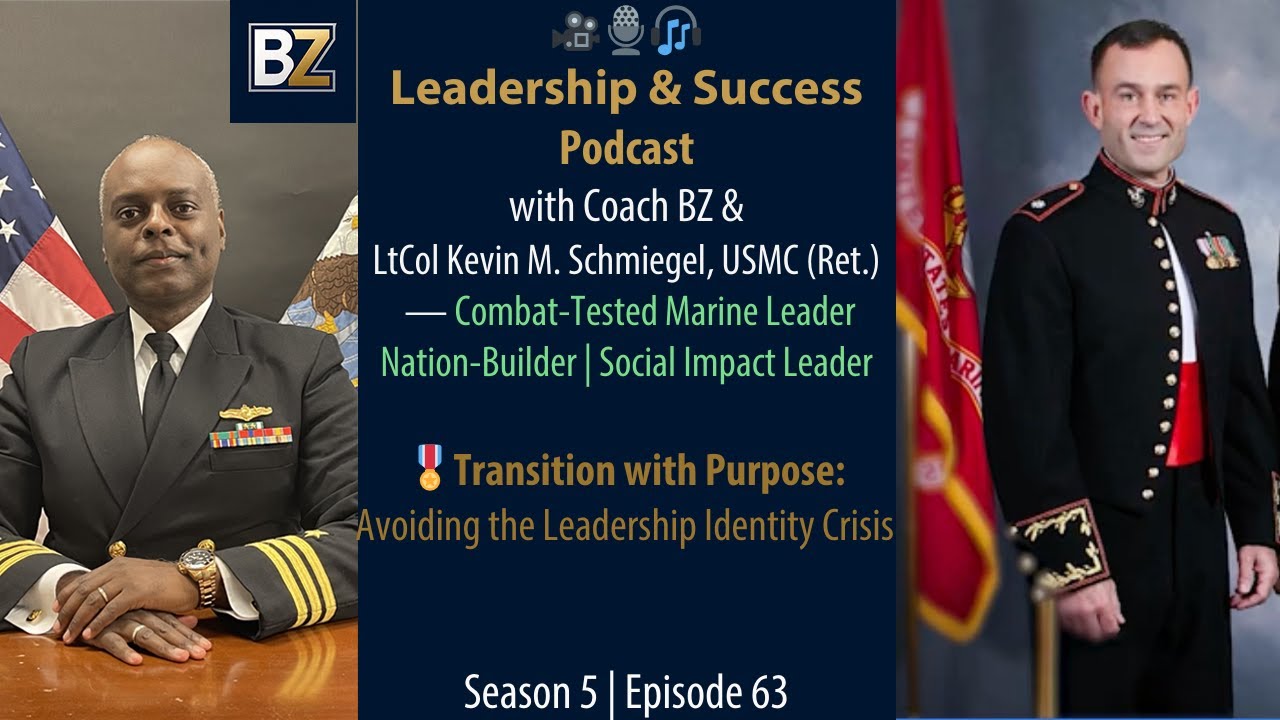
Retired Marine Lieutenant Colonel Kevin M. Schmiegel discusses his 20 years in the military, founding Hiring Our Heroes (which placed 120,000+ veterans), and his current work with Zero Mils to shift organizations from military-friendly to military-thriving. He outlines three Marine leadership traits—dependability, decisiveness, loyalty—and five elements veterans need to thrive: meaningful employment, purpose, community, health, and self-improvement.
Chapters
Hi, I'm John Maxwell. When the top companies in the world are looking for trainers, speakers, and coaches, there's one name that stands above the rest, and that's Maxwell Leadership. Our certified team members have gotten proven results for companies all over the globe, and our reputation, I'm proud to say, is second to none. Some of our members have risen to the top of their profession, including the one you're going to meet today. I proudly introduce you to my friend, Bob Fabien Zinga.
Welcome to the Leadership and Success Podcast with your host, Coach BZ, where we help you lead with purpose and succeed with impact. If you're ready to grow into the kind of leader others want to follow, this podcast is for you. If you're determined to elevate your success and leave a lasting legacy, this podcast is for you. As my mentor, Dr. John C. Maxwell, reminds us, everything rises and falls on leadership. Our goal is simple, to inspire you, challenge you, and equip you with insights that can transform the trajectory of your leadership journey. Welcome aboard. Welcome to another episode of the Leadership and Success Podcast with Coach BZ.
All right everyone, welcome to another edition of the Leadership and Success Podcast. I have a very special guest for you. So as you guys know, this is the second episode today. So you already know that this morning I was grateful that we really stand on the shoulder of giants, trailblazers, people who have gone ahead of us. So that's what I am grateful for today. So let us know where you are joining us from, what city, what state, and also what you are grateful for today. So let me see if I can actually introduce our special guest today. I am really privileged and honored today to be speaking to Lieutenant Colonel Kevin M. Schmigal, U.S. Marine Corps retired. He's a combat-tested Marine Corps leader turned national movement builder. After more than 20 years of service, including global deployment, NATO leadership, and shaping personnel strategy for over 170,000 Marines, Kevin transitioned from the battlefield to building one of the most impactful veteran movements in America. He's the founder of Hiring Our Heroes. He helped place more than 120,000 veterans and military spouses into meaningful career. He raised more than $100 million for veteran-focused initiatives and impacted millions of lives nationwide. Today, as co-founder and CEO of Zero Mils, Kevin is leading a bold mission to move organizations from military-friendly to military-thriving culture, to redefine the narrative from broken veteran to empowered leader, and also to bridge the civilian-military divide through service, Purpose and community. So without any further ado, please help me welcome to the Leadership and Success Podcast, Lieutenant Colonel Kevin Schmidl. All right. Good morning here, but good afternoon to you, Kevin. How are you doing today?
I'm doing great, PZ. What a great introduction. I think I should have you as my hype man.
Thank you. I actually have a short video of you, but because I know we are running out of time and it's my fault. I took my daughter to school today, but I got stuck in traffic. But I'm going to play the video at the very end of our interview. And I know you have to go at the top of the hour. So let me ask you this, Kevin, what is one thing you are grateful for today?
I'm just grateful to be alive and making a difference in people's lives. I think I wake up every day with purpose, wanting to serve our country, our communities, and fellow citizens like you, BZ. I think we should all be grateful that we have the opportunity to, to help other people, to help them get to achieve their full potential and thrive too.
It's really amazing because it really runs through your entire life and career, in and out of uniform. When, when did that start, that desire for you to really want to make a difference?
You know, a lot of people thought I became a Marine because my dad was a Marine. I think that was a big part of my initial desire to serve my country. But actually on St. Patty's Day, it's probably fitting to recognize my mom too, her maiden name McGonigle. I grew up in a big Catholic family. So I think she had a big influence on my propensity to serve and my heart to serve. So, you know, not just going to church every weekend, but actually serving the community. My mom was very active in that way. And I think that had a big influence on me for sure.
Wow.
And for the people who meet you for the very first time, uh, what is something about you they may not know?
I mean, I, I think a lot of people, um, when they see our company, um, and what we're doing now and, um, a life full of success, they don't realize that I myself had some challenges, uh, at different points in my life, struggles, and that this company, the company that I founded with my best friend and business partner, retired Colonel Paul Cucinotta, was not founded in a position of strength. It was actually founded in a position where we recognized that there was a time in our life when we both struggled and we got from barely surviving to thriving. So I'm starting to talk more actively about my story and those struggles to to let everyone know that struggle is okay, that failure is okay, because you can realize strengths from that and you can realize opportunities from the challenges that you have in life.
Well, this next question, I'm going to try to humanize you because, no, uh, you've spent time with President of the United States, President Clinton, First Lady Hillary, uh, President Bush and Laura, and also no, legendary general like Dempsey and on and on and on. And I believe this is you right here by the Air Force One. So you've really accomplished a lot, but yet you are so humble. I guess the question I have for you is, looking back on your 20-plus year career, what moment or assignment most shaped the leader you are today?
I would have to say that was my service in a combat artillery battalion from 2001 to 2003. The artillery battalion was 2nd Battalion, 10th Marines. And I guess for the first time in my life, I realized what thriving was all about. Um, I had the things in that, in that moment that really captured my time in the Marine Corps, which was what was the most thriving time in my 58 years on Earth. Incredible leadership, incredible Marines from the top all the way down. To the bottom, from the bottom all the way to the top. We, um, we, we were a unit that was, um, the strongest. We called it second to none, 2nd Battalion, 10th Marines. But it was really that experience, um, seeing, um, what I think is perfection culture, like the, the mindset of what the military allows you to do as a young man or woman, and then what we're required to do when we leave the military, which is to look for those same things, demand the same things of ourselves and of the organizations we work with.
It's really insightful how the leadership principles you learn in uniform, whether enlisted or officer, really can translate into the industry and whatever else you do beyond the uniform. Now, looking back at your career, you've operated at the highest level, from NATO to global deployment. What are maybe some of the top 2 to 3 leadership principles that translate directly from the battlefield to the boardroom?
Well, um, the Marine Corps has 14 leadership traits, so it's hard to not say all 14. I like to do things in 3, so if I had to start with one, um, one of the leadership traits that the Marine Corps talks about is dependability, um, which I always equate to like the ability to think about a mission, right, and have a vision and execute it. That's what I think of in dependability. So I always use this term that actions speak louder than words. Dependability is all about living up to the words that— for your mission and executing the mission. Decisiveness, I think, is another leadership trait that we learn in the military that applies to whatever we decide to do after we take off the uniform. Once you set a vision, once you know what your mission is and you execute, to be decisive in the moment knowing what you're directing to do, I think it's critically important. And then the last thing would be loyalty. Loyalty is one of the 14 leadership traits that we learn in the military, and there is a term called semper fidelis, right? It means always faithful. Yes. Not always faithful just to the Marine Corps, faithful to your Marines, faithful to your core values. And again, these are not just two words, right? Semper Fidelis is, is a verb. It's not a noun. Being always faithful means that you're willing to back up your words with your actions. So for a Marine, whether it's in uniform or as a veteran, those two words mean something. When you look another Marine in the eye and you say Semper Fidelis, there is, there is an understanding what those two words mean, and that you're always going to be there for each other. You're always going to be there and show up for one another.
So that is so, so powerful. I think it's true across the entire military branches, but I think you guys, Marines, take it to an, on another level, right? Once a Marine, always a Marine. And knowing that when you see another Marine, you pretty much have, you know, the same background training and ethos and mindset and way of looking at things and always helping one another. That's really, really incredible. And I think every branch of the service can definitely learn from the few, the proud, the Marines. It's not just a slogan, but you guys are a special, special breed. Because I remember before I joined the military after 9/11, I did talk to Marines as well, but I was like, no, that's not for me. Because you guys are just crazy. Somebody needs to do what you do, but not, not me. So great, great respect for, for you all. And also, of all of the branches of the military, you guys are the only one— after 21 years of service, I have never, never seen a single fat Marine officer, not one. And that's saying something. So, uh, it's just incredible. But can you tell us kind of like about the, uh, Marine Air Force? Again, from my experience, out of all of the other branches of the military, You guys just take it to the next level. Nobody even comes close. What do you think causes that? Why are you guys so, I wanna say, intent and you pretty much go above and beyond always, like no exception. When we talked about extreme accountability, I mean, You guys really live it every single day. Do you know why that's the case?
I think it's all about culture. You know, you mentioned our mission at Zero Mills and this idea of creating cultures that enable people to thrive.
Yes.
I'm not saying this for a fact. When I was a Marine, it was the most thriving time in my life is because everything about the Marine Corps was built around culture and taking care of people. Investing in your people, putting your people first. I mean, the whole idea of leaders eating last is, is literally true in the Marine Corps. Like, from, from junior to senior, the last person who eats is, is, is the most senior person in the unit. But it, it, it's more than that. Like, every minute of every day, you live inside a culture where people put people first. Leaders put people first. And I, I, you know, I haven't seen that to great effect, uh, outside of the military and outside of the Marine Corps. And I think the other services do a good job of this, but listen, you won't go 10 seconds when you meet a Marine without them saying, 'I'm a Marine.' Yeah. And there's a reason for that, because that is the most thriving time in your life. They transform young men and women from civilians into Marines. And it's transformational. And then when you leave the Marine Corps and you become a Marine veteran, that never leaves you. It is simplified, Ellis. It is once a Marine, always a Marine. And that can never be replicated unless you build a culture that starts by putting people first.
Man, that is really, really powerful. No wonder you guys have a president on and almost always are the first one to go to battle. In any of the operations or wars we've had to fight. It's really inspirational. Thank you for that. So you've also managed assignment and retention for over 170,000 Marines during wartime. How did you approach leadership at that scale?
Yeah, I mean, I think I approached it the same way. I do any job I've had. I had 7 jobs in the Marine Corps. I've had 7 jobs since I left the Marine Corps. You have to put this in appropriate context. I was the head of enlisted assignments monitors responsible for assigning 172,000 Marines worldwide, having a responsibility to retain those Marines. And this was during a time of war. So I actually got my, um, postgraduate degree at the Naval Postgraduate School in manpower., and I was applying those skills during a time of war. We used a model in that role where every Marine that came in the Marine Corps from 2006 to 2008, and even before and after, we would try to maximize the number of deployments that they would have to Iraq and Afghanistan. So almost every Marine that we assigned had 2 tours in Iraq and Afghanistan.
Wow.
But what was really different about my time is I tried to change a culture and challenge assertions. This happens in every organization that I start, every organization that I take over. And in the very first week I was there, I was walking down the hallway. There are 60 human resource specialists, the most senior people in their occupational field, who assign 172,000 Marines worldwide. And I was hearing those people talking to Marines on the other end of the phone. And they weren't, they weren't putting those Marines and their families first. They were using a model to say, this is where you're going to get assigned, this is where you're going to go. And they weren't listening to these special circumstances that submarines had. So I listened and I learned, and then I led. And, and, and to put it very simply, that week after I finished— the second week after I finished my first— I called all 60 Marines together and I said, every day at the end of the day, you'll come to my desk and tell me how you said yes to one Marine and his or her family that day. And by the end of the first year, Marines were coming up and saying, sir, I got 3 today. I said, what do you mean you got 3 today? I said yes 3 times because they were starting to work with each other in order to accommodate a Marine and his or her family's needs. And that changed the culture. They enjoyed their jobs more. It wasn't just a model. They weren't just a number, those Marines that they were serving. They were people that they were leading. And those 60 Marines—
wow—
in their field. So they understood that concept. And it was all about changing culture. So the lesson is listen, learn, and lead. You don't have to make change right away. But if you see something and you identify something, make that your legacy for that organization. You can, you can actually create real change if you do those things effectively.
So powerful. And I think especially for the junior officers listening to us now, you become a department head and maybe one day CEO, XO, listen, learn, and lead makes so much sense because I've seen some people when they take over a command, they try to start making changes right away. They don't even understand the culture of the organization. Where did that wisdom come from? Because it is so simple but so profound. Listen, learn, and lead?
I think I, I think I just learned that from other people. Yes.
Wow.
And sometimes when I forget to be a good listener at the start, because I think I have all the answers, it leads you down a road that you shouldn't necessarily take. To your point about change, again, I'll start with looking at a culture. When you go into an organization, or you start something new, and the culture that you want to build is critically important. And again, if you put the people on your team, if you put the people in the organization at the very center in the bullseye, and that's your focus, you'll always be successful. And that it really is important lesson that I learned as a Marine under, under some of the best leaders I could possibly imagine. And even in civilian life too.
That's really powerful. Yeah, I remember when I first became a commanding officer, one of my mentors told me take care of the people and the people will take care of the mission. And that is so critical. It's really amazing how in the industry people don't always do that. And it's quite a different experience at time. And I know we're going to be talking about that too, all of the work you've done after the uniform and how you've been helping, I think, hundreds of thousands of veterans really get job and really thrive in society after the uniform, which is really, really, really key. But But I feel like people in the industry, they get so much, or maybe they don't really understand all of the benefits they get by hiring veterans because of the experience we have, you know, especially with leadership, even at the lowest enlisted rank. It's just amazing how leadership is really what we do. It's baked into our culture and everything we do in the service. Anything you want to add? About that, Kevin?
Yeah, I, I mean, I think we've learned over time the value of veterans in the workplace. Um, we've seen a huge paradigm shift in the acknowledgement from big employers, small employers, across the public-private, nonprofit, academic, government sectors. Like, um, the truth is we've proven that value, and I think that's why you've seen a seismic shift in— yes, the, the veteran unemployment rate is has dropped. If anything, there's a war for that talent now. People really have understood the value and they're doubling down on their strategies to attract people.
True. And looking at your career, one question that comes to mind is, how do you build trust and cohesion in high-stakes, high-pressure environment, especially when you don't have much time to do it?
Yeah, I mean, I think it's all about responding instead of reacting to some— something that happens in a high-stress environment. Um, it's very easy to have a knee-jerk reaction to something that, um, will fundamentally affect the organization you're running. I have a great story about that because I— the last nonprofit I led was called Operation Gratitude, and we're the largest hands-on volunteer nonprofit in the country at the time. And then COVID happened and we couldn't bring people together to serve, essentially to assemble care packages, make bracelets, write letters. And for a time we thought we would have to shut down. So, wow, we responded. We didn't react. We evaluated the current situation and we evolved and we wound up having the most impactful year in the organization's history. We impacted 620,000 deployed service members, veterans, first responders, doctors, and nurses. And at the end of the day, in those types of environments, you have to lead by example. And however scary it is, right, that your organization might cease to exist because of something that happens in that environment, you respond, you don't react, you evaluate, and you evolve to meet the changing needs and what's happening in that environment. And then you lead by example and you never let your teams see that, um, you're, you're just as afraid as they are that you're not going to stay viable. So I think I— one thing I've learned after leaving the military is I'm an entrepreneur, and the chaos and uncertainty of running a social impact company or a social impact nonprofit, I'm comfortable in that environment and, and growing those organizations even even in the face of uncertainty and high-stress environments.
That is quite insightful. Now, talking about transition, I know a lot of people who listen to this podcast, some of them will be transitioning from military back to the industry, and it can be kind of scary. I remember in 2017, I think was the time where the Navy told me, because of medical issues, you are no longer qualified to stay. So Lieutenant Commander Zinga, your time with the Navy is done. I'm like, no, I'm not done yet. I still have so much more to give. But anyway, I had to fight back to get back in, but it took me almost 6 months, actually almost a year before the Navy took me back. But during that time, I must tell you, I felt like I didn't have a purpose in life any longer. I know Colin Powell said, "Never let your ego so close to your position that when your position goes, your ego goes with it." But I must tell you, I really didn't know where to go and what to do. I was completely broken. My wife can testify to this. Now, looking at your career, uh, from the outside, it seems like you really had what many would call, right, a very successful transition. But yet you have openly shared that you struggled with purpose as well. Can you walk us kind of through that experience?
Yeah, I actually did have a successful transition in the moment when I retired from the Marine Corps in 2009. I was working on the peace process in the Middle East, working directly for the Special Envoy for Middle East Regional Security, General Jim Jones, who I also was the aide for at NATO. And we were attached to the State Department. Um, and one day, um, I was with General Jones briefing Condoleezza Rice in uniform, and the very next day I was the Chief of Staff, U.S. Chamber of Commerce, and walking down the hallways with the president and CEO Tom Donahue. So In 2009 to 2011, those first 2 years, the incredible experience I got to learn the business community as the chief of staff at the US Chamber of Commerce. And then when I was asked what I wanted to do next is when I founded Hiring Our Heroes. And from 2011 to 2013, another incredible 3 years working really hard to grow that organization and make an impact for veterans and military spouses looking for meaningful employment and really created a military-friendly movement. We actually helped hundreds of thousands of veterans and military spouses find jobs. That program has now led to more than a million veterans and military spouses. So the incredible thing that happened to me, BZ, was in 2013, I had worked myself so hard, 80 hours, 90 hours a week, traveling 180 days of the year at Hiring Our Heroes, that I needed to take a break. And where I really struggled was in the wake of that. So actually leaving Hiring Our Heroes was the hardest thing to do. And it was also the worst thing I could possibly do because I actually spiraled into a pretty deep depression because I lost my purpose. I wasn't serving anymore. I got a really good paying job back at the chamber. I was making more money. I was working less hours, but I was unhappy and I lost my tribe. I lost my connection to this incredible community of leaders that I had gotten to know through Hiring Our Heroes and this ecosystem, this community that we built. And then I didn't take care of my health physically, mentally, spiritually, emotionally. I let that slip. And that led to a really hard 4 years of my life until I found those 5 things that I needed to thrive. Like, I found meaningful employment again. I found my purpose. I found my tribe. I went back to nonprofit work is basically it. And then I thrived again. I'm not upset.
Wow.
I'm not afraid to share that struggle. With anyone, anyone anymore, because I now am part of a movement where people need to realize that we all struggle, that we all fail, and that we can all thrive again. Transition is not easy, but it's not transition, it's transformation. How do we, as Marines, soldiers, sailors, airmen— we earn that title, we step on the yellow footprints, we earn that title— in transition How do we earn the title veteran? How do we demand the 5 things that we need to thrive in our lives? Yes, that would be the, that would be the suggestion, the recommendation to anyone leaving the military is the same thing that I learned. I just don't want them to learn that on the back. I want them to learn that on the front end.
Hmm.
Can you tell us about those 5 elements again for thriving?
Yeah. So I think for me, I go back again to your first question about my time in the Marine Corps. And I said it's the most thriving time in my life. And this is not anecdotal. This is, this is data-driven that veterans need these same 5 things when they leave. So meaningful employment is the first. We all talk a transition about transition when people are leaving the military. And we put a big focus on our careers. What are we going to do next? What job is it going to be? What career are we going to pursue? But that's only one of 5 things that we need that we had in the military because we both had meaningful employment. But what else did we have, BZ? The second thing that we need is a sense of purpose, finding purpose again through continued service.
Yes.
How many people that are listening today actually realize that veterans volunteer 30% more of their time each year than their civilian counterparts. That's a true statement. So on average, veterans will dedicate 94 hours of volunteer service while civilians dedicate about 73 hours. That's from a study that I didn't do. But again, anecdotal. The third thing we need is a connected community or a tribe. Let's be honest, when we're part of the military, we have a brotherhood, we have a sisterhood. We have a tribe that we rely on, right? It's so strong, so powerful. Well, when we leave the military, if we don't seek that connection in the community, we're missing our tribe. We, we feel alone. We feel isolated. That's on us just as much as it is all these organizations that support us.
Yes.
Health.
Name another employer, another organization in this country that gives you an hour to an hour and a half each day to work out, to take care of your body physically, that you're stronger mentally, you're stronger emotionally, you're stronger spiritually. The military, the Marine Corps does that better than any other organization I've ever been a part of. And then the last thing we call the kit bag, those things we need to constantly seek self-improvement in our lives. The military invests hundreds of thousands of dollars in all of us. They allow us to pursue education, training, certification, being a mentor, being a mentee. Those 5 things, BZ, we need to take care of ourselves when we leave the military. We decide who we work for, right? So if, if a company or an organization that you work for is talking about being military friendly, what are they doing to help you find these other 5 things outside of job and meaningful employment?
That is so powerful. But even to meaningful employment, one thing I have noticed is in the industry they tend to pay a lot more than we do in the government. However, nothing gives you more fulfillment. Like even me, even when I was still in the enlisted rank, I kind of felt like Superman at times, right? Because you are working towards something that is bigger than yourself, right? You are in some way impacting the national security of the most powerful country in the world. But then after you do that, then you come back into civilian life. Yeah, you may make a lot more money, but it's like, What am I doing this for? Just for money? That doesn't really satisfy, doesn't fulfill. Like there is really no real purpose than just making more money. So there is that sense of purpose and duty that it's very, very difficult to find in the civilian sector. I don't know if you've had that experience, but it really makes a big, big difference. Yeah.
I mean, I think I think people need to, to reflect on 3 fundamental questions, whether they're leaving the military or they're thinking about what they want to do next with their lives, their careers.
Yes.
What brings me joy? What am I good at? And what does my community need from me? How can I make money? How can I make an impact tied to that third thing? What brings me joy? What am I good at? And what does my community need from me? Getting a big paycheck, having a big title, that's all great. And I'll tell you, I mentioned it, I had a job where I was making more money and working less time and had a great title, but I was unhappy because I wasn't asking myself those 3 questions. And in the heart of that struggle, a Vietnam veteran ran into me at an event and said, "You don't look yourself. What's wrong?" And after I shared with him these struggles, he said, "Well, that's easy. Just go back to nonprofit work." And I did., and it fundamentally shifted me back on this pathway. I was getting paid less, I was working more hours, and I was completely happy because I was doing something that brought me joy, that I was really good at, and that my community needed from me. It's as simple as that.
Really insightful. Wow. So let's talk about Hiring Our Heroes because that's really a game changer. You founded Hiring Our Heroes and helped place over 120,000 veterans. What made that initiative so successful, you think?
Yeah, I mean, it wasn't, um, it wasn't really anything to do with me. We talk about taking care of your people and, and building teams. Another great leader once told me, always hire people smarter than you are. So hiring our heroes, um, a lot of people will attribute me founding the organization in 2011 when the truth is it was founded by, um, a number of a core team that built it from something, from nothing, to the biggest nonprofit in the country. So I look at the, the incredible leaders that were part of that initial team— Ross Cohen, Brian Gettle, Noreen O'Neill, um, Zoe Rand, Kathy Pointon. Um, I look at them and I realize that they are the founders of the organization. The other thing is We built a community of community builders. So we were very successful in getting corporate America involved. But it was the people within those companies that created this incredible group that actually solved for veteran unemployment. It was called the Veterans Employment Advisory Council and the Military Spouse Employment Advisory Council, and it still exists today.
Wow.
They're your heroes, which is why it went from 120,000 in the first 3 years to 1 million now. And we're getting ready to celebrate our 15th anniversary on March 24th.
Wow.
So the other thing that I would say, and I'll end with this, is the organization was very successful because we identified a problem at the very front end of it, and we addressed the problem with the public and the private sector working together. Yes, at the national level. But what real change happened was at the grassroots level when we executed 500 events over 2 years in all 50 states across America. And showed employers big and small that veterans and military spouses bring value to their companies. And that's when we really created change.
That is really incredible because looking from the outside, it seems to me like it's really that partnership that you built, right, across not just the government but the private sector, but also other nonprofits and doing it at scale. So how did you build those partnerships? Because I feel like that was probably one of the secret sauces of the success of Hiring Our Heroes.
Absolutely. So there's a, there's an acronym that I learned in the military called KISS— Keep It Simple, Stupid, right? So our mission was very simple at Hiring Our Heroes: jobs for all veterans and military spouses. And we started that organization in March of 2011. A month later, The Obamas, the administration started an initiative called Joining Forces. JPMorgan Chase started a 100K Jobs Mission, which is now the Veterans Job Mission. So we had the whole of government and the whole of the private sector working together to solve a problem. There were 1 million unemployed veterans in America. Unemployment for veterans was 10% nationally. For veterans under the age of 24, it was 30%.
Wow.
But because these organizations came together, we had memorandums of agreement with the Department of Defense, with the VA, with the Department of Labor.
Yes.
But having those partnerships in place and then executing relentlessly at the local level is what really created change. The last thing I'll say is it was led by the private sector. Companies dedicated time, talent, and treasure to the initiative. We raised $40 million. In 3 years, and we never took a single dollar from the government. I, I don't believe nonprofits take money from the government. I think they should exist based on corporate philanthropic, um, foundation funding and not from the government. That's not why they exist, and they shouldn't take money from the government.
Man, that is quite revolutionary and just so impressive because the, the other thing, I mean You can clearly see there are some— that organization, it seems like all they do is just checking the box. But then there are some organizations like Hiring Our Heroes that truly support veterans. What do you think separates both kinds of organizations at the high level?
You know, I think the biggest thing is putting the veteran first. I see a shift in a lot of bigger organizations where it's become about their egos and their logos. Like, the means has become the end, and— or the end has become the means. Like, we need to put the community we're serving first and the people in it first. And the success of nonprofits in particular, I look at leaders that are putting us first and not their egos and not their logos. I said actions speak louder than words. It's something that I truly believe in. This is not about podiums and panels. This is about actions. And I think a lot of the biggest nonprofits in our space are focused on egos, logos, and making big pronouncements and not following up with the actions. I'm actually dedicating a lot more of my time to local nonprofits, empowering those leaders. The last thing I'll say for people who are listening is measurement's important. In our space, the most effective nonprofits are the ones that are actually measuring the impact that they're making and reporting it publicly. And then the, the fifth and final thing is, um, people need to take a deeper dive and look at nonprofits. This is all public information. Look at their 990s, look at what people are getting paid, look at the actual impact that they're measuring, and hold them accountable. When we talk about military thriving and the nonprofits that we support, we decide where we put our time, talent, and treasure. If a lot of nonprofits are focused on the wrong things, we decide if we're going to give those things to that nonprofit. Yes, it's our choice, not, not theirs.
Wow, so simple but so powerful. Let's talk about, uh, Zero Mills, because you, you've really changed the paradigm, right, from military-friendly to military thriving. Uh, you really challenge that idea, military, uh, friendly. What's the difference?
Yeah, I, I'm, I'm not saying that military friendly isn't a good thing. Like, it's foundational. And if I had to describe what we did at Hiring Our Heroes, it was a military-friendly movement. It actually saw a huge problem, and at the time, we needed friendliness. We needed people to give us jobs. But the way I say this is, that's not good enough anymore. Um, the, the landscape has shifted, like it's completely flipped the script. And military friendly to me is ordinary. Military thriving is extraordinary. So the difference between friendly and thriving is ordinary versus extraordinary. And the difference also is Military-friendly is about attracting. It's just about putting butts in seats, putting people in jobs, and not following through on the culture piece. Military thriving is about building— it's certainly about attraction. But what do you do next to keep your employees for the long haul? What are you doing as a community to create an environment where you keep your residents, your small business owners for the long haul? It applies to communities too, because they're saying they're military-friendly. At universities, what are you doing for your students who are military-affiliated to help them graduate, to keep them for the long haul, to help them thrive on campus? It isn't just about getting their GI Bill. What are you doing to help them thrive? That's the difference— friendly versus thriving.
Now, I guess another paradigm shift too is the idea of the unbroken veteran, right? And why do you think that narrative is so dangerous, and how do we change it?
Yeah, I don't think it's surprising, right? We fought for war for 20 years. There was a proliferation of nonprofits. I'm not saying that's a bad thing. That's Sea of Goodwill, 40,000, 45,000 nonprofits that everyone talks about. But we were very successful in actually eliciting sympathy and pity for a community that is very strong and courageous and resilient. And we only focused on the challenges, right? We only focused on the fact that veterans were needy. Zero Mills and Military Thriving is not about helping veterans. It's about veterans helping America, helping companies, helping universities, helping communities. It's about empowerment, not entitlement. The truth is changing the broken veteran narrative is on us. It's on veterans, on military spouses. It's on us. We own the narrative and we can change it.
Yes, we're not broken.
We're not challenged. We're not— we're not barely surviving. We are thriving. A vast majority of us are doing really well, then we can lift our brothers and sisters up and help them get from struggle to finding strength, from trial to triumph, from broken to thriving. And we choose how we're seen and heard. So I think that changing the broken veteran narrative is our why. And we responded by starting a company and getting people, namely veterans and military spouses and our families, to think differently about how we want to be seen and heard. We decide who we work for. We decide where we run our small businesses. We decide which nonprofits we give our time, talent, and treasure to. And we decide where we live, work, and serve. And if someone's saying they're military friendly, ask them what that means.
Hmm.
And if it's not what you want to hear, If they're espousing a broken veteran narrative, say, no, that's not us. That is not us. And I'm not discounting the challenges. As someone who had really, really hard times in my life, I'm the perfect person to challenge these assertions.
Yes.
With my business partner who helped see me through those challenging times, and I helped him, him through some challenging times, too.
Yes.
Military Thriving is about changing the broken veteran narrative and getting people to understand the value that we bring to the workplace and to society. We are catalysts for growth, change, and impact. And that's why, that's why ZeroMist was started. And that's how we want our community to be seen and heard.
That is so, so powerful. And the work you do at ZeroMist, let's say for some of the senior executives listening to the podcast now and senior leaders, how can they build this culture, for helping veterans within their employee to thrive? What, what would you tell them?
Yeah, I mean, it's, it's really about putting people first and building that culture. So I, I say all the time that military thriving culture is an investment strategy. It's a revenue generator and not a cost center. We're not, we're not telling companies that they should make these changes because they're taking care of veterans in their companies. We're telling them that if you make these changes, you'll keep those veterans and military spouses in your companies for a long haul. You'll lower recruiting and retention costs. So we built a Military Thriving Culture Playbook that we work with companies to help them get from military friendly to military thriving in the fastest way possible.
Wow.
And it's really by integrating their people or recruiting strategy with their social impact strategy, with their marketing and storytelling strategy, and empowering their veteran employee resource group, their business resource group, and using that veteran ERG as a weapon system. Because if you hire, build culture, value, and retain really good people, if you give them a sense of purpose, allow them to find connection, take care of their health through some of the best nonprofits in the country. And you tell that story and you shout it from the rooftops, you will lower recruiting and retention costs. Your veterans and military spouses will become your best recruiters, your best retainers. They'll be your best volunteers in the community and they'll help you tell your story. So you sell more to the military consumer who accounts for $2.1 trillion in our economy. So Military Thriving is a revenue generator. Building that culture helps those businesses make money so that they can keep their employees for the long haul. And it's not a cost center. It's about investing in your people to drive outcomes.
That is so powerful. Wow, we have our first question from the audience. Daniel says, Lieutenant Schmigel, through Zero Meals, you've helped More Than a Thousand: Move from Surviving to Thriving. For a vet, military spouse, or ally watching this and are stuck in the broken narrative transition, how can this change? So not just for veterans, but for their spouses.
So I, I mean, I think, I think we have to own it and we have to demand these 5 things of ourselves. I give a lot of keynotes, um, to transitioning service members, military spouses to just next week, we're having what we're calling the Untapped Change Form, helping veterans and service members, veterans and military spouses make better, more informed decisions in transition. But, but listen, whoever asked this question, start with the 3 things, the 3 questions that I challenge you with. What brings you joy? What are you good at, the best in the world at? And what does your community need from you? And then ask yourself if you have these 5 things, demand those things of yourselves. And I think we all have a role to play in changing the broken veteran narrative. It starts with each of us. And listen, at the end of the day, whoever that person is, the one thing about Zero Mills and Kevin Schmiegel is if they reach out to me on LinkedIn, if they reach out to thrive@zeromills.com, we answer our emails and we give good advice. But it starts with you. It starts with you asking yourself these 3 fundamental questions, asking yourself if you have these 5 things, demanding it of yourself, demanding it of the employers you work for, demanding it of the communities you live in. If you're a student, demanding it of the universities that you're matriculating in. We, we are the agents of change.
Wow.
That it's most important that We take ownership again, right? We see we earn the title Marine, soldier, sailor, airman. We have the title veteran. We earn the title military spouse. We have to earn the title veteran spouse.
Yes.
I think if we think about it as empowerment and not entitlement, that we can, we can really change it together.
Well, I think the people listening in, if they don't get anything else from this podcast, we really need to focus on those 5 elements for thriving. Can you go through those 5 elements one more time? Please. This is so critical.
Yes, meaningful employment, which is obvious. That could be through owning your own business too, right? Um, the second one is a sense of purpose through continued service. The third is a connected community or tribe. The fourth is health and well-being— physical, mental, spiritual, emotional. And the fifth is what we call to constantly seek self-improvement.
Wow, powerful. Okay, we, we have about 10 minutes left, so I'm gonna get into the last segment of the show where I try to get into your mindset and all of the leadership principles that have helped you get so much success in life and in your career. One of the first questions I like to ask is, what do you think is the, or one of the greatest lessons you have ever learned, whether it's in life, in leadership, or just in general? Greatest lesson learned.
Yeah, I think that it, it probably is this idea that we all fail. I think it's really important to recognize this idea that we're never going to be successful at everything that we do, that we're going to have these setbacks. So I, I'll never forget that time in my life where I was, was depressed and wasn't myself. But I learned a lot from that. And I think we need to teach young people that failure, setbacks, struggles are okay because they are. And we learn a lot from that. We come back stronger, right? We turn these struggles into strengths. We turn these trials into triumphs. We, we take these challenges and we make them opportunities. And that growth mindset is is so important. Um, I, I think that most people would point to something in leadership that made them successful, and I would rather point to the thing that I learned the most from it. And, and, and that, that is why Zero Mills exists. Everyone thinks that we're focused so much on this idea of thriving and not broken. It was founded from a position of weakness. It was founded from the observation that we were broken and that we were barely surviving and that we thrived again. And we don't want people— we want their trajectory to be steeper coming out of that, right? And by teaching them these things that we learned fundamentally, that failure is okay and you need to find these 5 things, I think we can help a lot more people.
Wow, that is so insightful. And during that really tough period you went through, What did you learn from it?
You know, I think I did learn that there is a better version of ourselves, that we're all human beings, that it's okay to not be okay and it's okay to share your story after the fact. When, when I started Zero Mills, I was given advice from a lot of people not to share my story, not to share the struggles. And I think I have a responsibility to do that. I think, I think this is the number one thing that I was called to do at a time in my life where I was completely comfortable being a nonprofit leader. And I just started, decided to start Zero Mills in response to these trends. So I have a responsibility to share my story. I have a responsibility to, to, to help change the things that I don't like and that I think other people should be aware of.
Yes.
Wow.
Thank you. Thank you so much for sharing that. Now I've been doing this podcast for quite a while. I've interviewed more than 200 of the best people out there, but nobody really starts with failure. And I think this really teaches a lot and we can all really learn from it. So thank you. But looking over your career throughout the military, right? You retired as a Lieutenant Colonel in the US Marine Corps, you know, O5, that's a senior officer and the most powerful Marine in the world. And then again, going all the way to the top in the private sector now with the work you've done helping more than a million veterans and their spouses get employment and fulfillment. And now working to really change that paradigm from broken veterans to thriving. It is quite outstanding and incredible. So if somebody was to ask you, what do you think is the secret of your success? Why are you so successful, you think?
Huh.
Really, that's a tough one to answer. And I think I'm so passionate about the things that I'm trying to change that out of sheer force of will that I stay the course with a really good team that I work with, and I, I just don't take failure. Um, I think it's just relentless pursuit of trying to create change for something that you believe with all your heart, and, and you just don't, you don't give up.
Yes, that definitely shows throughout all your entire career. But for most people, I would say 97% of people they would give up as soon as they see an obstacle, but you see those obstacles, you keep going through them. Why do you think that is? Where does that motivation, that passion that drives come from, you think?
I think I learned that from other people that I worked for, the leaders that I emulated, the leaders that— you mentioned giants. Well, I walked in the shadows of giants. Twice in the, in the military, I served for General Jim Jones, the 32nd Commandant, the 14th Supreme Allied Commander of Europe, the Special Envoy for Middle East Regional Security. I worked for Tom Donahue with the U.S. Chamber of Commerce, and I walked in their shadows, and they taught me how to cast my own shadows. They taught me how to be CEO. So, and they have the same, the same, um, leadership lessons. They would probably say the same things about being empathetic, being loyal to a fault. Like, like, I've never seen more loyal people, more loyal leaders. So I think just learning from other people has set me on the right, on the right track. And then surrounding myself with incredible leaders too, that, that believe in your vision and your mission and want to get stuff done with the same passion and commitment and purpose that you do.
That is incredible. Now, we do read a lot here, and through your LinkedIn, I saw these books that you recommend. Lucky by Design. Why should our audience read this book?
That's a great story. So Judd Kessler, I was actually just with him in, uh, in New Orleans last week. It's a very practical approach that a lot of people, young and old, will understand. Um, he spoke to a bunch of young people at Dillard University, but Judd is a husband to one of my Presidential Leadership Scholars alumni that I was part of, so Great book, great author, and one of these practical lessons that people can learn from.
Yes.
Wow, that is really, really incredible. Okay, we only have a couple of minutes left. One question I'd like to know is, is there maybe a song, a book, or even a movie that would be like your life's theme or anthem?
Yeah, that would be a hard question. I was an English literature major. I love reading and writing. If I had to recommend a book for people to read, I refer to this idea of these 3 questions. There's a book by, um, Jim Collins called Good to Great. Simon Sinek is also a great inspiration. And then my favorite book, um, The Jungle Book, actually has a lot to do with this idea that, um, in the Marine Corps, that the strength of the wolf is the pack and the strength of the pack is the wolf. And this idea create teams. So those would be just a few.
What is the name of the last book?
The Jungle Book.
Oh, Jungle Book.
Jungle Book by Rudyard Kipling.
Wow, fantastic. Okay. All right. So we are all good.
I have a few more minutes, so let's keep going.
All good things come to an end. I could be speaking to you, sir, for many, many hours. But what can our audience do to add value back to you? We are so grateful. You, uh, here, man. This is incredible.
Yeah, I, I mean, I think getting to know, um, getting to know me, getting to know Zero Mills, um, asking yourself those 3 questions, whether or not you have those 5 things, and, and helping us make change. I think, I think it's on all of us. Um, go to our website, you see it, zeromills.com. Um, see where you sit and see how you can be a part of the military thriving movement.
Wow, that is just, just incredible. All right, uh, before we end, is there a question I should have asked you, Colonel, that I didn't get a chance to ask?
No, I, I think the, um, this last part of my, um, my life professionally, this is probably my last chapter. Um, I am focusing a lot of my time on this idea that we're all called to serve in different ways. So I've started a separate initiative to help smaller nonprofit leaders. It's called The Service Project. So I, I think there's a movement afoot out there that the biggest nonprofits are calling on consolidation when a lot of the people like me who started something from nothing need to be empowered to create change. So I fundamentally— yes, um, the most important thing to our country, to our communities, and to one another. So I would just encourage people to, to serve, to find their purpose. And, and if they, if they're called to serve, I'm happy to help them in any way I can.
All right. One of the last questions I'm going to ask you then, if you could go back and give a piece of advice to your 17-year-old self standing at the edge of this incredible career and really the impact you've had on so many veterans, what would you say to a 17-year-old? Kevin?
Yeah, I would, I would say, um, follow your heart and not your mind so much. Don't get inside your head. Um, I think instinctively, if you— I was told once by a Jesuit priest when I was, uh, 21 years old, it was about 6 months before I graduated and would become a Marine. I was having doubts about my own decision to serve in the Marine Corps.. And this Jesuit priest who was legendary on my campus at the College of the Holy Cross said these 9 words. He said, we are all called to serve in different ways. And those 9 words have been a guidepost for me.
Wow.
I've been called to serve in different ways throughout my life. And I always answer the calling in that moment because I know that that's a message for me to pursue a different pathway where I'm answering those 3 questions myself. What brings me joy? What am I good at? And what does my community need? And I'm going to that calling and I'm, I'm approaching it with the heart, hoping to make change. And I think if, if I could tell the 17-year-old, any 17-year-old, the same thing, um, they should be thinking a lot more about those 3 questions and their heart and what, what they need in life rather than the other things that people are telling them to pursue.
Powerful. All right, I always like to leave the show feeling optimistic. So what is one thing you are feeling optimistic about these days?
I'm feeling optimistic that service, service is a common bond that we all share.
Yes.
That service is the antidote to what's ailing America. I think service is the best way to bridge divides. And I think if we fundamentally think about ourselves as Americans, we all want to serve our country. We all want to serve our communities. We all want to serve one another in and out of uniform. I've seen it. I believe it. And I think it's the most important thing our country can embrace, our citizens can embrace. It's foundational to our democracy. And that, that gives me hope when I see other people, when I, when I work with other leaders and, and mentor them and, and get a lot out of being a mentor. I'm filled with hope because they're serving. And I think we, we as Americans, we as veterans, we as civilians all need to take this on board because we are all called to serve in different ways. If everyone listening to this or who listens to it in the future remembers that and they put service front and center in their lives.
Yes.
They're going to lead more fulfilled lives. They're going to make a difference and they're going to make our country, our communities and one another stronger. That is the number one thing that America needs right now.
That is so powerful. I remember when I talked to General McChrystal, his big thing was about character, building your character. And I think if you had character to service, there is nothing we cannot do. And from that very famous Jesuit priest, for you to all of us, we are called to serve in different way. Well, thank you so much, Colonel Schmidl. It's really a great, great honor to be speaking to you today. Thank you for your time. Being one of our master teachers today. The very last question I'm gonna ask you, just one word that represents our shared experience on this podcast today. One word.
Love.
Wow, I love it. Well, I am so grateful. Thanks again, sir. I really appreciate your service in and out of the uniform and the huge impact you've had on more than a million veterans and their spouses. This is really doing God's work.
And I use that word endearingly, Bizzy. I think that you do this out of love and out of service. And I, And I can feel that and why you're doing it. So leadership is about heart and it is about character and it is about service, serving other people, putting people first. And I can see that you're doing that too. So I hope you know how much I appreciate you and how others appreciate you too.
Thank you, sir. I appreciate that. All right. Wow, everyone. So if you don't get anything from this podcast, this is it. We are called to serve in different ways. Because I must tell you, for most people, I should have asked the Colonel, but your definition of success will probably change throughout your life. I remember when I first started my adult life here in the US, I didn't have anything. So my focus was, hey, I need to get a job, I need to make money. But then after a while though, money doesn't mean anything anymore, right? Once all of your needs are taken care of, you can pay your bills, you live in a house, you have a car and all of that, How many houses can you live in? How many cars can you drive at the same time? So after a while, you won't get any fulfillment from that. You are going to have to turn right from personal success to significance, helping others, focusing on other people. And hopefully that's really the lessons we learn, right? It really takes all of us to be a tribe, to be a country, to be a nation. We cannot do this on ourselves and we need to be able to serve others. All right, thank you so much for watching the show today. Later today, I am going to be speaking to the one and only Arti Garia. She's a cybersecurity expert, a changemaker, she's an empowered leader, and she's a global catalyst. We're gonna be talking about breaking barriers in cybersecurity and building leaders. So that's gonna be later this afternoon, and then tomorrow, I'm going to be speaking to a US Air Force veteran, Jill Peterson, a trusted cloud and cybersecurity advisor, a trailblazer leader, and industry influencer. We're going to be talking from the intelligence community to the cloud. She was working in the intelligence community in the Air Force, and now she is a trailblazer in the cybersecurity and technology world. So we're going to be talking about her leadership journey. And then I believe it's going to be on Sunday, I'm going to go back to the Book of Proverbs. This is not a religious podcast, but it's about the ancient wisdom and leadership lesson from the book of Proverbs. We're gonna continue on with Proverbs chapter 20. That's gonna be this Sunday, and we're gonna use AI in order to give us a 10 to 15 minute summary of the lesson we went through on January 20th, 2026. So you can go on YouTube, you can go on LinkedIn, or your favorite podcast, and you can listen to the entire season from Proverbs chapter 1 through Proverbs 31. So Sunday we're gonna do chapter 20 with AI. All right, that's all I have for you today. And the earlier podcast, I also said that our Black History Year, today we are celebrating the amazing Golden 13. So those are the very first 13 naval officers. I think I have a book here somewhere. Were, uh, who were commissioned in the U.S., uh, Navy, African American. All right, thanks again for watching, and I'll see you later today when we speak to Artie Gadia. All right, bye for now.
Thank you for tuning in to the Leadership and Success Podcast with your host, Coach BZ. If today's episode added value to your your leadership journey, be sure to subscribe, share, and join us again for more wisdom nuggets on how to lead better and achieve greater success. Remember, leadership is the most critical skill of our time. The world will always need leaders to inspire others, drive innovation, and execute meaningful strategy. So why not count yourself among the bold leaders shaping the 21st century? Until next time, stay inspired, stay committed, and keep leading with excellence.
More from Bob

S250:E4🎙️LIVE 🇺🇸America 250: President Barack Obama Leadership, Service, and the Power of Hope






S5:E157🎙️ LIVE with CMD CMSgt Dennis L. Fritz, USAF (Ret.)(Multi Tracks Audio)



S5:E156🎙️ LIVE 🇪🇸 Leadership Lessons from the FIFA World Cup 2026 Champions (Multi Tracks Audio)

S250:E3🎙️ LIVE Leadership Lessons from America’s First Documented Family of African Descent 🇺🇸📖