S5:E68🎙️ Live with SFC Philip Ayles, DD, USA (Ret.)
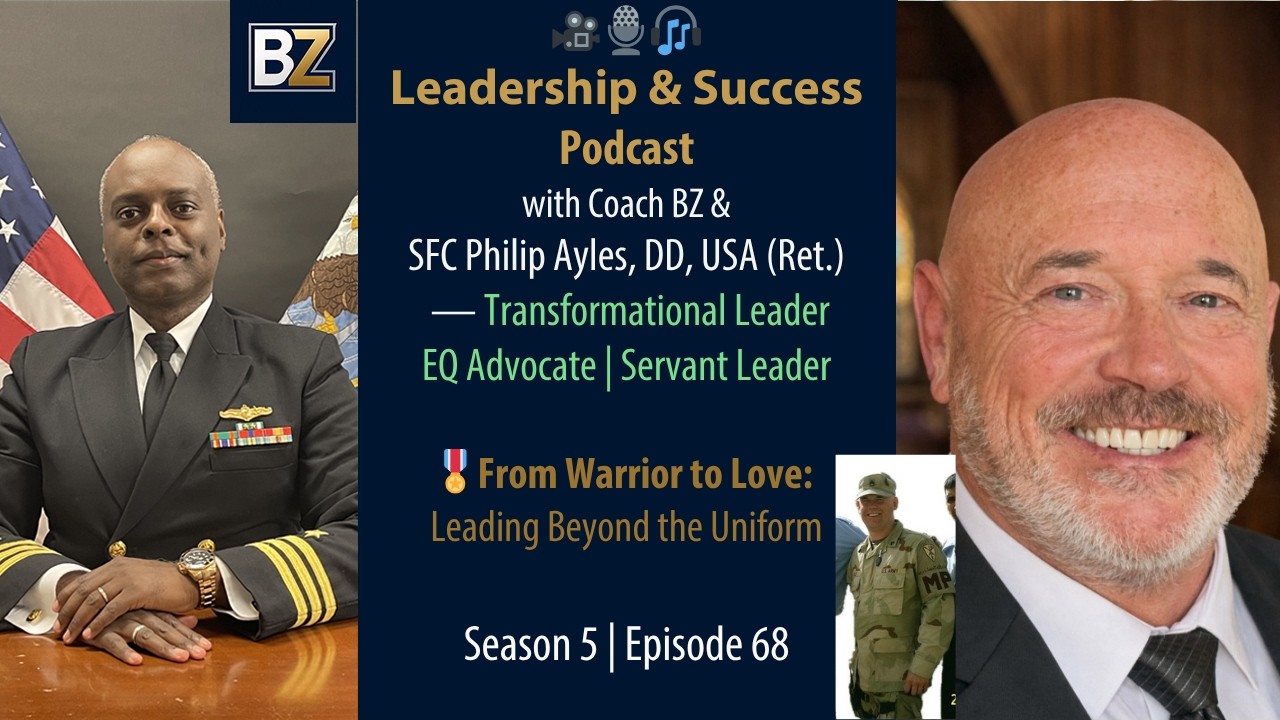
SFC Philip Ayles, a 24-year Army veteran and founder of Warrior 2 Love, discusses military leadership, PTSD, and the 21-22 service members who die by suicide daily. His movement's three pillars are slow down, self-awareness, and communication, with a 6-week cohort starting April 21.
Chapters
Hi, I'm John Maxwell. When the top companies in the world are looking for trainers, speakers, and coaches, there's one name that stands above the rest, and that's Maxwell Leadership. Our certified team members have gotten proven results for companies all over the globe, and our reputation, I'm proud to say, is second to none. Some of our members have risen to the top of their profession, including the one you're going to meet today. I proudly introduce you to my friend, Bob Fabien Zinga.
Welcome to the Leadership and Success Podcast with your host, Coach BZ, where we help you lead with purpose and succeed with impact. If you're ready to grow into the kind of leader others want to follow, this podcast is for you. If you're determined to elevate your success and leave a lasting legacy, this podcast is for you. As my mentor, Dr. John C. Maxwell, reminds us, everything rises and falls on leadership. Our goal is simple, to inspire you, challenge you, and equip you with insights that can transform the trajectory of your leadership journey. Welcome aboard to another episode of the Leadership and Success Podcast. The podcast with Coach Beasy.
Hurricane season is over, but one organization is still on a mission to help people through disasters. And joining us now with more about Team Rubicon is Metro Administrator Philip Ailes. Good morning to you.
Good morning.
You guys have a really interesting origin. Can you tell us about how group got its start.
Yes, we started out of a couple Marines out of California that went down to Haiti after the earthquake in 2010. They wanted to go to make a difference. And when they got there, they realized, hey, there's so much more we can do, and we can actually take it here to the United States.
All right, so you started with 2 Marines. Now, how many people do you have in your organization now?
Currently, national and international, we have 135,000.
That's quite, that's quite some growth there. So who's in Jacksonville and what do you do specifically in the Jacksonville area?
Jacksonville is a new market for us, so what I've been trying to do is establish, because most of the stuff that we've done is over in the Panhandle and in the south, north towards Orlando to Miami. Jacksonville is a unique geographic location to where we don't get hit as hard. And so it's a new market for us because, hey, you guys are very resilient in how you handle things.
And is there anything in particular that you're working on right now?
Just yesterday, we were part of the Community Health Outreach Jacksonville's partnership with FarmShare. We helped them disperse out food to about over 1,000 families that came through yesterday.
Yeah, we talked a lot about that. Didn't realize that you guys were involved as volunteers for that.
Yes, and that's what we're trying to do is trying to get into more of the resilient cities. So if we can get our member base well trained and ready to end up doing a lot of community service projects. And then as disasters happen, you can deploy anywhere in the United States that's needed.
So what do you say to someone who may be watching right now who says, hey—
Well, I am telling you, we couldn't be speaking to a better human being. I remember when I first joined the Navy as an E-1 Seaman Recruit, one bad first class told me Navy stood for Never Again Volunteer Yourself. Of course, that's just a bunch of nonsense. You do have to volunteer. You do have to help your neighbor. And nobody does it better than the person I'm going to be speaking to in just a moment. Before I introduce him, as you know, we start our program with a moment of gratitude. And part of the reason why we do this is because about 21, 22 service members and veterans commit suicide in this country every single day. And we believe it's not possible to be suicidal and grateful at the same time. So we advocate for mental health on this show. And this is the second show of the day. So like I did earlier today, I'm really, really grateful. I am feeling so much better. Sometimes your mind is very strong and can go like miles an hour, but your body is like, no, can't go anymore. You have to stop. You have to take care of your body. So recovering from the flu, feeling much, much better. I'm actually able to speak now, which is really great. And I am so grateful for that. Because as long as I am in the land of the living, there is hope for me. All right. So without any further ado, let me see if I can properly introduce our guest. He's really a true American hero. Of course, I consider anyone who's ever served in any branches of the military to be a hero, but we're going to be talking about from silent service to really— hold on just a second. I lost my— okay. Got it.
Whew.
All right. So today I will have the pleasure and great privilege to be speaking to Sergeant First Class Philip Ailes, 24-year U.S. Army veteran, leader, and the founder and president of Warrior 2 Love, a movement dedicated to helping veterans, first responders, and families transition from survival mode to life rooted in purpose, connection, and emotional intelligence. From military police to civil affairs to human intelligence, from global deployment to personal struggle, from losing everything to rebuilding a mission that now impacts thousands. Phil's journey is raw, real, and transformational. He doesn't just talk about leadership, he lives it, he rebuilds it, and now he teaches it. So I am so overjoyed to welcome to The Leadership Success Podcast, the one and only Sergeant First Class and also Dr. Philip Hale. Oh, let's see. Let me bring him back.
Bring me.
Here we go. There we go. Yay. It was a slight delay there.
So good.
Privileged to be talking to you now. I know you are retired now, US Army, but I did tell you in the green room, my entire career from E-1 to E-5, I have been mentored by what, you know, in the Navy we call the Chiefs, right? Chiefs, you know, Chief Master Chief, the Chief Mess. They've really taken me in, treated me just like a little baby, and taken care of me, told me where to go, what to do, how to look good. And everything I've ever accomplished in the Navy is because of them. I owe them so much. They really are truly the anchor for the service. And I know it's the same thing for the other services. So I salute you and I really thank you for being one of my mentors. And you are really a transformational leader and we want to get into this. But before we do, actually, you are also a doctor. You have a doctorate in divinity, which is pretty cool.
Yes.
So, Dr. Earls, is there something you are thankful about today?
I'm just grateful to be here and to wake up every morning and see what I can do today that I didn't get to do yesterday.
Man, you're so humble, so down to earth, just the kind of leaders that the military usually builds. It's just amazing. Is there something about you, sir, that most people may not know when they meet you for the first time?
Uh, that I come from humble beginnings, um, and everything that I've done has, uh, been me invested in myself. And what I can provide to any employer or whoever I work for. That level of expertise. And now it's about taking those skills and let's make the best community, communities that we can in our own backyards.
That's so powerful and so needed right now, especially. Wow! So if you could take us back, uh, who were you before the Army and what called you to serve?
Well, I joined when I was 17, between my junior and senior year of high school, because I didn't know what I didn't know, and I wasn't really into academics that much. Is because I was stuck in that survival mode. And so, but what I— what the reason why I served, because it's what I always wanted to do, because it gave me an out of my current— my upbringing, and I can break the cycle. And that's— and it's not that it was it wasn't as conducive to my happiness as I thought it would be, or as I thought it was. And then I realized, oh, that's not normal. And then you start seeing it outside your bubble and looking at a larger scale.
Yes.
Where you started doesn't matter.
Wow, that is so powerful. Say that one more time, please.
Where you start doesn't matter. Because I've met people in Uganda, out in the middle of nowhere, training their military. Man, they would live like kings in the United States because they were out in the jungle in adobe huts. With dirt floors. And here we complain if we don't. Yes. What do you mean there's not running water? I have to get it from that well over there.
Hmm, that's, that's really powerful. And that's one thing I really loved about the military, is the ability to travel the globe. And of course, America too. Our country itself is pretty big. Now, when you go from Alaska to Hawaii to Guam, some people don't even know that we have territories like Puerto Rico, Guam, and on US Virgin Islands. It's a very, very big country. Like, I remember when I first came to the US, I lived in Alabama, and there were some people, believe it or not, who were so proud. I was born here, I'm going to die here, and I've never really gone more than 10 miles from the place that we're born. It's like, and they are proud of it. I'm like, no, you shouldn't be proud. You should go out there and see what the world is like. Right? Like, even as you said, no, you in America, you think you are poor. You've never seen what poor is. Go to South America, Africa, see what real poverty looks like, right? You can be poor in America, you have a $500, you know, Nike Air Jordan shoes, whatever they are, big screen TV. No, most people, they don't have anything. So you, you really have to be grateful, grateful for that. It really changes your perspective, doesn't it, when you travel around the world?
Well, and that's what it gave me. It gave me the, the basic structure that I needed that I hadn't had. And in that, it gave me purpose, direction, and motivation to achieve whatever I put my mind to.
Powerful.
And I did. If I— 'cause I sat in my cruiser one night before in University of Dayton, Ohio, And I asked myself, please God, tell me there's something more than this.
Yes.
And that's when I decided to go active duty because I was National Guard before that. And you know what, I didn't take it serious because I was a young kid. I was more looking at being in law enforcement, so I focused all my attention on that and it was kind of secondary. Because what I found out is, you know, that was the hardest part. Going to school full-time, working full-time, and trying to raise a family and do all that. It, it was exhausting. And yes, but with ADHD, I kept up with it. I was always on top of trying to better myself because I was tired of hearing I wasn't qualified.
Wow.
Well, you need, you need this, you need that. So I got it all. I checked all those blocks. I was like, all right, well, hold my beer and watch this. And I've lived my whole life that way because, you know what, what's the worst can happen?
Hmm. Now it's actually less than 0.5% of Americans who volunteered for service. Now, as you know, we have a voluntary military here. That sense of service you have, that sense of duty, where do you think that comes from? Because most people in America, they just will not serve. They may want to, but they never take action.
Well, and that— I think that's a biggest part of it, is a lot of people talk stuff, but when it comes down to it, my thing is, is if I had— give me a budget and I can make anything happen.
Wow.
Because I've done it in so many, uh, places around the globe, and it's all about taking advantage of the resources that you do have. Because, I mean, I taught out in the middle of nowhere with an easel, and, uh, but it's the appreciation because They would have never got that training unless we'd been there.
Wow, that's amazing.
And that's why I— my curiosity has brought me to some very interesting places.
Wow, quite an adventure.
Because I didn't know, so I wanted to go find out. And you know what, being in law enforcement, you have access to a lot of places, so I went and And if they didn't stop me, I went.
Wow.
And you end up networking and you realize, you know what, we're all in this together, and it's the relationships that truly matter.
That is so true. Now, you have served over two decades in high-stakes environment, including— yes, military. What leadership lessons were forged in those moments that still guide you today?
Every, all the principles, values, and everything that they taught is, the military has some of the best leadership courses ever created because that's where the civilians steal it all.
Yes.
Because, but when you look at it, there is no company out there that can give you that level of expertise and experience in the most inhospitable places on the planet.
So true.
And we thrive. And I, I've gone to a lot of places, just two duffel bags. And you know what? You start over and you reconnect and make things the best that you can.
And that's pretty amazing networking. Yeah, because in the military, even for junior enlisted folks, even when I remember when I was a seaman, the Navy, the military really entrust things to you that are quite expensive. And you also get to have some leadership over other people who are more junior than you are. And they really trust you with that, which in the industry, they never do that. And sometimes it's kind of like sink or swim, but of course they make sure you are not going to break it. Everything and be a total disaster. Like I was talking about my chiefs, they kind of treat you like a little baby and they make sure you got everything you need to actually succeed, right, to prove yourself and go. That's not something that people in the industry do, and I think that is really quite fascinating. That's one of the reasons why we are as successful as we are in the military, just that sense of leadership of duty, of adding value. What do you think?
Yes, and I agree with that because that's what they teach you. Unfortunately, what happens is people put their own interpretation on that and they skew it to fit their narrative versus, wait a minute, it just says here in black and white, do it this way and it works. And that's when I started studying other leaders, and Colin Powell has always been the top of my list. Yes, General Colin Powell. I've read his books. That's what guided me, because I— and everybody that is ever— that I've talked to that has ever spoke with him and or have met him, he's exactly the way he is, no matter if you're the janitor up to the president.
Yeah, I can testify to that. And when he talks to you, even if you are in a full full of thousands of people who come to watch him and listen to him, he's going to make you feel like you are the most important person at that moment, at that minute. It's really remarkable. Yeah, I met him for the first time, the only time in 2017, was it? In Atlanta, when his second book came out, of course, and as a bestseller, it worked for me. And he's also extremely funny. Some people may not know that. He's very serious, but he's very, very, very funny too. But yeah, it is quite Amazing and remarkable to see. So let me ask you this then. I guess I'm going to call you Dr. Phil.
You just Phil. I don't go by that other yet.
Yeah, I know you are so humble, but you've accomplished so much. But what did pressure reveal about leadership that comfort never could?
Well, getting things done and that's the biggest part and what I've been trained in, what I've learned is because I had General Zanini, he was the 8th Army Commander when I was in Korea. He looked at me and he says, "It doesn't matter what the people above you think." Wow!
Your—
the ones that are in your charge say you're screwing up, listen, because they're your responsibility, not the people above you.
Wow.
And life is OJT. You get in there, just as you start to think about what you're doing, they pull you out and put you somewhere else. So, and anybody that served, that's I mean, I've been a janitor all the way up in landscape. At landscape, we know we can do all that because we had no choice.
Yes.
Wow.
I want to say OJT, that's on-the-job training for those outside of the military. But yeah, that is so true. It's really a different mindset because in corporate you really care a lot about people above you, right? You want to get the next promotion, you want to impress them. But what you're saying is no, your focus needs to be on the people you are privileged to lead. That's, that's really a different way of thinking. Wow.
And for me, that was always my priority because, uh, a lot of guys use their ego and their pride. My job is not them. My job is to make sure that you guys go home to your families.
Yes, yes.
And if I didn't prepare us enough for it, we do everybody a disservice.
So true.
So now it's about, hey, all right, it is what it is. Now what? And improvise, adapt, and overcome. I knew how to handle chaos. Chaos was easy because that's what my nervous system and Everything, neuroplasticity has all been wired for that. And I sat with my wife one day and I started, while we were watching a show about Vikings.
Hmm.
And what it was, they took a city kid, the town's connected, politically connected kid, and took him to combat and he was useless.
Hmm.
And they all made fun of him and everything. Well, when they got back to the city or the town, that warrior was so out of place.
Wow.
And the other guy was thriving just because of their mindsets.
Mm-hmm.
You need— that warrior could not stand down.
Yes.
And it— because, man, it, it's powerful dopamine being able to actually willfully do your job.
Yes, yes. Especially in a combat zone.
Yeah.
Yes. And well, and that's why that becomes a different— because you get to see the reality behind it. I mean, in Iraq They took out their military, their government, and their police all at once.
Wow.
And it created chaos and there was no accountability and everything. I mean, and they were talking about the Iraqis being corrupt.
Hmm.
You know what?
They were just surviving.
Yes. Wow.
And they were doing no more than what our own politicians were doing.
True.
But when it all comes down to it, is my job is to make sure that we have all the resources necessary to accomplish our mission and we do it, uh, safely.
Yes.
For— but yet aggressively.
Yes. And I guess we— the Navy did steal it from the Army, uh, mission first, people always. Yeah, that is so true. That's my leadership mantra.
But yeah, depending on your command, is it— because we all had great commands.
Yes.
And we've all had horrible, oh my God, what are you thinking, command.
Yes, yes. So what, what do you think makes the difference? Now, I am really grateful in my career, maybe only one or two in 21 years, that went so great, but most of the command, the people were just excellent, great attitude, culture, and the mission, everything was just, uh, very, very positive. But what, what do you think is the difference between those command that are just excellent and those that barely make it?
Uh, a lot of it has to do with is it a good old boy system or not. The bad commands are— it's pure good old boy. If they like you, you get everything. If you tick them off, they try to destroy you.
Basically, there is no fairness.
There is no fairness.
It's all—
and it doesn't matter color.
And consistency, of course, the troops.
Yes.
But my problem is I didn't know when to shut up. I mean, being in law enforcement, you know, I was black and white. It says in the regulations you, well, you can't do it. And when you call them on it and they find out you're right, they, they get even more mad and they all gang up on you. But the— and what— that's what's funny is some commands you're, uh, a liability, others you're an asset, depending on how they want to use you. Same exact mentality, everything, it all depends on do they understand what you do and what you contribute?
Yes.
And that's what leadership is. 'Cause my thing is I had to make sure that my people were mentally and physically there in combat. They can't be worrying about Susie Joe back home went on a date with someone, who cares?
Yes, focus.
That, that does nothing for you in the moment. Now you can go back and implode when you go home, but you know what, we all need each other here because this isn't our home.
Hmm.
And what I looked at it is the more, more of them I trained up and got them up and self-sufficient we get to go home.
Yes, yes.
So take care of your own. I'll teach you how to, or I'll show you how I did it, and that way you can do it on your own, and life is good. And yes, I go back home to my family, you go, you stay there with yours and pass on the knowledge.
It's, it's, uh, incredible.
Wow.
So because you've operated in military police, civil affairs, intelligence, What is one moment where leadership truly made the difference between success and failure?
I think when being a contractor in Iraq, because they're between trading contracts and— I mean, you get to see behind the scenes because we were an asset to the theater., the multinational forces. And so what they do, they allocate us to different divisions and parts of the country. Well, there was no guidance.
Hmm.
We, we— I sat around for 2 weeks just twiddling my thumbs because no one— the company that we replaced burn-barreled all their, their stuff, their, uh they call it intellectual property that the government owned, not them, but you got to play the games. And so I just got there and so I started doing training to fill my time and that's what I've always done is, hey, we have downtime, how can we either relax or do you need to learn something?
Yes.
And is it something that'll prepare you for tomorrow?
Yes. Wow.
All right.
Powerful. Yeah, because in the military, when you are on deployment or even some exercises, many times it's really up-tempo. It's pretty much 24/7, 7 days a week, including Sunday. You probably sleep 3, 4 hours, if any. But then there are times where everything just slows down and you have so much time on your end and kind of know what do you do with it. But I think training, studying, even doing school online, or now with the internet and all of that, there's really a lot of things you could be doing. Exercising, you know, getting healthier, fit. So there is a lot of good, good, good use of your time, right? Uh, for young sailors or soldiers out, out there who might be in that situation. Uh, yeah, it's really incredible too that in the military you can get a completely free education up to PhD. It's just incredible. Wow. But so many people just don't take advantage of it.
Well, that shows you that's the difference between, uh, success or failure. Most people don't even try. And that's why I created Warrior to Love.
Yes, yes, we got to be talking about that because that's so powerful and something we need so badly. Yes.
Well, Especially the military does an outstanding job training us to go to war. There's nothing on the back end to slow our butts down from war.
Yes.
And what we end up doing is isolating because I don't— the— I, I don't understand these people.
They—
I don't think the way— no, you don't, but it's your responsibility as a military veteran to win the hearts and the minds of the people. We're trained to do that all over the world. Do it in your local community. Don't sit there and gripe about it, and— because everybody can gripe about it. Bring solutions. And that's what veterans do. We bring solutions to your problems. If there's not a problem, well, I'll go on and something else. Or that's where, where Warrior to Love gets into. Now you're no longer that warrior, you're a normal citizen.
Yeah, what do you do?
Yeah, what do you do when no one cares what you did in the military? Yeah, all they do is thank you for your service and you— yeah, your energy scares me because It's a lot more intense than I'm used to.
So it's really something. It really could be quite traumatic because, you know, in the Navy you don't even have to worry about what, what you wear. You have your plan of the month and you know exactly what, what to wear and everything. But you become a civilian now, you have to make so many choices. It's like, wow.
Well, it's not wearing the same uniform 3 or 4 days in a row.
Yeah.
You're like, eh, that polo.
Yeah. Even simple things like that. But yeah.
Yes. And, but what that does, it creates routine and gets you in a comfort zone. Well, now step back and those same skills are not as effective in the civilian world because we come in, I mean, you think about it, most veterans come in sprinting. 'Cause that's what we know how to do. We know we can sprint like no other. But it's the walking. And that's where a lot of the driving on— I have no patience for traffic because in Iraq, you stopped, you're dead. So we plowed through traffic and you didn't move, we moved it for you. I mean, that was in the beginning of the war. And near the end of my first tour, they were like, hey, Ken, stop doing that.
Yeah.
Oh darn it.
Because what it is, they were switching tactics to put the bomb in the back of the trunk. As soon as you hit them, it goes off. So there's tactics.
Yes.
But to the most part is, what do you do when Uh, you— a lot of these guys that were in Iraq would go on leave in the middle of it, be on high alert and everything, and then within 2 days they're in a mall in Texas and that's— they're partying and getting drunk, and then they come back and right back into the mix. But there's not, you can't turn your nervous system off and on like a light switch.
Yeah, yeah.
It takes time.
It does.
I didn't understand it because I didn't think anything was wrong with me.
Hmm.
I was, and that's where I had to understand, smash, boom, wearing my armor everywhere and bringing the whole arsenal with me. Doesn't work around your family.
Yes.
And instead of creating that safe environment for them, you bring chaos into it.
Hmm.
Wow.
And it's that energy that you bring back from it because your nervous system— man, I was a rock star in, in over in Iraq, but I come back here and You just qualify.
Yeah.
I mean, I really have great, great respect for anyone who's ever worn the uniform, even just for one day, because again, less than 0.5% of people volunteer to do so. But let's see, for those listening to us, how can we help them when they transition off from active duty to back being in the industry, civilian life, because that can be quite a traumatic event, what, what would you advise them to do?
Well, slow down, uh, heal. And that's what one of our pillars is— heal, find wellness, heal yourself. Because yeah, you've got to, you got to let that nerve—
you're—
it's not so much your physical, it's your nervous system, the way your body naturally reacts into, in situations. To where standing down, stand down, realize no one's used to that tempo.
Yes.
And we both, we have all had high and low tempos at different parts in our career.
Yes.
But where we, where I found out what hurt me the most is time. I didn't know what to do with it. Once I had it to myself.
Yeah.
So I filled it with over self-indulgence and, uh, trying to make up for what I missed when I was in Iraq alone.
Yeah.
And that, I, I guess it's a different mindset.
And what, what do you think you kind of learned through that process, Phil?
I need to love myself.
Yes.
First.
And it, it was the last hurdle I had. I, I tried to— I rationalized through everything else and been through PTSD studies and then equine therapy, done this, done that with all these different organizations. They all serve a purpose. And I'm grateful for what they've done. Now I'm embarking on it, and what do you do after that? Well, you need to find yourself, because too many of us, we, we were taught selfless service our whole career.
Wow.
Because I think what you talk about, it really happens to a lot of people. I think more people in the military have PTSD than have been diagnosed. So some people may not even realize that. Now, for example, in the Navy specifically, that's my culture, my people. I've seen we've changed quite a bit in the last 21 years I've been in the service where we used to be kind of like macho alpha male, you know, you can't hurt me, I am tough and stuff. I can't ask for help. When you really need to ask for help, it's okay to go see a psychiatrist or psychotherapist or whatever. It might be and learning to meditate, to be mindful, maybe deep breathing. Because like you say, there is a lot of help out there, but you need to first say, "Yes, I have a problem and yes, I need help. Would you help me?" But sometimes, especially men in the military, they just won't take themselves to that position. Like I said, when I started the show, it's about 21, 22 service members and veterans commit suicide. Every single day in this country, and that is just so sad. What, what, what would you say, like, what, what is one, one thing someone who's transitioning out of the active duty military to civilian life, what need they need to do first thing tomorrow?
Like I said, heal. Uh, it's wellness. Take care of yourself. You might be in the same mental health plays a big part in it because what we found out is I repressed so much.
Yes.
So I can— because I didn't worry about yesterday. I never looked back because I'm pushing forward. I don't have time to look back. Well, in the downtime, that's all you have, um, is the— okay, trying to make sense. Well, that's why we block it, self-medicate.
Yes.
Well, now it's about taking responsibility just for yourself.
Hmm.
And that's where the self-awareness comes in with knowing that how you're responding directly affects everybody else around you.
Wow.
I didn't care because I had missions to do. I don't care. I didn't care about feeling.
Yes.
Wow.
But when I was a facilitator as a contractor, I had to learn it. That's where I truly learned emotional intelligence is working with different nationalities and different forms of government and everything. Because the whole purpose was they needed to get things done.
Yes.
The egos of our own military and their military and everything couldn't get anything accomplished. So they brought us in to work with— to get them all to work together and all the units and everything. We're all there for the common goal.
Mm-hmm.
Let's do it together. And because first couple months they couldn't get anywhere, but they brought us in and next thing you know, everything started happening.
Wow.
Because you get a lot of the people when they were there, if the project didn't— it took longer than 6 months, they didn't do it. So because how dare can anybody else get credit for something I did?
Yes.
Because everybody wants that OER, NCOER bullet. And so And there was no checks or balances.
Wow, that is, uh, interesting because like I said in the introduction, you've been very open about losing everything after leaving the military. What was that moment like and what were you feeling internally?
I was crushed because here I did everything right. I was a high performer. And then I lost all the connections I had and everything because I was overseas for 3 years.
Wow.
And low and lonely.
Because then I realized it was my mindset and I had to throw my ego and pride out the window.
Yeah.
Because that's what holds us back. And I get to see it in the Veterans Treatment Court here in Clay County in Florida.
Mm-hmm.
We go in because what we consider confidence, it comes across to citizens as arrogance or cockiness. Well, no, we're just confident because when you're around a bunch of alphas, you've got to be on your game.
Yes.
Because if not, they'll eat you alive. But if you step back and see the true purpose behind things in the bigger pictures, and that's what I— I got to see it from every level.
Yes.
And process it because I, I've done a lot of military analyst things and because I had a top secret clearance. So I got to know more than the average bear.
Yes, yes. Wow, I mean, that is, uh, quite insightful because, um, talking about transition, why do you think so many high-performing leaders like yourself would struggle when the mission ends?
Because we don't know how to slow down, and everybody else is walking and we're running or sprinting. And yes, we wonder why we're at the finish line alone. Well, they're 5 miles back because they're walking. And so now you have to end up turning around because I did. I retired young because— and that's the thing, when I joined when I was 17.
Wow.
And that has always been a major part of my life. Because it was easier being on active duty than it was in the Guard or the Reserves, because basically you had to keep all the same standards but you didn't get paid for it.
Yeah.
And you had to fend for yourself. And you know what, I, I've missed a lot of stuff. And I— what really disappointed me was when I really sat down and figured out how I spent my time. I spent it—
I only let—
I think 80% of my time was spent for the military and school.
Wow!
So 20% is what my family got and it usually wasn't the best parts.
Yes!
And it's the energy and that's when my daughter looked at me and says, Dad, We just wanted you present with us, and we wanted the good dad, not the mean one.
Yes.
Wow, man.
And that hit hard because I have 3 daughters, hmm, and I raised them as boys because that's all I knew. I didn't grow up with girls. Yeah, I didn't have a mom, so I, uh, did what the only thing I knew. Well, it's not out of stupidity, it's out of ignorance. And that's why a lot of you get an 18-year-old kid thinks he knows everything and absolutely knows nothing.
True.
The dumbest ones are the loudest, but the smart ones understand.
Hmm. Say that one more time.
The dumb ones are the loudest, or the most crooked ones are the ones that are screaming the most. Elon Musk said it. Hey, we just sit back and they'll just tell on themselves because the ones that are screaming, "Foul! I want my money!" Well, it's because you've been stealing it.
Wow.
But if you get back to the transition part, it's a loss of identity. Loss of structure, loss of everything. And now what am I supposed to do? I don't have those missions, and— but yet I have all this training, all this trauma. Everything is all boiled into— and the only thing you really hear is, "Go see the VA." Hmm. And unless you're on the edge or the trigger or the barrels in your mouth, they— it takes forever to get care.
Wow, that's—
I mean, 6, 6 months to a year out from when you had your incident. Yes, it's too long.
Yes.
And because we're not counseling, we're not doing that, we're coaching and facilitating. Because that's their job. There's other— there's professionals out there. But my thing is— main thing is the awareness, the self-awareness to, to real—
Phil, did I lose you? Hold on, folks, let me see if I can get him back. You were just talking about self-awareness, but really the experience SFC Phil Ayers is talking about is really truly experienced by a lot of people in the service. All right, welcome back. You were talking about self-awareness. I don't know what happened, but that is so important.
Oh no, I got a call coming in and it took me out of the—
and Because I was also telling people that what you were talking about is it happens to more people than we think across the branches of the military. So tell us more about that self-awareness.
Well, it is to realize, you know, we, we have a lot of pride and dedication, and you don't just— yes, it's been a love-hate relationship, but yet it's developed you into who you are. Well, now it's about standing down, taking that armor off and allowing yourself, allowing your family to see who you are, not what's left after the military took it all.
Yes.
And now it's—
you've—
I found out I didn't know my kids.
Wow.
I was there, but I wasn't there. I wasn't— present with them because I was so busy doing everything else, filling my time instead of just stopping. And you know what, they just needed me to be a parent.
Yes.
To see them and hear them rather than going and dictate everything.
Man, the sacrifices we make in uniform, it is so true. I mean, you miss so many recitals, holidays. Birthdays and on and on and on. And, uh, yeah, it's, uh, so looking, looking back, especially for the young people, either enlisted or junior officer, just starting their service, what, what would you advise them to do if they are married, they have a, you know, spouse and children?
They deserve you, your attention, you being present, not thinking And just showing them who you are and listening to your family. I think that was my biggest problem. I didn't want to hear what they had to say because it didn't match what my scenario was.
Mm-hmm.
What—
or my narrative.
Yes.
So, and I looked at it as, I'm responsible for you, so you do what I say.
Hmm.
Now you've also talked about this publicly before, but what nearly broke you and what helped rebuild you?
What broke me was not trying to people-please. I tried to please everybody, ended up pleasing nobody, made myself miserable.
Yes.
And that's when I consolidated everything down into an RV. And left. Had no clue where I was going, what I was doing. I didn't even know how to run everything in the RV, so I had to stop for 2 days and read the manuals.
That is, that is really, uh, fascinating. It reminds me of— what is that, that movie called with, uh, the great actor? Should I know them? The movie? Oh, come on. Uh, Forest, Forest, Forest Gump. Yeah, yeah. To remind me of that a little bit, because you lived in an RV, you traveled the entire country, you rebuilt your life. What did that journey teach you about identity, leadership?
That I needed love in my life, because it wasn't until I came here to Jacksonville, Florida, and I was out at Mayport Naval Station, met my current wife on Match.com. I passed her up initially thinking she was too pretty. And probably a cold digger, but, but I realized, you know, what do I have to lose? I'm— I was completely alone. My kids kind of stopped talking to me because we couldn't— we didn't know how to communicate. We were saying the same thing, but I was saying it from the top down and they were saying it from the bottom up. And so we never meshed because the difference, uh, but that's what I end up finding out later, uh, but so I wasn't looking for anything. I was just enjoying my life.
Yes.
Had—
and taking it day by day. So I went back and messaged my current wife. And she responded. And I met her. We agreed to meet the next morning out at Mykler's Beach here in Jacksonville because she was like, I'm not looking for much. She's like, I'm a hot mess. Sure, come on. She said, I'm just tanning. So I went down and when I walked out on the beach and I first saw her, God smacked me in the back of the head, told me to pay attention. Yes, I've never had that, and I've met tons of people throughout my life. I've never had anybody grab my attention that way, and so I took it as a divine intervention. Yes, and he— God told me that she will change my perspective of the world, man, and I fought it. That's because I didn't believe it, because I didn't— I knew how to give love, but I didn't know how to be loved because I always felt it was conditional.
And that's really powerful. So how did Warrior to Love come to life, not just as an idea but really as a calling?
Well, I, uh, I'm the warrior. My wife still knows, and she—
you have to write that book. You absolutely have to write that book, Phil. Man, this is crazy.
Well, and the thing about it is I realized maybe I was overthinking it, things, and I Because what I found out with Americans, I held them to a higher standard than I did the rest of the world.
Hmm.
And that caused problems back here because I'm like, well, you bum, what is it? Why can't you do this? If my dumb butt can do it, anybody can.
Yeah, my wife would say that's not nice.
No, but that, but that's where the lack of empathy and understanding— well, now I had to take a step back and meet people where they're at, not where I think they should be.
Yes.
Wow.
And that allowed— and that's when I got into, uh, working the football games just to reconnect with people.
Man, it's, it's really something. So you talk about moving from a warrior mindset to a love-centered life. What does that mean? What does that look like?
Well, what does it look like? For me, it's what do you do when everybody thinks they're right? I don't have to prove myself anymore.
Yes.
I don't, you know what, believe what you wanna believe. It's like a 5-year-old kid telling their parents they're dumb.
Yes.
Well, what do you mean? You pee yourself.
Yeah, yeah.
Who's— but, and that's why they say that, uh, youth is wasted on the young. Yeah, because by the time you figure it out, you're older. And but you need that because honestly, I don't think my wife would like me when I was in the military because I was very ambitious and high standards.
Wow.
But now this is what I tried my way and I ended up homeless and alone in an RV.
Because now you really help a lot of leaders rebuild those connection with their teams, their families, and themselves. Uh, I guess the question I have for you is how can leaders do that, rebuild those important connections?
It all—
everything starts with you. You have to step back and realize how you respond emotionally is how everybody else is affected because we're in the military, it's logic. We don't have time for feelings. Feelings we can do when we're back drinking a beer. But right now I can't do it. But now bringing that back and putting it on the shelf, taking that armor off and realizing you'll never put it back. You don't need to put it back on.
Nice.
Because the— they— you're safe with them.
Wow.
And what you bring to the table is more a positive, calm energy about what you're gaining from a situation rather than the possibilities of something bad happening. So it's a flipping— hold on.
I can hear you. Okay, here we go.
But to the most part, it's realizing that I have choices. And what does it matter?
Or—
and I had to pull all my triggers back.
Yes, yes.
Because I let other people trigger me all the time, and then I had somebody that did it a lot and was like, I like triggering you. That made me go, okay, so it's my fault.
Wow.
Because I allow you to do it. Why should I care?
Yes.
And that's where the news media and everything wants you to worry about things that have nothing to do with you.
Hmm.
Well, there's starving kids in Ghana. Yeah, there are. There's starving kids down the road.
Yes.
And when you focus on everything else, what you're doing, you only have 24 hours in a day.
Wow.
So really what we're talking about, We talked about emotional intelligence. What about communication? Why is that important?
Well, a lot of it has to do with— so communication is key for understanding. And I think that's where a lot of people want to be heard. And really, that's because there's times I just sit down with veterans. Next thing you know, they're just rambling on because they just want to be heard.
Yes.
Wow.
And not judged. And then you find out that's pretty much civilians because— and that's why I focused on, well, winning the hearts and the minds of the people.
Yes.
It's a Warrior to Love's a way to say, hey, thank you. For your service. Welcome home. Now calm down, slow down, and walk with me.
Yes.
Pay attention. This is what life's truly about now. Wow. And you— we excel in the military and then implode at home and die within a couple years. Well, it's because you lose that identity, that mission, that purpose. That sense of security because the civilian side is cutthroat. Everybody's out for themselves.
Yes.
You're no longer part of that 5%. You're part of the 95.
True.
And they've spent 20+ years building their own little nest. And here you are coming in from as an outsider Well, yeah, you have— they have experiences you, you'll never have. You will never have because they build it in that geographic location.
But don't you think coming from the military, though, you do have some skills, especially in leadership, that students can definitely learn and benefit from?
Yes, that—
and that's the leadership period in the high, high-stress, chaotic environments, because A lot of it has to do with not so much, uh, fighting. It's, it's more how you, uh, de-escalate rather than escalate things.
Yes.
And that's why everything— once the initial combat ends, it's about winning the hearts and minds of people so you can go home.
Wow, that is really, really powerful. Well, it looks like we've, we've been over an hour already. Can I get 5 more minutes, Phil?
Yes.
Thank you so much. And before I go into the last segment, one of a member of our tribe here is asking, how do you coach or train military veterans to carry that same firewall of faith and integrity into civilian leadership without losing their operational edge? Pretty cool question.
Well, define what operational edge is, because that's part of the chaos that you're used to. Well, what— how are you going to perform when there— it's a 9 to 5, nothing's going on? Most people are only worried about—
oh, I think I lost your sound again. Phil, I don't think I can hear you. Can you check your sound? I don't know if it's your AirPods. Maybe you can change the sound to just your phone or your computer. Okay, we are almost toward the end, but I definitely want to hear him. Okay, now I can hear you. Phil, can you hear me? It looks like— hold on.
There we go.
Okay, all right. I think I got you twice. Let me remove you on the other one. Perfect. Now I can hear you, see you just fine. You were saying something very important, right? 9 to 5. Most people, Monday through Friday, 9 to 5, so easy. Whereas when you're on deployment, it's pretty much 24/7. You get lucky if you get to sleep 3 or 4 hours every night, including Saturday and Sundays, which is quite different if you are used to the civilian tempo. But yeah.
For me, the hardest part was embracing the silence.
Hmm.
Being able to sit without the TV on or this, in complete silence, and not freak out or have to make noise. Well, you know what? Wow. I used to hate silence.
Hmm.
Because it's boring. Well, And I got to keep myself busy. And that's where that whole thing was. I was using up all my time trying to do everything, and I missed out on everything.
Wow.
Really, really insightful. Okay, uh, for the last segment then, one question I love to ask is, what do you think is one of the greatest lessons you have ever learned throughout your life, your career, in life, in leadership, just in general?
That's never really about you.
Hmm, that's really amazing. The person I interviewed, I went out before you, she said the same exact thing. Yeah, so I think, uh, that's so—
have you ever read Dale Carnegie's How to Win Friends and Influence People?
Yeah, yeah.
It's not about you. It's what it is, is how do you make other people want to know you.
Yes.
Well, you've got to know them. And you— and I realize you can't make everybody happy.
Yes.
Do your best to make yourself and your loved ones happy. Hmm.
That is really, really powerful. Now, when you look forward to your, your life, you know, all of the successes you had in the military, even losing everything and rebuilding your life from scratch and coming on top again. What do you think is the secret to your success?
Never giving up on myself or anybody, or in believing in myself to where, you know what, I deserve it, I earned it. And that's where you get a lot of veterans out there who scream, well, I'm not good, I don't— there's nothing wrong with me, I'm going to save for those people that truly need. That's the wrong mentality, and that's why a lot of them end up not going ever going to sit call, because they always want to be mission ready. And when you're in that is because it ends up being a leadership thing.
Yes, yes.
Because they need— they have to have so many people to be mission ready.
But really, you have to take care of yourself so you can take care of a mission. Wow. Really insightful.
It's all about you.
Let me ask you this then.
Yeah.
Some people have lost everything and they pretty much crumbled and their life was pretty much gone. But people like you, you just keep going and keep going and keep going. Why, why do you think that is?
Because I know what suffering is.
Hmm.
I— there's not— I, I've invested in myself enough to know that, you know, you could take all the materialistic things from me, I could care less.
Yes.
I'll show— I, I'll show up with my two duffel bags and I'll rebuild, and it'll be better than it was last time.
Wow, that's what Iman said.
And that's where the love part of it, it got me to slow down. And instead of not wanting, uh, or looking down, or snubbing my nose up, or judging the area, well, you know what, I had to immerse myself in it.
Wow. That's why I started, uh, of Okay, let's give him just a minute. Man, I really love doing these live shows. It's almost time for us to end anyway. All right, Phil, can you hear me now? All right, let's give Phil just a moment. But what we are talking about now I think is so critical and so very, very important. Phil, can you hear me now? I hope his cell phone is not losing—
Yeah, it's now good.
Okay, this is fine. It's almost time for us to end anyway, but this is so critical, it's so important. I really love for you to talk about this because it's really going to help a lot of people, right? We are trying to get real here. It's not just the fluff, oh, you know, I have positive mindset, success, and military and all that. No, it's like we have a rubber meets the road, right? What really happens to our warriors and how they can, you know, tools they can use to actually deal with the true challenges that they are facing. So I am so, so grateful for you being our master teacher today and sharing. That so, so powerful. So I really appreciate that. Is there maybe, uh, what, what are you learning these days? Because I know leaders are always learners.
Well, and that's every, every day, the more I know, the more I realize I don't know and I need to learn. And that's very humbling when you realize, I thought I knew a lot.
Yes. Especially in the age of artificial intelligence, right?
Yeah, well, and even with that, the artificial intelligence, all it, it, it depends on the input. If you're asking the wrong questions, you're not going to get the right answer.
That's right.
Wow. And then you gotta look at that in life with yourself. Love yourself. Realize you got to take care of yourself. You can't help anybody if you're dead.
That's true.
Or you're sick or doing whatever. And a lot of it we focus out now. Being a citizen of the United States is probably one of the best privileges ever. I'm glad I was born here.
I say amen to that.
Well, yes sir, because we know what it's like other places, and that's where Americans are coddled because it's a first world country. Well, they brought third world country problems into our first world.
Yes.
And by education, the more you know, the— because way I look at it is ignorance is slavery.
Yeah.
Because there's people that'll take advantage of you because you don't know. And so the best thing to do is self, self-educate. If it means something, research it, do your homework. Realize that how you respond in being able to control it is the greatest part in being able to be vulnerable, to show love and articulate it to somebody. Powerful, and for them to reciprocate. And don't settle for, hey, if you don't— there's, there's 8 billion people in this planet, you'll find another.
Yeah, yeah. So what would you tell to someone, a Marine, a soldier, or a sailor, who feels like they are completely desperate, there is no way out, like they don't really see a future right now? What would you tell them?
Be patient because it— nothing happens overnight.
Hmm.
Uh, realize there's so much— there's 45,000 organizations in the United States that say they have veterans and first responders.
That's amazing.
Why do we have any hungry and homeless?
Hmm.
Well, there's It is what it is, and but yet there's so much help, and I've, I've used it. So, and you gotta throw your ego and pride out and do what's best for you, because once you understand that and you start looking at what you gain from every situation rather than what you're losing— or what I had a problem with, my ex-wife didn't do X, Y, or Z. Yeah, well, what did you gain from it? What the heck you mean, what did I gain? From it? Well, I gained— I'm independent. I knew I couldn't rely on her, so I took that out of the equation and made better decisions that were in my best interest, not somebody else's.
Hmm.
Wow.
Ultimately, you have to pay for one way or another.
Yes.
For your actions, good or bad. Wow. And if you go into it with going, hey, I, I love you just because you're my butthole, you're, you're a jerk, but you're my jerk, and I understand it, but I'm not chastising you because, hey, when I need jerk, you're the person. But it— but when you want somebody, just like with a puppy, I had to control my emotions because if I yelled at him, it scared him. He peed all over the place.
Yes, yes.
That's the same thing with your family. You want your— my kids couldn't talk to me because they didn't know what— they didn't trust that it was safe.
Um, man, that is so insightful.
If you're getting out and you're, you're on the edge, man, there There's so many veteran organizations out there that can— you don't have to hit rock bottom in the criminal justice system. Yes, there's enough out there to where we'll give you a hand up, not a handout.
Wow, thank you so much for sharing that, because if that impacts just one person, it's definitely worth it. So I know we are completely out of time, so let me see if we can, uh, take this plan down quickly. Uh, Couple more questions I want to ask is, if you had one and only one day to live, Phil, what would you have liked your final contribution to be?
Celebration of life.
Yes.
I don't want a funeral, I want a party.
From warrior to love. I love that. Powerful. Man, I think your legacy is already written. For you. So let me ask you that, uh, if you could solve any problem at all in the world, you have this magic wand and you could solve anything, what is the one, one problem you'd like to solve first thing tomorrow morning?
Suicide.
Yes, because one is too many.
Yes, there—
and you have to lose all hope to do it. And now that's what we want to do with Warrior to Love is, yes, calm, calm your nervous system. You know what, come and give us a hug. Feel that energy of that human connection and humanity that everybody else gets to enjoy.
Mhm.
And be the best and live the happiest life possible. Wow.
And if that message only saves one soul, it's absolutely worth it. So we are toward the, the end. How can we add value back to you? How can we support you with your causes?
Just go on, uh, WarriorToLove.org. Uh, we're starting a new cohort on April 21st. It's a 6-week cohort. It's our, uh, pilot cohort, and it's about getting veterans to slow down, understand themselves, communicate, reintegrate. And a lot of it— our third pillar is re— uh, aftercare. Yes, is getting somebody at that point to where we can do maintenance. And bring in and make it inviting.
Yes.
Wow.
Well, I must tell you, Phil, you are doing God's work. You are definitely paying it forward, and I'm so proud to be speaking to you and privileged to know you. It's just amazing what one life the difference you can make. Like I played the video during the hurricane, you started an organization with just 2 people and before you knew it, 135,000 people all around the world. I mean, that's just amazing. That is a miracle, you know, what just 1 or 2 people can do and you are doing it and we are so privileged to be talking to you. I know I've used too much of your time already. I could ask you a thousand more questions, but I'm gonna need to end the show. Is there something I should have asked you today that I didn't get a chance to ask?
Well, how did you— were saying, let me put a caveat on what people can do. For the way I look at Warrior to Love and my ideology is the way for the 95% of the population that hasn't served, a lot of them want to help. They just don't know how. Well, support us and let's get your veteran back to you in better condition and calm enough to where they can figure out what their next move in life is.
Because a lot of—
especially if you join when you're young, you're young when you retire. Yes, I was 42. So I looked at it and it was like, okay, I have so much more to give. I can't just sit here and do nothing. Well, that's where the entrepreneurial part is. Hey, you know what? There's nothing stopping you.
Yes.
This was an idea of a feeling from— it was a title of my book. And, and then more I got into it, I got my wife involved. She gives her viewpoints. From someone that's never served.
Wow.
But though she's part of the 95% that can teach me how to win their heart and their mind.
Wow, that's powerful, man. Thank you, thank you, thank you, thank you. I guess, uh, one of the last questions I'm gonna ask you is, uh, if you could go back and give a piece of advice to your 17-year-old self— that's how old you were when you enlisted in the Army, right, out of I think you were a senior, a junior in high school.
Yeah, between the junior, senior year.
So standing at the edge of this incredible career you've had in the Army and now all of the work you are doing out of uniform, and now you are still serving, what would you say to 17-year-old Phil?
Learn emotional intelligence.
Hmm.
And love yourself. Yes, because stop people pleasing.
Yes.
But the biggest thing is love yourself and calm down. Everything's not a fight.
Yes. Wow, that is very wise. Okay, I usually do a, uh, fireside, uh, chat or rapid fire, but I don't have time to do it, which is okay. But I do, I do want to end on the optimistic feeling? Because we do talk about a lot of AV stuff here sometimes. So what is one thing that you are feeling optimistic about in 2026, or these days anyway?
I'm optimistic that this will be a phenomenal movement for people to understand, because there's a lot we don't talk about.
Mhm.
Well, You know what, it's— we go to other countries and study them. We don't, we don't study ourselves.
Yes, yes.
And the impact that I can put into it and the positive, and it comes back down to what are you gaining? Hmm, what are you gaining? Well, this, the whole conversation, I get to say a message to us. Put it out in the universe forever. And for— and if anybody goes, hey, well, yeah, just because they take your stuff doesn't mean it's the end. Yes, you started over before. Why are you going to let now, when you, you've earned your freedom and your— are you gonna—
powerful.
Implode.
Powerful. So you are not your stuff. And my psychiatrist taught me, I am not what I think.
No.
So powerful. Wow.
Well, and because you react to your thoughts, your beliefs, your upbringing, your, your education, all that plays factor into your decision making. Well, I had ADHD and didn't know it, so I didn't find out until later in life. And that's why I was never sitting still. Yes. And I always had to prove myself, and I had chip on my shoulder because why is this so hard? And this, that, the other— well, it's not that it's, that it's hard, it's the choices I made to make it easier.
Yes. Wow, man, I, I really hope this is going— I feel like it's going to help a lot of people, especially people transitioning from the military active duty back into the industry. I'm so, so grateful to be speaking to you today, Phil. And I know we didn't have time for it, but you did mention in the green room, you do recommend General Powell's book, My American Journey, and his second book, his last one, It Worked for Me. And you also talked about Dale Carnegie, How to Win Friends and Influence People. All right. As we come to the end, thanks again for giving us almost 20 extra minutes. Really, really appreciate that. I'm going to try to clean up the videos for when we got cut off today. And again, very sorry, we were supposed to have a meet actually at 6:00 AM my time today, but I'm still recovering from a cold. I just overslept. So I'm sorry for that, but I'm so grateful you were so flexible and so kind to really be one of our master teachers today. So the very last question before we end the show is what is one word that represents our shared experience on this podcast today?
Love.
Love. Yes. From warrior to love. I love it. I think the older I get, I really believe leadership is all about love. It's not about you, it's about the people you've been entrusted to serve. It's so powerful. Wow. That's the best word ever for today. Love, love, love. Okay, thank you so much, Phil. I really appreciate that. Surgeon First Class Dr. Phil, thank you, sir. I appreciate it. All right, all right, all right, everybody, this is it for today. This will be the last podcast we've planned for today, and tomorrow I should come back with the Book of Proverbs, chapter 21, is what we're doing. We're going to be using artificial intelligence to give us like a 10-15 minute summary of the podcast we had on January 21st. We went through every chapter in January for Proverbs. And also on Wednesday, I'm going to have the pleasure of speaking— let me see if I have a thing here. Hold on, I thought I had— let me get it just a moment. I'm gonna be speaking to Coach Maxine Maloney on Wednesday, and I hope you can be here. To hear her. She's really one of those people. She's a leadership coach as well, but I think you're gonna be learning from her life and expertise. She's a Truth Center executive advisor, leadership provocateur, and strategist. We're gonna be talking about institutional velocity, why decisions stall inside organizations. So that's going to be for Wednesday. All right. Until tomorrow, have a great rest of your week. But please let us know in the comments where you came from, which country, which state, and also what you are grateful for today, and 3 to 5 takeaways from this insightful leadership conversation with SFC Phil Ehlers. It's been such a wonderful, wonderful, powerful conversation, and I, and I really think it's going to help a lot of people, especially the junior officers I care about who might transitioning from active duty back into the civilian workforce. Okay. Thank you so much for watching and hope to see you tomorrow. Bye for now.
Thank you for tuning in to the Leadership and Success Podcast with your host, Coach BZ. If today's episode added value to your leadership journey, be sure to subscribe, share, and join us again for more wisdom that on how to lead better and achieve greater success. Remember, leadership is the most critical skill of our time. The world will always need leaders to inspire others, drive innovation, and execute meaningful strategy. So why not count yourself among the bold leaders shaping the 21st century? Until next time, stay inspired, stay committed, and keep leading with excellence.
More from Bob

S250:E4🎙️LIVE 🇺🇸America 250: President Barack Obama Leadership, Service, and the Power of Hope






S5:E157🎙️ LIVE with CMD CMSgt Dennis L. Fritz, USAF (Ret.)(Multi Tracks Audio)



S5:E156🎙️ LIVE 🇪🇸 Leadership Lessons from the FIFA World Cup 2026 Champions (Multi Tracks Audio)

S250:E3🎙️ LIVE Leadership Lessons from America’s First Documented Family of African Descent 🇺🇸📖