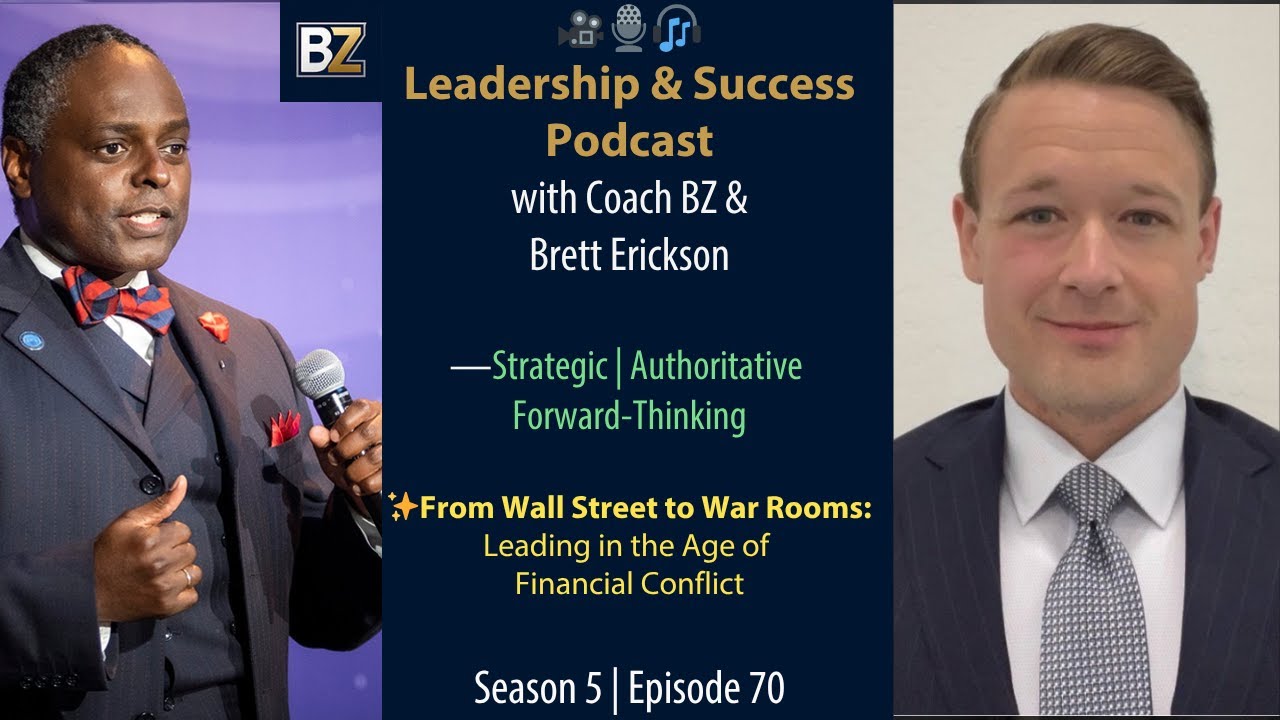
Brett Erickson, a 28-year-old financial-crime specialist, explains how state actors weaponize the global financial system. Russia runs a shadow tanker fleet to evade sanctions; Iran funds missile programs through oil sales. Machine learning and suspicious activity reports are critical to detecting crime networks across borders.
Chapters
Hi, I'm John Maxwell. When the top companies in the world are looking for trainers, speakers, and coaches, there's one name that stands above the rest, and that's Maxwell Leadership. Our certified team members have gotten proven results for companies all over the globe, and our reputation, I'm proud to say, is second to none. Some of our members have risen to the top of their profession including the one you're going to meet today. I proudly introduce you to my friend, Bob Fabien Zinga.
Welcome to the Leadership Success Podcast with your host, Coach BZ, where we help you lead with purpose and succeed with impact. If you're ready to grow into the kind of leader others want to follow, this podcast is for you. If you're determined to elevate your success and leave a lasting legacy, this podcast is for you. As my mentor, Dr. John C. Maxwell, reminds us, everything rises and falls on leadership. Our goal is simple: to inspire you, challenge you, and equip you with insights that can transform the trajectory of your leadership journey. Welcome aboard to another episode of the Leadership and Success Podcast with Coach BZ.
Uh, my name is Brett Erickson. I am a financial crime expert that has done a multitude of, uh, different things, including, uh, history with JPMorgan and Morgan Stanley, as well as involvement with the, uh, currently on the board of DePaul Business School, Seton Hall School of Diplomacy and International Relations, and Loyola University School of Law Center for Compliance Studies. Um, and then also do quite a bit of publishing with, uh, Newsweek, The Hill, American Banker, ACAMS, ACFE. Um, so cover a lot of recent events and almost always geopolitical, financial crime, or sanctions related. I mean, this is kind of the core of financial crime within, uh, financial institutions, banks, credit unions. Um, and the reality is, with the increasing sophistication of financial crime, which is rapidly evolving, the ability for a bank necessarily to catch an individual is not going to be nearly as strong as when you're involving multiple different companies with multiple different reportings, and the federal agencies are able to put those together and create a more concrete visual of what's going on. So these suspicious activity reports are great because it just gives the banks an opportunity to really contribute and not feel, you know, these aren't, if someone files a suspicious activity report, that client's not going to get arrested necessarily. It's not, you know, a, you know, terrible thing if a client has a suspicious activity. But when there's a pattern, the— especially as data aggregation and, uh, you know, machine learning is able to better decipher that data more effectively, it's becoming increasingly beneficial in the US and across the world, too, to be using these suspicious activity reports to be able to catch these criminals.
All right, ladies and gentlemen, thank you for joining us for another episode of the Leadership and Success podcast. Today we have a very special guest, and as is our tradition here on the show, we're going to start with our moment of gratitude. So, the way we are going to get started, maybe close your eyes, put yourself in your very happy place right now, and kind of think about one thing you are truly grateful for in this moment. And for me, I think I am very grateful today to be a US citizen, to be an American, to live in what I believe is the best country in the world. We are not perfect. We definitely didn't start right in America with slavery and all of that, but we definitely had aspiring values, let me put it that way. And nothing quite like that has ever been put in paper when you look at our founding document, because up to when America was born really in the world, it was mostly kingdoms, whether in Africa, in Europe, in Asia. There were the few nobles who were very, very wealthy and had great privilege. And then there were the masses, there were the peasant, you know, just the regular folks who were usually not treated well, not with dignity, not with respect. But in America they said, no, no, no, this kingdomship thing, we don't really want any of that. We believe that all men, all men are created equal. And that is so powerful and so transforming. Of course, we didn't leave it at that. Like I say, right, there was slavery. We didn't treat slaves as equal. We didn't treat women as equal. We didn't treat gay people as equal. So we definitely had a lot of work to do in order for us to live up to those aspirational values, but we did put them down on paper, and I believe that changed history. And each and every day I am in this country, seems like we don't always move toward those aspirational values, but at least That is our North Star. And, uh, as far as I can tell, America is still the best country in the world, especially if we can all live up to our aspirational core value, really having a multiethnic democracy. It doesn't exist anywhere else in the world. So I am really grateful for that. All right, let's, let's, let's start. I'm going to see if I can properly introduce our guest today. Today I have a really great pleasure of speaking to the one and only Brett Erickson. He's a globally recognized expert in financial crime, sanctions, geopolitical risk, operating at the intersection of national security, finance, and institutional governance. As the managing principal of Obsession Risk Advisors, Brett advises governments, financial institutions, and global enterprises on how to navigate illicit finance, sanctions enforcement, and emerging geopolitical threats. He has been featured and quoted in top-tier outlets including the Wall Street Journal, the New York Times, the Washington Post, Bloomberg, Reuters, Newsweek, on and on and on, shaping how leaders understand risk in today's complex world. So this is going to be a conversation you do not want to miss. So ladies and gentlemen, without any further ado, please help me welcome to the Leadership and Success Podcast, Brett Erickson. All right. Good morning, Brett. How are you doing today?
I'm doing well.
How are you? Great. Really, really honored and privileged to have you here on the Young Leadership and Success podcast. Maybe to get started, what is one thing you are grateful for today?
Yeah, my now, as of today, 6-month-old daughter. She is a blessing, and I'm so grateful to my wife and both of our families for allowing us to welcome this beautiful baby girl into our lives. And we couldn't love her more.
Yeah, you better enjoy this time because it passes by so quickly. I hope you are getting some shut-eye though. It's incredible. Like, I remember when my daughters were born, it seems like yesterday, and one of them just graduated from college last year. If you can believe that. It's just incredible how time just flies by so quickly. Is there something about you that most people may not know when they first meet you?
Yeah, I mean, I'm a, uh, I'm 28. Um, so actually sounds like right now we actually have some, uh, F-35s flying overhead. We're near Luke Air Force Base here in Arizona, so some flyovers going on right now. But yeah, 28 years old and have really worked hard to be able to establish myself as one of the experts in this field in asymmetric and strategic manner by specifically curating my CV, my narrative, and my expertise in a way that many others haven't.
That, that is really quite interesting because of people who meet you for the first time, right? Uh, how did your journey into financial crime, sanctions, and geopolitical risk kind of begin?
Yeah, so it's, um, you know, I went to college for finance and economics and have just always been very, uh, focused on foreign policy, international relations, geopolitics, as well as national security interests. But I think everything really accelerated, um, you know, 4 years and change ago with the Russian invasion of Ukraine. Changed perception. I think for a long time there was an understanding that a traditional ground war was a thing of the past. I mean, there's always the flashpoint in the Indo-Pacific, but realistically, especially for Europe or the United States, really not that belief anymore for the most part. We had World War II, we had Vietnam and Korea, and, you know, the Middle East, but not, uh, to that level, not to that scale, not where we're seeing tanks and, you know, trench warfare, drone warfare. Now, uh, it's just really accelerated everything, and we really got to see how Russia and, you know, world powers respond to economic warfare and sanctions evasion and the increasing adaptations these countries and individuals make in order to circumvent that and be able to profit and fund their war machine.
Hmm, really, really insightful. Was there a defining moment where you realized this is really the arena I want to operate in?
Yeah, I mean, it kind of evolved over time. You know, I've worked in financial crimes for JPMorgan and Morgan Stanley in the past. And, you know, for, for a long time, or I mean for, for several years at least, I enjoyed the day-to-day life of the corporate world where I had quite an allotment of vacation time and definitely was focused on maintaining income, looking forward to my next vacation, and then rinse and repeat. And I think that as the increasing adoption and acceleration of AI has really come into view over the last few years, I realized that there is a real threat to job security and you need to adapt or die. And I really plunged deep into career and professional development and really dove deep into my specific skill set and niche.
Wow, that— you had quite a, uh, foresight, because some people, they see what's happening around them, they look at the trends, but then they just— they kind of freeze. They don't do anything. So why, why, why do you think that is? People like you, they would actually move and, uh, be able to take advantage of the opportunity currently, and then others, usually the majority, they just, uh, let the opportunity pass by them.
Yeah, I mean, because it's easy. Um, it's easier to do what you're comfortable with. It's easy to, to, um, stick with inertia, and it's much harder to invest in yourself, to open yourself up to failure.
Yeah.
And really dedicate your time doing things that are hard compared to things that you might necessarily enjoy, um, or that are easy. So doing the hard things, uh, is not appealing to many, but that's where every successful person dedicates their time.
I really like what you say, right? Open yourself to failure. I think that's probably one of the keys because most people, they're like, I could do something different, but what if I fail? I remember my godfather used to tell me, but what if you succeed? Well, it's just a different way of looking at it. Insightful. Were there maybe some early mentors or influencers, people that kind of helped shape how you think about leadership and risk today?
Yeah, um, I mean, the number one would, would have to be my father-in-law, really. Um, my dad passed away, um, sorry, 7 years ago, um, of just a sudden massive heart attack. And he was the life of every party and really was a wonderful father. But from a work ethic standpoint, you know, he, he liked, uh, very much how, how I operated for a while, you know, look forward to the next vacation, do, you know, the minimum required to maintain employment and rinse and repeat. Um, and my father-in-law, you know, owns a rock quarry and does the nitty-gritty work and works in real estate development and land development and is operating a rock crusher and, you know, cat equipment. So very much a different approach, up at 4 AM every day, working until late into the night, um, and just really gets after it. And I think that that is a different perspective than what I grew up with, and it's very much inspiring to see someone live the hard work every single day. Um, and that's certainly been an inspiration. Um, within my fields, we, we— I mean, there are, there are plenty. Um, Ari Redbird, um, Ari Redbird at, uh, TRM Labs does great work. Ben Martenstein at Bloomberg has done a lot of investigative reporting that have exposed these financial crime networks. Dustin Eaton, now at Tactile, has been a leading figure in the financial crime space for quite a while now, and there are far too many to possibly name. So yeah, plenty of mentors in this lane.
Well, thank you so much for sharing that, and I like the personal story about your father and your father-in-law. What, what did you think you really learned from both, uh, from their example?
Yeah, I mean, from my, from my dad, I mean, while the work ethic may have not been there, the joy of parenthood, yes, was evident at all times, through easy times, through hard times. The joy of being a father was always there, always attending our events growing up, always supporting us, always cheering us on. And that's something that I hope to exemplify in my own life with my 6-month-old daughter.
Yes.
And then with my father-in-law, just really seeing what it's like to be the provider, do the hard work, um, and get after it day in and day out, every single day. Unbelievable how much the man works. So it's, um, it just already works. So it's, it's very inspiring to me.
Absolutely. Thanks, thanks, thanks again for, uh, sharing those perspectives, because I've noticed you kind of operate at the intersection of finance— that's true— but also national security, right? You Uh, can you help our audience maybe understand how is the global financial system being used as a weapon today?
Yeah, I mean, it could not be more, uh, pertinent right now than what we're seeing with the Iran conflict, Iran war, with their ability to continue to fund their war machine and bolster their war chest through sanctions evasion, through oil exports. Um, that is a huge aspect of how they've been able to keep their economy moving and survive, um, throughout and be able to fund these missile programs, be able to fund the Houthis, Hezbollah, Hamas. Um, these terror networks have been very intricate in how they have been able to create the quagmire that we're currently in. And this is also very evident with Russia, their shadow fleet of tankers exporting oil all over the globe, exporting weapons and dual-use exports around the globe, both through the financial system and ship-to-ship transfers, maritime shipping. All of this is able to then be funneled through the financial sector to clean these funds, get these funds back to the Kremlin, get them back to Tehran, um, EPRK. And that is a major risk. I mean, that is the— one of the emerging battlefields right now is economic warfare and, you know, sanctions evasion and billions of an economy.
Well, I guess you, you, you wouldn't, uh, blame them, but Kind of like in cybersecurity, one thing I love about my field is, right, when we figure out how to stop the bad guys and we can create controls and mitigate the exploit, they just don't give up and get the white flag and say, okay, this is it, we are finished now. The good guys knows exactly how to stop us. No, they're actually gonna find out another way to get to, if not to the system, to the user. So they just never, never, never stop. And now with AI, of course, they are using artificial intelligence as an offensive means as well, which really, you know, in many ways, I guess it means people with my skill set, that we're going to get job security because we will always need to keep learning and keep figuring out new ways, right, of trying to block them. So it looks like in the financial system, that's exactly what happens. Whenever big government finds ways to stop them, then they find other ways to go undetected and still get to their goal. But now there is a word I have seen when I was doing research for this. You've talked quite a bit about economic statecraft. Can you explain maybe to the aspiring leader of my audience what that means in practical terms. Yeah.
So economic statecraft will be, um, the different means by which a government will crack down or provide, um, opportunities to damage another country through economic means. Um, this is something we've seen extensively employed through United States history, and it's really evolved. I mean, when we're talking about Cuba in particular. We've had sanctions and an embargo on Cuba for decades now. And with the ousting of Maduro in Venezuela has really exposed that country to potential regime change. And that seems to be a really big focus right now, the Trump administration in Havana. But also with tariffs, we've seen that take place with restrictions on dual-use exports, which will be components that have both commercial and military purposes, as well as ensuring that countries aren't able to access materials they need, you know, semiconductors, things of that nature. Um, and as well as very heavily sanctions to a large degree as it relates to Iran, Russia, the DPRK, China as well, various countries around the world to be able to ensure that they are not able to maximize their revenue streams, they aren't able to source critical materials that they need for military use, and are able to leverage our financial system against their financial system.
Man, that's, that's really something. So what do you think are some of the biggest misconceptions leaders have today about sanctions and financial crime.
Yeah, it's, it's very evident right now and something you very much alluded to. Criminals, nation-states, transnational criminal organizations, they don't want to be caught. You know, if, if something is being picked up, they are going to adapt and evolve. And that's a very major aspect where There's lessons to be learned from financial crime and illicit finance from a decade ago, but to a large degree, it's very much out of date. Nation states, the central illicit nodes in particular, when we look at Syria, Iran, Venezuela, Mexico, there's, there's been so much geopolitical turmoil and changing in those countries that those countries that were used to launder funds, to evade sanctions, have been taken offline to a large degree over the last year, year and a half.
Mm-hmm.
And those networks, as you alluded to, they don't stop just because a, you know, a barrier was thrown in their way. They adapt, they shift, they adjust. We see this a lot in Central Asia for trade between Russia and China. A lot of dual-use exports and military components are flowing through Kyrgyzstan, through Kazakhstan, to be able to facilitate trade of military equipment between these countries, especially as the war in Ukraine continues into, well, into a fourth year here. So the level of nation-state involvement, it's not your local drug dealer trying to launder $30,000. Yes, we're talking about the Kremlin trying to launder $100 billion cryptocurrency based in, in Kyrgyzstan. So the scale and the sophistication is so much more advanced than I think many people assume it is.
And also, you mentioned cryptocurrency, which is now emerging tech, I guess, with, uh, AI now. It's, it's pretty amazing how they are able to use emerging technology in order to do their deed. And the other thing that I just thought about is, I guess, the adage, you know, follow the money. Would you give credence to it, especially in your field?
Yeah, yeah, absolutely. I think that's, you know, at the very center of it and how a lot of these illicit financial networks are deconstructed and torn apart. But the level of complexity when we look at shell companies, when we look at offshore jurisdictions, we look at, um, you know, intermediaries. It's very complicated. And yeah, we are not dealing with, you know, one or two people building this out. We're looking at dozens, hundreds, potentially thousands of people within a nation constructing these illicit financial networks. So follow the money is absolutely the single biggest aspect, but it is a very big challenge when we're dealing with nations.
All right, so I want to talk just a little bit about leadership and the complexity, I guess financial complexity in, in your case. You do advise leaders making high-stakes decisions. What separates the leaders you think who thrive in ambiguity and those who struggle?
I think to a large degree, it is opening yourself to individuals with deep expertise and insight. I think it's very easy to have that power high that many people experience where you're in control, you run the ship and therefore it's all on you.
Yeah.
And while to a large degree, that certainly is true that the buck stops here, you also have the ability and that same power to get time with experts in their fields, to draw insights from others that may be different from your own. And I think those that are able to build those networks to be able to facilitate targeted, specific, and strategic insights relevant to their government, relevant to their business, is very much what separates successful leaders from those who are exposed to extreme risk from catastrophic decision-making.
Yeah, and I I really love this because, you know, I have a lot of people who follow me, but the two audiences I care the most about is the military and high technology. And I do believe that leadership is universal. So at the strategic level, I'm trying to see someone from your background, right, financial crime, how the same skills or principles could actually apply, right, in the military or high tech. For example, How do you personally make decision when the data is incomplete but the stakes are high?
Yeah, it's a very interesting challenge, and I think that to a large degree it will involve the holistic expertise that one is able to bring to the table. You know, when we look at the events happening with Iran right now and whether or not to move forward with the seizure of Kharg Island with the 11th MEU and 82nd Airborne there, you know, you gotta examine the economic consequence of that. It's not as simple as can we capture the island. It's if we capture the island Yeah, what will the resultant effect be on oil prices? Will we be able to achieve our end goal of reopening the Strait of Hormuz? And what is the risk-reward calculus that we're baking into this decision-making? And if you're operating purely from a military perspective of, you know, boots on the ground and crew to deploy where and the mapping of the battlefield, you're missing the bigger picture. And while I certainly believe that our troops are able to conduct that operation successfully— yes, a good leader needs to examine what the resultant second and third tier downstream effects will be from that decision in order to ensure that they're making correct decisions. So it's a holistic approach to decision-making and not boxing yourself into only one lane. You need to have a full view of the battlefield.
That is really powerful. That's really what strategy is all about, the secondary, tertiary, and quarterly effect of a decision, actions that you are going to execute now, really looking into the future of all of what the possibility might be and being prepared for each eventuality. So in the financial line, I have a pretty good idea of what we do with military operation. What about in the financial realm? What type of framework, just at a high level, do you kind of use to assess risk at the geopolitical and financial level?
So a large degree will be legal exposure for companies specifically. Um, when we're looking at risk exposure. So whether or not they are in violations of sanctions, whether or not they are exposed to money laundering or fraud risk, um, whether they are making appropriate risk-based decisions. So what I mean by that is we need to understand from a corporate and company-level aspect, profitability is a huge aspect. If you're trying to entirely remove financial crime risk, your best option is to close your company. Otherwise, you need to accept that there is going to be risk and you need to make decisions that are appropriate based on those risks. So, for example, If funds are originating out of North Korea, is that an appropriate risk to accept those funds or accept that transaction? Probably not. If those funds are coming from Australia, your risk is going to be much lower. So it's making business decisions from a risk-based standpoint. And I think that's going to be really critical for companies to be able to operate effectively in an increasingly turbulent and volatile geopolitical situation that we see right now.
Thanks.
Thanks for sharing that. That is really quite insightful. And to kind of end this segment of the podcast, if you were talking to an aspiring leader in your field, because there is a lot of uncertainty, right? I guess you can probably predict what might or might not happen based on the trend, but you can't be 100% certain. So what would you advise an aspiring leader in your field, uh, who's kind of, you know, about leading in uncertainty, especially now in the 21st century?
Yeah, so particularly in the 21st century, as you're saying, you need to understand the overlap and intersection between so many dynamics. So when we look at things like money laundering, how does that initially happen? Does it come from sanctions evasion of oil sanctions that are then funneled through financial institutions to launder those funds? Do they come from North Korean IT workers embedding their— themselves in United States institutions to funnel funds back to North Korea to provide for funding of their nuclear missile program.
Yeah. And Nvidia knows a lot about that.
But yeah, I mean, that's a huge risk right now. But you need to understand that it's not just the fraud. The fraud and embedding into United States institutions is a huge risk from a security standpoint. But to get those funds back to North Korea, they have to launder them. They have to evade sanctions. And it's that overlap and intersection that really needs to be understood because that is a huge aspect.
Hmm.
Those elimination of silos between fraud, money laundering, and sanctions is rapidly deteriorating in the modern day.
Man, talking about the modern day of the 21st century, everybody has been hearing about AI these last couple of years. How do you think are cyber threat, artificial intelligence, and financial crime converging in ways most leaders may not be prepared for?
Yeah, this was something I spoke to the Wall Street Journal about. 2 weeks ago when Trump signed the executive order specifically targeting fraud and scam cybercrime networks to allow the United States to take a much more offensive position to these threats compared to a more reactionary position towards them. This was underlined in his cyber strategy that he released a couple of weeks ago as well. Yeah, I think that the barrier to expertise or sufficient capability to be able to create false identities, to create things that seem realistic and sophisticated. That barrier has been lowered so substantially due to AI that it doesn't take someone who's got their PhD in computer science to be able to create a false ID, to be able to create a deepfake voice, or be able to create a video that appears real to the naked eye. That barrier has been so dramatically reduced that I think that is one of the key emerging threats right now, is the ease of access to these technologies.
True. And what, what do you think then, because quite a lot of cybersecurity experts follow this channel, what should cybersecurity leaders start paying attention to that you think they may be underestimating right now?
Yeah, a lot of it that I see in my field as it relates specifically to cybersecurity and fraud is that document and identification manipulation, the ability to create fake pay stubs, to create fake passports, to create fake driver's license and history. That is such a major risk. And what needs to be understood, like we see with North Korea, is institutions move much slower than criminal networks. And that is a very major risk right now, is the innovation that happens in financial crime and illicit finance.
Yes.
With, you know, the cartels are multibillion-dollar organizations. These are not small groups. North Korea, Moscow, Beijing. These are very major groups and nations that we're dealing with. And the risk of being behind the curve is, is catastrophic to a lot of companies. And for cybersecurity experts, we need to understand and be ahead of the emerging trends. And to a large degree, that is the production of high-quality fake documentation.
Yeah, and I guess the bad guys, right, threat actors, they only have to be right once and they win and they could get a whole bunch of money, like real, real money. Whereas on cybersecurity blue team, we have to pretty much be on point 100% of the time, which is not always possible or even realistic. And another thing you mentioned kind of made me think How do you think artificial intelligence is changing the game right now for fraud, sanction evasion, illicit finance, money laundering, and on and on?
Yeah, it's, um, it's very challenging. Um, the ability, especially for when we're looking at like bills of lading for maritime shippers, when we're looking at documentation of cargo, when we're looking at, um, point of origin, um, as well as source of funds, um, who owns a specific vessel or a specific bank account. Um, it is the initial point that is most dangerous. So when we talk about the intersection of fraud, money laundering, and sanctions, If you want to launder funds, if you want to evade sanctions, you need a way to, for the most part, flow them through a financial institution.
Yeah.
And you need to be able to open an account in order to do so. So while you may have the most sophisticated money laundering scheme conducted and put together, if you don't have access to a financial institution to flow them through, getting them to their endpoint, wherever that may be, is going to be increasingly difficult if you're trying to do it through physical means only. So the ability to open accounts is just the starting point that provides for all the downstream risk for money laundering and sanctions evasion. So it's that first initial point of contact, which is the account opening, that we see a lot of risk from AI and fraud right now.
Now I'm going to ask you a question. I, uh, didn't send this to you in advance, but based on your background and your expertise, we've been talking about kind of digital currency for quite a while. I believe China already has one that they are using more and more. What do you think about digital currency for the US? Do you think that is something we might be heading into in the near future?
Yeah, so this is something I published in Newsweek maybe —last month, and something I've very much looked into. I've also published in The Diplomat on this as well. The desire from the Trump administration right now to make the United States the crypto capital of the world is great. The United States should be the capital of everything right now. That should be the goal, that we are the best in everything. The challenge, though, is when we look at financial crimes in your traditional financial institutions, so banks, credit unions, broker-dealers, things of that nature, they have decades of experience and lessons learned to draw from to be able to make effective decisions. When we're looking at cryptocurrency, when we're looking at fintech, so, you know, your payment rails and cross-border payment infrastructure, Yes, they don't have that same, you know, history and depth of knowledge. People haven't been working in the crypto sector for 3 decades. It hasn't been around for 3 decades. So the challenges there and the expertise availability to meet the threat is concerning. There are plenty of superstars in the crypto field. But the median skillset is far lower due to the limited talent pool availability than it is in the traditional financial sector. There's far more people to draw from when you're looking at a, you know, standard deviation. You know, you're gonna have your first, second, and third standard deviations, and then your third standard deviation, you're gonna have 1% of people. But when you're drawing 1% from 10 million, you have far more outliers than you do when you're drawing from a talent pool of 100,000 people. So that is a big aspect that I think needs to be taken into consideration as Western countries push for the adoption of cryptocurrency. Are we actually able to meet the threat environment in a way that does not leave us susceptible to massive amounts of illicit financial flows.
Wow, that is, that is really quite powerful. Let me ask you this then: what keeps you up at night?
I think right now a big aspect is Russia and Iran. You know, we are dealing with countries that are slaughtering thousands of people a day that are holding the global economy hostage. And we need to be able to crack down on their ability to evade sanctions, to utilize their shadow fleet of oil tankers and be able to launder those funds in a way that continues to allow them to conduct these operations, fund these terrorist groups. And that is really concerning because we are seeing a geopolitical landscape that is evolving at a rate that we have not seen since World War II. Wow. There, when we look at Bashar al-Assad being ousted in Syria, when we look at Maduro being captured in Venezuela, al-Menshah eliminated in Mexico, when we look at the Ayatollah being eliminated in Iran, there is so much change. And especially with Cuba on the horizon too, there's so much change happening right now that these illicit finance networks are going to adapt. And we need to make sure that we're not behind the curve right now. And I worry that we are.
Yes, that's, uh, very insightful for, for Interesting for you to mention that. Okay, it looks like we only have about 15 minutes left. I could be talking to you for hours and hours. You have so much wisdom and really knowledge and expertise in this subject. And really right now, I mean, going forward, this is really going to be key, you know, especially how they intersect with, I believe, national security, with everything else you do. But for— I always kind of like, no, Part of why I do this show, I want to help develop the future leaders. For me, the military and high tech, I guess people like you in the financial industry. What you've— let me put it this way, you have built one of the most visible and credible voices in your field. And like you say, you are relatively young and you've done an excellent job with your branding. For a young person going to college right now, about to graduate, and they want to be basically the next version of you, what advice do you have for leaders who want to build a personal brand, publish thought leadership, or influence at the global level the way you are at such a relatively young, young age?
So the biggest thing that people need to understand is that everyone accrues tenure at the same rate. Staying alive and staying in the seat is not going to set you apart from your peers. Yes. If you are wanting to accelerate your expertise, set yourself apart, you're going to need to do something different than showing up to work every day and doing what everyone else is doing. And that can be done a lot of ways. There are certainly considerations for individual financial situations that, you know, will need to be taken into account, but the ability to pursue certifications in your field, whether that's, you know, for mine, the Certified Anti-Money Laundering Specialist or Certified Fraud Examiner, or if you're a financial advisor, a Certified Financial Professional, or, um, you know, cybersecurity designations, there's ability to get those. And it's what we talked about with you need to be willing to accept failure and accept challenges. You may not pass the first time. You may not pass the second time. If it takes you 8 times, you're still further ahead than your colleague who never started. Mm. That is a huge differentiator in a world where I think what needs to be understood is when you're applying for roles, when you're wanting to get promotions, Everyone is incentivized to paint themselves in the best possible light in order to get the job, in order to get the promotion. So what someone says on their resume, what someone says on their CV, I don't put stock into. If I can't verify it, it's worthless. Every single employee was in the top 5 percentile of their company performance. Unfortunately, that's not possible mathematically. But everyone is going to paint themselves in the best possible light. Yes. Prove it. So if you can have a certification or a license or a publication, a quote, a board or committee, a lecture, you know, all these different areas that one can provide tangible proof of expertise and skill set, that I think is critical to being able to set oneself apart from their peers.
That is really, really powerful. Let me ask you the million-dollar question. First, do you have time to sleep and eat? Look at all of the credentials you have and even more. It's like, where do you find the time?
It's— I'm very busy. It is certainly accelerated. Due to recent events as well. Yes. Um, but I mean, this is just what I do. Like, it's— I'm genuinely passionate about it. I, I care about it and I'm interested in it. It's not simply a means to pay the bills, and I think that's very important. I just don't feel like I am obligated to work as much as I do, to pour myself into this field as much as I do I do it because I'm interested in it, I'm passionate about it, and I care about the ramifications that come from it. And I think that is a huge aspect of how I'm able to accomplish things at such an accelerated speed.
Yes, that is so powerful. And I think in pretty much every field, people always ask, what is your time management secret? Because there is always so much to do and little time to do it. Get it done. How do you prioritize things? What, what do you think is your secret in that?
Yeah, um, I'm a very obsessive person. Um, I am able to sit down and hyperfixate on something— wow— at a rate that many others couldn't. When we look at the certifications that I have, you know, the CAMS is supposed to take 2 to 3 months. I passed it in 3 days. The advanced risk management is supposed to take 2 to 3 months. I did it in under 48 hours. It is the speed and ability to hyperfixate and obsess over something that I think makes a big difference. It's not a, um, you know, a long-term focus that needs to be had It's, I'm gonna put in 18 hours for the next 2 days into this. I'm going to absolutely obsess over this, and then I'm going to take the examination, pass it, and move on to the next thing. Wow. And I see that hyperfocus and obsession and just ability to really dig deep into very specific topics is really critical to being able to manage time. You know, you have to be able to obsess and then you have to be able to step away. Um, and I don't think you can do that working 7 hours a day, 5 days a week. I think sometimes it takes 15, 16 hours a day, yes, for 2 to 3 days, and then maybe 1 to 2 hours of really hard work for the next couple days. I think there needs to be an imbalance to be able to get to the level of knowledge and intensity that is required for some of this.
That is really, really powerful. And I think this could help anybody who's listening, especially those trying to become an expert in their field. I'm really so— I was so excited to talk to you because most people, they think, well, I'm just started, I am a novice. But the truth is everybody who's an expert today, including you, at one time you were a novice in your field. You didn't know anything, but then, you know, You put in the time, the work, and now you are the expert everybody is looking up to. So that could happen to the young people who are watching and listening right now. You can become an expert as well. 5 years from now, you're gonna be 5 years older, but you might become an expert in, if you look, let's say what, 60, uh, 10,000 hours. That's about 5 years on average to become an expert in almost anything. So if you really focus, right, you talked about passion and you talked about prioritization. If you do those things, eventually, you know, 5 years from now, not only you're going to be older, but you are going to become an expert as well, or you could be. Powerful, powerful. Okay, we are quickly running out of time. I do want to take a question from the audience. Daniel from Orlando, Florida says, the edge of financial conflict, what does good institutional governance actually look like and how do board avoid the governance failure we keep seeing, uh, in enforcement cases?
Huh. Yeah, so a large aspect that we see is something referred to as tone from the top. Um, so the board and executive buy-in to financial crimes, illicit finance, it's often viewed because it's not revenue driving as a lower priority. It's not, you know, raking in profits, but it has outsized extreme tail risk that I think is often underestimated. When we examine enforcement actions in response to sanctions failures, money laundering failures, fraud failures, whatever it may be, you have the enforcement action, and the monetary penalty that may accompany it, but it's also the legal fees that need to go into it. It's the changes that need to be made and the more extreme compliance that needs to be had as a result of it that are dramatically more outsized than a company being compliant and sophisticated in their financial crimes risk management in the first place. So I think that's a very critical factor is board and executive understanding of what the risks are beyond, you know, the very— again, those secondary and tertiary effects that may come from it.
Wow. Really, really insightful. So we've pretty much run out of time. I'm so grateful that you were able to speak with us. I do have one more question for you, but before I do, is there a question I should have asked you during this hour I didn't get a chance to ask?
No, I mean, I, I think you covered it very well. It's the complexity and speed of evolution within financial crimes and illicit finance due to the tie-ins to a geopolitical landscape that is evolving faster than we have seen in decades. And I think that many companies and many governments are behind the curve on this and are constantly looking at what is only immediately in front of them and not what the further ramifications will be.
True. All right, we are coming toward the end. And, uh, what can my audience do to give back to you?
Yeah, so follow me on LinkedIn. I post pretty frequently on there. Um, you can find me all over the, the internet, um, in different outlets. Um, I also have a new X or Twitter account. Unfortunately, as much as I hate to do it, be done apparently. So Building that up, but LinkedIn is primarily the best way to find me, as well as at obsidianriskadvisors.com.
Well, thank you. Thanks so much. If I may ask, every time I get a question from the audience, I really want to ask it because when I started this about 5 years ago, it was just me, me, myself, and I. Nobody was listening, nobody was watching. But Daniel, I don't have a question, just briefly before we go. This is going to be the last question. He says, uh, In an era of economic statecraft where the global financial system itself is weaponized, how do we architect human firewalls that can withstand the psychological, ethical, and professional pressure of geopolitical conflict, especially for leaders on the front line of sanctions, cyber, and financial crime? I think this is a great section to end with because there is always that human element, right? Even when we talked about Jeffrey Epstein, the Epstein file, there was a way he was still able to make a whole bunch of money, fortunately, but he had to work with banks. So there was a human being at the bank who kind of knew something is shady here, but they looked the other way on purpose because of the money they were going to make commission or whatnot. So there is that part of us that is very human that could be tempted, right? You could make a lot of money. How do we resist that temptation when we know that something fishy might be going on and we need maybe more control and more investigation?
Yeah, this is a very challenging and nuanced question that I think is really important because again, what we, we need to understand from a corporate landscape environment again is companies need to be profitable. If you're wanting no financial crime, you are operating in fantasy. You need to be able to make educated and nuanced decisions in the gray area. I think the anti-financial crimes field itself has a generally higher standard for morals and ethics than maybe more revenue-driving fields where there's, you know, directly monetary incentive to bending the rules. Mm-hmm. But even still, the anti-financial crimes, as you deal with really horrible topics, human trafficking, drug trafficking, people whose entire life savings have been taken away by fraud and scam networks. And that's a really tough thing to navigate in day to day. So having people that you can talk to you and rely on is very important, as well as ensuring that you are aligning yourself with an institution that you genuinely believe operates in an ethical manner. There are certainly examples of companies that have, especially in the crypto sector, pretty rough histories of ethics and compliance. And I think if you're trying to protect your mental well-being, you need to ensure that your employer is in line with fighting financial crime and making ethical decisions.
So it's not just the law, but the spirit of the law. Yeah, exactly, exactly.
The, the spirit of the law is a huge aspect. There are plenty of companies try and follow just the rule and will bend it every which way to their advantage. But the spirit of the law is a huge aspect of this.
Well, I am so glad to have talked with you. Sorry we went over by about a couple of minutes, but the very, very last question I'd like to ask now, because we talk about some pretty heavy stuff sometimes. What is one thing you are feeling optimistic about right now in 2026?
It's a rough time to be asking that question, but the thing I'm optimistic about is—
There's got to be one thing, one thing.
Yeah, I think the level of the understanding of the level of division that we're seeing in the United States is becoming more and more well understood. I think people are realizing more that the more we engage in conversations with those that have different viewpoints, than us, the more we find common ground between one another. There was a long time where there was a lot of hatred and division. And I think that gap is closing as we become more aware of this divisiveness.
I love it. Thank you. Thank you. Thank you. Okay. Very last question. One word that represents our shared experience on this podcast today. One word and that's it.
Um, for, for your end or my end?
From your end. Um, insightful.
I think it was, um, yeah, a lot of very pertinent and relevant conversation. Absolutely.
And, uh, thank you, thank you, thank you so much. I really, really appreciate it. Again, I could be talking to you for another hour or two, but we don't have the time and I do respect your time. And thank you for being a master teacher to my audience today. And as always, my one word has almost always been grateful, just grateful that you were able to take the time and speak to us. And I do hope you do write a book because we want to purchase that book and read more about financial crime and how it intersects with national security and geopolitics and all of that. I think people need to know more and more, not just in the financial industry, but even in the military and high tech. I think people need to be aware. So Thanks again, Bright. Really appreciate it. Absolutely. Thank you as well. All right. All right, everybody. This is one for the books. So you can rewatch this show. It's going to be season 5, episode 70. It's available for replay right now on LinkedIn and YouTube, and it will be available on all of the major podcast platforms, Spotify, Apple Podcasts, Google, everywhere. By the end of today, man, there is so much we can learn from pretty much anyone. And I am so, so grateful that Brett was willing to talk to us today. Now, like all of you guys know, we are celebrating Black History Year here, right? Because the Black History Month is just way, way too short. So for one thing, and you can find that out on my LinkedIn post and read more. But today, on March the 26th, let me see, this was in, uh, oh, actually, just, just, just one second. I posted it on, on my LinkedIn page, uh, yesterday. I kind of like to, to do two quick vignettes on Black history. One is I like to start on the actual day, which what happened on March 26th in our calendar in history. And then also something about either a military or technology first in African American history. But anyway, March 26th, 1944, a Black minister was lynched for his land and justice never came. And this was in Mississippi. Basically, a white gang wanted his land and they lynched him and they pretty much took it over and there was no justice, nothing. That was not too long ago, 1944. My father was born in 1943 and this happened here in our state. So you can read more about that, but there is another thing that happened actually yesterday. Now usually when we talk about Black History Month, we talk about the past, hundreds of years ago, but this happened actually yesterday. For those who don't know, yesterday was the International Day of Remembrance of the Victims of Slavery and the Transatlantic Slave Trade. It's observed annually, and they had a very important vote at the UN yesterday. Basically what the vote said is slavery is a crime against humanity, which it is, and America definitely participated in it. But for whatever reason, the US was only one of 3 countries that said no. The US, Israel, and Argentina. And as an American, I think that's absolutely unacceptable. But anyway, that is where we are now. But like I said, when I started this podcast, I really hope to the aspirational core values of this country. I believe in America. It's the best country in the world, but we do need to live up to the aspiration of the founding document of this country because I think we are quite an awesome country. We are exceptional. And we're going to need to live up to that. So there is that. And then the one person I wanted to celebrate today is the General C.Q. Brown. Not only was he the second African American chairman of the Joint Chiefs of Staff, but he was also the very first African American to actually lead a branch of the US Air Force. That's never been done before in our history. So I'm going to play really two quick video, a couple of minutes each to end the show to kind of highlight these two events in Black history. Okay. And I'm gonna be back tomorrow and I believe tomorrow we are going to— no, no, tomorrow actually, yeah, I'm gonna have a great, great, great, great conversation with Julian Treasure. He is the number one TED, TEDx speaker in the world. Number one. He has more than 17 TEDx talks. He's going to be here all the way from England. The communication alchemist, the architect of human connection. I'm so excited about this. We're gonna be talking about communication being the leadership skill, mastering listening and speaking in the age of AI. You do not want to miss it. That's going to be tomorrow. I expect quite a lot of people watching us live tomorrow. And I'm again, I'm so, so grateful for such great illustrious guests, you know, taking time away from the schedule to come talk to us for about an hour. So I am really, really looking forward to that. And then on Saturday, I don't have an interview, but we're going to go back to the Book of Proverbs. We're going to be reading Proverbs chapter 21. We're going to use artificial intelligence to give us like a 15-minute summary of the first episode we had on Proverbs, which was January 21. So that's going to be on Saturday. All right, I'm going to play those two quick videos and that's going to be the end for today. Here we go.
Today we commemorate the victims of a staggering crime. Millions of people stolen from their families, and communities in Africa, trafficked across the Atlantic, and if they survived the journey, enslaved in the Americas. Millions more were born into bondage, brutally exploited for their labor, and denied their basic humanity. We honor their quiet resilience and courageous acts of open resistance. This global order prevailed for over 400 years and held our world even now: in systems and institutions shaped and enriched by chattel slavery, in social and economic inequalities rooted in past injustices, and in biases that permeate our culture and impact us all. On this International Day of Remembrance of the Victims of Slavery and the Transatlantic Slave Trade, we are called to confront this legacy. By rejecting the false narrative of racial difference and the ugly lie of white supremacy. By dismantling racism—online, in the media, in schools, at work, in politics, and within ourselves. And by working for truth, justice, and repair. I welcome the initial steps by some governments to address the consequences of slavery. But far bolder actions by many more Member States are needed. Including commitments to respect African countries' ownership of their own resources, and steps to ensure their equal participation and influence in the global financial architecture and the UN Security Council. Together, let us commit to a world where all people live and thrive in dignity.
Ghanaian President John Mahama has received overwhelming support from United Nations members to recognize the the past transatlantic slave trade as a crime against humanity and the need for reparations for African nations. Resolution on the matter was introduced on Wednesday at the General Assembly in New York.
It received 123 votes in favor, 3 votes against—
they were Argentina, Israel, and the United States—
while 52 countries, mostly European, including the UK, Portugal, and Spain, all abstained. Here is when the—
this is when the vote actually took place. Resolution A/80/L48 entitled Declaration of the Trafficking of Enslaved Africans and Racialized Chattel Enslavement of Africans as the Gravest Crime Against Humanity. Will all delegations confirm that their votes are accurately reflected on the screen? The voting has been completed. Please lock the machine.
The result of the vote is as follows: in favor, 123; against, 3; abstentions, 52.
Therefore, draft resolution A/80/L48 is adopted. Folks, as we said, the 3 countries that actually voted against this resolution were the United States, Argentina, and Israel. Ghana's President Mahama spoke about the transatlantic slave trade earlier today.
Your Excellency, Secretary-General of the UN, You've spoken openly, openly and passionately recently. You spoke at Shaw Air Force Base about the Tuskegee Airmen. What is it you want as people look at you and your experience? What do you want us to know and think about? Opportunity. You know, I think all I've ever wanted throughout my Air Force career is just an equal opportunity to compete. I don't want to be advantaged or disadvantaged based on my background. I want people to look at me as CQ Brown, as an F-16 pilot, the best F-16 pilot I could be, as a senior officer, the best senior officer I can be, and not judge me based on the color of my skin, but judge me on the merit of my capability. I think that's what all of our service members want. They just want an opportunity. But we also got to realize that, you know, young people only aspire to be what they see., and through that process, they want to look up and see somebody who looks like you, and, you know, throughout my career, that has not always been the case. There's few and far between. I hope by me serving and continuing to serve, I provide an inspiration to others. Now, I will just tell you, when I was at Shaw this past week, I had a number of young servicemembers come up to me and told me I'm an inspiration, which to me is I'm just CQ Brown, and my wife and I have talked about this, that I'm just, I'm an ordinary person with an extraordinary opportunity. I want to make sure that I do everything I can to open a door for others. I was going to ask you who your inspiration is, but you walked me in your office a few minutes ago. It's Tuskegee Airmen, right?
That story. Thank you for tuning in to the Leadership and Success Podcast with your host, Coach BZ. If today's episode added value to your leadership journey, be sure to subscribe, share, and join us again for more wisdom nuggets on how to lead better and achieve greater success. Remember, leadership is the most critical skill of our time. The world will always need leaders to inspire others, drive innovation, and execute meaningful strategy. So why not count yourself among the bold leaders shaping the 21st century? Until next time, stay inspired. Stay inspired, stay committed, and keep leading with excellence.
More from Bob

S250:E4🎙️LIVE 🇺🇸America 250: President Barack Obama Leadership, Service, and the Power of Hope






S5:E157🎙️ LIVE with CMD CMSgt Dennis L. Fritz, USAF (Ret.)(Multi Tracks Audio)



S5:E156🎙️ LIVE 🇪🇸 Leadership Lessons from the FIFA World Cup 2026 Champions (Multi Tracks Audio)

S250:E3🎙️ LIVE Leadership Lessons from America’s First Documented Family of African Descent 🇺🇸📖