S5:E73🎙️ LIVE with Dr. Nicholus Crow, PsyD, USAF (Vet.)
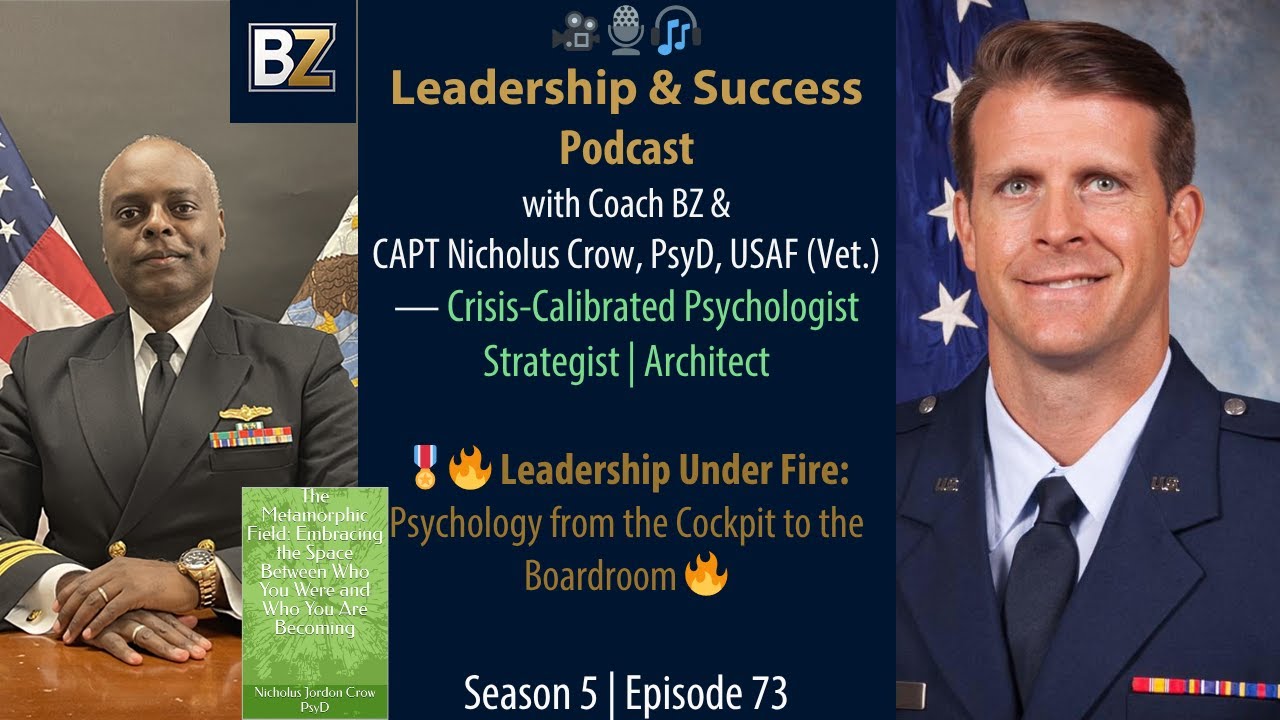
Dr. Nicholas Crowe, a psychologist and former Air Force officer, discusses military decision-making and his AI coaching platform, Leadership SOS. He emphasizes considering secondary and tertiary effects when deciding and tells active-duty service members to pause and self-regulate before acting. The episode closes on gratitude.
Chapters
Hi, I'm John Maxwell. When the top companies in the world are looking for trainers, speakers, and coaches, there's one name that stands above the rest, and that's Maxwell Leadership. Our certified team members have gotten proven results for companies all over the globe, and our reputation I'm proud to say, is second to none. Some of our members have risen to the top of their profession, including the one you're going to meet today. I proudly introduce you to my friend Bob Fabien Zinga.
Welcome to the Leadership and Success Podcast with your host, Coach BZ, where we help you lead with purpose and succeed with impact. If you're ready to grow into the kind of leader others want to follow, this podcast is for you. If you're determined to elevate your success and leave a lasting legacy, this podcast is for you. As my mentor, Dr. John C. Maxwell, reminds us, everything rises and falls on leadership. Our goal is simple: to inspire you, challenge you, and equip you with insights that can transform the trajectory of your leadership journey. Welcome aboard to another episode of the Leadership and Success Podcast. Podcast with Coach B.
Today I am honored to introduce a leader who operates at the intersection of military psychology, neuroscience, trauma recovery, and artificial intelligence. Dr. Nicholas Crowe, PsyD, is a United States Air Force veteran and former director of psychological services at Laughlin Air Force Base, where he coached pilots and commanders through high-stakes decisions, the kind where hesitation can cost lives. He later served as a PTSD specialist with the Department of Veterans Affairs, walking alongside veterans navigating trauma, identity transitions, and performance under pressure. But here's what makes Dr. Crowe's work uniquely powerful for our audience. He teaches that most leaders don't have a strategy problem, they have a regulation problem. When your nervous system is dysregulated, your judgment degrades. Your values go offline. Your clarity disappears. And no amount of intelligence or experience can compensate for biology. Today, Dr. Crowe is the founder and CEO of Leadership SOS, an AI-powered, psychologist-designed coaching platform built for leaders in crisis moments. It's real-time decision support grounded in neuroscience, trauma psychology, and what he calls a non-negotiable operating principle: Regulate first, decide second. He is also the co-author of The Metamorphic Field, exploring the powerful space between who you were and who you are becoming. Uh, a space many leaders find themselves in, but few know how to navigate. For my naval junior officers aspiring to command, for my cybersecurity engineers stepping into leadership, for founders and executives carrying the weight of high-stakes decisions, this conversation is going to challenge how you think about leadership at its foundation. Not just strategy, not just execution, but physiology, Please join me in welcoming Dr. Nicholas Crowe to the Leadership Success Podcast.
All right, welcome to another edition of the Leadership Success Podcast. This is your host, Coach Bizzy. I have a phenomenal guest for you today, and I am so excited to shortly bring him on board. Before we do, as is our custom, we go through what we call via moment of gratitude. We want to be grateful every single time we meet. That's every single day. And part of the reason, as you know, is because in the military, it's about 21, 22 service members and veterans commit suicide every single day. And I think our mental health is so important. So, if you would please just take a moment, maybe close your eyes, put yourself in your happy place, and think about one thing you are grateful for right now. And I think today I am really grateful for all of the experts, for all of the help, for all of the technology we have available today, which we didn't have just, you know, 10, 15 years ago to really help us with our mental health, especially those in the military, first responder, police officers, and people who have to make decisions at times, you know, that could decide life or death. So I am just grateful for all of the help and all of the experts. Including the one we're gonna be talking to today. I think something he might just tell us today might just save a life, and I'm so grateful for that. Okay, let me see if I can properly introduce our guest. So today we are going to be speaking to the one and only Dr. Nicholas Kru, uh, PsyD. So he has a doctorate in psychology, a US Air Force veteran, and former director of psychological services at Laughlin Air Force Base. Where he coached pilots and commanders through high-stakes decisions, the kind where hesitation can cost lives. He later served as a PTSD specialist with the Department of Veterans Affairs, working alongside veterans navigating trauma, identity transition, and performance under pressure. But here's what makes Dr. Crowe's work uniquely powerful for our audience. He teaches that most leaders don't have a strategy problem, they have a regulation problem. Think about that. When your nervous system is dysregulated, your judgment degrades, your values go offline, your clarity disappears, and no amount of intelligence or experience can compensate for biology. Now, today, Dr. Koh is the founder and CEO of Leadership SOS, an AI-powered psychological— psychologist-designed coaching platform built for leaders in crisis moments.. It's real-time decision support grounded in neuroscience, trauma psychology, and what he calls a non-negotiable operating principle, right? Regulate first and decide second. We are going to be hearing all about that. So without any further ado, please help me welcome to the Leadership and Success Podcast, Dr. Koh. All right, Dr. Nicholas Koh, how are you doing today, sir?
Very well, thanks for having me.
First of all, thank you so much for your service. You are an Air Force vet. If I didn't join the Navy, the Air Force would have definitely been the next branch for me to join for sure. But just to get started, sir, is there something you are grateful for today?
I'm so happy you asked that question, and I'm so happy that you do that throughout all of your episodes because you're really proving my thesis, right? A way of grounding is a very good way, and gratitude is a very good way of grounding yourself before any kind of activity that you're going to do. And so I'm grateful that you asked that question to all of your guests because it's, it's doing exactly what I'm asking folks to do, and that is to take some time to reflect on their life and be grateful for the very moment that they're sitting in right now. And I do this, uh, with my wife every day. I've been doing it for 8 years. We, uh, text her 3 things I'm grateful for every morning. And she was sharing with me just the other day that she does this before her big— she's also uh, was trained as a psychologist, but she has a wellness, uh, program at a local university hospital here. And before she gives any presentation, she asks the crowd to do exactly what you're doing. And so it helps her regulate. She said, it's not for them, it's for me to regulate so I can get my nerves to a place where I can present the material that I need to. So I'm so happy that you asked that, and I'm very grateful to be on this show with you today. And grateful for my health. I'm grateful for the weather outside and so many other things.
Actually, finally got some rain here in the San Francisco Bay Area. We need rain so badly.
Send it over to El Paso. We're desert, we're drying out over here.
Yeah, yeah, it's, uh, incredible just being grateful for small, small things. But of course, um, those who watch my show know, but I was diagnosed with PTSD myself about last year, connected with my service. It's, uh, uh, it is, it is not easy at times, but, you know, again, I'm very grateful for all of the technology, the medicine, and tools we have today that we just didn't have 5, 10, 10 years ago. And hopefully we're going to be talking about that a little bit because I, I don't know, I feel like most people in the military especially, they might have PTSD but they haven't been diagnosed yet. They just do not know. And especially for some of the male officers and enlisted, sometimes, I don't know, maybe it's arrogance or pride, I don't know what it is, but we don't want to seek for help or admit that, you know, something might be wrong and we may just need somebody else to help us out. But anyway, I'm hoping we're gonna be talking about some of these issues shortly. But before I do, sir, is there something about you that most people may not know when they first meet you?
Yeah, a lot of times I guess there's a little bit of an intimidation when they meet me. I'm kind of a taller guy and a little bit bigger, and so people might not think that I'm pretty humorous. I have a sense of humor, so that's one thing. Um, related to my military career, I kind of came in unconventionally, so I commissioned at 37 years old and served for about 4 and a half years. So I had the privilege of doing my doctoral internship at Audie L. Murphy in San Antonio at VA there. So getting to see what it's like with folks, the transition out of the armed services, and then getting to go in and experience that for myself. And then I went back to the VA for a couple of years. So that was— wow, it was a really neat experience for me, kind of going in as, you know, an observer, having some insight coming from a military family. Grandfather's stepfather, uncle, Vietnam-era brothers, both sister, both Marines. And so like you, I was thinking, hmm, Navy or Air Force. So just split the branches a little bit.
So yeah, wow, that is really amazing. And I believe you had earned your PsyD prior to joining the Air Force, right?
That's correct. That's how it goes. Health Professional Scholarship through the Air Force. And so that was a little bit of a help along the way when college, you know, courses are not too cheap these days.
Man, that is really quite an achievement. I think I had a picture of you graduating. I think— do I have that? No, no, that's not it. But, but anyway, Quite, quite, quite a huge achievement. Uh, what attracted you to earn a CID?
Well, I think for me it was, uh, not wanting to go to school. So untraditionally, I didn't go to college right after high school. I wanted to become a self-made man, and so I, I worked construction, landscaping, I did food service for a while, worked at Outback Steakhouse.
Yeah.
And throughout that experience, I was able to sit on a lawnmower and reflect on, you know, is this really helping somebody? It might be helping the business or the, the owner of this property, but it might not be helping a larger community. And so I finally got the, the urge to go back to school, and I wanted to be a physical therapist. I was into working out, kinesiology. And I took my first psychology course, and it kind of fit like a key in a lock situation. And I started thinking to myself, you know what, I like helping people, but I'd rather not, uh, you know, if I don't have to physically touch people and I can help them outside of that, I think that might fit me better. Levels at the time. And so that's kind of where, where it all started for me.
That is really, really impressive because, uh, you've coached pilots making ejection decisions. What does that environment kind of teach you about leadership that most boardroom really—
it's interesting now, now that I can look back, and it's been about 5 years since I started that role, I can see myself at a different angle now than I was then because we had a unique, uh, program for pilots that were going through difficulty with Gs. And so they would come to us for— from cyberspace physiology that couldn't handle it. And so we would have to focus in on, you know, getting them calm before they could think about even, you know, getting in the spin chair again. And so I didn't put those two and two together until I started using these skills myself and kind of maybe glossing over some of the breathing exercises that are super important, you know, with any kind of anxiety-provoking or trauma-related experience, you know. And so that was one of the key insights for me.
What, what does deep breathing really help kind of slow down the nervous system?
So for, for me, and kind of like what we started this, this episode with, is just taking a moment, right? And that can mean, you know, following a breath protocol or doing some box breathing, or it could simply just having your feet on the ground and noticing things that are physically in front of you Sometimes people like to visualize things, and so that way it's, it's kind of nice to shut your eyes and think about things that you're grateful for because it kind of like goes with your theory. It's really hard to feel anything else other than gratitude when you're thinking about things that you're grateful for. So it kind of turns off that fear response that some people kind of guides their life or behaviors with when they're kind of working in that fight-or-flight realm, and they're not usually— their frontal lobe is not online. And so it's more difficult for them to make the decisions that align with their values. I think that's the important piece that we're really trying to help people get to is, yeah, you can go ahead and make a decision, you get coached if you're feeling dysregulated, but it might not translate to your values. And then it might not translate to you making the same choices in the future because they align with that North Star that you have.
Wow, that is really incredible. Like I said in the intro, I believe in the military, we disproportionately have people with challenges like PTSD. I think many of them still not diagnosed just because of the high tempo and the really environment we work in day in and day out. But one thing my psychiatrist helped me do is to really help make the difference between my thought and myself, right? I am not my thinking. Because what usually happens is you start thinking and then you kind of like spiral and then you end up into some type of depression or anxiety kind of gets out of control. So as you said, can you kind of tell us for people who are listening right now, one technique or one tool they can use to pretty much, I don't want to say control, but have a better handling of their life?
Yeah. It's a sequencing I used to help people with of kind of understanding kind of a three-pronged approach. So it's thoughts, feelings, your emotions, and behaviors. You know, those two greatly affect one another, right? And so we separate those three out and understand how they affect each other, then we can focus in on the area that is most useful for us in the moment. So like what you mentioned before, that our thoughts aren't who we are, it's just the idea of who we are as a person. And we can never really know ourselves, much the way the sword can never really cut itself. We can only have an idea of who we are. And I think if we remain static with that idea of who we are, that's going to remain the same throughout time. If we're more flexible, we understand that in every moment of the day we're going to change based on our internal state, our externals, the folks around us. All those different inputs and variables are going to change who we are and how we react in situations, especially if we try to tie ourselves to a certain thing, you know. And I think another people tend to do with trauma in the recovery response is they think that they're focusing in on emotions when they're really avoiding the emotions, and they're focusing on memory. They're trying to avoid the memory, and with that comes the emotion, right? So it's like, I don't want to think about it, it makes me anxious, I'm not going to think about it, when the real job is, yes, we want you to experience the emotion because that's not going to last forever if you remember something a certain way and you don't go back and reflect on it, then you can never change your perspective of who you are right now in reference to who you were when the trauma actually took place, if that makes sense.
Wow, that's something. So you said three-prong approach: thoughts, feelings, emotion, and behavior, right? And I think one, one thing I did have trouble with is my emotion. I don't know, maybe it's being a man, but one thing, again, my psychiatrist helped me do is to name that emotion, right? Not just what you are thinking, but what you are feeling, what is it, and name it. And that really helped a lot.
And what you're talking about is emotional granularity. And that's— it's— it might be how somebody else has described it to you, or what you've observed others seeing as an emotion, but for you, it has to be named. And that way we can get down to, okay, what is that? When I'm feeling riled up, what does that mean? Does that mean I'm having a traumatic event in my life, or does that just mean that I'm feeling some emotions in my body? Maybe the interoceptive feelings, like I feel something weird in my stomach, or I can't think straight, I'm starting to get this tunnel vision. What does that mean? And so understanding all those things, becoming more aware of what the body is going through in those, you know, reactions related to your memories. And without naming the emotion, it just gets stuck in that loop, right? Where we're not naming the emotion, it's just this is a reaction, my body's doing something, so I have to do something to react to combat whatever's happening to my body. And a lot of times people will avoid— and avoidance, you know, as you know, it can be not thinking about or trying not to think about it, using substances to do that, uh, you know, getting involved in your work, you know, going hardcore at work and not spending time with whatever it might be that you need to. And that's kind of the idea.
That is really powerful. We've only been 20 minutes in, but I think what you are saying could literally save a life. Again, I'm thinking about my junior officer and young enlisted men, especially, uh, because I've seen so many people, even myself, I think, when I first joined the Navy 21 years ago, I would never admit to myself, uh, I'm having some trouble, especially if it has to do with mental health, because now the DOD has changed a lot. But back then, I was 99% sure if you said you had some mental health, uh, issue or challenges, or you were seeing a psychologist, you would probably lose your security clearance right away, which means you're gonna lose your job, which means the Navy is going to kick you out. That's no longer the case. Thank Thank God. But, but why, why do you think it's so important, especially for men out there, to really seek help when, when they—
it's interesting, and I noticed this too, and I came in kind of a little bit differently than most, so I was a little bit older and I had some life experiences. But I noticed this in our, in our medical group, is mental health was the only door that had glossed over a window so you can see who was inside, right? And so that sent a message. Uh, what everything that you mentioned before sent a message, right? And so we remember those things because we're talking about our livelihood, we're talking about a lot of different things that come along with having a security clearance and being an active duty member and maintaining that. You know, some people's dreams to do that, as it was for me and a lot of other people. And so that has to be taken into consideration, I think. And so we're taught from day one, and, you know, I had recruiters that, you know, offered up the idea, well, if you have anything, you know, kind of minor, you know, just kind of don't mention it unless they ask about it, you know, kind of.
Yeah.
Uh, don't ask, don't tell kind of related things. And so that creates this, this sort of conflict or conundrum in our thoughts about, all right, I'm supposed to lie here, but I'm not supposed to lie here. And so what do I do? And so that kind of gets back to establishing your values, right? And for the younger folks that get in the military, they're kind of, they're segregated from their, their parents into maybe big brother, big sister military, right? So they have that governing body that follows them. But maybe he's not telling them to do the things they need to, like seek, you know, somebody to talk to about, you know, a traumatic situation that they were involved in. And I think talking about it, getting it outside of kind of that loop inside of your mind, offers a different alternative than to be traumatized by it every single time. And so, wow, I think all those things factor into why having, you know, the mirror, the glass, the clouded door on the mental health, you know, who's in there, who isn't in there. And my thinking was that, you know, if we want people to do that, we need to take those sort of governing, uh, things down from those services so people can access them. And I think we're starting to cut some of that red tape now. And, you know, I still have a lot of good people in myself that are in, you know, the space that I was in. And I think there's some real change, but super important, you know, I think this conversation is a huge one because some people listening to this might not have ever thought that it's okay.
And like yourself.
I was too, undiagnosed trauma, you know, and, and providing the service that I was, you know, kind of combating against became a difficulty for me too. So I had to name that as well and seek my own help. And that's kind of what started me on the trajectory that I'm on now as well.
Man, because that could really, really save your life. Again, like I said, the beginning of the show, it's about 21, 22 service members and veterans who commit suicide every single day, every day. I mean, that is really catastrophic. I mean, we really have to do something about that. And I believe people who are listening right now who might be challenged with mental issues, you really, really, really need to have health. And actually, you could also have added trauma throughout your service. Like for me, for example, when I talk to my psychiatrist who You— I remembered, I had completely forgot about it. I guess when something happens to you, you don't like it, you kind of brought it up and then you just compartmentalize it. Yeah, compartmentalize it and completely forget about it. But it was when I was, um, I mobilized in the USS Essex. I was a Lieutenant JG at the time. That was the first and the only time I actually lost a sailor that was, uh, attached to me. Jumped overboard. I, I didn't realize back then how much it had affected me until years, years later. But anyway, anything could happen on active duty. And again, I need to give, you know, all of the kudos and props to the Navy and to the VA. They're really going above and beyond trying to help sailors. But I'm just afraid many sailors just don't take advantage of the help and all of the resources available out there.
Well, I think if, you know, folks like you and I are out here being vulnerable and talking about our, you know, that we had these issues too, and everybody goes through them, I think more people will be inclined to seek out, you know, at least someone to talk to, a battle buddy, or, you know, professional psychiatrist, psychologist, find a coach, you know, talk to a friend, whatever it might be. I think that's really key.
Absolutely. So you, you were a director of psychological services at Laughlin Air Force Base. What type of pattern did you see in commanders under pressure?
A lot of different ones. We had some interesting things go on. We had two aircraft mishaps while I was there, so we, a couple of our, um, training, uh, aircrafts went down and we lost, uh, some members there. And so I got to see firsthand what that looks like, you know, from, um, a student pilot and instructor pilot perspective and from the higher-up command from the base level and seeing how that affects people from the very moment of the information being shared with the cohort and And that was probably one of the most difficult things that I had to see a commander do, was, wow, tell a group of, you know, instructor pilots that they lost, you know, a comrade essentially. And seeing people's faces go from joking and wondering like, where's so-and-so, to just complete horror, you know, and loss. And I'm getting the chills now just thinking about it. That was probably the most impactful one. And then, you know, I served during COVID and so there's all kinds of of, you know, interesting things that went on during that time period from a command perspective, that we were kind of just figuring it all out as we were going along, you know. And so, yes, seeing a lot of dysregulated decisions being made probably during that time because I don't really know what we were doing. And, uh, we finally got a hold on it, you know. And so those are two extremes that I, that I noticed, anywhere from that to just the simple You know, I've got somebody that's coming in with some, you know, has difficulty with getting to appointments on time or showing up, attendance type things that are kind of minor but can become bigger along the way if, you know, if they're not corrected.
Well, what you are saying is really powerful because this is the other thing that happens in the military that doesn't really happen in the industry or civilian life. Something tragic like that happen, you still have to work. You still have work to do, right? It's not like you can take time to grieve and— no, you have to go back out there and do your job. And, uh, that's probably— I mean, I understand we, we absolutely have, have to do that, but that probably compounds the impact of a trauma, does it, does it not?
It does, you know. And I remember talking to a couple of flight docs that, you know, unrelated. Maybe a student pilot had lost a family member, and it was a close family member, and they wanted to know how long it takes for somebody to get over something like that. And I had to step away from my clinical, you know, lens and, and think about it from my own lens. And if I had lost somebody and how long it would take me, I couldn't answer that, you know, because I don't know. And there's so many different variables that go into it, and it's something that maybe we never get over. And I think we have to be okay with that too. And yes, true.
So one thing you've said, and I mentioned in the intro, is leaders don't have a strategy problem, but they do have a regulation problem. What does that mean? Can you expand on that?
Yeah, so I think that leaders have really good, uh, strategy going into— they might have a strategy on what they need to do physically for their life, taking care of their home, taking care of them themselves physically, working out, eating healthy, all those things, having a spiritual connection, all the outlets that one might need. But if they don't have that regulation, if they don't have that time where they can sit with their thoughts and be comfortable with it, then I think they're really doing themselves a disservice in, in forming a strategy. Because if you're not regulated before you do these things, then, you know, and not knowing what you know, where their headspace is when decisions need to be made, you know, if they don't follow that kind of step-by-step model of, okay, some— like, kind of like with my 4-year-old son, you know, something happens, it's, it's the end of the world, and okay, it's not, you know. So I'll do some, some kind of coaching, but before I can do any coaching where you can hear me, I need to get them out of the, you know, fight or flight sort of, uh, everything's— so how do we calm them down, you know? You can do some techniques with kids. They're, they're much like adults where we can slow the breathing down, we can talk, meet them where they're at, bring them down to a level, you know, kind of a quiet talk where they can start to understand things a little bit better. And I think some of the same things hold true for myself, uh, anytime that I'm worked up or gonna get involved with something that I feel like this is really important, I can feel my anxiety level getting up. Is this anxiety or is this fear? It's understanding, like we talked about earlier with that granularity of, okay, I feel these emotions in my body, what is that telling me? Am I anxious or am I just excited? I think having that differentiation is super helpful, and I might not have been able to get to that point if I hadn't taken the time beforehand to reflect on what is this moment all about, you know. And I'm not saying people don't have that, you know, all the time, but if we start to establish that practice, right— and, and you know, and I know this, and anyone else that's gone through military training— that it takes about 90 days before a habit can, you know, take place. And the same is true for this, and it's not often stressed, you know. We can talk about all the different avenues of, of kind of regulating, you know. Off the top of my mind, I think of meditation, and I think of mindfulness. I think of trance work and hypnosis. I think of yoga, all the practices that sort of bring that sympathetic nervous system down to that parachute, ah, relaxing sort of calm that needs to come into play if real thoughts are going to put into actionable values.
So really what you're saying, I think most people, they tend to emotionally react to whatever is happening, but you really need to take the space to respond, and it helps you make much better decisions.
Yeah. And, you know, the reaction, that's— I think that's what was really hammered into me, is reacting in the military. But we really did respond, you know, and having some time away from it now and getting to think about how we would train for certain events and how it wasn't reaction. It really was a response, and it was based off of years of training and strategy where a lot of the commanders probably did have that regulation practice down without naming it, you know. And I think if we can put that into practice as kind of the starting block— and it doesn't take long, you know, look at what you did to start this episode with the gratitude, you know, that didn't take very long— but it gets everybody sort of, okay, I know what this is about, I feel, feel safe, you know. If I'm in a safe place, then I can kind of feel regulated enough to to think about things from how I really want to think about it, not what my self-judgment is coming in to say about it, or what you might be saying about it, you know, outside of what we're actually saying in words. Yes, that kind of comes into play too.
Well, so can you explain, uh, the idea regulate first, decide second, and why is that a non-negotiable?
Well, for me, it's, it's kind of like I don't know if you remember back in the day with, um, people used to wear rubber bands on their wrists.
Yeah.
And they would snap it, right? And that was to interrupt something. And it's kind of like what we're talking about now. Instead of going down a rabbit hole of thoughts and worry, people would do that to kind of stop it in the moment. And so that is kind of the first thing that we need to do when we feel ourselves doing it. But what do we do in the meantime? We just sit with our thoughts, or is a way for us to sit with our thoughts comfortably, you know. And so I think being able to stop ourselves before we start to go into whatever it is that we want to with our, you know, whatever cognition tells us to do— if we can stop and take some breaths, think about it, think about the moment we're in, be grateful for it— that changes the kind of, of, of output that our brain is going to give us, right? Where we might tap into, you know, some values that have been instilled or that we've thought about that kind of align with who we are as humans and how we can help our fellow man from left, right, front, behind us. And not just from a military perspective, as we do, but also out here in the real world, the civilians, you know, how can I help out? Wow.
So what physically happens in the brain when the liver is dysregulated?
So there's, um, the, the vagus nerve is the longest nerve in the human body, and it goes all the way from our brainstem to our gut. And that's what we're really talking about here when we're trying to get the regulation going. A lot of times that happens because of the physical state that our body is in when it gets in fight or flight. So there might be shallow breathing, and I mentioned this before, sometimes we get that tunnel vision where kind of that shock or excitement is really at a high level.. And if we don't do something to interfere with that, much like the, the snap of the rubber band, that can take us to, you know, kind of scary places sometimes and into a panic state. And so if we can get the brain and that vagus nerve to start activating in the way we need to, and it's based off the polyvagal theory, then we can get to a place where cognition takes place, where that, where the, the frontal lobes are online. They're not offline. We're not in that fight or flight state where we're taking, we need to take action without thinking about it just so we can live to have a conversation tomorrow kind thing.
Wow. And for, uh, especially my junior officers listening right now, what is maybe one fast reset tool they can use before they walk into a high-stakes conversation or make a critical decision?
Yeah, so sometimes you can't always do the breathing exercises because you might look silly sitting over the corner doing this, breathing in for 4 and letting out for 8 and holding. That's something you can do. But what I like to do in these situations is, you know, just feeling my physical body in the space that I'm in. So I'll feel my feet on the floor, for example, kind of that grounding, you know. And, and like going back to what you started with, that grounding is gratitude, right? And so I can think about the moment and how grateful I am to be alive in it, you know. That changes kind of it from being something that I'm fearing to something that I want to be a part of. And so I'm in this harmony, this brain-heart sort mind harmony that allows me to think about things in a way that I can get through it, you know. And so naming 4 things that you see physically, having your feet on the ground— I can see the window outside, I can see the trees, I can see the wind blowing the trees— kind of takes you. And this doesn't happen overnight, right? So this is the big— for me, when I was doing trauma work, especially prolonged exposure, they bring in an element of regulation, which with breathing exercises that I used to think wasn't a big deal. And I didn't spend as much time as probably I would now on that piece, kind of hammer it home first. But especially coming into any sort of, you know, physicians or psychologist office, there's always going to be a higher level of, oh my gosh, there might be something wrong with me, what's going on here, you know. My son just went to his doctor's appointment last week and they had to do a check his blood pressure twice because because even at 4 it was elevated and he didn't know what was going on, you know. And as adults, we're kind of the same way. And so if we can use those techniques and continually use them— and they might not work right away, you know, we got to give them that time, much like we kind of had to transition from being civilians into active duty members. It takes more than 30 days, it takes 60, 90 days sometimes to get these habits into place where we see the real results starting to happen. They start to happen automatically where you don't have to think about it. It's just, I don't, you know, my body just goes to taking breaths, not going into that shallow breathing, you know. So then my brain is online, everything's working like it's supposed to be because I'm not running away from danger, you know. There's nothing here. Oh, it's just, um, it's a lecture, it's a conversation, it is what it is.
Yes. Well, what is true is, I guess there are a lot of, what would I call it, signal distraction and things. And when you are dysregulated, you tend to make mountain out of molehill. And really, you talked about that fight or flight response. But when you take the moment to reset, you have more peace, you are more aware, you can use your logic better to actually solve the actual problem you are facing. So I feel like this is really a critical, critical skill. And sometimes, You even mentioned some— when I do deep breathing, I have to do it 2 or 3 times, no more than that. And then, I feel like I am centered and I can pretty much face whatever challenges that is in front of me. For the people who are watching, especially my junior officer, would you mind showing us, I guess, the way you do it? You breathe in 4 and then you breathe out 8, right? Can you show us just one time?
Yeah, we'll do a little bit of box breathing here. And so, there's a Variety of ways of doing it. I don't think there's any wrong way of doing it other than if you don't think it's going to work, it's probably not going to work, right? And so what we'll do is we'll do just a short one where we'll breathe in for 4, we'll, we'll hold, uh, for 8, and we'll let— I'm sorry, we'll hold for 7, we'll let out for 8, and then we'll hold again. And you can do that 3 times usually, and I found that that usually is the most helpful thing to do. And so you can do— you're welcome to join with me. Some people like to take off their glasses. I'll leave mine on for this, but we'll what we'll do is we'll start in. We'll breathe in for 4 and hold for 7, 6, 5, 4, 3, 2, 1. Let it out for 8, 7, 6, 5, 4, 3, 2, 1. In for 4, quickly. Hold for 7, 6, 5, 4, 3, 2, 1. Release for 8, 7, 6, 5, 4, 3, 2, 1.
Wow.
In for 4. 1, 2, hold, 3, 4, 5, 6, 7. Out for 8, 7, 6, 5, 4, 3, 2, 1. And then breathing takes over.
That is so, so powerful. Even now we have technology like the Apple Watch, the app called Breathe, right? In 1 minute, it gets you centered.
It's—
wow, that's powerful. Thank you. Thanks so much for showing us that. So There is one thing that you do that's quite extraordinary. I'm so grateful of how much you are giving back. Uh, you built an AI tool instead of just doing traditional executive coaching. Why did you do that? That's with your—
I'm so glad you asked that, and I've been toying around with kind of the opening line on why I did it, and it kind of goes back to my time definitely working in the Air Force and maintainers working on aircrafts and when I worked in, in the VA and in, in the Air Force, uh, they're trying to get an HRO designation for the hospital, which just means that they're a high reliability organization. And that is predicated off of aviation psychology, which establishes kind of the human factors that, that go into aircraft mishaps. And, uh, they had to redo a lot, um, during the 1970s because there was a lot of of mishaps that were happening, and people were afraid to fly. And so there were some regulations that had to go in, and so they developed really stringent checklists of, you know, tightening nut 6 on the propeller 15 times— not 16, not 14, 15 times. So that got me thinking about, okay, we've spent so many, so much time maintaining machines and making sure that we do things correctly, and we have the technology now And machines really do have the ability to maintain us, and they will remove that judgment, you know, that we talked about earlier that comes into any conversation, whether it's self-judgment or judgment from others. Machine doesn't care who you are, doesn't care that I have a PsyD, but it's going to give me the output that I, that I, I wanted to if I don't allow for some sort of guardrails to be put on it. And you might have seen the research that came out of Stanford here recently about AI. They looked at 11 different models. And what they found was that in all those models, um, the most times out of not, I think it was 49%, they would give them the information that they wanted to hear and they wouldn't push back. And so that was a little bit concerning for me. And so I'm like, is there something out there that does push back or at least nudges somebody in the other direction to help them think about it a little bit more? Or we just, we just have tools out there now that are making people, you know, feel more confident, but maybe they're feeling confident in making other people's lives in their own, not so good. And, you know, there's been some research on, in some, you know, some articles in the news about people using it for, you know, suicidality and it's about that. And so, you know, I talked to some colleagues about this too, and they would have talked to, you know, some professionals in our realm that we would have told them right away what people were going to start asking about. And so it got me doing some deep research, and I got a part of some communities to find out what was out there. And so So, um, taking my time and kind of putting a lot of thought and research and education into this, uh, I developed, um, our Leadership SOS. That is not, you know, it's not a therapy tool. It is not something that's going to provide you with, you know, the kind of clinical lens that I would or anyone else would that is doing medical or mental health work. It's more as a tool for individuals to use in between um, if they're deciding on, okay, oh my gosh, I really need to get some help with this, how can I be better prepared going in? So I really saw it as, I've sought out mental health services, sounds like you have too. I really wish I would have had a playbook on kind of what to ask while I was there rather than just sit there with my, my nervous thoughts about what was going to go on. And so this really equips people with, you know, having that solution or the kind of their pocket that they can ask at any moment in time. You know, if I have a problem and it's 3 o'clock in the morning and, you know, my coach isn't available, who am I going to talk to? And I want to talk to somebody that's going to give me real advice and not just fluff and tell me to do things that are going to cause bigger problems down the road.
Yes.
And so we've developed this tool that helps people to do that. Um, along with that, I've provided a bunch of free tools on our web page that kind of help people make decision. Um, we talk about a lot of things you and I have already spoke about here today with that emotional granularity, kind of understanding themselves from inside, and that has to do with interoception. I talked a little about that with the polyvagal theory. Yeah, but yeah, that's kind of the idea. There it is.
Yeah, and we're talking about leadership-sos.com. That is really, really, uh, powerful stuff. But, uh, Having said that, I know you also talk about the, uh, 3 gates, right? Uh, can you kind of walk us through, through that just, just a little bit? I think you said, uh, safety, regulation, and coaching. And why in that order?
Well, we kind of talked about this briefly before, um, in talking about how, you know, if you're offline, let's just say you've got a coaching moment, you need to do something, you want to seek help, and you just want the answers and that's it, right? And I might be really revved up and irritated and pissed off about something, and I don't want to hear anything other than confirming those emotions, right, to make sure that I'm making the decision that I want to make. Well, what— taking the time and through the gates of, you know, first of all, are you regulated? First, are you safe? Are you in a safe place to make a decision? And getting somebody to regulate themselves first. So they could simply go through the breathing exercise that you and I did, right? And that's going to take them from super regulated down to a little bit. If they've been doing this for 30, 60, 90 days, then they're going to know the pattern themselves and they're going to see it differently. And so what this does is it nudges them towards, I don't want to do that, you know, I don't want to regulate first. But if they've done it for a while, it becomes a pattern and they see it as being useful. So they have real data that they can use for their— for themselves rather than somebody using data against them. And so that takes us into, you know, the regulation piece, and we finish that. And so when we're regulated, then that, that vagus nerve is back online, you know, our brain is functioning in a way that we can really think about a situation, understand from an awareness perspective where we're at, you know, think about it from, um, kind of what course of action do I want to take, how does that affect the people around me, kind of the secondary and tertiary effects that come along with it with any strategy. And then you're really able to have a strategy that is going to provide the values that you have to action those in a way that's going to be impactful for you and other people around you in a positive way.
That's really powerful. If you had a crystal ball and you were able to look into the future, I'm really amazed. We're definitely living in the age of artificial intelligence right now, and the technology is just mind-blowing. But what do you see in the next 5 to 10 years, where do you see this AI leadership tools going into?
Well, for us specifically, this is kind of our, you know, our test model here. And we wanted to start at the highest level possible. And I think your podcast does this too, is in looking at leaders and what does a leader really mean. And everyone is a leader, you know, and developing this too, had people pushing back like, well, that's, you know, that's not really leadership. Like, you don't really know what leadership is because you have to lead from here first. You have to lead yourself first before you can lead anyone else. That means, you know, you have a family and, you know, you have to lead as a father, if you lead as a commander, if you lead as, you know, somebody that's taking out the trash each morning because that's your job, you know, you have to do those things. In order to do that, we need to realize that that is leadership and we have to lead ourselves first before we can ever want to, you know, help others to do the same. So I think that's kind of the initial sequencing, if you will.
Wow, that is really powerful. I think one last question I'm going to ask about this before we get into your best-selling book, just because I am a cybersecurity executive, what do you think about safeguard, safety, privacy, security around AI tools now? Like you mentioned, many of these AI tools like Stanford showed, they try to affirm what you are thinking, make you feel better about yourself, and they don't always think about safety. As far as I know, there's always already been one teenager dead, I think in Florida, because of a conversation with AI mainly. But anyway, just at the high level, what type of safeguard do you see as a society that should really be That's—
yeah, that's really the clinical lens of why we, we built this, was that we wanted to make sure that, you know, we weren't giving— we weren't allowing models to give bad advice. Or it's not in there— in the model's mind, it doesn't know the difference, right? And so we wanted to make sure that it does know the difference, that it does learn from, uh, you know, whatever mistakes that it's making along the way, right? And so in creating this, we wanted to have the guardrails in place that don't allow for that, like that don't allow for someone that comes in that wants to make those decisions. So we've safeguarded our product with, um, and anyone can test this out if they want to, with those types of questions, it's going to provide the resources outside of, of what it can do. So 988, you know, contact, uh, you know, mental health provider. If it's serious, dial 911. Those kind of things let it know right away that it's, it's not gonna, you know, it's not gonna allow them to take them on this journey of, of a thought process that, you know, isn't going to be helpful for themselves or anyone around them. That was kind of at the forefront of— we want to make sure that it does that, that it's not giving people bad advice, you know. That's where I guess the, the, all the education and experiences that I've had, not only through leadership training but also through mental health, and, and, and having people understand that what we're offering is not mental health. It is kind of the— what somebody might go through before they go to it, or if it's just everyday coaching. And, you know, it's really creating a safe place for people to make decisions without that judgment element. So that psychological safety is really kind of the space that we're really promoting.
That is really powerful because not all AI tools are equal for sure. And again, so, so grateful for the work you've you've done, it's gonna make a big difference. Now, this book you wrote, The Metamorphic Field: Embracing the Space Between Who You Were and Who You Are Becoming, why did this book have to be written?
This is something I put together last year, and I was kind of going through this thought process of life, right? Thinking about it from maybe the life of a caterpillar. We don't necessarily have a cocoon that we go into, but our life is really that cocoon. Throughout our lives, we're really in this metamorphic field that every little instance or exchange that we have can change us, not only from a chemical level, but really from a thought process level and how we think about things and life around us. And so you might be the only one that's picked that book up to take a look at it. I don't know if I've gotten much play from it, but I'm glad that it's in the conversation. Yes, it's really just a nice guide of of taking people through a step-by-step process of what it looks like as a human to go through a metamorphic process from the very day they're born to, you know, the breath, the last breath they're going to take in their life. And understanding that it's, it's the journey that's, that's the real, that's the real part of life that people miss. It's not the destination, it's, it's the lived experience. And who you're becoming is how you change each day, you know. And I think if you have a mindset where you're changing for the better each day at least by 1 or 2%, then you're on a trajectory that you're gonna— everyone you meet, you're gonna be able to show them that you're somebody that's gonna advance them, that's here to help, you know, that wants to promote, you know, well-being.
That is really a mindset. It reminds me of Greek philosopher, right, who said you really never swim in the same river more than once because it's always changing and evolving. So when you say embracing the space, what is that space between who we were and who we are becoming?
That's the space that, that you get to choose what it is, right? And so that's what taking the time and regulation, having those moments where you're with your thoughts to think about, who is it that I really want to become? Is this possible? And the more time you spend in that space, the more possibilities open, you know, not to get too woo-woo here, but it is sort of tapping into that subconscious level. Right, where I think all the work really gets done, you know, whether it's us when we're sleeping and our body's repairing itself and our memories are consolidating. That work doesn't end there, it continues, and it can continue throughout the day if you're in that calm, collected, and regulated space, you know. And I see you there now, you know. So yeah, I think it's that space that, that we get to create that no one else can say, no, that's not how you're supposed to do it, you know. It's, it's whatever it is that's advancing you to that next level of version of yourself that you want to be.
Man, that makes me feel like I have agency. Quite powerful.
Perfect way of putting it.
But why do you think so many high performers kind of struggle in between seasons, even the military, like in between deployments?
I think it has— I think it's the transition piece, you know. It's not that they're transitioning out, but they're in between doing something that's super physically demanding, mentally demanding, and it's going back to that hurry up and wait mentality. Me. Like, what do we do in that hurry-up-and-wait? You know, I need to do something when I'm waiting. I think this, this regulation piece can come in there and, and really, uh, work its wonders, you know. And so I think the gap really, um, with a lot of this is that, you know, the identity that we see ourselves as, you know, it's— we mentioned this earlier too— it's you're not always going to be the same person, right? And so this moment in time, you might see yourself as X, Y, and Z, but that's only an idea of who you are in that moment in time, you know, where tomorrow you might look back on and say, what was I thinking? Where's my head at when I, when I came to that? But that you don't get there unless you do spend that time to reflect and to think about things in life. And so you can make the better choices moving forward based off of, you know, your past experiences. They're not going to determine your next, your next action. You're going to determine that. But you have to be calm, you have to be regulated, you have to get to that place where, for cognition and thoughts actually can take place so you can make that value action decision.
Yeah, and I think I've seen that too when people transition out of the military back into civilian life. Like, even in my own career, I think I was a lieutenant commander at the time where the Navy told me I was no longer physically qualified to stay, and they technically kicked me out. But I felt like my ego was really attached to my career. I felt like a nobody, like nothing, like I didn't really I have a purpose anymore. So I fought almost like a year and a half, but eventually the Navy took me back. But now I feel like I'm ready to retire now. I've done my job and my duty, but it's just amazing how we attach so much ego to what we do. I guess the question I have for you, sir, is how can leaders transition without burning down what they have built based on your book?
And well, actually, it's funny you mentioned this. I've been talking to a researcher another Navy veteran actually who's putting together a program right now, and I might be getting involved with it as well. It's called Total Veteran, and it really takes a look at what exactly you're talking about and taking cohorts of individuals who have exited the military, you know, on their own wishes, or maybe not so much, but it doesn't matter. We're meeting individuals where they are, understanding that there is a transition and there is an identity shift, and the ego is very much play, you know, that's the judgment that's, that's talking to you, that self, that critical voice in the back of your mind. So getting to a place where they're able to find out a new identity, you know, if this is who they were before, what part of that can I take with me forward? The good qualities I want to take forward, moving forward. Which ones can I leave behind that are no longer going to serve me? And if we can make that sort of, you know, idea shift of Does it serve me? Does it serve others? Then I'm going to keep it. If it doesn't, see you later, I'm going to let it go.
That is powerful. So we only have about 5 minutes left, which is okay. So I would like to do a rapid-fire scenario with you to end the show. But before I do, I do have one question from the audience. Let's see, uh, Daniel, uh, young, who's a very active member of our community, says, how do we build regulation protocol into daily SOPs so we don't wait for a 2 AM crisis to find out we are already in fight mode? That's a good question.
Well, they can start each day with gratitude like you do, right? They can put that into practice for sure. That would be one thing. You know, it's not reinventing the wheel. It's a matter of checking to see if the wheel's in the spoke it needs to be in so it can rotate the right way, you know. So I think if we change the whole approach to maybe in the SOPs, the first thing we do there is— it's not that we're going to say a prayer, you know, before we're having dinner here, but it really is, you know.
It's—
let's just get connected to who we are and what we're doing and be grateful for the ability to have, you know, a brain to make the next decision, you know. And so I think that might be one of the best ways moving forward., in order to make sure that it doesn't. But if it does happen, you know, now there's a tool available, uh, to help you with it at 2 AM when you're stuck in bed. I think for me and everyone else that's, you know, ever had any, you know, 2 AM moments where they're laying in bed thinking, oh my gosh, you know, I'm going to be junk tomorrow, I haven't slept at all, what's going to happen to me? What I've found in those moments is that I've actually probably been in, you know, a subconscious state of meditation where my body's resting, my mind's still active, but it's not focused focused in on those things that I want to improve on. It's all the, you know, the ego pieces that are falling apart that I need to— yes, take control of, that maybe don't matter, you know. And so I think that's the main thing.
Powerful. Okay, to, to end the show, we have about 3 minutes left, uh, 30-second answers, right? Don't take too long to answer, whatever comes to your mind first. So you are the expert, you are the SID, so let's see what you would do. And I believe this scenario, people who listen to the show will relate to that. Let's say a founder texts you at 2 AM. Should I fire them? What's your first move?
Well, first move is going to be, are you regulated? Right? Good.
Okay. A coworker conflict has been brewing for 6 months. What does nervous system dysregulation look like in that dynamic?
It looks like I'm only thinking about the negative things. I'm thinking about all the things that can go wrong to me and to that individual, not about the, you know, more of the positive the things that can come from whatever decision you're going to make down the road.
But if you regulate, then you can have the time to actually think about both.
You can think about both.
Both. Powerful. So, uh, what's the biggest mistake leaders make in difficult conversations?
Uh, biggest mistake they make is, is not regulating first.
So how do you repair after saying the wrong thing?
How do you repair after saying the wrong thing? Apologize. Be humble about it. Go back and say, you know, I was wrong. The data didn't line up what I was thinking. So here I'm being humble.
The last one. What's your advice for leaders on the edge of burnout who don't want to admit it? I bet you that's a man.
Admit it. Don't admit it to anybody else. You don't have to admit it to yourself. And you can start there and then start the regulation process.
Basically, be humble and regulate. That's gonna be an answer that might just save your life. Okay, we are at the end of the show. Is there a question I should have asked you that I didn't get a chance to ask?
So I think you did a fabulous job of asking all the questions, and, uh, I really appreciate all the time you've taken today and what you do with other folks in this space.
So how can we add value back to you? Thanks so much for giving us your time, expertise, and wisdom today.
Take a look at Leadership SOS. There's a lot of free tools on there you can take a look at if you're interested in having a conversation with me. There's a 45-minute call you can make. You can type in what your, your question is, and I can get to it within 24 hours, and we can have a, a Zoom call. Or there's the AI Coach, and there's a bunch of other tools I mentioned on there. Fantastic.
All right, I always like to end, because we talk about some pretty heavy stuff at times, something positive. What are you optimistic about in 2026, or these days?
Human's ability to make decisions with considering others that might be involved in that. So not just for themselves, how's it going to affect— kind of how we were taught in the military of looking at, you know, tertiary and secondary effects of what one single thing or one course of action might do. So having more awareness of, I do this, what's one thing that might happen negatively, what's some other things that might happen negatively, and how do I combat those? How do I make sure that, that the collateral damage is minimal if I have to make a decision?
And if you had the ear of every soldier, service member right now on active duty, many of them afraid of this war that might escalate, or just life in general, what would you tell them the next 60 seconds?
Just be with yourself, you know, find those moments, find a place where you can regulate and have some thoughts. Don't be afraid to think, you know, without having that either, you know, because it's important. To get those in.
Wow, powerful. Okay, this is it. And the very last question I'm going to have for you, sir, is one word that represents our shared experience on this podcast today.
Simple. Gratitude.
I am so grateful for your time. So we went over by one minute, but this could save lives. And thank you so much, Dr. Nicholas Cole. We really appreciate your expertise and your wisdom today. Thank you.
Thank you. Thanks for having me. Anytime. Pleasure.
All right, folks, this is one for the book. Very, very grateful to Dr. Koh, a U.S. Air Force veteran. And this is really where my heart is, especially for young men in the military, any branches. If you need help, you just need to raise the hand, be humble, and ask for help. It could just change and save your life. You have to be humble and you have to Regulate. Those are really the only two tips. If you get from this podcast, I think that would be worth it. Be humble the way you lead, know when you need help, and regulate. All right. Hopefully this brings a little bit of hope in your life and career. And later today, I am going to be publishing my vignette about Black History Year. As you know, I felt like Black History Month, 28 days, is just not long enough. So we're gonna continue celebrating this on this platform. And thank you so much for watching today. And I'm gonna be back Tomorrow, I believe I will do Proverbs chapter 22. I'm going to be using artificial intelligence, have a 15-20 minutes recap of the episode we have on January 22nd. It took about an hour to go through the book of Proverbs chapter 22. Tomorrow we are just going to do the 20 minutes recap with AI. And then on Thursday, I will have a great pleasure of speaking to a legend, That is going to be Richard Stannin. He is cybersecurity industry cartographer. I think he's written more cybersecurity books than anybody else I know. We're going to be focusing on his last book, Guardian in the Machine Age, talking about agenting AI and cyber warfare leadership in an autonomous threat landscape. You do not want to miss it. Okay, that's all I have for you right now. Thanks again for watching, and I hope to see you tomorrow. Have a Wonderful rest of your day. Bye for now.
Thank you for tuning in to the Leadership and Success Podcast with your host, Coach BZ. If today's episode added value to your leadership journey, be sure to subscribe, share, and join us again for more wisdom nuggets on how to lead better and achieve greater success. Remember, leadership is the most critical skill of our time. The world will always need leaders to inspire others, drive innovation, and execute meaningful strategy. So why not count yourself among the bold leaders shaping the 21st century? Until next time, stay inspired, stay committed, and keep leading with excellence.
More from Bob

S250:E4🎙️LIVE 🇺🇸America 250: President Barack Obama Leadership, Service, and the Power of Hope






S5:E157🎙️ LIVE with CMD CMSgt Dennis L. Fritz, USAF (Ret.)(Multi Tracks Audio)



S5:E156🎙️ LIVE 🇪🇸 Leadership Lessons from the FIFA World Cup 2026 Champions (Multi Tracks Audio)

S250:E3🎙️ LIVE Leadership Lessons from America’s First Documented Family of African Descent 🇺🇸📖