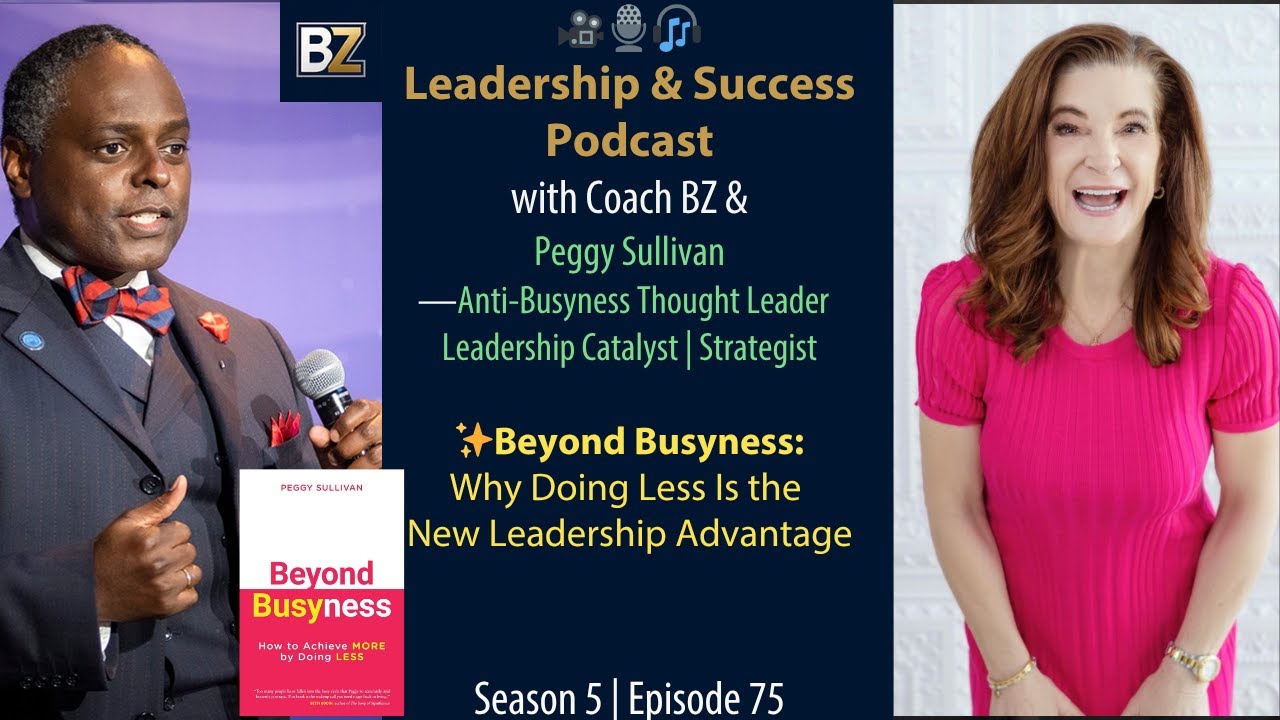
Peggy Sullivan, a performance strategist, discusses her framework for escaping busyness: subtract low-value activities, build daily happiness rituals, and align work with core values. She claims leaders can reclaim 5-7 hours weekly by fixing time leaks, and notes it takes 21 minutes to refocus after interruptions.
Chapters
Hi, I'm John Maxwell. When the top companies in the world are looking for trainers, speakers, and coaches, there's one name that stands above the rest, and that's Maxwell Leadership. Our certified team members have gotten proven results for companies all over the globe, and our reputation, I'm proud to say, is second to none. Some of our members have risen to the top of their profession including the one you're going to meet today. I proudly introduce you to my friend Bob Fabien Zinga.
Welcome to the Leadership Success Podcast with your host, Coach BZ, where we help you lead with purpose and succeed with impact. If you're ready to grow into the kind of leader others want to follow, this podcast is for you. If you're determined to elevate your success and leave a lasting legacy, this podcast is for you. As my mentor, Dr. John C. Maxwell, reminds us, everything rises and falls on leadership. Our goal is simple: to inspire you, challenge you, and equip you with insights that can transform the trajectory of your leadership journey. Welcome aboard to another episode of the Leadership and Success Podcast with Coach BZ.
Are you time-starved? Too much to do and too little time to do it? If you answered yes, you are Not alone. 94% of people are over the top busy. You can change these habits. My name is Peggy, and I am a busyness addict in recovery. For over 25 years, I've helped people escape the hamster wheel. People who use this framework get on average 5 to 7 hours hours back per week. And the best part is that you're gonna replace it with meaningful productivity, health, and overall quality of life. 75% of people find basic self-care to be a challenge. What would you do if you had 7 more hours? Time poverty is real. You don't have to spend a life Being Time Poor.
All right, we have a very special guest waiting for us in the green room right now. Before I bring her on, as is our tradition, we are going to spend what we call a moment of gratitude. This is where we take just one moment every time we meet to just be grateful. So if you would, you know the drill, maybe close your eyes, put yourself in your happy place, maybe take a deep breath, slow down your nervous system, and think about one thing, one thing you are grateful for in this moment. And today I am really grateful. I know the world is on fire right now, right? War in Iran and still things going on in Ukraine. Gaza, in the Middle East, in Ukraine, and everywhere. It looks like the start of World War III, and the economy isn't very stable, and people are not really sure, very uncertain about the future. But in the midst of all of that, I am so grateful that I live in the United States of America. I know some way, somehow, we are going to make it. Things are going to work themselves out. I think America has been at a situation just like this before, and we found a way out, and I believe we will again. So somehow I have hope and peace, and I know that as a collective, we will figure this out. We are going to get out of this mess and find our way back to becoming the United States of America, a country respected around the world, and I believe the leader of the free world once again. All right. So that's what I am grateful for. So let me know in the comment what you are grateful for. And also, let us know where you are joining us from, what city, what state, and if you are outside of the US, since the show has gone global now, which country. And also, if you do have a question for my guest, please type it in the comment and we will be answering live. So before I bring her on, let me see if I can properly introduce our guest today. Today, we really have a great honor and pleasure of speaking with Peggy. She is a clarity -driven performance strategist. Peggy helps leaders cut through noise and focus on what truly drives results. She transforms overwhelm into intentional high-impact performance. She is an anti-business thought leader. She challenges the hustle culture mindset and redefines success by proving that doing less better leads to greater outcome and well-being. And I know we really had a heavy hustle culture here in the Bay Area. I know during the COVID pandemic, it's changed significantly, but it looks like we are going back into our bad ways. But anyway, Peggy will help us really because she's a purpose-centered leadership catalyst. She empowers individual and organization to align action with value, unlocking sustainable success, engagement, and fulfillment. So we're gonna be talking about Beyond Business today, why doing less is the new leadership advantage. Peggy Sullivan is an international keynote speaker, workplace performance expert, 2x TEDx speaker, and the bestselling author of Beyond Business: How to Achieve More by Doing Less. With over 25 years of leadership experience in Fortune 100 organizations, Peggy is on a mission to help you, help leaders and teams escape time poverty, eliminate burnout, and achieve more by doing less. She has worked with organizations like Google, Bank of America, Blue Cross Blue Shield, She's helping leaders all around the world reclaim clarity, focus, and impact. All right, ladies and gentlemen, please help me welcome to the Leadership Success Podcast, the one and only Peggy Sullivan.
So excited to be here.
Good afternoon, Peggy. Really, really excited to have you on board. I can't believe you are here. Maybe to get started, is there one thing you are grateful for today, Peggy?
My niece is having a baby as we speak.
That is so wonderful.
You can't beat that.
Yes.
Wow.
New life. It's, it's just amazing. It is really magical having a new life.
It is. I just lost my sister and her daughter is now having a baby. You talk about serendipity and a beautiful, uh, a beautiful way of commemorating her, and I'm just thrilled, grateful.
Sorry to hear about your sister, but hopefully— well, what really my prayer is that, you know, we leave America in a better place than we found her. It's kind of scary because it looks like right now it's the first time in American history, right, where people with degrees actually do not have much hope of finding a job. People in high school have a much better chances of getting job than those who come out from colleges and university. But again, like I say in the intro, I'm still grateful this is America and I believe we are going to find our way out of it. But what is something about you that most people may not know when they first meet you?
I think I'm a person that always finds a way. I think everything is possible, and I really believe that I can do anything, and I am constantly challenging myself. I ran my first marathon when I was 50.
Wow.
I entered a bikini competition and wore high heels when I was 55. And wow. Goes on and on. I just think we're meant for big challenges and we're meant to do anything we want to.
That's really, really powerful. That's really a mindset. Where do you think that comes from, Peggy?
I think a lot of times we set our own limitations because we don't ask how we can get there. We think about the obstacles And when we really focus on the how to set ourselves up for success, everything is possible. It may take a little more time than we hope, but it is possible. Everything's possible.
That is such a beautiful way to look at the world because sometimes I always wonder, you could have two people, similar backgrounds, sometimes even the same exact family going through the same exact experiences, but one of them is just going to crumble and pretty much die and somebody else is going to thrive? Like, what is the difference? It seems like it's the mindset, isn't it?
Mindset, mindset is everything. And all you need to do is turn to your gratitude if you don't have a positive mindset. And there are lots of other tricks, but gratitude is a great one. Love you started with that.
Yes, indeed. So you describe yourself as a recovering business addict. What was your personal breaking point?
I ate cat food for dinner thinking it was pistachio nuts. I came home from work one day tired, exhausted. I grabbed the cupboard. The only thing I could find to eat. I chomped down some salty pistachio nuts. I woke up on the couch. My cat was throwing up. My cat was throwing up pistachio nuts and I had eaten I had eaten cat food for dinner. So I think that was a huge wake-up call. And as life would have it, that, that was the funny signal. But life wasn't so fun right after that. My, uh, my husband left me because I wasn't spending enough time on our relationship. I got demoted because I wasn't focused at work, and I had a stress-related heart attack. And all of them I could really tie back to being busy and being overwhelmed and not focusing in on what was important. So that kind of set me going on this mission to look at the data. What does the data say about busyness? And I really learned that the data shows us in a pretty crisp still clear way that busy is not better.
Wow. Yeah, I guess for most people, they can't really make the difference. Uh, what moment made you realize that really success and business were not the same thing?
Well, busyness measures activity, and you can work really hard, but if you don't have an outcome, then you're busy for busy's sake. So success measures outcome. And to me, everybody has a different measure of success. Some people want to monetize, some people, um, are relationship-based. Every— you know, some people want to make the world a better place. But to me, when you look at outcome, that, that makes you successful, not having a lot of activity. Activity just makes you burnt out, it makes you tired, You're in meetings, you're emails, you're multitasking, constant motion. But success, it's bottom line. It's meaningful progress towards what matters to you.
Wow. But again, thank you so much for sharing about your life because we all go through some tough times sometimes, but you went really through a lot of tragedy and heartache and challenges, but you thrived. You survived and beyond that, you thrived to come back to write about it and speak about it today. So if you could go back and give your younger self one leadership lesson, what would it be based on everything you've been able to really survive and overcome?
Yeah, I was the daughter of an immigrant, so I grew up thinking busy was better. That's how it went in my household. And I always had to work hard and work a lot of jobs for my education and all of those things. So I wish I understood that busyness doesn't equate to success or results a lot earlier. I think I would have been able to spend my time on things that brought me and the world more joy.
Wow.
And what did that experience kind of teach you growing up as a child of an immigrant?
I I think I saw my father, and he measured success by hard work. And he did well, and he escaped the Holocaust, and he came to America, and he worked hard, and he learned English, and he did all these amazing things. But by the time he was 60, 70, he was exhausted. He didn't have time to enjoy life. He hadn't done the things that were important to me. He spent very little time with his family. And, and I think a lot of people wake up to that last little piece of life, and they realize that their time here, it's limited, and it's a gift. So you've got to make your own meaning. You've got to understand what's important. You've got to lead a value-driven life.
Well, like I said in the intro, Silicon Valley has always been a very business-driven culture. Although during the global pandemic of 2020, I did see a huge shift, people starting to really value their relationship and all of that. It's not just about money and being extremely— having a huge output at work. But it seems like once the pandemic was over, they went back to their old ways. So I guess the question for you is, why has busy become kind of like a status symbol for many people, especially in leadership and corporate culture?
Yeah, I think busyness is a status symbol. That doctor is so busy, I can't get in to see him for 6 months. He must be really good. You know, my next-door neighbor, he leaves at 7 in the morning. He misses dinner with his family every day. But hey, he's a rock star. He's been promoted. You know, we just, we wear it like a badge of honor. Even, even my son, I'll call him up and I'll be like, hey dude, it's mom, how you doing? He'll be like, I am so busy. And you know, that's, you know, connect with your mom. You know, that's, that's, that's not the way life is, is meant to be lived.
Wow. So what do you think then is the real cost of business?
Most important, I think it shrinks decision quality and strategic thinking. But mostly, as a society, we don't look at the opportunity cost of time poverty. So functionally, in an organization, you look at sales and what's lost revenue, customer service, what's going on in your service metrics, you know, operationally, how many widgets are you not getting out the door because there's no clarity between functions. When you start to measure the opportunity cost of busyness, it is huge.
You just mentioned time poverty. Can you expand on that? What does that look like today?
Yeah, I mean, in the beginning when I started getting into this whole concept of, of busyness, um, what people told me was they didn't have time for what's important. But yet people will tell me, I love being busy, I love being busy, I want to be busy. And so it made me reframe the problem as time poverty, not having time for what's important. And I think that's something that everybody can relate to instead of saying I love being busy, which many and most of us do.
Yes. And I guess really business creates an illusion, right, of productivity while actually reducing effectiveness. Can you tell us a bit more about that?
Yeah. I mean, I feel as though we focus oftentimes on the urgent instead of what needs to be focused on. We reduce execution quality, talent growth, you know, revenue potential because we're— our calendars are so overloaded. We have so much decision fatigue. We, we switch from one task to another not realizing the switching task time that it takes. You know, we're reactive, we're strategy-starved. The list goes on and on. We neglect our people, we miss opportunities. It just It goes on and on.
Really, based on what you've said and what you talk about in your book, there are two leadership principles I believe really significantly impacted my life when I was still a teenager. One is the Eisenhower Matrix, right? It's talking about what's urgent. Most people spend a lot of time doing what's urgent but not important. And I feel like that should be delegated, but I should spend time on what is both urgent and important. And then next is what is important but not urgent, but really get it scheduled. It needs to be done. And then, of course, what is not important and not urgent, I definitely need to stop doing. Because people, like you say, they're busy, they're doing things not urgent, not important, getting busy all day, getting tired, but it's something they shouldn't even be spending any energy on. Isn't that crazy?
Yeah. I mean, I go through an exercise with executives and leaders where we sit there and we talk about busy traps and everybody nods their heads. And then we quantify them based on the reality of that particular workforce. And then we look at if they were spending their time on the right things, what would that equate to? And to me, you know, we just need more discipline to look at these things from a different lens and really start to think about the lost opportunity cost. And when you go through that process, it's so black and white in terms of, okay, Where do I need to focus? What is my highest level intervention? The one thing I can do that's going to give me back the one thing that's most important to me right now.
That really could be life-changing for those who are listening right now. Again, it reminds me of something I learned from one of my dearest mentors, Brian Tracy. He talks about the 80/20 principle. I guess it's the Pareto principle, right? 20% of what you do could get you up to 80% of the results you are seeking. But most people, they do the inverse. They spend 80% of the task to only get 20% of the output, of the actual impact they are seeking. If you could reverse that, I mean, you would be extremely effective and actually have even more time to stay home and be home for dinner with your family and friends and be more fulfilled, really. So how does business impact team performance and culture?
Well, I think when we're so busy, all we're doing is firefighting. We're putting out problems. We're reacting to discussions. We're reacting to customers, big and small. And we're not protecting clarity. And we're not protecting focus. So all of a sudden we're trying to be good at many things instead of one thing. And you ask the average person, you know, what is your to-do list like? And they'll, they'll show you a page of things. And then I'll be like, but you can't get all that done. So really, what are your priorities? Show me the top 3 things. And they're still like, no, these are all important. And I'm like, well, not really. They can't be. Nothing's important if they're all important.
That's true. So I guess that's probably one thing that even a lot of executives have trouble with, right? Earlier you mentioned something like, you know, what is the best use of my time right now? What is the highest level task I need to focus on? Something I ask myself quite often. Why do so many leaders kind of struggle with delegation? Because I'm sure the list that you said on one page, things they think they need to do, some of that they need to completely stop doing. They don't need to be doing at all. And the other is they need to delegate to somebody else to do so they can just focus on the most important task. Why is it so difficult for so many leaders to delegate?
Yeah, I think there's a lot of, a lot of reasons. I think one is what I call the hero complex. Nobody does it better than me, so I'm going to do it myself. I'm going to save the world. I'm going to save the company. Number 2, they don't have trust in the people, in their people, to actually delegate the work and belief that maybe if it looks a little different than they would do it themselves, that it can be still just as effective. But I think it's just too many people grew up by being doers. And so they rewarded, they became CEOs because they were doers. So they're like, I don't know any other way. So I'm just gonna keep on doing.
That is really powerful because it reminded me when I went from being an individual contributor to becoming a manager, I did have a hard, hard time going through the transition because you are right. Most of us, we feel like we are the hero. We do it better than everybody else. So Why even try to mentor and coach somebody else to do it? I mean, just as well do it. But that does have a huge impact. It limits the organizational growth when you think like that, does it not?
Yeah. And it's not even only that. It affects diversity. I mean, I love collaborating with my team because they help me think about things that I don't normally think about from a different perspective. Perspective. And so I may have an idea, but certainly 3 minds create a better idea.
Yes. Wow. That is really, really insightful. So let's talk about your bestselling book, Beyond Business: How to Achieve More by Doing Less. It looks like it's a paradox. Achieve more but doing less. How is that possible? So maybe to get started, the first question I have for you is why did this book have to be written?
Well, for me, I took a pause in my life from corporate America to take care of my father who was dying. And after he died, I kept on thinking, what's my legacy? What do I want to give to the world? And I kept on asking through market research the same problem, you know, what's your biggest challenge? I asked people, young, old, nationally, locally, men, women, didn't matter. They all said the same thing: I don't have time for what's important. And I thought to myself, if I could help people with that, what a gift it would be, and how, how much value I would get out of helping people do that. And so that's why I started to write the book, and then case studies and examples and And statistics and all the proof just kept on popping up, and it got to be this topic that, that just got really big. And, and I could look at it in so many ways. You know, I, I often say time poverty, um, eliminating time poverty is choosing meaning over mayhem. And that people think time poverty, we're a victim because so many things chew up our time, but we have so much choice. Too. We can choose time wealth.
That's really a different way of looking at it. Another thing from your book which I like is, you really, you don't try to be nice, but you are being truthful when you say business is actually an addiction, not just a habit. And for most people, that's not how they see it. But I think if they did, they would probably act a little bit differently. Can you tell us what what you mean by business being an addiction.
Yeah, I mean, every time we cross something off our to-do list, we get a little giddy, we get a little happy, and we get a shot of dopamine, and it feels good, and we love it. So we do it again and again and again and again. And what happens is we are forever chasing that dopamine high. The American Psychiatric Association says an addiction is anything that keeps us from what we should be doing and normally would be doing. And I can't tell you how many people I coach that say, oh, I just want to finish that last little thing, and I missed dinner with my family, and work another couple. And it's, you know, it's just so easy. It's so easy to do because short term it feels good, but long term it's dangerous. Wow. Really dangerous.
Really, by reading your book, you get the sense that not only is busyness an addiction, but it's also tied to burnout, anxiety, even major life consequences. And people just don't realize that, do they?
Yeah. I mean, one of the things that I always tell people is spend some time in your day creating happiness rituals. And My first book was about the neuroscience of happiness. And what I learned is that whether we're happy for 60 seconds, 30 seconds, or 5 minutes, we get this burst of energy. Our brain is able to focus more. We, we are more charismatic. We fight off chronic disease. We live longer. And for most people, happiness is the soft thing. They don't see it as a neuroscientifically proven tactic to improve your health, your happiness, and your productivity.
Because in, in, in your book, and I think you have those videos on your website as well, you talk about kind of like a 3-step process, right, to kind of walk us through, uh, your busy busting process. Can you take us through that, please?
Yeah, absolutely. Um, I kind of had fun with with naming the process, but, um, the first step is subtraction, and it's about eliminating low-value activities. Nobody wants to take on anything new or has the bandwidth unless they, you know, make time and make room for it. So subtraction is the first chronological step. The second step is what I call Mojo Making, and that's tapping into happiness as a superpower. And the small little things that we can do to ignite our brain power, our energy, our focus. I, I tell people I eat a piece of dark chocolate at 11 AM every single day, no matter where I am. I close my eyes, I'll put that chocolate in my mouth, and I will smell it, I will taste it. 30 seconds. But you know what? It's like the reset button. And That's all it takes. And I think we forget about it. So Mojo Making is number 2. And oh, by the way, it works in the organization too. When you create organizational happiness rituals, metrics improve. Lots of case studies about that. And then the 3rd thing, which I think is super important, is being able to define success. And understanding what you value. I, um, very early on really wanted to understand what are the things that equate to quality of life. And so I surveyed thousands and thousands of people, and what I learned is that there's only 3 things that equate to quality of life. It's human connection.
Yes.
It's growth, to always be growing. And then the last thing is, is self-care and energy management and the capacity to make sure that your mood is always in a place, at least of curiosity, and that you're setting yourself up for success with sleep and eating habits and just all those things.
Yes. That is really, really powerful, simple, but Powerful and quite insightful. And I really like when you talk about happiness ritual. You gave the example, you eat chocolate every day at 11:00 AM, but really, you are aware of it, you favor the senses and everything, really, really enjoy it and it really lit you up. You even said that it's almost like a reset button, which is quite powerful. Why should people create their own happiness ritual? Ritual throughout the day? And how does that improve performance as well?
Well, for me, I encourage people to not have something that takes a lot of resources, to do something that's portable. When I worked at UnitedHealthcare, I headed up their customer service department. My job was to improve their service metrics. And working in service is such a hard job. And I thought to myself, what can I do to help these people? Is it a new phone system? Is it a new process? And then I thought, yes, no, what if we do happiness rituals in the day? What if we have cubicle dance parties? What if we all get on Zoom and sing a happy birthday to somebody, or, wow, or make a card for somebody in a nursing home, or just do things that— and you know what Customer service metrics, first call resolution went up 33% in 6 weeks. So when I say happiness is a superpower and move metrics, I truly believe it. And I have so many case studies that show it. And it feels so good doing it. Like, who doesn't want to walk outside and feel the sun on their face? You know, for me, I'm a fur baby lover. And even just sitting down and petting my fur baby and making them happy because I'm connecting with them and talking to them, that makes me happy.
Yes. Wow. So simple, but so effective and so powerful. I really love what you are really talking about, right? Focusing on eliminating low-value work and creating intentional joy and aligning with your core values. Powerful. Now, going back to your book, right? You say, Achieve More by Doing Less: Beyond Business. I guess one question I have for you is what's maybe one simple change a leader can make today to reclaim, let's say, 5 hours a week? You're saying that's possible.
How?
Yeah, it's totally possible. I mean, I think if they just put together simple little diagnostic tool on what are the busy traps for me? What are the busy traps for my organization? And honestly, look at them and pick one or two. It can be life-changing. It can be something as simple as, I'm not going to let interruptions distract me. Interruptions, it takes you 21 minutes to refocus. Think. And so there are so many little things that you can do to pick up a ton of time during the day. It's a matter of really understanding the metrics. And for me, that's what got me serious, was looking at, oh gee, if I multitask, it actually takes me 2.5 times longer and I make 50% more mistakes, or whatever the metric is. The metrics consistently tell us that busyness kills happiness, health, and productivity. So why, why are we so enamored with it? It just makes no sense.
So powerful. I will definitely going forward recommend your book to all of the people I mentor because that's really life-changing when put into practice, right? I kind of learned everything you are teaching about mostly from Brian Tracy when I was about 17. 18 years old by reading 3 or 4 of his books, but you got it in just one book, which is just amazing. One resource that could potentially change somebody's life. Another thing that you mentioned before I do that, I really like what you are saying. So focusing on your most important task. When I was talking about the 80/20 rule, the 20% of the things you need to do right now to get 80% toward the output, the achievement you are you are seeking. That really makes such a big difference. And you talked about not being interrupted, right? One thing I've learned, I think it's from Darren Hardy, is to have those jam sessions, like an hour, 2 hours, or an hour and a half where I don't get disturbed. My phone is on do not disturb, no email, and I'm just focused on my most important task of the day. And then when I'm done with that, then I can do email or know what's going on with the news or whatever it might be. That makes such, such a big difference every single day, focusing on things that really truly matter to your work.
Yeah. I have a funny, a funny story about that. And I love to write. When I write, I love to focus and I don't want to be interrupted. So I have this rule. This rule, my husband is like, when my door's shut, that means I'm focused. Do not disturb. That's the rule. And the other day I'm writing away and I'm having, I'm, I'm in my creative flow and the ideas are coming, and I hear a knock on the door and I'm like, this has got to be really busy. He knows the rule, he knows he shouldn't interrupt me. So I open the door and I let him in and I'm like, like, what's going on? You know, what's so important? He looks at me and he says, we're out of ketchup. And I'm like, yeah, it was important to him. He loves his burgers with ketchup, but important. And, you know, I just sort of told him, we'll talk about not having catch-up later in the day, but I want to get back to my work. And that was maybe a 50-second, 25-second conversation. I couldn't remember that big idea. And so, you know, setting ourselves up for success is so important.
Yes. Yes. I believe it was Maya Angelou. She, she would get herself into like a cheap hotel for like a week. A week to finish all of the books she was on contract with. Otherwise she would never get to it. No husband, no friend, no family, just her and a blank sheet of paper or whatever and writing, writing, writing, writing. Now I think that Tony Robbins had sent us a do not disturb thing when we took his seminar. So I have one of those I put in my wife's office downstairs. So when she's doing her thing, everybody knows the kids to just leave her alone. But of course not. I'm not always perfect. Sometimes I interrupt her flow just a little bit, but I need to do better because it really makes a big, big difference, especially when you are in the flow, right? Because you may not get those big ideas again. But wow, that's an important lesson. So how should a leader then rethink time management and energy management? You talk a lot about energy management in your book. What's the difference? And how do we do it?
Yeah, I mean, I did a— I did my last TED Talk about time management versus what I call values management. And the funny thing with time management is it's a $20 billion industry. $20 billion. But yet under time management, 79% of individuals have a lost sense of purpose. So time management, you know, keeps us humming along and squeezing in more and gives us and provides for overstuffed schedules, and it gives us little things to prioritize and this and that. Yeah, but it doesn't align with our values, and it's just too complicated. I, I don't like complicated. I like easy. I, I like simple. You know, so for me, I'm just like, what are my values? Every single week I take a Post-it note, I put them down on there, and I'm like, grade myself. And if I missed a value next week, I'm like, okay, I'm gonna time block out what I wasn't doing that is important to me.
That is so powerful, living by your core values. No, I, I speak about 12 to 15 times, uh, every year mostly to Chief Information Security Officer and Chief Information Officers across the country. And usually I ask them, hey, you guys are C-level executive for your organization. What are the core values of your organization? Less than 2% know what the core values are. They are— maybe it's about fairness and working hard, taking care of customers, but they don't know what those core values are. Of course, for those who are in the military, like me in the Navy, we know exactly what our core values are. It doesn't matter what time of the morning or night, it's really driven into us during boot camp. We know what the core values are, but it's really something to know who you are, what you stand for, and also live your life by those, right? Because it kind of helps you say no to things that are not aligned and then really focus on your own purpose. Isn't that something? So So what is one thing that your book— maybe one or two misconceptions your book was written to really fix? What are some misconceptions people have that this book is really going to help them with?
That's a good question. I think that people think that doing this is hard. And that it's an involved process. And I intentionally designed it so that it would give the average person 5 to 7 hours back per week. But I intentionally designed it because it's easy. It's so easy. It's so measurable. Subtract Mojo Make, you know, values, live your life by your— it's not rocket scientist. And I think in a world that's so complicated, we all think we need complexity, and it's sometimes simple is better. And this is so anti-everything that we've been raised to believe, right? Busy is better, more is better, you know, all of that. I, I once got on a stage And I put a penny in big boxes and a $20 bill in a small box. And I asked people to pick the one. And everybody picked the pennies, right? Because they thought the big box was going to be better, right? But the $20 was in the small box. So I think we need to let our experiences drive our reality and be open to a different way. That maybe leads us to more success.
Wow, that is so insightful. Now, let's try to make this practical for the people who are listening to the show right now. Let's say Fortune 500 tech executive or military commanders. What would you tell them to stop doing immediately based on your book?
I would actually tell them to actually do something. And that something would be to really identify their busy traps and where they're leaking time.
Yes.
And then take a moment to look at the opportunity cost, like what is it costing them— family time, sales, widgets, whatever it is— and, and then think about one remedial action. So it wouldn't be something— I mean, you know, I'd say stop looking at the phone, stop spending 3 hours on emails, all those things. But the reality is every culture, every person has different habits, and you need to identify the ones that are clogging your arteries and, and hurting you. Um, and, and that can be different among cultures and size of organizations. And, you know, entrepreneurs are, are different, and, and women have different type time poverty, all these market segments, they all have different things that are keeping them from what's really important. And so for me, I look at it from a target market lens and really try to understand that first and personalize it because nobody wants to do anything if it's not going to work. But if they can do one thing and it's going to work, so I say, you know, look at the data, look at the analytics, Roll up your sleeves and figure out what's the opportunity cost of your time poverty.
That is really, really powerful. One of my mentors, he's pretty extreme, Darren Hardy, he actually leaves his phone in his car when he goes to the office. This way there is absolutely no distraction. He just focuses on the most important thing he needs to work on. Now, one thing I do, there is a program called, I think it's called Inbox When Ready. If you go to your email like Gmail, it will pretty much block your email unless you click another button, then you can see it. So that forces me to only read my email maybe 3 or 4 times a day, but not every 5 minutes, not every 15 seconds. Well, this way I am not addicted to it.
I look at it twice a day and I never look at it first thing in the morning. My good energy goes towards what's the most important task I have of that day, the most important thing. That's where my good energy goes. And well, for me, that's my flow state. I have high energy in the morning, take advantage of my flow state. And, you know, emails, I can do them maybe when I'm a little tired and a little less alert.
Yes. And that's also good for your mental health, isn't it? Wow, that's, uh, powerful. Okay, so how do you operation— this is going to be the last question about the book— how do you operationalize doing less, especially in high-performance, high-stakes environment where, you know, stakes are pretty high.
Nobody can argue with results. So if you're results-oriented, if you're bottom-line-oriented, if you want to make a difference and you can deliver results, this is the way to do it. You know, when— if you want to focus on, on things that matter and drive your personal health drive your relationships, drive your happiness, drive your bottom line, then this is the way to do it. It— I've never seen it not work, ever, ever, ever.
Wow, so powerful. Okay, uh, we have about 15 minutes left, so let's get into the last segment. That's where I try to understand the leadership principles you follow that have helped you be as resilient as you are and achieve your level of success. First question would be, uh, what do you think is, um, the greatest lesson you have ever learned, just in life, in leadership, in general? Greatest lesson you've learned?
Yeah, I mean, I think a day without learning something new is a lost opportunity, and that when we develop this continuous learning state, that we become more valuable to everybody around us and to ourselves. And so it's just such a good, just such a good value. And, you know, thing to think about on a regular basis is, is how do I continue to learn? Wow.
Learning something new every single day. That is so powerful. And in hierarchical organization, like in the military where we have rank and all of that, that sometimes you also have to have the humility to learn from people who are much junior to you. And it's really amazing what you can learn from the troops when you are their commanding officer. Wow, that is powerful. Why do you think you've been so successful, right, on the TEDx Talk, not just one but two? You've written a best-selling book and you are helping so many people and all of the experiences you've had in Fortune 500 company? Why, why do you think you are successful?
Um, for me, I'm always thinking about the relationship piggy bank, how I can add value, how I can help other people. And that comes back, not because you ask for it back, but it comes back because you help people become better versions of themselves better versions of their company. And then in turn, you know, it's just, it's just a great way to be. So for me, focusing on how I can help somebody is always, always, always on my mind.
That is really powerful because I remember, I think it was Zig Ziglar, right, who said, uh, you become successful if you can figure out how to help enough people because that pretty much, yeah, you can have everything in life you want if you will just help enough other people get what they want. It's the exact word he used, and that is so true. Wow. So I know on Leaders Are Learners, what, what are you learning these days?
How to do pull-ups.
Wow.
As a woman, I've always wanted to do pull-ups. I'm stuck on 4. It took me years to learn how to do 4. It's not a woman's Anatomy. So I am so focused on learning how to do pull-ups.
Well, I'm gonna tell you, I didn't even know how to do a push-up before I joined the Navy 21 years ago. But, uh, yeah, that is— wow, that is, that is powerful. Very, very—
it's random, it's random, and it's really hard for me, and that's why I love it, because I love doing hard things. So, you know, I mean, I mean, not meet this is the goal that I have to do it by the end of this year to get to 10 clean straight, but I'm gonna, I'm gonna try.
Wow, that is, that is really inspirational. Now we talk a lot about success and we should, but what about failure? How has failure shaped your life?
Oh boy, I'm, I'm will get up in front of any group and tell them I'm a hot mess. I failed so many times. I've made so many mistakes. I've done so many wrong things, but I've always learned from them. And so it's never failure when you can grab a piece of insight and you can learn something from it. And so, you know, we don't— you know, we don't fail. We, we, we just, we just learn how not to do the things that don't serve us.
Powerful.
Yeah.
My primary mentor, Dr. Maxwell, says sometimes you succeed and sometimes you learn. So failure is learning. Failing forward, I think, is what he calls it.
Wow.
Powerful. Powerful. Can you share maybe one of the greatest fear you've been able to overcome in life?
I, as a speaker, I think It was, um, getting up on stage.
You're kidding me! What?
International?
Wow.
But be— and, and I made myself learn to love it because I realized that as a speaker I can help so many people, and it's a medium for change. And so that's why I love speaking and coaching and workshopping and, and things like that, but Wow. It didn't come naturally to me. I actually, in the beginning, I was more like an actor where I would try to entertain instead of speaking from the heart. And wow, then I didn't have the credibility. And so learning how to speak in a way that is vulnerable, transformative, honest, Um, that's been hard for me. I mean, you get up on a TEDx stage and the lights are bright and you're like, yeah, oh my God. And then you're like, no, if you can just teach somebody one person one thing, that, that's all this is, man.
You make it look so easy though.
Wow.
And by the way, you look very good in red and pink. It's, uh, incredible. I guess yellow also, also, uh just terrific.
Yeah, those are my colors. There's something about putting on a bright color that just makes you feel amazing.
Right, right, right there on your book, just, just, um, perfect. Because I mean, it looks like— I mean, uh, I don't want to think of it as a production, but from somebody looking from afar, it looks like you, you have absolutely no fear and you were born to do just that it's so electrifying when you speak and the effect you have on the crowd.
Wow.
That's powerful. So who are some of the people who have inspired you throughout your life? Some thought leaders you follow or mentors who've really helped show you the way?
Yeah, I mean, definitely my father. I mean, he was in a constant— my grandfather, he escaped. He was in a concentration camp, and when he got there, he knew, he knew that surviving and having a positive attitude was his biggest obstacle. So he figured out how he could maintain a positive attitude and have hope.
Wow.
And as I learned that, I, I learned that, you know, hope is, is really such a powerful thing, and all he did was say to himself, I am okay, I have everything I need, and I got this. A little mantra, just a little mantra. So he taught me, whenever I get nervous, whenever things get hard, I just remind myself, I am okay, I have everything I need, and I, and I got this. Um, wow. Lately I've got a mentor, David Myrnen-Scott, and He, he talks about, um, being a raving fan of something and how you make a difference by being a raving fan of something. And, you know, he's been a really huge, um, influence, um, in my life. But, um, you know, I've met a lot of people. I met JFK on a park bench.
Wow.
He influenced me, and that was a really, um, you know, cool thing. So, you know, I just— I, I live a blessed life, and— but I learned from all types of people, you know. It doesn't matter if they're famous, if they're rich, you know, what color they are, any of that. It's, it's who they are inside.
So let me ask you this then. If you could choose 3 people, anyone alive, dead, or even fictional characters, who would you choose to have dinner with and why?
Wow, that, that is, that is a really, really hard one. Um, I, I would definitely say Oprah because I just love her vibe and her approach. And how she's aging with grace and her practicality. So she is, is definitely, um, you know, one of them. I would also go back and say, if I could have another hour with my parents— they're both dead— like, I would, I would take those 2 hours over anybody else, you know. Spend an hour with my mother, spend an hour with my dad, and tell them how much I miss them and how much I love them. That would, that would be more than anything.
Powerful, powerful. And, uh, is there a book, of course, outside of, of your own, a book that you would recommend to my audience?
Right now I'm reading a book called Small Giants, and it is an amazing book because it's It's about greatness, and greatness has nothing to do with size. Yeah, it has to do with integrity and doing the right thing and doing a couple of things well versus doing a lot of things. So it's called Small Giants, and I am loving every case study, every word, every page. It's, it's been awesome.
That's by Amber, um, Birmingham, right?
Yeah, yeah, exactly.
Okay, I, I will make sure to, to add that to our digital, uh, uh, book bookshelf, which I started last year. It already has over 300 books, if you can believe that. People have come on this podcast and recommended books for our readers, which is really awesome. So is there maybe a song or a book or a movie that you would consider like your life's theme or anthem?
I, um, have this song that I play that's by Maroon 5 that's called Sugar, and it's a dance song, but it's also a video that shows the group, the band Maroon 5 crashing weddings and delighting and surprising people. And it shows the surprise and the delight and how contagious it is and how it goes from one person to another to another. And to this day, it's a song that I watch before I get on stage. To this day, if I can do a happiness ritual for people, I'll show that video It's just a really beautiful group of people exuding happiness.
Ah, so beautiful.
Yeah, it is. It's fun.
I really love music because it can definitely change your mental state, right? And also take you back to a specific time where you were happy or whatever milestone in your life. And the book you mentioned earlier, Small Giant by Bo Burlingham. Companies that choose to be great instead of big. Wow, powerful. Thank you. Thank you so much. Okay. If you had one and only one day to live, Peggy, what would you have liked your final contribution to be?
I think I would like my legacy to be teaching people how to escape time poverty. And because I truly believe that if we all had more time wealth, there'd be less poverty, there'd be less hunger, there'd be less war, there'd be less hate. I, I just think so many times we're so busy and, and we're so jealous because we don't have time to live that it just cuts life short. And so for me, that's why I am so passionate about Escaping Time Poverty. Anybody that will listen, I will sit there and tell them it's the secret sauce. It's what makes chicken better every single time.
So powerful. Definitely can see the passion and you were born to do this. It's just incredible to see you at work. Thank you so much. And When you wake up in the morning, let's say you had a magic wand, you could solve any problem in the world. What is the one problem you'd like to solve first thing tomorrow morning?
I think hate.
Yes.
And lack of open-mindedness and realizing that everybody has a different way. None, none are better or worse. And, and that we just need to be a little bit more open-minded. We can agree to disagree, but there doesn't have to be violence. There doesn't have to be nefarious activity. Let's just agree to disagree and respect each other.
Powerful. And if you had the ear of every aspiring leader, I would say probably people in college about to start their career across America, every boy and girl, what would you tell them to do first thing tomorrow morning?
I, I would say that life's an experiment, and don't be afraid to experiment and try different things. I was that person who changed careers, changed focus, changed target markets, changed industries, roles, responsibilities, literally every 4 years, 5 years, because I love to learn. And I, I just think people, young adults, feel as though they need to choose what they need to And I believe that life is an evolution, and when you let it evolve and unfold naturally, then you can really level up.
Wow, powerful, powerful. Okay, all good things come to an end. We are running out of time, so how can we add value back to you? Thank you so much for speaking to us today.
I, I love speaking, so you can invite me to speak. You can invite me to come to your company and help. You can drop me a note via email or on LinkedIn. It all works. I'm a people person. And so just reach out. I'm here and I will respond because I love, I love helping other people.
And I can find you on LinkedIn, Peggy A. Sullivan, and your website peggy.sullivan.speaker.com. And of course, everybody needs to get a copy of this book. I believe it's really life-changing. Beyond Business: How to Achieve More by Doing Less. Now, Peggy, we are toward the end of the show. Is there a question I should have asked you I didn't get a chance to ask?
I think we covered just about everything. And so I guess I would I just want to publicly thank you for this opportunity, and more importantly, thank you for your service. I think that too often we, we don't appreciate so many things in life, and I appreciate you. You reached out to me organically. I read up about you. I didn't know about you. I was like, oh my gosh, this guy, I share so many values with him. What an What an interesting person. So I just want to, you know, thank you.
No, it's really a great honor, privilege, and joy because you are a superstar, 2-time TEDx speaker, and best-selling author, and everything you do making this world a better place. So, so grateful. Now, if I could ask you one last question, if you could go back and give a piece of advice to your 17-year-old self, right? Standing at the edge of this incredible, marvelous career you've had, what would you say to 17-year-old Peggy?
I think I would say life isn't going to be what you thought it was going to be, and that's okay.
Yes, yes.
You know, and that's okay. I'm a big believer in having a plan, and I have a big poster in my office that says, "A goal without a A plan is just a wish.
Yeah.
Yeah.
But I also believe that let life unfold. It's a beautiful thing.
Beautiful. But if it's, if it's okay with you, this is going to take a couple of minutes. Can we do a really quick rapid fire? You don't have to—
Absolutely.
First thing that comes to your mind, right? So what is one word that defines great leadership? One word. Transparency. What is a morning routine or practice that keeps you grounded?
Petting my fur baby.
A book or a quote that changed your life?
A book or quote that changed my life. I think what my father taught me, a day without learning something new is a lost opportunity.
Who inspires you most these days?
Inspiration is all around me. I watched a one-foot lizard sit on a tree and just do the lizard thing, and it was so beautiful and so magnificent. Um, so I, I think, I think just pausing, like pausing to enjoy what's right in front of you is is what it's all about.
So beautiful, so magical, and it doesn't cost you anything. Wow. The simple things in life. So what is a leadership habit you refuse to compromise on?
People.
Okay. And what is a question every leader should ask themselves frequently?
How I can do this, how I can do this with the purpose in mind, you know, like not jump to doing, but jump to— but spend some time on strategy.
Wow, powerful. And what did you want to be when you were a kid?
A princess, probably Cinderella, you know.
Okay. All right. I guess you are our speaking princess and you look good on stage for sure. What are 3 adjectives describing you as a kid?
Nerdy.
2 more.
I was an ugly kid. People always told me I was unattractive, shy, ugly, quiet kid.
Okay, that's definitely a lie. I can tell you that. Okay, what about as an adult?
I think as an adult, people always tell me my energy is is contagious. My smile is contagious.
Yes.
And, you know, just don't ever lose hope and positivity because, yeah, we don't have enough in the world.
That's really exude every time we speak to you. So wonderful. Okay, I always like to finish the show optimistic because there's so much happening in the world right now. What is something you are feeling optimistic about these days?
There is joy in every single day. We need to look harder for it.
Powerful, powerful. Okay, this is my very last question, and this is the end of the show. One word that represents our shared experience on this podcast today.
Where we started— gratitude.
Yes, and I am so grateful for you, Peggy Sullivan, the one and only. I am I'm so overjoyed and privileged and honored to have you really mentor my tribe, my audience, and keep doing what you are doing. You are doing God's work and you're making the world a better place. Thank you.
Thank you.
Well, ladies and gentlemen, this is one for the books. That was Peggy Sullivan. Again, make sure to get a copy of her bestselling book, Beyond Business. I think this could literally change your life. And I know in Silicon Valley, we tend to to, you know, work 60, 70, 80 hours a week, but it's very important to only focus on the most important thing. Because I know when you are on a deathbed, and one day you will be, you're not going to want to go back to the office for 2 extra hours of work, right? It's about your family, your friendship, and things that you really value that are important in your life. Okay, and as you guys know, we do celebrate Black History Month because we felt February, 28 days is not long enough. And you can see that on my LinkedIn page. So I usually have kind of two tracks to do that. One is I like to talk about what happened this date in history. And I go back to April 3rd, which is today. In 1911, again, you can read my LinkedIn post, but President William Howard Taft expelled Black soldiers from San Antonio for protesting Jim Crow laws. That really happened in America in 1911. All right, and then I also like to talk about a first in African American history. And I ask, who was the very first African American lawyer to practice before the Supreme Court? And the answer is John Stuart Rock. That is really, really amazing. This guy was a doctor, he was a dentist, He was a lawyer and he was an educator. And that is back way in 1865 is when he had the privilege to practice law before the Supreme Court, if you can believe that. But anyway, so that's what we're gonna learn about Black history here today. Thank you so much for watching. And I want to remind everybody that tomorrow I will have a pleasure, Saturday, of speaking with Michael Gibbs. He is a lawyer, but also an adaptive security strategist, a thought leader, and human-centered leader. We're gonna be talking about leading without a map. He's written a book, It's Not in the Manual. So what do you do when you navigate chaos when you do not have a playbook? So that's going to be, uh, tomorrow. And I think on Sunday, uh, which is going to be, uh, Easter Sunday, I will go back to the book of Proverbs. This is not a religious broadcast, but we are studying ancient wisdom and leadership lesson from the book of Proverbs. We're going to be going through Proverbs chapter 22. We went through the entire chapter on January 22nd. It was about an hour. This time I'm going to be using artificial intelligence. It's going to be about 15-20 minute broadcast just to highlight the main leadership principles from more than 2000 years ago that are still relevant today in 2026. Okay, that's all I have for you. Thank you so much for watching, and I hope to see you you tomorrow with Michael Gibbs. Thank you so much for watching. Bye for now.
Thank you for tuning in to the Leadership and Success Podcast with your host, Coach BZ. If today's episode added value to your leadership journey, be sure to subscribe, share, and join us again for more wisdom nuggets on how to lead better and achieve greater success. Remember, Leadership is the most critical skill of our time. The world will always need leaders to inspire others, drive innovation, and execute meaningful strategy. So why not count yourself among the bold leaders shaping the 21st century? Until next time, stay inspired, stay committed, and keep leading with excellence.
More from Bob

S250:E4🎙️LIVE 🇺🇸America 250: President Barack Obama Leadership, Service, and the Power of Hope






S5:E157🎙️ LIVE with CMD CMSgt Dennis L. Fritz, USAF (Ret.)(Multi Tracks Audio)



S5:E156🎙️ LIVE 🇪🇸 Leadership Lessons from the FIFA World Cup 2026 Champions (Multi Tracks Audio)

S250:E3🎙️ LIVE Leadership Lessons from America’s First Documented Family of African Descent 🇺🇸📖