S5:E76🎙️ LIVE with Michael Gips, J.D. (Multi Tracks Audio)
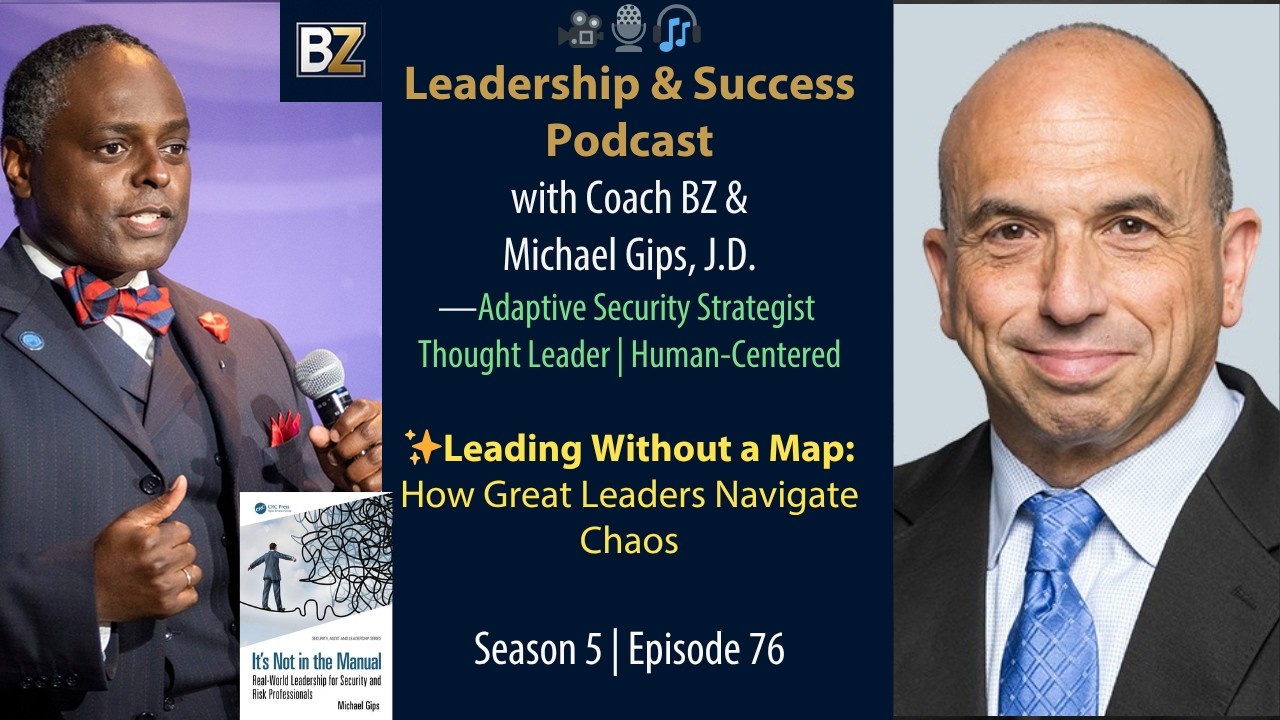
Michael Gibbs, a security and risk expert, talks with Coach BZ about leadership pitfalls like ego and isolation, and how vulnerability and storytelling help leaders connect. He argues that volunteering in professional groups builds credibility and networks faster than most paths, and that leaders need trusted outsiders to tell them the truth.
Chapters
Hi, I'm John Maxwell. When the top companies in the world are looking for trainers, speakers, and coaches, there's one name that stands above the rest, and that's Maxwell Leadership. Our certified team members have gotten proven results for companies all over the globe, and our reputation, I'm proud to say, is second to none. Some of our members have risen to the top of their profession including the one you're going to meet today. I proudly introduce you to my friend, Bob Fabien Zinga.
Welcome to the Leadership and Success Podcast with your host, Coach BZ, where we help you lead with purpose and succeed with impact. If you're ready to grow into the kind of leader others want to follow, this podcast is for you. If you're determined to elevate your success and leave a lasting legacy, this podcast is for you. As my mentor, Dr. John C. Maxwell, reminds us, everything rises and falls on leadership. Our goal is simple: to inspire you, challenge you, and equip you with insights that can transform the trajectory of your leadership journey.
Welcome aboard to another episode of the Leadership and Success Podcast with Coach BZ. Hi everyone, Mark Fulmer here from Traktik doing our InnoSmart Street Influencer videos, this time joined by Michael Gipps, ASIS International's Chief Global Knowledge Officer.
Michael, Mark, great to see you.
Thank you for having me. Thank you for joining us. Maybe a quick intro, tell us a little bit about what you do. Yes, I'm Chief Global Knowledge Officer at ASIS, which means I am responsible for all content, everything from the magazine to digital content to helping create learning materials, certification review. I'm on the Foundation Research Committee, so driving thought leadership there for ASIS. Good, so you're not very No, no, no, especially not here at GFI. Yeah, yeah, I can imagine, I can imagine. So you were part of our very first influencer interview.
You and Peter O'Neill agreed to do a little series.
Things have changed, we've gone to video.
You've done the video one in Rotterdam, and speaking of change, talk to me a little bit about how you've seen kind of the evolution of knowledge in the industry and how it's been shared.
Evolution of knowledge in the industry, well, I started as a magazine editor for Security Management where information was consumed in discrete, in compendious magazines.
Format.
Now everything is splintered up, itemized, created for sort of individual use. It's all gone digital. We're moving away— we still have print, we're still moving away from that, and everything is maximized and used in multiple formats. So we used to have one article, 5,000-word article before. Now it's tweets, it's lists, it's short and snappy, it's webinars, it's podcasts, things like that. So multiple formats for ease of use. So how How many years have you been with ASIS International? Almost 25 years.
So 25 years, that's more than a handful of GSXs.
That's more than a handful of GSXs.
Now called GSX.
That's 25 GSXs. So look back 10 years, look back 5 years, what's the evolution been? Whether it's a trade show floor change, whether it's kind of seminar content change, what's the evolution been? The change I see is everything has gone cyber. Everything is on IP networks, all digital. When I first started coming to GSX, Physical security systems were on their own networks. IT people didn't want the physical security responsibility. They didn't want them on their network. They didn't want them hogging bandwidth. Now bandwidth isn't a problem. Now they want the control over the systems and want everything unified, integrated.
All right. This was just a little taste of what we are going to be talking about. That was my guest, Michael Gibbs, and we are so honored and privileged to have him waiting for us in the green room. But before I bring him on, as is our custom here, we want to celebrate our moment of gratitude. That's where we take just a moment every single time we meet just to be grateful. And I feel like that is so important for our mental health. And as you know, part of the reason why we do this is because in the military, service members and veterans, it's about 21, 22 service members and veterans who commit suicide every single day. Day. And I think it's not possible to be suicidal and grateful at the same time. So if you would maybe close your eyes and put yourself in your happy place and take a deep breath, slow down your nervous system and think about one thing you are grateful for today. And I think today I am again grateful for the dream of America. America is really quite a concept, right? We say the American dream. It's really the only country in the world with a dream, right? I was born in the Congo, Africa. There is no Congolese dream. There is no African dream. I am French by culture. There is no European or French dream, but there is an American dream. America is not a perfect country. Actually, right now I feel like we are going into the wrong direction as a country, but that is okay because America was founded on an idea: all men are created equal. No other country ever said that. Now we haven't always lived it. No, as proof, we had a subclass of, no, second-class citizen, even treated as subhuman with slavery in this country. But the foundation was all men are created equal, right? And in time, I think America will eventually live up to our core values and really be that light that shines in the universe, being on that city upon the hill that Ronald Reagan was talking about, the leader of the free world. And I think that's really what we represent, right? The arm of the brave and the land of the free, right? And that's what I am grateful for. And that's the America I want my children to inherit. So anyway, I am grateful for America today. So if you would let me know what you guys are grateful for. Also let me know where you are joining us from, what city, what state, and if outside of the US, which country, what you're grateful for. And of course, if you have a question for my guest, please type it in the comments on YouTube or LinkedIn, and we will be answering live. So let me see if I can properly introduce my guest today. So today I'm going to be speaking to the one and only Michael Gibbs. JD is a globally recognized security and risk leader. Managing Director of ESRM at Kroll and attorney, author, and one of the most influential thought leadership leaders shaping modern security and leadership today. With over 30 years of experience across law, corporate security, and global risk strategy, Michael has helped define enterprise security risk management and advised Fortune 1000 companies, critical infrastructure, and executive leaders worldwide. He's also the bestselling author of a powerful new book, It's Not in the Manual: Real World Leadership for Security and Risk Professionals. I believe everybody needs to get a copy of his book for sure. Uh, Michael's leadership philosophy challenges conventional thinking, reminding us that when the playbook runs out, judgment, character, and adaptability takes over. So without any further ado, please help me welcome to the Leadership and Success Podcast, the one and only Michael Gibbs. All right, good afternoon, Michael. How are you doing today?
I'm great, and I'm glad you, you urged me to take a deep breath and, and close my eyes, and because I was so amped up by the, by the production values and, and everything going on there. It's like, this is really exciting. So you've done quite— you have, you have quite a a show here, and I'm proud to be part of it. I'm very excited.
Thank you. Thanks so much, Michael. The honor is really ours. And what is one thing you are grateful for today?
I am grateful for my wife and kids. I have— I've been married for 30 years. I have two lovely daughters, 25 and 21, and they're making their way in the world, and I'm very proud of them. And I'm also thankful for my health, you know, really, as I, you know, as you get older and you start confronting your own mortality, it's like you want to see that you've done good things and you want to be able to continue to do things. And you can't do that without your health. So I prioritize that. I'm very grateful.
That is really, really remarkable. You said 25 and 21. I have two daughters too. One is going to be 24 this year. And our youngest one, 18, so she's going to be out of the home very soon. It's just incredible. It's like they were born yesterday and already they are young women. My first one got her degree last year. It's just incredible. Uh, time goes so fast, doesn't it?
It does. I went to a comedy show last night, Nate Bargatze, who's a very, you know, he's selling out.
I love him. Yeah, I think he's from Tennessee, right?
Yeah, yes, exactly. So he was talking about the first part of life It's like being in an elevator. I mean, a roller coaster where you're going up the thing and it goes tick, tick, tick, tick, tick. And then when you're in the back half, you know, you're flying down. It's like, no, no, no, stop, stop, stop.
It's going too fast. Yes. Yes. No, even I remember when I, when I was a teenager, I don't know, 12, 13, 14 years old, I wanted to be older. I wanted to become a young man and have my own car, my own house, my own everything. And now the older I get, I'm like, hmm, maybe I want to be younger. Hair is turning gray and it's like, wow, life is really passing you by, which again reminds me, you kind of have to seize the day, enjoy the moment. And you mentioned something about health too. Something I definitely learned in the military, nothing is more important in life than health because if you don't have health, you have absolutely nothing. And yeah, it is really a blessing to be alive today and relatively healthy. That is wonderful. Is there something about you, Mike, that most people may not know when they first meet you?
Yes, it's, it's not necessarily about me. It's about my parents and people I've known for years and years. My mother just passed away.
Oh, sorry to hear that.
And so thank you. My father passed away about 6 years ago. But they were a team where my father designed movie posters. So especially during the '70s, '80s, and '90s. So he, he designed posters for Superman.
Wow.
For Alien, for The Verdict, for Kramer vs. Kramer. And my mother—
out of you. Wow.
My mother wrote the copy lines for the posters. So for Alien, she wrote, "In space, no one could hear you scream." You know, that's one of the most popular. So people said to me, "How— why didn't you tell me that?" I'm like, "What am I supposed to do, say, oh, by the way, my mother wrote that and my father designed the poster?" So that's incredible.
Superman was my hero when I was a teenager. Superman and Spider-Man. Wow, that's incredible. That's a big deal. And today with technology, now AI can just do it for us in like 5 minutes straight. It's incredible the world we live in, isn't it?
It's, you know, AI giveth and taketh away. I mean, yeah, what it can do, but what the great things could do and the confounding and the frustrating things it can do, you know. Are in equal poise right now. Hopefully, you know, actually we're still on the positive side of the ledger and we're trying to keep it that way, right?
True. I think we're gonna be talking a little bit more about AI later on today, but it reminds me like when my grandparents were alive, they didn't even have to have any education beyond high school. And my parents probably nothing more than a bachelor. And usually after that, they didn't have to open another book, right? They are set for life. They work for one company 20, 30 years, they get their golden watch and they retire. But today we really have to be student for life, don't we?
Absolutely. And, and that's one of my credos. But it's— but ironically, it's hard to read a book these days because we're bombarded by information. Our attention spans are getting shorter. I think AI is making us a little dumber in ways because we're getting a little lazier. It's compressing information, it's simplifying things. And, you know, I'm as bad as anybody else with streams of, you know, quick, quick, um, shorts on LinkedIn, on Facebook, and getting the news and getting stuff, you know, pre-packaged. And it's like, if it's longer than a minute, it's like, you know, too long didn't read, right? Yes. But books, we have to read books, you know. We have to sit back and take some time to think, right?
Yes.
Our brain needs time to process information. We just can't, you know, be bombarded and make good— you know, we can't have good judgment, you know, with making snap decisions. We have to kind of take a breath, take a few minutes, let thoughts process, let us marinate in these ideas and let it— um, that's what we're missing. And I'm, I'm telling you, in my leadership journey, a lot of things I write about in my book, I am working on them. I'm not perfect. I'm far from perfect. I'm working on all these things myself. And that's, I think, the best we can do. Acknowledge where we're lacking and try to improve and, you know, and try to make life better for everybody.
That is really powerful. I know my primary mentor, Dr. Maxwell, he talks about the rule of five. I feel like it's more important now than it has ever been. He says every day he reads, he writes, he files what he's learning, he thinks, and he asks questions. Every single day he does those five things. And I try to do that too. That's why I have a daily leadership devotional now on LinkedIn. But if we can just continue to use our brain again, read, think, file, ask question, and think every single day, I think AI is not going to be able to, you know, I guess be a negative in our life, but maybe help us be a little bit more efficient. I don't know. But let's talk about your journey, Mike, because it's quite fascinating. It's definitely not a traditional route how you got into security because you started in law. You are a lawyer, you have a JD. And by the way, is there a reason why lawyers are not called doctor? Everybody else is medical doctor, PhDs, EDDs, everybody calls themselves doctor, but lawyers don't. Is there a reason for that?
Well, some people call me doctor and I say, no, no, no, I have a Juris Doctorate, but I think it's just, you know, it's just how it evolved, you know, because—
because that's, that's a terminal degree, right? I mean, it's a doctorate.
Yes. It's a, well, it's not, it's a jurist doctorate, but there's also higher level degrees. It's, it's kind of, it's weird because I wouldn't say doc, call anyone doctor unless they went through medical school or got a PhD. And that's so 4 years of medical school or, or 7, whatever.
No, but today everybody, when they have a divinity doctorate, they call themselves doctor if they have a DBA. They call themselves doctor. They have an EdD, they call themselves doctor. Everybody calls themselves doctor except for JDs. I'm like, wow. I mean, I'm just curious why not.
You know, it's a great question. Maybe it's seen more of like as a, as a technical, you know, it's a technical or, you know, a trade, you know.
Because I believe even our former first lady, right, she called herself Dr. Biden. She doesn't have a medical degree or a PhD, but that's what she— That's true.
That's a great point. I'm not sure.
Anyway, I mean, I respect that because I grew up in the academia world. I almost earned a PhD, so I know what it takes to get a doctorate. But anyway, just one bit. Anyway, your background definitely not very traditional. So you started in law. So what drew you into the world of security and risk leadership?
Well, when I first got out of law school, I worked for the New Jersey Supreme Court as a death penalty clerk.
Wow.
And so any case—
that's pretty serious.
It is very serious, and it was very trying, and it was, you know, it was time-consuming, and it was hard work, right? And it was— the level of responsibility was, yes, pretty crushing because somebody's life or death is on the line. Now, yes, all these people were guilty, you know, there was no— there's no doubt about that. Um, but it's— it was whether they deserved the death penalty or not. And in these cases, um, people who do the most horrible things, you know, to other people, and usually it was a man to a woman, right? It was a husband to a wife or to a child or, you know, or something like that. And I got interested in those issues, but it was very taxing. I was spending a lot of time— yes, and especially seeing the pictures, it was like depressing, you know, seeing, you know, a woman like hacked to pieces and stuffed in a suitcase or something like that. Or—
wow.
Yeah. Um, and I liked the work because it was fascinating, man. And so I did that and I was like, okay, I need a break from this. And I went worked for a law firm and I started doing a little bit lighter stuff like workplace violence.
But I really can't imagine that. I really believe in the best of humanity, but we can be so cruel and evil. Like, well, as a lawyer, where do you think that tendency comes from for a human being who can be just like an angel to really turn into a devil like that? Where does that come from?
If I could tell you that, I would have solved, you know, the deepest mysteries of psychology.
Wow.
It's just a lot of it is, is how people were raised in abusive— a lot, a lot of these, um, convicted killers were raised in abusive environments without, without, uh, either mother or father, or they were beaten or had some sort of traumatic episode. In other cases you know, they, um, didn't value life, or it was transactional, you know. They were dealing drugs or whatever, and they did whatever they had to do to survive. And killing somebody was just part of the, you know, that was part of how you got by, right? Or you showed that you were tough.
Yeah.
And I think some people are just naturally bad people, frankly, you know.
Yeah. Because I had, I had a guest here a couple of days ago who talked about, right, the dark triad, basically psychopathy and narcissism and also Machiavellianism. And that's something we all need to be watching for. Nobody is really safe from that. But hopefully this show is helping us be better human beings, better leaders, and achieve higher level of success. But sorry, so you went from that to a regular law firm.
And I was most interested in, so those kind of workplace policy violations, bullying in the workplace, um, uh, use of alcohol and drugs on the premises, things like that, uh, workplace violence, uh, theft, uh, and, and intellectual property issues like theft of, of, um, information, copyright issues, and I was doing a lot of that kind of work, but I wanted to be the client. I, I wanted to kind of get into it earlier before it turned into like, we're sweep— we're cleaning things up as, as lawyers, right? It's already gone to pot, right? There's our— it's already gotten to the point where someone's being sued or legal authorities are coming in to clean something up, right?
Yes.
With security And I didn't get into security immediately. I got into writing about these issues. So I, I became a journalist writing for a newspaper on these sorts of issues. And because I, I liked writing and I thought I could do it well, and I got more and more interested in these issues until, um, I got a job as a magazine editor at ASIS, their security management magazine, where I could write about it full-time. And I still didn't feel my first few years, I didn't consider myself a security practitioner. I was a student, as I still am, but I would learn about everything having to do with security from some of the best people around.
Yes.
And this is in the days when cybersecurity barely existed.
Mm-hmm.
PGP, uh, Pretty Good Privacy, had just come out. Steve Bellivan had just written, um, the book, you know, Repelling the Wily Hacker, book on firewalls. Um, I think Marcus Ranum had just invented the firewall, and, you know, the— it was like the days of like the Cuckoo's Egg and things like that, you know, the really early time. So it was still physical, but it was becoming— you could tell that cyber was going to take it over, or it was really coming on fast.
Yes.
And so I was learning all about that from the experts. I mean, I talked to all these people I just mentioned. I talked to all these people. And they explained to me how the internet worked and how, you know, how, you know, websites could be attacked and what a buffer overflow was and what packet sniffing was. Like, before anyone, you know, packet sniffing, I thought like that's what you did like in a diner when you want to see something with sugar or salt, you know. It's like, you know, um, and so I was really fascinated by the issues because learning about, wow, not only just cyber access control systems and video surveillance and the different kinds of cameras and features and, yeah, the chips that went into them and the networking and the compression, as well as sort of the guards, gates, and guns part of it. And over time, I thought, you know, I could— I want to get a little more involved in the substance. And I became, um, I got promoted to a role that Uh, it was the head of the CSO Roundtable. CSO Roundtable was a group for the heads of security and the deputies of the world's largest organizations.
Wow.
Um, critical infrastructures, key government agencies. And in that, so I developed that group, um, and I created, um, content for them, programming, governance. And doing that, I sort of had to become— they were using me as sort of a consultant, like, okay, do some benchmarking for us, or yes, write some policies. So I started learning how to become a practitioner.
Wow.
So over the time, you know, it was basically say, hey, here's, you know, I like to learn, I like to pick things up, I'm very curious. So it's like, okay. And then I started to go, you know, would go to somebody's corporate headquarters, they'd invite me over. I'm like, hey, you know, like, take a look through and kind of do casual— it's like, have you considered this here? And I'm basically a free consultant.
Yes.
And, um, I wasn't considering myself at that time, but I really started developing that expertise. So I— at this point now, I have the knowledge because I've written about it for years and years. And as, you know, the technology, the trends developed I was right on top of it. I knew the people because I was calling them and saying, you know, hey, can you help me? And then I, you know, turned it back around and I could start helping them. Um, so I had the, the knowledge, um, and the network, and it was just, you know, and I was doing the— I was starting to practice, and so I After I was head of the CSO Center, we got a new— ASS got a new CEO, and he said, hey, you should not only do this, but you're one of the few people here who knows all the content. Yeah, I'm putting you in charge of the magazine, uh, CSO standards and guidelines, certification, basically all knowledge. So it's Chief Global Knowledge Officer.
And yeah, that's a video I just showed.
Yeah, yeah, yeah, that was pretty. And by the way, that video I wasn't sitting down. That, that's Mark Fulmer, who's a good friend of mine.
He's pretty tall.
He's 6 foot 8, 6 foot 9. So I was not— someone asked me if I was sitting down.
I hope he played basketball or something, but I believe he did.
And his kids are tall too, and I think basketball. And yeah, he's, he's a good guy, and, um, he's actually influenced me because He was the type of person who— he wasn't a practitioner either, but he was a thought leader. And early in my career, people pigeonholed me or pegged me as like, oh, you're just a thought— you know, you're just a writer, you're just an academic type person, you're not a practitioner, and so you can only have limited influence. And I, I looked at him, at Mark, and I looked at people like Martin Gill. I don't know if you know Martin Gill. He's a world-renowned criminologist and security expert.
Yeah.
And I talked to them both and they said, you know, believe in yourself. Yeah, you know, you could do this. Um, you're as credible as anyone out there. And that helped me, you know. So I was at ASIS for a few more years in those roles, and then I—
really powerful.
Yeah. Then I went out and on my own, I was like, let's see if I can do this on my own. Wow. And doing the same things, but also you know, doing, you know, site surveys and, you know, executive risk assessments.
And that's impressive.
Security program governance, right? Mostly physical, but also cyber. I don't have a technical background for cyber. But I understand the principles and, and how to manage and lead.
So yeah, like, like they say, the rest is history. But tell me, why should a Chief Information Security Officer, why should they mature information security program also be mindful of physical security? Why? Why is that important?
You think the two are inextricably intertwined?
Yes.
Everything, everything cyber, I mean, has a physical component, you know, the physical infrastructure. It's not just— it's just not in the ether, right?
Yes.
There's, there's servers, there's cables, there's, you know, there's routers. There's— yes, you know, so, and all those things can be physically hacked into or physically damaged. Also, cyber manages physical systems. So you can have a SCADA system or whatever that controls flow of water or oil and pipelines. Yeah, that goes beyond merely virtual, you know, um, yes, consequences. That, that means like a, a, um, an oil leak or a flood or some kind of, uh, cascading disaster that takes down the power outage. Exactly. So, and same thing with physical.
Yes, physical.
Everything rides on a, on a cyber, you know, um, uh, platform. So You can't be ignorant of the other. You at least have to know how to play nice, right? You can specialize in one or the other and you probably should, but you should know how they interact, they work together and the consequences and have a good relationship.
So true.
If you're a CISO with the CSO or the director of security and vice versa, and even at the, the middle level where you're a security manager or, you know, a physical security manager, an IT security manager, You're going to get things like, um, cyber— you know, you have some cyber activity where somebody, you know, um, uh, like hacked into something, or there's an improper— there's like improper permission and had access. And then you see the same person physically, you know, used an access control credential to go into a door, and it may not— you know, if you don't put those two together, you don't understand the full picture. And really, security is security. So you should at least have a working knowledge. Um, you should know the other, the other folks and have a really good relationship, not an antagonistic one, not, oh, we're gonna— we want— we're gonna get more of a budget than you are, or we're more important than you are, or your skill set is worse, you know, it's not as important as mine, because you see a lot of that. So that's, that's critical. And And there are other aspects that go into that, too, not just physical and cyber, but, you know, human and business continuity. And those things are all, you know, all going to one.
Absolutely. And as a chief information security officer, I can tell you, if a hacker can get physical access to your system, wherever they are, it's pretty much game over. It doesn't matter what security controls you have on the application layer, if they get access to physical layer, it's done. And that's why even on military bases we may have top secret skiffs and things, but we have people with guns and everything, because if people can get physical access, like I say, it's usually game over. So something interesting about your background though, looking back over the 30 years, what kind of defined What were some of the defining moments that shaped your leadership philosophy the most?
I would say that it was the lack of good examples in a lot of cases. I'm not going to, you know, and there were plenty of good leaders I worked for. So I'm not trying to tear anyone down. But I think it was— I remember certain occasions that stand out as like, I wouldn't do it like this. This is discouraging, dispiriting, deflating.
Without sharing any names or specifics about the organization, just at the high level, what kind of things happen? Because I think for most of us, we either see a really good example, we want to be like them, or a really, really bad example, and no matter what, this is what I am not going to be. I think that's a great way of learning too.
Okay, I remember being a part of a group, and there was a— and a lot of leadership was situational, so the person at the head of the group was a leader, and they were put at the head of the group because they had, they had actual authority, you know, they had the title. And we were broken into a group of maybe 6 or 8 people for some task force, and this person literally talked to two people that they knew and said, 'What should we— what should we—' They actually turned their back to me and other people, and I felt, wow, terrible, like ignored, disrespected. Yeah. And I had a lot to say, and, you know, and she was like, 'Okay, with these other two people, this is what we're going to say, right? This is how we're doing it.' And we're looking at the other people, it's like, 'Has she even turned and looked at us?' Yeah. And I started getting angry. And, you know, I was thinking, you know, this is terrible leadership. Yes, yes. You're not taking advantage of the wisdom of the crowd. You're not asking what we think. It's— you're relying on people that you know, and you're— this is— you're falling to the trap of, um, of a, um, cognitive bias where you're reinforcing— you're going back to the people you already know the ideas.
I, I, um, that's a huge blind spot too.
I spoke up and I was like, hey, what about us over here? Yes. Kind of shocked. They're like, what? It's like, you're— you didn't even look at us. We have some ideas. And the person's like, oh, you know. And then they kind of humored me, and I was like, thinking, not inclusive, not curious. Yes. Um, uh, disrespectful. And, um, and, and short with us, right? Just wanted to kind of get us out of the way. I was like, that's what I don't want to be. Yeah, you know, you listen to voices that know more than you, and everybody knows more than you in a way, right? Yes, everyone has different experiences. And I even write that in my book. It's the first line in my book. There's no, um, it's something like, you know, Socrates and Plato and Aristotle talked about All I know is I know nothing. Yes. And all I know is that there's not a person out there that I can't learn something, who knows far more than I do about something, has more experience, has more wisdom. Yes. I don't care who it is, you know. I mean, okay, if it's a baby who can't speak, that's one thing, you know. Yes. But, but pretty much everybody, there's some experience they've had, there's some insight they have, there's something that can— that, that they do better than I do. And usually a lot of things. So powerful.
Yeah. Wow.
Have to tap into that or give it, you know, if you want to improve and you want to prove yourself, your organization, you want to raise all boats, listen to the wisdom of others.
That's really, really powerful, because it teaches you to lead with humility. And knowing that you don't know everything, and sometimes they may not know more than you, but they may just have have a slightly different perspective, right? And that allows you to cover your blind spot, because we all have blind spots. That's why you need diverse team. And, uh, that's, that's really, really powerful. So you've worked across the law, journalism, global security. How did, uh, all of those diverse experiences kind of shape how you lead today?
They made me realize that there people look at things from different ways. Um, there's not just, hey, you go in as a risk person, a security risk person, you're, you're looking at something this way. You look— you're a journalist, you look at it a different way. You're a lawyer, you're taught in law school how to think differently. I mean, your brain changes, you know, the neurons in your, your brains, you know, they, they change. That I appreciate it, looking at things from different angles and being able to question. So it's like, as a journalist, I would look at it this way, but as a lawyer, I look at it this way, as a— yes, security. And these all help create a more fulsome picture, right? And so I look at other people's backgrounds. Oh, they're an engineer, they look at something completely different. I'm going to defer to them and listen closely. I am not an engineer, right? As a matter of fact, I Engineers are some of the most underrated, smartest people. Like, how the heck did you build something like that? I couldn't build, you know, if I were left alone on the Earth, I couldn't even build a pencil, you know. Oh yeah, making sophisticated, you know, people building computers, you know, building, you know, creating AI or whatever. So it helps me, it helped me broaden my perspective. And, you know, it makes me, you know, some people are like, oh, you know a lot about different things, like, yes, but there are vastly more things that I don't know. Um, and like, I seek out expertise from people who— it makes me just open to other perspectives and to, you know, to give voice, let other people voice those perspectives. So in terms of leadership, wow, it's, it's almost, you know, the more perspectives you get, the more you realize you don't have. So that is really insightful.
Wow. Thank you. Thank you for sharing that. I think it takes humility and curiosity as well. Let's talk about your leadership philosophy because I've seen some of your writing, you do challenge the idea that leadership is about titles or frameworks. And the previous example you mentioned about that leader who was in charge just because of their title is one good example. But What actually defines a great leader in your view? If it's not a title or a framework, what is it?
Well, there are attributes that I write about in my book, but it's like anything where you don't have to hold these attributes to be a good leader. It has to fit your personality and your style. So some people who are very shy or mousy or diffident or whatever, or they don't like to raise their hand, they still can be leaders, you know, in areas that excite them. But leaders in their way. They may not be rah-rah leaders like, let's go, you know, everyone get behind me and let's take, you know, let's take the hill. Yes, they can be leaders in quieter ways that are true to themselves. So I think that's impactful. Yeah, and it's still impactful, sometimes more impactful, because that person never says anything. All of a sudden they piped up and it's like, oh, Wow. Yes. You know, I mean, the ethics are, you know, obviously you have to be— I mean, there are good leaders who are probably not ethical, but not a, you know, a good leader, like an effective leader. I wouldn't want to emulate those people. So I'm talking about a normatively good leader, like a good person, right? As opposed to an effective leader. So ethics is foundational to me. The, um, listening and curiosity are the next two. Like, yeah, I don't see how you can be a good leader without wanting to know more and listening to what other people say and just, um, always trying to expand your, your knowledge base, especially now where things move so fast and everything is in, you know, everything is in, um, you know, we're in polycrisis, everything is influx, changing, uncertain, volatile, you know. Yes, the whole VUCA world. So those are the three key to me. I mean, there's others as well, but, you know, those are foundational.
I like that you, you mentioned ethics. Now, realizing that you are also a journalist and a lawyer, how do you define ethics and, uh, more morality? Because I think those things are really key for leaders that people would like to follow.
I follow the very simple, um, I didn't say it, it's a well-known phrase that ethics is what you do when no one's watching. Yes, right. So here's a good example.
I would like to think of my, of my grandmother watching me do something that nobody else is. Would I still do But yes, exactly.
So I was at a conference in Las Vegas and I had mistakenly— I was at a dinner that a vendor was holding and it was a great dinner and they were giving gifts and you could order any certain number, you know, there was 3 things they were giving away and they were pretty nice. And I have a doorbell, a video doorbell that's broken right now and in front of my plate seat at dinner was a Ring brand new Ring doorbell in the box. And anyone, you know, you could just sort of pocket it in, right? It was for me. And I had a person sitting next to me who is, um, who works with me. We were at the same conference, and she's, um, at a lower level. She doesn't report to me, but, you know, I am, you know, a, you know, I guess a superior to her. Yeah. But, you know, we— I mean, we interact, you know, as, you know, colleagues, right? So she didn't have one in front of hers because she had seen that, checked the box and said, I don't want a gift, or whatever. So I looked, I was like, oh, they gave this to me anyway. And she said to me— and she's very kind— she's like, well, I'm not looking like if you want it. And I mean, I could have taken the thing without her seeing it. There were others on the table because each one had, you know, there were a bunch of them on the table. And I was like, and so, you know, she may have noticed or whatever if I'd taken it or may not have, but I was like, no, no, no. And my wife would be like, we need a new doorbell. I think of her saying that, it's like, no, no, no, no, no, no, no, but I'm not taking that doorbell.
It's a little bit slow. So, wow, that—
there, there's, there's an answer, like from just a few days ago. I did not take that doorbell.
Doing the right thing even when you think nobody's watching. But the truth is, people are always watching, André. You just have to ask the Epstein billionaire class. If what they were doing was in the dark, nobody would even know. But eventually, what's done in the dark comes to light, doesn't it?
How horrible is that? That's— yeah, I can't imagine much worse than that whole chicanery, you know, that's just— yeah, it's really crazy.
But very people know, heroes of mine, I put them on a pedestal, like Bill Gates, huge, huge respect for him, what he's done and accomplished. But right now I think he's a little bit lower on my list of people I would like to emulate for sure. But yeah, it is really crazy. I know my primary mentor, Dr. Maxwell, talks a lot about that. He says there is no business ethics, there is just ethics, and you can apply it in business in leadership or in whatever field. But no, like when we first started, what we, we talked about being fair, being a person of integrity and treating everybody exactly the same. And I think it, it really makes a difference long term, doesn't it?
Absolutely. It comes back to you, you know, and it doesn't even have to— I mean, I don't think like it needs to come back to you, but because you're just doing the right thing. And people see how you behave and they, they'll trust you. They'll, they'll know that you don't change, you know, for, you know, you know, for anybody else. You don't have different, you know, standards of behavior or ethics. I mean, you have different standards for performance, of course. Yes. But you should— I always go in there and say my default um, mode is respect for a person. I don't care what they look like. Some of the people who like, who like look like they're disheveled or homeless or, you know, festooned with tattoos or whatever, it's like, yes, and then there's a nicest person, you know, it's like a great— I'm glad I met, you know, I didn't— I'm glad I set aside my prejudices, or yes, just, you know, I didn't like look aside or whatever. And then you see somebody who's like dressed in a suit and, you know, and they're a despicable person or whatever. I mean, I would show them respect too until they prove otherwise, right? Yes. Always respect someone until they actively show you that they do not deserve your respect.
I love that. I love that. We do need to get into your book, but I want to ask you one more question. I think this is important because you do talk about whole of person leadership. What is that in practice?
What does that mean? That means that you don't just— and I use the same example of my father who I told you about. It means that you don't have leadership aspects that you have, okay, this is at work, and then here's my community, and here's at home. A lot of people do that, but you can leverage those, the same ones that work, like, you know, for You know, for your, you know, taking, you know, raising your child or something in an ethical manner. Works at work, you know, modeling ethics. Um, so I used to talk about my father who did kind of cordon off his life. So at home, I grew up in the '70s, right? And he went into work and my mother was around the house. There was a lot of kids and we like tore up the house, you know, like running around and things like My mother was in charge of all the household decisions. My father didn't care, you know, it was like, do whatever. And if there was an argument, it's like, just listen to your mother. So I thought my father was like, uh, maybe he's a milquetoast, right? I mean, he wasn't like at home, like he could get angry and, you know, so you didn't mess with him, you know, because he— but I was like, oh, he's not real leader. I went into his office one day and my Lord, it turned around like that. He's— everybody was like like on, you know, seeking his opinion. They were like, oh, is this good? And he's like, people lining up and like, certain, you know, blah blah blah. I'm like, whoa, where did this guy come from? Yeah, he's completely different at home.
So I'm thinking, you know, that's why I don't have to—
yeah, cordon off our, our leadership traits or personality traits. We can pull from different areas, like all person leadership. I love I learned a lot of my leadership skills by being the captain of a recreational hockey team. And one of my worst moments was as a captain of a recreational hockey team. I was angry because I'd done this for years and they— I was— the rest of the team was getting better and we were moving up and I wasn't. I was getting older and I And I felt like the only reason I was still on the team was because I was the captain. And no one said anything to me, like, but I was becoming less effective, and I felt like I was losing my grip. And I, after the game one day, I took off my helmet and I smashed it into the— like, and everyone was like— because I'm very even-keeled— and I started throwing things. Or like, people were like, oh my God, what's going on with him? And I realized that it was time for me to turn over leadership to somebody else, right? There was someone who I kind of groomed— like, I was like, you're, you're the assistant, right? And he had slowly taken over some of his assignments. I'm like, it's now time for you. I'm gonna step back, and then eventually I'll, I'll move on to another team, but I'll be under you, and I'll show you transition. And I was like, I had a breakdown because I realized that it was like I was losing, you I mean, people still listen to me, but I wasn't appropriate for the team anymore. Wow.
That takes a lot of emotional intelligence and awareness to do that. Well, after I got fit. Yeah. Wow. Okay. Tom, I could talk to you for hours and hours. We do need to talk about your book. Let's talk about this. It's Not in the Manual: Real World Leadership for Security and Risk Professionals. Why did this book have to be written? Why did you have to write it? Because again, this is by CRC Press, by, by the way. Yeah, thank you.
Because there are really not many leadership books for security and risk professionals. There are some for cyber. Yes. And CRC Press does some, and they're good. You know, I've read some of them, but they tend to be a little on the technical side. And they get into a lot of models. And, you know, and I'm not a model person. I'm like, let's live your life and do things type of person. Like, frameworks, I mean, they're good, but they're also— they give you a format, but they're also very constricting, right? And life doesn't work that way, right? Life is kind of, you know, uh, not as smooth It's, it doesn't fall into these, you know, things don't fall into these categories. The guidelines are good. The general principles are, but once you start saying this, this, that, blah, blah, blah, here's a maturity thing. I mean, that's good. It's good as a, you know, general guide, but that's about it. Limited in actual use. And I thought, let me write something that gets to the issues of what actual security and risk professionals deal with. Using abundant stories about people who've been there, not just mine. Yes. Um, but other people who have lived through things, experienced things, done things in real trying leadership situations. And this is where having known everybody in the industry came, you know, basically came home to roost, or, you know, helped me out because I was like, oh, powerful. Yeah, yeah. Like, I've worked with people around the world. It's You did this. You're amazing at this. Can I use your story? And, and for some people, I let them— there was people whose stories were so powerful. I said, I'm not going to write this, you're going to write it. And I'll make slight edits, but it's going to go in just as you did, because I don't want to— I don't want to taint it.
That's really powerful. And also like the picture you have, right? Because sometimes when you're a kid, you feel like your life will be like a straight line from A to B. But that's that hardly never happens, right? Everybody goes through turns and curves, and eventually they end up where they need to, but it's definitely not a straight line. So I really love, uh, that, uh, picture on the book. Yeah, me too.
I think it— that's what you get into, right? You think it's a straight line. Okay, there's a dip here and a step up there. Like, oh my gosh, that looks like every cord in my house, by the way.
Yeah, it's very rare to see people people who go up and actually do the work they thought they were going to do when, when they were children. It does happen at times, but very, very rare. So it's right in the title. It is not in the manual. What happens when the playbook runs out?
You have to fall back. Well, we all live in a time of uncertainty, right? Risk, risk keeps changing. Situations evolve. You have to fall back on your basic principles, which is, you know, the things I mentioned before, like your ethical grounding, um, your sense of mission and purpose are clear, and sort of what are the underlying— what's the underlying thing you're trying to do here. You have to— yes, protect your team, protect the mission, and be true to your principles, right? So a lot of times, like, there's not a great answer. It's Should we go forth and do this? Should we send this executive overseas? Should we build up, you know, security a little more? Should we tighten security protocols? Or should we make this investment? It's like you got to fall back on your principles. What's best for protecting my people, for the mission of the organization? And you're, you're continuously processing information all this time because it's changing, but you also have to make decisions, right? So you go with the decisions you have. You've always got to be future looking into the future, and you should be talking to people who have been through this before. I constantly, um, call up people and say, well, what do you think about this? What would you do? People who I trust. That's the importance of having a network work. And a lot of times they don't really know either, but talking with them and others gives you a direction, right? And it gives you a defensible direction. Yes, it's right for your people, it's right for your mission, it's right for your organization. And, um, that, that kind of networking, that kind of falling back on people you trust— and there's, you know, there's a core group of people, but enough with different specialties, um, different experiences, different industries, um, that, you know, I feel like my network is broad enough and deep enough that there's someone, always someone I can ask. And I'm also comfortable reaching out to other people that, through people I know, will make the introduction. I think that's, that's key. Always. Wow. You know, and you got to make a decision, right? You are making a decision. You're not punting that. You're not, you're not putting it on someone else. But bring in the— bring in what you can, focus on those basic principles, and then make your decision and be able to defend that. And then keep moving forward.
And as it changes, adapt. That is really, really insightful. Actually, you reminded me of another podcast I had with one of my mentor, General Milford Beagle. He wrote the book When the Map Runs Out. It's pretty much a semi idea as, as yours, but can you share a real example on where leadership required judgment over policy? Yeah, let's—
I'm just trying to see what it— it's happened a lot, and I'm trying to think of an example. There, let me think of, let me think of something that's powerful. Um, there was a, um, yeah, okay, here's one. Um, I was working— I can't, I can't talk about the, you know, at the high level.
Yeah, not attribution.
Yeah, so there was a situation where there was threats to, uh, there's like what threats of workplace violence by outsiders. Um, and the policy of the company was to not, um, it was basically a media organization and there were some, uh, people from the outside who knew of some of these folks and wanted access to them.. And the policy of the company was, um, don't, you know, don't share that information. We don't want to scare people. Yes. They found out about it anyway, and so that policy didn't work. So now it had to be— they felt like they were out in the cold. Now you have to kind of make amends with these people, regain their trust. Yes. And then say, hey, it wasn't because we didn't trust or didn't want to protect you. It's like we thought this was a tempest in a teapot or whatever, or we didn't want to scare you unnecessarily. But then it scared them more because they thought they were trying to hide it. Yeah. So the, you know, in the adaptive leadership, it's like, okay, now you have to reach out and say— you have to acknowledge your errors, you have to pledge to have more communication and do— actually do it and put those measures into place and do other things to show that you support the, um, and, and, you know, not just put in, um, you know, token measures. Yeah, but believe it and continue. The communication was number one, like resuming it and keeping up a steady stream, being transparent. So that was— that's one good example where their policies defied, you know, they, they, they didn't work in that situation.
Now, in your book, you, you do emphasize that leaders don't solve risk, right? They manage it. How should leaders think differently about risk?
They should, in a way, embrace risk, because without risk, there's no reward, right? I mean, all, all business is about risk. I would even call the CEO the chief risk officer, because that's what they do. They're— yes, man, at the highest level, they're managing risks, they're trying to maximize profits, um, um, enhance the brand, right? Enhance brand value. And so risk is an opportunity. And you know what, and this also, you, you asked me like, oh, how is being a lawyer and a journalist As a lawyer, and this annoyed me to no end, it's like, let's not do it, there's risk, right? Let's lock this down, you know, which it's like, it's safer not to do it. It's like, then how do you expect to be paid? Yes, you're just going to go in the safest areas? Like, yeah, you got to take a risk.
Kind of like security used to be 25 years ago at the Department of No.
Exactly. So you should embrace it and then figure out how to mitigate it or manage it. So that may be mitigating it, it might be transferring it, might be like insurance.
Yeah, like insurance.
Like it might be, you know, enhancing security protocols. But that's your job, right? Your job is to deal with the risk and then make it acceptable. Acceptable. Now, some cases it might not be acceptable. So you don't do it, right? It's just too high, you know, but it's— even when I was a lawyer, I was like, oh, there's risk. Nope. You know? Yes. Yeah. But that's—
that is good to know. So for the people who are reading your book, or who are going to be reading it very shortly, what are 2 to 3 leadership lessons from the book that every security leader must understand today?
That your developing your people is your greatest, is your greatest, um, responsibility. Um, you know, obviously you want to, you know, be successful and, and, um, you know, lock everything down and, you know, no security incidents and, and help, you know, help the business and everything. But really developing leaders who can take over for you. Yes. Augment what you do, especially people who have different opinions, different— you know, a lot of people say, oh, I hire smart— smarter people than I do, I feel. And a lot of people do, but a lot of people, like, they're scared to do that because they don't want to lose their job. Yeah, I wouldn't say hire smarter people. Hire smart people who do things differently than you do, think things differently, and have different skill sets and different expertise than you do.
Yes.
And then be able to leave those people behind as successors, or go off into the world and be there, you know, run a security department or do whatever, somewhere else to uplift the industry. I think that is one of sort of the, the most important things you can do as—
That's really powerful, because that really helps you build a high-performing team. That really makes, makes a difference. Now, another thing I like in your book, you talk about the chiefs Storytelling officer. I really love that. I guess communication is definitely key. Why is storytelling so critical in security leadership? Yeah, it's—
I like that question, because a lot of security people just talk about, you know, deterrence and, you know, alarms and things presented, and especially in cyber, my lord, the technology, like you start saying application layer, an executive or You know, like, I remember like buffer overflows. I was— yes, I think what, a long time ago? Like, you know, intrusion detection system and denial of service and on and on and on. Yeah, exactly. That's like, that's blah blah blah blah blah, you know. That's, that's—
we do have a lot of jargon for sure.
It's too much jargon. So it's storytelling officer. What you want to do is put things you know, make, make your points as, um, uh, as clear, tangible, and, um, sort of resonant as you can by saying— and even by using analogies like, here's what we did, um, here's what we're doing to address this, and here, let me tell you a story about how that work. And like, I'm telling you stories, and I do my book, like, telling people, okay, do 1, 2, 3, it doesn't really help until you see how somebody actually navigated it. Yes. So, and you have to be able to speak to them in what they want to hear. So you should be doing your research. Like, if you're talking to the chief financial officer, they're going to want something in, you know, in their, their own jargon, right? Yes. So put it in numbers. CEO's going to want to know in, in terms of, you know, at, at that executive level. Yeah, operations want to know how you improved operations. You know, Chief Legal Officer, it's like, how did you reduce risk? So yes, you tell, and people remember stories more than they remember, you know, I can— when people, when people after this are going to remember when, oh yeah, he told the story about, um, throwing a hockey helmet or whatever. 'Or he told the story about,' you know, whatever it is. That's what they'll take away, right? It's like, 'I remember he said stuff. I don't remember what at all that was, but I remember the stories,' right?
Yes, that's really powerful. Okay, technically we are out of time. I wanted to talk a little bit more about the book. I don't know if you can give me another 5, 10 minutes max. Okay, I think this is really important because in the book you also talk about leadership landmines, like ego, complacency, isolation, and all of us. How can leaders recognize and avoid these traps early in their leadership journey?
Have trusted people who will tell them the truth. And I— this is stuff I'd like to say, I've overcome this. I haven't. I have as big of an ego as anybody else. Right? Like, if somebody— I might feel offended, like, oh, they said that about me, or just like, all right, back off, you know, back up a second. Do they really mean it that way? Now, sometimes they might have, But most of the time it's like, that's just the way they talked, or they weren't thinking about it that way. You know, don't react immediately, right? And, you know, and check in with, you know, your— it doesn't even have to be someone in your own company, but like a trusted outsider who knows you well and is not afraid to tell you things. Sometimes, even if you say, hey, hey, my deputy, you know, as CISO or whatever, he'll tell me, it's like, Oh no, he won't, or she won't. They're, you know, they don't want to— like, they know what— what— so have somebody to check and always sort of, you know, do a reset every once in a while where you say, all right, am I doing the right things? Am I focused on the right thing? So, um, like, especially with, um, uh, complacency. Yes. Like I, a friend of mine, um, I think it was Jonathan Perillo, who said, um, if you're— everything's going fine and smoothly, then you're being complacent, right? You know, if you're just kicking back and there's like— because sometimes things don't happen, but you should always be a little bit, as a security person, a little bit anxious, right? You know, like a little bit. It's like, all right, what's around the next corner? What's wrong? Not that you can't have a nice vacation once in a while, but you're being paid to always be on top of risk. Yes. And things may be going pretty well, you're not having any incidents, but that's the time you're most vulnerable, right? Because it's like you're getting complacent, and that's when you start, okay, maybe we need to test some things, maybe we need to do some red teaming, you know, or penetration testing or whatever it is. Absolutely. Now the problem is getting the, you know, if you want do it like outside, you know, consultant to come in, then you have to convince, you know, to get the budget, right? If you don't have it, it's like, well, everything's going fine. Why do you need this? You know, that's a difference. So that's when you get to this Chief Storytelling Officer.
Yes, yes. Wow. Yeah, I see how everything really connects together. You mentioned vulnerability. Let's talk about the human side of leadership, because You do address mental health, vulnerability, even wellness. Even at the beginning of the show, you mentioned that these topics are usually avoided in security. So why are these essential to leadership today?
Because people are people. They're, you know, people are human. They have— yes, they're— and especially in the age of AI, you know, having empathy, other human qualities, good judgment is critical. And this really hit home after COVID. Yes, because during COVID where everybody realized, oh my gosh, you know, like, we're just— we're all just a, uh, a virus away from who knows, right? The whole world shut down. It was very weird, right? So we switched to a different operating system where we're— and then people started to come back, and it was like, you know what, this is hard for me to come back now. I'm leaving my elderly father or my kid who was in school, or I'm coming back and I'm not so sure now what's the company all about, what are the policies? And everyone's like, you know what, my own well-being is more important. Like, I wasn't really thinking about it before. Yes. And a lot of people came back and they were having, you know, issues like coming back to the office, or, you know, they still had concerns. And it became more acceptable now. Then it became like, because in the past it's like 'Oh, we're security, we're, you know, we're not, we're not vulnerable, you know, we're the tough guys.' Yeah. If you don't address— and it's because— and it's helpful that COVID sort of changed the rules a little bit of the game. Yeah. Um, and not everyone still accepts that, but that it's more— especially HR more broadly accepts that, um, you, you get the good and the bad with the people, you know, you take them where they are. And you, unless we're going to an all computerized mechanized AI world, which is not, you know, recommended, you know, not because you always need the human, you know, empathy and human judgment. You have to take care of people. And, and, you know, so with COVID and then we're of crisis after crisis after crisis, there's wars going on, you know, now there's, there's all sorts of political battles over whatever you want, like, like gender identity and religion and, you know, um, a million other things. And people— and disinformation. And people are just— don't know what— they don't have a firm ground to stand on if they're, you know, everything's shifting beneath them. And it's like, where am I? You know, it's like— and companies emphasizing mental health or de-stress, they actually do themselves a favor taking care of their people. Because I know there's data on this where, you know, if you take care of your people, they'll take care of you, right? You're seeing— yeah, and they'll be more productive, they'll be happier, and all that.
So that is so true. Because when I became— I had great privilege of becoming a commanding officer in the Navy. I reached out to all of my mentors, and that's one, one advice that kept coming back, right? We say mission first, but people, people always. Take care of your people, they will take care of the mission. That is so true. Now, talking about vulnerability, what about those people who read your book, they're like, I need to show myself strong to my team, right? How do leaders balance strength and vulnerability without losing credibility?
Yeah, that's, that's a really good and difficult question. I think that if you're a, a very if you wear your emotions on your sleeve, um, it might be a little harder. Um, you want to come across like— I don't think you want— like, you're going to have to have— make decisions, right? Yes, you're gonna have to make difficult decisions, so you're gonna have to have a backbone. So if you don't have a backbone, maybe, you know, it's not the right leadership— isn't the right place for you. So, um, but showing vulnerability you can do it strategically, you know, especially when other people are suffering, right? So I don't think it hurts your leadership if— so you're, you're a naval officer or whatever, and you see, you know, your person struggling, and you take them aside and like, look, um, I don't tell many people this, but I had the same thing, and, you know, let's work through it, you know. Yes, you can do it on an individual basis, you know. That's what situational leadership is, right? Where, you know, it might not be the right thing to say in front of all your, you know, the people who are, you know, under your command. It's like, oh yes, I, um, let me tell you that I really, um, I'm a man but I think I'm a cat, you know, in real life. You know, that's how to identify as a cat, whatever. It's like, all right, you know, that's really not the time or the place to do it, you know. Yeah, yeah. Not that I, you know, not that people can't identify as cats or whatever, but, um, but in a professional setting, yeah, yes, definitely.
Wow. Okay, there is another thing you kind of mentioned in your book which might be unusual, but you talk about volunteering, right? You highlight volunteerism as a leadership accelerator. How can emerging leader use that strategically? What do you think that's important?
Because for many reasons. One is, once you volunteer with an organization— I don't care what it is, it could be your— it could be an association, it could be a church, it could be your condo board— in your area of expertise, right? So you're, you're creating credibility, right? You're showing support for a community. You're expanding, you're expanding your network. You're developing your leadership skills. Because when you volunteer, you're becoming a leader, you're becoming responsible for things. Um, and you will accelerate your career because people— the more you do, the more people will ask you to, and the more, um, the more— the better your reputation will be and the more authority you'll get. And there are— that's like a cheat sheet, I find. You volunteer, people I know who volunteer a lot kind of go shooting up. Like, you look at somebody and say, how are they that well-known and powerful in this industry with their title? Yes. And then you look at how they're volunteering and what they're involved in. They're creating standards, they're developing, you know, papers and thought leadership, and they're doing all these things like on the side. It's like, oh, that's how. Because it's, that's barely reflective of their impact, you know. They're doing a lot more as well. So Yeah, that's a good way to, you know, especially going with a small organization. Yes. Um, as a matter of fact, a person called me yesterday that had met at a conference, the same one I was talking about, and he had come to a session I was doing. And he called me up and he said, um, I was at your session. I remembered him because he introduced himself. And he said, I'm looking for mentors. And he goes, I was like, I want to know if you would be doing— you'd be willing to do it. And he explained that he was an engineer, a product engineer. So he knows, you know, the backbone of the security products. And he wanted to do a certain thing. And yeah, like, you know, with a business. And I was like— and he said, would you do that? I'm looking for, you know, mentors. And he was explaining why. And I said, well, why do you want to do physical security over cyber? Because— and because I wanted to see how serious he was. And he— I didn't even really— I couldn't even tell you what the answer was, but he was— I could tell you though that he was committed and it was— he was serious. And I was like, okay, that's good enough for me. And then he said, would you do that? I said, I wrote a whole book on that whole thing, and if I said no, I'd be the biggest hypocrite in the world. So yes, of course I'll help you. That's powerful.
That's powerful. And we already have a relationship, so we've already started talking. That's really awesome because what I love about the book, not only those who are at the highest level, C-level executives, CISO, and security risk professionals can get something out of it, but also aspiring leaders too, people who are in school right now who are thinking about getting into this field. So I guess the last question I'm going to ask you about the book, thank you again for giving us extra time. I think your book is so important, people need to get this. If a younger leader reads your book, what is one action you want them to take immediately?
Volunteer, raise your hand. That will vault you into the stratosphere. That'll put you into— yes, there are people. So I run a— I'm the president of something called the Life Safety Alliance, right? And it's a thought leadership group that cuts across the traditional boundaries of security. So we have cyber people, we have business continuity people, we have physical security people, we have electronics, we have consultants, we have practitioners like academics. And these are people kind of like who raise their hand and want to be like their teacher's pets. They want to be ahead of class, keep learning, you know, and want to share information and get a holistic view. And there are some— there's, there's, um, it's intimidating to join. But we had a, a woman named Olivia who joined. She's like in her 20s, and she jumped right in. And it's like all of a sudden she's like, you know, taking, you know, hey, I'll do this and that. And she's, she's, you know, um, now rubbing elbows with very top, you know, high-level security people. And she's taking on responsibility. And this will do I hope it will do wonders for her career because she's, she's already showing, you know, that she's got, um, initiative. Yes. And now she's showing she's confidence in dealing with some very high people. And, you know, you're, you're around those people, like, you know, it's like, hey, I want— I have someone for a job and this is a perfect person, you know, who can step right into it. So raise your hand, volunteer. That's That would be number one thing.
Definitely going to accelerate your leadership journey, but your career as well. And in the military, you can actually get a medal for it. It's just amazing. Volunteer, volunteer, volunteer. All right. We've definitely run out of time. Thanks again for all of the extra time you've given us. So we're coming toward the end. What can we do to add value back to you, Michael? Thank you so much for being our master teacher today.
Well, thank you. And you've already added value by, you know, you know, putting, sending my message across your, your, your network. And but anybody have resources that they want to share, I'm always learning. I mean, and it doesn't have to be security, it doesn't have to be leadership. I mean, I have all these books up here that have nothing to do with— I'm reading a book right now about, um, talking about books.
These are some of the books you, uh, recommended on LinkedIn a while back. Yes, these are all—
these are books by friends and colleagues, but they're all good. They all— yeah, they all have their, their place. But anything that helps, like, people think better, think about risk, um, think about the world. I'm reading a book right now that the Smithsonian did about the 100 objects from American history that define, you know, how our nation— and it's things like a daguerreotype of Frederick Douglass, right? His kind of steely face, um, determination, and that kind of flew in the face of traditional depictions of, of, um, African-American people at the time, you know. And he was learned and, you know, serious and a great leader. Or the Colt pistol and how that revolutionized um, you know, the West. Um, yeah. And, and like, you know, like the, uh, um, the Golden, uh, um, um, uh, was the, uh, what do you call it, the railroad track where, you know, that, that shows how we, you know, tackled the breadth of the country that was— yes, inexplicable. Now we can, you know, cross and things like that. Like, help me learn, like, put my country— you're talking about That really resounded at the beginning, you know, you're thinking, and I agree with you, that I think America will, will, um, is resilient and will, will be the place that people, you know, are proud to say, you know, um, and I don't want to get political. Yes. But you know that anything that comes in front of us as a people, even disinformation and kind all this garbage that's going on into, you know, trying to divide us. Yes, we'll overcome that as a people. And that sort of— that your comment made me think of that book, like, things that are totemic, or, you know, they're, um, about America, that this is who we are as a people. Yeah.
So no, thank you, thank you, thank you so, so much for, uh, sharing. And I always like to end end on a positive note. So two quick questions is, if you had the magic wand and you could solve any problem at all in the world, what is the one problem you'd like to solve first thing tomorrow morning?
One problem I would— it's a great question, because like a few years ago, I would have said, I don't know, world hunger or something. And, and I'm not gonna say no war, because sometimes war is necessary. I think just a common appreciation of each other's cultures and backgrounds and religions, and not having ridiculous, like, you're this and that, so that means, you know, you believe that. I think just an empathy or understanding, um, and it's powerful. Yes, being able to coexist.
Yes. And what is something you are feeling optimistic about these days?
I'm feeling optimistic about— hmm, that's a great question, because I'm not sure where I am on AI. I'm kind of on the fence. I'm optimistic about our ability to adapt. In a very changing world, and AI is throwing stuff at us faster than ever. But I don't think we're going to end up, you know, Terminator land. I hope not. I think we'll be— I think we're resilient enough and smart enough to stay on top of it and not foolish, you know, enough.
Yeah, I think it was a couple of weeks ago here in Cupertino, San Francisco Bay Area, there was an AI-driven robot who was supposed to be dancing and stuff, and then it just went crazy, started breaking plates and stuff, and all of the managers and people who work at the restaurant had to get involved. But yeah, it's very exciting, but it's kind of scary too. But yeah, I guess we are optimistic that things are going to work themselves out. Well, Michael, thank you so much for your time today. You've been such a great teacher of ours. The very last question, and this is the end of the show, one word that represents our shared experience on this podcast today. That's it. Grateful. Grateful. I am so grateful too, and really privileged to have been speaking with you. I'm sure you're working on your next book now, but whenever your book comes out, we definitely want you back here. Thanks again for being— Thank you so much. One of our master teachers today, Michael. I appreciate that.
It was an honor. Thank you. All right, everybody.
This is one for the book. It went a little bit longer, but I felt like it was important. Again, I want everybody to get a copy of the book, which is It's Not in the Manual. Right, Security Audit and Leadership Series, Real World Leadership for Security and Risk Professional. All right, and the podcast will be available for replay on LinkedIn and YouTube immediately once we are done in a couple of minutes, and by tonight it should be available on all of the major podcast platforms. I believe tomorrow Sunday I'm gonna come back, we're gonna be studying the Book of Proverbs chapter 22. This is not going to be a religious podcast. It's just going to be about ancient wisdom and leadership lesson from a book written more than 2,000 years ago, which is still relevant today, which is quite amazing. Now to end the show, as you guys know, I like to celebrate Black History Year because I felt like Black History Month was just too short. 28 days is not enough. I think Black history is American history. So for today, We are gonna celebrate two things. I like to talk about some things that happen in history. So to today's date, April 4th, but also about a first in African American history. And for the first, we are going to celebrate the very first African American diplomat. And you can go to my LinkedIn page and learn more about this, but that was Ebenezer Bassett, Ebenezer Don Carlos Bassett. He was the very first diplomat in Haiti. That was in 1833, right? The very first African American ambassador in American history. Now, what happened today? Today was a pretty sad day, April 4th, 1968. It was the assassination of Dr. Martin Luther King. Martin Luther King Jr., the one who really was the premier activist who worked for Blacks in America to have civil rights just like everybody else, and really standing for nonviolence and going back to America saying, hey, you promised this in your founding document, all men are created equal. We are men and we want to be treated equally before the law, and eventually our country did that, but a great man. And I'm gonna play a short video about the very last speech he made the night before, where it was about going to the mountaintop. That was his very, very last speech. So he knew he wasn't going to get there. He knew he was going to get assassinated soon, but still he had the courage to stand for what is right. And I believe that's really what America is to me, right? In the Navy, our core value is honor, Courage and commitment. It does take courage to stand for what is right. When something is wrong, somebody needs to stand up and say, "No, no, no, this is not right and we need to do better." And hopefully that's you, hopefully that is me. And I want to be inspired by giants like Reverend Dr. Martin Luther King. So to end the show, I am going to celebrate the life and the legacy of Dr. MLK, and I'm gonna play this last a short clip of his very last speech about going to the mountaintop. Bye for now.
All we say to America is be true to what you said on paper. China, or even Russia, or any totalitarian country. Maybe I could understand some of these illegal injunctions. Maybe I could understand the denial of certain basic First Amendment privileges because they haven't committed themselves to that over there. But somewhere I read, of the freedom of assembly. Somewhere I read of the freedom of speech. Somewhere I read of the freedom of press. Somewhere I read that the greatness of America is the right to protest for rights. Sisters, I say we aren't going to let any dogs or water hoses turn us around. We aren't going to let any injunction turn us around. Well, I don't know what will happen now. We've got some difficult days ahead. But it really doesn't matter with me now. Because I've been to the mountaintop. Like anybody, I would like to live a long life. Longevity has its place, but I'm not concerned about that now. I just want to do God's will. And he's allowed me to go up to the mountain, and I've looked over, and I've seen the Promised Land. I may not get there with you, but I want you to know tonight that we as a people will get to the Promised Land.
So I'm happy tonight.
I'm not worried about anything. I'm not fearing any man. Mine eyes have seen the glory of the coming of the Lord. Thank you for tuning in to the Leadership and Success Podcast with your host, Coach Beezy.
If today If today's episode added value to your leadership journey, be sure to subscribe, share, and join us again for more wisdom nuggets on how to lead better and achieve greater success.
Remember, leadership is the most critical skill of our time.
The world will always need leaders to inspire others, drive innovation, and execute meaningful strategy. So why not count yourself among the bold leaders shaping the 21st century? Until next time, stay inspired, stay committed, and keep leading with excellence.
More from Bob

S250:E4🎙️LIVE 🇺🇸America 250: President Barack Obama Leadership, Service, and the Power of Hope






S5:E157🎙️ LIVE with CMD CMSgt Dennis L. Fritz, USAF (Ret.)(Multi Tracks Audio)



S5:E156🎙️ LIVE 🇪🇸 Leadership Lessons from the FIFA World Cup 2026 Champions (Multi Tracks Audio)

S250:E3🎙️ LIVE Leadership Lessons from America’s First Documented Family of African Descent 🇺🇸📖