S5:E77🎙️LIVE with Yadira “Yadi” Caro 🌟 (Multi Tracks Audio)
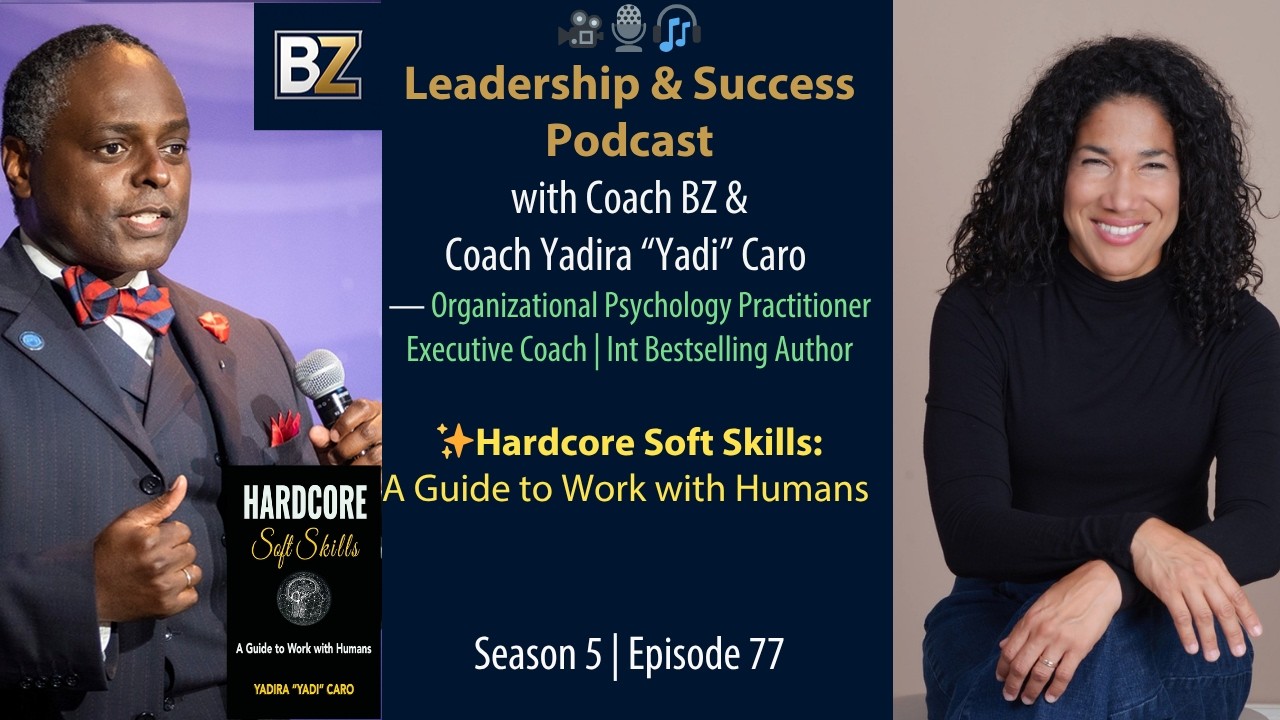
In this live episode of the Leadership and Success Podcast, host Coach BZ (Bob Fabien Zinga) interviews international bestseller Yadira “Yadi” Caro, author of Hardcore Soft Skills: A Guide to Work with Humans. The conversation weaves together Yadi’s personal journey—from a Puerto Rican upbringing, through a COVID‑era podcast, to publishing a best‑selling book—and the core concepts of her work. Yadi explains the 5 C’s framework (Connect, Communicate, Collaborate, Create, Correct) and the 5 SEAS model that structure her practical exercises for teams. She argues that soft (human) skills are the decisive competitive advantage in the age of AI, emphasizing elite listening, feedback culture, psychological safety, adaptability (especially for veterans transitioning to civilian roles), discipline, mentorship, authenticity, and vulnerability. The episode also touches on the host’s personal prayer for peace, the role of AI as a tool, and Yadi’s plans for future editions and multilingual releases. Throughout, the dialogue is conversational, enthusiastic, and purpose‑driven, aiming to equip listeners with actionable habits and a mindset shift toward normalizing soft‑skill education in organizations.
Chapters
Hi, I'm John Maxwell. When the top companies in the world are looking for trainers, speakers, and coaches, there's one name that stands above the rest, and that's Maxwell Leadership. Our certified team members have gotten proven results for companies all over the globe, and our reputation, I'm proud to say, is second to none. Some of our members have risen to the top of their profession, including the one you're going to meet today. I proudly introduce you to my friend, Bob Fabien Zinga.
Welcome to the Leadership and Success Podcast with your host, Coach BZ, where we help you lead with purpose and succeed with impact. If you're ready to grow into the kind of leader others want to follow, this podcast is for you. If you're determined to elevate your success and leave a lasting legacy, this podcast is for you. As my mentor, Dr. John C. Maxwell, reminds us, everything rises and falls on leadership. Our goal is simple, to inspire you, challenge you, and equip you with insights that can transform the trajectory of your leadership journey. Welcome aboard. Welcome to another episode of the Leadership and Success Podcast with Coach Biz.
In a male-dominated industry and advocating for herself as well and making sure she's treated at the same level as everybody else. That's really beautiful to see. So if you had one day to live, what would you have liked your final contribution to be?
I think It goes back to parenting, that the contribution being that I, that my kids are, are, um, emotionally intelligent and that are capable of, of living in a world, you know, without me or without, like, they're just healthy, healthier emotionally and healthy physically. I think that will be my greatest contribution because it's like, yeah, that's all the part of the other work and, you know, all that stuff is out there. But when it thinks like it's your last day, and then you're like, contribution, like, great kids that are able to do great things in the world.
Wow, that is, that is—
Hi, Gabby Caro here. And the reason I have hair and makeup done is because I was doing an interview for a TV station, a local NBC station. And we were talking about my book, Hardcore Soft Skills: A Guide to Work with Humans. And one of the topics that we discussed was the role of artificial intelligence in the workplace. Should we feel concerned? Should we embrace it fully? And one of the things that I've discussed was the fact that it all depends because AI is a tool and of course is taking over a lot of the responsibilities that we do. But in order to really have a great output or a great use of AI, it depends on a human factor, on us, on us to define how we better want to use it. On us to establish those connections first with the people that we serve through our products, to understand what the real users' needs are, and that's what's gonna enable us to use AI effectively instead of just creating copycat solutions that we see everywhere in terms of the graphics or the copy that we see on text. So this is why it's so important that we connect with people, that we that we understand their true pain, and taking that information and taking it back to the office, using AI as a, as a tool to help us make better decisions and help us co-create with them, will certainly create better products. Because if AI is getting better, we need to be better humans as well.
Thank you for listening.
All right. Thank you so much for joining us for another special episode of the Leadership and Success Podcast. I have a very special guest today. Actually, she's coming back. She was here for season 4, episode 66, and I highly recommend everybody goes back and listen to it. But today we are going to be focusing on her instant international best-selling book, Hardcore Soft Skills: A Guide to Work with Humans. Now, as is our tradition, we like to kind of start the show by being grateful. However, I must tell you, I am not feeling too grateful today with everything that's happening in the world right now, including, you know, my own country. It looks like the US is about to commit some war crime. Now, as you know, I am an information warfare Commander in the US Navy. I believe a force for good. I don't think America is a rogue nation that doesn't respect laws or the rights of humans or the laws of conflict. I really believe that we are very, very special and we are set apart, right, from the terrorists and from the rogue nations out there. We represent something. We have core values. For example, in the Navy, my core values are honor, courage and commitment. And that really, really means something. And I've been in the Navy for 21 years, and really the oath I took was not an oath to a man or even to the country, but really to the Constitution of the United States of America. We stand for law, we stand for order, and we stand for integrity. So having said that, I am grateful that, you know, we have peace in the world right now, but I am really, really praying for whatever is going on in the Middle East and especially in Iran. There are a lot lot of very innocent people, uh, who might be dying, uh, in— by the end of my country. And I, I just cannot accept that, right? We are not criminals, uh, we are not terrorists, we are not mercenaries. We are the United States of America. So, uh, I am praying that, uh, whatever checks and balances and controls we have in this nation, everything falls into place, that we do not participate in a genocide. That's not who we are, and I refuse to believe that. All right. So I guess this is— it's not really a thank you, but I guess it is a prayer. I am praying for peace in the world, peace in the Middle East, and I hope you guys can support me in that. All right. So let me see if I can actually properly introduce our guest who has been with us before. And again, I am so very, very proud of her. Everything she's been able to accomplish. And let me see if I can do her justice. So today, Yadi, from the first show, we talked about going from Puerto Rico to Harvard to becoming now a bestselling author. So Yadira, Yadi Quero is back and I am so, so pleased. After an incredible conversation in season 4, episode 66, right? Yadi returned to the show with an even more powerful message. Now as the author of her instant bestselling book, Hardcore Soft Skills: A Guide to Work with Humans. And I believe this is so timely. This is more than a book. It is a leadership playbook for the modern era, where human skills are the ultimate competitive advantage in military, tech, and global organization. So we're gonna be exploring a lot of things today, including why soft skills are the real power skills in leadership. So Yadi's journey continues to inspire. From her roots in Aguada to influencing leaders across more than 30 countries, her work reminds us of a timeless truth: leadership is not about being the hero, it's about empowering others to rise. All right, without any further ado, please help me welcome back to the Leadership and Success Podcast, the one and only Yadi Kao. All right.
You're so generous. Thank you. I know he was having some issues, but this is a great podcast. So if you're listening live, definitely this is a podcast to listen to in terms of all the great conversations that he has with so many fascinating leaders. So I'm very, very, very honored to be here, and I welcome you as a viewer and listener to just check out all the conversations that he has had with military leaders, industry, academia, and many others, and he teaches so many valuable things. So I'm going to stand by here and wait for Coach Vizi. And he'll be back. And we're here. I'm going to stand by here. You got a question for me? Just go ahead and type it right now. I'll be talking today about my book, Hardcore Soft Skills: A Guide to Work with Humans, and it's a book that I recently wrote, inspired by a lot of the great experiences that I've got working with military organizations and with tech teams and engineering teams. And it's just been very, very grateful to have had the opportunity to work with fascinating people and learn from the guests on my own podcast, Hardcore Soft Skills, which you've— I'll let you— I'll share as well the interview that I have with Coach Bizzy too, and where he shared his experience in terms of the all the work that he has done as a, in the Navy and as a leadership coach himself. So let me stand by here and confirm that we are still going live. And if you are curious on where to get the book, it is available via Amazon as well as Barnes Noble, audiobook version too, which is available in English right now, and I plan to publish an edition in Spanish very soon. In the meantime, one thing that I will share with you in terms of the receptiveness, I guess, for the book has been the fact that it's, it has opened many conversations of people in different industries, not necessarily just the military. It has opened conversations with people in the operations world, automotive world, and many others, because they, these people that work in different industries realize the importance of of the so-called soft skills that are very important for the workplace. So, and it has been great to get that feedback from the folks in terms of applying the 5 SEAS framework, which I talk about in the book, and that we'll hopefully get to talk soon with Coach BC.
Hey, Yadi, can you hear me now?
I can hear you.
Okay, sorry, it looks like I lost my internet for whatever reason. We are, we are, we are. Thank you, thank you, thank you so much. Uh, I guess I was gonna start just anything you are grateful for today.
Yes, absolutely. So I'm grateful for the opportunity to talk to you, and I'm grateful for the fact that we— even if you're on the other side, I'm on the East Coast, I mean in Florida, and that you are in California— that I get to have met people like you that bring such an important message. And I feel honored for the the opportunity to speak with you. So that's one thing that I'm grateful for today.
Well, I'm especially grateful that you are here now that you are an international best-selling author and you don't feel too important to come back here. So I am so, so grateful. So really, welcome back. So what inspired you to turn Outgore Soft Skills into a book?
Yeah, so I had a podcast because my exploration with soft skills overall as a topic. Started in 2020 during COVID times when I was working with teams of developers and engineers, and I just wanted to learn more about what are those skills that make teams and projects succeed. So I launched a podcast, and you were one of my first guests, so I was very happy to learn from you. And I've had many guests who were in the military, academia, famous authors. And as I learned from the— from those interviews, I also learned through my studies in organizational psychology and my my own experience working with the teams. So based on that, I discovered that there was some sort of like pattern. I started coming up with my own framework, which is the 5 C's framework for launching teams. And I really wanted since the beginning to be able to capture all that because I really like to share what I learn and apply. So that's how I came up with the— I wanted to launch the book, and I see it as a, uh, like the MVP, the minimum viable product for now, because then I see things like I could have improved on this or apply that. So I really want to plan to have new versions. And based after the book, I've gotten so much feedback and ideas as well that I really want to include those in future sessions too.
That is really something. Hardcore Soft Skills, that's definitely your brand. So it's your podcast, your YouTube channel, now a bestselling book. We couldn't be prouder. And I guess if you had to summarize the book in one sentence for maybe, you know, a new naval officer or Silicon Valley engineer, what, what would you say?
In one word or one sentence?
Yeah.
One sentence: roadmap to master critical skills, because it's like a roadmap because of the 5Cs framework. So I was intentionally giving a lot of exercises to practice with the team. So it's a roadmap, it's intended to be like, we're not gonna— it doesn't have all the answers. I'm learning myself a whole lot as I go along. So It's just the framework or roadmap to learn these critical skills that we need.
That is so important because I'm sure we mentioned that before, Silicon Valley where I am, people, I think their IQ is completely off the chart, but we need a lot of work with our soft skills for sure. So a guide to work with humans. Why is that so important even when someone is extremely intelligent? Why do we have— what does everybody need to learn? To work with humans and develop those soft skills.
Yeah, because the way that the intelligent people like yourself or the people that you work with, they, uh, we need the ability to, to create things for others or understand who are customers. And that just comes through building empathy with the people that we are building products for, or just to create even better things and collaborate with people that have other skills that we don't that we may not have. So I think it's just a matter of just the ability to learn how to work together effectively is what's going to differentiate who are the smart people who succeed, but then there are the ones who go beyond their capabilities. It's going to be through the soft skills.
Well, so we have our first comment from the audience. NJ Robinson says, nice roadmap to learn critical skills we need. So NJ, let us know where you are joining us from, which city-state, and also if you have a question for Yadi. Thank you so much. Now, like I say, this is your brand, right? Hardcore Soft Skills. When we first met, it was in 2021 or 2022 when I was on your podcast. I think you were living in Germany or somewhere in Europe at the time. It took us a while to find a good time to record your podcast, but— sorry. I'm just recovering from the flu.
Oh yeah, it's turning around, all something going on.
I always get the vaccine, sorry, every single year. I never had a problem until 2 weeks ago. But anyway, but one thing that's very special about your tagline though, you said hardcore. Why do you say hardcore soft skills? Because most people, when they talk about soft skills, hardcore has nothing to do with it. Can you expand on that?
Yeah, that's exactly because I was thinking of words for the contrast, because when we think like we're a hardcore fan, or we're like, we're going to be like very hardcore about something, it's because of that contrast. When we, when I was initially thinking about soft skills, it's like, it sounds so nice. It sounds like it's like etiquette, or, you know, how to, how to dress properly. And it's just, it's way beyond that. You realize that in order to really master these skills, you need to be hardcore about them. You really need to take the time practice, being a good communicator, being able to manage conflict. Building emotional intelligence is so hard. So this is why I use the concept of hardcore soft skills, because we have to be committed. And we also have to be able to accept that these are not just soft things. These are— it's a lot of emotion involved and vulnerability involved with them. So we really need to be willing to, to do those things, to do the work in order to master these critical skills.
That is so, so true. And especially for those who come from the military background. And I understand NJ is also from the military, Air Force, retired, but especially for a lot of men, I've seen not everyone, but the majority of people I've seen, we tend to be alpha male. So we like, oh, we are not soft, very, very hard, manly and all of that. So I like when you say hardcore soft skill is different skills. We need to have it, even if you are a man, it could definitely make a big, big difference in your career, I believe. So what do you think is one of the biggest misconceptions leaders have about soft skills today?
I think they presume that it's either nice to have, or also that the fact that people either have them or don't have them, that they treat, for example, team members that may join, it's like, yeah, this guy's super smart, but they soft skills, they don't have them. And the realization that, hey, we— these, these are things we all need. These are skills we practice. And a lot of times these are reserved for the C-suite or the— on the manager side to teach them how to be leaders. But realizing that we as leaders or managers in a team, we— these are skills that any of the team members can obtain. And we tend to relegate that to say, like, no, the manager who has the communication skills is going to be in charge of the group, and the rest let them do the work. And it's just so incorrect to think that, because a lot of the the best developers or engineers I have worked with, they all have those ingrained skills of empathy, of understanding the users, of critical thinking that are very important.
That is so true. So what do you think might be the cost to an organization when soft skills are completely ignored?
I think ignoring that is a high cost because companies lose a lot of money when they have to hire people, or when they have to waste so much time either managing conflict in the team, or either because the team lacked, or the organization just lacked the ability to communicate effectively or communicate the big vision, then they don't get the results they need. And any effort right now, particularly for managing change, adopting technologies, is not just giving people tools of like, hey, go use AI or do this thing. There needs to be strategy. So it needs to be like the embracing of, hey, this is why it's important to have clear message and make sure that we all communicate effectively. Or this is why we need to be able to build through exercises adaptability in our team. It's not like it would just save companies so much money to do that. And the team members and having to figure those things out, rehire people, it's just— if we just spend some time learning the skills, as I try to in the book, just give exercises so we can all practice them, it will just make such a big difference.
Wow.
So how does organizational psychology shape the way you teach soft skills in the book?
So it was critical in the sense that I wanted to have the foundational research because I get the— I've seen the great examples working with military leaders or working with, uh, with organizations and tech leaders, and just seeing that validated through, uh, either research that I've that I've worked with or learned through organizational psychology. It was just very critical realizing like, okay, there are different sets of leadership, there are different styles of— this is how companies make decisions, or these are like the psychology behind us as individuals. What, what are the elements needed for good motivation? So having that foundation on just what has worked, but also the validation of this is why it works. I think has been very important. And there's so much more to learn on that. But it was very important for me.
That is really powerful. You mentioned the 5 C's earlier. Can you maybe walk us through one of the framework or model from the books that leaders can apply?
Yeah, absolutely. So the 5 C's refer to is the framework that I used to either when launching a new team or either engaging with customers, or is it could be a model that could be used for different things. So first is connecting, building those skills to know, connect with yourself and connect with others, meaning either be it your customers, or either be your team members. So knowing what are their strengths, what do they bring to the team, what do you bring to the team, and also building that empathy of understanding what are their— the putting yourself in the other person's shoes. So connecting is very important before you go in, and communication happens throughout. But when I refer to the communicate aspect, is the vision, communicating the big vision, the big picture, also having the ability to practice the skill of listening throughout. And when we're working organizations or teams is so important. Practicing our ability to write or public speaking, that happens in any— no matter if you're an actual public speaker, but we all need, if we're talking with more than two people, that's basically public speaking. So connect, communicate, then we can go into collaborate and create, because when we collaborate and create good things, we practice so many skills of how to, how to do good meetings, how to do allow creative thinking in a team, which is very difficult to collaborate between this diversity of thought. So collaboration and creation only happens after we have connected with, with those people that we're going to work with, and that we have communicated clearly the why, what's the vision. And after that is correcting skills. So correct, meaning that we do some work. And a concept that I use a lot based on agile practices is the retrospection of evaluating what's going well, what needs improvement, but also those skills of Managing conflict, and I'm not saying resolving conflict, it's managing the conflict that exists that could be a great source for ideas for the team, getting feedback, receiving feedback. So there's a lot of big— in each, in each C, there's so many skills included. So connect, communicate, collaborate, and create, and correct. And within that is the— so many different skills that we need to—
wow, that is quite a framework. And for those who are in the military, I know we talked about the 3 C's of leadership. You reminded me of that, which is character and then— let me see— character and competence and then connection. Yeah, those are the 3 C's that are taught in the US Navy. I'm sure we stole that from the Army, but that is really quite powerful. So if somebody was to pick up your book today, which again, I want everybody in the audience right now to get a copy of the international bestselling book, Hardcore Soft Skills: A Guide to Work with Humans. Everyone should have a copy for sure. If they picked up your book today and they needed to read just one chapter, which chapter would it be and why?
This is a tough choice because I have 27+ chapters and each one focuses on a different skill. And I guess it will depend on which skill we want to master specifically. So I think the one I would pick today will probably be the one on self-assessment, I think, to get started, just because of the fact that we want to understand. In that chapter, I have the review of, of all the different skills that we need to practice, and I invite people to kind of conduct a self-assessment, but also give that self— same assessment to somebody else, because other people are able to recognize the skills that we do have that for us may seem obvious, but in fact, there are things that we bring great to the team. Like perhaps we could be a person that explain concepts in a complex concepts in a very simple way, and we didn't realize that until somebody else brings it to us. So I think the self-assessment is just the first one, and actually I think that what is available on the excerpt, the free excerpt, I put the link there, and that people can learn, uh, just as a beginning stage to get started in the journey.
That's really cool. So really, this is emotional intelligence, right? Because you are being not only self-aware of yourself, and then also of the other members of your team so you can learn how to work together. Why is that so important, you think, especially when you are collaborating with other people?
The aspect of self-awareness, it's very important because it is how we show up to— how do people perceive us and how do we presume we are showing up for them? Or we may not even be thinking that at times when we're at work and or collaborating in something, we just are so focused on the thing that we have to deliver, the work that we have to do, that we forget. And sometimes we're not very nice with others. And we just need to not just— it's not a matter of just being nice and courteous with others, but it's the aspect of by treating others fairly in a collaboration or seeing how do we come off, we're also able to bring the best in them too. So it's kind of like a selfish approach to that. But I would just say that it's very important to be self-aware in And if we don't know, just have the vulnerability to say like, you know what, I have no clue what this is, but let's figure it out together. I think it's very critical to do.
Yeah, I guess humility is so important as well. So for— there are really two groups of people I really focus on on this podcast, which are aspiring commanding officers in the military and also aspiring tech engineers. So maybe for a junior officer or an individual contributor, security engineer or analyst right now, who aspire to lead one day. While they transition into a leadership role, what soft skills do you think become the biggest bottleneck?
I think it's the adaptability. And this is based on what I have been— the feedback that I've been getting from people, because I work with a lot of military or former military, is the transition from an environment where you're told exactly what to do and you need to follow orders into a space that you— it may not be very clear what you're going to do. And then, you know, to navigate complex spaces and come up with new solutions or things to do, or figuring out what is really the problem of what we're doing. And realizing that, hey, the manager, the leader may not— well, probably not have all the answers. That's why they hire you, who they're counting on your military experience and your expertise to bring that, that experience to them. So I think that's very valuable, the realization that as a veteran and former military, you, you have to be adaptable, but just take those adaptable skills that you have had and apply them like a lot in the workplace to realize like, hey, this is an unknown environment, the challenges may not be as tough as what you got in the field, but just applying that same mindset to to understand problems and just being, figuring out to be willing to be able to do things that you may not have the answer to or figuring out what the problem exactly is.
That's really powerful, learning to lead in ambiguity. Yeah, because it's true, in the military, usually everything is pretty much set up for you and it's usually very, very high tempo and many times, you know, it's The consequences could be dramatic, right? The worst consequence is probably loss of life. I don't think that would happen much in Silicon Valley or in the industry, but being able to adapt, that's really a core skill. So from all of the people you have coached, mentored, and taught before, can you maybe share a generic story where improving one soft skill dramatically kind of changed a team? Outcome?
Yeah, I think one of the greatest experiences I've had was when I was working in a big organization helping with that transformation effort, and just the ability to connect people who were working in different departments for the same mission. And we were all just very used to working in our own team, our own department, and realizing like, hey, no, you can— let's, let's connect with the person, this other department who is also very relevant to your project or your product. And me as a facilitator to help build those connections that were already there. It was just a matter of giving people, I guess it wasn't a matter of giving permission, but I guess we get used to the us versus them attitude. And when it comes to that connection with just going across the hallway to talk to the person that you communicate via email, just makes a significant difference. So I think just that small step of facilitating those connections has been very powerful and was really a significant change for that organization that I work with.
That is really insightful. Now, another thing I saw in your book, you talk about elite listening. Maybe you can tell us more about this. It reminds me when I was a kid, my mom used to tell me, right, God gave me two ears and one mouth and I should use those in proportion. But I feel like many leaders have trouble listening, but really listening intently, right? I think it was Steve Covey who said most people, they listen to respond. But not to actually understand. So when you talk about elite listening, how does that look in practice?
So in practice, it's not easy, particularly if you're in a managerial position that you feel that you have to give the, the big speech, the big, uh, uh, inspiring message to a group and, and motivate people. And a lot of times it looks like from, uh, it's a lot of listening, as you mentioned, which is really Eliciting those questions to the people, to users, not users, but I guess the team members, but eliciting those questions to really ask, what are we doing well? Hey, what, what do we need to improve in this particular area? And pausing. We are so scared of silence or just sitting in the talk into our thoughts. So it could get a little uncomfortable. But this is why it's so important to have the practices skill, because we just tend to fill the void, the silence with, with speeches or with a lot of communication. And the best leaders that I have seen are able to really pause and reflect. And it's a skill that's very important to learn.
Now, you also talk about a feedback culture, which I think is so critical. So I guess my question for you is, how can leaders build that feedback culture? Both safe and accountable?
Yeah, so feedback is, is a, is a, is a critical skill because of the fact that that's how we are able to learn. But a lot of the times we as managers, and particularly women in an environment, we're afraid to ask for feedback because we think that it's just going to make us, you know, either look weak. So in order to create a safe space for that, it starts with the people who are on the top or the people who are just a team manager. That if they are willing to receive feedback instead of just jumping in, assuming that they have the knowledge to give the feedback to the team, of course, it's the role of the manager to give feedback, but welcoming the aspect of like, okay, now that I've given you feedback on this specific process, not in yourself as a person, but also on this particular thing that, that didn't go well or that went great, and I want to give you feedback on asking back to the, to that person.
So what feedback can be positive?
Yeah, absolutely. Exactly. And giving positive feedback, a lot of the times we neglect that so much because it's like, yeah, it's just, this is how the way things are. But positive feedback is so important and we should do that often and it just builds better relationships with people.
Yeah, because I have seen that in many organizations they have at least, I know in many we do it once a year, we have fitness report or annual evaluation. And many times people are very, very scared. They're extremely anxious when it's time for their annual evaluation because they feel like they're gonna receive negative feedback. But the truth is they could be receiving positive feedback as well, right? And what advice would you give to a new manager in such a way that people are not terrified to actually receive feedback? And I think in your book, you even allude to having feedback more consistently, frequently, throughout the day, weeks, or month, and not just wait for this one big time of the year where they receive that one feedback, which might be uncomfortable for some of the employees.
Yeah. So in, in agile frameworks, one practice that is used is a retrospective. So after you have like a sprint, which is a period of development, that the team gets together and identifies what went well, what needs improvement, and what's one little thing that we can improve in the next cycle. Even if we don't have sprints or development cycles, we could make it a thing like, hey, this is Feedback Friday, or the monthly feedback, like make it an exercise to make it a deliberate effort. Like, hey, today we're all giving positive feedback on this thing, or things that we could improve. And again, always focusing on the process, not the person, because that's what discourages a lot of people to to kind of, if they are receiving feedback and they feel like, oh, I'm a failure, you know, it is, it's just processes that we need to improve. And if we make it a safe space and a way of operation, I think it becomes very, it becomes easier. But a lot of times we just neglect that and wait for the moment to address the thing or address something or for the annual reviews on performance assessments. So if we make it as something that we deliberately practice, we encourage that in our culture, no matter if we're in a big organization or a small team.
Yes, because the good thing about that too is when that big annual evaluation comes, people are not surprised. They know exactly what it is going to look like and they can be more confident. I really love that. So I also like how you really talk about psychological safety. But now, we are human and I love you say, how to work with humans, because usually we say they are our greatest asset, but many times they are also our greatest challenges. At, at times. How do you turn conflict into productive collaboration instead of personal friction within a team?
It's not easy, let me tell you, because a lot of the times the conflict, um, when we look at it, there could be conflict in terms of just personalities because, because of the fact that, uh, people not getting along. And in the— if we look a little deeper, we realize that, hey, maybe because that person thinks that, yeah, that they're not as performing as, as good as they should be. So that's the key part that we need to focus instead of like how we're going to fix this person or fix this particular conflict, see what the, what the root cause is to identify, okay, this is based on a performance on this particular process. So if we have to keep centering it back to the process itself, and a lot of the times having that thought myself as a manager, it's just that very— we tend to jump in to want to fix the issue and intervene. And it's important to kind of take a step back and facilitate that conversation between the folks that are having the conflict. It's not easy. And we presume that it's going to be a fight necessarily. But if we frame it in the right way, like, okay, it seems like we're having issues, I'm going to step up, facilitate a conversation, but I'm not going to be coming in to intervene as mediator. If we try to figure out ways of How can I not be the mediator and just like foster the conversation with the team? It becomes much more productive. It's not easy, of course, because I'm still kind of practicing that too, but it just creates a better environment ultimately.
Wow.
That is, that is powerful. So what is one daily habit from your book that every leader should start tomorrow?
Daily habit. Let's see. I think the part of the reflecting, but also I'll mention something too about the mentorship, because hidden here, like when we're on LinkedIn, or when we're in different environments, or even with our peers, seeking the practice of either mentoring somebody on something that they may need, or looking for mentors. And it's not like going in and asking a person, will you be my mentor, as if it was marriage, but just say like, hey, how can you help me with this? I have, for example, if I work in a team of with many project managers and try to create the opportunity for like, okay, we're all project managers, we're all doing the thing. How can we learn from each other? Let's frame, let's set up a learning session that we can all learn good practices from each other. So seeking mentorship and also offering the knowledge that we may have that may benefit other person, I think it's a daily practice that leaders can and should implement too.
Man, that is so insightful. So many success nuggets in your book. Let's talk a little bit about growth, discipline, and influence. In the book, you talk about discipline as a driver of success. How does discipline connect to soft skills?
So discipline is important. There's a famous quote I think I mentioned before from Jocko Willink, which is that discipline is freedom. And I love Jocko Willink, so I think it's It's because of the extreme ownership. Yeah, exactly. And I think it's just the ability to— it's habit creation. So being disciplined is just a matter of like, we know we go every day, we brush our teeth morning, evening, at least, and we just do it without thinking about it. And we realize like, hey, this is why we have teeth and we're not doing— our teeth are not rotting and we are able to continue each day and eat the food that we like. So just along the same lines, if we establish a good practice, the discipline to either read 10 minutes a day, listen to a podcast like this one, like, like 20, like weekly, save some episodes when we go on the road. So, and not only listening, but taking a step that, that somebody has recommended and implementing that. This is what really builds us to be, to become a little bit better each day. And a lot of the times we think along the lines of like, if I take this big course, invest so much money. It starts with just little small steps every day that we take, because that's what really makes a difference. And it seems less overwhelming. And it's— those are small steps to just— when we think of discipline, we think it is something extreme, but discipline is something we do every day, just like we brush our teeth.
That's true.
Wow.
Never thought of it that way. Now, there's another thing people who read your book, they may ask, asked, how do leaders balance authenticity and vulnerability versus influence?
Yeah, and that's— that, oh, it's also not an easy thing to do, especially when it comes to, for example, myself as a female working in heavy military environments, that we want to— we have to be, let's just say, cautious in terms of how we show, how much of ourselves we want to show in an environment. We do have to show like certain power, certain attitude in the workplace to make sure that we feel respected and that we are respecting others as well. So I think the authenticity, it might come more from the aspect of like how true to our values we are abiding to. I think that's more the authenticity. Like, let's say if I want to, from the extreme of I just dress as I want and I'm being authentic, like, no, it's not about that. It's more about about the how true to our values we are and how true to what we think is important. And how do we show that at work every day and not compromise those values?
That's, that's really powerful, because I think people need to know what their own core values are, but also making sure it's aligned to the core values of whatever organization they work for. And yeah, being a person of integrity, that really makes all the difference, doesn't it? Now, I did play a short clip of you after one of your interviews. You talked about artificial intelligence. So we are definitely living in the era of AI now, the age of artificial intelligence. So in today's AI-driven world, why do you think human skills matter even more than before?
Yeah, and the more I see and read about it, the more it's reaffirming that the fact that human skills are gonna be so critical because those only skills that of the capabilities that artificial intelligence gives us is the ability to automate a lot of the work that can be automated, process-driven work. And even then, the— when I see more reports, like recently I was reading an article about the— that the highest-paid developers in Spotify right now are the ones that they don't even code, they just guide the AI to, to do the work for them. But they have the skill of like a director of the orchestra, let's say, that they are able to first identify what is creative thinking, what are the right questions to ask, what are the right prompts to give. So that part that cannot be quite automated yet, which is like thinking, empathizing with the people that are having the issue problems, how do we design the products that abide to satisfy those audiences or those customers, and then having that thinking creatively, um, because the output that AI will provide a lot of the times can be great, but a lot of the times it just needs a lot of creative thinking and a lot of the, um, that ensuring that we are connected with our human side because it's uncertain. It is, uh, it, it is not automated yet. So this is why every world, um, like, um, job report and that we see right now, they provide the need for creative thinking, communication, building strong stronger relationships with the people that we serve as the skills that we need today.
Wow, really powerful. OK, here comes the million-dollar question. Do you believe that soft skills will become the ultimate differentiator in leadership? And if so, why?
I absolutely believe that. And that's the reason that I did the book, because I believe that because at the end, when we're leading, we're leading people. And we're leading people that we are, as opposed to machines, that we can have all this AI, agents working for us and doing exactly what we need to do. That is great. And you can build, as we have seen, multibillion-dollar companies with that. But when it comes to the differentiator of leading people, it's— that's when no matter how expert you are, technology will change. All the work that we do in a technical side or even the— all the operations side could change, but people will continue being people, unpredictable, abiding with our own ideas and living harmoniously, or not even just the ability to collaborate and create things together. That's when we need the skills. It's not easy, but that deliberate practice is what we need.
Now, AI has been quite a transformational technology, but unlike previous, uh, revolutions, this is taking away white-collar jobs. At least we're starting to see that even here in Silicon Valley. There are some developers Prior to AI, they were, I guess, the unicorn genius. Everybody wanted them and they made a whole bunch of money in Silicon Valley. But now we have AI in some companies that are taking away those positions, which is just incredible. So for the people who might be kind of afraid about what AI is doing or what might happen in the future, why do you think these human skills, these soft skills are so important in this age?
Yeah, particularly for people that, whose jobs are either changing, shifting, being reduced, having those skills are important, meaning the empathizing, communicating, because they are able to allow us to identify problems. When we identify problems, then we are able to find a market for solutions that we want to develop, identify what are the needs, because ultimately, when we are in looking for work or looking or having a new company, we are trying to serve a need out there. And the way that we're going to find what needs need to be met and how, what's going to be the next type of jobs, we need to be able to communicate what we, not just listening to others to kind of hear what's going on, but also the communicating what, what, what's the value that we bring to, to an organization or to a new team. So the hard skills, of course, are very valuable, but the people that are gonna thrive in the market are gonna be those that are able to take that and package it nicely and take it to any industry and apply it.
So, so powerful. Okay, we have about a dozen minutes left. For people who are gonna read this book for the first time, what do you want your readers to either learn or become? After they read this book?
I think it's a— I want people to take away practical insights in realizing that learning the skills is not just something that is reserved for, um, if you want to go in like in a CEO job. It's just, it's just practical for anybody who is a team member. And also the aspect that these exercises that I write about in the book, they're meant to be done as a team. So learning individually is great if we're in an organization, but it's so much more powerful, as research has shown, to have that shared experience of learning as a team. So we can bring the book and show it to your team members and practice, like, hey, let's practice this retrospective that is recommended in this book. Let's try it out and see how it goes. And that people could experiment with the exercises that I provide there and just to see the difference or the meeting management ideas that I give in the book. So it's embracing that willingness to like, let's practice this today. We'll see how, let's see what could happen and then they could come up with their own ideas.
I think there's so much potential to really bring a lot of change in the workplace. I'm so proud of you and all of the work you have done. And I think if you're book could change one thing about workplace culture globally, what would it be?
I think it will be normalizing the education on the soft skills, because again, we leave it to the either go take a course or let's give these leadership training to new managers only. But when it comes to normalizing, like, hey, we're, we're teaching how to do AI prompts 'Let's take a little course here on, or facilitate a session on conflict management. That will save the team so much time.' So normalizing those things and recognizing, like, you know what, yeah, we need a conflict management workshop, or we need a negotiation little class here. So I think it's, it's normalizing soft skills education. That is my biggest aim with this book.
Really, really powerful. I'm really, really glad of all of your successes. And I'm assuming we've all of the feedback and testimonial you're receiving. Are you working on book number 2?
Oh yeah, I'm working on, on adding more things to this edition and more exercises, and particularly with AI, because there are— I'm thinking of a section of prompts that you can have. But I definitely want to have this book in Spanish language because it's my native language, and Portuguese as well, and just have it in more— Yeah, yeah, so many languages that we can have the book in. So I really want to do that and expand it to other audiences as well.
I can't believe this. I'm talking to the international best-selling author of Artcore.
That's really wonderful.
All right, so we are almost out of time, but if you had to leave my audience with one Artcore soft skill, skills they really must master to succeed in leadership? What would it be and why?
So many. Again, just having to choose, I think adaptability will be a big one today. Because I would say if it was yesterday, I would say listening, but today I think adaptability. Because of the fact that, as you mentioned, the, the work environment shifting, just learning how to adapt, it is a skill. It's just some, some of us are not loving change that much. So being practicing things to embrace new situations and seeing them in a more positive light, I think it's a, is a very important skill. So adaptability will be one, but of course you can read the book for all the others, all my other very close favorites.
Yes. Okay, is there a question about the book I should have asked you I didn't get the chance to ask?
Um, where to get the book, I think. Yes, yes. So yeah, they get the book, will be in my website, yadicaro.com. I have a link there to where to go get the book and get a free excerpt, like the self-assessment. And also I think that first chapter and a couple of the chapters of the book on Amazon, which is on Kindle, audiobook. And the audiobook is read by AI. I want to have my own voice soon, but I thought that was an interesting voice or an interesting experiment to do. So Amazon, Barnes Noble, and also via my website.
That is, that is powerful. Of course, people can follow you on LinkedIn, Yadi Karu. And is there anything else my audience can do to add value back to you?
I think connecting with me and asking any questions that they may have. And I want to hear what other tips they have of how they have improved on on those soft skills. I always like to learn from people.
That is really powerful. Now, if you could go back and give a piece of advice to your 17-year-old self, standing at the edge of this incredible career you've had, what would you say to 17-year-old Yali?
Stop overthinking. Just go on more adventures. I think I've embraced that, but I could have embraced it a little a little more at 17.
And also, uh, last time, uh, season 4, episode 66, you told us about this music here. You introduced me to Bad Bunny. Of course, no, it changed the world during the Super Bowl this, this year, and it was just fantastic to see how he brought everybody together from Puerto Rico to South America to America and just love unity. It was extremely, extremely powerful, and I think that's something that music can Definitely do. So thank you for introducing my audience to Bad Bunny's music. That was just fabulous. I'm sure you were super proud. It's just incredible. All right, so we have about 5 minutes left. If we can, let's do this rapid-fire lightning round. So you're gonna have to answer really, really quickly the question. Don't take too long to think, right? So what is one word that defines great leadership? How would you describe your leadership?
One word. Adaptability.
Okay. What is your morning routine or practice that keeps you grounded?
Just breathing for about 4 minutes, because that's all I can do.
What's a book or a quote that changed your life?
A book that changed my life? That Viktor Frankl book. I can't remember right now the name, but it was about be just embracing a very bad situation and looking for the, the good side of it, meaning that we are able to control our environment via how we respond to something.
That is really, really powerful. Okay, who inspires you the most today?
Inspire me the most? My kids. They're very smart and humbling too.
Really powerful. All right, uh, what is the question every leader should ask themselves frequently?
How did I serve people today?
Okay. And what is the leadership habit you refuse to compromise on?
I refuse to compromise on that I shouldn't, that I wouldn't do, or that, that I—
yeah, one that you, you will do always no matter what, you will not compromise on.
Oh, never stop learning. Definitely. Yeah.
Okay.
What did you want to be when you were You did?
I wanted to be a journalist. I did that for a little bit, but then I wanted to like write stories for the paper primarily, but— and I did some of that too.
Well, but now you are writing best-selling books, so that's even better. Fantastic. All right, uh, 3 adjectives describing you as a child?
Shy, very shy.
2 more?
Uh, oh, shy, um, intellectually driven, I guess. I just An avid reader. And, um, one more. Oh, one more. Um, so I think shy again, uh, but I think, uh, just, uh, observing. I was really observing.
What about as an adult?
Um, disciplined. Um, let's see, uh, driven, very driven. And also, um, overthinker. Still overthinker.
Yeah, definitely very intellectual. I love that. Okay, uh, I like to end the show with something optimistic, especially with everything that's happening in the world around us today. What is something you are feeling optimistic about these days?
Optimistic about the people craving connections with other people. It feels like we are glued to our phones and our technology, but seeing that people are trying to just get out more and, and connect with others, I think I'm optimistic that that will happen even very much more in the near future.
We definitely need it more than ever before, for sure. All right, this is the very last question of the show. We have about 30 seconds left. What is one word that represents our shared experience in this podcast today?
Joyful.
Joyful. I am so, so grateful. International best-selling author Yadi Karo, thank you so much for the privilege and the honor to be talking to you about the book. And everybody needs to get a copy, Hardcore Soft Skills: A Guide to Work with Humans. I'm telling you, in the age of AI, we definitely need it more than ever before. Thank you so much, Yadi. So great to— Thank you.
Thank you. An honor to be here. Thank you.
I appreciate it. All right, everybody, again, follow Yadi, LinkedIn.com/YadiIkaro, and get a copy of her best-selling book. And you go to her website, you can also get a copy, I believe she said, of a chapter or two. But I am really, really so glad and so proud of what she's been able to accomplish, and let's support her work. Okay. So this is it for the podcast today. Tomorrow morning, I'm going to be speaking to Elinor Stutz. She's an international bestselling author, keynote speaker, and top 1% influencer. We're going to be speaking about believe, become, and empower. She's the bestselling author of several books, but we're going to be be focusing on Nice Girls Do Get the Sell. That's going to be quite insightful. And then day after tomorrow, I will be speaking to Master Chief Petty Officer Jamie J. McCoy. He also has a doctorate in theology, US Navy retired, aviation and UAS safety innovator. We're going to be talking about servant leadership at scale from sailors to strategy. You do not want to miss it. Thank you so much for watching the show today. And like you all know, uh, we decided to celebrate Black History Month on the Leadership and Success Podcast, right? Because 28 days in February, the shortest month of the year, that's just not enough. So for our celebration, there are two things. One is, uh, today, right, on April 7th, and I think the data I was able to find in Black History, it happened in Mississippi on April 7th. Okay, a decision was announced that would begin to reshape the future of the United States Navy, but not without resistance, delay, and our truth. But basically, the Secretary of the Navy on April 7th, 1942 His name was Frank Knox. He declared that African Americans would be allowed to enlist in general service beyond the restrictive messman branch, effective June 1st, 1942. So that's when America finally decided that Black people were good enough to join the US Navy. So without that, I wouldn't be able to be a senior officer in the most powerful navy in the world. And to celebrate that, I'm going to play a short video on our way out about The Golden 13. These are the very first 13, uh, U.S. naval officers in the U.S. Navy. And, uh, they had a very, very tough time, but I am so glad they persisted and they succeeded. At the time, it was not 13, but actually 16 of them, and they had the highest score for the officers' test. And not only that, uh, white officers at the time, the, the officer school was 16 weeks. Weeks, they were forced to do it in 8 weeks only. Basically, they were set up to fail. But in spite, in spite of that, they did so well. They had the highest score and all of them passed. But still, they, they felt like, well, we cannot make, uh, 100, uh, officers, you know, from these Black Negroes, I think is what they used to call them back there, because that would be against their white supremacist belief. Because if white people can only pass 80% of the time, we cannot have this, this Black passed 100%. So they decided that 3 people among the 16 of them would not become officer, even though they passed all of the tests. They just said, "No, that is too good. We're just going to allow 13 Blacks to be officers." So it would be in line with the passage rate on average for what white officers had at the time. Anyway, not fair, not always right, but I am so glad that MLK says, right, What is the, I really love that about the arc of justice, right? It is long, but eventually, right, justice will come your way. It says the arc of the moral universe is long, but it bends toward justice. And I think eventually that's exactly what happened. So let's celebrate Black History Year. With a short clip about the Golden 13 and celebrating the fact that eventually the Navy allowed Black people to join again. That directly affects me because if that wasn't the case, I wouldn't be an information warfare commander in the most powerful Navy in the world today. So I'm so grateful for that.
We have their inspiring story in Heroes Among Us, presented by Navy Federal Credit union. In 1944, there were nearly 100,000 Black sailors in the United States Navy, none of which were officers. That would change when a group of 16 African American enlisted men assembled at the Recruit Training Center in Illinois in hopes of becoming United States Naval officers. Officer Training School for the United States Navy was 16 weeks. However, that was not the case for the Golden 13. They were given only 8 weeks to accomplish the same achievement as their white counterparts, a move many believe was an attempt to ensure their failure. With the odds stacked against them, these 16 men band together to support one another, placing blankets over their windows at night and studying steading with flashlights.
You know, to think of the Golden 13, you know, pulling back the blinds so that no one would know that they're still up steadying. That's, you know, the peer pressure of that. Guys, we have to do this to show the military, to show the U.S. Navy that we have what it takes to be pilots in the Navy. And that's that glue, that bond that I think that makes our military so powerful.
Powerful.
When the course was over, all 16 passed their exams. In fact, their scores were so remarkable that some in Washington were certain that the men had cheated. When the group was forced to retake certain exams, they scored even higher, with a cumulative average totaling 3.8 out of 4. At the time, this was the highest score of any candidate in naval history.
You overcome adversity by teamwork. First off, these gentlemen were highly educated. They were just about the cream of the crop. So they were well-educated and capable of doing what the Navy wanted them to do. But because of the instilled, ingrained racism, like you said, they made them test twice. But the perseverance and the teamwork, the excellence, excellent story.
Despite the fact all 16 men passed the Navy's requirements, the service elected to only commission 13 of the men, earning them the nickname the Golden 13. The additional seamen were, without explanation, sent back into the enlisted ranks.
It's unfortunate that that did happen, but when I think about the, just the, both the overt and just direct racism that a lot of those that came before me had to endure really made me strive more. You know, got to be the best. But that also puts some undue pressure on yourself. But that's how I looked at it. I will perform at the very best of everything that I'm required to do, both tactically, technically, and professionally, so that there is no question about my competence, my ability to lead soldiers both in peacetime and in war.
These untold stories have paved the way for other African Americans to make their mark in the United States military. Their accomplishments were revolutionary, spurring the vision of hope for today's military servicemen.
The hostility, the open hostility they faced, that was government policy at the time. It's unthinkable now. They allowed me to achieve my dream. I always wanted to serve, and by them doing so, it allowed me to achieve my dream.
African Americans have been contributing to the nation's success for many years in all ranks, from, you know, Dorie Miller, who shot down numerous attack airplanes coming in during World War II, to Crispus Attucks, to General Lloyd Austin, who's now the Secretary of Defense. We've been contributing and serving in any number of capacities, and we've given during those times when our country didn't necessarily love us. That is really a testament to the character of those that serve and persevere despite being badly treated. We're willing to sacrifice and give our lives for the well-being of this nation. And that's why I think it's so vital that the story is told.
Thank you for tuning in to the Leadership and Success Podcast with your host, Coach Beezy. If today's episode added value to your leadership journey, be sure to subscribe, share, and join us again for more wisdom nuggets on how to lead better and achieve greater success. Remember, leadership is the most critical skill of our time. The world will always need leaders to inspire others, drive innovation, and execute meaningful strategy. So why not count yourself among the bold leaders shaping the 21st century? Until next time, stay inspired, stay committed, and keep leading with excellence.
More from Bob

S250:E4🎙️LIVE 🇺🇸America 250: President Barack Obama Leadership, Service, and the Power of Hope






S5:E157🎙️ LIVE with CMD CMSgt Dennis L. Fritz, USAF (Ret.)(Multi Tracks Audio)



S5:E156🎙️ LIVE 🇪🇸 Leadership Lessons from the FIFA World Cup 2026 Champions (Multi Tracks Audio)

S250:E3🎙️ LIVE Leadership Lessons from America’s First Documented Family of African Descent 🇺🇸📖