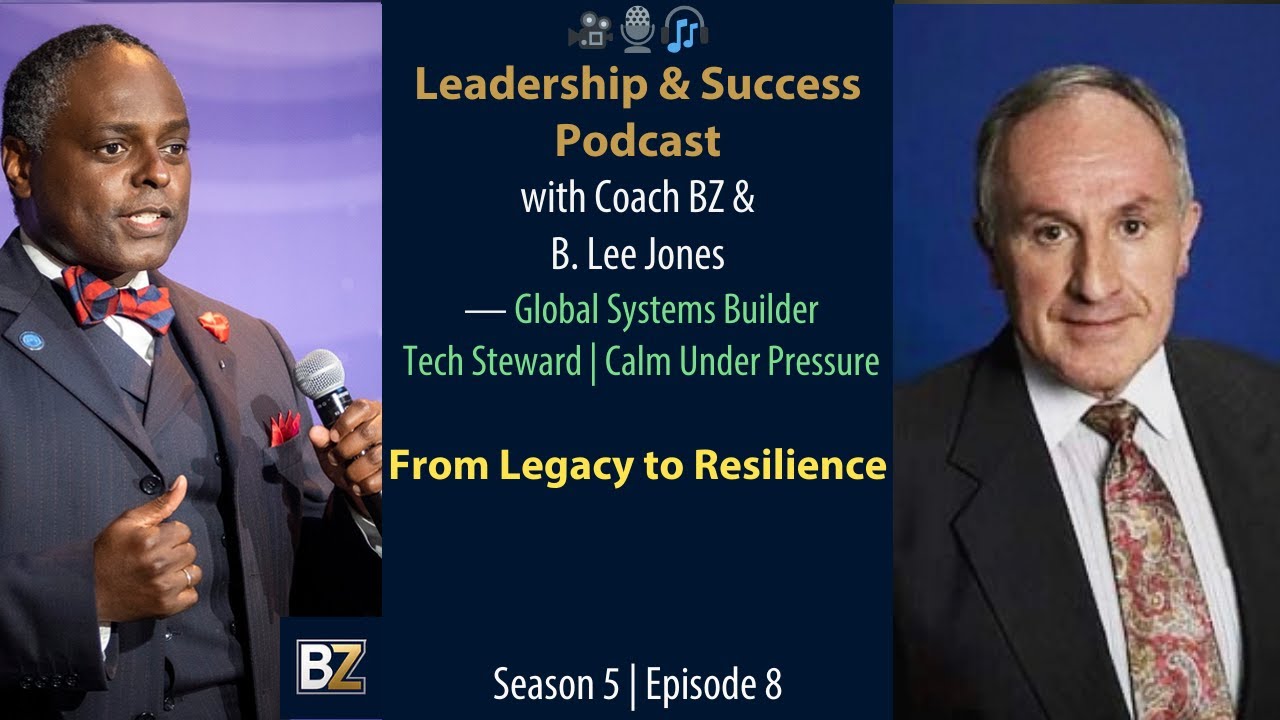
B. Lee Jones, a CIO award winner, talks leadership, cybersecurity, and AI ethics. He dropped out of college after a family tragedy, then earned an MBA in data science at 69 as a summa cum laude graduate. His core belief: responsibility over control, ruthless clarity, and never delegating moral decisions to machines.
Chapters
¡Hola! Hi, I'm John Maxwell. When the top companies in the world are looking for trainers, speakers, and coaches, there's one name that stands above the rest, and that's Maxwell Leadership. Our certified team members have gotten proven results for companies all over the globe, and our reputation, I'm proud to say, is second to none. Some of our members have risen to the top of their profession, including the one you're going to meet today. I proudly introduce you to my friend, Bob Fabien Zinga.
Welcome to the Leadership and Success Podcast with your host, Coach BZ. Where we help you lead with purpose and succeed with impact. If you're ready to grow into the kind of leader others want to follow, this podcast is for you. If you're determined to elevate your success and leave a lasting legacy, this podcast is for you. As my mentor, Dr. John C. Maxwell, reminds us, everything rises and falls on leadership. Our goal is simple, to inspire you, challenge you, and equip you with insights that can transform the trajectory of your leadership journey. Welcome aboard to another episode of the Leadership and Success Podcast with Coach BZ.
Well, uh, well, I have a number of friends in the cybersecurity, uh, you know, space, and we talk a lot about that. I also have a daughter that works for a cybersecurity software company, and a lot of what's happening now is a bit more of a focus change from the corporate security, which has been pretty steady. But now, since you have individuals working from home, uh, now we're into that PAM space, the personal access manage. You know, what kind of software do you have that you can deploy that will guarantee, or at least, you know, somewhat guarantee the security of devices you have from your employees who are working from home. You know, it's a, it's a different focus. That didn't used to be a problem because before everybody was at a desktop, you had servers internally, you had a protected firewall and everything. That's fine, but it's different when all of a sudden you're, you're working from home and you have Wi-Fi and you have kids who are in school and people who are on their cell phones and everything, I mean, you're in a much more vulnerable position. So, you know, a lot of work is being focused more in those areas, you know, towards the individual kind of security and less so in corporate, because especially now since people aren't using corporate you know, requirements to do their jobs, you know, that's been always somewhat under control. And now you're starting to see some of those places where larger places that have some vulnerabilities being attacked, notably healthcare. A lot of healthcare facilities have been falling prey to ransomware. And even worse, I've talked to some of my people in cybersecurity, you know, particularly I'm on it, I'm part of the InfraGard team that works with the FBI. I have friends at Interpol. We're seeing cases where people are Facilities, institutions are getting attacked with ransomware. They pay the ransomware, and then they get attacked.
All right, everyone. That was a short clip from Billy Jones, and I am glad to inform that he is on the queue in the green room right now. And we're going to have a really wonderful conversation about leadership and cybersecurity and technology. And I want to acknowledge Tammy James. Thank you so much for being with us right now live on LinkedIn. She says, hi from Solar Intangible Panels Inc. Thanks so much for being here. And tell me, let us know what city or state you are coming from and also what you are grateful for today. And if you have a question for Billy Jones, please type it in the comment and we will answer live. Thank you so much. I really love interacting with the audience. Like I said, I started this podcast, we in season 5 now, so 5 years ago. And the first episode, it was me, myself and I. I had no audience. Whatsoever. I was talking to myself. So whenever I get any comment from the audience, I definitely want to make sure to highlight that. So thank you so much. So as you guys know, every time we start the show, we want to spend just one moment to be grateful. I think it is so important to practice gratefulness every day. And this is the second show of today. The earlier show, I said for today, I'm really grateful for the rain in Silicon Valley. It doesn't rain a lot. There was a time where We have beautiful rolling hills here and the grass used to be completely brown. So now it is green again. And that is just a beautiful thing to see. Just know how majestic nature is and how beautiful and inspiring. So I am very, very grateful for the rain. The wind, maybe not too much, especially when the wind is too strong, but the rain, I definitely love it. All right, so let me introduce our guest. Let me see if I can do it properly. He has accomplished so much and I'm so happy that he's here. But Billy Johns is a CIO 100 Award-winning Technology Executive, and he was number 1 out of 8,000 global CIOs. That is quite an accomplishment. Well, he's a board advisor, educator, and globally recognized leader who has built and led mission-critical systems across 6 continents. He's known for his clarity under pressure and principled approach to technology. Lee brings decades of experiences as a CIO, CTO, Chief Technology Officer, interim and fractional CXO, and trusted advisor to boards and CEOs. He is also a powerful voice on artificial intelligence responsibility, cybersecurity governance, and leadership under uncertainty, reminding us that technology exists to serve people, not the other way around. So ladies and gentlemen, would you please help me welcome to the Leadership and Success podcast, the one and only Lee Jones. Good morning, Lee. How are you doing today?
Hi Bob, I can't hear you, I'm sorry.
Oh, sorry, can you hear me now?
Can you?
Okay, let's give it one more try. Hey everyone, while he's fixing his camera, let's see, we are hearing from— happy to be here and we just learning and listening. Thank you so much, I appreciate that. Okay, Lee, can you hear me now? Let me see, sometimes it helps if I kick you out and then bring bring you back. Let's see if that makes a difference. Okay, can you hear me now, Lee? Yes, I can hear you. Let me send you a private chat. So, can you hear me? I wonder— okay, can you hear me now? This almost never happens, but yeah, he's going to dial back in. We usually set up for like 10 minutes before we start, so we tested this earlier. All right, Lee, can you hear me now? No, you cannot. Okay, this is very, very strange. Hold on. Just one second. You still cannot hear me? All right, I think before I publish this to all of the other podcast platforms, I will make sure to remove this dead silence, but let's see. Okay, can you hear me now, Lee? No? This is so strange. Okay, is your volume up?
Volume?
Man, I was just able to speak to him like 5 minutes ago. Let's see, maybe the third time's the charm. Okay, can you hear me now, Lee? Can you hear me? No? Okay, this is really strange. We have two tech executives and we can't get this technology to work right. All right, again, Tommy, I'm really grateful you are part of the audience. If you would just be patient. We should get this fixed in just a moment. So let's try this again. All right, can you hear me now, Lee? No, but I can hear you. Uh, let me, let me give you a call. Just, just one, just one moment. Good morning.
You cannot hear me. Let's see, do you see the wheel? On the screen, yes. Okay, let's go back.
Uh, if I have to, I can make you speak through my phone, but, but I think we can fix what you're having.
Okay, let me try restarting again. We were fine before. And here you just sign.
On the screen—
Right.
There is a setting wheel below the video.
The setting wheel over video? Yeah, right below the video. And if you click on it, there should be an audio tab. Okay.
I wanna see what your audio input and output is.
Okay, I don't see a setting. Below your picture, there should be a wheel, settings on the computer. Okay. So, what happen when you click on it? Yeah, I got the video settings were okay, and audio shows the iPad microphone. Okay, that's for the audio output. Okay. What is— what you— I'm doing it to my headphones.
Okay, you are not wearing your headphone.
Say again?
You don't have your headphone on.
Oh!
Maybe that's why you couldn't hear me.
Okay, let me— Let me get out of that then, and I'll, I'll do a hard connection. Okay.
Is that, is that good now? Can you, can you hear me through your phone?
I changed the audio. Okay, the input is microphone. Okay.
And the output? Can you hear me through your headphone now? Can you hear me now? You should be able to hear me through your headphones, yes or no? Huh, that is very, very strange because if you set up your audio the input to go through your iPad, right, the microphone on your iPad, and then the output for your headphone, you should hear me. Okay, I can hear you just fine.
Okay, there's the— can you hear me now from the headphones?
Yes, I can hear you. Can you, can you hear me? Can, can you hear me now? OK, I can hear you just fine. OK, can you hear me now in your new headphones? I can hear you. Are you— Technology is really something else. Let's see. Okay, Lee, can you hear me now? Okay, one thing we can do, I can use my phone. Let me try this.
Okay, hello?
Yes, okay.
One thing we can do.
One thing we can do. I can use my phone.
You're gonna leave your video on, but mute your microphone on the video. Okay. Let's do, let's try that. Okay, try to unmute. Your microphone.
And I would hear you through your telephone.
Okay, can you hear me now?
Yes, I can hear you.
Oh, I can— wait a minute. I think I can hear you now too.
Can you hear me through your headphone now?
No.
Yes. No, you cannot. Okay. Okay.
Can you hear me?
Yes. Yes, I can.
I don't know why I can't hear you.
Okay. No, no problem. So let's go ahead and use the phone. But you're gonna need to mute your microphone. This way there will be no feedback. There should be a microphone icon below the screen. Right. So click on it to mute it.
Microphone.
Yeah, right below the screen. Great. Okay, is your microphone muted?
Yes.
Okay, so I cannot hear you. People are going to be able to hear you through my microphone. That is fine. Okay, so you can hear me through your phone and say something. Absolutely. Okay, they're gonna be able to hear you too. I'm gonna put my phone closer to my mic and I will even be able to clean up the audio. So let's see, let me— so can you stay an extra 20 minutes or no?
Oh, no problem.
Okay. Thank you. Thank you so much. So what I'm going to do then is let's get started. Okay. I am going to have— hold on— something that I was shown this way. When I replay this, I will know exactly where to stop. All right. Thank you so much for being with us, Lee. How are you doing today?
Well, except for our audio problems, doing pretty well.
Yeah, I am not exactly sure what happened with the audio because when you first got into the green room, we tested it and it was working just fine.
Yeah, it was fine.
Yeah, I guess technology sometimes. And I know, Tommy, I hope you are still listening. Can you let us know that you're hearing Lee Jones just fine with my phone? I am gonna wait for feedback, but it sounds pretty good to me. All right. So just to get started, what are you grateful for today, Lee?
Say again?
What are you grateful for?
Grateful for my family, grateful for our health.
Yes.
Grateful for the country we live in and grateful for Good friends.
Yes. Yes. That is so important, isn't it? Is there something about you that maybe most people may not know?
Oh, yeah. Actually, probably a couple of things. One of the things early in my career that was kind of somewhat problematic was that I had to drop out of college after my second year.
Wow, I didn't know that.
My parents were involved in a horrific traffic accident and both of them were near death, so I had to drop out of school, come home, uh, go to work and pay the mortgage and everything.
Wow.
So at that point, I had never finished my college degree, so everything pretty much, you know, for a number of years were based on, you know, my performance. Wow. How I did it, what I worked at. I took a couple community college courses, but then as I got more involved with, you know, managing and everything, that kind of went away. But finally, a couple of years ago, I was approached by a couple of friends of mine. Who had been Stanford professors, who encouraged me to, you know, become an adjunct professor for them. Wow. And my S courses. But the problem with that was you had to have a master's degree.
Yes.
So what they did, speaking of good friends, was they interceded, you know, with the Scholastic certification people. And got me basically certified for my bachelor's degree. Wow. Based on my experience. Okay, so that got me to the point that I could, you know, work on a master's degree.
That's amazing.
So I worked on my MBA with an emphasis in data science. And at the time I was 69 years old.
Wow.
I was at least 3 times the age of almost every other member of the class.
Yes.
And I graduated summa cum laude.
That is such an inspirational story. Wow. That is awesome. Wow. If nothing else, just for that story, you know, it is, it is worth all of the time we tried to spend trying to fix the audio. People need to hear that. Wow. So what did you learn from that experience?
Well, always that education is important. Yes. You know, I'm sure I was the subject of some snobbery because I didn't have a degree. In fact, you know, one of my first jobs with the city and county of Denver, I kind of got pushed out because they brought in a gentleman who had a PhD to run that part of the IT organization. And since I didn't have a degree, uh, you know, I was kind of put along the sidelines.
Wow.
You know, that didn't deter me from working hard and accomplishing, you know, what I have during you know, my career. But, uh, wow, didn't keep me from reading the books and keeping up with things. You know, I always got good grades because I read the books and did my homework.
That is really amazing. It's so fascinating. How inspirational. That is just awesome. And I also kind of like, I know in Silicon Valley where we are, more and more CEOs like, you know, Tim Tim Cook, Elon Musk, and all of those people, they are saying that no degrees are not really required anymore. And they can teach, you know, those young people what to do, how to code and really get into the industry and start getting some skills and some experience, right? As far as I know, experience always trumps degrees and certification. That's another thing we have a lot in tech. Some people have like 20, 28, for this certification, myself included. But really, you do not need all of that. Really, to me, experience matters the most. Don't you agree? Because you could have a PhD, but it's all theory, right? Whereas when you have experience, you've done it before, you know how to do it, you can actually lead a team. What do you think about that?
In particular, I would cite my experiences. I, I'm, I don't pride myself on being an expert on everything.
Okay.
I do pride myself on being a problem solver.
Yes. Yes.
My, my main focus has always been, and in fact, it's what I won the CIO 100 Award for, is enterprise application integration.
Yes.
So I've always been sort of an expert on the existing systems. I've always been sort of an expert on the new systems, but most importantly, I've been an expert on how you get from one to the other.
That is just amazing.
The transition process from legacy process. Wow. And during my career, that's involved not only software, but it's involved hardware, operating systems. I wrote my first program when I was a junior in high school in 1965.
Wow.
Okay.
That's really, really amazing. I can't get over this. So from college dropout to professor at Stanford, and now you are also at the California Science and Tech University.
And so I've been through the process from, uh, to many computers to mainframes to, uh, super minis.
Wow, that's amazing.
You know, to all that, through all those transitions, and also from how the software has changed. You know, I started out writing BASIC programs.
Yes.
And with mainframes, I was writing COBOL and PL/1 and Fortran.
Wow.
And I became a pretty good programmer, but what I really found was that that's not where my real worth was. Mm-hmm. In being a programmer, it was being the person who could take existing system, look at the new system, and how do we get there?
Yes. Wow.
And the year that I was nominated for the CIO 100 Award, that's actually the area that they focused on was enterprise application Communication Integration. There were 8,000 nominees. Yes. Around the world for that. And they picked the top 100.
Wow.
And I'm very proud to say that I was a member of that. In fact, when we talked earlier, I actually showed you the CIO 100 Award. In fact, mine was number 1.
That's just an incredible, inspiring story. Thank you so much for sharing. You've led technology across, what, 6 continents, multiple eras. So looking back, what early experience most shaped how you define leadership today?
It's very important. You know, leadership isn't just about, you know, the knowledge. You know, a lot of my early experience really helped me define adversity. You know, leadership is really about being able to calm the storm.
Yes.
Being able to, when there is adversity, to develop a path, but most importantly, to insulate your people, you know, from any of the outside noise and everything in order to accomplish what needed to be done.
Wow. That is one of the best definitions of leadership I have ever heard. And you also just mentioned adversity. And you often say, right, leadership is developed through adversity, not comfort. What was one adversity that permanently changed how you lead today?
Well, once you've been through enough pressure, you realize that trust and culture, not tools, are what determine how teams perform when it matters.
Hmm, that is quite fascinating because another great thing that you have done throughout your career, right, is maintaining near-perfect uptime in mission-critical environments. So, how do you lead in those environments where failure is not an option and where stress is pretty much everywhere? How did you do it?
Okay, when failure isn't an option, leadership becomes less about inspiration and more about discipline. My focus then tends to shift to predictability. People do need to know how decisions will be made, who owns what, and what success looks like in the next hour, not the next quarter. Yes, well, stress is inevitable, but we just have to decide how it spreads. Take as much out of that pressure as possible so teams can stay focused on the actual execution, especially in high-stakes environments. The goal isn't heroics, it's creating conditions where calm, trained professionals can do their work without distraction.
That is quite powerful. Now, another thing you've said is complexity is inevitable. Right. But confusion is always optional. I really like that. So what practical behavior then can help leaders kind of eliminate confusion in high-stakes situations?
Well, the most important behavior is what I call ruthless clarity. Leaders have to be explicit about 3 things: who decides, what matters right now, and what can wait.
Mm-hmm.
Confusion usually comes from ambiguity at the top, not from the complexity in the system. In really high-stakes situations, I limit the inputs intentionally. Not every opinion is helpful in the moment.
True.
Leaders earn their keep by absorbing ambiguity themselves and presenting the team with clear priorities and constraints. When people understand the boundaries, they move faster and make better decisions.
Wow, that is quite insightful. Another thing which I mentioned earlier is you really, you've led, right, global teams across culture and time zone all around the world. So what have you learned about trust that leaders in single country organization often miss?
Well, trust is learned. Okay, you can't go out and, you know, demand that somebody trust you. You know, I'm a great believer in pressing flesh. You know, when I did the CIO 100 Award project, I was at every office. Wow. And met with every one of the developing teams and also pretty much with everybody at that office. Wow. There were 56 offices from 8 data centers across 6 continents and 22 time zones.
That's crazy.
We brought that project in 3.5 months ahead of schedule and $8 million under budget.
Wow.
And I accumulated a lot of freaking flyer miles.
Can you imagine? That is really awesome. Now, another thing you've said, and you've just mentioned that here too, because you do emphasize insulating professionals from the noise, but what does that really look like in practice? And why is that so rare?
Well, I guess one of the biggest lessons I've learned is that trust isn't built through proximity. You know, it's built through consistency. You know, in global environments, people don't judge you by the intent. They judge you by whether you can do what you say and you'll do it every time.
Mm-hmm.
Leaders in single-country organizations can rely on shared assumptions and informal rules. Global leaders can't.
Yes.
You have to be explicit, predictable, and fair. When expectations are clear and decisions are consistent, trust scales across cultures, time zones, and languages. Now, I have the benefit of being fairly multilingual. You know, I'm business fluent in 7 languages and That's conversational and probably a dozen more. And that, that's opened innumerable doors for me.
Yes.
You know, because when you can actually converse with somebody in their language, but also it's not a matter of understanding their language, it's a matter of understanding their culture.
Yes.
Because with very diverse global teams, one thing that you learn that people who haven't been exposed to it take for granted is everybody everywhere learns at the same rate, has the same experiences. So when you do a project, everybody does the same.
Yes.
That's not true.
Well, because I also noticed, right, on your LinkedIn page, you wrote your name in Chinese as well, which is pretty interesting. What inspired you to do that?
Well, actually, that's, uh, my, my friends at California Science and Technology University. Uh, all of them are Chinese. Um, most of the students I have in my MIS class are Chinese.
Wow, that's pretty impressive because, no, I still believe— no, you said you were grateful to be born in America and to live here. I believe it's still the greatest country in the world, but definitely I think China is becoming a peer competitor. They will maybe outpace us if we are not careful. But the truth is there are more people speaking Chinese in the world than any other languages, right? Just because of the population there. And I really love your attitude about learning foreign languages and cultures because when you travel the world, if you have a blue passport, a US passport, you pretty much can go to most countries in the world without a visa for like 90 days. And one thing many people in the world say, Americans tend to be arrogant. They think, you know, everything just works the way it is in America, and they kind of bring their culture, their way of thinking everywhere they go. They don't show enough respect for the local culture of the people. So basically, your attitude, I think, is very much appreciated because if we are going to work together, it's important, I think, for both sides to try to learn each other's culture and language.
I had senior people at various locations who were responsible for major parts of the implementation, you know, for their particular site.
Mm-hmm.
Well, if I compared them all, you'd find that most of them had about the same education level, the same level of experience.
Yes.
But what differentiated everybody was the culture. You know, being in Silicon Valley, you know, the pressure here to succeed is immense. You know, people who've never worked in Silicon Valley can't even begin to understand.
True.
The pressure is— but if you're in New Zealand, the culture is a little more restrained.
Mm-hmm.
The person that's there at the same level as a person in Silicon Valley is going to do it a little bit slower.
Yes.
Okay. It's not because they're not as smart. Mm-hmm. It's not because they're not as experienced, but the culture itself determines that. So I've always used that. I'm— I've been an advocate of Microsoft Project, you know, since my days at Bechtel when I was using SPSS.
Wow.
You failed to plan, then you plan to fail.
Yes.
So I take that into account when I'm doing projects, that it takes 1x to get it done in Silicon Valley, it takes 1.25x to get it done in New Zealand or in Singapore. Or in South Africa.
Yes. Wow, that is really wisdom.
And that's even true in countries where the language is English.
Yes, yes.
You know, the first time I was going to Scotland to talk with our people there, I talked to the general manager and he said, Well, we were certainly glad to have you come and see us. And is there anything we can do for you?
Hmm.
I said, well, I was there, my friend. I'm very familiar, you know, with where you are in Scotland. Yes, I work for Lam Research and they've done some work in another area, but they're down in the Redlands and you're up in the hills. Am I right? And he says, well, I guess you have been before. He says, can we make any new arrangements for you? And I said, well, you can tell Mary McGregor at the stewards I'll be having my regular room. Yeah, that's amazing. We'll have to have dinner and talk about it.
Wow.
And I said, well, I knew a great little pub in Englishham where we can have some venison on a wee drum. And he says, well, this is going to be a beautiful business relationship.
Yes, yes.
But the point was, then when I arrived in Scotland, I wasn't this American tech person. Yeah, I was already a Goomba.
Yes, yes, that makes a big difference.
You know, when I was in Germany, I was one of the consultants, uh, on a big project And I was the only one who got to stay at the hotel in the little town where the headquarters was.
Wow.
Because I speak German. Hmm. The Americans had to stay at a hotel 22 miles away.
Yes.
And I had dinner almost every night with the owner.
Wow.
Who was under the impression because I spoke high German initially.
Mm-hmm.
Well, I was a Swiss financial person because I, I had a Swiss accent because my high school German teacher was Swiss.
Wow, that is amazing.
And when I confided in him that I was really an American computer geek, he was overwhelmed.
Wow. No, but I think it, it really opens up a lot of doors, especially when you go to somebody else's country. You should respect your you learn the culture and even if you don't speak the language very well, but you attempt to, I think they really appreciate that very, very much. That's part of leadership, isn't it? And I also love how technology is really bringing us together, right? No matter where people live, like even on this podcast, I've been able to interview people from Switzerland where they speak German, English, and French, and people from France, from Brazil, from Australia, from all around the world. And we are able to share this moment because of technology. So let's talk about artificial intelligence. It's been disrupting almost every industry lately. So you've been outspoken about AI accuracy and accountability. So where do you think leaders are underestimating the risk of artificial intelligence today?
Well, I, I think leaders now are underestimating how easily responsibility gets worded, when AI enters decision-making. Uh, there's a tendency to focus on efficiency and scale, uh, assuming that accuracy will improve over time.
Mm-hmm.
Um, the real risk isn't that AI will be wrong, it's that no one will clearly understand the consequences when it is. When decisions are mediated by models, uh, leaders can be detached from the outcomes. AI doesn't eliminate risk, it redistributes it. And without explicit accountability, errors scale faster than they ever did before.
Yes.
Wow.
And, uh, what ethical red lines, if any, do you think leaders should never delegate to technology, no matter how advanced it becomes?
One of my favorite subjects. I've written a couple LinkedIn articles about it, that, uh, uh, there's certain decisions that should never be fully delegated, uh, those that involve moral judgment, uh, human dignity, and, uh, irreversible impact on people's lives. Yes, technology can inform those decisions, uh, should never replace human accountability. Uh, if a decision— if a decision, an AI decision effects, rights, safety, or long-term harm, a human must own it explicitly and visibly. The ethical failure isn't using the advanced technology, it's, um, hiding behind it. You just have to remain accountable for the values embedded in the systems that they deploy, whether they're AI or not. You know, once you accept that responsibility It concentrates upward. The conversation naturally shifts to boards, governance, governance and decision-making happens under uncertainty.
Yeah, I'm glad you mentioned Bob because there are a lot of aspiring leaders watching us right now. One day they do aspire to maybe serve on a board or at least become an executive that will will be reporting to a board. So as a board advisor and board director, what do you wish more executives understood about how boards think under uncertainty?
Okay, well, I've worked with a number of boards, obviously, and, you know, a lot of Silicon Valley boards, and they're pretty tough. But people that haven't worked with boards don't understand boards don't expect certainty. They expect clarity. What they need is clear understanding of the risks, the trade-offs, the options, and especially when outcomes are uncertain.
Uh-huh.
Executives often fail by trying to present a single answer instead of framing a set of credible paths forward. Under uncertainty, boards think in terms of bounded risk and resilience. They want to know what happens if assumptions fail, how quickly leaders can adapt, and whether accountability is clearly defined. The strongest executives help boards make informed decisions, not comfortable ones.
So let me ask you one more question about, um, boards then, and then we're gonna go into our last segment where I solely focus on leadership. Uh, how should boards and executives prepare for systemic risk?— not just cyber risk, but organizational fragility, in your opinion?
Well, systemic risk comes from tight coupling. That's when people, processes, and systems depend on each other without many buffers. Boards should focus less on individual threats and more on how failures can propagate through the organization. Preparation, real preparation, means stress testing decision paths, leadership behavior, and cultural responses, not just technology. You don't discover fragility during a crisis, you reveal it.
Yes.
Organizations that survive disruption are the ones that have practiced clarity, accountability, and adaptation long before they ever needed it.
Hmm, that is quite powerful. And actually, we have another note from Vivek. Is saying happy to see Lee Jones. Thank you so much for being with us, Vivek. Let us know where you are coming from, what city and state, and also what you're grateful for. And if you do have a question for Lee, please type it in the comment. We're gonna answer it live. All right, so Lee, let me ask you this then. What do you think is the greatest lesson you've ever learned, just in general, in life, in leadership?
Now, that's, that's actually pretty easy. The, the lesson that took me the longest to learn is that being right is far less important than being trusted over time.
Wow, say that again. That is powerful. Being right is—
early in my career, I, I put a lot of energy into precision, the right analysis, the right architecture, the right plan. And that matters. But what experience taught me is that people don't follow leaders because they're always right. They follow leaders because those are leaders that will be fair, consistent, and accountable when things don't go as they're planned. You know, trust is cumulative.
Yes.
Built slowly on how you behave under pressure. How you handle mistakes, especially your own.
Wow.
And whether people believe you'll stand by them when decisions are difficult or unpopular. Once I understood that, my leadership changed. I stopped trying to win arguments and started focusing on sustaining credibility. Wow. Looking back, it seems obvious, but it took years of responsibility for me to really internalize it.
So let me ask you this then. What do you think is the secret of your success, right? Dropping out of college to earning a Master of Business Administration to becoming an adjunct professor to becoming a number one global CIO. I mean, what made you so successful?
Well, I have to say that learning that responsibility is rarely glamorous and it's often lonely. Leadership isn't about visibility, influence, or even having a seat at the table. It's about willing to carry consequences when outcomes are uncertain and pressure's high. If you want responsibility, you have to be prepared to make decisions sometimes without complete information, to absorb distress so others can do their work and be accountable even when success isn't guaranteed. Responsibility doesn't feel like power. It feels like— it feels like obligation. It shows up late at night in quiet moments when there's no one else to consult and there's no easy answer. The leaders who endure are the ones who accept that weight willingly without resentment and who understand responsibility isn't something you earn once. It's something you recommit to every single day. Wow.
So you believe that committing to responsibility every day, whether it's school, academic, your your work is really what has helped you overcome and be as successful as you've been in your life so far.
Yeah, you know, at the end of the day, it isn't about what you build, it's what you leave behind.
Legacy. Yes. Wow, that is quite powerful. Okay, so we know that leaders are learners. So what are you learning right now?
Well, AI is a lot about what's going on. So, you know, I follow a lot of what's in the trades, and I also, you know, follow my good friends on LinkedIn.
Yes. Well, normally around this time I ask about how has failure shaped your life, but I think you've already shared a lot of the failures you've gone through that you were able to overcome. Again, that's extremely inspiring. But is there anything— maybe I can ask you this different way. What is the greatest fear you've been able to overcome in your life?
Passive avoidance. Okay. If there's an issue, we need to address it directly and professional. Yes. Silence in leadership brings more damage than bad news.
Hmm. That's quite insightful. And if you could choose 3 people to have dinner with, they could be alive, dead, or even mythical figures, who would you choose and why?
Well, this is— this interestingly is one of the questions that I have gotten asked most frequently when we've done interviews. So this is one that I'm fully prepared to talk about.
Yes.
Okay. I would pick Leonardo da Vinci.
Leonardo da Vinci.
Why? Leonardo represents interdisciplinary thinking.
Yes.
The ability to integrate art, engineering, and science without any artificial boundaries. That's exactly what modern leaders need as AI and other technologies increasingly border those traditional domains.
Yes. Who else?
Alexander.
Alexander the Great.
Alexander, because, you know, he was not only a great leader, his men would have followed him into the jaws of hell.
Mm-hmm.
But, you know, he, he was a student of Aristotle.
Yeah.
When he conquered countries, part of the wealth that he brought to share with everyone was knowledge building the Library of Alexandria.
Yeah, but it burned down, unfortunately, in Egypt, right?
Okay. So he, he interests me as kind of a case study in leadership. Yes. Scale under extreme uncertainty. He moved faster than information, uh, governed diverse cultures.
Yes.
And made irreversible decisions with limited feedback.
Yeah, it really changed the course of history, didn't it?
You know, challenge executives and boards.
Yes.
That are now, uh, facing, uh, evolving rapidly evolving, uh, technological environments.
Wow. Okay, one more.
Uh, Isaac Newton. Yes, Newton represents first principles of thinking in an intellectual discipline. And in an age of accelerating automation and AI-driven outputs, his insistence on rigor, patience, and accountability for ideas is reminder that judgment can't be outsourced.
Yes.
Together, they reflect the balance leaders must strike today.
Mm-hmm.
With pivoting, decisive leadership, and disciplined governance.
That's really powerful. Now, I talked to you in the green room and you recommended this book. We do read a lot at the Young Leadership and Success podcast. Why should our audience read this book by Peter F. Drucker? I think we called him the father of modern management.
Well, because Peter teaches that— I think the fundamental principle that Peter teaches is that leadership's about decisions and responsibility, not about personality and style.
Yes, yes. Wow, amazing. So is there maybe like a book or a song or a movie that would be your life's theme or anthem?
Well, that, you know, I, I've, I've thought about that, and I'm, I'm a big Star Wars fan and big Star Trek fan too.
Yeah, and I think we know, Jedi CIO.
Jedi CIO.
Yes.
Okay, well, the movie I thought about, and I hope that The ending for me is not the same as it was for them, but I think that, uh, my favorite among those is, uh, have you seen Rogue One?
Rogue One, yes.
Okay, because it's a story about leadership without any spotlight. Yes, people stepping forward, uh, knowing there will be no recognition and no guarantee of this, but they chose responsibility because the mission mattered.
That's powerful. That's really the way I felt most of my life in the Navy, right? In the US military, we do things out of a sense of responsibility, you know, whether it might negatively affect us or not, or not, regardless of a personal impact or even sacrifice. And that's, that's really beautiful to, to see. Okay, let me ask you this. We are getting toward the, the end of the show, but if you had one and only one day to live, what would you have liked your final contribution to be?
Learning to pause before irreversible decisions. A single habit improved my judgment, reduced my regret.
Yes.
And helped strengthen trust among others. You know, I hope to be remembered as a leader that got the job done and whose, whose people trusted.
Yes.
Decisions, even when they were tough, even sometimes when they disagreed Well done.
Hmm, back to responsibility again. It really shows up throughout your entire career. Thank you for sharing. So if you had a magic wand, you could solve any problem at all, what is one problem you'd like to solve first thing tomorrow morning?
Oh, wow. That's an interesting one. You know, a lot of the problems obviously I'd like to solve, you know, relate to, you know, people's relationships and unfortunately some with politics. But, you know, I'd like for people to be able to achieve what I think that I have achieved to some degree.
Yes.
And what I've strived to do is to get along with and understand other people.
Yes.
And their, uh, their politics, their everyday lives and everything. You know, I once, uh, was having lunch with some Nigerian technologists, and we were talking about the fact that, you know, they were Muslim.
Yes.
And they wondered about my religion. And I, you know, said, well, my religion is kind of interesting because my family is pretty diverse.
Mm-hmm.
I'm a Methodist. My wife is an Episcopalian. My, my daughter is Catholic. And our son-in-law, who unfortunately passed away from brain cancer, Soy te agradezco. Yeah. And they said, well, that's interesting. I said, well, the good thing is we get to celebrate a lot of holidays.
Yes, yes.
But, but the thing that I said was, you know, I don't judge people by who they sleep with, who they vote for.
Yeah.
Uh, uh, you know, uh, who they sleep with.
Yes.
Who they— which God they pray to or don't pray to. I won't judge people by the color of their skin.
Yes.
I will judge people by the color of their heart.
Yeah, that reminds me of the quote by MLK. Absolutely. Yeah, judging them by the content of their character. That is so powerful because, yeah, I guess Dr.
King would certainly have been the fourth one at my table.
Yes, it is really amazing because people from my generation, Gen X, two things I think really shocked us or marked us growing up. One was 9/11, 2001, and then the global pandemic of 2000. 9/11, of course, was a terrible, terrible day, but I must tell you, I really love 9/12, the day after 9/11. I've never seen so much unity in this country. It didn't matter if you were gay, straight, male, woman, black, white, didn't matter. We were American. And that was so powerful and loud. I mean, I couldn't be prouder, right, to live in this country. And we've come very, very far from that. And again, my prayer and my hope is that we get back to that position again, because whether people like it or not, I think there is so much more that we have in common, right, than that separates us. No, we are really one one country and one united— it's even in our name, United States of America, not 50 separate states or countries, but we are one united America and it's so powerful. Anyway, okay, so we are coming to the end. And what can members of my audience do to kind of add value back to you?
Well, of course you can follow me on LinkedIn. Yes, you unfortunately, you have to follow me because I've been at 30,000 first level max on LinkedIn for a number of years. Yes, you can follow me. You can be in contact with me also. You know, I encourage you to, you know, be in contact with the people that I prefer to deal with.
Yes.
My friends and, and mentors during the process. Uh, Dr. Jonathan Reichenthal, you know, a very old and dear friend who literally wrote the book on smart cities.
Wow, that's amazing.
Andreas Ramos, who wrote the book on about everything else in American modern technology.
Wow, that's awesome.
I was fortunate enough to to have a digital marketing class with.
Wow, that is really great. Thanks so much. And I think I'm gonna reach out to them too. I think I should interview them here. And also you have written a lot, a lot of articles on LinkedIn. I was just wondering, are you gonna start a newsletter so those articles are better, I guess, displayed? That might be a good idea for you. But people should definitely follow you because you share so much of your knowledge. That's really what I love. About you. It's really— I think sharing is really caring.
I think one of the things is, you know, I have no hidden agendas.
Yes.
You know, what you see is what you get.
Yes. Wow, that is really, really powerful. All right, let me ask you this as we end the show. Is there a question I should have asked you, Lee, that I didn't get a chance to ask? Anything else you want to share on the podcast today?
Okay, uh, let me think. I suppose, you know, if there was a final conversation, um, humanity, you know, what what would be the leadership truth, uh, that you would want to be remembered? And I would have to say leadership isn't about control, about responsibility.
Wow.
Accept it willingly.
Yes.
Accept it with clarity and integrity, and people will follow.
That is quite powerful because when I joined the Navy, uh, exactly what, 21 years ago, I feel like there was still a lot command and control. But now I see that especially with the next generation, it's more about influencing and responsibility and getting the job done by really inspiring people where people really voluntarily want to follow and not just follow you because you are the boss, the commanding officer, just because you said so. Especially this new generation, Gen Z, they like to know, why are you asking me to do this? It's like, why, why? You know, they don't just want to follow blindly in any way. I've had to learn that. And both of my kids have had to help me know how to lead and inspire members from the Gen Z generation. They are quite different than Generation X and prior. But yes, thank you for sharing that. Okay, let me ask you this then. If you could go back and give a piece of advice to your 17-year-old self, standing at the edge of this incredible career you've had in academic and technology and all of that. What would you say to 17-year-old Lee Jones?
Uh, learn to pause before you make irreversible decisions. Yes. That habit improved, uh, my judgment, um, regrew— reduced my regret.
Yes.
And, and strengthened the trust that I was other has had in me.
Wow.
You know, it isn't about, you know, uh, being the smartest person in the room all the time. Yes, a lot of times I suppose I am, but the thing I take most pride in is, uh, in the room I'm among the most prepared.
Powerful. But now, especially with this new generation, I think there is more distraction today than ever before, social media, the internet, AI, and all of that. And people, sometimes it's very difficult for them to pause or to focus. What would you advise them to do in order to kind of slow down their— I guess their lymphatic system and to really focus and think before they take an action, like you say, could be irreversible?
Well, for sure, you want to look at the sources, you know, since you're getting your information from social media, you know, make sure you know who it's coming from.
Yes.
You know, with, with AI, you know, there's, you know, a lot of people are putting their trust in AI that that response is the right one, the truthful one. That's not always Necessarily true. You know, AI is about machine learning.
Yes. Yes.
And it depends on the machines you're getting your learning from.
Mm-hmm.
So if you were getting your scenes from a certain, you know, entity that had, you know, noticeably a bias toward, you know, one area. Yes. Then it's not going to be informed. And it's— and one of the things that, you know, again, I've written LinkedIn articles about is AI is becoming incestuous.
Well, tell us more.
More people are starting to rely on AI and using that. Yes. To be able to come up with answers. But now when AI answers become the answers, then, you know, it becomes a self-fulfilling path. If, if the wrong answer was what became the answer in the beginning, and that gets proliferated.
Wow.
You know, like, do your homework.
Yes. Hmm. That's, that is great, great advice. Very insightful. Thank you so much. All right. So we are getting to the to the very end, we're going to be landing this plane. So let's do a very quick lightning round, right? Rapid fire. So don't take too long to think. So one word that defines great leadership. One word.
Credibility.
Okay. Morning routine or practice that keeps you grounded.
What was that again?
One morning routine or practice that keeps you grounded.
Having coffee with my wife.
That's beautiful. So what's maybe a book or a quote that changed your life?
Oh geez, there have been a couple. I think one of them, my friend Mark Goodman wrote the book Future Crimes.
Hmm. Yeah.
And, you know, he had a lot of insight about what was going on, you know, at the time he wrote it. But yes, you know, provides a lot of insight to what's happening now and what can happen, you know, with AI. So I'd have to say Mark's book I recommend highly.
Thank you so much. We're going to make sure to add it to our digital bookshelf. So who inspires you the most today?
Well, well, you know, I mentioned a couple of my friends on LinkedIn, Jonathan, Dr. Jonathan Reichenfeld. Andres Ramos.
Yeah.
And my friend Isabella Lundberg, who has a great career, you know, advising on leadership. I share a lot of, you know, the same ideas and concepts.
Yes.
So, you know, I look to those three and Chuck Brooks. Chuck Brooks. Yeah.
The guy I look to for, you know, uh, yeah, Chuck Brooks was, was on the Leadership and Success Podcast last season.
Uh, the guy I look to for, you know, finding out what's going in the world of, uh, scams and hacks.
What is the name again?
Uh, oh, his name is Pierluigi Paganini.
Oh, cool. Thank you. And also you are giving me ideas on who I should invite next. So I really do appreciate that.
You should invite all those people.
Yes, yes, absolutely.
They're all smarter than I am in all those areas.
That's really incredible. So what is a leadership habit you refuse to compromise on?
Honesty.
And what is a question you believe every leader should ask themselves?
Frequently. Is this the right thing to do?
The right thing to do. That's so powerful because many times it's true, we do a lot of things very well, but it's probably something we don't even need to be doing at all. Isn't that funny? Sometimes. So what did you want to be when you were a kid?
I wanted to be a fighter pilot. Wow. And in fact, I had an appointment appointment to the Air Force Academy, but I blew out my knee in high school playing football, and so I didn't pass the physical. Yeah, and that's, that's how I wind up going to another university, and, and then, as I said, had to drop out after 2 years because—
wow. Okay, and, uh, what were 3 adjectives describing you as a child?
Uh, well, I was smart.
Too much.
Uh, I, I suppose, I suppose, uh, you'd have to say I was a little bit talented because I talented even back then. I did a lot of things, you know. Yeah, I did athletics, but I was also the first chair cellist Wow, in the school orchestra.
Do you still play cello?
Yes.
Wow, that is amazing. And one more.
And I was All-City and as a cellist, and I won a second in the state solo contest.
I, I am pretty sure most people in Second Valley don't know that you know how to play the cello. That's, that's pretty amazing.
As a vocalist, I was a baritone.
Wow.
In my high school concert choir, which was famous for our singing Christmas tree. And in fact, I did a LinkedIn post about the West High singing Christmas tree with a picture of the tree, and I invited people to check the album free.
Yes, that's amazing. Wow. One more adjective as a child.
Curious.
Curious. Okay. What about as an adult? 3 adjectives that describe you as an adult?
Well, I'm still curious. You know, I still, I still read and, uh, follow things a lot. Uh, you know, I'm, I'm more, I guess I'm more seasoned. You know, I'm even more resilient.
Yes.
Now when it comes to adversity.
And one more.
Well, I'm curious, but, you know, I've been more about, you know, coming, you know, doing something about those curiosity. I mean, yes, why else would I go back for an MBA in data science?
Taking action. Yeah.
69 years old.
Yes, that's really truly amazing and inspiring. All right, this is it. This is the end of the Leadership and Success Podcast with Billy Jones, everyone. So the very last question I have for you, Lee, what is one word that represents our shared experience today on this podcast? One word.
Informative.
Thank you so much. And I am super, super grateful. And thank you for allowing us to continue the podcast with the phone. And I really appreciate your time and your wisdom. And thank you, Lee. We really appreciate that.
My pleasure. I'm honored to be with you.
Thank you. Well, everyone, this is it. This was B. Lee Jones, and what a wonderful, wonderful time we've had. So I want to remind you guys that I'm going to be back here tomorrow. We are going to have a great conversation with the one and only Admiral Melissa Byrd. She's the former JAG officer, Judge Advocate General, for the United States Coast Guard. Principal strategic empowering— we're going to be talking about leadership at the intersection of law, trust, and national security. So that's going to be tomorrow. And tomorrow I will also come back for season 31, episode 6, for our lesson on the books of Proverbs, right? Ancient wisdom mentoring from The Book of Proverbs. So it's a very special edition of the Leadership and Success Podcast. This is not religious at all, but it's going to be studying ancient wisdom and leadership lessons from the Book of Proverbs. So we are doing, uh, there are 31 chapters in Proverbs, so we do one chapter a day for the month of January. So today we did Proverbs chapter 5 earlier this morning, and tomorrow we're gonna do Proverbs chapter 6. And then I will have a great pleasure on Thursday of speaking with Charlie Wetzel. He is the writing partner of John C. Maxwell. And it's gonna be really fun speaking with him. He's a master craftsman. He really knows how to use words. And it is really amazing to have him on the show. He's really made a lot of leaders great. Like, for example, the books he's written with Kevin Meyer, but he's written his own books too, like the Marvel Studios Story, Christmas Wish, and also a short film, The Candy Shop. So Charlie is going to be here on Thursday. And then I will also have the pleasure of speaking with Temua Rae Stevenson. She's a food justice visionary, cultural engineer, scholar-practitioner, and bestselling author of the Wanda for Kids series. We're going to be talking about leadership with nourishment. And then later that week, I will be speaking finally with Dia Ramesh. She's a cybersecurity leader. We're going to be talking about cybersecurity being existential. And I think I have one more that's been confirmed. I'm going to be speaking with Lisa Fan. She's really the mentoring architect. She has done two bestselling books on mentorship, The Mentor's Guide and Bridging Differences for Better Mentoring. So I'm really, really excited to have her here. All right, that's what I have planned for for you for the next 2 weeks. And thank you so much for being here with us and a member of my community. So see you tomorrow. Bye for now. Thank you for tuning in to the Leadership and Success Podcast with your host, Coach BZ. If today's episode added value to your leadership journey, be sure to subscribe, share, and join us again for more wisdom nuggets on how to lead better and achieve greater success. Remember, leadership is the most critical skill of our time. The world will always need leaders to inspire others, drive innovation, and execute meaningful strategy. So why not count yourself among the bold leaders shaping the 21st century? Until next time, stay inspired, stay committed, and keep leading with excellence.
More from Bob

S250:E4🎙️LIVE 🇺🇸America 250: President Barack Obama Leadership, Service, and the Power of Hope






S5:E157🎙️ LIVE with CMD CMSgt Dennis L. Fritz, USAF (Ret.)(Multi Tracks Audio)



S5:E156🎙️ LIVE 🇪🇸 Leadership Lessons from the FIFA World Cup 2026 Champions (Multi Tracks Audio)

S250:E3🎙️ LIVE Leadership Lessons from America’s First Documented Family of African Descent 🇺🇸📖