S5:E84🎙️ LIVE — Leadership Lessons from the Golden Thirteen
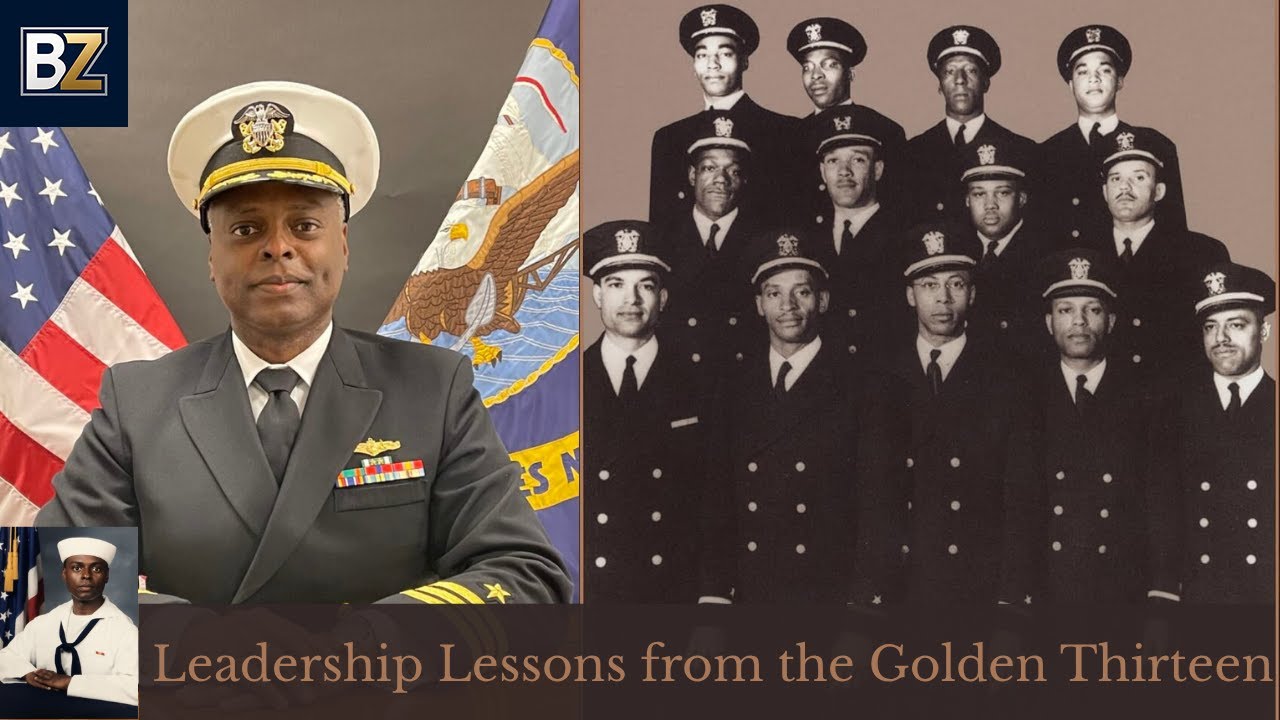
Commander Bob Fabien Zinga explores the Golden Thirteen, the first Black sailors commissioned as Navy officers in 1944. Deliberately given a brutal 8-week curriculum, all sixteen passed with a 3.89 GPA, the highest in Navy history, yet the Navy commissioned only thirteen and accused them of cheating. Zinga extracts four leadership lessons from their story: facilitation and trust, excellence as resistance, accountability to future generations, and devotion to one another.
Chapters
Hi, I'm John Maxwell. When the top companies in the world are looking for trainers, speakers, and coaches, there's one name that stands above the rest, and that's Maxwell Leadership. Our certified team members have gotten proven results for companies all over the globe, and our reputation, I'm proud to say, is second to none. Some of our members have risen to the top of their profession, including the one you're going to meet today. I proudly introduce you to my friend Bob Fabien Zinga.
Welcome to the Leadership and Success Podcast with your host, Coach BZ, where we help you lead with purpose and succeed with impact. If you're ready to grow into the kind of leader others want to follow, this podcast is for you. If you're determined to elevate your success and leave a lasting legacy, this podcast is for you. As my mentor, Dr. John C. Maxwell, reminds us, everything rises and falls on leadership. Our goal is simple, to inspire you, challenge you, and equip you with insights that can transform the trajectory of your leadership journey. Welcome aboard to another episode of the Leadership and Success Podcast with co-host Bob Fabien Zinga, Leadership and Success Podcast.
Thank you for joining us. And today we are going to be talking about the Golden 13, right, leadership lesson from the Golden 13. And before I do, as is our custom, we like to spend a moment, we call it moment of gratitude, just to be grateful. And for those who have watched the podcast this week, it has been very challenging for me to be grateful this week because of what happened on Tuesday, right, our commander in chief actually threatened to commit a war crime, the way he put it, exterminate an entire civilization. And as a sailor, that just doesn't go well with me. I've been having a very, very hard time trying to process it, right? Because when I joined the US Navy 21 years ago, Even when I was enlisted, we have to take an oath, right? Oath of enlistment or an oath of office. And as an officer, I said something like, "I, Bob Fabien Zinga, having been appointed an officer in the Navy of the United States, as indicated above, in the grade of commander, do solemnly swear that I will support and defend the Constitution of the United States." against all enemies, foreign or domestic, that I will bear true faith and allegiance to the same, that I take this obligation freely without any mental reservation or purpose of evasion, that I will well and faithfully discharge the duty of the office upon which I am about to enter, so help me God. So the last time I did this is when I promoted from Lieutenant Commander to Commander, so that was April January 1st, 2021. So that was 5 years ago. And I take this extremely seriously, and everybody in the military does. So again, my oath is not to a man, not to an institution, but to the Constitution of the United States. Our constitutions, our law, international law, the law of armed conflict, that is the oath I take. And I cannot imagine having a commander-in-chief, somebody who's at the very, very top of my chain of command, about to give an illegal, unconstitutional, immoral, and unethical order. And as a sailor, I just cannot obey an order like that. That's not who we are. We are not barbarians. We don't kill babies and children. We don't kill people who are unarmed. We are professional. We are not mercenaries. Right? We have values. In the Navy, our core values are honor, courage, and commitment, and it really means something. Since I joined the Navy again 21 years ago, even as enlisted, our sailors' creed, "I am a United States sailor. I will support and defend the Constitution of the United States of America. I will obey the orders of those appointed over me. I represent the fighting spirit of the Navy and those who have gone before me." to defend freedom, democracy around the world. I proudly serve my country's Navy combat team with honor, courage, and commitment. I am committed to excellence and the fair treatment of all. That is who I am at my core. I am a US sailor, and I support and defend the Constitution of the United States, period. And I've really never understood, 21 years I've been in the Navy, how the, uh, Office talks about enemies, foreign and domestic. I understand about foreign enemies, but domestic, like having somebody in your own chain of command, your Secretary of the Navy or Secretary of Defense, or the President of the United States, the Commander-in-Chief, uh, giving you an order that is completely unconstitutional, that is criminal. I, I couldn't even have imagined that in my wildest dream, but that's exactly what happened in this country, uh, on Tuesday. Our Commander-in-Chief threatened to do just that. And I still cannot really get my mind around it. So I'm having a little bit trouble this week being grateful or thankful. Now, I am grateful that we didn't commit a genocide. I'm definitely very, very grateful for that. But just that it was even a possibility, it is really messing up with my emotional health, with my mind, and I just cannot believe it. So be patient with me. Hopefully by next week I'm going to come back and we're going to be grateful every single time we meet. But, um, that was really shocking. It was a shock to my system. I guess my psychiatrist calls it, um, institutional betrayal. Uh, it goes against everything we represent, everything we are in the military, and it just doesn't make any sense at all. It's like the world is upside down. Uh, that's not who we are. We don't kill children. We don't kill babies. We We don't kill women, we don't kill unarmed people. We are professional. We are the US Navy. We are a force for good. We are not terrorists. We are the good guys because we have a moral compass. We have values, honor, courage, and commitment. That is who we are. All right, that's all I'm gonna say about that for now. So, um, I am going to play, um, it's gonna last about 30 minutes or so. So we're gonna be talking about an article I wrote about leadership lesson from the Golden 13. So those are the very first Black officers in the US Navy. We call them the Golden 13. So leadership lesson from the Golden 13, timeless leadership lesson in resilience, unity, and legacy. And I go through what happened, the circumstances that led them to become the first Black officers in the Navy, and what are the leadership lessons we can and should learn from it. Again, you can read the entire article, it's on my LinkedIn page. So for the time being, let me play the 30-minute summary of the article.
So when engineers want to find the, the exact breaking point of a new material, they don't just gently tap it. Right?
Right.
Yeah.
They definitely don't just like look at it under a microscope.
Exactly. They take it, they place it inside this massive hydraulic press, and they apply just thousands of pounds of pressure per square inch. And then they just wait.
They wait for the structural integrity to just completely shatter.
Yeah. It's clinical. It's, it's mathematical. The entire apparatus is literally designed to force a failure so the engineers can pinpoint the weak spots.
It's a stress test.
Right. But in January 1944, the United States Navy decided to run that exact same stress test on human beings.
Which is just wild to think about.
It really is. They took 16 Black sailors, gave them exactly half the time to complete this impossibly dense officer training curriculum. And they basically just waited for them to shatter.
But they didn't.
No. Instead, they broke the machine. And that's what we are unpacking in today's deep dive. Welcome in, everyone.
Yeah, glad to be here. Because this story, it completely upends our understanding of how institutions operate when they feel threatened.
For sure. Because when you apply that kind of deliberate structural pressure to human beings, you're testing vastly more than just their capacity to absorb facts or memorize training manuals.
You are testing their resilience. I mean, their dignity. You're testing their fundamental right to occupy a space that was architecturally, legally, and culturally designed to keep them out.
And the way these 16 men responded, it isn't just some, you know, interesting historical footnote from World War II.
Not at all. It is an absolute tactical blueprint.
Right. It's a blueprint for you, the listener. If you've ever been forced to operate inside an environment that is actively betting on your failure, this Deep Dives is for you.
Because it happens all the time today, right?
Oh, constantly. Think about it. Have you ever been handed a promotion or a new project, but you can just feel that the system around you is just waiting for you to drop the ball?
Like, they give you the fancy title, but, uh, they cut your budget in half.
Yes.
Or they give you the team but completely withhold the actual authority you need to lead them. That is the exact dynamic we are looking at today.
And we have some incredible source material for this. We are looking at a historical analysis by US Navy Commander Bob Fabien Zinga, who goes by BZ.
Along with insights from the book called The Golden Thirteen, which actually features a foreword by the late General Colin Powell.
And what Zinga does so brilliantly in his analysis is that he treats the story of these men not as distant history, but as an institutional receipt.
Okay, let's unpack this. Because to fully understand the magnitude of what these 16 men pulled off, we have to, um, We have to look at the Navy's math in the early 1940s.
Right. We are in the thick of a global two-front war.
Exactly. So you would assume that the primary directive of the military would just be to maximize every single ounce of human talent available to, you know, defeat the Axis powers.
You would think so, but the reality for African American service members was dictated by this deeply entrenched caste system. I mean, up until 1942, Black sailors were entirely pushed out of what was called general service.
Yeah, they were restricted to the the stewards branch.
Right.
And I wanna just break down what that actually meant on a day-to-day basis, because you join the military to fight fascism.
Uh-huh. Right.
And you are handed a serving tray.
It's degrading. Your entire military existence is structured around supporting white officers, serving their food, making their beds, maintaining their quarters.
You could literally be in the middle of the Pacific Ocean taking active fire from enemy aircraft, but your official capacity is still classified as a mess attendant.
Because it was a system engineered to utilize your physical body in a combat zone while systematically ignoring your mind, your tactical acumen, your leadership potential.
And it was legally codified. Like, there was absolutely no pathway to authority.
None. But then, by April 1942, the sheer crushing demand for manpower begins to override the Navy's commitment to that strict occupational segregation.
Because they're fighting in the Atlantic and the Pacific.
Exactly. They are literally running out of men to crew the ships.
So the Secretary of the Navy realizes, uh, we cannot sustain a global war while leaving an entire demographic of able-bodied men on the sidelines of the actual warfighting effort.
So necessity basically forces their hand, and they officially open up general service ratings to African Americans.
But I wanna pause on that for a second because calling it an opening up of general service feels honestly a bit generous. Oh, totally. It's kind of like, imagine a modern Fortune 500 company publicly announcing this massive, heavily PR-driven diversity recruiting initiative.
Yeah, I can see where you're going there.
They bring in all this incredible talent from all over the country.
Yeah.
But once those people actually walk through the doors, the company quietly enforces this unwritten rule.
Mm.
You are only allowed to work in the mailroom.
Or like in background IT support.
Yes. You are completely barred from the executive track, no matter how flawless your actual performance metrics are. The Navy wanted the bodies, but they wanted them contained.
That is precisely how it operated. The policy shift was a reluctant, mathematically necessary concession. Yes, they expanded access to general service, but they maintained strict, absolute segregation in the training pipeline.
And even after training, the deployment was severely throttled.
Right?
Severely. The Navy actively avoided assigning Black sailors to seagoing combat vessels. They were placed in stevedore battalions loading ammunition or assigned to shore details because the institution wanted the manpower. But they were terrified of the implications of Black authority, especially on a warship where survival depends on a strict chain of command. You can't have segregation in a foxhole or on a sinking ship.
So if you are a recruit in that environment and the system is explicitly legally telling you that your ceiling is permanently fixed, that you will never give an order, you will never steer the ship, how do you even muster the motivation to excel?
Right? Why excel when mere compliance is all that's expected or even allowed?
Exactly. I mean, why not just do the bare minimum?
Well, what's fascinating here is that you find that motivation in the environment, they inadvertently placed you in.
Wait, what do you mean?
Because the Navy mandated segregated training, they had to create a separate facility inside the massive Great Lakes training complex in Illinois. Oh, and they named this specific segregated enclave Camp Robert Smalls.
Wow. Okay, we have to talk about Robert Smalls.
Yes, we do, because whether the Navy fully grasped the irony or not, that name provided a profound psychological anchor for the men stationed there because his story is the ultimate counter-narrative to the idea of a fixed ceiling.
We were talking about 1862, right?
Yeah.
The middle of the Civil War.
Right. Smalls is an enslaved man forced to work as a pilot on a Confederate transport ship called the Planter. This is in Charleston, South Carolina.
And he doesn't just escape.
No, he studies the ship. He memorizes the Confederate captain's hand signals, the navigational routes, the placement of the heavily armed forts guarding the harbor.
He literally waits for the white officers to go ashore for the night, smuggles his family and the families of the other enslaved crew members aboard, disguises himself in the captain's wide-brimmed straw hat—
And literally sails the ship past Fort Sumter in the dead of night.
Giving the correct signals.
Giving the exact right signals until he reaches the Union blockade and surrenders the ship to the US Navy.
It is honestly one of the most audacious, tactically brilliant acts of self-emancipation in American history.
It really is. And Commander Zinga points out the sheer weight of that symbolism for the recruits at Great Lakes.
Oh, I can only imagine.
You have an entire generation of Black sailors being told by their government that their potential is inherently limited, that they are only fit to serve food or load cargo. Right. Yet they are eating, sleeping, and training in a camp named after a man whose entire legacy is about taking the wheel, mastering the machinery of his oppressors, and proving that those ceilings are an illusion.
So when the system doubts your humanity, you draw strength from a namesake who weaponized his own competence to break the ultimate system of bondage.
Exactly. It sets the perfect stage.
It really does. You have this highly pressurized atmosphere of reluctant integration simmering with this profound historical inspiration.
And that tension finally snaps in January 1944.
Right, because the Navy, under mounting political pressure from civil rights leaders, and the Black press finally cracks the door to the officer ranks.
They assemble 16 Black enlisted men at Great Lakes to see if they can become the first Black commissioned officers in the history of the United States Navy.
And this is where the institutional stress test begins.
Right.
Let's look at the mechanics of what the Navy actually asked these 16 men to do.
A standard Navy Officer Candidate School curriculum is brutal under normal circumstances. It is 16 weeks long.
Right. 4 months.
And it covers celestial navigation, spherical trigonometry, naval law, engineering, fluid dynamics, ballistics, damage control.
It is designed to take a civilian or an enlisted sailor and cram everything they need to know to command a warship into 16 weeks.
But the Navy looked at these 16 men and gave them exactly 8 weeks.
8 weeks? They literally cut the timeline in half.
Yes.
And I really want to push back on the official narrative here, because sometimes, um, Historical accounts frame this as wartime expediency, like, "Oh, we needed officers fast, so we accelerated the program." But if that were true, they would have accelerated the white officer classes too. Exactly. But they didn't. This was exclusive to these 16 men. It was mathematically designed to induce failure.
It was an institutional trap. As Zinga's analysis highlights, that 8-week mandate was not an efficiency measure. It was a calculated hurdle set intentionally so high and the runway cut so short that the only logical outcome the system expected was failure.
Because the institution wanted to be able to turn to the civil rights leaders, point to the failed test scores, and say, "Well, look, we gave them a chance." Right.
We tried, but they simply don't have the intellectual capacity to meet the standard.
It's sickening. So let's look at the human reaction to that kind of trap. If you put 16 ambitious, highly capable guys in a room and everyone knows the system is actively trying to weed them out—
Human nature dictates that you turn on each other.
Yes.
You start playing the odds.
Yeah.
You think, "Okay, the Navy is never gonna pass all of us.
They might pass 2 or 3 just for optics." So I need to make sure I outscore the guy sitting next to me.
Exactly. You hoard your notes, you keep your head down, you look out for number one.
But these men did the exact opposite.
Which is incredible.
They entirely rejected the premise of individual competition. They understood with absolute clarity that if one of them failed, The institution wouldn't just indict that one individual.
The institution would use that failure to indict their entire race.
Precisely. They realized their survival depended on a system of absolute, uncompromising mutual accountability.
And the mechanics of how they achieved that accountability is just staggering to me because they were in formal classes for hours upon hours during the day, right?
Yeah.
Right. They had virtually no time to synthesize the massive amount of technical data they were being force-fed.
And naval barracks have strict lights-out policies. You can't just stay up studying at your desk.
So the moment the lights went out and the guards began their patrols, these men took heavy wool blankets and taped them over the windows of their barracks to block any light from escaping.
And then they huddled together on the floor under those blankets and studied by flashlight.
You really have to imagine the physical and physiological toll of that. It's January in Illinois. It is It's freezing outside.
But they are huddled in this claustrophobic, oxygen-deprived heat under these wool blankets.
Whispering so they aren't caught by the roving watch. And they are physically exhausted from marching and drilling all day.
And yet they're drilling each other on the intricacies of the Uniform Code of Military Justice or the mathematics of celestial navigation while literally fighting off sleep deprivation.
It's just unbelievable dedication.
I look at what they built under those blankets kind of like a mesh network in computing.
Oh, that's an interesting way to put it. How so?
Well, in a distributed computing network, if one node doesn't have the processing power to solve a specific problem, it routes the data to a node that does, ensuring the entire system doesn't crash.
Right.
That's exactly what they did. If one guy had a background in mathematics, he took the lead on teaching navigation. If another guy had a background in engineering, he tutored the group on shipboard propulsion.
They didn't just study, they fused their brains together into a single, highly efficient processing unit.
Yes, they pooled their intellectual capital because they knew the institution was trying to bankrupt them.
And the output of that mesh network was mathematically undeniable. At the end of the 8 weeks, they sat for the exact same rigorous examinations that the 16-week classes took.
And what happened?
All 16 men passed.
All 16.
But they didn't just scrape by. They achieved an average class grade of 3.89 out of a possible 4.0.
3.89 in half the time.
Yes.
And according to the historical data cited in the source, that 3.89 was the highest average of any class in the entire history of the United States Navy up to that point.
Wait, really? The highest in history?
The highest in the history of the institution.
Here's where it gets really interesting, though. Because how does an institution respond when the group they deliberately designed to fail absolutely shatters the historical record?
They accuse them of cheating.
Of course they did. The system literally could not process the data. It was easier for the institution to believe that 16 Black men orchestrated some elaborate heist to steal the examination papers than to accept the reality of their intellectual superiority.
This is a critical juncture in the story because their response to this accusation is just the defining lesson in professional dignity.
Because being accused of cheating when you have sacrificed your physical and mental health to study under suffocating blankets is a profound insult.
It is enraging. But they didn't riot, they didn't storm the Kommandant's office, they didn't refuse to take the test on moral grounds.
Which is exactly what the system wanted them to do.
Exactly. If they had rioted, or refused the retest, the Navy could have dismissed them for insubordination.
And the narrative would have been, "Oh, they lack the discipline to be officers. They're too emotional." Right.
They recognized the trap within the trap, so they sat back down under microscopic scrutiny, and they retook the exams.
Man.
And they scored even higher.
They weaponized competence. That is the only phrase for it. Their response wasn't a protest or theatrics. Their response was just undeniable mathematical mastery.
They took the exact metrics the institution worshiped—test scores, regulations, discipline—and used them to completely dismantle the institution's foundational assumptions. He's brilliant. It perfectly illustrates the concept of excellence as resistance. In a system that is fundamentally designed to doubt your worth, arguing your value rarely works because the people judging you are operating from a premise of bias.
The debate is rigged from the start.
Right. But discipline, competence, flawless execution that holds up under the most unfair, aggressive scrutiny, it leaves the system with nowhere to hide. They didn't just meet the standard, they eradicated the standard.
But institutions don't just surrender their bias because you show them the math, do they? No, they don't. They always find a way to reassert control, to remind you who actually holds the power. And this brings us to what Commander Zinga highlights as the most painful paradox of this entire historical event. It really is heartbreaking. They take the tests, they break the record, they endure the cheating accusations, they retest, they score higher, the results are bulletproof. And yet, on graduation day, February 24th, 1944, the Navy makes an announcement.
They announce that only 12 men will be commissioned as ensigns, and one will be appointed as a chief warrant officer. That makes 13.
13 out of 16. So 3 men, Augustus Alves, J.B. Pinckney, and Lewis "Mummy" Williams, were pulled aside, denied their commissions, and returned to the enlisted ranks.
And the Navy provided absolutely no explanation. None. No official reprimand, no failed scores, nothing. Just a silent, arbitrary demotion.
This is the part of the history that absolutely infuriates me. Because if their entire ethos under those blankets was, We rise together or not at all. Why did the 13 accept the commissions? It's a tough question to sit with. Like, why not strike? Why not walk up to the commandant and say, "If Alves, Pinkney, and Williams don't get their gold bars, you can keep ours too." Wouldn't that have been the ultimate stand for mutual accountability?
It is entirely understandable why that feels like the morally satisfying response today. We want that Hollywood ending. But you have to contextualize the suffocating reality of 1944. Right. If the 13 had refused their commissions in solidarity, the Navy would not have suddenly realized the error of its ways and commissioned all 16.
They would've just shut it down.
The Navy would've accepted their resignations, charged them with insubordination or mutiny, and permanently closed the door to Black officers for perhaps another decade.
The institution would've spun the narrative again. See, they don't understand military order. They aren't fit to lead.
Exactly. So they were trapped. Accepting the 13 commissions was the— literally the only way to hold the door open, but it required them to swallow the bitter pill of leaving 3 of their own behind.
That is just the ultimate excruciating burden of being a trailblazer. Holding onto professionalism when history hands you an opportunity and an insult at the exact same time.
And the historical consensus on why the Navy did this is chillingly pragmatic. Acknowledging a 100% success rate at that unprecedented level of performance would have directly, undeniably challenged the foundational assumptions of white supremacy that the military was built upon.
It was too much reality for the system to digest all at once.
Exactly. By arbitrarily cutting 3 men, the institution retained its power. It allowed the Navy to say, look, we are progressive, we commissioned 13, But clearly, not all of them were cut out for it.
The system gave them a door, but strictly controlled how far it opened. Very strict. I just challenge you, the listener, to put yourself in the shoes of those 13 men on graduation day. You have just achieved the impossible. You have your gold bars. But as you are standing there, you look to the back of the room and see Alves, Pinckney, and Williams, the men who tutored you, who held the flashlight, who suffered under the same blankets, being quietly pushed back down into the enlisted ranks.
How do you ever celebrate your own success knowing what it cost your brothers?
You carry that tension for the rest of your life.
And Commander Zinga is deeply passionate about correcting this specific injustice. In his essay, he issues a public plea for historical accountability. Yeah, he's actively searching for them, right? He is. He's searching the archives and reaching out to the public for any photographs of Augustus Alves, J.B. Pinckney, and Lewis Williams. He notes the tragedy that we don't even know J.B. Pinckney's full first and middle names. Wait, really? Yeah, even the official Navy memorial only lists his initials.
Which perfectly encapsulates a massive lesson in modern leadership. True leadership is about remembering who actually did the work, who met the standard, even if the institution purposefully left them off the official slide deck.
We call them the Golden 13, but history owes a massive debt to the the full 16.
It really does. Yeah. But I want to ask about what happened next. Because if you are one of those 13 men and your immediate reward for breaking a historical record is— what? Did things change for them?
Well, we must recognize that even for the 13 who were commissioned, the victory did not end the discrimination. Their new rank came with immediate heavy constraints.
Because the Navy didn't actually integrate them into the fleet, did they?
No. They were largely assigned to oversee all Black stevedore units or to train new Black recruits. They were actively barred from the white officers' clubs.
So the social segregation remained rigid, it just had a slightly different flavor now that they were officers. This is a dynamic that translates directly into the modern corporate world. How often do we see people from marginalized backgrounds given a massive new title— VP of Diversity, Director of Innovation, But they are given zero budget, no direct reports, and no actual structural empowerment to execute the role.
It happens all the time. They are given the title for optics but kept away from the actual levers of power. Right.
So if you are one of those 13 men, did it actually matter? What is the long-term return on investment for that kind of profound personal sacrifice? If their immediate reward was limited authority and continued segregation, did it change anything?
If you judge the return on investment by what happened in February 1944 alone, it looks pretty bleak. Most of those men quietly returned to civilian life after the war, having never been given the chance to command a warship in combat. That's heartbreaking. But if you trace the generational ripples, the impact is structural and permanent. By the end of World War II, just a short time later, 64 African Americans had become officers in the Navy. Wow.
So the barrier had fallen.
The hull of the segregated institution was breached. It was a messy, incomplete integration, but the precedent was set and it could never be undone.
And the magnitude of that breach is captured perfectly in the book Commander Zinga reviews, right? The Golden Thirteen, edited by Paul L. Stillwell.
Yes. And it's not a dry academic textbook. It is a living archive. Stillwell tracked down the surviving members decades later and recorded oral histories.
So you get to hear their raw voices.
Their fears, the strategies they used under those blankets. The lived reality of carrying that burden.
And perhaps the most vital piece of context in that book is the foreword, written in 1992 by General Colin Powell.
General Powell writes something profound. He says the Golden 13 were not activists in the traditional sense. They didn't join the Navy to lead a civil rights march.
But they intuitively understood that history had dealt them a, quote, stern obligation.
They realized that if they held the line, generations of future military leaders would climb on their shoulders And Powell specifically notes that those generations included, in his words, a skinny 7-year-old kid in the Bronx named Colin Powell. I mean, that just gives you chills.
The future chairman of the Joint Chiefs of Staff, the man who would eventually direct millions of troops across the globe, explicitly acknowledging that his entire trajectory was made possible by 16 guys studying with flashlights under a wool blanket in Illinois.
And Commander Zinga draws that exact same line to his own career. He maps out his personal timeline, and it is a masterclass in generational progress.
Right. He entered Great Lakes, the exact same physical location where the Golden 13 trained as an E-1 seaman recruit in May 2005.
And because of the wedge the Golden 13 drove into the system, Zinga's progression was based on his actual merit. He was able to compete for a commission without the institution actively plotting his failure based on his race.
He commissioned as an officer in 2007 under President George W. Bush, and he pinned on the rank of commander in April 2021.
When he reflects on a pinning on that rank, he describes experiencing two realities simultaneously: immense personal pride in his own hard work, but also a deep, humbling generational gratitude.
Because he explicitly notes that sacrifice and discipline are not always enough when the system itself is structurally designed to deny opportunity.
Someone has to break the architecture of the system first.
Zinga's success is directly tethered to their 1944 flashlight study sessions.
But as a crucial piece of this historical mosaic, Zinga also introduces us to another hidden figure, someone who fought the system long before 1944.
Oh right, Lieutenant William Lloyd Garrison Payne.
Yes. Often, the Golden Thirteen are viewed as the absolute of the first Black men to hold officer authority in the Navy, but Payne's story complicates that timeline in a fascinating way. How so? Payne was born in 1881 to a white mother and a Black father. Given the absolute rigidity of racial exclusion in his era, historical research suggests he may have passed as white in order to serve and advance.
And his record is staggering, isn't it?
In 1918, during World War I, he commanded the USS SC-83. For context, Submarine chasers were small, heavily armed wooden ships designed to hunt deadly German U-boats.
It was incredibly dangerous work.
He earned a Navy Cross for valor in combat, and by 1919, he had attained the rank of lieutenant.
Payne's story just highlights the agonizing choices forced upon brilliant individuals in a segregated society. Payne likely had to erase parts of his identity to bypass the institutional barriers and prove his tactical brilliance.
While the Golden 13 couldn't pass, their presence was an overt, unavoidable challenge to the system. Both represent different, necessary phases of dismantling institutional exclusion.
So what does this all mean? I kind of see it as a relay race. Yeah. The Golden 13 didn't get to cross the ultimate finish line of full equality, but they forced the officials to let them run the first leg of the race.
Successfully passing the baton to the Colin Powells and Bob Zingas of the world. Exactly.
Which brings us to the most critical part of this deep dive. We have unpacked the history, the physiological toll of the stress test, the massive generational ripples. But if you are listening to this on your commute or while you are prepping for a boardroom meeting, you are likely dealing with your own modern version of an impossible hurdle.
You need to know how to apply this tomorrow morning.
Right. And Commander Zinga distills the Golden Thirteen's playbook into 4 highly tactical pillars for leading under pressure.
Let's examine pillar number 1, leadership. Zinga defines this not as exerting authority, but as building trust under pressure and then making that trust contagious.
Creating conditions where your people can win when the environment wants them to lose.
Exactly. The Navy gave them a curriculum designed to be an individual performance evaluation, a tournament where only the strong survive. They actively chose to subvert that tournament and turn it into a cooperative system. Think about this in a modern corporate setting.
Let's say you are a middle manager and there's a massive corporate restructuring. Your department's headcount is slashed by 30%, but executive leadership demands that you deliver the exact same Q4 product launch on the exact same timeline. The pressure is immense. The natural instinct in that environment is to turtle up, You protect your own metrics, you micromanage your remaining staff, and you let the weak links fail so you can blame the headcount reduction.
But the Golden 13 model demands the opposite approach. When external pressure spikes, you shift your paradigm from competition to facilitation.
True leadership in high-stakes environments is about creating the conditions where your people can win, even when the external environment is actively trying to make them lose.
Zinga anchors this with a verse from the Gospel of Matthew. Whoever wants to become great among you must be your servant.
I love that. If you are that manager, ask yourself, what are the flashlights and blankets you are providing for your team? When the budget is cut or the timeline is slashed in half, are you defaulting to authority or are you getting down in the trenches and studying the material with them?
Are your daily actions proving that you are for your team rather than just positioned above them?
Which flows perfectly into pillar number 2. Excellence. Let preparation speak when the room doubts your right to be there.
We discussed the cheating accusation and how they responded with even higher scores. Excellence in this framework is not about neurotic perfectionism; it is about a calculated, disciplined competence that serves as the ultimate rebuttal to doubt.
Picture a young female software engineer walking into a room full of older male executives, to pitch a new system architecture. She knows before she even opens her mouth that they are underestimating her technical depth.
They are waiting for her to stumble. If she gets defensive or argues about her credentials, she loses the room.
But if she projects her CAD models, walks through the math without a single stutter, and answers every technical challenge with flawless data, she weaponizes competence. She lets the preparation speak.
Zinga offers two incredibly sharp coaching prompts for this pillar. Ask yourself, am I preparing at a level that matches the responsibility I seek? And if my work had to speak for me today, what would it say?
Wow. If my work had to speak for me today, what would it say?
That's powerful. When you are walking into an environment where the bias is thick, your loudest argument isn't your voice. It is the undeniable microscopic quality of your execution. Make sure your math is flawless.
Pillar number 3 is accountability. Carry the mission and the meaning of the mission. Zinga notes that when a first occurs in an unequal system, that person becomes a symbol, whether they ask for the burden or not.
The Golden 13 knew they weren't just memorizing naval law to get a paycheck. They were carrying the hopes of future generations.
Accountability isn't just checking off a project management dashboard. It is owning the execution and understanding the long-term impact of your presence in that room.
If we connect this to the bigger picture, this brings us back to the title without power scenario we discussed earlier. The tension of modern organizations where responsibilities expand faster than real empowerment. Right.
If you are hired to turn around a failing department, but you are denied the budget to hire new talent, you are caught in a massive tension. The Golden 13 experienced the ultimate version of this given officer rank but forced to command segregated units.
So how do you operate in that tension? You hold the line on your integrity. You focus on the why.
You keep integrity intact inside that tension.
Exactly. You may not be able to fix the entire corporate structure in one quarter, but you can ensure that the team directly under you is protected, mentored, and developed. You carry the meaning of your mission, ensuring that the next person who takes your role inherits a slightly wider door than the one you walked through.
And that requires the final pillar. Pillar number 4: Devotion. Stay devoted to service, but intensely devoted to each other. We rise together or not at all.
Zinga makes a crucial distinction here. Their devotion was not blind loyalty to a system that hated them. It was a fierce loyalty to the mission, to their own professionalism, and to each other's survival.
In a modern workplace, toxic management often tries to survive by splitting teams apart. Forcing stack ranking systems where employees have to compete against their peers for a limited bonus pool.
Devotion is the antidote to toxic stack ranking. It asks you, are you as committed to your peers' success as you are to your own?
If a colleague is drowning in a project, do you let them fail so you look better by comparison, or do you pool your knowledge and pull them up?
Devotion is the glue that transforms a group of stressed individuals into a legacy-building organization.
These 4 pillars, Leadership as facilitation, excellence as resistance, accountability to the future, and devotion to each other. They are not abstract philosophical ideals. They are daily, gritty disciplines forged in one of the most high-pressure environments imaginable.
Absorbing these lessons isn't just about advancing your own career. It's about paying the rent on the space you currently occupy.
Because none of our lives are written on a clean slate.
When you look at the entire complex arc of this history, from the enforced legal segregation of the stewards branch —to the psychological anchor of Robert Smalls, to the claustrophobic 8-week crucible under those wool blankets, and the profound lingering sting of seeing Alves, Pinckney, and Williams left behind it—is a towering testament to collective resilience. It really is. You, the listener, may never face the precise codified barriers that these men faced in 1944, but you will inevitably walk into rooms that doubt your right to be there. The playbook is exactly the same: excellence, collective accountability, and quiet dignity.
At the top of this deep dive, we talked about engineers putting materials in a hydraulic press, forcing failure to find the weak points.
And the Golden 13 absorbed the full crushing weight of institutional pressure. They insulated each other, and they forged themselves into a material stronger than the machine designed to break them.
But we cannot walk away from this history without acknowledging the cost of that forging.
History always tempts us with a clean, triumphant narrative. But the reality of progress is rarely clean, and it is almost always painful.
We rightly build statues for the trailblazers. We celebrate the firsts who get the titles. We celebrate the Colin Powells and the Bob Zingas who get to operate in the sunlight. We celebrate the 13 who got the gold bars. But I want you to sit with the reality of Augustus Alves, J.B. Pinkney, and Lewis "Mummy" Williams. The three left behind. They absorbed the exact same pressure. They met the exact same impossible mathematical standard. They did the work in the dark, and they were still denied the rank.
It's a heavy thought to end on.
It is. As you navigate your own career, as you build your own teams and climb your own ladders, ask yourself, how many undocumented pioneers are silently holding up the ceilings that you walk so comfortably under today? And more importantly, when you finally get the title, The budget and the power. Whose ceiling are you going to help hold up tomorrow, even if history never records your name?
All right. This is it for today. This was the podcast about the Golden 13 leadership lesson. From the Golden 13. Again, I encourage you to read the article. It should take about maybe, I don't know, 15, 20 minutes to read on my LinkedIn newsletter. And I also want to remind everyone that tomorrow I will have two podcasts. One will be my regular podcast with, I can't hardly wait, Dr. Raquel Knotts, and she's a transformational leadership coach like me. A Maxwell Leadership Certified Coach. We're gonna be talking about leading on purpose, the power of intentional growth. And then at 6:00 PM tomorrow, 9:00 PM Eastern time, I will have the pleasure of again spending time with Daniel Leong. He's gonna be my industry guest expert to be speaking to the student in my class, California Science and Technology University. So this is a little bit different. An hour-long regular podcast, but it's going to be 20 to 30 minutes top. And basically it's going to be like a TEDx talk he's going to give to my students. He's going to be talking about "Honor Mode for Future Leadership: How to Stay Human in an Agentic AI World." So I bring in a guest industry expert to talk to my engineering and MBA students. And I want them to look at practitioners, people who actually practice cybersecurity engineering or lead businesses in the real world. So that's going to be a treat for them. Basically, it's going to be recorded tomorrow on my podcast. And then I'm going to play the video for the student during our next session. Okay. And just, you know, quick reminder, Season 5, Episode 26, that's when I actually had an hour-long interview with Daniel D. Young, again, a system architect. We talked about turning value into daily non-negotiable actions. So, I encourage everybody to go back and listen to that. All right, as everybody knows, we always celebrate Black History Year now because we felt like Black History Month was just not long enough. So, I like to do two things about that. One, I like to talk about a first in Black history, but also something that happened on this date. So if I share my screen and I have the post, you can read the full post, but I ask who was the first African American to serve a full term in the U.S. Senate, and the answer is Blanche Kelso Bruce. And this is what he looked like. I think I have a picture right here, but you can go from Mississippi, right? Uh, you can, you can go to my post on LinkedIn and find more about him. Now, on today's day— today's, uh, April 11th— so on April 11th, 1913, uh, something really shameful happened in our country. Leadership reinforced division instead of unity, right? April 11th, 1913, President Woodrow Wilson authorized policies that would formalize racial segregation within the federal government. It really marked a pivotal and painful moment in American history. That was extremely shameful. I guess our president was a racist back then, but that is our story. And again, we cannot whitewash history and pretend that things that happened didn't happen. They did happen, and hopefully we learn from that. So as I sign off today, I'm going to play a short video. It's about 2 minutes about this shameful time in our American history. April 11, 1913.
On April 11, 1913, recently inaugurated President President Woodrow Wilson received a plan from Postmaster General Albert Burleson to racially segregate the railway mail service. Mr. Burleson said that he found it intolerable that white and black employees had to work together and share drinking glasses and washrooms. That sentiment was shared by others in President Wilson's administration. By the end of 1913, black employees in in several federal departments had been relegated to separate, or screened-off, work areas and segregated laboratories and lunchrooms. In addition to this physical separation from whites, Black federal workers were appointed to menial positions or reassigned to jobs slated for elimination. Although implemented by his subordinates, President Wilson defended racial segregation segregation in his administration as in the best interest of blacks. Segregation in federal employment was seen as the most significant blow to black rights since slavery and seemed to signify official presidential approval of Jim Crow policies in the South. After backlash that included organized protests by the NAACP, segregated Discriminatory signs were removed, but discriminatory customs persisted, and there was little concrete evidence of actual policy reversal.
Thank you for tuning in to the Leadership and Success Podcast with your host, Coach BZ. If today's episode added value to your leadership journey, be sure to subscribe, share, and join us again for more wisdom nuggets on how to lead better and achieve greater success. Remember, leadership is the most critical skill of our time. The world will always need leaders to inspire others, drive innovation and execute meaningful strategy. So why not count yourself among the bold leaders shaping the 21st century? Until next time, stay inspired, stay committed, and keep leading with excellence.
More from Bob

S250:E4🎙️LIVE 🇺🇸America 250: President Barack Obama Leadership, Service, and the Power of Hope






S5:E157🎙️ LIVE with CMD CMSgt Dennis L. Fritz, USAF (Ret.)(Multi Tracks Audio)



S5:E156🎙️ LIVE 🇪🇸 Leadership Lessons from the FIFA World Cup 2026 Champions (Multi Tracks Audio)

S250:E3🎙️ LIVE Leadership Lessons from America’s First Documented Family of African Descent 🇺🇸📖