S5:E86🎙️ 🔥 LIVE with Sergeant Douglas P. Pflug, Guelph Police Service (Ret.) (Multi Tracks Audio)
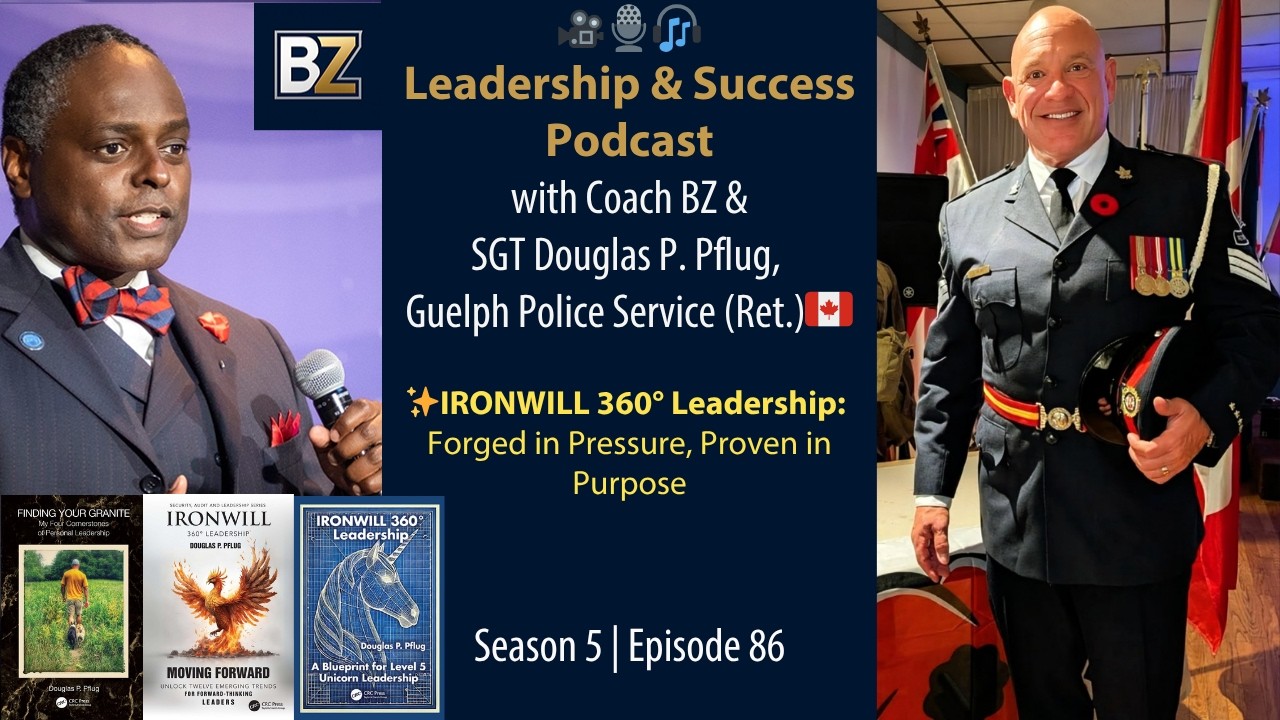
Retired Guelph Police Sergeant Douglas P. Pflug discusses his 30-year career, PTSD recovery through service dogs, and leadership frameworks like Iron Will 360 and Level 5 Unicorn. He wrote three books with proceeds funding PTSD charities and urges first responders to seek help.
Chapters
Hi, I'm John Maxwell. When the top companies in the world are looking for trainers, speakers, and coaches, there's one name that stands above the rest, and that's Maxwell Leadership. Our certified team members have gotten proven results for companies all over the globe, and our reputation, I'm proud to say, is second to none. Some of our members have risen to the top of their profession, including the one you're going to meet today. I proudly introduce you to my friend Bob Fabien Zinga.
Welcome to the Leadership and Success Podcast with your host, Coach BZ, where we help you lead with purpose and succeed with impact. If you're ready to grow into the kind of leader others want to follow, this podcast is for you. If you're determined to elevate your success and leave a lasting legacy, this podcast is for you. As my mentor, Dr. John C. Maxwell, reminds us, everything rises and falls on leadership. Our goal is simple: to inspire you, challenge you, and equip you with insights that can transform the trajectory of your leadership journey. Welcome aboard. Welcome to another episode of the Leadership and Success Podcast with Coach BZ.
Hey everyone, I just wanted to reach out and let you know that today is September 23rd, 2020, and it's my 54th birthday. Today's been the most amazing day when you can see with the weather, but more importantly, these small acts of kindness that so many people have done by sending me birthday wishes, texts, Facebook messages, LinkedIn messages. It's truly a humbling time for me and a very incredible experience. I always challenge everyone in my sphere of influence, whether it's personal or professional, to make a stranger smile because you have no idea how those small acts of kindness can unleash some incredible human potential. That being said, I'm the friend of many of you and know that even though I'm not a stranger, you certainly made me smile today. You've made me humbled, Honored, loved, and I just can't really speak or articulate how incredible today has been. I do have another challenge for you. The power of 10 is pretty important, and we look in a lot of sports or a lot of different grading scores where 10 out of 10 is perfect. Well, I've got the power of 9 right now I want to issue you. You've made me smile, so that's one smile today. I want you all to reach out to 9 other people through your social media. And please let them know how important they are to you. Let them know they're loved. Let them know that you care for them, that you're thinking about them. So let's make the Power of 10 on my birthday a pretty special thing. We all have the ability to reach out to people through this COVID time where people are depressed, people are sad, people just aren't living the life that they want to be. Knowing that they matter and possibly giving them hope to live another day or to pursue something they need to do is an incredible gift that we can all give to them. So today, you all gave me an incredible gift of kindness, love, respect, and just reaching out. So let's extend that to 9 other people today because as soon as I hang up here, I'm going to go out and do it to at least another 20 people. Let's all get out there and make strangers— All right.
The power of 10. I hope you all practice it. So first, I am sorry we started late today. I was having some technical difficulties, but we are back online now. And thank you so much for watching. And I had a previous podcast this morning and I was just so grateful that not only do I stand on the shoulder of giants, but it is also so fulfilling to see how many other people who have come behind me now kind of stand on my shoulders too. So, it's kind of beautiful to see it going kind of full circle, right? You received help and support from so many, many, many people. And then in turn you help other people too. So I am really, really grateful for that. So without any further ado, let me see if I can properly introduce our guest today. I am really privileged and honored to be speaking to Douglas today. Sergeant Douglas P. Flagg is a retired 35-year-old law enforcement leader, executive coach, elite performance trainer, and PTSD advocate who has lived leadership in environment where decision carry real consequences. So from the frontline of policing to coaching elite athlete to rebuilding his life after PTSD, Doug doesn't just talk leadership, he embodies it. He's also the author of the bestselling books, Iron Will, 360 Leadership: The Series, A Blueprint for Level 5 Unicorn Leadership, and Moving Forward, and also Finding Your Grand Knight. So without any further ado, please help me welcome to the Leadership and Success Podcast, the one and only Doug Plog. All right. Good afternoon, Doug. How are you doing today?
Wonderful. And thank you so much for having me. I think today we're going to change people's lives.
Yes, yes, yes. I believe that is definitely possible. Sometimes it just takes one idea, doesn't it? Is there something you are grateful for today, Doug?
I'm actually grateful that I have a lot of friends and family who stood by me when I was at my darkest through the, the travels of PTSD. I am because they cared, and, uh, you know, they— a lot of times when I said I can't, they said you can. And I'm grateful to have people that really truly care about me and let me know that I matter.
That is, that is so important to really have those relationships and people who care about you. I remember during our COVID-19, right? A lot of people, I think, in the Bay Area, they started to realize that, you know, work and money isn't really all that's going to satisfy you, right? It's really your relationship, family, and friend that is really what keeps you going, isn't it?
It was. And, you know, the neat thing with COVID as much as it locked a lot of people down, what we were doing is we were finding on a Saturday and Friday night, we'd have 3 mini dates with people we hadn't had a chance because our lives were so busy. So we would have a glass of wine with another group of friends. That way we could do 3 different couples and we really got to see our friends way more through COVID, through online than we did in person.
That is really amazing. Is there something about you that most people may not know when they first meet you?
I think sometimes people look that I'm 6'1", 225 or 240 pounds and they just assume, they make these assumptions. But what people might not know is I have an incredibly big heart. I take things very personal, and I literally want to make a stranger smile every day and save people's lives because for me, it's about legacy, and I truly want to make a difference. And sometimes I'm really too hard on myself for that.
Hmm. So let me ask you this. From the introduction, right, you've really led in an environment where decisions carry real consequences. Now we're talking about policing, uh, elite sports leadership development. Uh, what does leadership mean to you when lives, not just outcomes, are on the line?
What I did quite a while ago is I established a mantra for myself, and it's quite simple. I always want to lead with my best self. I want to model the behavior I seek from others, and I always want to create an environment where other people can succeed, because leadership is not about me, it's about we, and then later on about us. And through that, I found out that basically we need to create common chaos. In law enforcement, high-leap sports, or wherever you go, generally you're gonna go into a conflict situation. And if you go in there and create calm, calm is contagious, where your emotions control every, your survival tools. But if you come in there as a leader in chaos, you're gonna reduce and erode all those aspects away, and it's gonna be a free-for-all.
Wow. And it's also so true, people tend to follow their leaders, no? Even in cybersecurity or technology, if there is some type of breach or incident or something, and the leader is like, "Oh, the world is on fire. I am so anxious," then everybody on your team is going to feel exactly the same way. So shouldn't we really model what we want to see? Or I guess in the Navy, we always say that we don't always step up to our potential, but we always fall back to our training. So we pretty much train the way we fight. But isn't especially if you are the leader of a team. It's pretty important, right, for you to model what you want to see throughout your organization.
Very much so, because if anything, it shows authenticity that if you tell people to do one thing, yet you do the other, then you've lost them, and then you've lost the case. If you are doing what you say and you model what you say, people are gonna see success. They're gonna trust you. They're gonna be inspired by you, and they're gonna move forward and help people.
Wow. Now, one thing you have said, and I had at least copies of your two latest books, something you say a lot is pressure doesn't build leaders, it reveals them. What do you mean by that?
I look back very young in my leadership career, and I found out that when I got into leadership roles, it exposed my need for approval instead of conviction. And for some situations, I tried to belong to a team before I had the right to be there.. And with that, it forced me to really build some internal standards when external standards validated, disappeared. Sometimes I had some great leaders, sometimes I had some bad leaders, but at the end of the day, I needed to establish who I was, what I wanted to be, and how I move forward. And the practice is very simple. I took the good things that I saw, I took them, I tweaked them, I made them my own, and I made them better. And I hopefully I move forward positively. And anything that I experienced was bad, I did the opposite because I knew how it failed and how I felt. It wasn't that hard. But if anything, for me, it was creating a template and a format for which I could be successful and share that with people and hopefully coach, counsel, and mentor them to be successful in the same way.
Yeah, I guess the million-dollar question has been, are leaders born or are leaders made? Can you take us back before the badge, before the books? Who was Doug before Leadership Foundational?
Unfortunately for me, I grew up and I was quite stubby. I was bullied a lot. I have a last name. It's Doug Flug, but people would say Doug Plug. I was beaten up by a lot of kids. I wasn't one that would go out and fight. I was a very emotionally aware young man at a very young age of time. Being raised— I'm 60 now— in a world where real men don't cry, suck it up, and all those types of things, I didn't flourish in those relationships because I didn't believe about leading with my fist. I wanted to leave with my heart. But in the end, what happened is I really learned that being empathy is, or vulnerable is, is a superpower. And I went from being a bullied kid to later on being very successful. And I really want to make sure that I want people to know that they can do better. And even if you experience bad things, always think, what am I going to learn from this and how is it going to make me better moving forward?
Well, thank you so much for sharing this, because I think a lot of people, especially when they are kids, they do get bullied. A lot. So, you've experienced bullying, adversity, and loss early in your life. Can you maybe share how that made you feel and kind of what you learned through that experience?
I can remember back in grade 5, 2 guys beat me up in our townhouse complex. I remember their names. I remember their faces to this day. And we're talking, that was like, geez, 55 years or 50 years ago. But I remember laying there freezing cold, beaten, bloody, and I remember how irrelevant I felt. I remember how unseen that I was. I remember being lost. I remember being laughed at and defeated. And then several years later, I went to grade 7 and grade 8, and my teacher at that time saw my last name and called me Fatty Fluke, a piece of welfare trash who's never going to amount to anything. And that shut me down because I thought these— I was raised to respect teachers and persons of authority and a person that was supposed to elevate me, make me feel good about myself. Actually was just as bad orally and verbally and emotionally to me as those two guys who beat me up in grade 5. Luckily for me— well, sadly for me— grade 7 and 8, I really didn't play any sports. Grade 9, I didn't play any sports. But in grade 9, in the spring, I remember playing touch football in the end zone at our high school football stadium. And an incredible man, Mr. John Cater, saw me. He was the high school football coach. He saw that I had some skills. And he was one of the very first people outside my parents that showed me and taught me that I have value. And as a result of that, that's why I have gone to be the type of man that I am. You know, by the end of high school, I was captain of the football team, the wrestling team, the track team. I finally grew. But one of the defining times in my life, and I don't know if a lot of listeners will remember, I think it was '84, '85, I had a young man. He was being picked on in our school. He was Indian descent. And unfortunately, there was some racial, racial behavior in my school. And I remember physically fighting 2 or 3 guys who were smacking him around, and I beat the snot out of those 3 guys because I realized it wasn't right. The sad thing for me is I went to high school, summer school that year for math. And back in those days, the radio station would say, ladies and gentlemen, we want to interrupt you. And they interrupted us with the story that my best friend was blown up in the Air India crash and he and his sister were killed. And I felt crushed that all of these years I tried to protect him.. And in the end, bullying took him away. But at that time I said, I need to find my leadership voice now. I want to be a university football player. I want to be a teacher or a police officer because I need to extend this. I really felt in Ram's honor I needed to go out there and save more people. And that's been the beginning of my journey.
Wow, that is really amazing. Basically, you lost your voice as a young man, but then you turned that around and today you are giving people their voice back as a leadership coach. One thing I sometimes wonder about is how life happens to us all, but you would see two people relatively same background, sometimes even from the same family, and they go through the same exact challenges, but one of them is just going to crumble and pretty much be paralyzed and destroyed, but while somebody else like you, you will just thrive and be a better version of yourself. Why do you think that is?
I'm a Christian, and right from the beginning when I was born, within 3 years, my parents were told that I was going to die twice because of different medical situations. And I remember one time he listened to my dad, and when the doctor said the second time that I was okay, he raised his fist and said, that little sucker is not going to die. I honestly believe that I'm not saying I'm anything better than other people, but I believe that all the adversity I've faced in life had to train me and bring me into a mindset with lived experience to help people. And when I look back now, even with PTSD, I don't look at it as a negative. I look at it as a springboard or a key to a door that I can use to help people. And I kind of qualify my life now as battle born, tried, tested and true. And at the end of the day, if anyone wants me to coach, counsel, or mentor them, they're going to have all this lived experience of some successes, a lot of failures, but it's going to be real and it's going to be authentic. And for me to give someone their voice back, that shifts for me. They're becoming a victim to be the first step to being a survivor, and it gives them power to move forward.
Wow, I really love that. And something you said earlier, right, especially for young men, I think. We tend not to be vulnerable or show any emotion. It looks like your father and my father must have been best friends growing up because my dad said exactly the same thing when I was a little boy, right? Men do not cry. And, you know, if you're crying, I'm going to give you something to cry about. It's all a bunch of nonsense, really. But that's just the way Ian grew up. I guess you can only give what you have received. But can you maybe help, especially the young men who might be listening right now? When did you realize that vulnerability was actually a strength? Actually, you called it a superpower. How did that happen for you?
You know, I went through some counseling because I was trying to figure myself out. You know, my mom was amazing that way where she was ultra-EQ. And I went to a counselor. It was an interfaith Christian-based thing. But they told me to think outside myself, and it was okay to hurt. It was okay to be scared. It was okay. All of these things that toxic masculinity said— real men don't cry, you're not allowed to be scared, tough it up, you know, be a man— all that stuff, whether it was right or wrong, it was not the right thing for me. And through the counseling sessions that I went to, I learned it's okay to hurt, it's okay to cry. And if anything, they taught me that when you're scared, that's good because you care about the outcome. And I've taught that to a lot of my athletes, that before a game, I want you to be scared because if you're scared— I was scared before this podcast— if you're scared, you care about the outcome and you're generally going to be able to bring yourself. And that was a very pivotal time for me where, you know, we don't have to have all this toxic masculinity crap. It's— we're men by biology, but let's be human beings by practical application and who we are and what we stand.
Well, that is really powerful. And I think such insight could potentially change the life of somebody who is listening right now. Because another thing I want to talk about is PTSD. You openly speak about your experience, which I think would help a lot of other people, but especially, you know, for first responders, the police force, the military. I feel like a lot of us may have PTSD but have just not been diagnosed yet. Like, I started sharing that with members who follow this podcast. I was diagnosed when I came back from my last deployment to Djibouti. But it's really amazing how you could be suffering in silence or even don't really understand what is happening to you. You don't even know how to describe it. I guess the question I have for you then is, being open with your battle with PTSD, what was maybe one of the lowest moments and kind of what pulled you back?
Well, it breaks down to 3 for me. I started policing in 1989, and by, I think, '91 or '92, I got a call for service on Devil's Night, which was October 30th. It was someone had thrown a mannequin in the leaves on one of the streets in town. As I'm driving there, I'm thinking, okay, I'm going to pick the mannequin up, put it in my trunk, take it to property, move forward. When I got there, it was a dead, crushed 12-year-old little boy who was playing in the leaves. And I remember later on that night when we lifted his little body onto the stretcher, I had big alligator tears coming out of my eyes. I'd never seen a dead child. I'd never seen something like this. And I went back behind our major command vehicle and, you know, started to cry a little bit because I learned crying is okay. Gentlemen out there, crying is okay. And I was spun around, kind of grabbed by the shoulders, pushed against the vehicle.. And my coach officer, who was an idiot, said that they hired me to fight like a man and not cry like a baby. And at that time I started to— because that's what I thought policing was. We suppress everything. We drank it away. And then in 2007, I had another infant that passed away. And I did the wrong thing where I started to self-medicate with alcohol, which was wrong. And then I started really suffering with lack of sleep. I had classic PTSD, but it hadn't even been labeled at that time. Let's not forget, too, that I grew up as an '80s kid and watching the TV show M*A*S*H, they would talk about people that had shell shock and they would make fun of them. But shell shock was PTSD, was just undiagnosed. So in 2007, I started to plan my exit thinking I could take my service revolver home. Then I got some really good help from the Homewood Health Center in Guelph through some counseling. And was doing fantastic. And then here we were, 2023. I just had some adversity creep up, kind of like, you know, like a snake biting your ankle. And I crashed tremendously. And I was at 2023. I was finally diagnosed with PTSD. And it was accumulative in the sense that, you know, I totally respect our military, but this wasn't like a 6-month deployment that I went over, saw some terrible stuff and came back. This was day in, day out, 12 hours a day of trauma, trauma, trauma, trauma, call to call to call to call. Well, you never gave yourself a chance to debrief or even understand a lot of the things that we're dealing with. And I ran from myself. I hid from myself. But you can't do that. And eventually, when you run and hide from yourself, one day you're going to look in the mirror and you're not going to see who you are and you're going to crash. And I'm thankful now I've got the proper supports. I have a service dog. That was the little dog that people saw at the beginning.
Yes.
My lovely wife, Michelle, she's a retired police officer. I have the supports in place and the systems and counseling. So if I do fall next time, I don't have to get up by myself. I'll have a system and friends that will actually put out their hand and help me up.
Wow. Thank you so much for sharing that, because I'm thinking about my own experience. I found out years later, mine started— I was on board the USS Essex. I was a Lieutenant JG at the time. That's the first time I saw a dead body. One of our sailors pretty much jumped overboard because he got bad news from his— I think his wife was cheating on him or something happened, and he felt like he didn't have any hope, and he killed himself. And when we were able to recover his body, it turned kind of purple. I've never seen anything like that. But kind of like what you said too, right? Because the mission does come first. We do have to accomplish the mission, and I feel like our group didn't have time to grave, and we just had to go back. It's not pretty much 20 hours a day at the temple, and there is a lot of things we had to do. But, but, uh, and I know, no, we have some chaplains that try to help us as, as much as, as they could. But, but later on, I found out that's really where my PTSD started, but then it revealed itself many, many, many years, uh, later. And, uh, What would you say? Again, it happens to men, it happens to women, but from my experience, I feel like women, when they go through suffering, I've learned from my wife and my two daughters, they don't have any problem saying, "Hey, I need help. Something isn't right. I need to talk to somebody." But most male I have seen, especially in the military, we try to be bravado, alpha male, and all of that, and we really suffer in silence. What would you say to a young man who's listening to us right now who may be going through some emotional challenges and doesn't really want to speak up and say, "Hey, I think something might be wrong and I may need some help here." And this is something I do and I will offer it to all of our listeners and viewers.
Call me. There's nothing wrong with— In Canada, we've got a January. It's called Bell Let's Talk. And you get all these celebrities talking on mental health issues and just different things that they went through, because whether you're a police officer, military, elite athlete, there is stress, there is adversity. But if you figure out and you feel that you're alone, that I'm the only guy who's ever gone through this, or my dad or my brother, they're tougher than me. If you hide behind that, you're never going to get help. But I think we in positions of power, we that are in positions of being out there like we're doing by sharing our story with people, maybe someone's going to go, hey, I'm just like him. And maybe through our strength and vulnerability, that's gonna help them call us and take that first step. And that's what giving a voice to someone silenced by PTSD is being that authentic person that they might say, hey, maybe I can get that guy or that girl to help me because men were raised in this toxic masculinity stuff. It didn't have a purpose, but you're seeing a lot of first responders and military die by suicide now because they're so scared to come forward because, well, then I'm weak, I'm broken. Well, I was weak, I was broken, but I'm on the other side of that now. I'm still gonna fall one day, but I want people to gain strength from my story. And that's where lived experience is important. If you and I speak from a textbook, people are gonna go, you don't know where I'm coming from, you don't know how I feel. But in you sharing your story, me sharing mine, we have a connection there that most people don't have a connection because we know what each other went through, different scenarios and synopsis, but we know what we went through. And the lack of a critical incident debrief shut my life down as it did yours.
That is so powerful. And also the power of empathy and really learning how to deal with your emotion, especially as a leader, because you really do affect the lives of the people who are under you, whether you realize it or not. Isn't it right?
Yeah.
Wow. But now, from your story, there was a point though where you nearly reached a breaking point. And that's part of the reason why when I start the show, I always start with what I call moment of gratitude. Just take a few moments, just think about one thing you are grateful for. I feel like that is so important. Like, I don't know what it is in Canada, but in the US, in the military, service member and veterans, about 21, 22 people who commit suicide a day, every single day. I mean, this is just crazy. And if we could just give hope to someone, I guess going back to your story, what did that moment teach you about leadership, not just about other people, but really about yourself when you nearly reached the breaking point?
Back in those days, we didn't have critical incident debrief. And I remember it was my mom. She's like 5 feet tall, just a short little thing. She came and saw me in what I had become, 6 or 7 days of lack of sleep, drinking rye whiskey to fall asleep, not to get drunk, just to fall asleep and feel numb. And she literally basically said, you know, when I was a good boy, it was Doug or Dougie. But when I was in trouble, it was Douglas. And she screamed at me, Douglas, you're calling this number. And She was always there for me. She was always the loving, kind, caring mom. And I called what it was, it was EAP, Employee Assistance Program. Had it not been for her forcing me and ordering me to do it, I don't know that I would be here today. So, I thank her for my life. And that's so important. So, if people that are listening don't have that person in their life, you and I can be that. And I'll kick their ass and say, I'm calling the number with you. Let's get you some help.
Yes. And in the US now, it's been a couple of years, you can dial 988, just like 911, to speak to someone. Sometimes that's really all you need to do, talk to somebody else, get a different perspective. Wow. But what would you say to leaders who, from the outside, it looks like they are very successful or well put together, but on the inside, they feel like they've lost control internally? What would you say to them?
That's how I operated for the better part of 10 years, that everyone was always like, you're so happy, you're so kind, you see me like you got the life, the dream. Doug, how are you doing today? Living the dream. I was trying to convince other people, but more importantly, I was trying to convince myself, because people had this expectation that this guy is always happy. This guy, you know, I, I've done a lot of really cool things in life, um, you know, coaching different elite athletes and stuff. So I was always trying to find different stimulus to bring joy into my life when the darkness kept growing, growing, growing, growing inside of me. And I remember when I got really, really dark in 2007 and I started seeing my counselor, Mary Margaret, we talked about an analogy and she said, tell me about the darkness. And I said, well, it's like being in a dark room right now. And I'm trying. I know I got to get out of that room and I got to put my hands on the wall and find that light switch. But the more I looked, the more I couldn't find it. And she said, Doug, the light switch isn't on a wall. It's within yourself. We need to find your your inner light, because your inner light is what makes you shine. It makes you vibrant. And this was a Christian organization. And she said, have you talked to God lately? And I hadn't. And that night I— oh, geez, you got me here. That night I went home and I got on my knees. Well, I gave myself back.
Yes.
Because I realized there was a purpose for this pain. There had to be. And not that I was being arrogant, but I thought, why would I be put through all this? If there wasn't a purpose for someone else. And that was the critical time in my life. And I went, I got to do this.
Wow.
So sorry about that.
No, no, no, please. That's really, really powerful. Wow. You really gave me the chills just then. I think there's somebody who is listening right now who really truly needs this. But we could potentially save the life even of just one person.
Wow!
And then, getting back to what you said earlier, vulnerability is your superpower. So, how can the leaders who are listening to us right now embrace vulnerability without feeling like they are losing authority?
Yeah. You know, I remember the story I heard about Nelson Mandela and it fits right towards this. And Nelson has been regarded as probably one of the world's best leaders. And he talked about 3 stories. You know, he would go around with his father to the different tribal meetings. And his father said, one rule, we never sit on a table opposite other people. We always sit in a circle because the ideas flow in the circle. And, you know, the leader always speaks last, which was another great one where you throw the situation out. And just think of us leaders. We bring all these subject matter experts on our team, but then we don't ask, we don't ask them their opinions. They're the ones that Yes. You know what Simon Sinek always says? Always be the dumbest guy in the room. And then the other third, the third point is God gave us two ears and one mouth, so we should listen twice as much as we speak. So if you're feeling down about yourself or you're questioning your leadership ability, are you subscribing to those three simple things? That, man, oh man, that can elevate your leadership beyond what you'd understand.
That is so powerful. And what I really love about what you've done, especially with with your books is you didn't just survive, but you actually built a system. So I want to speak mostly about your latest book, which is this one, Iron Will 360 Leadership: A Blueprint for Level 5 Unicorn Leadership. But prior to that one, you also wrote Iron Will 360 Leadership Moving Forward, Unlocking 12 Emerging Trends for Forward Thinking Leaders, which is so So powerful. I guess the question I have for you is why did this book have to be written? Why did you write this Iron Will 360 Leadership?
When I was teaching at the Ontario Police College, my boss came to the leadership unit and asked me a question that did not make sense to me. What is your leadership style? And I thought, I don't have a leadership style. No one should say I'm a transactional leader. I'm a 360 leader, servant leadership. Because leadership is so fluid based on the stimulus. Sometimes in a critical situation, I'm very directorial. You do this, you do this, you do this. Other times it's very participatory. Well, then I've always been a fan of Jim Collins' Good to Great and his Level 5 of leadership. But I thought, why are we limited at 5? There has to be something more. And I've always been taught to shoot for the stars because even if you don't reach them, you're still going to be better off than had you not tried. So in that same vein, I thought, well, what's something that we all talk about that's rare? A unicorn. You know, they say that a very rare unicorn. So I thought, let's qualify that actually Level 6 is the unicorn. And with that, we want to find leaders that lead when lives and consequences are real. We always want to have calm under pressure and be decisive in chaos and realize that we're coming into most people's lives as first responder or military. On their worst day. We want to create calm in chaos. We need to own the outcomes completely and don't make excuses if we make a mistake. We need to protect people physically and psychologically. And we have to have that rare balance between elite performance and deep humanity. IQ gets you opportunities for leadership writing your tests, but EQ is where you excel. And far too often, people can recite the rules and regulations, but they don't know how to apply them.. And we have to realize that in leadership and the unicorn leader, they don't build results. They build people. We want a situation where I can hand the torch over to the next leader. And how better to do that than if someone I've trained or I've influenced to take the torch once my day is done. Wow. That's, that's what a unicorn leader strives to be.
That is really powerful. Level 5 unicorn leader. And why do you think the world needs them right now? More and more.
We are in a world now where there's so much geopolitical unrest, there's so much division, there's so much— everyone finds a reason not to be unified. There's— we're in a world where, you know, when I talk to community policing, to over 10,000 recruits, I would come in the first 5 seconds and say, I'm going to speak to the 3 elephants in the room. Law enforcement in Ontario and probably Canada, and I'd even extend it to the States, We failed our LGBT populations. We failed our Black population, and we failed our Indigenous populations. I can't change the past, but I got to learn from that, take those lessons and move forward and have meaningful relationships and engagement with people moving, as we say, moving forward. Throw in AI where people are scared of it and everyone's on their damn phone. We are losing that sense where, hey, how are you doing today? Great. So as future leaders, We have to realize that we got to get out there and speak with people more and maybe understand the why, as Simon Sinek talks about. If I know your why and how you want to do something, as a leader, it's easy. I just have to show you how and what to do. Wow.
That is so simple but so profound. I guess really the magic happens with execution, doesn't it? Yeah. Wow. Yep. That is amazing. Now, another thing that you do emphasize in your book is professional will and personal humility. Sounds like an oxymoron. Why is humility so rare and so critical in leadership today?
I think humility people are scared of. But for me, ego blocks your growth. It always will. Because you think about me, not about we, and not about us. And I remember when I got promoted, one of my dear friends, and he's still a mentor today, Woody pulled me aside and it was the first 3 days I was promoted as uniform sergeant. I was trying to fix the world. And he said, Doug, you slow the fuck down. You're driving me nuts. He said, first of all, you got promoted. You did it, kid. Well done. He goes, now your job is to no longer look to your next promotion. Your job is to look for the people that you work for. This is not your team. It's their team that you just happen to be a leader on that team. And once you create an environment where those people can succeed and get to what they want, Then and only then can you start to look for your next promotion. Too many people get promoted and they're already looking for the next one, and they're not even earning the rank that they're at. So we got to really be careful that way. And a lot of leaders fail when they think that they've arrived. Okay, I'm a sergeant now. I could be a staff sergeant. Well, there is a process. As much as we want to accelerate time, there is a process. As you know, going through the military, each rank is designed to train you at a different level. So sequentially gets you up to that pinnacle. Much like I talked about my life, I've had a lot of adversity from day one. I think each one of those is like a promotion to another area to go through adversity to earn the lived experience to help people through that rank.
Yes. Okay. So, let's talk about Level 5 Leadership. If someone listening right now wants to become a Level 5 Leader starting right now, what are maybe a couple of things they should do immediately?
The toughest one is get brutally honest with yourself. Be real, don't lie to yourself. And you need to be productively critical, as I like to say. Yes. Ask yourself 3 questions: what am I doing right?
Hmm.
What am I doing wrong, or what would I like to change? And the mistakes I made, what did I learn from them? Because you look at— we all love football. When you look at the team that lost the Super Bowl last year, I guarantee you the next day the coaches were all looking at game field— this film— to see why they lost so they could make that not happen again.
Yes.
The team that won the Super Bowl, they were partying and they didn't look at film. Life is designed, I think, to make us make mistakes. So we have to learn from those. The second part is that we need to build daily discipline habits for yourself and others. Make the stranger smile, mentor a young person. But we have to realize there's two things here that I really strive on. When we get up in the morning and think of yourself, when you got ready to go to work as a military commander, you went through a mind, pros, physical, mental, spiritual to go from being you at home to being that position of authority. Yes, you did that all day. Now I ask you on the way home, Did you go from a mental process to go from the Navy commander back down to the spouse? Most people fail that. Most people fail that gap. So we have to do that. And the last piece is we've got to surround ourselves with truth tellers. We can BS ourselves all we want, but you're not going to help anything. But, you know, my lovely wife, she's incredible. She's actually more my best friend than my wife. So I'm super, super lucky. But she'll be honest with me. Doug, you shouldn't have said that. This is why. She won't criticize me, but she will actually say, you shouldn't have done this. Did you think about this? Did you think about that? I don't get offended because I realize, one, I'm not perfect. And two, if I can learn to be a better leader, coach, counselor, mentor because of this simple mistake, it was a lesson worth living.
Right? That is really powerful. Wow. But it's true, especially when you go on active duty and you are being deployed for like 6 months, a year or whatnot. You can take your family with you and it's always high tempo, you know, stakes are always very high, 20-hour day including on weekends. It's very, very difficult to turn that off or down once you come back home, right? Because you're not in a combat zone anymore. Now you have people who actually love you and respect you and really care about you. And sometimes I think people really have a lot of challenges trying to adapt and just, you know, bring their mental state way back down. Because when you are out there, you are really on very, very high alert. You almost see— sometimes my wife has to tell me, hey, you have to chill. But you pretty much see, you know, I guess that's the way you are trained, potential risk and threats. And when you come back home, it's like, no, this is over. No, chill, chill back down. And that's not always very easy to do, is it?
And that's very true, and that's one of my dominant symptomology of PTSD. I'm always trying to manage risk. I'm always hypervigilant. I need to learn to slow down. I need to shut down. And I've got two daughters. One actually just became a police officer and the other one's an amazing young lady. I know I made mistakes with them because I didn't shut it off before I got home. And I probably treated them like a young person criminal. When I shouldn't have, and I made mistakes. But, you know, as parents, we all make mistakes. And, you know, most kids will look at their parents and think we're all crazy. But again, it's how we learn from that. And we can't talk to our spouse or our children or family like we would people at work, especially if we're dealing with the criminal element. They didn't deserve it. They don't earn it. And you owe more to them. And when you hide it, guess what? They can read it off you anyways. So one of the secrets Michelle and I had with us both being in law enforcement, when we come home, um, she worked a different shift from me, and sometimes it'd be 5 or 6 days we wouldn't see each other. So we had 3 simple rules: we're never going to end the date we're on until we plan the next date. Because if I don't see you for 5 days, it gives me 5 days to get excited about seeing you. It makes us extra accountable. You know, if you and I say let's have a beer next week and it doesn't happen Well, that's okay, but that's not okay with your spouse. The second one she came up with was we're only going to talk about work 15 minutes each because we could complain about her organization, my organization the whole night. Then the last one that she came up with was so smart. She said one time I came home and I was telling her a story at work in my 15 minutes, and she said, why didn't you do this? Why didn't you do this? And I said, well, I don't want your answers. I just want you to listen. So she said, stop right there. The next time you tell me stories, tell me, do you want my listening ears or do you want my problem-solving brain? And that saved us probably hundreds of arguments because you can't set your spouse up to fail. When you come home from a bad day, whether you're a Navy commander, you're pumping gas or whatever, we all have bad days and we need to share with our spouses, I just need to blow some steam. I just want you to listen. Or what do you, what do you think? And that's going to save a lot of internal grief. That why would you bring the negative world inside that family unit? But you got to learn how to communicate properly.
That is so powerful. I guess I learned that from my daughters because they're like, okay, Dad, especially when they just become teenagers, I don't want you to solve anything, Dad, just listen. I'm like, yes, ma'am. So, uh, something I definitely had to learn because I always try to solve problem when I— well, I guess not. Yeah, I guess I find solution for problem I see everywhere. But that is so true when you are building relationship, just knowing that sometimes all they need is for you to just listen and that's it. So powerful. Wow. But now, I guess this really was your second book, but I kind of like this because you are really shifting from who we must become to how we must lead in the future. So I guess one question I have for you is, what do you think is going to be kind of like the biggest leadership shift coming in the next 3 to 5 years?
Right now, I can see that we're knee-deep into the multi-generational leadership. You know, the 1980s leadership was good because it got us to this point. But what I see a lot, and I've talked to, like I said, over 10,000 rookie police officers, and they are getting sick and tired of you Gen Zs, you Gen Xs don't know anything. You haven't lived experience. But what I laugh at, so I'll talk to older officers and I'll say, well, what's the problem with them? Well, they want to get promoted too fast. They want to solve the world. They want to do this. It's like, dude, we did the same thing 35 years ago.
Yes. Yes.
We wanted the same. And then I look at my resume when I got hired in 1989. So with the resumes of these young people today, I wouldn't even, I wouldn't even get a job to clean streets compared to these kids.
Yes, yes.
So we have, we have to stop looking at the age and look at the experience. But the, the younger generation have to respect that they may have all the theory, but we still have that experiential knowledge they don't. But we have to learn that conversation back and forth, and we have to go from command and control to connection and influence with the younger people. And we have to go from an information advantage to an emotional intelligence advantage. I always hear, well, it's so stupid that Google has this, this, this. I didn't— but again, if we have these most productive people in the world want a free lunch or a Google chair, does it really matter?
Wow, that's quite insightful. No, I really like what you said. Actually, when I had the opportunity to become a commanding officer, I was having trouble leading Gen Z because it's really strange today, right? Basically, you are from baby boomers all the way down to Gen Z. You have like 3, 4, 5 generations working together in the same place, and not everybody is motivated by the same things. Kids today are not built the way we were when we were their age, but there is so much to I appreciate those. But anyway, make a very long story short, both my daughters became my mentors. So they taught me how to reach out to people their age. Beautiful. And it was so powerful. But wow. But now, another thing is you do talk about in that book, digital mindfulness and what I love, human-centric leadership. First, what is it? And also in this age of artificial intelligence, in this AI-driven world, What will separate great leaders from those who are just average?
Well, first we have to have leaders who think, feel, and connect. They're the ones that are going to dominate in this changing world, and they've got to establish human connections because they're always going to outperform technical knowledge. You can have a computer that does everything, but the computer doesn't talk to the human buying the product. So we have to make sure that we Focus on that. And I know right now there's so much talk on AI, AI, and how people are scared of it. When we look at it, when I was typing out my notes for this, spell check is AI. We've been using it for, we've been using for 35 years. You know, you being in the military, me being in law enforcement, how many times did you go into a, a module or modulator and do some VR training?
Yes, yes.
Could you imagine now as a supervisor, the hardest thing a supervisor is going to do now and where the greatest opportunity for litigious environment lawsuits is in that adult conversation between a supervisor and someone not up to standard. Could you imagine if someone, and someone can have this, go out and create a human resource documentation via our interview portal that you could walk in there and you could start dealing with someone and they could throw 10 or 15 different responses back to you. So you could learn how to respond professionally, not bring emotion into it. And when I have those human conversations, I always tell people, use the HALT rule. Never talk in those real meaningful conversations when you're hungry, angry, lonely, or tired. But if you can go through the reps in this simulator, much like the reps in the gym, much like practicing cooking, Just think how much better we would be as effective leaders if we could have those adult conversations where we remove the emotion and we focused on the performance standard not being met and not angering the person we're talking to so that they thank you for that moving forward. But you're only going to get that if you invest in the ability to have those adult conversations. But a lot of organizations don't want to put money there, and you're going to continually fail, and there's going to be a tipping point. Legal costs versus investment into this. Eventually, hopefully, they'll invest and the legal will go down.
Wow, that is really powerful because in this book also, so again, we're talking about your second book, which is this one here, Leadership 360: Moving Forward. Another thing that you kind of bring out, I guess you talked about 12 trends. That you have identified, which one of those you think is that most leaders completely underestimate right now?
I remember when I started policing, I had a sergeant that I came in and said I had a really bad day. My girlfriend or spouse and I had an argument. And he said, I didn't pay you to bring your work home or your home into work. Go out and do your damn job. And so basically I was angry at two people now, my boss and the person at home. So I think our new leaders, and the biggest one for me, and just be— and people get scared with mental health. It doesn't mean you're weak, you know. And again, I don't joke, I'm 6'1", 240 pounds, I still pump iron, I'm a physically strong guy. But sometimes I'm not strong in my heart, in my head. That doesn't mean I'm weak, it just means I need help. So we need to get out there and realize that mental health and emotional resilience Those are leadership skills. Think about it. If I know my staff and I create those great relationships and say you work for me and one day you walk in, I go after 10 minutes, hey BZ, you just don't seem to be yourself today because I've got learned experience on what your normal is. And you say, hey Doug, hey Doug, thanks for noticing. Actually, my daughter and I just had an argument and I'm a little bit upset right now. Come on, dude, let's hold it. Get someone on the floor. We talk about it. How can I help you? Giving you the chance to talk for 5 or 10 minutes. Maybe I'm going to lose 15 minutes of productivity, but it's better than losing you for a 12-hour shift. So the new, the new leaders need to realize that the speed of change outpaces the leaders right now and our ability to adapt. But we need to get back to the IQ— excuse me, the EQ. IQ writes the test, gets you the job. It's your job description. But EQ is where you take that and you create environments where people will succeed. And you can't be a leader unless you have followers. EQ teaches you to generate followers so that maybe you make a mistake one day, and we've seen it all around. And I know in the Vietnam War, we've heard of supervisors being fragged in the field. If you create an environment where your people aren't scared to make a mistake, maybe when you make a mistake, they're going to be the first ones backing you up.
That's really powerful. Yeah, I really love how you highlight emotional intelligence. Intelligence versus artificial intelligence, but even EQ and IQ like we mentioned earlier. Why will emotional intelligence, EQ, become more important than IQ in the future?
At the end of the day, IQ is books and policies and procedure. And, EQ is people. And, you know, Simon Sinek talks about People will work for you for their money, but they'll stay with you for the environment. And if we can create an environment where people want to work with us, you know, in policing we always hear, we just, we always lose the good ones to the other organizations. And I say to, when I go into organizations, well, what did you do to keep the good ones?
Yes.
Well, what do you mean? I said, you spend 95% of your time on the 5% of bad people and all your good ones feel, well, they don't care about me. So they go to organizations that do. So that's where EQ comes in. You've got to treat your good people good, create environments where they can exceed at a different level, give them some incentives, empower them to take on some tasks, find out what their promotional goals are, and create environments where they can succeed. But we got to shift the balance from the 95 towards the 5% bad and go 50/50 or whatever so that we're taking care of our good people just as much as the bad.
Wow, that is really insightful. That could definitely change even a business and definitely relationship within the organization. Wow. Yeah, because I think I can remember who said this, he may have been from Canada. He said that you really need to be scared and worried, concerned when your good people start becoming quiet. Because what that means is they are about to leave because whatever they are saying, you are not listening. And because you are not listening, they don't see a reason why they should stay. That's really powerful. So let's see if we can make this practical as we close, man. I've been talking to you, we only have about 5 minutes left. Let me see if we can end this in a nice way. Okay. To make this practical, what does your daily leadership discipline look like?
Wake up in the morning, put my feet on the floor, go brush my teeth. I look at myself and I compliment myself. Positive psychology. Too many people wake up and they go, ugh, and they start the day, and it goes back to making your bed with Admiral McRaven. Yeah, psychologically say something nice about yourself. Start your day in a positive, then basically challenge yourself. And I challenge myself today, I'm going to make 3 strangers smile, I'm going to mentor 1 young person, because I have no idea what those small acts of kindness can do to unleash human potential. Work through the day through my core values of honor, integrity, passion, accountability, and everything that I do, because that's what I stand for. And at the end of the day, I say my prayers, but I lay there. And when I say my prayers, I talk to my God about every smile that I made that day. I remember it in my mind. I tell him about it. I remember how I felt. I remember seeing the sparkle in their eye where they went from being anonymous to valued and maybe given hope. And I sleep like a baby because I know that I've earned that day because I've made those simple things. And I sleep well.
So simple but so powerful. Wow, amazing. Now, you've also coached elite athletes and leaders. What separates high performers from everyone else?
For me, honestly, it's their obsession with growth, and they don't, they don't want to be comfortable, you know. They, and they're going to do the boring basics, the repetitions, because we know that repetitions breed ability, ability breeds confidence, and confidence breeds success. And I coach, counsel, mentor an awful lot of university football players. And it's funny because when I was in high school, university, oh, you're just dumb jocks, you're dumb jocks. But you look at the intercollegiate athlete right now, 40 hours of academic classes, and then you've got about 40 to 60 hours in your season to do your athletic stuff as well. If I'm, as a leader, those are the people I want to hire because they've got great adversity. They know how to time management. They've got so many intangibles. Versus the young person that's doing 40 hours of classes a week and getting drunk every night.
That is really powerful. Now, the other thing we kind of mentioned earlier, and I also played the video at the beginning, you talk a lot about challenging people to make a stranger smile or mentor somebody. Why do small acts really matter so much in leadership? One big example where I have seen this in action, maybe it was 2006, I think, 2007, I was living in Alabama at the time, but my church, they decided even when you go to Starbucks or something to just get a cup of coffee, they started this experiment where they would pay for the order of the person behind them, no matter how expensive or small it was. And what they noticed is everybody else who received a free gift they tend to pay it forward. So, they would pay for a person behind them. So, all day long at the Starbucks, people were paying for everybody else's coffee and drinks. And that was really, really touching to know that there is a stranger out there. I don't know their name. They're never going to be able to— I would never be able to pay them back, but they did this for me and it was so meaningful. So, why are those small acts of kindness so powerful? And again, I love what you talked about. The power of 10. So simple, but could be so powerful.
Yeah. And I look back to grade 9. I did nothing. I felt like I was garbage. I believed I was garbage. I was not engaged. I believed I was fatty food, the piece of welfare trash. And when I talk in sessions or, you know, in keynotes, I'll always say the names of good people in my life. I'll never say the negative ones because they don't deserve— they don't deserve the press. But Mr. John Cater played professional football in Canada. He saw something in me that I did not know existed. And had he not done that, I wouldn't have grown to be the guy who tried to help Ram. I wouldn't have been recruited for football, wrestling, track, baseball, university. I wouldn't have become a police officer and I wouldn't have had the opportunity or the soapbox to stand on and help the people that I have in life. It was just like a spider web. You know, when you take a nail and you hit it, you hit it in a window, that small point. Spiders this way. And because of John Cater, my spider has reached an incredible amount of people. And when I turned 40, uh, geez, 20 years ago, I actually called him up and I thanked him. And the funny thing about him is he didn't even remember doing that.
Wow.
And that's humility, that's power, and that's a hero, and that's a leader. And all my life I wanted to be like John. And now he's passed away about 3 years after that. So in the spirit of the memory of my buddy Ram, and the spirit of my buddy John, my coach, I hope I'm earning that opportunity that you gave me, and I hope I'm making you proud from up above.
Really, what you're talking about is legacy. Long after you are gone, you're still having an impact on those who come after you. So I guess one question, I guess we only have about a couple of minutes left, man. I could be talking to you for hours and hours and hours, but, uh, One thing I, I do want to ask you, what would you have liked your final contribution to be? Let's say you only had one day to live, what would you like that to be, your final contribution?
I would literally want to go and help as many people as I could, uh, and I know that sounds really whatever, but I've been a Special Olympics coach, I've been a— I've coached in so many areas. And why? Because I just want to make a difference when I'm gone. I want to be selfish and there'll be 500 people at my funeral. I want people to go, Doug might have had a few, uh, he got angry once in a while, but he was a good man. It kind of goes to that movie. Do you remember Saving Private Ryan? At the end of the movie when he touches the tombstone and he says, tell me I'm a good man, tell me I deserve the chance. Yes, that encapsulates me 100%. I just want to know that I mattered And because of me, other people succeeded.
So powerful. Actually, what I'm going to do is I'm going to play the trailer for Private Ryan just as a teaser for people to watch this entire podcast. Very, very emotional. And it's really amazing how you can learn so many leadership principles just by watching movies. I think I was Lieutenant JG when my mentor started to teach me how to do that. And I never seen movies exactly the same after that. So we are definitely running out of time. Before I ask you the last question, let me ask you this. If you had the magic wand and you could solve any problems at all in the world, what is the one problem you'd like to solve first thing tomorrow morning?
Good question. I think it would be our fentanyl crisis because that destroys people's lives, it destroys families, it destroys communities, and it destroys— it just destroys. And if I could find some way. That would be the big thing. It's, it's such an unrealistic goal, but that's where I would focus my efforts. Wow.
All right, so we are coming towards the end for sure. So the question I have for you— thank you so much for your time, your wisdom, and teaching us today— but what is, uh, one thing we can do to add value back to you?
Oh, if anyone has the opportunity, my website is riseupinexcel.ca. I'm IronWill360 on Instagram. I'm just finishing up my fourth, my fourth book right now called I Will. And this book reflects on the moment I stopped waiting to be saved from my PTSD and took my life back where everything felt out of control. And regardless of the adversity, I want to give people a voice. So it's a blueprint built from my lived experience and shows how anyone can turn adversity, not just PTSD, into strength, rebuild your identity and lead yourself forward with purpose. At the end of the day, I just want everyone to be battle-born, tried, tested, and true.
Wow. Thank you so much. And again, your LinkedIn and then the website you said, Rise Up and Excel.ca. Powerful. Wow. All right. Thank you so much.
Rise with an R. Yes.
Thank you. Thank you so much for taking the time to talk to us today, Doug. Is there a question I should have asked you I didn't get a chance to ask? Anything else you wanted to share?
No, I'm honored to be here and I truly hope that we've made strangers smile. And if people are suffering, whether it's in Canada, United States, please reach out and ask for help. You know, take that first step. That's where living begins. Once you go from being a victim of circumstance to a survivor. And that's why the first book was Finding Your Granite. If you look at it, shows me walking into the The Wilderness with Two Dogs. The second one was Phoenix Rising Out of the Ashes. That was me rising out of the ashes of despair. And I just— if you need help, contact me. I don't want money. All my money goes to PTSD-related charities for first responders and military. So if you want to buy the books, they're on Amazon. And trust in knowing that all the money I raise goes to buy service dogs for those who serve us.
That is so, so powerful. Thank you, thank you, thank you. And I always like to end on a positive note. We talk about some pretty heavy stuff sometimes, including mental health, PTSD, and all of that. But what is something you are feeling optimistic about these days?
This summer, I just got a new boat. We live right in an area, but I'm just optimistic to go out there and share that with my friends. You know, it's being out on a boat, listening to some music, water energy. Just being there with people and spending some meaningful time with meaningful people, that fuels my soul and it lets me know that I matter. But again, I just want to give other people a great opportunity.
That is powerful. Okay. The very last question I ask is, give me one word that represents our shared experience on this podcast today. Hope. And I'm always, almost always grateful. Thank you. Thank you so much. That's Doug, everybody. Thank you for being one of our teachers. And we are looking forward to your— that's going to be your fourth book, right? I Will. And wow, you are definitely making a big difference in the world and we are so grateful. Thank you so much. Thank you, guys. All right, everybody. That was Doug. Again, make sure to follow him on LinkedIn and also his website, wiseupandexcel.ca. And Again, right now he has 3 books, the first one being Finding Your Great Night: My Four Cornerstones of Personal Leadership. And then we talked about the leadership series, Iron Will 360 Leadership Moving Forward, and the most recent one, which is the Blueprint for Level 5 Unicorn Leadership. So they are available everywhere books are sold. And again, I am so grateful he talked to us today. So later today, I'm going to have a special podcast. I'm going to be talking with Dr. William Calvin Witcher, and he's going to be talking about shadow AI, the invisible risk leaders aren't governing. This is really for the graduate students in my class at California Science and Technology University. It's going to be like a TEDx-like talk, maybe 15 to 25, 30 minutes max. And If you are able to join us, do so. And also, as soon as I can, we've studied the book of Proverbs, not as a religious study, but really the leadership lessons and ancient wisdom from that book, which I believe is still relevant today. So next time we have the opportunity, we're gonna study Proverbs chapter 22. So we've done chapter 1 through 21. The next opportunity we get, we We're gonna get through chapter 22, and I use artificial intelligence to kind of summarize the initial 1-hour podcast I had about each chapter of the book of Proverbs back in January. All right, that is all I have now. Oh, actually, I was having such a great time with the podcast, I didn't check the messages, but we have Collins Anya, he says, what an amazing session. I know this guy, Dan Swanson, he says, an amazing program. And we have Daniel, He says, it's the same work as the Arnold framework, move people from positional power to load-bearing leadership that can sit quietly, absorb the room, and then speak with conviction when the pressure hits. So thank you everybody for interacting. I really love that, especially since when I started this podcast 5 years ago, I was the one and only person listening to it, but now we have up to 65,000 people who follow us. So I'm very, very grateful. For each, each one of you and for letting us know how you feel and also how you contribute to this very, very important conversation. All right. Thank you so much for watching today. And I hope I will be back again. Like I say, in just a few moments, speaking next with Dr. William Calvin Witcher. All right. Bye for now. Thank you for tuning in to the Leadership and Success Podcast with your host, Coach BZ. If today's episode added value to your leadership journey, be sure to subscribe, share, and join us again for more wisdom nuggets on how to lead better and achieve greater success. Remember, leadership is the most critical skill of our time. The world will always need leaders to inspire others, drive innovation, and execute meaningful strategy.
So why not count yourself among the bold leaders shaping 21st century.
Until next time, stay inspired, stay committed, and keep leading with excellence.
More from Bob

S250:E4🎙️LIVE 🇺🇸America 250: President Barack Obama Leadership, Service, and the Power of Hope






S5:E157🎙️ LIVE with CMD CMSgt Dennis L. Fritz, USAF (Ret.)(Multi Tracks Audio)



S5:E156🎙️ LIVE 🇪🇸 Leadership Lessons from the FIFA World Cup 2026 Champions (Multi Tracks Audio)

S250:E3🎙️ LIVE Leadership Lessons from America’s First Documented Family of African Descent 🇺🇸📖