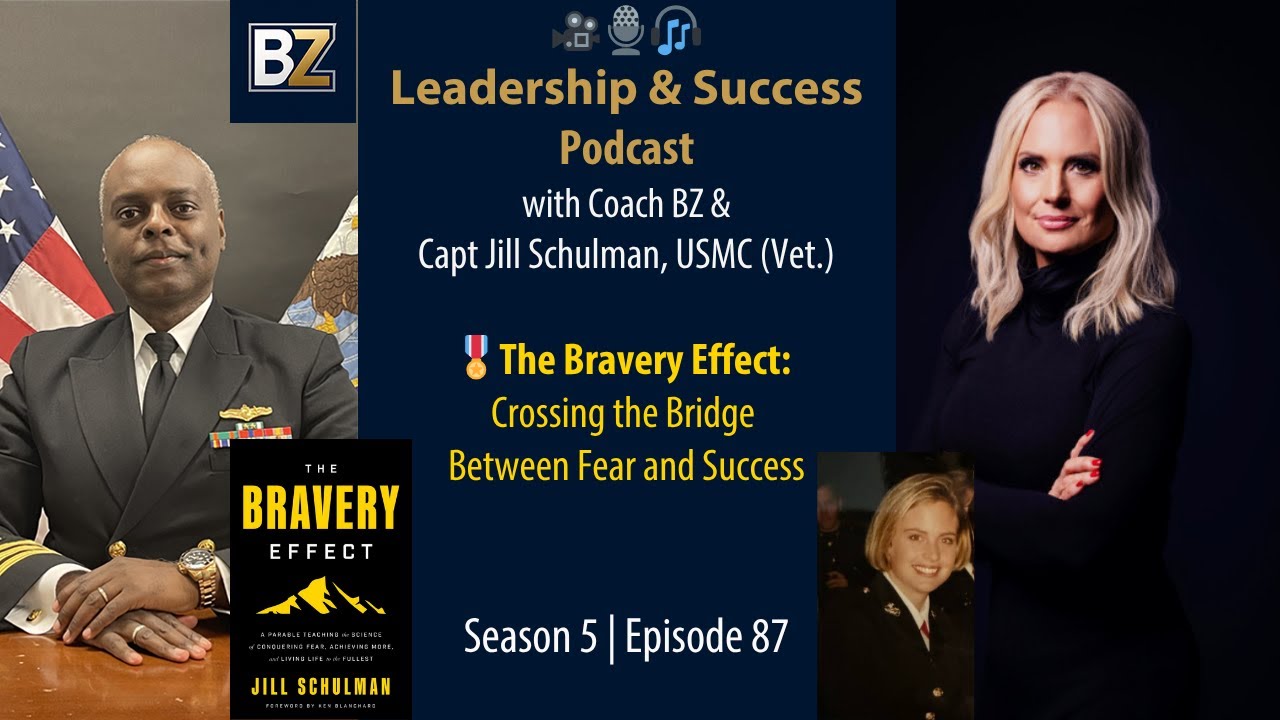
Jill Schulman, a Marine Corps veteran and author of The Bravery Effect, talks with Coach BZ about cultivating bravery as a skill and treating fear as a signpost, not a stop sign. She shares how military leadership translates to corporate environments and offers a free bravery assessment for leaders.
Chapters
¡Hola!
Hi, I'm John Maxwell. When the top companies in the world are looking for trainers, speakers, and coaches, there's one name that stands above the rest, and that's Maxwell Leadership. Our certified team members have gotten proven results for companies all over the globe, and our reputation, I'm proud to say, is second to none. Some of our members have risen to the top of their profession, including the one you're going to meet today. I proudly introduce you to my friend Bob Fabien Zinga.
Welcome to the Leadership and Success Podcast with your host, Coach BZ, where we help you lead with purpose and success. Leadership with Impact. If you're ready to grow into the kind of leader others want to follow, this podcast is for you. If you're determined to elevate your success and leave a lasting legacy, this podcast is for you. As my mentor, Dr. John C. Maxwell, reminds us, everything rises and falls on leadership. Our goal is simple, to inspire you, challenge you, and equip you with insights that can transform the trajectory of your leadership journey. Welcome aboard to another episode of the Leadership and Success Podcast with Coach—
What is one of your most proud accomplishments in life? What is one of your mountaintops? Think about the journey to achieve it. Was it hard? The greatest moments in life that bring us the most joy Well-being and life satisfaction are things that require bravery. Everything you really want in life is on the other side of something really hard. Anyone can be brave, and I'm on a mission to convince all of you that you can be brave too. My name is Jill Schulman, and I'm a researcher, speaker, and writer on the science of bravery. And my goal is to make you uncomfortable. I not only want to make you uncomfortable, I want you to get more comfortable being uncomfortable because that is one of the keys to achieving greater success, happiness, and well-being in life. When I started doing PT with Marines, which is what we call like physical training, I did not realize the hills of Southern California— you guys, I sucked. Like, we started running, you know, and I was falling back. It is the most shameful thing. For the first year and a half, I could not keep up in those hills with all the male Marines. There were so many times that I wanted to quit. I was so embarrassed because I couldn't keep up. Like, what am I doing? Those moments of struggle is what makes you who you are. There's a phrase that we say in the Marine Corps, and it is pain.
All right, uh, welcome to another edition of the Leadership and Success Podcast. I am really excited We have a very, very special guest waiting in the green room. Before I bring her on, as is our tradition here, we want to start with what we call a moment of gratitude. And as you guys know, we do this because about 21 veterans and service members commit suicide in this country every single day. And I believe it's impossible to be suicidal and be grateful at the same time. You know the drill, just take a moment, maybe close your eyes and think about one thing you are really grateful for right now. It might help if you take a deep breath and just relax your nervous system and be grateful for one thing. And today I am really grateful, like I am many days, I really stand on the shoulder of giants. So many people have helped me throughout my career. Many of them I will never, never be able to pay back. To pay back. But, uh, I am so grateful they've been part of my life, and I feel like it's now my duty, my responsibility, to try to teach to others what I've been taught, what has worked for me. So that's what I'm grateful for. So let us know in the chat, uh, where you are joining us from, what city, what state, uh, which country if outside of the US, what you are grateful for. And if you have a question for my guest, please type it in the comment. Alright, let me see if I can properly introduce Jill today. Again, I am really, really, really excited to be talking to her today. What a great honor and privilege. She's part of the few, the proud, the Marines, right? Once a Marine, always a Marine. I must tell you, when I tried to join the military after 9/11, I talked to everybody. I talked to the Marines, to the Army, to the Navy, and the Air Force, and eventually I decided, ah, I am not strong enough to be a Marine. I feel like the Navy or the Air Force is where I am going to be, add a lot more value, right? I use my brain more than I would use my body. But anyway, so she's very, very, very special just being a Marine, I must tell you. So Jill Schulman is a US Marine Corps veteran, keynote speaker, expert in the science of bravery. She has delivered over 1,500 leadership programs worldwide. She's the author of the powerful book, The Bravery Effect, and we're gonna be talking about that today. Jill's mission is quite simple, but it's transformational. She helps leaders and teams do hard things and do them well. She combines military leadership, positive psychology, and real-world business experience to help organizations build strong ownership, resilient teams, cultures of accountability, leaders who act, especially when it is Uncomfortable. Her message is one every leader absolutely needs to hear. Bravery is not a personality trait, it is a skill. So ladies and gentlemen, without any further ado, please help me welcome to the Leadership and Success Podcast, Jill Shulman. Good afternoon, Jill. How are you today?
I am fantastic. I'm so excited to be here on your show.
No, I am more excited than you are. This is really, really great, man. The book you've written, it literally could be life-changing. But to get started, can you tell us one thing you are grateful for today, Marin?
As you were asking the question, I was thinking of the people in my life. As I've gone down this journey, I've met so many amazing, inspiring people that have connected me with opportunities. And then, I love also connecting with people and helping them. So it's the people, the people that I was thinking of that I'm so grateful for.
That's right. I'm sure in Numerian you guys have this leadership maxim too, right? Mission first, but people always. That is so, so powerful. Is there something about you that most people may not know when they first meet you?
Well, usually when people first meet me, like I was just in Chicago for 3 days doing a leadership development program. Program for a group of leaders, like a full 3-day, and, and, um, I think they didn't learn until after lunch on day 1 that I'm a United States Marine. So that's usually what people don't know in the beginning because usually I like to wear dresses and different things like that. So surprised, but usually it comes out and people go, what, you're a Marine? Um, so, um, but I always like to tell people, like, the one, the one secret even everyone in the Marine Corps would, would never guess about me is the, the sport that I was most serious about in high school. You know, you think of like me as a, as a United States Marine and this great career. This, this— I'm a— I'm not embarrassed by this, I'm proud of this, but it's one no one would ever guess. Do you want to take a guess? What is the most unlikely sport you think that a United States Marine would be?
Is it team sport or individual?
It can be both.
Huh, I don't know. Uh, no, since you were a girl, you usually don't do football, right? So I would say soccer.
That's a great guess. It's a great guess. Actually, no, it was synchronized swimming.
Wow.
Yes, yes, that's why they think of Marine Secret swimming. So yeah, so please don't tell anyone. Oh wait, now it's out there, so it's gonna take away from my bad girl, like, uh, brand.
Actually, talking about swimming, that's something I, I had one of my greatest fears once I became a sailor. The Navy wouldn't let me be a sailor without really knowing how to swim. It took me almost an extra year to really overcome my fear. But I understand, as a Marine, I think the Navy SEALs do the same thing, don't you learn to stay kind of underwater for long periods of time?
Yeah, there's a lot of things that we had to undergo in our training just to get, get used to this discomfort. So yeah, it's like we had to learn to be uncomfortable. Like, the— one of the scariest things I did in my training is we, we had to simulate that we went down in a chopper and then we turned upside down and we had to stay there for a while before we got out. And like, and then basically the, the water is filling your nasal cavities and stuff, but you have to learn not to panic. They also put us through a, a CS, like a, you know, going through tear gas, like going in a chamber where we're sprayed by tear gas and learning like how it burns your eyes and sears your lungs, but all those things so that if we ever had to encounter it for real life, we're going to be more calm under pressure.
Yes, the tear gas, I believe everybody in the military does that. First time it happened to me, it was at boot camp at RTC Great Mistake, I mean Great Lakes, 2005. That was quite terrifying. And what they told us, yes, they wanted the tear gas to burn, not for too long, maybe, maybe, maybe only 5 or 10 seconds, but it felt like an eternity. But, uh, so that you would have confidence in your equipment. Yes, this, uh, mask works and is going to keep me safe. That was just terrible, terrible. So why, why in the world did you join the Marines? And the Marines are usually tough, no? Because I mean, I, I know I have great, great respect for, uh, Marines. Not that girls can't can be tough. But like, I have two daughters, so I usually joke if it wasn't for our family dog, right, I would be the only male in my household. But yeah, I know my kids can do almost anything, but still, though, I don't think I would like— if they have to join the military, I would probably encourage them to join the Air Force or Space Force now, or the Navy. But why the Marines?
And I think for everyone it's the right fit. I have two daughters too, and I think the Air Force would probably be the best fit. Well, maybe my younger one, she, she could. It's tough. You know, I've always loved challenges. So when I was looking at the different services, I was like, I'm like, my number one choice is the Marine Corps.
Why?
Because it's the huge, the proud. It's the one that— yes, I just, I guess I was enamored by the idea of it being the most elite and the hardest. So that's why I wanted—
absolutely.
Um, I did have a grandfather that was a Marine, but he never really spoke about it. So people always said, your grandfather was a Marine, is that why you're a Marine? But yeah, not really. It was more of just looking at all the different options. And I originally wanted to be a pilot, but back— now it was a long time ago when I was in college, this was in the '90s— my vision wasn't perfect, so it took me out of the running to become a pilot. So I was thinking either Air Force— I mean, could have been any of that— to be like a fighter pilot. That was kind of my first choice. But once that was done, I'm like, I'm gonna be a Marine.
I, um, believe a Blue Angel beat the Thunderbirds, right? Any day and every time. Of course, I am biased, but wow, that is really quite amazing. So starting your leadership journey as a US Marine Corps officer, how did that experience kind of shape your definition of leadership?
You know what, for me, my military occupational specialty, my MOS, was combat engineering. So I was actually, I raised my hand, I was one of the first women to ever serve as a combat engineer officer. So one thing that I learned as a Marine Corps officer, which I was such a benefit, and I don't think we get this in corporate America, is an officer, like, you know this, like, I'm out of college, I went through my military training, and then I'm now a platoon commander in charge of Marines. And a lot of the Marines that were in my platoon were more senior than me. I mean, in terms— not senior to me, they're more tenured. They had more technical expertise. So, and, and in the job of a combat engineer officer, we, we have a lot of different, like, um, special skills of Marines that are underneath us, but we're not an expert in any of them. So for me, it was understand the strategic direction, make sure we're collaborating with, um, you know, our partners, our other units. Let me give them the resources, the clarity. So there was no way that I could micromanage my team. Like, I had explosive at his disposal. EOD reported to me, and these are Gunnery Sergeants. Do you think as a Second Lieutenant I'm gonna try to tell them what, what wire to cut? No, no, no, no. So I think in a way it really teaches you, like, you know, be— you know, our job as a leader in the Marine Corps is how do we best serve our Marines so they can be successful. Like, you know, in the Marine Corps, we always, like, like, leaders eat last in the Marine Corps. You always make sure your Marines are taken care of. So I think that lesson was something that carried me through my career.
That is so insightful. Wow. So what did Marines teach you about fear, courage, and decision-making under pressure? You guys probably go through the most pressure than any other branches. Yeah.
Well, and I did not realize why this was until I studied psychology 5 years ago at Penn. But I think what I learned about fear and courage was every time I was scared, you know, in the Marine Corps, the norm is you do it anyway, right? It's like, you know, when you're surrounded by people who are all doing the thing, like, you— I mean, bravery is contagious. Everyone else is going up. And I remember when I was training to become a Marine, so I was still in college in San Diego, and at one point we went to the Navy SEAL base on a weekend as a fun field trip.
Fun?
I was promised a day at the beach because it's on Coronado Island. And we get there And we start doing this Navy SEAL confidence course. And I had— to that point, I'd never been more terrified in my life. I remember standing 40 feet in the air, but I was terrified. And did I feel ready?
No.
But I, I did it anyway. And every time I did one of these obstacles, you know, and I, and I, I move forward in the presence of fear, I felt more confident. So that's one of the things I learned, is if you're really scared, you just got to do it. And then when you're done doing it, then the confidence emerges. So then I realized in psychology like that's Albert Wenders research. Like a lot of people wait until they feel ready to take a step, but that's not the way it works. So I think that's one thing I learned is bravery is being scared and doing it anyway. And that's what makes you stronger and builds your courage.
That's so powerful. Feel the fear and do it anyway. I learned that from Tony Robbins, but it is, it is so true. Is there a difference between bravery and courage?
There is. I mean, I use it many times interchangeably because most people use it interchangeably. But if you want to know what is the difference between the two when we look at psychology, like specifically in the VIA Character Strengths that are really done in positive psychology, bravery is considered the act. Bravery is taking a step in the presence of fear toward a noble, worthwhile goal. So bravery is, is the action that you're deciding to take in the moment. That is being brave. Courage is considered a virtue and there's more than bravery under the virtue. So think of it like the more you demonstrate bravery, that you keep taking a step in the presence of fear, the more you build your virtue. So it's kind of like if someone's honest, because they tell the truth, they tell the truth, they tell the truth, they tell the truth. So the virtue of honesty or integrity is because people tell the truth. So people, we can say they are courageous when they are consistently brave in the moment, brave in the moment, brave in the moment. So they're related, but it's more of an umbrella term of courage. Where bravery is the act.
Yes, let's, let's talk more about bravery. Actually, before I do, I must also acknowledge I have never ever seen a single fat Marine in my 21-plus-year career. Never.
You've never what?
I've never seen a fat Marine in my entire life.
Fat Marine?
Yeah, not once. Not once. We have a lot of fat Navy officers, no, uh, soldiers and airmen, but the Marine, never.
Yeah, it's not, not part of the culture. And if you start, start getting fat, they're going to start taking you out for runs.
So, wow, that is just amazing that you guys really, really work. So, I have great, great admiration for Shuwa. But, so, when then did you realize that bravery is going to be a core part of your life's work? Because that's pretty much what you do.
You know, it is my mission now. And, it's It's a realization that I had recently when I went back to school. I mean, I had already had— so I went from the Marine Corps to working in corporate America for about 15 years, and then I've had my own company for the last 13 years doing leadership development consulting. But after doing my leadership development consulting for about 8 years, I'm always focusing on my clients and how do leaders develop their people and perform at their best. And one of the secrets is making sure they're challenged, they're learning, they're growing. And I looked in the mirror and said, I need I need to challenge myself. I'm hungry to learn. So that's when I went back to school and when I studied psychology. And that's when I had the epiphany because my degree is in applied positive psychology, which is basically the study of happiness and living your best life. And what struck me because of my past, my past experience in the Marine Corps and in corporate America was that it was realizing that one of the blockers from people being the happiest, living their best life, but also being the most successful is their relationship with fear. And if they let fear control them to stop them, then it led to a less fulfilling life, many times an unhappy life. But if people can learn to step toward it— so, so that's where I, I realized that. And another reason I had that aha moment is I think I, I saw the world through the eyes of my daughters. And, and I think the world is giving out wrong information because sometimes the messages you see in social media tells our younger generation that the secret to a happy life is you want to avoid any things that would cause anxiety or fear. And if it causes you fear and anxiety, have a mental health day and run away from it. So you want a life of ease and you want everything to be smooth. And that's just not a reality. And if People think that, oh, for me to be successful, I just need to avoid obstacles and challenges and take the easy path and run away from what I fear. And so it's just not true. So I'm here to, you know, like, I'm really on a mission to convince my two daughters. I'll let you know when that happens. And the rest of the world.
Yes. Wow, that is really powerful. Now, including what you went through, officer's training in the Marine Corps, what do you think is one of the greatest fears you've had to overcome in life?
I think my fears are the fear of failure, which is the most common fear that people— it's the number one fear, is the reason why people don't take a step toward what they want is their fear of failure. So I am the United States Marine. I am the expert in the science of bravery, but I have been a victim of this fear. And sometimes you study what you really need. So You know, for me, you know, within corporate America, you know, I think I could have moved up faster if I would have been braver to take that next promotion before totally ready. When I took, when I took a step and I actually left a company I was with a long time to go to another company that was risky, that was a scary move, or starting my own company. So, you know, I think for me it's that the fear of failure It just makes you hesitate. And sometimes you wait 5 years, 10 years, and some people never take the step because of the fear of failure. Or even the fear of— sometimes it's not even the fear of failure, but if you're a high performer, and I bet a lot of people watching or tuning in right now, if you're a high performer, we have such a fear of not always be a high performer, of always being a high performer. And if you're going to step into something you've never done before, then you're like, I may not be getting a perfect score all the time. If I try something new, I might be getting like a B or a C because I'm not perfect yet. So it's the fear of not automatically being a high performer out of the gates. And I think that has been a fear that has slowed me down in my career, my journey. But I think I'm finally figuring it out now.
Yes. Wow, that is really so insightful. And it does happen to a lot of people. Of course, we're going to get into your book and people who are listening right now are going to get some practical tools on how to actually be brave and take that first step. Because that's usually, it seems to me like that's the most important and critical thing, right? Just the very first step, just moving forward even though you feel the fear, right?
Yeah.
Yeah. I mean, that is the most important thing is all the work that I do in cognitive psychology, social psychology is to drive the behavioral psychology, which is how do I just get people to take a step in the presence of fear, right? And so yes, if people just take that first step— I mean, there's so many things that we'll unpack later, but I mean, that's the, that's the one message people are going to learn is stop waiting until you feel confident and ready. That is, that's the mistake. You, you, you take a step before you feel ready, and then after you take the step, that's when the confidence comes, right? So for any of you that have been saying like someday, Someday I'm going to put my hand, my name in the hat for the promotion and be the leader of the team. Someday I'm going to write a book. Or, you know, not ready yet, the timing's not right. That is a bunch of words that disguise fear into sounding wise.
Wow, so powerful. So it looks like you really went 360 degrees because You kind of transitioned from blowing things up as a Marine combat engineer, but now you are really building people up, right, as a leadership expert. How did that transition work out for you?
You know, the transition went from, you know, I was an individual contributor in my first corporate job. I went into— my joke is I went from blowing things up to then selling drugs, the legal kind. I went to the pharmaceutical industry. And a funny story is I did not— It's not like I got the Marine Corps going like, I want to be a farmer in pharmaceutical sales. I just had recruiters that encouraged me to at least check it out and interview. And the second hiring manager was a Marine, so I decided like, yes, I'll try this out. Um, but the reason I got into leadership development is you would think that as a captain of Marines, I was an expert in leadership and would have been perfect. But, you know, going into the corporate environment And here's the difference here. I was in sales, and I became the top salesperson in, in my unit, right? You know, and then I became a trainer, and then I became a leader. So one thing that I did is I made a lot of mistakes as a new leader, because now I had more expertise, and I knew how to do the job better than anyone else. So that led me to giving too much direction, do doing too much micromanaging. So early in my career as a leader, as a first-time corporate leader, I went through leadership classes because my company was just amazing. They did a lot of leadership development. And I was a sponge. I learned so much. Like, I know you do Maxwell Leadership, right? You know, so, so you go through a program. And I realized, and I've always been good about this, I can recognize when I'm like, uh-oh, I'm doing it wrong, right? So maybe for me, telling them to do it exactly the Jill way. So, um, I benefited so much from the leadership development courses. I had a great foundation in the Marine Corps, but I kept learning and growing. And my career, I think I, I credit my success as a leader in corporate America because of leadership development programs. So that's why I transitioned to— I'm like, ah, wow. I love— this made such an impact. Like, I want to help other leaders, like, go through that transition of, of realizing— you go in those classes and you have those what I call "oh crap" moments. You're like, and you're like, oh crap. Like, when I learned about emotional intelligence, that was one of my biggest aha moments, not only as a leader but mainly as a mom and as a wife. Oh, right. You know, so, um, so yeah, that's when I made that transition to, to leadership development because it made such an impact on me. And then I got to be the facilitator creating it with Tiffany and others.
That is really, really powerful. So we're going to be talking about your book, The Bravery Effect: A Parable Teaching the Science of Conquering Fear, Achieving More, and Living Life in the Fullest. I think it couldn't have come at a better time. We really, really, really need this now. Actually, We got Daniel saying, "Okay, thank God it's Friday. Good afternoon from Midland, Florida." Go Semper Fi.
Semper Fi. Thank you.
Really, really amazing. So yeah, I'm trying to build this community here. But something you said, which I love, is bravery is not a trait, it is a skill.
Yes.
What's the difference?
Yeah. Well, I think one of the mistakes that people make is they think that bravery is something either you have or you don't. I'm just born with it. I'm just not a brave person. So I never do that. And that is just absolutely not— that is just not what the science says, that bravery is a skill. You might have a low level of skill, but it's a skill that you can build if you choose to. It's just like a muscle. Like, it's— someone might just be born and they don't have as much— you might be one of those kids that are just— you look like a toothpick because that's just the way everyone looks like in your family. Say that I'm just not a strong person, I could never be strong. You would say That's ridiculous. Get in the gym and do the work. It's the same thing with bravery, right? You know, so when it comes to bravery, what we know based on the science is there's, there's, there's things that we can do to build that bravery muscle. And, um, not to get like too complicated, but it's just like a muscle grows the more you stress the muscle, um, which causes, you know, our body to respond and make it stronger. The same thing happens in the brain each time we take a step forward in the present fear and discomfort, right? Parts of our brain, you know, will change. So it's our brain plasticity. So we can actually see the wiring and the physical makeup of a couple different parts of our brain shift as a result of our workouts. So anyone can build the skill of bravery. And, and not only can anyone if they want to, it's a skill I think everyone should Right.
So what happened then for people who become, you know, perform at the senior level? So they've been doing this for a very, very long time. Why do so many of these high performers sometimes still struggle with fear?
Well, there's a lot of different types of fear. So later I'll tell you, like, I've got a free bravery assessment on my website we can talk about later. So You know, fear is one of those, or bravery is one of those skills you always have to be working on. So fear is very, or fear is very personal and it's invisible. Like what scares you in a professional environment, if you were in the same corporation, I would, I don't know what scares you. I don't know what fears are holding you back from performing your best. It may be different than me, right? So, you know, some people have a hard time speaking up, sharing ideas in a meeting. Maybe that's what their fear is because they're, they're scared that their idea may not be listened to or Or accept— people are afraid of, afraid of speaking in front of a group. Some people are afraid of admitting they don't know and asking for help, and that prevents them from performing at their best, right? You know, so there's, you know, some people are scared of, you know, um, yeah, applying for a stretch role where they're not going to be perfect. So like everyone has different fears, and part of it is acknowledging what is a fear that's What's blocking me from having the most impact at work? So the first thing is identifying what that thing is. So senior leaders have fears. Our mid-level leaders have fears. New leaders have fears. They're just different, right? And it's a matter of identifying them and overcoming them.
And like me, you've worked both in the military and in corporate America. What are some of the most common fears you've seen for military leaders and corporate leaders?
Well, in the military, I would say, especially for Marines, because I— it's mainly Marines that I know— usually physically, we're very like, we are brave, we're not scared of anything, we will, we will jump out of a plane, we'll, we'll do all the crazy stuff. So we love the adrenaline. But usually it's, it's the, it's the social bravery where a lot of Marines feel uncomfortable, right? You know, and so you were talking about some of the mental health health challenges, you know. So that's a, that's a fear we need to overcome. If we can, if we can learn to open up and ask for help, right, that is not a sign of weakness. That is a source of strength. And it's part of, you know, social psychology. So I think in the military, that seems to be the one that's most common. And it's, and it's, and we, when we think about that fear, and you think about success on the battlefield, success in the boardroom, right, your ability to say, like, I'm not sure, what's your perspective? Or, hey, I'm not going to be able to get this done. Can you help me? Right? That's going to help you accomplish the mission, but, you know, and it's going to help you learn and grow, and it's going to increase that collaboration. So when people are too stubborn to ask for help and admit they need help, like, uh, it's so frustrating. So, but you can't just tell them to do it. You gotta have them acknowledge and get over the fear first. So that's the military. And then, and then corporate, I think we've already— we, we've covered. It's the fear of failure, the fear of rejection. I I spend a lot of time speaking to sales organizations or sales leaders because that's where I spent most of my career, in commercial or sales leadership. So, you know, there's the most common fears that we see there are the fear of making the customer uncomfortable with questions. Close. The only way you're going to change behavior is if you can, you know, bring insights that get them to think differently and then ask them to act on it. So salespeople need to get comfortable having those conversations that bring the most value, that make people think differently. So like salespeople, and then sales leaders, the most common fear, I'd say just leaders in general, is they're afraid of tough conversations. They're afraid of delivering the feedback that's going to really help their people grow because they don't want to ruin relationships. So, so those are some of the common fears that we see.
Man, Quite insightful, because in your book you also talk about those micro-moments that really define a career. And we really have to be brave, you know, or choose bravery over fear every, every time we have the opportunity. So for somebody who's listening right now and they kind of feel stuck, what do you think is the first brave step they should take today?
Well, first of all, we should make it a small brave step. So you don't have to— if you have a fear of speaking in front of a group of people, you don't have to get in front of your entire company next week. Like, that is ridiculous. Like, that is setting you up for, you know, for failure. That's, you know, so it's figuring out what is a small step, what is a small thing that you can do. Take that one little step. So it's about doing a little bit each day. When you look at the mountain of the thing that you want to be able to— that hard thing that you want to do you just focus on what's one step at a time. What's one thing I can do today? And you take that little step and then tomorrow you take another step. So, that would be my advice. And you mentioned something too is when we talk about the small step, to motivate your listeners to take the small step, I want to talk about the compound effect of your choice day in and day out to do the brave thing or the opposite of the brave thing is to hesitate. To step back. Sometimes we call it to cower, which is the verb of shrinking back in the face of fear. So just imagine you've got Person A that has an idea that is, they're really excited to share with a team. So they go to the meeting, they're excited, they know it's the right thing to do to share the idea, but in the moment they get scared, so they hold back and they don't share the idea. So that's what they do in the morning, right? You know, in the afternoon there's you know, someone on the team, there's some tension. They want to have a conversation to address it because it's, it's affecting the customer, this, you know, this tension there. They want to have the conversation, but oh, in the moment, you know, this person says, "I don't want— like tomorrow, I don't, I don't want to do this today. I don't know how it's going to go." And then, and then the next day, there's an opportunity for a stretch assignment, and they're a little bit excited, but they're nervous, so they don't go for it. So if we just went on and on and on, so Each day there's these little micro moments where you can do the brave thing. You're taking a step forward in the presence of discomfort or fear toward a worthwhile or noble goal. And it's not like one time is going to ruin your career, make you unhappy. That's no big deal. One time, no big deal. Now a trend, week after week after week, that's not good. And if it's that trend lasts for years, that becomes your life. So I want people to think about the compound effect. If that's your default, imagine where this Person A's career is going to be in a year.
Yes.
Impact. They're going to probably be at the same level, right? Where are they going to be in 5 years or 10 years? Do you see how their career trajectory is going to be much flatter? Their impact is going to be less. Now, if you take Person B, all the same opportunities, they share their idea, even though they're a little bit nervous. They have the difficult conversation, even though they're a little bit scared it may not go perfectly. They, they put their Name it. They volunteer for the stretch assignment that they may not be perfect. And if they're constantly leaning in and taking those little steps each day and doing the thing that's a little scary, what's that person's career in 5 years? It is absolutely— it reminds me of saving for retirement. You see all those compounding interest. You're like, you don't want to be this person that doesn't save. You want to be the person that has a lot of money in the bank. So we need to think of it like, what are those little deposits that we're making? And these are for you, right? It's for you. And, you know, if— I mean, not to get philosophical, but I mean, I want your audience to like look back on their career and their life with pride, not regret, right? Wow.
So what did the lack of bravery cost you? Wow, that is powerful. So we're talking about the book The Bravery Effect, and the one and only Jill Schulman is right here to answer your question. I can't believe this. But Jill, your book, of course, it's available everywhere books are sold. And also, someone very special wrote the foreword for your book. Can you tell us about him? I call him Papa Ken Blanchard. He doesn't know me. I've never met him, but I've been following his work since I was about 17, 18 years old. Definitely impacted my life. This man here, is a hero. Can you tell us about him just a little bit?
So Ken, and look at that picture of me, I was younger back then. So yeah, Ken has been a mentor to me for many years, like 12 years when I first met him. And I do, I did work for his company. So like I got to know him really well. And first of all, I just, I love that man so much because he's just everything you hear about him and you see in his books is the way he is a human.
Yes.
He is the one who's encouraged me to write the book. I don't think I would have written the book book. And I would— I wouldn't have done it without his mentorship and guidance.
Yes.
Which, that's why you want to surround yourself with people that are going to encourage you to do the hard thing. But, um, so Ken wrote the foreword, um, and I'm so incredibly pleased, so honored that he did that. So the foreword's by Ken Blanchard, but he also is the one who inspired the format of the book because Ken wrote so many different books, but the one that's probably most well-known is The One Minute Manager, The New One Minute Manager. And it's written as a parable, a very simple but profoundly compelling story to teach people how to lead effectively. And I think you mentioned that when we first connected. You're like, oh my gosh. So Ken did the parable. I love Lencioni's book on Five Dysfunctions of a Team. I love John Gordon. He's another mentor of mine with The Energy Bus. So I decided to write my book as a parable. So, so for your audience, it's a story. And my motivation is I actually want you to read the book until the end. And if it's a story, you want to know what happens at the end.
Yes.
Then there's also all the science is baked into the story. And then if you are a geek like me, you want all the research in the back to support the story. It's there. So it's entertaining. It's short. And it's, and it's because of Ken. He's the one inspired me to do it. That way. Yeah, yeah. If you want a message to stick, you know, a story is probably the best way to do it.
Yeah. And I think it also allows you to use both sides of your brain, right? Left brain and right brain as well. That's— wow, that is great. So why, why did this book have to be written?
The reason this book needed to be written is no one is really talking about and teaching Bravery as a skill. Like, even in corporate America, everything's about like, let's, let's just make everything safer and let's take away anything that stresses people out. Like, yes, you know, adversity and challenges are not going to go away.
They—
in the companies that are my clients, there's big growth targets, there's going to be adversity, there will be stress. And to just live in this utopia land of hoping that there's just rainbows and butterflies and unicorns floating around and there's not going to be any— is just not the reality. So the reason this book needed to be written is to teach people how they can acknowledge the fear that's holding them back and then step forward and conquer that fear. Because when they do, they have more impact and success at work. Which is fantastic. Their career, they start getting promoted faster, which, if that's what they want, is really important. But the best part, the absolute best part of the book, um, is the relationship that someone has with themselves when, when they set a goal and they actually take the brave, brave steps to be able to accomplish it, right? You know, so when people look in the mirror, they like when they see— when, when people want something and they, and they keep putting it off and never do it because they're scared, when they look in the mirror, they don't— their self-confidence and their self-efficacy goes down. We know that, right? So, so this book is, is needed for my, my daughters, for the younger generation. So many people that hear me do keynotes, they love it for their team. And of course, I do workshops and stuff to help really build the skill. But they always tell me, I want to give this to my teenager, my younger one. So it's to take the pendulum in the other direction from like, oh, the path to success is removing obstacles and ease all the time, to the reality is let's teach people how to be brave so they're resilient and they can overcome challenges and they know that they're unstoppable.
That is really legacy, man. Your book does teach that the life we want is really on the other side of fear. That is so true. But it looks like for a lot of people, they get into what you call the comfort trap. Can you tell us more about it?
Yeah.
So the comfort trap really suggests that if someone chooses in the moment to do the easy thing that's comfortable instead of stepping outside of their comfort and doing something that's hard and scary, what happens is when you choose comfort in that moment, your self-confidence confidence and your self-advocacy just, just goes down just a little titch, right? Just goes down a little bit, which makes it a little bit harder the next time there's an opportunity for you to do something hard. It's a little bit harder because— so think of it as a— is a— in the beginning, there's the trap is kind of like loose, right? But then each time you use comfort, the, the trap, you know, or, you know, gets tighter and tighter. So every time we let fear win we give it more power and the trap becomes harder to escape. But every time we choose to be brave, we're taking power away from fear and then life becomes bigger. So we've got to be careful and people kind of, they end up spiraling down, which is why we have the highest levels of depression and anxiety than we have ever had before. But why is that? Is so good, everything's so easy, right? Well, it's because all the evidence in experiential avoidance tell us that when people avoid what is uncomfortable, they're scared of, it leads to the development and sustainment of anxiety and depression, right? So that's why this book is needed. It's for mental health.
Absolutely. And also in the book, you really talk about, um, 3 keys, right? Uh, you outline 3 pillars of bravery. Brave mindset, bold action, and brave relationship. So with the mindset, how do we rewire our thinking about fear and discomfort?
Yeah, well, there's 4 things that I teach in my book, like 4 different cognitive psychology techniques. But just in general, to keep it simple, is we first have to win the battle in our minds. So as a fellow, you know, veteran, you know, I use a lot of military terms, but we do, we need win the battle in our mind first. Because if we can change the way we think, it can make us take that brave step. So, so like one of the most basic things that I teach is Carol Dweck's research on growth mindset and, and shift people from a fixed mindset, like I could never do that, to I can't do that yet. And that, that little shift, that little shift of I can't do it to 'I can't do it yet' makes people realize that, oh yes, it is possible, right? You know, so that's just one of the many techniques, you know. But we know this, and I've got a lot of friends that are Navy SEALs, and, and they all tell me that, yes, the number one reason why someone makes it through BUD/S or not is not the amount of muscles or any of that. It, it is, is winning the battle in their mind. So, yeah, so that's why we have that as the first step, is help people with mastering the mindset to be able to create that.
That is so powerful because it reminds me sometimes you do have to— when you face something that seems impossible, it really helps a lot to just reframe it, right? You can ask a question, how can this become true? Or how can I make it happen? And then your brain starts thinking about possible solutions instead of, oh, this is a barrier, this is a challenge, cannot do, cannot do, no, no, no. It's not become 'Okay, there might be a possibility. Let's see how that is possible.' That makes a really big difference just the way—
Wow. And you can also look at examples of people. What are other people that went from not being able to do it to being able to do it? And then you study their path. And usually when it's called like vicarious learning, so you find someone who's gone through the path and then you can just follow their steps. And then when you look at their path, you realize that it's not just super easy. They went through ups and downs and learning. And so when you realize— and that's what happened with Ken. When I was writing my book and I would check in with Ken every once in a while, I remember at one point I was telling him, like, I'm like, I don't know if I am meant to do this. I'm like, I can talk all day long, but the writing is just not happening. I am having writer's block and I don't know if I can do this. And Ken just smiles like he always is, calmly, and he goes, same thing happens to me. That happened to me. And I'm like, how's that possible? You're Ken Blanchard. And he told me about his early struggles, that the same thing happened to him. So then you're like, if you're Ken Blanchard and you've had 48 bestselling books and you went through the struggle, this is normal.
Yes.
I can overcome it too.
Wow.
So let's talk about bold action. Why can't we wait until we feel ready? I feel like many people go through paralysis by analysis. They just never feel ready. Therefore, they never take the first step.
Well, when we look at how confidence is built, the only way that we can build confidence is taking a step before we fully know how to do it. And that's how we build confidence. And so that's where that equation is. People think, okay, when I'm ready, I'm going to take a step.. And that is opposite of what's true. You take a step and that builds the confidence. That's all of Albert Bandura's research in self-efficacy, right? If you keep— that's where I think a lot of people think like, well, when I feel ready and confident, then that's the wise decision to take a step forward. So it's helping people realize when people just understand that you're supposed to feel scared right when you do it. I mean, that really helps people because some people think that, oh, bravery is when people are fearless and I feel fear, so there's something wrong with me, so I shouldn't. And you let people know, no, that's, that's not true. Feeling the fear, that is, that is exactly how you should be feeling. And in the feeling of fear and the feeling of excitement are very similar. So how can we reframe? So we teach people some very simple steps in terms of like, okay, you can tell yourself yourself, like, um, when you feel like the physical, like, fear, the manifestation— my, my heart is beating, you know, I maybe I'm, you know, I'm, I'm breathing harder— you can tell yourself, like, this is my body preparing me to perform at my best for something that matters.
Wow.
So this doesn't mean there's something wrong, I should run away, right? So this is important. This is my body excited my body. And then my last hint, and this really helps people in that moment, some people like start thinking if they're going to take a step forward. First I say, don't think, just go. Do not start thinking about will I, will I not. If you told yourself yesterday that today you're going to take a step, like just take it. But when people are getting in their head, I tell them to have a conversation with their future self. By just saying this: what does your 5:00 PM future self want you to do in this moment? Do you want to wait and not do it, or does your future self want you to take the step right now? And that usually gets people that, boom, they'll take that step.
Wow, that is really powerful. Yeah, that's like me jumping off the plank, what, 20 feet into the swimming pool during boot camp. That was one of the scariest things I've ever done in my entire life. But Yeah, you just have to take a step, right? Like Nike says, just do it.
Just do it.
Yeah, man. So let's talk about brave relationship then. Talk to us about the importance of a brave tribe. What do you mean by that?
Yeah, so in order to build your bravery muscle, you've got to think about first, like, what is the brave thing that I want to do? And we've already talked— we're going to work on mindset and also taking the steps in order to support us taking the brave steps. Brave relationships, we know based on social psychology, can help us take the brave step. And what I mean by a brave tribe is you think about the goal that you have and then you want to curate. Like, like what does an art curator do? They very carefully select the pieces that they're going to put into their gallery. So I want you to curate, to really be like, who will be your brave tribe? Who will encourage you? Encourage means to put courage into you. So if you want to— for me, if I wanted to write a book, if I don't have anyone in my circle that's ever written a book and I'm struggling, they're going to say to me like, why are you killing yourself? Like, just, you don't need to do that. Just come back over here and do this other thing, right? You know, so, but if you surround yourself with people that have accomplished that thing that you want to accomplish, right, and they have the wisdom because they've done it and they care about you and they want— so they're— if you surround yourself with those people like I did with Ken Blanchard and John Gordon and many others, those are the people that you surround yourself with. And when you want to tap out and say, I don't think I can keep going, they're going to say you can keep going. So it's that, you know, it's like what your grandma probably told you, you are who you hang out with, you know. But it's more than that. It's almost like a Ken Blanchard situational leadership. For each, really, like, you know, in your career, sometimes we make kind of brave moves at different points. Like, whatever that goal is, that transition is, sometimes your brave tribe needs to change, right? Like, well, I'm going in a new direction, so now the people I surround myself, I need different wisdom and expertise to help me successfully do this brave thing.
So, wow, that is, that is really Insightful. Back to what we talked about earlier from your book, if bravery indeed is the bridge between where people are right now to where they want to be, so what is the cost of not crossing that bridge?
Well, that ends up leading to regret. And regret has a very negative consequence. So this is where, um, you know, I can answer it in a couple different ways. Like, you know, people always want to do something and then they never do it, so that leads to a life of regret. Or sometimes, or sometimes it can be the difference between people having a good life and a thriving life. Like, sometimes living, like, having a good job and a good life is what gets in the way of you being brave and going for what you really want. And the reason for that is like, it's comfortable. Like, I can even look at myself when I had my leadership development company. I mean, I'm doing a lot of crazy things that— I mean, why, why am I writing a book? Why am I getting in all these stages? Why am I— like, why am I going in this direction? I have a successful business that does very well. I've got customers that are really happy. So sometimes when you have a job and it's a good job and you've mastered it and you're good at it, but you know, but if you've always yearned for more and you want to have a bigger impact, it's just the difference. Sometimes it's the cost between living a good life.
Wow.
You want a good— do you want a good life? Like, life is fine and life is fine. If you want just a— if you want a life that's good or fine, then great, then stay in that in that same path. But if you want a life where you're flourishing, where you're thriving, you sometimes have to take a step toward that thing you really want. And that means leaving a little bit of what's good. Right? So in any way, and that's really what positive psychology is.
Yes.
I want to help people thrive, to live their happiest life.
That's a really powerful reminder of the book From Good to Great, because sometimes the enemy of greatness is not bad, but it's actually good.
That's exactly right. Yeah. I mean, how many people do you know were like, you know, like, well, how's work? Same old, same old. Like, oh yeah, like, I can't wait to retire. You know, like, it just, it's just the drudgery, right? You know, and even like, there's ways that we can even make our job, like, we can make it more inspiring by finding challenges, finding more purpose, you know. But just to feel like, uh, like like, my career is like a prison, I gotta go there. Like, that's sad. Let's, let's find a way to thrive in life.
Wow. Okay, one last question I'm going to ask about the book. With all of the changes happening, artificial intelligence, emerging tech, and there is chaos in the Middle East and wars and the economy and all of that, there's a lot of uncertainty these days, the job market and all of it. What is one thing you could tell us to learn to develop the skill of bravery, to be more brave in the midst of chaos?
Well, you know, I'm going to answer that because you mentioned AI, because I get a lot of questions on AI. So just whenever there's a change happening, like some of us are the early adopters. A lot of us are going to just wait and see, you know, some of us are going to resist. So just think about the cost of hesitation, because that's really the energy of bravery is like, I mean, if you're, you know, the problem that I'm trying to fix for people is was hesitating, waiting, right? Or running away, but also just hesitating. So the cost of people hesitating to fully embrace AI in order to be the most effective in their job, it can be great. So the wonderful thing about AI that can help us be braver is I think of Steven Pressfield. So if you know Steven Pressfield and his work, I had never heard of him. And then I just met him at a conference last fall and I'm like, who are you? But I guess he was also So we met and I'm like, he's kind of a big deal. But now I've read his work and, you know, what Steven Pressfield, you know, teaches in The War of Art is he talks about resistance. It's so related to my work. So he's like, there's always the thing that you should do, but resistance is like all the things that pull you away from what you should be doing, right? And it's like, oh well, I should be doing the emails and I should be folding laundry and I should be like doing all this. So in one thing is using AI, it allows to automate or simplify all the busy work that's usually your excuse to not do the hard thing. Yes, right. You know, so, um, you know, so in the age of AI, I think it's— I think there's, there's a couple of, of skills that are absolutely mandatory, is, um, lean into your ability to move forward in the presence of uncertainty, change, and adversity. Like, that bravery skill will differentiate you in the workplace because most people are running away from what they're scared of. And then number 2, not related to my research, but your ability to have, um, the, the high-power connections at work. Your interpersonal skills are absolutely going to be a game changer. So embrace AI to get all the lower-level work done, and when you do, that frees up your time to have meetings and coffees and, and have great interpersonal relationships relationships, and then do the hard things that you're scared of doing and to be brave. So that's my kind of take on the future and AI. It'll give us our time back to be brave and to build relationships.
I really love that. I read something a little bit funny. I think it was 2 weeks ago. Vistedi says, I don't want AI to do my creative writing. I want AI to do my laundry so I can have time to do my own creative writing.
Yes. And I think we're getting to the point, like, I mean, my team uses has used AI a lot to do some of my posts. And now I just— now it's so obvious. Then you can see it all looks the same. And now I hate it. I'm like, stop it. We can't use that. Like, can we please, like, make it me? Like, I have to say, yeah. So you're right. We don't want AI to do the creative stuff because if AI does all the creative stuff, we're all going to sound the same. You know, you can tell when it's the post that's just obviously AI.
True. Okay. We don't have much time left. I could be talking to you for hours and hours, but of course, we're going to need to bring this plan down soon. Can you give me maybe an extra 5 minutes or do we need to—
Yeah, I'm fine.
Okay, great. So for this last segment, I tried to get into your head kind of like the principles that have helped you become as successful as you've been. So one question I have for you is, what do you believe is one of the greatest lessons you have ever learned, whether in life, in leadership, just in general?
It is the ability to always be working on yourself, to always look in the mirror and always be admitting like, what is— I think that's one of the things that's made me the most successful and I'm most proud, even as a parent, to model. I'm always talking to like my colleagues and my audiences and then my kids about this is the thing that I'm really working on. So, so I think a lot of times people think like, no, I've got to be like, oh, I'm always like, oh, I'm so good at everything, but I'm, I'm always just talking about, you know, I've accomplished these things, but here's the next thing that I'm really working on to be a better human, to be a better consultant, to be a better speaker, you know. So always working on myself.
That's so powerful. One of your friends, Jim Rohn, he used to say, uh, if you work on a job, you'll make a living, but if you work on yourself, you will make a fortune. Big difference. Wow. So what, what do you believe is, uh, the secret to your success, not just in the Marine Corps, which and I believe you guys are just crazy. And, but then in corporate America sales and then your own business and all of the leadership development and having a best-selling book. Why are you so successful, you think?
I think I've always been in a career where I've found the passion in what I do. So, you know, I've always been someone who's gritty, you know, can work really hard. But I think the reason for it is I've always been able to work in an area that I just have found so much passion. So, you know, we've got to find out what are our interests, what are our strengths. I've always aligned my interests and my strengths with my career, which is— that allows us to be gritty. If I was in a job where I was like, look, staring at a computer and crunching numbers all day, I would not be a high performer because that's not leveraging, you know. So I think just always letting my passions and my strengths lead me to my next step.
That is really powerful. I was born in Africa, like most Africans. My parents were like, you're going to be a doctor or a lawyer. But I'm like, no, I'm going to the Navy. For my daughters, no, they can do whatever they want and I support them. But it's true, if you don't have a passion for what you do, the first obstacle challenges you're going to meet, you're just going to want to quit because your heart is not in it. Wow. So I know that leaders are learners. What are you learning these days?
Well, right now, what I'm obsessed with learning is the neuroscience. Like, I, you know, like, I've got my master's in psychology. And so I know a lot about the science of bravery. But now, I'm becoming really interested in just the mechanism of the brain, you know. So, so that's what I'm learning in terms of becoming a deeper expert in my area of expertise, the science of bravery. And this is kind of related to— that's what I'm learning. But I'm also, I'm I'm also very interested in filling the gap in what research has not been done on the science of bravery. There has been some done, but like, I have read, I think, every piece of research on bravery. That's what you have to do to become an expert. But there is more work to be done. So the other thing that I'm learning is like, okay, so what do we know about bravery? But what research needs to be done? Like, and, and, and I want to do that research because the world needs the research because I've always been evidence-based. Like, don't do it just because like, "Oh, I'm a Marine, so do it." No, what do we know based on science?
All right. I can see Dr. Jill Schulman in your future very soon. That's wonderful. So, I also like to ask, if you could choose 3 people, anybody at all, dead, alive, or even fictitious character to have dinner with, who would you choose and why?
Oh, wow. Um, I would probably say Marcus Aurelius. Hmm. Yeah, because I love stoicism and I love meditation. So having conversations, I think, with him would be great. Um, yes, maybe General, um, Admiral Stockdale, who also was a fan of stoicism, right? You know, um, and then beyond that, like, I'm like an academic nerd. So I would probably say maybe in addition, I've actually had little conversations with this person kind of over email, but I haven't actually sat down. So I'd love to maybe invite Adam Grant, maybe to the conversation because I just think he's brilliant. He's from Penn. But if I were to have dinner with those people, what an What an amazing conversation that would be.
Absolutely. I think I would probably add Scott Galloway too, contemporary of Adam. But yes, that's really great. I also love, of course, everybody encouraged to get your bestselling book, The Bravery Effect. But in addition to your book, the ones that you have mentioned, you may mention one more if you want, but you mentioned The War of Art. Steven Pressfield. Why should my audience read this book?
This one is so great because even though it talks about battles to be creative, he really talks about that you will have goals and he teaches you that where you feel the most resistance, what you don't want to do, he goes, the resistance is really the sign of what you should do. And it's really great because Steven Pressfield discovered this with his own experience with himself. This is not scientific. This is Stephen Pressfield with an N of one. It's what he discovered when he discovered that where there's the most resistance is a sign that that's exactly what he should do. That's where his career turned around. So, he discovered that on his own. So, this is what I love. This is what the Stoics told us to do. This is what Stephen Pressfield discovered himself. This is what I write about in The Science of Bravery. It's like these are universal truths. And read that book by Stephen because my book might be the thing that clicks everything for you. But sometimes for me, it's like the third person that tells me about a concept that it finally sticks. So yeah.
That's amazing. I believe it's the same Steve Pressfield who wrote Beyond Gates of Fire, isn't it?
Yes. Yep. He wrote that one. He's got a new book actually coming out this summer. That's amazing. And hopefully I'll be interviewing him about that book coming out.
Yep. That's amazing because I think he's given us the best, best definition of leadership I have ever, ever seen.
What is his definition of leadership?
On page 412. And every time I speak publicly about, no, 12 to 15 times every year, but when I talk about leadership, I have to mention this. It says, "I will tell His Majesty what a king is. A king does not abide within his tent while his men bleed and die upon the field." A king does not dine while his men go hungry, nor sleep when they stand at watch upon the wall. A king does not command his men's loyalty for fear, nor purchase it with gold. He earns their love by the sweat of his own back and the pains he endures for their sake. That which comprises the harshest burden a king lifts first and sets down last. A king does not require service of those elites but provides it to them. He serves them, not they him. Every time I read this, I get the chills.
Oh my God, I got chills too.
That's the best definition of leadership I have ever heard.
Page 412.
Yes, Steven Pressfield. I'd like to meet him one day. And I think he also wrote another book I've read, which I like, the 4 archetypes. No, I think it's King.
I can't even keep track.
Yeah, yeah, so many.
I was so embarrassed because I went to an event and he was like a speaker and I'd like, again, I'd never heard of— he was like interviewed and then I was the next keynote speaker up there and I just had asked like, hey, is there any other service members here? And I honored them like, are there any other Marines here? And he raises his hand and I'm like, oh, Semper Fi, like I get to meet you. And then, and then I had never— I just had— I wasn't familiar with his work, you know.
So he is a Marine.
He is a Marine.
That makes sense. That makes sense.
And then I came home from that trip. And I went to my husband, I'm like, "Have you ever heard of Steven Pressfield?" And my husband's on the couch laying down reading a book and he goes, he holds up a book, he's like, "Yes, have you been living under a rock?" That's amazing.
Yeah, I think it was 4 archetypes. There was the king, the magician, the warrior, and the fool. And it looks like in all of us we have a part of that. But okay, let's go next. Of course, your mentor, Ken Blanchard, The New One Minute Manager, probably one of the best-selling books of all time.
Every single leader should read this. In fact, for a lot of my clients, when they have new leaders, I'm like, they have to read this before they come to the first class. So like, wow. I mean, it's like my daughter just became leader. She's about to be 21. And she just got promoted to be leader of a social media team in this internship for this magazine. And she was asking me like, OK, she needs help with leading because they're having a hard time with all the other college kids. And I'm like, I'm like, first you read the book, The New One Minute Manager, and then we talk.
Wow, powerful. You also mentioned Patrick Lencioni, The Five Dysfunctions of a Team. Why is this book important to you?
Oh God, this one is— you're like having all my favorites here. So like, I get so many calls from my clients because, you know, the team is dysfunctional, right? And so like, I've I've worked for The Table Group and teaching these 5 dysfunctions or the 5 behaviors. So, it's like a lot of times when there's dysfunction with a team and things are not working, people just don't know how to solve it. So, this book, The 5 Dysfunctions, really helps you like start at the ground level with trust. So, it just gives you a framework of how to build a highly functional, a cohesive team that can get high results. And it's another parable. So, it's so entertaining to read and then it sticks. Yeah, yes.
And then this one I haven't read yet, but you mentioned John Gordon.
Yeah, well, he's got a ton of different books, but this is an amazing one, The Power of Positive Habits. So, um, you know, John Gordon's written a lot of different parables. I think all of his books are short, they're effective. He actually has a new one called The Power of Positive Teams, which is another really great one. But I mean, John Gordon's books are all just, you know, fantastic because they're short They're practical, you know, and those are really good ones to have the whole team read it, do a little book club. So yeah, great. And a mentor of mine too. Great guy.
Man, that is really great because I feel like maybe one of my master skills, I was about maybe, I don't know, 16, 17 years old when I started thinking this way. Okay, maybe I wasn't born a leader. Maybe I am not brave. Maybe I am not a manager yet, right?
Yet.
But I can learn. So I have the ability to to learn. Definitely Ken Blanchard helped me a lot when I became a first-time manager of what it really means to manage and to be effective. So whatever skills— and today we're talking a lot about bravery— if you are not that yet, you can read this book, you can learn the skills, you can apply it and become better, right? That is, that is really, really powerful. So is there maybe like a song, a book, or a movie that you would consider like your, uh, Like live stream or FM?
You know what, I need to think about that. Like, I never have an answer to that, and then other people tell me the names of songs.
That's all right.
I'm completely blank here, but I need to— I need a better answer for that. Is there anything that you— is there a movie that comes to mind for you? Like, I feel like I just reacted—
for me, it's mostly music. I've been playing the piano since I was 7 years old. I feel like my entire life is a music play, play, play. Playlist, right? There are songs and music that I hear, it takes me back to a specific place and time. For example, during 9/11, I know exactly what music was playing back then, or when COVID started and we started to get quite anxious and depressed, songs that really kept my spirit up. So there is always music throughout my entire life that really—
If you think of any song, Graver, anyone listening here, like, please send me a message on LinkedIn so that I can—
Actually, there is a song that comes to mind for you. I think, is it I Am a Champion? What's that woman's—
I know that one, like, this is my fight song.
Yeah, that sounds like, yeah.
Maybe that one, but like—
That sounds like a song that would align with your values. But anyway, and also, we say the fear really never goes away, even when I've been speaking publicly for a very long time now, but still, I kind of feel the butterfly. I'm a little bit anxious before I go talk to a crowd. So just like you say, I have to focus on the first step and why it's important that I be there, that they hear my voice. And then once you get started, and then you can still feel the fear, but you are really focused on the mission. Yeah, it's quite powerful. Okay, we are about to land this plane here. Let me ask you this. If you had one and only one day to live, what would you have liked your final contribution to be?
My final contribution to the world would simply for people to discover that fear is not a stop sign.
Yes.
Fear is a signpost pointing you toward exactly what you need to do. So if people can just change their relationship to fear, that is what I hope my legacy is. Is to help people realize that. So they want to fear more. The more you go after things that scare you, the better your life is. So I don't want people to be fearless. I want them to fear more.
Wow, that is very insightful. And if you had a magic wand and could solve any problem in the world, what is the one problem you'd like to solve first thing tomorrow morning?
I would love for people to learn to listen to one another and have conversations instead of having convincerations. So if people can learn the skill of listening and being able to, to learn and disagree in a way— like, that is my one wish, because all the world problems would get solved if we can learn to appreciate each other's different perspective and actually converse instead of try to convince one another in conversation.
Powerful. All right. All good things must come to an end. We are coming toward the end of the show. How can we add value back to you, Jill? You've been such a great, great master teacher for us today.
Yeah, well, I love you having my LinkedIn right now, so please follow me on LinkedIn. I make a promise to always send out little messages or little inspirations for you to be brave every day. So I try hard to do that. So if you follow me, hopefully that will bring you some value. In addition, if people go to my website, I have that free gift, which is there's a free bravery assessment. It just takes about 2 minutes to take, but then you can download the free bravery blueprint. So it is a PDF that's fillable, interactive, so you can identify a goal. And then it will give you basically the, you know, it'll help you with the brave mindset, brave action, and brave relationships. And when you first log in, it'll be a pop-up screen. So Yeah.
Powerful, powerful. Thank you. Thank you so much, Jill. If I can ask you one more question, if you could go back and give a piece of advice to your 17-year-old self, standing at the edge of this incredible career you've had in the Marine Corps, corporate America, and now your own business, what would you say to 17-year-old Jill?
Hmm.
Gosh.
You were not quite 17 here, but pretty close.
That was only a couple of years later.
Yeah.
What would you tell her?
You know what, believe in yourself more. Believe in yourself. My husband and I were just talking about that today, like, you know, what we— it's like what we want to tell our 17-year-old daughters now, right? Which is, yes, you know, I just wish I could tell my younger self, like, stop worrying what everyone else is thinking, which makes me, like, hesitate, and just believe believe that you're going to be great. So yeah, maybe it's two things. One is don't worry what everyone else thinks because that's why a lot of people hesitate. So it's just such wasted energy. Stop worrying what everyone else thinks of what you're doing and just believe in yourself.
That is so powerful. Maybe I would add, even if you are making the wrong decision, to me, it's better to take action and have it be the wrong action than take no action at all because you can always learn from your mistake. Get better. All right. So, we are definitely out of time. You don't have to say yes, but if you said yes, I could do what I call rapid fire. It's going to take about 2 minutes. I'm going to ask you questions. You're going to have to answer really quickly. Okay.
Fantastic.
Thank you for coming. Quick answer. First thing to come to mind. Okay.
What is one word that defines great leadership?
One word. Servant.
Okay. Morning routine or practice that keeps you grounded?
Never press snooze. Jump out of bed.
Okay. Book or quotes that changed your life?
When Are You Going to— it's on my desk right here. How Long Are You Going to Wait Before You Demand the Best of Yourself? Epictetus.
Wow. That is powerful. Okay. Thank you. Actually, I'm kind of selfish. I think part of the reason why I do this podcast is so that I can learn. So thank you so much. Who inspires you most today?
Who's inspired me the most today? My husband.
Fantastic. A leadership habit you refuse to compromise on, you will do no matter what?
Keeping promises. Integrity. Keeping promises to myself and others. So doing what I say I'm gonna do.
And what is the question every leader should ask themselves frequently?
How can I grow? How can I get better?
What did you want to be when you were a kid?
I wanted to be a TV broadcaster. I wanted to be the person on the nightly news.
Well, in a way, you are doing this with your leadership development. You are broadcasting leadership. You're doing it on YouTube video, your books, and your platform, and you're speaking.
But yeah, I'm on the news, but I'm just being interviewed. So I guess, yeah, I think I'd rather be interviewed than to be the one on the—
yeah. So 3 adjectives describing you as a child?
Stubborn.
Two more.
Independent.
One more.
Passionate.
As an adult?
Same, same.
Okay, you didn't change. That's great. All right, uh, I always like to end on a positive note. So what is something you are feeling optimistic about this day?
Oh gosh, um, I just am feeling optimistic about the power of connection between people. I guess I just— I've had such an amazing experience every time I meet more people. Like, you know, there's something magical about the power of human connection. So I'm just optimistic because the world is a— is not a horrible place. The world is a wonderful place, and there's so many amazing, wonderful people out there. So yes, you have to see the best in the world, see the best in others, and be open to receiving it. So, you know, just let— let's Don't just stay in your house and watch the news. Go out there and see all the great things in the world and be optimistic about the goodness of people. I think that's a skill. But yeah, the power of connection in people is what I'm most optimistic about.
That's so powerful and so timely. It's really my prayer. I feel like our country is more divided than I've ever seen it, at least in my lifetime. But it reminds me of 9/11. 9/11, it was really horrible, but I really loved 9/12. America was more united than I've ever seen. It's just, uh, wow, connection. That is so, so powerful. Okay, uh, to end, this is the very last, last question. Actually, before I ask you that last question, is there anything else I should have asked you that you didn't get a chance to talk about?
No, you probably should have just told me this at the beginning, is Jill. One of the things I'm working on is is being more concise. So no, I think we covered a lot of ground.
No, every word you said is really building people up. No, I want you to speak more. I just wish we had more time. So this is it, very last question. What is one word that represents our shared experience on this podcast today?
Oh, I think powerful. I think you said it a lot of times. Like, yeah, this was a powerful discussion. So thank you for having me and thanks for the powerful discussion.
Thank you so much, Jill, for being one of our master teachers today. And I am always, always so, so grateful. Wow. Ladies and gentlemen, Jill Schulman. I think soon to be Dr. Jill Schulman. Thank you so much. Really appreciate it.
All right. Have a good one. Have a great weekend.
Thank you. All right, everybody. You've heard it. So I want everyone to please consider getting a copy of the book. And I think this really could change your The Bravery Effect: A Parable Teaching the Science of Conquering Fear, Achieving More, and Living Life to the Fullest. So do that and follow her as well, jillshulman.com, and of course on LinkedIn, Jill Shulman. All right, that's all I have for today. Tomorrow, I'm gonna advertise it soon, one of my mentors, Kean Williams, tomorrow, Saturday, is going to talk to us for about 20 to 30 minutes. It's going to be a TEDx-like talk, and he's going to be talking about government risk management. All right, so this is a new series I started for my students. I am an adjunct professor at California Science and Technology University, and I want my students to kind of meet the operator and the executive in the end industry. So you can meet us there. That's going to be an hour long. It's kind of like a TEDx talk, 20 to 30 minutes max. So that's going to be tomorrow. And whenever I get a chance, it's probably going to be on Sunday, I am going to go back to the book of Proverbs. We studied Proverbs 21 last time. Now we're going to do Proverbs chapter 22. Again, this is not a religious podcast, but it's about ancient wisdom and leadership lesson from the book of Proverbs. It's really surreal how those old lessons are still applicable and relevant today in 2026. All right, that's all I have for you. Thank you again for watching, and I hope to see you tomorrow. Bye for now.
Thank you for tuning in to the Leadership Success Podcast with your host, Coach BZ. If today's episode added value to your leadership journey, be sure to subscribe, share, and join us again for more wisdom nuggets on how to lead better and achieve greater success. Remember, leadership is the most critical skill role of our time. The world will always need leaders to inspire others, drive innovation, and execute meaningful strategy. So why not count yourself among the bold leaders shaping the 21st century? Until next time, stay inspired, stay committed, and keep leading with excellence.
More from Bob

S250:E4🎙️LIVE 🇺🇸America 250: President Barack Obama Leadership, Service, and the Power of Hope






S5:E157🎙️ LIVE with CMD CMSgt Dennis L. Fritz, USAF (Ret.)(Multi Tracks Audio)



S5:E156🎙️ LIVE 🇪🇸 Leadership Lessons from the FIFA World Cup 2026 Champions (Multi Tracks Audio)

S250:E3🎙️ LIVE Leadership Lessons from America’s First Documented Family of African Descent 🇺🇸📖