S5:E97🎙️ LIVE with Michael P. Hart, U.S. Army (Ret.)
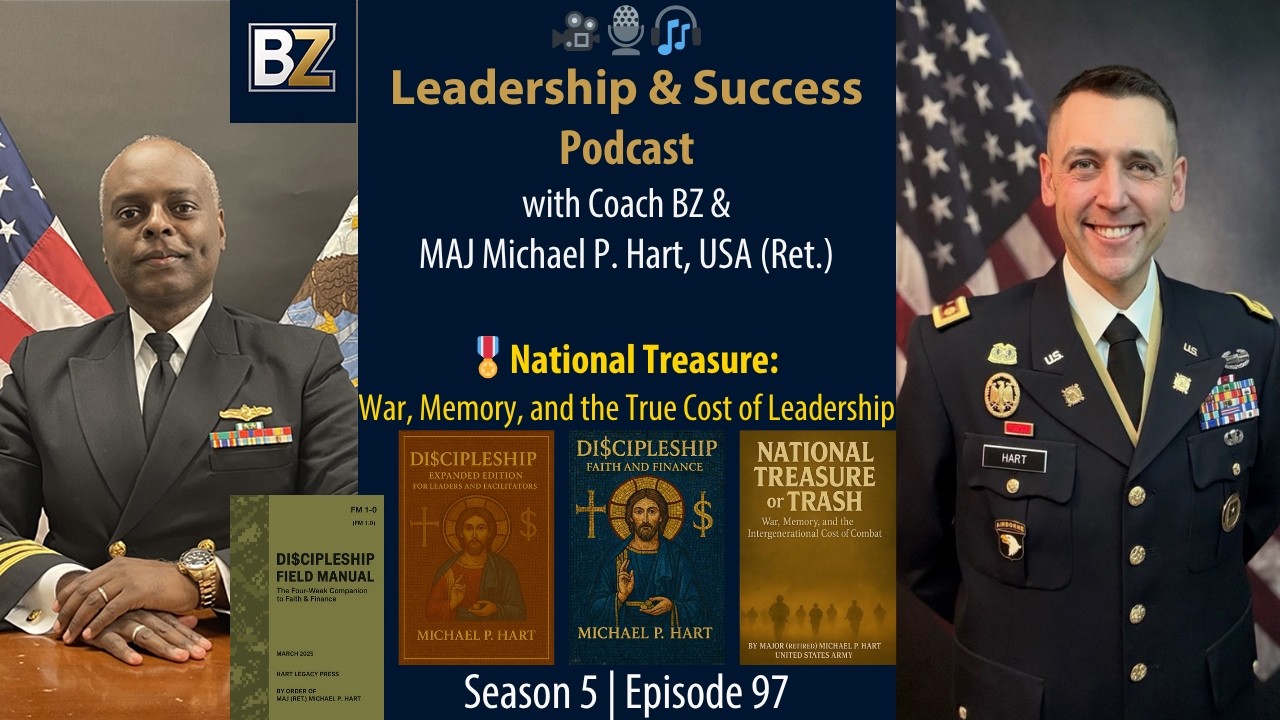
Retired Army Major Michael P. Hart discusses his leadership philosophy built on people, competence, character, and connection. He shares combat memories, including a moment that taught him the importance of restraint, and explains how his book National Treasure or Trash explores war's invisible wounds and generational costs.
Chapters
Hi, I'm John Maxwell. When the top companies in the world are looking for trainers, speakers, and coaches, there's one name that stands above the rest, and that's Maxwell Leadership. Our certified team members have gotten proven results for companies all over the globe, and our reputation I'm proud to say is second to none. Some of our members have risen to the top of their profession, including the one you're going to meet today. I proudly introduce you to my friend, Bob Fabien Zinga. Welcome to the Leadership and Success Podcast with your host, Coach BZ, where we help you lead with purpose and succeed with impact. If you're ready to grow into the kind of leader others want to follow, this podcast is for you. If you're determined to elevate your success and leave a lasting legacy, this podcast is for you. As my mentor, Dr. John C. Maxwell, reminds us, everything rises and falls on leadership. Our goal is simple: to inspire you, challenge you, and equip you with insights that can transform the trajectory of your leadership journey. Welcome aboard to another episode of the Leadership and Success Podcast with Coach B. Michael Hart, how you doing, sir? Hey, good. I'm doing really good. Thanks for having me on this morning. How are you today, sir?
Good, Mike.
I, um, I first wanna say thank you for your service. You are an Army veteran, an author, an entrepreneur, right? You've, you've accomplished so much as a young man, but before all these accomplishments, before all these amazing achievements that you've you were able to achieve at such an early age. What is your origin? Who is Michael Hart? That's a great question. And I really appreciate that. Michael Hart. Um, yeah, so I am in a, a second phase of my life. I've been a retired Army officer. I was a major and traveled the world and seen and experienced quite a bit. I grew up in Illinois, pretty grounded in a middle-class environment. And, you know, it wasn't perfect, but my parents were amazing and it was structured and we had good work ethic, accountability, and, and a place where I could kind of figure my life out. And that's brought me to a great place through service and now authorship. You know, I appreciate you sharing that. You mentioned being raised in Illinois. How did that, how did that shape you with just your, your, I would say your perspective when it comes to service, when it comes to serving others, because I'm sure being raised in Illinois, the values of tradition, right, is probably very present. Absolutely. Growing up in the middle, middle here of the country, seeing everything, being able to feel the country. And, and it's exciting being born in, in the '80s. Season as a millennial in a middle-class environment. We really had all of these opportunities and Illinois is, it's, it's in the middle of everywhere. For lack of a better word, you can get anywhere around the country from Illinois and go anywhere and see everything. I was gonna, you know, I was gonna ask you, it sounds like Illinois being very traditional and you having a tight-knit family. Did you have any family members who joined the military before you did? Did you have any influence? Yeah, I think that's a great question and a really unique one for the millennial generation and Gen X, because we grew up— well, I'll pause. I was a sophomore in high school when aircraft—
All right, so that was just a small sample of Major Michael Ard. So grateful to have him waiting for us in the green room right now. Before we get started, as is our tradition here, we call this a moment of gratitude. That's where we take just a moment to be grateful. We do this every single time we meet, and this is very important to me because, as you know, in the military, It's about 22 veterans and service members who commit suicide every single day. And we believe that it's not possible to be suicidal and be grateful at the very same time. So if you would, maybe close your eyes, put yourself in your happy place, maybe take a deep breath, slow down your nervous system, and in this moment, think about one thing you are grateful for. And today I am really grateful to be an American, a citizen of the home of the brave, the land of the free. And our freedom isn't free. It's been really won by the blood of our brothers and sisters and people who were willing to put their life on the line so that we might be free. And I am so, so grateful for that. All right. So let us know in the comments, where are you joining us from? What city? What state? And also let us know what you are grateful for. And if you do have a question for my guest today, go ahead and type it in the comments. We will be answering live. And hello to Daniel Young, uh, joining us from Metland, Florida. All right, let me see if I can properly introduce our guest today. Today we are going to be speaking again to Major Michael P. Art. He is a combat veteran former US Army Major and commanding officer who led soldiers in high-stakes environments where decisions carried real consequences. During Operation Enduring Freedom, he served as the Deputy Task Force Engineer integrating multimillion-dollar combat engineering operations alongside US and coalition forces. He later continued his impact in strategic readiness role and now brings that experience into his work as an author and thought leader. Michael is the founder of Art Legacy Press and author of National Treasure: War, Memory, and the Intergenerational Cost of Combat. His work challenges us to confront a truth many avoid: war doesn't end when the deployment ends. I think every soldier, sailor, airman, and marine knows that for sure. Leadership decisions don't stay in the moment, and the weight we carry often gets passed forward. So one of the things you're gonna be learning during this podcast today is what leadership really feels like when lives and consequences are on the line. So please help me welcome to the Leadership and Success Podcast, Major Michael Hart.
Pleasure.
Good morning.
It is a pleasure to be here this morning to you and to all of your, our listeners here this morning. Yeah, absolutely excited to share all of the above and then some.
Yes, we're definitely going to get into it. And it's really a great honor and privilege to be speaking to you today, Major. And what is one thing you are grateful for this morning?
Well, I am grateful for this opportunity to be here. Truly, we say that, but I have friends and family that have given that sacrifice and aren't here today. To be able to be thankful. So I'm thankful for them for that opportunity today and to respect and talk about such an amazing topic, set of topics.
Yes, yes, indeed. And for me, anybody who's ever served any branch of the military for any length of time is really an American hero, in my opinion, because it really takes a lot of courage and bravery to do that. And I believe it's what, less than 1% of US citizens actually volunteer to be in the armed forces. That's the other thing about America's military, right? It's all volunteer.
And that number is actually— it's become even smaller than it used to be in our history where we had the draft, conscription, more service members. It was common. And now since '70, 1973, it's become much more, as you just said, The 1% and a very small part of our population that carries that burden.
Yes, yes. It's just incredible the work we do in uniform, and I will be forever, forever grateful. That's also why even when after people have retired, or even if they didn't retire, but they got out or whatever, I always want to highlight their military service because that is a great achievement in my eyes. But anyway, is there something about you, Major, that most people may not know when they first meet you?
Hmm, you know, one thing people may not know when they first meet me is I love guitar. Absolutely love guitar. It's one of my— I can't go anywhere without having one, and it is my outlet for all emotions. And most people don't realize that.
When did you start playing the guitar?
Yeah, I started playing in the fall of 2004. And funny story there, I was on a date and I told the the gal I was across there at the table that I always wanted to learn to play the guitar. And she looked at me and kind of gave me one of the— so are you one of those guys that says he's gonna do something and never does? And I had a guitar within 2 weeks and I've been playing for 22 years since.
That's pretty amazing. Wow, that is good. You can see I have my professional keyboard there. I've been playing the piano since I was about 7 years old, but when I was about 12, I started playing the guitar a little bit. I play okay. You probably play much better than I do the guitar, but the keyboard's definitely my go-to instrument.
It's a gift, any instrument.
That's true. That's true. Wow. So to get started, before the uniform, who were you and where did you grow up and what kind of home shaped you?
Sure. I grew up in mostly the affluent suburb of Naperville. Outside of Chicago and in a loving middle-class family. We had— I'm very proud and I've been very fortunate. My parents set my sister and I up for success. We, we had the support and the opportunities to do the things that we had wanted to do, but we didn't have so much that we couldn't do things. And that was really truly a gift that came from my grandparents down to my parents that translated into the opportunities that I had out of Naperville and going into the military. And one quick note, I want to say I'm very proud of Naperville. A lot of people look at it for its affluence and some of the southwest suburbs and what there is there. But a lot of people don't realize outside of Chicago in Illinois, during the Global War on Terror, Naperville lost the most sons and daughters outside the city of Chicago.
Wow.
For a city of 325,000 plus to a city of 4 million, that should tell you a lot about how we believe in the country in those, those suburbs and Naperville and Sometimes it gets a bad name for that, but you can see that the care and respect for the things that we have is very strong there in that fact.
Wow, man, it's really amazing. Like we say, you know, what is it? Many gave some, but some gave all. And it is really, really humbling to see. I know when I joined the Navy, it was right after 9/11. I think most people in my cohort, it was really for love of God and country. But I really don't see that type of love and devotion anywhere, right? I now live in Silicon Valley. I've never seen anybody from Google, Microsoft, or Meta, or Facebook, or whatever saying, hey, Bob, I would be willing to give my life for you. But I know in my Navy, in my unit, unit for sure, you know, the sailor to my right and to my left, that young man or young woman is definitely willing to do it for me, and I'm willing to do it for them. It's, uh, it, it really keeps me in awe. Uh, there's just nothing, nothing like it.
Absolutely. And, and to that, we have grown up, um, both you and I, in the professional military post-1973, and you know, we carry quite a lot of a little bit different of values, um, in that growing up in that shadow of the World War II and Vietnam generations. But that, that truly shaped us when we became that professional military in the pipeline. And then when it come time— when it came time to answer to the country on 9/11 in this very different world that most people didn't realize was as violent and fractured as it is for most Americans coming up in the 1990s following the massive success of Desert Storm. 9/11 was a— it was a blindside for many people.
So true, man. But now, in your case, both of your grandfathers served in World War II. What did you learn, not from what they said, but from what they didn't say?
You know, what they didn't say and what they did, the two most important things. Both of my grandfathers were very reserved, like most of the World War II generation. There's not talk of glory or we did this or that. It's really we had a mission. And we did that.
Yes, they truly were the greatest generation, for sure.
They absolutely were a, a cut of a different thread. And one of the things for me, seeing my grandparents, one being very quiet about his entire experiences and the other also quiet, however there were moments where you got a glimpse of that trauma.
Yes.
Um, but I was too young to truly appreciate or understand most of that. So for me, and I think many of my peers, we grew up with the Greatest Generation almost giving us a quiet, you know, not talking about what it was because it was just so horrific. That we had Vietnam in the middle occur, and then the operations in Desert Storm. So there we have a lot of disconnects there. Um, so while that generation of my grandparents kept quiet, it also stirred questions within me about what that was, and without the information, we tend to fill those holes.
True.
And I think myself, just like many in my generation growing up in, in the '70s, '80s, being born, we looked to media, we looked at America being the powerhouse. We watched the Cold War, uh, end with America being the sole standing power. And so without having as much information coming from my grandparents, it almost became a, what is the dream that you want to have? You know, I'm going to give back in my part.
Yes.
Without really quite understanding some of those deeper implications about, well, maybe why were my grandparents or certain relatives so quiet or affected?
So true. So did you feel pride pressure or something more subtle from that legacy? You're good.
Yeah, so there's pride, a lot of pride. Um, you can't not, I, I believe, uh, feel that, especially in this country. Um, there is absolutely, you know, for me, the desire to hold up my end of the bargain But it was also counterculture in a field to say, like, because I didn't need to go into the military. Um, one of the true privileges of being born to my parents where I was and when I was, was the opportunity for my parents to say, you know, Michael, you're getting ready to go to ROTC and you're looking at getting your education paid for with scholarships, but You know, we love you very much, son, and we're willing to pay for your school. You don't need to get a scholarship to go to college. And so having, you know, that love, that option and choice was very special for me to be able to look at that and make those decisions and still choose to serve.
That is really powerful. And I do know people come into the military for all kinds of different reasons. That is, that is fine, nothing wrong with it. And in the military, we do have a whole bunch of benefits. And sometimes I am flabbergasted that some sailors of mine, they don't take full advantage of all of the benefits that the Navy provides to them. And I think that's kind of wrong, right? If you have an opportunity to get free education and get the VA mortgage and all of that. I think you definitely should take advantage of all of those. However, I really believe you don't join the military for benefits. It's just not the primary reason why you become a sailor, a soldier, a Marine, or, you know, uh, an airman. We do have a mission, and to me, especially when I become a commanding officer, it, it was really crystallized in my mind. Basically, we pretty much do one of two things. One, we kill our enemies, and then we save our allies. That's pretty much what we do. Everything else is kind of extra. So we do have a mission and I think we borrowed it from the Navy, but in the Navy, one of my leadership mantra was mission first and people always. And that is true. But as the commanding officer of my command, I have a mission I have to accomplish and I am going to get it done. Right. So that's, that's pretty, Pretty, pretty much the bottom line. Again, when you volunteer to join the armed forces, again, I believe to me you are definitely a hero regardless of the reason why you initially joined. But yes, we, we do have a—
Yeah, you make a great point. And that sometimes can be a challenge for leaders, understanding that soldiers, airmen, Marines, people You know, we join the military and there are, you said it, extrinsic values. You know, maybe that's, I want to get my college paid for, maybe I'd like to get out of the environment that I'm in, I'd like a change. Um, those would be those extrinsic values. And, and then we kind of go, you know, what are the intrinsic ones? And that's where service or our ideals to support things bigger than ourselves come into play.
Yes.
But I think it's important to understand that no matter why somebody is in the uniform, they've raised their right hand.
Yes.
And that is a gift that sometimes people don't realize. And whether that is on the front end, an extrinsic why you joined, very quickly, uh, soldiers, people realize that this isn't about the what you got out of this, but you've become a part of a system, and that transcends those extrinsic values and becomes the reason why people really look at service and go, this is why I stay. And, and in a quick— just pause— that's also the main reason why businesses and the military lose soldiers. We fail Uh, soldiers, Marine, airmen, we fail our people to provide them. Yeah, there are extrinsic benefits here, but life isn't about the benefits external. It's about the reward internal.
Yes. So insightful. Now, in your case, as a young man, I'm sure you were definitely influenced by both your grandfathers, but what were you searching for when you chose the Army?
The Army. Absolutely. My grandfather was Army on Okinawa in World War II. My other grandfather was in the Navy in World War II initially, and then he had gone into— used his GI Bill and become a medical services officer. And so the Army was a trend common bond for me. And, um, I, like many people, uh, I'm afraid of water. I like— I love swimming, but I am afraid of big open water. So the Navy, yeah, that wasn't, um—
but you, you'd be surprised, uh, how many people become sailors who can't even swim, including this one. But, uh, there's a story to it. But anyway, yes, yeah. Although prior to 9/11, no, you would join the Navy, you'll think, okay, I will be at sea on a big ship and take— no, I'd be pretty safe. But after 9/11, we end up going where the Army led us in the sandbox.
So that wasn't very Navy, but, uh, well, and, and to be honest, we had the Navy in the middle of the landlocked country. We had the Naval, uh, Provincial Reconstruction Team working with, uh, the different departments of the, uh, Greater Islamic Republic of Afghanistan, um, working infrastructure transportation things. So we really did have all of the branches, including the Navy, Yes. In all of our engagements, they fill a role.
Absolutely. Wow. Because you've said that ROTC was the path, so that's the path you chose. How did that shape you differently than a direct commission route or going to the academy?
Sure. So the academies weren't much of an option for me. They're so competitive., to get into the—
Do you feel like people go to the academy are a little bit more arrogant? Just a little bit?
You know, I think that there is, uh, there's a, there's a different mentality, and there's mentalities in everybody.
Yeah.
Um, you know, the, the military academies, I, I believe each commission about 1,000 lieutenants a year, and in 1,000 officers, you're going to have the absolute mix of everybody.
Yeah.
Um, and you know, there are professionals in every profession, and whether it's ROTC, officer commissioning, the direct route, um, and/or the academies, we all share that same initial service obligation.
That's true.
And then what we do after that, we'll see where that, that, that that becomes more telling to the individual.
So I am going to guess Navy versus Army college football. Go Navy, beat Army.
Hey, go Army, beat Navy.
Okay, at least this year the Navy won, right? So maybe you guys are gonna—
It generally happens that way.
So much fun. But was Was the reason you joined the same reason you actually ended up staying, or did leadership change that?
Love that question. It was those intrinsic values of service, uh, for me to join. And when you start, that looks like the 3 meters around you, and you affect the mission around you and the people around you. But as you advance in that career, your initial obligation, it is the people. You realize as you've gained responsibility that you're not just affecting the people around you, but it's the second and third lines of people around you. And when you start to get into that system and you're being proactive and, and successful, you see those rewards, um, in people that you never meet. So yes, intrinsically it starts and you see the, the belt, the growth and the benefits around in the people. But as you stay longer and grow up in rank, you see more and more that allows you to go, hey, this is, this is really making the impact for soldiers across the formations. And that becomes the reason to stay. So the people and then the people multiplied.
Yes, I know the, the 3 C's of leadership which we taught in the Navy. Again, I believe we borrowed it from the Army. Uh, it's, uh, you know, competence, character, and connection. And like I said earlier, my leadership mantra, again, which we bought from the Army, I am sure, uh, mission first, but people always. It's really the people that makes all of the difference, doesn't it? When, when did service stop being about opportunity for you and really start being about responsibility for people? Because I must tell you, as a commanding officer, I really had the pleasure and the greatest honor of my life. The greatest joy I really had was to see my people promote and see them do well and really, you know, reach their potential. There was nothing more fulfilling than that. How was that for you?
Maybe you could hit me with that one more time. I think there's just a lot there that I want to make sure I—
So at some point, service stopped being about just opportunity, just me, myself, and I, you moving up the ranks and all of that. It started being about the responsibility you had for your people. When did that happen for you? I think for me, it was when I was a Lieutenant Commander, so Major equivalent in the other branches, when I became the executive officer for my unit. Prior to that, I was a division officer, I was a department head, but once I was second in charge for the entire unit, I started thinking differently. It was no longer about just me, but it was about the people that served under me.
Yeah, you know, a really great— I, I, a perfect example. You know, people think on a drill weekend for the Guard and the Reserves, you show up one week is a month, two weeks in the summer. It's absolutely never that. It's a lot more time.
Yes.
When you show up as a leader, you are tracking and taking care of all the different training tasks and events down to the dot. And if you're not doing it down to the dot, you're wasting soldiers' time. And as an officer, as a leader, one of the most important jobs you have is to protect those soldiers in that training time. And in this instance, I'm thinking back, we had our entire battalion, so 500 soldiers together. And the colonel needed a detail to get done, and the colonel asked me for soldiers. And I respectfully looked to my roster and said, sir, I can give you soldiers, but you will have to take them out of X, Y, and Z training that has been directed. And the answer back to me was, you can't give me 3 soldiers?
Captain.
And the answer was, sincerely, sir, here is my— here's my soldiers that are at X, Y, and Z training. I will happily send soldiers from training and take them out of that. So, hmm, the colonel immediately understood that our unit and we were taking care of the soldiers. There wasn't wasted time. We didn't have soldiers to just pull. Yes. So that may be a very simple answer, but one where sometimes you do, you have to put your neck out and say no respectfully with a yes. You know, it's like, sir, I will do this, but I promise you, I don't have soldiers that are not in collective training.
Yes. Wow. That is powerful. And I think your people will definitely know when you stick your neck out for them, because in many organizations, especially in the industry, civilian organization, people usually say, yeah, people first, we love our people and we cherish them, blah, blah, blah. But the first occasion they get, they will lay off an entire department. It's like they say a lot of things, but they don't really mean it. And in the military, the great majority of leaders I've had, they really do mean it and they would put their own rank on the line and provide you top cover. And people like that, you know, I would follow anywhere they lead. So talking about the transition from being a civilian to becoming an officer, What surprised you most about becoming an Army officer?
I think one of the things that surprised me the most was how you are truly expected to know and be all and do while also learning. And that can be a huge learning curve to go, okay, from whichever pipeline of training that was, uh, to all sudden you're, uh, you know, second lieutenant with possibly no experience outside of the military standing in front of, you know, anywhere from a platoon to a company, 15 to 100 soldiers speaking, and they're all looking at like, who's this young person and have they shaved yet? Possibly.
Yes.
Um, so it can be very, uh, yeah, a little bit of a jolt, you know, as you transition from your versions of the schools and the steps to you're right in front of soldiers.
Yeah, I guess in, in many branches of military you kind of go through what we call no sink or swim. They just put you out there to, to lead and see what you are made of. Did you have to rely on any of your NCOs, especially when you're first starting leading soldiers.
Absolutely. If you do not support the non-commissioned officers, the NCOs, that is the sergeants, uh, your folks that are making that happen, you will fail. Yeah, there's not even a question, uh, in my military mind, um, ensuring as the leaders, as the officers, kind of, this is what the mission is, this is what we're gonna do, can kind of come up with some of the left and right limits. You have the NCOs ensuring that the soldiers are taken care of and they're able to actually make that mission occur that the leader is, is planning.
Um, so powerful, because I remember when I first became a CO again, I reached out to all of my mentors, okay, what do I need to know. And one of them told me, you know, take care of your people and your people will take care of the mission. And that is so true.
Absolutely.
So in your experience, your leadership journey, when did leadership start to feel heavy for you? Because I do believe the, you know, we talk about the weight of command, but I think it's a real burden.
Yeah, the things become very real out there. You know, two things. An experience I had, one of the first moments I was on Bagram Air Force Base getting ready in Afghanistan, getting ready to move down to Ghazni, which was halfway down the country. Um, I took the opportunity to step outside and, and have a cigarette. I've quit now, 2 years in July. Um, but when I went outside I saw an enemy combatant prisoner being guarded by two soldiers there, being ready to be transported. And, you know, when you see all of a sudden, you know, it's not that there were people in the Twin Towers or this is a green target, the enemy. When you step outside and all of a sudden you're seeing somebody that's got their arms zip-cuffed behind them, they're on their knees with a blinder on, being waited to move, you know, nothing wrong here, totally standard. It becomes a, wow, this is the person, a person, that I'm here to be fighting the war with. And that, that was a, a moment of, this is extremely real. And it doesn't come with a take back. Here, here is a person that I'm the enemy of. And I think, you know, that, that translates to, you know, that responsibility that we have in our restraint and our control and our ability as officers on the battlefield when things do get heavy and real, when we're having to answer to those realities.
Yes. Wow, that is quite insightful. And as an officer, how do you keep yourself from despising— no, the enemies of your country, still treat them with dignity and respect, knowing that we all share the same humanity. And I know, like me, you are a believer, so you do believe that all men were created in the image of God. But what I have seen in the past is sometimes people, they kind of forget that and they kind of dehumanize the enemies of America and treat them like vermin or animals, and that kind of gets out of hand. Abu Ghraib is one good recent example in our modern history.
Yeah, absolutely. It is— it's a challenge, and we do need to be careful. That becomes a little bit of the disconnect, and one of the things that I write about in National Treasure is while we have risen our right hands, while we had drafts, World War II, Korea, Vietnam, since 1973, we have been more insulated from actual combat as a country. I'm not saying we haven't had limited engagements, we have, but our veteran population becoming now 1 and 2% of the American population that understands, or at least has been through training, exposed to violence. And/or the potential of it to, to now where the Vietnam generation is getting deep into their 80s, the leaders, you know, we're starting to lose some of those human memories that are important to remember about, you know, violence and warfare being that extension of politics and/or failed diplomacy.
Wow. So let's, let's talk about this now, combat and decision-making under uncertainty. Can you take us to a moment in combat when it became real, right? Not just the action, but really the responsibility.
Yeah, the, uh, one of the most difficult moments that somebody can experience truly is setting themselves up for what will happen in a moment. And we go through the training and the drills with our weapons to have outcomes that match our intent. For example, our soldiers receive very similar training to police when they have to do positive identification of a target. Mm-hmm. Just like a police officer has to assess, is this person a threat or not? Soldiers have to assess a threat based on the rules of engagement of the theater. I had an oppor— I had an opportunity, an instance in a village where we had been shot at or shot at on the way out for months leading up to it. And it was an engineering survey that turned into an impromptu, let's look for a cachet site. And I ended up finding myself pied up on a corner doing a dismounted patrol. And, you know, everything went silent and I was on the corner of a building looking down an alley and a door slowly started opening up and I immediately raised my rifle, rotated my safety select switch. From, uh, safe to semi and prepared for what I was expecting to see a machine gun pop out and, and, and plug me and, and the guys next to me. Um, what ended up happening was about a 6-year-old child popped out, looked at me, and his jaw just dropped. And I immediately rotated safety select fire, uh, to safe and caught my breath and motioned for that, that, that child who was just staring at me to go inside. And, um, and, uh, that kind of moment, I'm— I am thankful that I had the additional training to be able to pause, follow that, um, positive identification, the rules of engagement. And we had a, a non-fatal event, although a very emotional one, and one that soldiers have to be prepared to do. Um, wow. So that was a very big one for me, um, carrying that child's life. And, and I often do wonder what might have happened to him.
That's really something that people in the industry who've never worn the uniform will truly never completely understand. And so you didn't pull the trigger. What did that teach you about restraint and leadership?
That was an incredible moment and one I've struggled with. Um, and, and this might come across different than than I'd like, but sometimes it is— honestly, it is more challenging to not fire because you are putting yourself into what I call the child conundrum, which is a topic that I discuss in National Treasure. And that's, you know, there are enemy, enemy combatants, and there are also civilians and people just trying to live their lives.
Yes.
Amongst all this chaos. And so the child conundrum is, you know, how do we protect ourselves also protecting, you know, the future? And that is children, people, not just there, but here in our own country. So, you know, that balance is— yes, it's one that many people haven't ever had to think about. That, you know, I've written about, and I encourage people to, you know, consider those thoughts.
Wow. So what thoughts came through your mind in that moment?
You know, the thoughts that came through my mind— well, I am so thankful for the Army Basic Officer Leadership Course 2. It was one month of soldiers, officers following commissioning. And it didn't matter what branch you went to. You could have been a nurse, you could have been a signal officer or infantry. You were going to get an extra 6 weeks of kicking in doors using the most modern techniques, tactics. And what that did— that course was a response to the Jessica Lynch convoy ambush. Early on in the Iraq War. It was trying to balance leadership across the board. But that additional training, had I not had that, we might have a very different— I might have had a very different experience there. So that person— so those little things can change the world.
That is really so insightful because in the military we do train like we fight and we fight like we train. And people think in moments of great challenges, people will step up to their potential. But the truth is, we always fall back to our training. And in the military, we know that so well. Last question I'm going to ask about this: what do you think is the major lesson you learned from that experience?
You know, I think the biggest thing from that, that experience is is to pause and to have trust and, and to not take training lightly. That's the most important thing.
Wow.
People—
so do not react but respond.
Do not react, respond, and understand training. And this can be in any business.
Yes.
If a, if a leader is looking to train you, it is for a reason. It's not for you to, to, to blow off, think maybe this won't happen. You're hearing about it because of a failure, you know. So for every success we have, that is because we've grown. Um, so that's one thing I just encourage people, especially in the civilian world, we, we often, uh, talk ill of training or corporate meetings, but honestly, that's that can be where some of the most important things you learn to do or not do occur.
Hmm. Wow. That is really powerful and insightful. It's not really complicated. It is simple, but it is very, very impactful. So how do you lead when you don't have all the information?
Sure. You will never have all the information, as you know. And so one of the lessons that was imparted upon me early was create your feedback loops. You know, if you don't have the information that you need, listen. You know, if you talk less and listen more.
Yes.
Look around you. You will see events occurring and be able to tie into those. And so, you know, being a leader is very alone. That's one of the things you realize you're up at top, but you don't need to be alone. You know, you can create those feedback loops, those abilities to have information without standing on that mountain. And you've never been designed to stand on that mountain in any organization, especially in the military. They give you a NCO that we were talking about early, a sergeant all the way up to Command Sergeant Major to take care of, you know, the officers as we sort of work through.
Yeah. And I'm sure it's the same thing in the Army, but really sergeant in the Navy, we call them chiefs. You know, they, they really take care of all of the junior enlisted and they do mentor junior officers as well, all the way up to O-4. So when I met O5, I'm like, okay, you guys took care of me from E1 to O5. I'm not going to abandon you now, so please continue to mentor me. So yeah, absolutely great respect for my chiefs because they truly, truly run the Navy, you know. Sometimes they do all of the glory from all of their hard work, but, uh, man, without them, uh, there's no way we can make it. Just impossible.
It might be kind of funny because I was in the military, but I did used to joke that you know, being a leader in the Army is kind of like being a ship, and your NCOs are the, the water. And if they want, they can literally lift you up and drop you on the rocks.
That's right, that is absolutely right. I do believe there might have been a few officers from the academy that didn't make it back from Vietnam just because they wouldn't listen to their NCO. Uh, but yeah, you, you do have to listen to them. Uh, it's, uh That could save your life for sure.
Absolutely.
What should leaders understand about decision-making when lives or career are on the line? I'm going to ask this before we get into your book.
Yeah, I absolutely think the most important thing people need to understand— soldiers' lives are on the line and yours is as well. You know, there's not a single job in the military that doesn't somehow have to do with life and death. You know, so that's one thing, you know, I would look to tell people to make sure that they're— again, you know, you don't have to be infantry to make— to look at how you are a major part of the battlefield.
Yeah.
A logistician, cybersecurity, signal telecommunications. And they all have extremely important roles to provide across that.
Powerful. So again, your book— you've written several books, but the one we're going to be focusing on today— we're almost out of time already, I can't believe this— but National Treasure or Trash? War, Memory, and the Intergenerational Cost of Combat. Before I ask you about the book, there are a couple of questions from the audience actually. Sure. Uh, Jessica says, I love this conversation. Thank you. We have a question from Daniel. So Daniel asks, uh, on a mood question, how do you coach junior officers to build internal firewall early so they can carry the weight of responsibility, faith, and stewardship without passing weight in destructive ways?
Okay, you know, that is an outstanding question. Part of creating a firewall and insulating yourself from soldiers also, while being similar to a parent, you know, children are not going to love you if you're parenting right. Soldiers are not going to love you if you're leading right. Now, that being said, You know, being a leader can be being alone. You know, you have the people next to you, but you have to make sure that you're not befriending. You can, you can have personal relationships with your soldiers that are professional— sorry, professional relationships with your soldiers, not personal relationships with your soldiers. And that will allow you to be as a leader, um, what you're doing is trying to insulate yourself and protect your integrity and the ability to make decisions equally for all of your soldiers regardless of the situation. And that can be very difficult, especially as a young soldier. So you really need to, uh, protect yourself, get tight with the command and the people, the resources that your organization has given you and start learning.
Wow. So, you can have high standards but still be fair across your troops.
And that's incredible. You have to be as unbiased as you can. The second you compromise yourself is the second you become essentially command ineffective.
Yes.
Wow.
Powerful, powerful. And so, this book, why did this book have to be written? National Treasure. Yes. Trash.
Yes, National Treasure or Trash. So from my grandfather's experiences to what did or did not come from Vietnam in 1973, ultimately, that shaped the military that I would join and ultimately serve in, in Afghanistan. And what really occurred here were a series of discussions and my own dialogues over the last 15 years and really unpacking PTSD, combat, um, the geopolitics, our history, what I was finding in discussions were people going, that makes too much sense, Michael, how come nobody else has said that? And then, or that's just me. And you hear that and you go, for a certain period of time over and over and over again, you're like, I can't just not write this. This has to be told. Um, and it's not something that is easy. This is a very challenging book to write on a topic, um, 1925 through 2025, in our living memory of war and what comes forward from that unintended consequences, and, and how does that shape today?
Hmm. So if you can define this for our audience then, what is the intergenerational cost of combat? Again, I love that you go all the way back through, you know, your grandparents and to what you yourself lived during the war on terror. What is this intergenerational?
Sure. Uh, so intergenerational Costs, you know, we've done a pretty good job in our, our modern sciences at looking at, let's say, a parent was abusive to a child. And so statistically, we have found that that child will become more likely to be abusive and/or show different traits, manifest different symptoms. So we have gotten pretty good at looking at direct results, you know, in, in a generation. But what we haven't started to do is go, you know, what are some of those silent things? You know, my grandfather had a very violent experience on Okinawa, um, hand-to-hand combat. And wow, he loved this country, and yet he was going to— and when Vietnam came around if my uncles or my father had gotten drafted, he was going to move them either to Canada or another country. And that's—
he—
my grandparents were going to make us war refugees. And that's not because he didn't love this country. That's just because of the sheer, uh, violence of it, of it all. He was not going to pass that. That down. And so, you know, that information that didn't, again, so to speak, get to me, um, through that Vietnam generation, these lessons— we've distanced ourselves, um, so much that again we don't understand what lessons of violence need to be taught. Um, part, part of this, and I have to say, you know, National Treasure is not an anti-war book. It's not for war, it's not anti-war. What it does seek to say is, you know, it's— you have to love your neighbor, that works. You love your town, that works. Your city, your state, your country, your continent. Do you see where this is going? Um, if this information— if we don't start looking at, at violence and war as a species, what I'm reminded of is that people without education can fly and be manipulated to fly buildings into towers. The Pentagon crash in Pennsylvania, um, the Chinese and their influence around the world. They care about China just like Americans care about America. So it's not necessarily good enough, so to speak, that I'm sharing or we are sharing our generation, but that the countries in the world need to also start to go, yeah, this is a, a bigger, um, a bigger problem. And that's something that when we look at World War II and it was long ago, it really wasn't at this point. We are absolutely living the results and/or—
80 years ago only. Yeah.
The results and/or lack thereof results in different regions.
That is really fascinating. Again, all of the junior officers out there, you need to get a copy of National Treasure or Trash. It really makes you think. What silence did you inherit? And how did that shape your leadership and your life?
Yeah, that, that silence from, from my grandparents, it definitely opened up that curiosity to go down this route. And that's a hard thing. And I think that also is— I wish I had a version of this, so to speak.
Yes.
To, to have understood, I think, both my grandparents and what the decisions I was making were actually tied to, you know, in the bigger part of this, this country and in this world, which has never been so small with information.
Yes.
Than, than ever.
Well, if you are willing to go there, do you believe that America right now is honest about war or just comfortable with it?
Yeah, that is a challenging question, and I think the answer is in some ways we've become comfortable with it, in some ways we've ignored it. In other ways, the defense industrial complex, as coined by Eisenhower, has, has played us all a little bit. A challenge here in understanding, you know, war and politics is the integration. We built the F-35 strike fighter in over 30 different states, and over 30 different politicians get to say they have brought jobs to their constituents. And in that, that's a benefit. And people haven't had to have their right hand raised and been pulled into a system to support that— our democratic capital— capitalistic democracy that we have, which allows people to be able to keep their heads down and not necessarily have to worry about it. Um, the military. Now the conundrum here, um, is part of the American dream is doing everything better so our children have a better future. Nobody wants their children to go to war. Nobody wants their children to learn about violence. But how do we teach them ways so that they don't participate in systems that then utilize violence as a, um, not an extension of policy but more of a policy tool? Um, you know, like, that one should be last. It shouldn't be, be first.
Yes. Wow. How should leaders recognize and address invisible wounds in their people?
Invisible wounds, um, PTSD.
I'll come out with, with that one, and I'm gonna go back in history a little bit, which also, by the way, I do believe that right now many people in the military have PTSD but just haven't been diagnosed yet. Absolutely.
Um, PTSD— we've been very fortunate that the medical community and our society has really started opening that, that door and that window. And that has occurred here in, in, in our time here and in this last, uh, 26 years with the Global War on Terror. But back in the Vietnam era and World War II, we called it battle fatigue. And then in Vietnam, they called Post-Vietnam Syndrome, PVS. And PVS is actually a really good description because it is addressing how did a person react following Vietnam. And that is following the experiences that they were through, both the military raised your right hand and triaged them through training, and through the experiences they had. So we've gotten better at saying that PTSD isn't just a combat thing, it's also a life thing. People experience things that are extraordinary, and different extraordinary events then have the opportunity to, to have a post traumatic stress syndrome. And I think for leaders, they just need to listen more. I think people, myself included, if, if a leader gives me an opportunity to share with them in a way that I'm not being judged, that the soldiers feel supported, people will tell you. And/or if they're not, if you're a leader, you should be watching and paying attention to that. A quick analogy: back in the day in the military when we had black leather boots, you had to shine them every evening. And so if you saw your buddy didn't have shined boots, you kind of knew something was going on. You know, so to your question, leaders, they need to be observant. They need to talk to their people, and they need to do that with grace.
This is really powerful. And in your book on page 128, after the last chapter, you have 16 chapters there, War's Eternal Lesson, you end by saying, "Sacrifice therefore concentrates predictably at the margins while the crowd moves on unburdened." Can you unpack that for us?
Yeah, if anybody's been to a VFW, and they're all over the country, you know, a lot of the times you'll see, you'll see the veteran community. And you'll see, you'll— Bob, what can you— could you unpack that one for me one more time?
Yes, this really moved me. To me, that is really the summary for this entire book. You say, sacrifice therefore concentrates predictably at the margins while the crowd moves on unburdened.
Yeah, this is a very deep one. Um, it goes into the mentality of If we look at post-9/11, there were flags on everybody's porches and doorsteps. Everybody was gung-ho. A couple years later, as, as it starts to become unpopular, as soldiers start to come home, as the war ends, um, all sudden everybody with their flags on their doorsteps were not the people that were actually out there responding. To the events. And in time, what occurs is, you know, the, the thank you for that, I appreciate you, the actual moments are left just amongst ourselves. And like we discussed earlier, that stovepipe effect of, of our military experience being shared by increasingly smaller and smaller demographic of our country has made that even more worse. And you mentioned it earlier, and that really impacts and shows with the amount of suicides, and that's soldiers not being understood by a society that asks them to do things that this society doesn't have the courage, willing fall, and/or the politicians tell them what war actually is about and/or how they have failed those soldiers. And wow, that's a big crux that most people don't want to talk about. It's not that veterans are afraid of what they've done, it's just that this country doesn't allow them to say and experience and process it honestly.
Wow, this is really a very, very important work. Again, all of you, Junior I think should get a copy, National Treasure or Trash: War, Memory, and the Intergenerational Cost of Combat. If somebody was to read just one chapter or was to read this entire book, what do you want them to feel or to see differently after reading your book?
I think the most important thing with, with this book. And I would encourage— this book touches every American. There's not a single person that can hear this interview and not have a veteran family member, a veteran grandparent, somebody that they've seen, a war movie that they've seen, economics, Um, this is, this is truly the first book that I've been able to put out that I've seen that can try to address such a broad topic in yet a way that people haven't been able to associate with, and/or they've associated it with in a way they didn't realize.
Yes. Wow.
For example, Forrest Gump. I talk quite a bit about Forrest Gump in my book briefly, and what they show you versus what occurs, you know. Yes, it's a great example.
Wow. No, thank you so much for bringing light into this very, very important subject. Now we won't have time to go to the other, but you've written actually 4 books. Another one is this one. Can you just tell us briefly why the audience should read this one? Discipleship, faith, and finance.
Sure, I'll be, uh, be really quick here on that. Yes, so discipleship, faith, and finance. Um, the church can't touch— sorry, schools can't touch Jesus because of the religious aspect, and that's a huge disservice to people. The churches don't by design want you to do anything but tithe, and that's— I'm not anti that, that keeps the resources piping blind. However, there are so many experiences in the Bible of business that we just completely glaze over. So what I've tried to do with Discipleship, Faith, and Finance is bridge a little bit of the, the teachings of the man Jesus and bounce that off of some of our contemporary leaders. I don't need to be the expert for finance when Warren Buffett exists. Um, Kiyosaki, Ramsey, Kramer, uh, Bogle, all these amazing smart financial icons in our world. So what I've done is allow the reader to pick about 32 different scripture bits that are not spiritual but, um, human in the Bible and bounce those off of our contemporary financial, uh, concepts to give somebody and everybody an opportunity to, to, to get that middle ground. And, and, and just to— for— I did do discipleship so that it could be turned into a group. Um, so the expanded edition is for clergy, and this is how, um, do you do a discipleship ministry and who do you have run that, um, where then everybody in your group would get a workbook, um, that would guide you through, uh, one month, one week with two hours a week reading Discipleship in a practical, safe environment that supports both the individual journey and the the community that's hosting that.
Yes, that is really powerful. And I like how you split this up into 6 parts. You talk about stewardship and faithfulness, generosity and giving, wealth and growth, uh, warning against wealth and greed, and teaching and voices. So basically, you do not have to be a Christian to read this. You can still get a lot out of it.
Absolutely. You know, really great example Jesus and the widow. Jesus is at the temple, uh, some gentlemen come through in their beautiful silk garments and they throw some silver in the, the offerings and they walk by. A woman walks in and she throws in 2 leptins, which is the equivalent of half a loaf of bread, her dinner. And Jesus goes, time out, you guys appreciate what you gave, but you didn't give out of your hearts. It was not a gift that was truly— it was just, here's some of my silver.
Yes.
Whereas Jesus points out she just gave her dinner. And so if you can't have that story and just talk about giving an actual— what is giving? I mean, you've missed that. So that's a— it was a very quick little vignette that I like in there.
That is really, really powerful. Like, I know Oprah Winfrey, I think she's still the richest woman in America, maybe the world. But she said part of her secret is she— we talked about the tithe earlier— she gives at least 10% of every penny that comes through her bank account, she gives it back away. And she says that lesson has really helped her become one of the wealthiest people in the world.
Absolutely. Being stewards and being able to share, you know, that is the definition of truly, um, becoming better than oneself and giving and being a part of this, this world in a positive way.
Yeah, I know we've definitely already run out of time, but I was going to ask you, is there a book you would recommend my audience, a book you didn't write?
Oh yes, absolutely. So I have been, uh, reading, and I really enjoy this one. I'll make sure you can see it. It's, uh, Seeking Wisdom Yes. Um, and that is From Darwin to Munger by Peter Bevelin, and it's one of my favorite books. It just covers from part 1, influences our thinking, psychology, physics, better thinking. Um, it touches a little bit of everything, and, and I think that, uh, you can't go wrong taking a little book there about pulling up wisdom. So again, Seeking Wisdom: From Darwin to Munger by Peter Bevelin.
That is really, really powerful. I will add that to our digital bookshelves. Okay, we've absolutely run out of time, so I won't be abusing your time. I could speak to you for another hour or two, but we do need to land this plane. So let me ask you, what can my audience do in order to give value back to you? Thanks so much for spending time with us today, Major. I really appreciate that.
Yeah, no, sir, I really appreciate it. For the audience, The biggest thing I could say is take a look at National Treasure. Take a look at Discipleship: Faith and Finance. They are both on Amazon. You know, if you take a look at them, pick them up, give them a read. If they really speak to you, I think they will. If not, please pass them on to a little library. Knowledge and sharing of knowledge is the most important thing. I think, and that would be the gift I would ask of and say thank you.
Wow, fantastic. I'm looking on LinkedIn, MMPH Offer. And yeah, thanks again for your time today. Before we end, is there a question I should have asked you, sir, I didn't get a chance to ask?
Oh, no problem.
Any question I should have asked we didn't get a chance to cover?
Boy, I think this has been outstanding. Outstanding. You didn't catch me up on any that I was like, oh man. But, you know, this opportunity is great. I really appreciate what you do, continue to do for your viewers and for this country and for us, because this is truly special. And I'm very appreciative to have been here.
Thank you. In that case, the last question I'm going to ask you, I like to ask every guest, is knowing what you know now and having had such an incredible career, what would be your advice to the 17-year-old version of yourself? What would you say, 17-year-old Michael?
Yeah, I would tell myself to, uh, continue to do everything the best you can with a smile. And that is something my parents imparted on me when I was very young, and that is something that I still to this day would tell myself to make sure and go back and do. It can make any situation better. And, you know, attitude, attitude's everything. So I would do it all again and I'd tell myself to keep doing it with a smile.
Yeah, my primary mentor usually used to tell me, your attitude will determine your altitude. And following question I'm going to ask, based on everything you've experienced, especially in the Army as a major, in, uh, combat veteran. What if you could have the ear of every junior enlisted and junior officer across America right now? What would your advice be based on your experience and the book you just wrote?
You know, the best experience that, uh, and advice that I can give to, to leaders is, is to truly listen and look more than talk. You will be— you will find success from everybody around you, from above generally telling you what to do, and below generally expecting just care a little bit in the middle. And, and that is how you will be successful both in the military and in, in most things in life.
Wow, powerful, powerful. All right, we did talk about some pretty heavy things. I'd like to end on on a positive note. So what is something you are feeling optimistic about these days?
Boy, I am, uh, feeling really optimistic about, uh, about continuing to write, continuing to, uh, share stories and, and travel and play music. Um, you know, the, the feedback I've been getting from veterans and in the local community about these books has been everything that my heart has, has struggled with in the past 10 years with all of these topics. So it's just truly a joy to have these come to fruition, have them start making meaningful contributions to people's lives, and frankly, amongst families being able to talk about these experiences. Wow.
Thank you so much. I think if you are open to this, I'd like for you to come back so we can do a deep dive on discipleship, faith, and finance. Again, people don't have to be religious to read this, and I think you really share a lot that's going to help a lot of people, especially in these economic times. I think we really need to know, right? That would be a real blessing. So again, Michael, thank you so much for your time today and spending extra time with our audience. I really do appreciate that. The very last question, this is it, and then we're gonna end the show. One word that represents our shared experience on this podcast today, one word.
Joy.
Joy. I always feel so privileged and so, so grateful for coming here, giving your time, and being one of our master teachers. Thanks again, Major Michael P. Art, U.S. Army retired. Thank you, sir.
Thank you, sir. Thank you, all your viewers.
All right, everybody, this is one for the book. So I would encourage you to at least follow Major Art on LinkedIn and also his website mph-author.com so you are aware of everything is written and get a copy of his bestselling book. Again, this book will make you think. National Treasure or Trash? War, Memory, and the Intergenerational The Cost of Combat. And I hope I'm gonna have Major Art back and we're gonna spend some time, do a deep dive on discipleship, faith, and finance. Again, this is not a religious book per se, but it really gives you a perspective on how to handle finances and how it impacts you. So hopefully you can get a copy of this one too. It's available everywhere books are sold. Now, later today, I am going to have a 30-minute talk with Andres. Andrew has been on the podcast before, so he's an alumnus of the podcast, but this time he's going to be speaking to my students, California Science and Technology University. I am an adjunct professor there. I teach CSE MB 624, Network Security and AI. He's going to be talking to us about adversarial intelligence, how AI powers the next wave of cybercrime. And I think you need to listen to it. It's going to be like a TEDx-like talk, and you will have an opportunity to ask him questions. And today, again, I think around 12 noon, Pacific time, I will be speaking to my shipmate, Commander Julie Rosati Vida, U.S. Navy retired. We're gonna be talking about leading from the cockpit, lessons in trust, courage, and command. You do not want to miss that. And then at the end of the day, it's gonna be about 4:00 PM California time, I will be speaking to my new adopted mentor, that's Colonel Michael "Check the Mic" Black, U.S. Air Force retired. We're gonna be talking from Tuskegee to the White House. A Blueprint for Purpose and Driven Leadership. So I hope this is going to add a lot to your leadership journey. And I hope to see you for the next Leadership and Success Podcast today in about an hour or so with Andres Andrew. All right, bye for now. Thank you for watching.
Thank you for tuning in to the Leadership and Success Podcast with your host, Coach BZ. If today's episode added value to your leadership journey, be sure to subscribe, share, and join us again for more wisdom nuggets on how to lead better and achieve greater success.
Remember, leadership is the most critical skill of our time.
The world will always need leaders to inspire others, drive innovation, and execute meaningful strategy. So why not count yourself among the bold leaders shaping the 21st century? Until next time, stay inspired, stay committed, and keep leading with excellence.
More from Bob

S250:E4🎙️LIVE 🇺🇸America 250: President Barack Obama Leadership, Service, and the Power of Hope






S5:E157🎙️ LIVE with CMD CMSgt Dennis L. Fritz, USAF (Ret.)(Multi Tracks Audio)



S5:E156🎙️ LIVE 🇪🇸 Leadership Lessons from the FIFA World Cup 2026 Champions (Multi Tracks Audio)

S250:E3🎙️ LIVE Leadership Lessons from America’s First Documented Family of African Descent 🇺🇸📖