S5:E98🚁🎙️ Live with CDR Julie Rosati Vida, USN (Ret.) (Multi Tracks Audio)
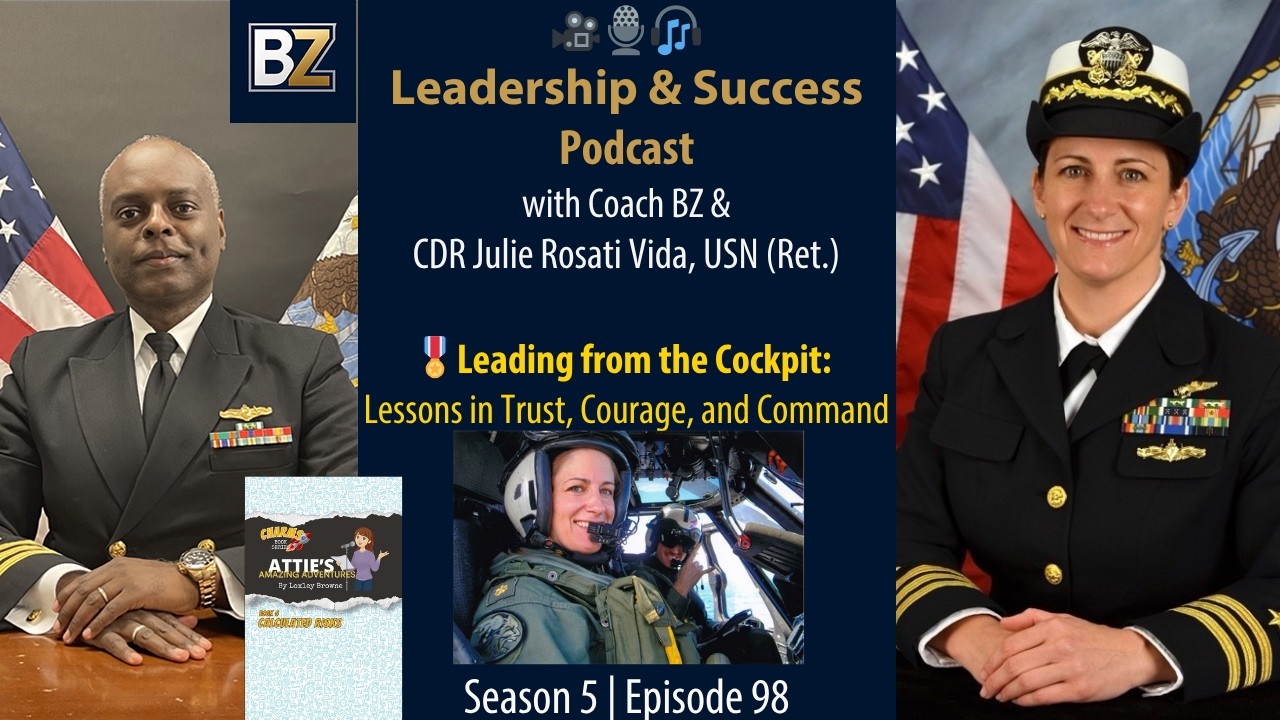
Retired Navy Commander Julie Rosati Vida, a former helicopter pilot turned tech executive, discusses surviving SERE training, the ripple effect of being the only woman in the cockpit, and her upcoming book F-Bombs: Tactical Tips to Fight Your Fears and Build Confidence. She emphasizes listening, trusting instincts, and mentoring underrepresented groups in STEM.
Chapters
Hi, I'm John Maxwell. When the top companies in the world are looking for trainers, speakers, and coaches, there's one name that stands above the rest, and that's Maxwell Leadership. Our certified team members have gotten proven results for companies all over the globe, and our reputation, I'm proud to say, is second to none. Some of our members have risen to the top of their profession, including the one you're going to meet today. I proudly introduce you to my friend Bob Fabien Zinga.
Welcome to the Leadership and Success Podcast with your host, Coach BZ, where we help you lead with purpose and succeed with impact. If you're ready to grow into the kind of leader others want to follow, this podcast is for you. If you're determined to elevate your success and leave a lasting legacy, this podcast is for you. As my mentor, Dr. John C. Maxwell, reminds us, everything rises and falls on leadership. Our goal is simple, to inspire you, challenge you, and equip you with insights that can transform the trajectory of your leadership journey. Welcome aboard to Welcome to another episode of the Leadership and Success Podcast with Coach BZ.
Now, another thing you wrote that really touched me, you said you wrote about being the only woman in the room and the cockpit. How did that kind of shape your passion for mentorship?
Because not everyone can have, you know, it's like replicating yourself. You know, I'm going to show and just share what my experience has been. So even though you may not experience, you know, young girls may not experience being in the cockpit or being in the military. She at least knows that there's somebody who has done something different or unique or scary or something. And boy, it's about showing up for young, in this case, girls who may not have the role model. They may, I don't know, maybe they don't have good teachers. Maybe their parents are absent. They work all the time. And so if I can just You know what they say, if you could just touch one person, you know, that's right, the ripples can affect so many people and do so much good. And that's how I look at it. It's just, I don't change the world, but if I can talk to one girl into reaching her potential and not downplaying herself, then I feel good about that.
That is amazing. I've already used too much of your time, so we're going to need to shut this down. But I could talk to you for hours and hours and hours. Man, this is good. This is good. But you are coming back, right? Once, once your, your book is out.
Yes.
So, all right. Welcome to another special episode of the Leadership and Success Podcast. So our guest is waiting for us in the green room. So, uh, before we get started, like we normally do, we have what we call here a moment of gratitude. That's where we take just a moment, uh, to be grateful every single time we meet. So I had the earlier podcast today. And today I am really grateful to be a US citizen, right? To live in America, the home of the brave, the land of the free. And freedom isn't free, and the reason why we are free is because men and women have volunteered, they raised their hand to join the armed forces, which makes our country great. And they are willing to give their life if needed in order to safeguard our freedom. And I'm so, so grateful. For that. So without any further ado, let me see if I can properly introduce our guest today. And as you may know, I guess a question I have for you is, what does leadership look like when you are in the cockpit, when lives are on the line, and there is no time for hesitation? Well, Commander Julie Vita knows. She's a 24-year Navy veteran helicopter pilot technology executive. Julie has led in some of the most demanding environments imaginable, from combat missions at sea to executive leadership roles at Splunk, Gartner, ManTech, and now as Vice President of Growth at RDC Systems. She's also a board director, advisor, and STEM champion, inspiring the next generation through her leadership and her powerful forward to Addie's Amazing Adventure: Calculated Risk. We're gonna talk a little bit about that book. She brings a rare combination of combat leadership experience, executive strategy, and growth expertise. Authentic people-first leadership. So part of what you're gonna be learning today is we'll go inside the cockpit and beyond leadership under pressure, what it takes to make decision when time is short and the stakes are high. All right, ladies and gentlemen, please help me welcome to the Leadership Success Podcast, the one and only Commander Julie Vida. All right, good afternoon, Commander. How are you doing today?
Oh, wonderful. I thank you so much for that very enthusiastic introduction.
So we're gonna have to do this all over again, but this, this is just fantastic. What are you grateful for today?
I am grateful for my physical health, that I can walk around and get where I need to be and breathe fresh air and live my best life.
That is so, so critical because I guess most people take health for granted until they are no longer healthy. That's for sure. Yeah, I know I injured my back a few years ago on active duty. I couldn't even get out of bed for like a couple of days, man. All I was thinking about is I need to get my strength back. But such a blessing. And something about you most people may not know.
Most people may not know that When I was in high school, my class voted me the most sarcastic.
Wow, that is really amazing. But I would say you actually went from E1 to becoming a cadet at the Naval Academy, so the top of the cream, right? That's what you guys call yourself. So I was joking earlier, as a graduate of the academy, do you feel just a little bit more arrogant than an average sailor? Just a little bit?
Yeah. Just a little.
This is, this is, uh, wonderful. And of course, I interviewed the Admiral yesterday, Sinclair M. Harris. I think he's a living legend. But again, huge, huge endorsement for you. He says, "J.V. was my boss at Mantec, but also a shipmate in the, um, TL-ARG during 9/11. Julie Vida is a sensational leader, compassionate boss, and the person who leads with ultimate integrity. I would take a screenshot of this and probably frame it. Thank you so much, sir.
Thank you, Admiral.
This is really great. So the first question I had asked, and I am really glad I've asked this, but you've led in some of the most demanding environments, from the cockpit of Navy helicopter to executive boardroom. When you look back, what moment best defines you as a leader? And I do want to put the spotlight also on being a female leader? Like I said earlier, we have more and more female leading in our society, but not quite enough, right? 50% of the US is female, but less than, what, 20% of women lead any major industries out there. So I think we still have a long way to go. But looking at your outstanding career in the Navy and the industry, which moment you believe define you as a leader?
Actually, one, um, that, that came, just came to mind, uh, when I went to survival school, SERE school, Survival, Evasion, Resistance, Escape. It's where they teach— it's a contrived scenario, but they basically teach you how to, how to survive off the land, and if you get captured, how to survive capture. Well, one part of that, I was, I was the, um, second person in command, so I got lots of special treatment when we finally got captured. And I was one of— I don't— there might have been another woman in the group or two, but I rarely saw them. But what defined me, and it was for myself and others, was there's part of the, the contrived capture part where they kind of torture you to get information. I can't give a lot of details, but it is very uncomfortable. It is scary, even though, you know, it's not, it's just training, it feels like it's real. And there was a time that I, I let myself get into a point where I was physically in danger. And because it kept other people from being physically harmed. And when I got out of that situation, they threw me back down on the ground in the dirt. There was a guy laying next to me. We all had our hands tied behind our back. He was a guy I knew at the academy. We were not close. He was a big football player. He was kind of somebody who didn't like women so much. He turned to me and he said, "That was impressive. Thank you." I was like, "Oh my God, he noticed that I kind of took one for the team." I, from that moment, I was like, I, I guess I, I have it. Like, I, I can do this. I can do this too. And I'll, I'll never forget it. I remind myself of it all the time. That was a real pivotal moment for me as a—
that is really— and this was at the Naval Academy?
No, this was in the survival school out in the mountains in California. It's once I already went through and got my wings. I was already a, a wing aviator yet.
Okay, is that something you had to volunteer?
No, everyone goes, all aviators go to survival school.
Okay, okay, because you are an aviator. Yeah, because I never had to do that because I know special operation, they have to do that too. Basically the only survival school I've went to is online, you see, computer-based training, and I didn't really have to go through anything. Wow, that is impressive. So can you tell us the story I guess let's go back to the beginning. First, why did you join the Navy? Looks like you joined with a sibling, right?
I did. I joined with my twin sister, and, uh, it was a fluke, although I don't believe in flukes. Everything happens for a reason.
But, um, I believe this is— oh, is it, uh, is that right?
Yes, yeah, yeah, we're twins. And, um, when we were in high school, we lived in a little town in Pennsylvania, Lancaster, and Well, I was planning on going to college. I was college prep. I was student council. I was all that stuff. And one day she comes home.
It was probably the most sarcastic student.
That's right. That's right. And she comes home one day and she says, guess what? I signed up to join the Navy.
And what?
Are you out of your mind? Nobody we knew was going in the military except people who were in trouble with the law and they had to go. And My dad had— our dad had been in the Marines, but for 2 years. It was not his life's career. We were not raised to be military folks. I was like, what got into you? And she said, no, no, no, I'm going to language school. They're going to teach me a language and I can go be a spy or an attaché. And I was like, oh, that sounds kind of cool. And so she said, you should join with me. Now she got credit for for getting me to join. But I did. I was like, okay, well, uh, for college and, you know, we get to travel, it'll be fun. And so I went and signed up and, and we went together and that was the beginning of our naval careers.
Wow.
Where did you go to boot camp? It's not RTC Great Lake, is it?
Uh, it's— it was Orlando. They used to send all the Orlando, but it's not— it's not there anymore.
RTC. I sometimes mistake it for RTC. Great mistake. But yeah, great mistakes.
That's right.
I remember some of my trauma going there. Well, that's pretty amazing. So you study Russian, right? At the Defense Language Institute in Dillard. Now, how in the world did you go from seaman recruit to becoming a cadet at the Naval Academy?
Fortunately, I had a— I was a top student in my class, so I did well. I was seaman of the month.
You know, bragging again, bragging again.
I know, a little bit. Don't break my arm. Wonderful. I, my career counselor, that's a person like a chief petty officer or someone who's like your guidance counselor and they look out for sailors to get other educational opportunities. And she came to me one day and asked, you know, have you ever thought about going to the Naval Academy? And I'm so embarrassed to say this, but I said, what's that? And she said, It's kind of like West Point, but for the Navy. Have you heard of West Point? And I said, yeah, I've heard of that. And, um, it's so silly, but it's true. And I said, no, I, I don't know what that is. She explained it. I said, sure, I'll put in an application. And they accepted me. And on the first—
I believe it's less than 5%, I believe, of people who apply get accepted.
And, uh, I didn't have to— a lot of enlisted sailors have to go to the prep school in Newport, Rhode Island. I didn't have to go to prep school. I did better on the SAT. Uh, yeah. So I, I spent 2 years in Monterey, 1 year on the basic course of Russian and 1 year in an intermediate, intermediate advanced class. That was awesome. And after it was over, I went off to Annapolis.
Yeah. Because even many of the, of the one I know who went, they had to add a congressman send like a, uh, letter of recommendation.
So I, because I was enlisted in the Navy, I got my nomination from the Secretary of the Navy. That the secretary can nominate enlisted sailors. So I didn't have to get— I didn't have to get a congressional nomination.
That is really, really amazing.
Um, thank you.
So going back, I, I was, uh, asking about the moments that define your leadership, and you mentioned the survival training. What does that really teach you about leadership under pressure?
Well, it taught me to be, to remember that I was representing other people. Like, I, it wasn't just Julie going to this torture device. I was the second in command of this whole group. And I knew that my behavior would affect everybody in very negative ways, probably. And I'm not saying I thought myself was, I thought I was this awesome leader. I just had to stand up to the challenge. I didn't want to. I didn't know what was going to await me, but I was like, well, all these people are kind of relying on me to give them a couple more minutes of peace on the ground. And I just, that was a lesson for me. Like you have to realize the responsibility that you have for other people.
Yes. Yes.
And that was huge. It was huge for me.
Man, and, uh, it's really interesting how you went to, um, becoming an aviator. And, uh, I believe— that's just my opinion, but I think it is true— I think most, uh, male sailors, especially officers, we are all frustrated pilots. If, uh, because when you watch a movie like Top Gun and all of that, I think most of us would dream of flying one day. But, uh, it is, it is quite a rigorous process, right? The selection— and I know at one point you had to have 20/20 vision. I don't think that's a requirement anymore, but it definitely was before. What was that process like for you?
Um, so because I was already an officer, I went through a different process. I, I asked for a transition from the community I was in, which is surface warfare. Go Swo. Uh, I know one of your listeners, at least in the surface community.
And yeah, the only thing I know about that, because the Swo have a gold standard, but they They tend to eat their young, don't they?
That's the, that's the stereotype. Yes, that is the stereotype. But I, so I applied through a different process than I would have out of the Naval Academy. At the Academy, you have to, basically they take everybody by grade, by what their grades are, and you get ranked. And the first person with the highest class rank gets to pick whatever they want. And if everybody picks aviation and you're at the end of the pile, you don't get to go. But that wasn't me. So I had to put a package together why I wanted to be an aviator and physical testing and stuff. And at that time, you pretty much had to have nothing physically wrong with you. Like, they were looking for reasons to say no to people to go to flight school. And, um, got picked up. And, um, yeah, it— I initially was just so excited. I thought, oh my gosh, I'm gonna be the first female Blue Angel pilot. I'm gonna because we didn't have any at that time. And I was so excited to be a jet pilot. And then, um, just a lot of things happened that I ended up being a helicopter pilot. And I'm so grateful. I am so grateful I ended up in the helicopter community. But that's, that's how I entered.
Yeah, that is just amazing. It looks— I mean, you are definitely a trailblazer. It looks like you have the habit of going into, uh, industries and, uh, just organization where there are not a lot of women doing stuff and you're going to be one of the very first. I guess growing up, I think you said you grew up in Pennsylvania, right?
Yes.
Did your parents or your mom ever kind of tell you you could pretty much do anything a man could do? Like there was no limit to your powers or ability?
You know what? My memories of, I had a fine childhood. Lancaster was a great place to grow up. It was very, not, you know, um, like the old times, you know, it just was— there wasn't any problems, people didn't get in fights and stuff. But I don't remember— so my parents had been divorced and we, all the kids, lived with my mom, and she was always working 2 or 3 jobs. She wasn't home a lot. I don't really remember having a lot of guidance or influence from my mom or my dad. Not— they weren't bad, they just weren't encouraging us to do stuff. But I will say, being a twin, I think it gave me— we got a lot of attention. People knew who we were. They know, oh, look at them, look at them. And so I kind of was used to not being able to hide and not being able to pretend I didn't exist and I was small. That might have been part of it. I'm really not sure. I don't know how I ended up doing this series of things that were just unusual for women. It just kind of turned out that way.
Absolutely. Because maybe I'm more sensitive to it now because I am married to a woman and I have two daughters. So if it wasn't for our family dog, I'd be the only male in my entire family. But I just see how this world really wasn't meant for women. No, it was pretty much created for white men. And, uh, seeing you out there and doing things that men do at the highest level, like you start as an E-1, Lowest rank in the military, and then you retire as a commander, and then you get into fields where there are absolutely no women, or very few, and you're just a trailblazer, and you go all the way to the top. So there is like that drive, there is that je ne sais quoi, there is something that is making you do like the impossible. Where do you think that creates that, that drives, comes from?
I think a lot of the things early in my career built confidence in myself, helped me build confidence in myself, and then fortunately people came into my life, women generally, who were not from the military, from business. They would tell me, like, you realize that other women are looking up to you. They want to hear your stories. You're unique and different. And I was like, yeah, they're— and my women friends would tell me, yes, you, you need to tell your stories. You need to show up for others. Back to that leadership thing.
Yes, yes. It's about me.
It's about all the other young women that are looking for role models or all the other people of color or marginalized groups that don't have a model. They don't have anyone to look at. And I started to kind of own that and realize like, I think this is my purpose on earth is to share. You know, share and hopefully inspire somebody else to do something they're afraid of or do something that they never thought they could.
Absolutely.
Yeah, and now I embrace it. Now I'm like, who else can I talk to? Where can I go?
Yes, yes, yes. Because I mean, representation really, really does matter a lot. Because if you never seen somebody who looks like you at high level in society, it's almost impossible for you to even imagine that it's possible for you. Like, I know one, I am so glad I ended up meeting him in Atlanta. I think it was in 2015. But General Colin Powell was such guy. I'm like, well, this Black guy, he became a 4-star general. Chairman of the Joint Chief of Staff. If he can do it, Siemens, Zinga can do it too, right? It gives me hope, and it's really, really, really powerful because not only you did that in the Navy, but then you get into the industry, you do it again. Now you are vice president of this and that, STEM this and that. It's like, wow, it doesn't matter where we put you, like, you're just gonna go shoot all the way up to the top regardless.
Towards the end of my, you know, looking for jobs Man, that is awesome to see.
It's very inspirational, I must say.
Thank you. And the same for anyone else who's sticking their neck out there and saying, I'll represent because other people deserve support. But I have to say something. I have to tell you something. So let's say for hypothetically, you might have asked me to prepare a question about if I could have dinner with 3 people. Guess who my number one person was?
Wow.
And then you told that story. So yes, he was wonderful, one of a kind, that's for sure.
Uh, not many people like him because when I went to— it was actually, I think I have this book here, uh, It Worked for Me. Not, not his first book, his, uh, second book. But I mean, when he got into the arena, I'm telling you, there was like a molecular change in the atmosphere. Like atoms are just changing, uh, state. It was just incredible, just the charisma, the power. I mean, he wasn't like shouting or, or anything, but just his presence, it's like, wow, I've never been affected by another human being quite like that before. Uh, but he is—
I think he's the first person I was mature and old enough to, to realize moral courage and when people take a stand against something. And when he resigned because he didn't go— he couldn't go along with the policies that he was— I mean, that was the first time I realized how important that is and how unique that is and bold. And, uh, wow, what a hero. What a hero. God rest his soul.
That is true leadership. Absolutely. And by the way, uh, your former employee, the legendary Admiral, says, uh, I love being a real Navy. Do you agree with him?
I love being a SWO too. Yes, I do.
What I would say is you SWOs are the gold standard. I must say that for sure. For the longest, you know, I guess I was a restricted line officer being an information warfare officer, but basically everything we do in the IWC community, we just copy it from the SWO community. I mean, it's just copy and paste pretty much. But I love that star though. That star looks very, very good. Restricted or unrestricted, it doesn't matter. Wow, this is just incredible. So what do you think people do not understand about leading in the cockpit?
I think they don't understand how much you're this close to a mishap or an accident like every second of the mission, um, and other parts of the military and I guess life, but probably not much out of the military is like that. But I mean, there's— from the time you strap in and you spin up, there are forces that are happening that could rip the helicopter apart if something is off balance or a piece of equipment fails or a bird flies into the engine or I don't know, whatever. It looks cool, it looks fun, it is really dangerous. And, um, you just have to— you have to study, you know, you have to do simulators, you have to, you know, fly as much as you can, get a lot of hours, get practical experience, um, learn from other pilots, learn from air crewmen, learn from the maintenance staff. There's so much more to it than people, I think, would realize. It's not all volleyball on the beach and, you know, going Mach 3 past the tower and spill in the guy's coffee. Like, it's almost none of that. The, um, and I know jets, not helicopters, but, um, yeah, it's, it's dangerous and scary. And I tell people that's why there are age limits, because the older you get, the more you realize, I just can't do this anymore, you know. For me, for me and, and a lot of people that I know, you, you know, it's, it's fun and cool for a while, and then you realize, like, okay, um, I'm not immortal, and But it's also, there's a lot to learn. You have to understand the engines inside and out and the transmission and how—
Wow.
Everything. You have to, because if something goes wrong, there's no call someone for help. The crew has to figure it out. That could be happening while you're on fire. It could be happening while you're crashing into the ocean. It could be happening while you're on the back of a ship. It's a very dynamic and stressful environment.
Wow, I can't even imagine that. I guess there is a reason why there are all of those safety checks and maintenance stories.
Yes. Yeah.
So do you have to absolutely trust your instrument, especially, you know, I'm assuming, you know, if you are flying and, uh, you are disoriented, you have to absolutely trust that if your engine says, okay, you are going north, or, or whatever altitude, that is the truth, not how you feel, right?
That's exactly right. That's vertigo. That's called vertigo when you lose your space. But you learn that in flight school. So there's— you start out, everybody flies, it's only during the daytime, it's only, you know, and then you advance to instruments and it's a big change. It's, it's a lot. They even put, um, uh, the instructor will put like a cardboard or something on the cockpit so you can't out so you can't cheat. And, um, your eyes are just on the, on the instruments, and you're just—
wow—
for altitude and airspeed and, and all of that.
That's crazy.
And you just— there's a lot of practice, there's a lot of repetition. They don't let you pass if you're— no, you're not safe, obviously. Um, and wow. Yeah, because your, uh, your brain fools you. Your brain will fool you if, if you can't see. And you don't, you might not know if you're upside, if you're upside down. And that's, that's not good.
Wow, man. Uh, yeah, maybe that's not for me, but, uh, if definitely most sailors I have, I've seen, we are all frustrated pilots, or I think, uh, we, we think we are.
Yeah. Well, actually, so this is probably relevant to people, all people who are not in the military but fly commercially. If there's something going wrong and you're like, oh my gosh, I'm scared or whatever.
Yes.
Pilots are very highly trained. They know what they're doing. They, they don't want to crash either. And I just often have to tell that to people when I'm flying with them and they're scared, and I'm like, yeah, they didn't just show up yesterday, you know. So, um, just for your listeners out there who may be, uh, afraid to fly, they fly a lot of hours and they practice a lot of procedures.
So that's amazing. So if you can, uh, take us into, uh, the cockpit now, a mission you, uh, offer us to talk about a mission where everything was on the line and leadership really made all the difference?
Yeah, um, there was one time I actually ended up having— there was a mishap. We had a— something went wrong. I, I was flying, uh, I was the helicopter pilot in command. I was the senior pilot. I was responsible. I had a junior pilot with me, and we had two enlisted guys in the back, and we were doing a training, um, exercise where we were looking, hunting for a submarine. So we would go out into this area over the water, and we would be hovering over the water, and we would lower a sonar transducer below the helicopter into the water and listen for submarines. And, um, that's— it's very dangerous because you've got this thing hanging off the bottom after, and, you know, you, you have to keep it still because the cable can snap if the helicopter moves too much or, you know, there's— it's too windy or whatever.
Wow.
That happened and the cable snapped. And that is a million-dollar piece of gear, which means it was a Class Alpha mishap, which means when we landed, we all were downed. We were not allowed to fly and we had to take urinalysis and they had to ask us things. And there was a big investigation., and I couldn't, I could have lost my wings. I did not because they found out there was some other, some other thing that was not my fault. But for me, leadership moment there was, we all knew, like when the crewman in the back said, we lost the dome. It's called the sonar dome is what we called it. We lost the dome. I said, say again? We lost the dome. It's at the bottom of the ocean. And it was immediately like, oh my God, like all of our careers are over. What are we going to do? And I, you know, I had to keep cool. Um, I said, all right, let's— you know, we had emergency procedures for— we'd get up to a safe altitude, get back to base and all that stuff. But I also knew that I needed to tell the crew, look, they're gonna, they're gonna ask us all what happened, and you all just need to tell the truth. Just you tell what you saw, you tell what your experience was, because sometimes when an issue like that happens or an event, the people— everybody talks. And I'm not saying they're lying, but they kind of get the story straight, you know. I said, we are not going to talk to each other about this. We're each gonna— and, and we did. And one of the reasons, uh, when they did the whole investigation and all of us were found without fault and we kept our wings and all that stuff, one of the reasons that they— the investigation board cited was that they could tell that we were all telling our own story and it corroborated what had happened. We were not all telling the same story.
Wow.
And, um, that sticks with me as well, that that's— man, it's really easy in moments like that to lose your integrity. It's really easy. And I didn't, and I'm proud of myself for that.
Yes, that's our first core value: honor, courage, commitment. Wow. That is powerful, man. What did that experience teach you? Because you were the senior officer, you were in charge, and I'm sure everybody else was kind of looking at you for a clue of how they were going to act or panic or whatever it might be. What did you learn from it?
They were looking at me. They were also— there was at least one aircrewman in the back who I knew did not care for me, so he might have been thinking, 'Good, you know, we won't have to deal with her anymore.' But that didn't happen. But they were looking— I had to be the calm one and the voice of reason and all that. Trust me, I was not the best pilot in squadron. I had lots of problems with confidence, I had lots of problems with 'they don't want me here.' Not everybody, not everybody. What I learned though, is that an, an emergency or a mishap, it's, it's seconds away for anybody. It doesn't matter how much you're trained. It doesn't matter if you're the best pilot in the squadron or the best leader in the organization. Sometimes accidents happen and bad things happen, and you just have to be ready to keep a calm head, um, execute the procedures that you're trained to do. And keep your integrity. That's all you can do at the end of the day is just be yourself and make the decision. So, um, wow, thank you.
Thank you so much for sharing that. And some things that you said, uh, it happens to men too, but it looks like statistically it happened more to women than it does men. I guess they call it imposter syndrome. You are fully qualified, you deserve to be where you are, but for whatever reason you feel like, hmm, maybe I shouldn't be, or maybe the Some people don't want me here. How did you overcome that? How did you deal with it? Because I'm sure the people who are listening to us now, I'm sure many of them have gone through it. And again, you are fully qualified. You've gone to the school. You've got the grades. You've got the experience. You've got everything. But still, though, you feel like, ah, maybe I don't really deserve to be the boss here.
Right. Well, I'll tell you, there were a couple of things in flight school that helped me learn not to feel that way. And one of them was— we all would study in the study area before going out to fly. So, people would be reading their procedures and they're practicing and all this stuff. People are talking about the, oh, how do you fly this maneuver and that maneuver? And everybody pretends like they're the most confident person. They don't have any doubts. They know everything. We used to say, there's a phrase that we use Everybody's Chuck Yeager in the ready room. Chuck Yeager, the first pilot to break sound barrier. He's a hero. And so everybody's like, yeah, I'm like Chuck Yeager when everybody else is around. But then we would have study groups in smaller groups and like 5 or 6 people and we'd rotate whose house they went to. And what I learned was that those guys were just as scared as I was. And they were just as unsure about the procedure or the, oh my God, I have to fly my solo tomorrow. And Oh my God, I feel like I'm going to throw up. And that's where I learned a lot of people are just making stuff up. And going, I'm not saying a lot of them weren't confident, but there are just as many men out there and just as many, just other people that question themselves as much as I do. They just don't show it, you know, they, they, and men, I think, do a better job of just, you know, remember that old commercial, never let them see you sweat. They never let me see them sweat until we were in a small group. And then I was like, oh, okay. Then when I got to the Pentagon later in my career, like right before I retired, I learned the same thing again. I'd go into these meetings. Admiral Harris is listening. He's going to laugh.
I don't know.
I was almost always the most junior person, um, as an O5, because there were like 2 and 3 stars, uh, chief information officers around the table. And they would all be sitting there taking notes, and they didn't know what was going on either. After the meeting, they would go find their aide, and they would say, go get me the answer to this, help me figure that out. They didn't— people can't know everything. And so I just— it was front and center for me again, like, don't let— don't be fooled by who's sitting at the table and who's not. Don't be fooled by who looks confident in the meeting, because they're gonna They're just pretending a lot of the time, not all the time, a lot of the time. And that helped me. That helped me get over my, you know, I don't belong here. And now I tell myself, instead of saying, why me? I say, why not me? I've done this, I've done that. It takes life and experience. Why not me?
I love it. Because when I was in this, especially when I went through boot camp, I used to think, no, admiral will like say my God or something. But then the more experience you have, the more senior you, you become, you understand we are all just people, right?
That's exactly right.
That's exactly right. But even when you, you become a one-star admiral, there is a two-star, there's a three-star, there's a four-star. So you can still be at the bottom of the chain, even though especially at the Pentagon, right, almost everybody is a three or four-star there. So You still have to salute all the time.
That's right. It's tough being an O-5 in the Pentagon.
But it's wonderful being an O-5 on a carrier, I can tell you that. Because when I was deployed on the USS Essex, I was only a Lieutenant JG. My goodness, I couldn't use the gym, I couldn't use the phone. It's like I was like a second-class citizen, but all of a sudden they could, of course. O-5 and above, they did whatever they wanted when they wanted to. I had to wait almost like at midnight for me to be able to use the gym. I'm like, this is not right. I'm gonna make Commander if it's— if, if that's the last thing I do before I retire from this Navy. But anyway, that's funny. Wow, that is, that is really, uh, amazing. Uh, how do you make decision then when you don't have perfect information, which is almost all the time, especially in the cockpit? But lives depend on it.
Yeah. Well, one of my key tenets of things I learned about leadership is you've got to listen more than you speak. Ask other people for information. So you're gathering information, getting opinions from people, what should we do? Of course, you can't do that forever. You've got to make a decision. But before the mission, there has to already be trust. And so if you haven't built trust where other people trust you and you don't trust them, it is very difficult to make hard decisions in a cockpit or, you know, in any dynamic and stressful environment. So what I focused on, what I focus on now is I build, I do things every day to build trust. And so whenever there's a, you know, there's an emergency or there's a, oh my gosh, what are we going to do? I don't have to worry about people thinking that they can't trust me. Because I've built that. And I don't have the best relationship with everyone, you know, I'm a human being, but I show up as someone who cares about other people. They can rely on me. I delegate, I, you know, do all of those things so that when it's crunch time—
Yes.
Now we don't have to worry about that. Like, we all trust each other. Let's just kind of do what we're trained to do and make a decision after gathering information. But that's how I approach it. I think God's pretty smart. He doesn't let us remember everything. So, those memories are gone. But the memories that stick with me on the dark and scary night and the things that were— like, they really stick with me. It's all about things did not go well, but at least we had enough trust in the cockpit or on the ship to make the right decision and live through it. Live to fight another day, as they say.
Man, that is really insightful. And again, in the Navy, depending on your warfare community, we almost always have, you know, in high-risk environment, and the stakes are usually pretty high. Unlike the industry, the work we do for our country, people could actually die. So that is quite serious. But sometimes though, you don't have a lot of time to build trust with a new crew or a new command. In those instances, what type of things do you do to try to build trust as quickly as you can?
Gosh, when you don't have a lot of time, I mean, trust does take time, but I think showing in small ways that you will stand up for people, that you will give them top cover if they need it, that you'll ask the hard question. I mean, there's 100 different scenarios that I'm thinking of, of like working with a new kind of group. But, you know, showing up and just speaking to people with dignity and respect and not talking down to people. I remember my first ship, you know, I'm Ensign Rosati. I come in and I'm one of only one of the first women on the ship. It was when women were first allowed on destroyers. And I'm going to assert myself. I'm a Naval Academy graduate, for crying out loud. And I go to my first morning quarters where the whole division is there. The men are standing there. They were all men. The men are standing there and the officer stands in the front and like reads the what's going to happen for the day and like talks about the day. Yeah. I had like 20, 20 guys in my division and sonar. I was the anti-submarine warfare officer. And I remember I had gone into my office space that morning on the ship. On the ship, new space for me. And I turned on my computer and it was like these old clunky computers. And my computer screen had like colors going across it and had like waves of color. And I thought they were messing with me. I was like, this isn't right. You know, and I'm not a techie person. I wasn't then, but I'm like, they're trying to mess with me. So I don't say anything to my chief. I go to morning quarters and I stand in front of the group and I said, I don't know which one of you did it. "One of you is messing with my computer and you better go fix it," whatever, words to that effect. It was not good, it was not my best moment. I kind of stormed away and my chief came and found me later and he said, "Aswad, there's a button you press on the computer. What's happening is the degaussing, like, you know, whatever it is, is causing that. It wasn't the guys, it's the way the ship, because the ship is made of metal." perception. I was like, oh my God. So I then sought his advice. I'm like, what do I do now? Do I apologize? You know? And I did.
And humility, right?
And so even though I screwed it up the first time, I think by apologizing, then they were like, okay, she's okay.
Yes. I, I must tell you, a lot of alpha males would never do that, which is a shame, because That's really the only way to lead and to earn trust.
That's right.
Wow. Now, the good thing with you, like me, you are a tech executive as well. So for leaders in cybersecurity or tech, how do these same principles apply in the digital battlespace?
Well, there's always ways that you can show people that they can rely on you. You know, just be honest about things, share information, don't hoard information. Share opportunities with people. So, when you say digital battlespace, let me just clarify one thing. I was not— I was like a cyber policy person. I'm not— I don't have a math degree. I'm like hands-on keyboard cyber. So, that's not me. But in a dynamic computer-based environment, there are still lots and lots of ways to show people that you are a good person that they can rely on. And it's just small things. You cover for people who aren't in the meeting or you Don't lose, you know, someone comes and they need to take a day off and, you know, they have a family emergency. Don't make them feel bad about it. Like, tell them to go take a trip. Small things like that. And surprisingly, not all leaders do that. They just feel the need to assert themselves as some kind of, I'm better than you. And I've just never been like that. And I think that's in any business environment. It's, you know, it's construction, it's medicine, it's cyber, it's sales, whatever. Small things, you know, put the small amount in the bank, in the trust bank.
Yes, because even in Silicon Valley, I think our IQ is probably off the chart, but our EQ, we have a lot of work to do. If we could just get rid of it.
You said it.
Yeah, yeah, it's amazing. Well, the Admiral says that traditionally women have held themselves at a far higher threshold than men in terms of being confident in a new position or to the next level job. But I guess being a woman in a field that is way underrepresented, you kind of feel the burden of maybe something you kind of mentioned earlier. It's not just about you, but it's really about the next people who are gonna come after you as well, right? Yeah. Wow, that is powerful. So talking about transition from the Navy into the civilian world, the Admiral is asking, Share about the transition from the Navy to being a GS employee to commercial industry. Would you please?
Um, my transition was actually quite seamless in both cases because I did, I made like adjacent moves. So when I retired as an O5, I was on the chief, on the staff of the chief information officer and she hired me to be her deputy. As a GS-15. So, completely different role as a civilian, whole new way of like, I had to wear different clothes, I had to, you know, carry myself. But I was still in the same organization. Then, fast forward 4 years later, or however long it was before I decided to go into industry, and big change coming from the government, working in industry. But I went to a company that created thought leadership and analysis. It was Gartner research and analysis for CIOs. So, a new kind of environment, but still supporting the federal government and the CIO world, which I understood. Left Gartner, went to Splunk. Splunk was a completely different Silicon Valley, super cool, high-tech product company. But I was in the public sector. So, I I kind of took pieces of what I was doing that gave me enough comfort, and I knew enough about it. So when I went into the new role, it wasn't entirely new to me. I don't know how my transition would have been if I hadn't done that. If I had left the government and went to, you know, run a car dealership, probably it wouldn't have been so great. So I think that, like, Knowing what your comfort zone is and what your expertise is, if you can take a thread of that to the next thing, that seemed to work out for me.
Wow.
That is powerful. Another thing you've mentioned earlier was about really active listening. So, it looks like you are a Type A extrovert. So, learning to listen, was that a leadership breakthrough for you? What changed for you?
I will tell you that I only got good at— I got a lot better at listening after I left the government and I met my husband, who is an introvert. He is not— he does not like the spotlight. He is a very private person. We are the exact opposite. And I remember when I first met him, I went to a happy hour with two of my other girlfriends who had went— who had gone to the Naval Academy with me. We were classmates, both extroverts, both like to talk. So we're at this happy hour. And the three of us are just talking over each other, interrupting each other, not finishing each other's sentences. And my husband's sitting over there the whole time and he's like, what are you doing? And after we left, he said, how do you even know what the other person is saying? You're talking before they even stop. I was like, what are you talking about? You need to slow down with the talking. He opened my eyes to how little listening to other people. And then I started to notice when people bring your attention to something, you, if I say red shirt, oh, you're going to see everybody wearing a red shirt. And, um, I started seeing a lot of red shirts, which was me not listening. And, hmm, a lot of help. I still like to talk. Most, most of us do, but I've learned to be a lot better about looking people in the eye and paying attention. And that, so I didn't learn that as early in my career as I wish I would have. Yeah.
I think my listening coach is my wife. She definitely taught me to be more patient and yeah.
Like silence is okay. You don't have to fill the silence. Silence is—
Absolutely. Wow. So how does listening build trust? We talked about trust earlier, especially in I. Performing terms?
I'm sorry, say that. Ask me that again.
How does listening build trust?
Oh, well, because you're showing interest in the other person, first of all. And we all want other people to think we're smart and funny. And we like that. We want to know that the other person values us in some way, even if it's just 2 seconds in a conversation. So a couple different good things happen when you listen. One, you learn stuff. Um, two, you have an opportunity to like maybe generate some new ideas or some new opinions. This is assuming you have an open mindset and, you know, you're that kind of person. And you're also showing that other person that you care about the words coming out of their mouth. And that's really powerful. Like, isn't it terrible when you're in a conversation with someone, you can tell they all they want to do is talk about themselves and they're looking over their shoulder. Who's the next person that they're going to talk to? Because you're not that important. It's the worst. And, um, there's just so much good that comes from listening. And, um, yeah, and, and I like to learn. Like, I, I, I want to hear other people's opinions and viewpoints, especially these days with how divided everybody is. And like, teach me why you think that. Why, why do you Help me learn, help me understand what that viewpoint is. But you have to be listening in order to get that.
And you also create an atmosphere of psychological safety, which people will tend to listen and trust. So your first pillar of leadership, active listening. The next one is trusting your gut. In aviation and combat, there's often a moment where your instinct just kicks in. Can you share a time when your gut told you something others didn't see?
Um, there was— yeah, there have been a couple times, and most of them have to do with other people. Other people just not— they're not acting right, like something's wrong. And there were a couple— I won't go into all the details, but in one case, you know, um, there was a group of people and somebody who normally behaved a certain way, you know, kind of calm, was not behaving calm. And you know, everybody has a bad day, but this was off the charts. This was very unusual. And I mentioned it to somebody. I was like, I think we better go check on, you know, so-and-so. Oh, no, no, they're fine. They're just having a bad day. I'm like, mm, you know, something just isn't right. Sure enough, we check on this person and they are having a mental health crisis and talking about hurting themselves. And I mean, I'm not a mind reader, but you just can tell, you know, and I think I'm attuned to other people's body language and stuff.
But that—
I lost my train of thought. But there were a couple instances like that. And oh, you said when I kind of picked up on stuff that other people didn't see. I'm just— that's one of my gifts, I think. I'm perceptive. And I've learned, trust it. Yes, it doesn't hurt to ask. It doesn't hurt to validate if you, you know, see something out of place or whatever. So that's why I still do that. And I know you can't make decisions by the seat of your pants all the time, but there, I think there are times when you just, you feel your, you know, your skin is itching, or at least for me, I trust it.
Especially as a leader, you don't always have complete information and you're going to have to Trust your gut. But what about trusting your gut against intuition and fear? How do you see that? How do you distinguish between intuition and fear?
I think fear is more of a long-lasting thing. So I'm getting ready to publish a book and it's about women facing their fears because often we make stories up about things that we're afraid of and they're often not even grounded in reality. It's just We tell ourselves lies and whatever. And, but that's not an in-the-moment kind of thing generally. It's, you know, I'm afraid I can't provide for my family. I'm afraid that I'm going to embarrass myself in this career field. Those are not moments. They are longer drawn-out type of behaviors or environments. But in my experience anyway, that intuition, that voice in the back of your head or the Holy Spirit or whatever you believe, It's generally like happening right now. You know, like there's a message. And that's, that's what I would say, how I differentiate from like, this is just a gut feeling, or this is something that I'm actually afraid of.
That's actually great, because your third pillar of leadership is overcoming fear. And the book you mentioned, which is upcoming, F-Bombs: Tactical Tips to Fight Your Fears and Build Confidence. Please, please come back here once the book is published. And we need to talk about it. I think this is going to really help a lot of people. I know you mostly focus on women, but I think it's going to help a lot of men too. You've spoken about irrational fears holding leaders back. What are the most common fears you have seen?
The fear of not being good enough. So we talked about imposter syndrome. There's these stories, like we just assume other people are more educated, highly trained, experienced. We assume that, yes, they're better than us. And we don't have any facts or data often to even make that assumption. But because we have our own stereotypes about what successful people look like, or what kind people like, or what mean people look like, and when we see people, we assess them, we, we judge them. And then we kind of run the tape in our head about, oh, I don't have an MBA and they have an MBA. Oh, I guess I'm not going to do so well at this job. And we tell ourselves these stories that we don't even bother to take a second to research. Or it just— things don't even make sense. So that's why, for me, the book is a lot of like, just take a second, ask other people what they think. Give yourself grace. And then, you know, you can just open your mind to what the reality actually is and stop being worried about not being good enough. I think that's what I see.
That's really, really powerful. If you don't mind sharing, what is one of the greatest fears you've had to overcome?
Me? That fear of not measuring up because like we talked about, I've just found myself in these environments where it's high stakes. Often there's high performers. There's a lot of activity. It's not like boring, sit around, you know, go to the office and come home every day. Like, I don't— those are not the jobs that I enjoy. And I tend to gravitate towards, you know, high energy, high activity. But when you're in those environments, there are high performers. And, you know, at language school, at the Naval Academy, on the first— on a destroyer, you know, in flight school. And so there were a lot of opportunities for me to think that I was not as good as everybody else until, like I mentioned, those things happened where I proved to myself I could do it too. And then I'm really grateful for those opportunities because a lot of people decide this just isn't for me. I'm not gonna— I'm not great.
Yeah.
They get out, you know, or they, you know, make other choices.
So looking back now, what do you think is the secret of your success in those new environments? How you are able to find your footing and then excel over and over and over again?
I think my secret boils down to some of my own personal strengths. We all have them. I like the StrengthsFinder, you know, instrument where you can, you pick your 5 strengths. And the things that keep coming up for me every time I take the test are communication and being a connector. And I think that that's really helped me because it does lend itself to building relationships with people. I want to be with other people. I want to talk to other people. I want to listen to other people. And I, the connecting part is unique because I, Every person I talk to, as soon as we start having a conversation, I'm like, oh, you should, you know, you should meet this person. I'm going to have you, I'm going to connect you to that person. And it shows other people that you care about them. And you do that, you build trust. And I mean, it's all like, it's all, it's all connected. And those are just, those are just my unique gifts. And I love that other people have different ones.
Yes.
But when I look at the times that I'm successful, it all comes down to how I treat people and how I show up as a leader that they can count on. And, um, wow.
Yeah, so your upcoming book needs to be written for sure. Looks like it should have been published yesterday or something. Advanced Tactical Tips to Fight Your Fears and Build Confidence. So we know what is inspiring you to write the book. What is maybe one main message? What do you hope leaders are going to take away from it?
I hope they're going to take away that when they see other people in their environment that are holding themselves back or not meeting their full potential, have a conversation about what is getting in your way. And when you ask people question after question, you find out that often It's because they lack confidence or they're afraid of embarrassing themselves. That's another one of the fears in the book, embarrassment.
Yes.
They're afraid of other people's opinions. And you can fix all that because you can then feed that person actual factual data that shows they shouldn't be embarrassed or there aren't people judging them. But elite leaders have to be alert. They have to be watching and paying attention to their team's behavior. Their moods and all that. But a lot of the book is just about awareness and whether you notice it for yourself and you notice it in other people. And, um, wow. Yeah, that's what I would say what leaders can take away from it.
That's leadership. That's emotional intelligence for sure. All right, your fourth and last pillar is becoming a mentor or a trusted advisor. Uh, who are some of your mentors that kind of shaped your journey from Benevi to Vaporum?
I like to think of my mentors as my personal board of advisors. I don't know why. I just, because I never really had someone officially, oh, you're going to be my mentor and I'm your protégé. Like, I didn't grow up with that. But I learned to surround myself with people who will tell me the truth and not always what I, you know, tell you what I need to hear, not, not what I want to hear. And they hold me accountable. And those people, um, start with my husband, my sister, and then I have probably 5, um, women that I've met, one from the Naval Academy who, um, we sang in the glee club together and, um, you know, have been friends forever. In fact, She was a beta reader for my book because she'll tell me the truth. This is good, this is not good. And I trust her. And then others are women that I've met through my business and industry career because they have experience that I didn't have. I was doing the military thing while they were building their business careers. And so they help me and they help me think about things. But I don't really— yeah, I haven't really had official mentors. And, um, and I'm not really— I'm only an official mentor to one young lady also. She's— she was a Naval Academy graduate, and the Navy, they have a program where they align mentor-projé. But otherwise, it's just, um, people I just have coffee with every now and then, and we check on each other.
Yeah, that's powerful. All right, so technically we are out of time, but I wanted to talk a little bit about the foreword, uh, that you wrote for, uh, the Ari's Amazing Adventure. Do we have time to do that? Okay, I'm gonna do it quickly. Thank you so much, man. I could be talking to you for hours and hours and hours. This is the book. Now, you didn't write the book, but you did write the foreword. Uh, let me see. This is, um, part of the foreword you wrote. I think your signature, but the book— yes, here, here it is. Okay, Ari's Amazing Adventure by Loxley Brown. Yes. Uh, book number 6. She has like a series, Calculated Risk, and this is actually perfect for you. So in this book, you really wrote a powerful, powerful, uh, foreword, and, uh, you are inspiring the next generation, especially girls, to step into STEM, right? Science, technology, engineering, math, with confidence and curiosity. Do you say STEM or STEM? Do you add art to it?
STEM. I don't add art to it.
I never— okay, okay, okay. Leave me alone, leave me alone. Okay, I think my, my wife, she likes Tim better because both of them— I mean, I have great, great kids. I, I am a STEM guy. I almost got the PhD in microbiology, but yeah, they like art and music and things like that.
But anyway, you can like two things, you can like all.
Yeah, although the, the more I am an executive in Silicon Valley, the more I feel like we need to expand expand the, uh, the skills of the people who enter the cybersecurity workforce. I feel like mostly we kind of focus on science, tech, and engineering, but I feel like people who are good with art or outside of that, they add a lot of, uh, you know, things that we are kind of missing. But anyway, just my thought. But what, what drew Locksley, uh, mission and the, uh, uh, Cham's theory? What drew you to it?
So interestingly, I met Loxley through LinkedIn. But when I was at Splunk, the software company, she connected with me somehow. She was then helping girls build cars, like elementary school girls. And they would— she's a builder. She's like a mechanical engineer type. And I saw her on LinkedIn or something, and I was like, wow, that's really cool. And she was in San Diego. And I had served in San Diego, so I knew people there. And Splunk, the company I worked for, had a partnership with the McLaren racing team, the F1. And I was like, this is back to me being a connector. You know what? Wouldn't it be cool if I connected with somebody at McLaren? I didn't know a lot of people, but I was like, I could find a woman engineer who might love to know that girls are learning how to build cars.
Cars, wow.
I reached out to Loxley and I said, you don't know me, and, you know, but I think this is really cool, and would you like to maybe connect with somebody at McLaren? And she was like, yes. So that was like, I don't know, 7 years ago or something. We've stayed friends, she's moved, um, and And she started this book series and she knows my background. And that's how we met. And I just— what she's doing is so important and focused on girls in STEM and getting them excited. And I have young nieces who, you know, I want them to be successful and I want them to reach their potential. And, you know, as you might know, most girls, even when— even though they're really good at science and math in elementary school, when they get to junior high, And like popularity starts to be really important and peer pressure, that's when they drop it. And so Loxley is getting there right at the time.
Wow.
That's awesome. Yep. And I just, I love what she's doing with the Addie series.
Well, you'll be pleased to know last night she agreed to be on the podcast. I don't know when she's going to schedule it, but I'm going to be talking to her soon. This is really, really dear to my heart. And I know even in the Navy, the Office of Naval Research, I used to work with them. They would support all of the STEM science fairs and things. We would go and give kids awards and things. It's just amazing. I really believe it is a matter of national security because if we don't get these kids into STEM, everybody wants to become, I don't know, a singer or a writer or a poet or whatever.
Want to be a—
Yeah. Again, nothing wrong with that, but we do need to compete.
We do.
Tech and engineering, for sure. Now, another thing you wrote that really touched me, you said you wrote about being the only woman in the room and the cockpit. How did that kind of shape your passion for mentorship?
Because not everyone can have, you know, it's like replicating yourself. You know, I'm going to show and just share what my experience has been. So even though you may not experience, you know, young girls may not experience being in the cockpit or being in the military, she at least knows that there's somebody who has done something different or unique or scary or something. And boy, it's about showing up for young, in this case, girls who may not have the role model. They may, I don't know, maybe they don't have good teachers, maybe their parents are absent, they work all the time. And so if I can just, you know what they say, if you could just touch one person, you know, the ripples can affect so many people and do so much good. And that's how I look at it. It's just, I don't change the world, but if I can talk to one girl into reaching her potential and not downplaying herself, then I feel good about that.
That is amazing. I've already used too much of your time, so we're gonna need to shut this down, but I could talk to you for hours and hours and hours. Man, this is good. This is good. But you are coming back, right? Once your The book is out.
Yes.
So that's something that so many people are doing out there. And I think it's so important for people to be aware, kind of give you your flowers while you are still here with us. So this has been really wonderful. So the last question I'm going to ask you today before we close is, what is one thing that you are feeling optimistic about these days?
Um, I'm feeling optimistic about— oh, I have started— look, I'm feeling optimistic about more people coming, seeming to be interested in faith and church. Um, there's an app that I've been— I started listening to or using during Lent. It's called Hallow, and it, it just, it makes it so easy. And, and I'm a faithful person, but I don't, you know, I'm like, I go to church on Sunday kind of thing. But, and then what I've learned is like all these young people are looking for something in their life and they're using this app. That makes me really happy. It makes me, it gives me a lot that there are, there are still, there are young people who know they're missing something in their life and they're turning to something positive. And, um, it makes me feel good.
That is really, really great because I know there are a lot of even Hollywood movie stars who have commercials about this, like the guy who played Jesus in—
Yeah, Jonathan Roumie in The Chosen.
Yes, yes, it's just amazing.
And Chris Pratt and Mark Wahlberg and Gwen Stefani.
Yeah, yeah, that's all of them. Yeah, yeah, it is incredible. I guess, you know, we are living in some pretty rough times right now. The economy is not what it should be a lot of uncertainty out there, but one thing you can definitely rely on is your faith. So thank you so much for sharing that. Okay, this is going to be the end of the podcast. Definitely looking forward to speaking to you again soon, probably around June, July, I hope, whenever you're—
I hope so.
Ready for pre-order. So very, very last question. This is going to be the end of the show. What is What one word would you use to describe our experience on this podcast today? One word.
Authenticity.
Okay. And I am almost always so grateful. Thank you so much, Commander Julie Vida, for your time and your wisdom. And definitely I look forward to speaking to you again soon. Thank you.
Yes, sir. Thank you. Thanks, Coach.
All right, everybody, this is one for the book. I would say go ahead and get a copy of this book, commend the video, did write the foreword, right? Addie's Amazing Adventures. And I think this is so wonderful to encourage our kids, especially girls, to get into tech, technology, science, and STEM. It's something I think we absolutely need.
All right.
I have one more podcast for today. So my adopted mentor, we talked about mentorship, Colonel Michael Check for Mike Black, US Air Force retired, is going to be on the podcast in about an hour and a half. So 4 PM California time, 7:00 PM on the East Coast. We're gonna be talking from Tuskegee all the way to the White House, a blueprint for purpose-driven leadership. You do not want to miss it. Okay. I hope to see you in about 90 minutes or so. And that's it for now. Thanks for watching. Bye.
Thank you for tuning in to the Leadership and Success Podcast with your host, Coach BZ. If today's episode added value to your leadership journey, be sure to subscribe, share, and join us again for more wisdom nuggets on how to lead better and achieve greater success. Remember, leadership is the most critical skill of our time. The world will always need leaders to inspire others, drive innovation, and execute meaningful strategy. So why not count yourself among the bold leaders shaping the 21st century? Until next time. Stay inspired, stay committed, and keep leading with excellence.
More from Bob

S250:E4🎙️LIVE 🇺🇸America 250: President Barack Obama Leadership, Service, and the Power of Hope






S5:E157🎙️ LIVE with CMD CMSgt Dennis L. Fritz, USAF (Ret.)(Multi Tracks Audio)



S5:E156🎙️ LIVE 🇪🇸 Leadership Lessons from the FIFA World Cup 2026 Champions (Multi Tracks Audio)

S250:E3🎙️ LIVE Leadership Lessons from America’s First Documented Family of African Descent 🇺🇸📖