S5:E99🎙️ LIVE with COL Michael "Cheque The Mike" Black, USAF (Ret.) (Multi Tracks Audio)
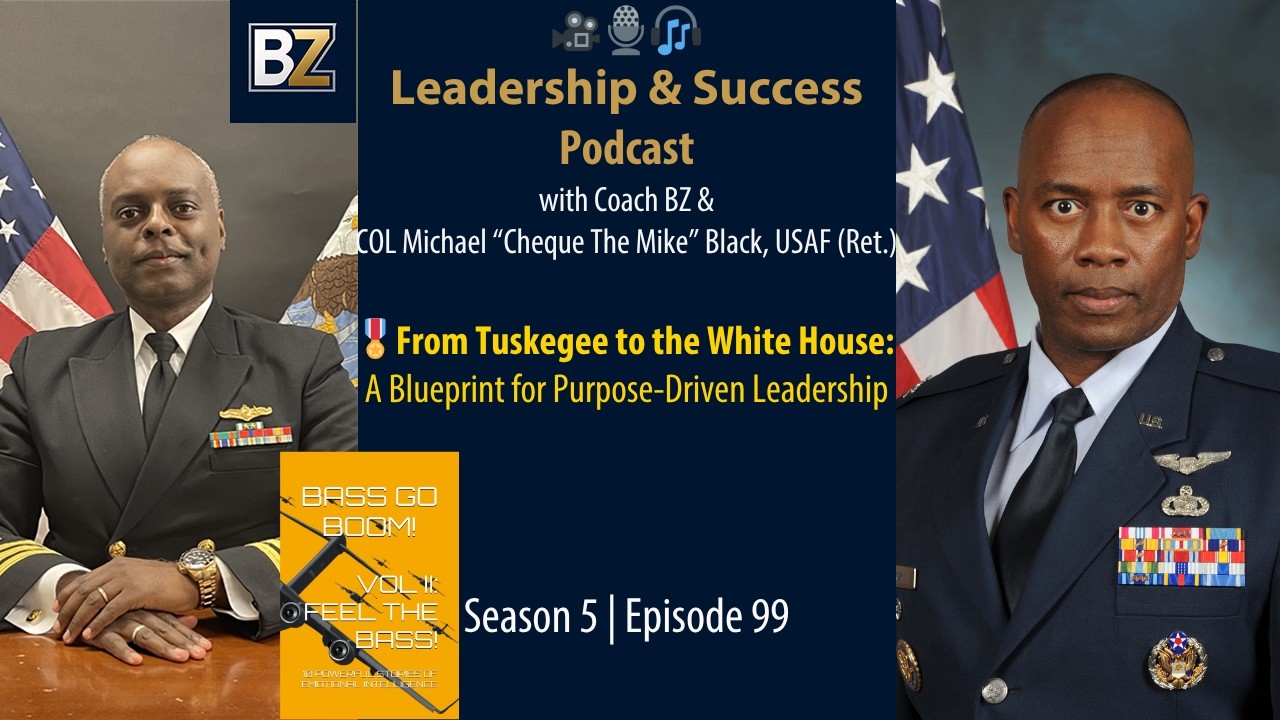
Retired USAF Colonel Michael Black shares his leadership library, recommending books like Just Breathe, Intrusive Leadership, and Red & Me. He tells how a former White House communications colleague gave him Red & Me, and advises his 17-year-old self to keep a head on a swivel and train successors.
Chapters
Hi, I'm John Maxwell. When the top companies in the world are looking for trainers, speakers, and coaches, there's one name that stands above the rest, and that's Maxwell Leadership. Our certified team members have gotten proven results for companies all over the globe, and our reputation I'm proud to say, is second to none. Some of our members have risen to the top of their profession, including the one you're going to meet today. I proudly introduce you to my friend Bob Fabien Zinga.
Welcome to the Leadership and Success Podcast with your host, Coach BZ, where we help you lead with purpose and succeed with impact. If you're ready to grow into the kind of leader others want to follow, this podcast is for you. If you're determined to elevate your success and leave a lasting legacy, this podcast is for you. As my mentor, Dr. John C. Maxwell, reminds us, everything rises and falls on leadership. Our goal is simple: to inspire you, challenge you, and equip you with insights that can transform the trajectory of your leadership journey. Welcome aboard to another episode of the Leadership and Success Podcast. Podcast with Coach Beasy.
Colonel Michael B. Black was born at the hospital on the campus of Tuskegee University in February 1963. 5 months later, his dad, Clinton Black, graduated with honors from the institute and was awarded a direct commission into the U.S. Army Signal Corps. Mike grew up as a textbook military brat as he transferred from school to school. He learned to speak Italian while attending the Italian Montessori School in Asmara, Ethiopia. Mike excelled in both academics and competitive team sports. That laid the foundation for leadership, teamwork, communications, and discipline. His dad was his primary inspiration to to join the military, followed by his church, and finally by the Tuskegee Airmen. In 1981, he received a congressional appointment to the U.S. Air Force Academy from Congressman Jack Edwards, Alabama. Before departing for the academy, Mike visited the congressman in his office and received the following advice in a true Southern drawl: "Looky here, son." Don't you let me or your daddy down. And Mike certainly did not. He was a distinguished military graduate. Mike followed his dad's footsteps by choosing the cyber and communications career field. Armed with his diploma, his commission, and new gold bars, Second Lieutenant Black was off to Keesler Air Force Base for basic communications officer training. Once again, Mike was a distinguished graduate and number 1 in his class. His early career was filled with opportunities to hone his technical, program management, and leadership skills. As commander of the 5th Combat Communications Squadron, Mike led 59 theater communications projects critical to CENTCOM's C4 mission success. At Langley Air Force Base, he led the 27—
All right, welcome to another episode of the Leadership and Success Podcast. Do we have a very special episode for you. You today. As you know, this is our third broadcast of the day. And every time we meet, we call this moment of gratitude. We want to take just one moment to be grateful every single time we meet. As you know, part of the reason why we do this is because in the military, veterans and service members, about 21, 22 people commit suicide every single day. And we believe it's not possible to be suicidal and grateful at the very same time. So for today, I am really grateful to be a US citizen. I believe it's the greatest country on earth. Not that it's perfect or anything, but something about our aspirational founding document, right? When they wrote, "All men are created equal," I don't think that's really ever been said before. And since our creation, it's going to be 250 years now, we're going to celebrate that, but we've been trying to make that a reality for each and every resident and citizen of the United States of America. And I think there is just nothing, nothing like it. So, so grateful to be an American today. So let us know in the chat, let us know where you are joining us from and also what you're grateful for. And if you do have a question for our guest today, the Colonel, please type it in the comments. We will answer live. Okay, let me see if I can do a proper job introducing the Colonel, really a man who doesn't need any introduction. What I would first ask you is, what does it take to lead in a no-fail mission environment where the stakes are global, the pressure is constant, and failure is not an option? Well, Colonel Michael "Check the Mic" Black is a distinguished US Air Force Colonel, retired, former commander of the White House Communication Agency, and current Vice President of Defense at FCI International. He led a 1,200-person joint force delivering secure real-time communication to the President, Vice President, and national leadership of the United States, supporting over 2,000 presidential missions. But beyond the title, Colonel Black is a mentor, a connector, and a servant leader who believes that leadership is about people, not position. And I hope what you're gonna learn today is the 5 F's of leadership: family, fitness, mission, fairness, and fun. All right, without any further ado, please help me welcome to the Leadership and Success Podcast Colonel Michael Ladd. All right, good afternoon, Colonel. How are you doing today, sir?
I'm doing great, BZ. How are you?
Great. Uh, just to get started, sir, what is one thing you, uh, grateful for today?
Well, I'm, I'm grateful for my family. I'm grateful to be able to wake up, uh, today. I'm grateful for my friends. I'm grateful for my health. I'm grateful for a lot of things, uh, just thank the, uh, the good Lord for the, uh, opportunity to wake up another day.
That is so, so powerful. Is there something about you, sir, that most people may not know when they first meet you?
You know, I think once people get to know me, they understand that I'm a person about, about people and about my, my network of folks. And that is, that's important. And, you know, you might not recognize somebody's superpower right away, but my superpower is, is my network and my connections and my, my relationship. And as you get to know me, you'll understand that. You may not recognize that, uh, right away.
Now, something you've said before is, uh, leadership did not start when you put on the uniform. It started with your family. Can you tell us more about that, sir? Can you unpack that for us?
Oh, sure. Um, well, um, my father, uh, uh, Colonel Clinton James Black, uh, United States Army, was my inspiration. And he went to Tuskegee, Tuskegee Institute, as it was called back then, 1963 graduate. Wow, Tuskegee. And, and so he laid the foundation. My, my grandparents, Billy and Oweta Black, from a very small town in Alabama called Beatrice, Alabama. Today, the population is probably less than 120. They raised 7 kids, 6 of which went to Tuskegee. My dad was one of the 3 youngest of the 7. My grandparents went and visited Tuskegee, Tuskegee Institute as it was called back then, and saw the statue of lifting the veil of ignorance and decided that's where they wanted their kids to go. And so they made a way for the three oldest to go, and they assigned— and that's the key word, is assigned. Okay, when you get assigned something, that's a task, you get told to do something, you've got to complete that task. So the three oldest were assigned one of the three youngest, and their responsibility was to make sure that not only they graduated, the three oldest, but the youngest. My dad, as I said, was the oldest of the three youngest. And so he was assigned to Aunt Velma, and Aunt Velma was responsible for getting him to complete college. Now, I learned of this as I was growing up, and as I reflect back on it now, I really see the power there and, and the vision that my grandparents Billy and Oweta Black had for that. Grandfather was a farmer and grandmother was the Avon lady, sold Avon in the small towns there in Beatrice, Alabama, just north of Mobile. And so getting to witness that, seeing the example that my dad set, growing up being a military brat, moving around and learning and witnessing what he accomplished, Wow. You know, the foundation for me.
That is really, really powerful. So how did your upbringing, sir, kind of shape the leader we see today?
How did my upbringing shape that? Yes.
Yeah.
So I moved around as a military brat quite a bit. And so I had to go to new places. And always the new kid on the block. And you can see from the slide that's up there now, I've been to a lot of places. There's even more since that was created. But, uh, um, you know, actually even lived in Ethiopia, uh, which the part of Ethiopia that I lived in is now called Eritrea. There's two countries, uh, that, that were separated by a war. But, uh, 5 years old, uh, living in Ethiopia The Emperor of Ethiopia, many might know, was Haile Selassie. At that time, he was still alive. And I was able to actually witness Haile Selassie coming on base, Cagnew Station.
Wow.
Station. My mom, also college graduate, went to Alabama A&M, said that, that I was going to go to school. Even though I wasn't old enough to go to school on base because my birthday was in February. And so my mom sent me to an Italian Montessori school. And I had to speak Italian as a 5-year-old. Our maid, Mabrette, which means light, she could speak about 6 languages, to include Italian. As you probably know, there's a lot of European influence in Africa. And in East Africa, the Italian influence was prominent in Wow. And so I went to an Italian school, learned Italian. My brother and I would speak Italian at the breakfast table and my mom would have no idea what we're talking about.
Wow. That is really, really powerful. So growing up as a military brat and living overseas, really adapting constantly, how did being the new kid prepare you to lead diverse teams at the highest level later in life?
Well, as you know, moving around, going to different schools, being the new kid, trying to be accepted at all these locations, I got a lot of practice in introducing myself and meeting new folks and fitting in and sharing, you know, what, what I brought to the table to my new environment. That happened a lot when I was in elementary school. You know, moved around sometimes at 1-year stent locations when my dad was at a school, sometimes 2 years for a permanent change of station, but a lot of moving around until I got into high school.
Wow.
That aspect of meeting people, learning how to meet people, learning how to fit in, learning how to adapt, ultimately prepared me for, you know, what my path was later on in life. As I say, my steps are ordered. You know, at the time I was 5 years old in Ethiopia, I didn't know that, you know, later on I would be doing something very similar to what my dad did, just in another branch of service. And so, me and my sisters— I have 2 younger sisters, Michelle and Marsha Black. They are 4 and 5 years younger than me, respectively. So we moved all around, they experienced the same thing., and both of them are very successful today as well.
So before leading airmen, you really learn how to connect with people all around the world. What does connection look like in today's fast-paced, artificial intelligence-driven world?
So I think connection really— when you connect with somebody, you know them, you understand them. You experience some of the same things that they've experienced. But, you know, I think connection and relationships are like the key to success and getting to know your audience, if you will, your organization, your partners, your clients, your colleagues, your other teammates. All of that is important in life. And that foundation of moving around and experiencing that as a, as a young adolescent ultimately prepared me for that today. And little did I know, and I'm sure we'll talk a little bit more about this, but you know, where I'm at today, at a nonprofit organization, AFCIA International, where we bring together government, industry, and academia A large part of what I do involves my relationships and who I know and bringing together those folks. And in general sense, people want to do business with people that they know and trust. And so you build those relationships over a period of time, people get to know you and trust you.
That is so true. Of course, the 3 C's of leadership I've learned in the Navy is competence, character, and connection. And connection is definitely key if you want to make a career out of it. Now, one of my mentors taught me that rank is rented, but trust is earned. Something that you said a lot, sir, is leadership is responsibility, not rank. Can you unpack that for us and kind of when did that click for you?
Right. And so, I mean, in the military, and you know this and probably some of our audience, I saw that Dr. Xavier Bruce was on here. A colleague of mine also went to the academy. So you, you have this, this, this rank that you have as you move on up into the, into your career field and that kind of thing. But rank is, you know, it's just that it's something that you have on your shoulders, or on your chest and that kind of thing. And of course, with rank, you do get more responsibility. And that kind of thing. But trust, leaders earn that trust by showing that they care and that they take care of the other people, the people that are actually executing the mission. Many cases, and I think we'll get into this a little bit later, but the noncommissioned officers, the enlisted force, that's the backbone of the military. Specifically for me, the backbone of the Air Force. And then I had the pleasure of serving in a couple of joint assignments. And so we had Army, Navy, Air Force, Marine, Coast Guard, Space Force, government civilians and contractors, all of that bringing to the— bringing that to the table. But you earn that, that trust and that respect as a leader. I have had the opportunity to command 3 different times, 2 squadrons, Communications Squadron, and then a large Communications Squadron at Langley Air Force Base, and then what is now wing command equivalent for the Air Force, the White House Communications Agency. And each time I was a leader, I built upon everything that had happened to me in the past, both my time in the Air Force, coming in the Air Force, 22, June 1981.
Wow.
Entering the Air Force Academy all the way up until the end of 2011 at the White House Communications Agency.
That is really amazing. Now, one thing for sure, sir, you are quite a reader. You studied and applied powerful leadership books, including The Purpose Driven Life by Pastor Rick Warren and Intrusive Leadership by Captain Kennedy. Actually, he was on the podcast too. What separates leaders who read from leaders who actually apply? Not just read, but they apply what they learn.
I think you said it there. That's what separates. I mean, we both have a lot of books in our background. And I'll be honest with you, I haven't read each one of these titles, you know, from front to back, but I have read parts of every book that I have on my bookshelf and many others. And, and for me, the, the, the leadership that, that I read about, or the, the actions that I read about in these books, I'm able to apply into my actions, and really shorten the learning curve. But, but, but applying that, that leadership, I mean, you can learn things, you know, school, we learn, we take tests, and we show that we're competent. But actually applying that to your organization, to your small team, to your large team. It's, it's, it's really, really important. And so leaders do read a lot. But leaders also apply what they, what they learn.
Yes. Wow. I guess it does really make a difference to live out those leadership principles. Because in my opinion, it looks like all the branches of the military, we are really like a truly a leadership organization. We just happen to have a bunch of hardware, and it's at every level, at every rank, really. Even when I joined the Navy as an E-1 21 years ago as a seaman recruit, I felt like the Navy expected me to lead, if not a team, myself, you know. It was embedded in the way we did boot camp and training and all the way up to my first station. Why do you think leadership is so important, critical, especially now in this age of artificial intelligence?
Well, people are part of an organization and they do expect the leader of the organization to take care of the organization, provide that vision, that guidance, that direction. To achieve success, to accomplish the mission. I want to rewind just a minute because you specifically mentioned The Purpose Driven Life and intrusive leadership. Let me just say something about The Purpose Driven Life. Thank you for putting that up there, Pastor Rick Warren and The Purpose Driven Life. I take a yoga class, participate in a yoga class every morning for about the past 5 years. And you can see me doing the yoga down there in that caricature that AI created for me. And we'll talk a little bit more about AI and all of that. But that Christ Moves Now leadership or yoga class that I take, we read a chapter, summarize a chapter in that Purpose Driven Life book every single day. And we've been doing this for 5+ years. Wow. 42 chapters in that book. And if you do the math, I'm not going to do the math, but, you know, 42 chapters, 5 years, 365 days, so 365 times, you know, times 5, and then divide that by 42. It comes around to, I believe, 43 point something. You know, plus or minus. And so I've read that book that many times.
43.45 times.
Yes, thank you. So my public math wasn't— my mom will be proud of me and being able to execute that. But that book, it talks about, you know, what is your purpose in life. And after reading that book, I was able to really validate what I believe my purpose in life is. And I believe that I am a connector. You mentioned earlier, you know, Colonel Connector, as some people call me, but my purpose in life is that I'm a connector. And over reading that book, you know, 43 times and understanding what Pastor Rick Warren is asking us to get out of that book has really helped me and shaped me And that word SHAPE is written in that book many times. You know, in the military, we have a lot of acronyms. So SHAPE is an acronym in that book where it talks about your, your spiritual gifts, the S, your heart, that's the H, your abilities, that's the A, your personality, that's the P, and your experiences. And so how am I shaped? I'm shaped by my spiritual gifts, I'm shaped by my, my, my heart. I'm shaped by my abilities. I am shaped by my personal experiences. And we described some of those as I was growing up and, and what I experienced. And then experiences. And so as I understand my shape, I understand that my purpose in life is, is that I'm a connector. And I embrace that all my steps have been ordered accordingly for me to do that. I'm also an intrinsic leader. And I follow that philosophy of my fraternity brother, proud Omega Psi Phi fraternity brother, Marcus Kennedy, and his intrusive, you know, leadership. And intrusive leadership is, is simply being intentional, consistently, and personally engaged in the lives of your people. Especially just beyond— I mean, especially beyond mission tasking. So you know your people, you get involved early and often, uh, you be present when it matters, uh, you care enough to act, and you build that trust. We talked about trust through genuine investment. And so Marcus, Captain Kennedy, United States Coast Guard, uh, Coast Guard Academy graduate, uh, you know, presents that in, uh, in this book. And I saw that you book up there, and I have it as well.
Yes, I have it here somewhere. I was just reading it earlier this morning, but I will find it. Very, very important book. Yes, because it looks like in the industry, that's not really the way they tend to lead, and I feel like it really makes a difference when you get to know your people, really know them and really care for them, doesn't it?
Oh, you know, absolutely. I mean, you you know, you take care of your people, you know, and knowing your people. And one of my colleagues when I was at the White House Communications Agency, Dr. Jeff Coleman, who was the physician to the president, he said something one day that really, you know, hit home with me about taking care of people. He says that taking care of people who take care of the president is taking care of the president. So like, translate that. He's talking about— yes. And that's the picture of me and my family with President Obama. And that was our departure photo.
My forever president.
Amen.
And I had the opportunity to work for President Obama. And then my first 2 years I worked for President Bush, so '43 and '44. But getting back to that quote of taking care of your people, so taking care of the people who take care of the president is taking care of the president. And I preach that to my members of the White House Communications Agency and letting them understand that, you know, the 1,200 people that we had in the unit and the subordinate commands, if you take care of the people who take care of the president, you are taking care of the president. And you can apply that to any mission that you have. If you're taking care of the people, you know, the, the, um, the 3 places that I worked at in the private sector before coming to, uh, AFCIA International still had people to take care of. Taking care of those people helped take care of the mission.
Wow, that is really powerful. Now, another thing you teach, Colonel, is, uh, you break leadership development into 3 roles: coach, mentor, and sponsor. What's the difference?
So I, I, I, uh, I grew up playing a lot of sports. You show that— you showed that one picture of me in my baseball uniform. Baseball, basketball, football. So coach— a coach is somebody who's going to teach you how to, uh, you know, have proper form in your shooting and follow through your shot if it's a basketball. A mentor is, uh, in my mind, somebody who's been there and done that, and it's going to teach you that and really shorten the learning curve. But the sponsor, the sponsor is somebody who is going to give you access, somebody who's going to speak on your behalf when you're not in the room. And I was fortunate enough to have a couple of different sponsors throughout my career. I can remember Lieutenant General retired Al Edmonds, United States Air Force, one of the pioneers in the, in the communications career field.. And I remember him sitting me down. When I was getting ready to take command of the White House Communications Agency, we went to a restaurant called Mike's American Grill. My name is Mike, so you get that there's a little bit of a— we're gonna get to some double and triple entendres here. So Mike Black goes to Mike's American Grill with General Edmonds. And and his son-in-law, Rod Holder, who's a retired Lieutenant Colonel I was stationed with at CENTCOM. And he tells me when we get ready to leave, he says, hey, he used to be the commander, the director of the Defense Information Systems Agency, which the White House Communications Agency is administratively assigned. So he knew about my mission that I was about to go to. He says, Mike, I need you to check the mic. And I said, yes, sir, you know. Check the mic. And you see the podium behind me? Check the mic in the podium and make sure the mic is— yes, there you go. Check the mic. Make sure that the microphone is on when it's supposed to be on and off when it's supposed to be off. And he said that, you know, 4 or 5 times. And I'm like, you know, yes, sir, I got it. And the final time he said it, he put a little adjective or modifier on it, an expletive. You know, check the— and you put in the word— the mic. And so what he was talking about was, you know, something simple. But it's something that I lived by while I was at the White House Communications Agency. We need to make sure that microphone was on when the president stepped up to the podium and made sure it was off when it was supposed to be off. And so, you know, he is, he is a sponsor for me. My other sponsor that I can think of is Major General Retired John Maluta, United States Air Force. And I had the opportunity to meet him when I was on the air staff and then was with him at Langley Air Force Base. He's a person that opened doors and had a vision for me to compete to be the Deputy Commander of the White House Communications Agency after my time at Langley and after my time at War College, and then ultimately compete to be the commander. But he didn't reveal all of that to me, you know, when we went down to Langley Air Force Base and he was the Air Combat Command A-6 and I was the first comm squadron commander. First come, first served. And, and so his plan, he executed that to a tee. And he revealed it to me at the time that I needed to know what the plan was. But that sponsor is the one who gave me access and gave me the opportunity to compete. So we need a coach, you need a mentor, you, you need a sponsor, you may not know who your sponsor is, they may not reveal that to you. Fortunately for me, it was revealed to me that those folks and others were sponsors who gave me access. They're going to speak on your behalf. They spoke on my behalf when I wasn't in the, in the room. So that's the coach, mentor, and sponsor. You need all three of those to be successful. And some people are just coaches. They may not be your mentor. Some people can be your coach and your mentor. And some can be all three. Your sponsor may not be your coach or your mentor. It may be his or her role just to give you access.
Wow.
That is so powerful. And one of my favorite quotes of yours, sir, you say, "A mentor talks with you, but a sponsor talks about you." Absolutely.
I mean, you think about the times, and I know you can relate to this when you were mentoring and people were mentoring you. Yes, they're talking, talking to you, but that sponsor is talking about you. And I have no idea the things that the sponsors that I mentioned, the things that they said when I wasn't in the room. But I know they said some good things because of the opportunities that I had based upon what they said. And to this day, I'm still in touch with the, with, with, with those mentors and those sponsors, particularly the two that I just mentioned, I've talked to both of them within probably the last—
That is really amazing. Now, I know another thing that you highly value, sir, is the enlisted force. You've highlighted the critical role of senior NCOs, noncommissioned officers, in your own journey. What did they teach you about leadership that no officer school could? And just for those who are not in the military, NCOs are senior enlisted So as an officer, even as an O-1, technically you are above them, but the truth is they truly outrank you because they have all of the experience, all of the knowledge, and they are still mentoring you as a junior officer.
No, absolutely. Critical to my success, critical part of my career is the noncommissioned officer. And as I think about a noncommissioned officer, I'm reminded of really the senior noncommissioned officer at every assignment. That I had. And if I go back to my 12 assignments, 13 assignments, I can think about the senior noncommissioned officer, whether it was Senior Master Sergeant Earl Glover when I was at Cheyenne Mountain, all the way to Command Sergeant Major Gerald Williams or Command Sergeant Major Willie Clemmons and everybody in between. Those two were at my last assignment at the White House Communications Agency. But I can tell you that, that those those NCOs, those senior NCOs taught me the value of the NCOs, the folks that are doing the heavy lifting and conducting the mission. And they helped me understand how to provide the— give the people the tools, the resources and the environment to be successful in the job. I take my time at the 1st Communications Squadron at at Langley Air Force Base. My superintendent was a gentleman by the name of Chief Master Sergeant Mick Johnson. Mick has passed away. Rest in peace, Mick. Was my— was my superintendent. And he was tasked with, you know, helping me get those nearly 500 people to be successful at Langley Air Force Base when we were ushering in a new weapons system, the F-22. When we went IOC, or initial operating capability, on our watch. And so I had, you know, 5 chief master sergeants in my unit, but the senior, the superintendent, was Mick Johnson. I had a bonus because Mick Johnson's wife, Toya, was on the base and she worked at the higher headquarters, but she came to a lot of our functions. I also had a first sergeant, a senior master sergeant, Dwayne Hillard, who was my right-hand man, my battle buddy. And we, you know, successfully put that unit together and accomplished the mission. And I just want to highlight, if there's any FIRSTCOM folks that are on here, what I like to say is that FIRSTCOM, we won everything. We were big men. We won all the intramurals. We won all of the— Wow. Are many of the awards on the base. I mean, at one time I had the number one senior NCO in the wing, the number one company grade officer, the number one field grade officer.
Wow.
The number two first sergeant. This is out of, you know, 20 squadrons and a very large wing. And then the number one squadron commander. Over the course of—
wow—
over the course of 2 years, I, at some point in time, we had had those as well as base championships. So we were big man on campus.
We were bad.
Amazing.
But it was those, those NCOs that were getting the work done, the mission done, whether it was Global War on Terrorism that we were doing, whether it was hurricane restoration, whether it was taking care of the 18 general officers that were on that base, 200 colonels and 250 chief master sergeants. So we had a lot of senior folks on there.
Yeah.
And I rarely, if any, got a call and said, hey, Mike Black, thanks for the dial tone, the internet access. But let, let there's— let there be a problem with that, you're gonna get a call. But we, we have very few, uh, uh, calls like that, uh, because of the mission that the NCOs were doing. And that Mick Johnson Senior Master Sergeant Dwayne Hillard were the ones that were key to that. And all through my career, whether it was Chief Master Sergeant Carl Aronathy at the 5th Mob, he was dual-headed as a superintendent as well as a first sergeant. Whether it was Wayne Boger when I was overseas and Chief Master Sergeant Wayne Boger when I was overseas in England. To Master Sergeant Walt Van Allen when I was at 2152nd Comm Squadron. And it can go on and on. Jesse Green, when I was at the IG team, and many, many others. But they are, you know, where the rubber meets the road. The NCOs were key to it. And those senior NCOs, my battle buddies, The, you know, in the joint environment, Command Sergeant Major Gerald Williams and Command Sergeant Major Willie Clemons, they are the ones that helped and guaranteed mission success and taught me what the NCOs brought to the table.
That is really, really powerful. I know when you are an officer, you are expected to be a leader. I remember when I was an IT-3, IT-4 at the time, and One of the people who interviewed me for the commissioning program, Captain Roxchel, who became my sea daddy, one thing he told me is, hey, as an officer, you know how in real estate it's all about location, location, location? As an officer, it's all about leadership, leadership, leadership. But the truth is, we really value leadership at the deck plate level in all of the branches of the military, even for our junior enlisted. Why? Why is that so important? Because most of the militaries around the world, they only focus on leadership for their officers, not even their senior enlisted. Why is that so critical for us here in the US?
And I'm obviously biased because I'm military, but we have the best force out there. And you can see that. Hoorah! Yes, you can see that. Hoo and hoorah and go Air Force. You know, but the— you can see that in the way that we accomplish, you know, the mission on a daily basis.
True.
And, you know, whether you're at a headquarters executing the mission or whether you're in a unit, you know, part of an element or part of a squadron, or whether you're at higher headquarters, whether it's a combatant command like Central Command where I was stationed, or the headquarters at the Pentagon. The common ingredient is the, the NCOs that are there executing, you know, the mission, you know, and getting things done. I mean, you know, when I was at the White House Communications Agency, you know, roughly 1,200 people, only 67 officers, if you count the warrant officers as well, and we do count them and what they bring to the table, 67 officers, The rest were enlisted, and at that time, just a few civilians and contractors that were there. But the bulk of the work was being done by, by the NCOs. And they are professionals in what they do, the training that they get, and they get the job done. And so it was my job to give them the tools, the resources, and the environment to be successful.
That is Absolutely awesome. Now, another part of your leadership philosophy, sir, is relationship over everything. One of the powerful concepts I've heard from you is contacts versus contracts. Could you break it down for us, sir?
No, absolutely. I wish I was the one who invented that phrase. I picked it up along the way, but somebody asked me the difference between contacts and contracts. And, you know, those words are spelled almost identical. I mean, if you spell them out The only difference is the R in contacts. Okay. And so your contacts can get you contracts.
Wow.
If you have the right relationship with your contacts. I'll say that one more time. Your contacts can get you contracts if you have the right relationship with your contacts. And we talked about relationships earlier and how important the relationships are, but not only the relationship, you have to cultivate that relationship. And this is where I go back and think about my grandfather, Billy Black, who was a farmer, and the crops that he had, he cultivated those crops so that they would grow, he nurtured those crops so that they would produce, produce the fruit so that it would produce the vegetable and all that. But what he did is he learned, he knew how to till the soil, he knew crop rotation, he knew how to fertilize, out of water, if there wasn't enough rain, you have to do the same thing with your relationship. You have to cultivate that relationship. And I can think of many examples of cultivating the relationships and how they're important. And I talked about contract. A contract doesn't necessarily have to be a contract as we might think of it today, a government contract or a contract with the state or local. Entity. I use it more to— not as a cliché, but just as a, as a symbol to talk about what relationships can do for you. But in the literal sense, as well, when we start talking about contracts, like government contracts, or contracts for work, your relationships can get you contracts, because people want to do business with the people that they know and trust. And so those relationships are key. And I think about this, I give you just a quick example. I was at the White House Communications Agency in 2007, and I was there from 2007 until '11. When I moved up to be, to take command of the White House Communications Agency from the deputy, I had, you know, two bosses, if you will. I had Lieutenant General Carol Pollitt, who was the director of DISA, and then, um, uh, Admiral Ray Spicer, who was the director of the White House Military Office. Uh, and so those are two bosses that I report to, and I had an excellent relationship with both. You fast forward to now, I'm at the White House Communications Agency, and Admiral Spicer is the president and CEO of the United States Naval Institute. Well, with the United States Naval Institute, USNI, on a big conference in San Diego called West. And, you know, lo and behold, I have a relationship and I nurtured that relationship over, over the years. Yes, he comes and he's there. And so my president and CEO, Lieutenant General Susan Lawrence, United States Army retired, former CIO G6 of the United States Army, she appreciates that fact that that relationship that I have with Admiral Spicer. And so we're able to really utilize that to take things to the next level. And so you have to cultivate, you know, that relationship. You've seen this in cycles, I think, in the military, you know, people that were at your first assignment, maybe you're at your third assignment and, you know, you've progressed on and you're going to work together again, or somebody that you partnered with. Early on. But those relationships are, are huge and important. And it's not just in the military. I mean, the relationships that I cultivated while I was at the Industrial College of the Armed Forces, ICAF, or some of the relationships that I, I used in the private sector after I retired, some of those same people that were my War College classmates are folks that I have worked with. I mean, today, We've announced who our next president and CEO is going to be later on this summer at ASEA, Lieutenant General Retired Bruce Crawford. Bruce was a classmate of mine at War College.
Wow.
So I'm not meeting my boss or my boss's boss for the first time. You know, when he takes over in June, I will have already worked with him. We were classmates, we played on the basketball team together. Even in a class or two together. So I know them, and those relationships are important.
Man, that is so, so insightful. Now, another component of your leadership philosophy is situational awareness and opportunity. One thing you've said is you talk about keeping your head on a swivel. Can you unpack that for us, sir?
No, absolutely. I think if you think about keeping your head on a swivel, the image that comes to my mind is like maybe a bobblehead, where that head is moving all around and you're used to see, see things. And for me, I always say, I keep my head on a swivel so that I don't miss my blessing. I know what's going on. And so I'm trying to pay attention. It's not that I'm, I'm looking around because I'm paranoid. I want to know what's behind me or anything like that. I just don't want to miss my blessing. And so in that yoga class that I talked about, that Christ Moves Now, yoga class, one of my, one of my mentors who actually knows my father, Elder Michael Bowie, he loves to say what I say about having your head on a swivel. And so it's important to not miss your blessing, you know, in that. And that's why I pay attention to, to see so that I can add, you know, what I'm witnessing, what I'm taking in, and add that to my toolbox, if you will. And so I keep my head on a swivel so that I don't miss my blessings, just so I can pay attention and see what's going on, gather that knowledge, and be able to use that. Because you can, you can be looking, and if your head's not on a swivel and you have blinders on, you're not going to see what's right or what's on your left. And that may be something that you need to get the job done. But if your head is on a swivel, and you see all of that, you're going to be able to, to use it. And the way the good Lord works is sometimes he'll put it in your path a second time, a third time if you missed it. Uh, but I don't want to miss my blessing because, you know, I can do more by, by being blessed and by getting this, this information and, and then, you know, get the next blessing, um, rather than have to be told, you know, once or twice about things. But I'm okay. I don't, I don't miss it. I'm thankful for, uh, you know, putting something across my path a second time if I missed it, or heaven forbid, it was a third time and it comes across. But I'm thankful for that. So that's what I mean about keeping your head on a swivel.
That is a very powerful mindset to have. And talking about the Lord, part of your leadership philosophy, sir, is also faith, purpose, and resilience. You've spoken about faith and ordering your steps. How has faith guided your leadership decisions, especially in times of uncertainty?
Yeah. And so as we mature, we get wiser and understand more and understand why certain things happen. And so early in my career, when something didn't go the way that I thought it should go, I would get upset and ask, why me? Why is this? Happening this way. And I can think of a couple of, you know, examples of, you know, like when I, when I, the first time I came out on the command list as a young major and getting, trying to get matched to a squadron and I did not get matched to a squadron. I was, you know, they were looking at me to go to Saudi Arabia to Eskan, to Eskan Village to command a comm squadron there. And I didn't get it. And I'm thinking, man, I was qualified. I came out on the list. And why didn't I get it?
Yes.
And then lo and behold, I go to Intermediate Service School, the Army Command and General Staff College, after an assignment at Central Command. I do want to also highlight another mentor and sponsor from my time at Central Command, Lieutenant General Retired Harry Rattigee, who was instrumental in me going to school and instrumental in me getting command. But the point I'm making is I thought I should go to command. And lo and behold, I don't go to command, I go to school and then I go to combat comm, which is a premier job in the communications group. Many people want to be a combat comm squadron commander. And so I went to the 5th MOB at Robins Air Force Base to command. So that's a time where I thought I should have gone to command early and I didn't. And I got combat comm and I probably would not have gotten combat comm if I had gone to that command early. Second is after commanding at Combat Comm, I was thinking, yeah, I need to go joint and Joint Staff is where I should go. And I did not get the Joint Staff, I got the Air Staff. And I was inside, I was hotter than a firecracker. I'm like, man, I did so well here. And why isn't the Air Force sending me to the Joint Staff to get my credit to check that box of a joint JSO, Joint Specialty Officer,, and all that. Well, lo and behold, I go to the Air Staff. And I, I get assigned in what was known as ILC, you know, back then. And, and I work for two, two general officers there. And I get, I get picked up for going to command at Langley Air Force Base, being there two years. Now, if I'd gone to the Joint Staff, I was supposed to be there for three years.. And so I probably would not have gotten picked up for one of the largest and the premier, you know, communication squadrons. And, you know, in the Air Force. And, you know, thinking, you know, how my steps were ordered, I— my flag said I should have gone to the Joint Staff. Yes. The Lord said, you're going to go to the Air Staff, and then we're going to send you to you know, to Langley, and then you're gonna go to school, you're gonna go to the War College in DC, and then you're gonna go to White House Comm. So all that stuff happened, and it probably would not have happened like that.
Yes.
I had done what I thought I should, I should do. And so it was just, you know, amazing.
Yeah, amazing. And indeed, so O-6, for those who don't know outside of the military, being a colonel, it's only one promotion away from becoming a general officer or an admiral, a flag officer. Really looking at your career stories, it's quite amazing. I think you are a trailblazer. I think all of the assignments you've had in the order you've had them, I don't think anybody else has been able to duplicate it. Some people looking at you may say serendipity or may just believe that you're simply a lucky man, but what do you attribute your success, your professional success to, sir?
Um, so I, I attributed a lot to, uh, to my, my upbringing, the, the foundation that I had from my, from my parents. And I do want to single out my mom, uh, Rutilia Black. I mentioned my dad, Colonel retired, uh, Clinton J. Black, who passed away a few years ago. But my mom, Rutilia Black, who is still living, uh, will be 86 in August. Incidentally, I'll just give her a quick shout out. Mom is an excellent golf player. And she plays golf on Tuesdays in a women's league at Andrews.
Wow.
Mom is an 8-time women's club champion at Andrews Air Force Base and also had 6 hole-in-ones in her career.
Wow.
But Mom, I tell everybody my mom got my appointment to the Air Force Academy because she did all of the work, filled out all the paperwork. You can kind of see a typewriter behind me. That was back before computers. My mom would type all my application stuff and put it all together. And so she got the appointment to the Air Force Academy and I went in her behalf. Mom is a college graduate. She, you know, set that example at Alabama A&M. So the foundation of my parents, the foundation that I got, you know, from my mentors, my coaches, and my sponsors, the NCOs that did the job at keeping my head on a swivel, and following the, you know, the steps that have been ordered. All of that led to my success. Now you have to, you have to do your part, you know, as the individual.
Yes.
And that is, you know, get the job done and do excellence in all that you do. And that's what we strive for. That's one of the core values of the Air Force, excellence in all we do. And we strive, I strove, I strove for excellence in all that we did. And my team executed that excellence at every single place that I was at. You mentioned, you know, my path and all this, and I do like to highlight this is not a brag moment or anything like that, but commanded a combat comm squadron, commanded the first comm squadron at Langley, and commanded the White House Communications Agency. I believe that I'm the only guy in the Air Force that has done those three units, and any one of those would be a measure of success. Command one of those in somebody's career. And the way that my steps were ordered, I had the opportunity to do all three.
Wow.
Tied to those coaches, mentors, sponsors, head on a swivel, and, and paying attention and putting all that stuff in my toolbox.
Yes.
And today the toolbox is, it's a lot smaller.
Yes. Yes, sir.
Stuff in there. Go ahead.
Well, so first I need to acknowledge, uh, your mother went to AAMU, which is an HBCU. I'd like to acknowledge that, historically Black college and university. I do mentor a few HBCU graduates through the UNCF here in San Francisco. I think that's very important to acknowledge. But then I'm going to ask you, sir, with all of your achievement, uh, what keeps you humble?
You know, you talked about my, you know, my command philosophy and the 5 Fs, my family. You know, I'm super proud of my family. You had shown a couple of pictures of the family with President Obama. You showed the pictures of the family at the tour of Air Force One. So, you know, married, my wife, you know, 37 years and 3 kids. And the sacrifices that they made, you know, along the way to, you know, to just get things done. That has kept me grounded and super proud. My wife, Dr. Wilda Black, you know, who's the—
Say that again, sir.
Yes, Dr. Wilda Black, who is a a professor and teaches nursing to the folks that are aspiring to be nurses. My oldest daughter, Jordan Black, who is an assistant principal at a middle school, the oldest, who incidentally is getting married in August. Yes, that's Jordan, 3 from the right, and then Clinton right there, 3 from the left. Clinton, is in the Space Force. And then Hannah, who was standing next to President Obama— and there's a little story behind that. All the kids were fighting to stand next to the president, and President Obama said, I'm choosing Hannah. And so the baby girl— and Hannah is studying to be a registered dietitian. She has a master's. And so the family—
such a blessing—
has kept me grounded. They've made tremendous sacrifices. You know, over the years. And, and I, and I appreciate what they've done. And that, that keeps me humble. And then, you know, the folks, my team.
That is really powerful. And talking about the family, really, it's not just the service member who's serving the country. It's the entire family, isn't it, sir?
Oh, no, absolutely. I mean, the family makes sacrifices, you know, throughout. And, you know, and I can I really can talk about family. And I, if we have time, I can tell you about one, uh, one, you know, one, one aspect of family where, you know, one of the hardest things that I had to do, um, was make a, uh, a death notification, uh, to a family for one of my, uh, service members. And, um, that's the hardest thing I had to do in, in the Air Force and in, in life really, is to go make that notification on behalf of the Chief of Staff of the United States Air Force in my case You get one chance, one chance to get that right. And you have to go look the next of kin in the eye and basically say, I regret to inform you of the untimely death of your husband, Staff Sergeant Luis Melendez Sanchez, who was the gentleman that was in my unit. And I had to go tell his, his wife, Michelle, who is, who I'm still in touch with today. And then also had to explain that to 2 young boys at the time. They were 3 and 5 years old, but they were young at that time. And so, you know, hardest thing that I had to do, you don't get any training on that. I didn't go through any training, you know, on how to do that. And like I said, you get one chance and you're representing, in my case, representing the Chief of Staff of the United States Air Force and me and my First Sergeant. Senior Master Sergeant Hillard, a medical professional, and chaplain all went to, to make that notification.
Wow, that is quite a sacred duty. What was going through your mind, sir?
Uh, really was, I gotta get this right. I have to be strong. Um, I have to, uh, you know, I'm a human being, uh, but I have to be be strong for the, for the family and let them know. And in this, this instance, I had to actually do that twice because the first time his duty status, whereabouts were unknown. They had not recovered the body of a mid-air helicopter collision over Africa and then go back after they just recover the body and, and, and say that I regret to inform you. So that was the hardest thing I had to do that night. I had to do that twice in my career. I had to do another notification notification, uh, to a family member, uh, that was located in my area near Langley Air Force Base, but the, uh, the member was stationed at Whiteman Air Force Base in another communications squadron. And my, my counterpart over there, Kelly Kurtz, uh, at the time, uh, was the commander there, and I had to make a notification to the next of kin in the Tidewater area. Um, so two of the hardest things that I've had to do, uh, in, in my career.
This is one thing I think people in the industry, civilian, don't really understand about the military. What did those experiences teach you, sir?
Say that one more time.
What did those experiences teach you?
That, first of all, that taught me that, you know, that you just have to get that, you have to get that right. And as a leader, as a commander, that is your responsibility to to go do that. And you need to mentally prepare yourself for that. Hopefully, you won't have to do that in your career. But things happen. And you have to be prepared to do that. And incidentally, my wing commander at the time, that now retired Lieutenant General Burtfield, who is the president of the Air and Space Association, Again, that goes back to relationships. I stayed in touch with him, you know, throughout the time, but he asked me to provide a teaching session to the rest of the squadron commanders on how I did that notification so that they would, if they ever had to do it, they could capitalize on any lessons learned that we had. And so we were able to, you know, to share that., you know, like that. And so I think that also is important with, you know, just kind of teaching, coaching, mentoring, that kind of thing, you know, share your lessons learned, shorten the learning curve for those that, that follow.
Well, I guess the last question I'm going to ask about this experience, sir, is, uh, how do leaders prepare for moments they really cannot rehearse?
You know, um, I'm not here to preach to you, but I, I do pray about that. I have been blessed to be surrounded by an amazing team. I mentioned those senior NCOs and named off a few and my first sergeant and the faith that I had. And then paying attention and learning those lessons so that you can apply it, you know, when you're ready. We had a saying at the White House Communications Agency called ready to receive. And when we said ready to receive, that means we had tested everything. We were prepared to receive the President of the United States. And so all of our circuits were tested, all of our comms was tested, and you make that call back to the operations center, you know, location XYZ is ready to receive. Well, in life, you need to be ready to, to receive, and you need to prepare yourself and gather all this information, this knowledge, this training along the way so that you are ready to receive when, uh, your name is called, when the task is called, if it's going to be early on a Saturday morning, and they say, you know, Lieutenant Colonel Black, I need you to go make this next of kin notification, that you've thought about that, thought about what you had to do, you know that you have one chance to get it right. And so you equip all of this stuff in your toolbox, this phone that I mentioned earlier, you can put so much in your toolbox today so that you are ready to receive.
So as you prepare, check the mic and be ready to receive.
No, absolutely. Check the mic. Thank Lieutenant General Al Edmonds and Lieutenant Colonel Rob Holder for that opportunity. But yes, check the mic, be ready to receive. And we have lots of sayings throughout our time in the military, and they apply in life. If you just, you know, look, listen, and learn those things, you can see that they apply.
Well, so we almost are running out of time. I could talk to you for hours. I do want to talk at least briefly about your chapter in this book. I believe it's chapter 4.
Yes.
Press Go Boom. But before I do, I do need to talk about the 5 Fs even briefly because I feel like this could change the life of someone. You said your 5 Fs are family, fitness, flying, fairness, and fun.
Yes.
Now, they've become a signature leadership model. Which F do leaders struggle with the most today? And to me, I was surprised to see fun in there, and I'm sure there is a story to it. Yeah.
So, um, I think, um, I'm gonna say I, I mentioned the importance of family, and I don't think struggle with that. I think that that is that is important. But to be fair, as a leader, it's, it's important to be fair, but, but equally important, and part of that being fair is being perceived as being fair. So I can think I'm being fair. But if the perception is I'm not fair, and we're going to get into that emotional intelligence a little bit, that's where that comes into play there.
Yeah.
If you're not fair, that can affect good order and discipline. And I think that's important. But but also the perception. So I could think I'm being fair, but if the perception out there is that I'm not being fair, then people are going to operate, you know, based upon their perception. The fun aspect, I think, is just, you know, you have to be grounded and you have to take care of yourself. And so for me, the fun is sports. You had that caricature up before. You can see in that caricature, I was You know, I was a big fan of the University of Alabama, big fan of San Antonio Spurs, who— Obama just clinched the first round yesterday, and the Washington Commanders and our fraternity Omega Psi Phi. Those are things that are fun to me and be around. So I like to go to professional sports. Whatever you do that, you know, you get that relief, you've got to take care of yourself and have an outlet. And have fun, even if it's just, you know, doing karaoke in the car by yourself and singing. And incidentally, I probably got, you know, 150 karaoke songs of just me in my car singing Poison, Poison, and, you know, all that other stuff.
Yes. Wow. So in that best-selling book, Bass Go Boom Volume 2: Feel the Bass, You contributed chapter 4, and what inspired you, your story, and what leadership lesson did you, did you want the reader to really walk away with?
Yeah, so Dr. Xavier Bruce, who I had mentioned earlier, who I believe was on here, he put together, you know, 4 volumes on this, and the second volume was about emotional intelligence. And that's something that I— that's another superpower that I believe I have, and it's leader's ability to understand, manage, and apply emotions. Here's the keyword, both their own and others. I just saw Ranita Alexander just chime in there. She made me think about something. Let me digress for one second and thank Ranita. Ranita wrote this book called Just Breathe: Leading Myself One Breath at a Time.. And I apply this, I use this in the yoga class. Wow. Did it this week, teaching our folks about breathing one breath at a time, but it's focused conscious breathing, where you're breathing in something positive and blowing out something negative. And I credit her, you know, in that book, and the folks that are in my Christ Moves Now yoga class.
Yes. You know, with that, but that book, Emotional Since you interrupted, quick interruption, since I am an alumnus of the University of Alabama, Roll Tide Roll!
Roll Tide Roll! Yes, I have a lot of Alabama gear, hats and sweatshirts and hoodies and all that. My son and I, Clinton, actually went to an Alabama game and that was a great experience walking through.
Quite an experience.
In the, in the neighborhood. But yeah, so emotional intelligence, as I said, not only applying and understanding and managing your own emotions, but understanding those of others and influencing those outcomes to build the trust that we talked about and to achieve mission success. And so emotional, emotional intelligence is a force multiplier. It is emotional intelligence, it says inspires trust, emotional intelligence enhances decision making. Emotional intelligence strengthens relationships. We talked about relationships. And emotional intelligence strengthens your, your performance and your team cohesion. And so your ability to understand and be able to project upon yourself what others are feeling as a, as a leader, you know, that helps me, helped me make the best possible decision. And I think emotional intelligence is hugely important. You put that all together with that intrusive leadership, the command philosophy of the 5S, the family fitness, flying, fairness, fun. Flying is the mission, the primary mission of the, of the Air Force at the time. Fitness, mental, spiritual, and physical fitness, and taking care of that. But you put all that together, you can be, be successful. And so that's what I did. And I thank Dr. Bruce and the other 9 authors that were able to put that together and the opportunity. And like I said, there's 4 volumes of that. So 40 chapters on leadership. And his intent is to put that all together into one big book about their— based upon experiences that folks had. And mine happened to be about emotional intelligence.
That is really, really outstanding. Could you share, sir, a moment where emotional intelligence, not technical expertise, really made the difference?
Sure. The one thing that really comes to mind is my time at the, at the 1st Communications Squadron. I mentioned my, my first sergeant, Senior Master Sergeant Dwayne Hillard. We had a young airman who was not performing up to par. In my words, looked a little sloppy in his uniform. And, you know, after constant counseling, still was performing at— not performing at a level, you know, high enough. And so much so that we were, um, we were going to, um, you know, release him from the United States Air Force. We had enough, you know, documentation, if you will, uh, to do that. I, uh, I remember when we had made the decision to do that, and I'd asked the, uh, Senior Master Sergeant Hillard to, you know, go check one last time, make sure we're not missing anything with this individual. And what he discovered was that his wife, the individual's wife, had an illness, and it ended up being terminal, that we didn't know about. And that could have been contributory to his performance and that kind of thing. So I was ready to push the button to release this individual. It was kind of the last thing I said, check one last time.
Wow.
Came back with that.. And we put the brakes on. And we took care of that family, made sure that his wife got to experience some of the things that she wanted to experience before she ended up passing away. But that emotional intelligence, I mean, I could have just followed the law, I had enough documentation to release this person from, from the Air Force. And that's what we're going to do. You know, that's what I, you know, you're, you know, hard decisions you have to make as a as a leader. But that emotional intelligence that both me and my, my first sergeant had caused us to take another look and understand the bigger picture. And we were able to provide some happiness for that family and his wife instead of releasing him from, from the Air Force.
Wow.
So would you agree that one definition, simple definition of emotional intelligence, would be awareness of self and awareness of others, especially those.
No, absolutely. I mean, if you had to break that down into just that, something that, that simple, yes, being aware of yourself and being aware of others and your surroundings. And, you know, this all ties together, you know, with the head on a swivel, you know, so you can see what's going on and, and understand that. But all of that is, is important. And it was key to to success in all of the organizations and teams that I've been a part of.
And if you were to summarize your chapter in that book, so chapter 4, in one leadership principle, what would it be?
Um, understanding and knowing your people and knowing your team. Um, and, uh, um, uh, you know, having some empathy.
Yes.
To understand that.
I've already abused your time, sir. If you can give me 5 more minutes, we're gonna land this, this plan. So for this last segment, I kind of want to get into, uh, your head and understand the principles that have helped you be successful as you have been. I guess one question I have, sir, is what do you believe is one of the greatest lessons you've ever learned, whether in life, in leadership, or in general?
I think probably the greatest lesson that I've learned is understanding that I am part of a team. And the team, you know, gets the, gets the job done. So it's not the end. You have individuals that are part of the team. But you're, you're only as strong as your weakest link, if you will, you know, and that kind of thing, that kind of thing. So having your team, you know, and executing that team, you know, throughout. And I, you know, we talk about my military time and my military career. I spent 10 years in the private sector, had amazing teammates at the 3 places that I was at: Premier Management Corporation, JMA Solutions, and Concise Network Solutions. Those 3 places that I worked for 10 years. And then the amazing team that I have at the at, at AFC International, um, the, the, uh, national security and defense team that I have there, uh, they, uh, know my teams know how to get the job done. And I've just been blessed to be on great teams. And so my job as a leader again is to make sure that those folks have the tools or resources in the environment to get done. But you know, your team can do amazing things. And when You know, you have a great team, you have that synergistic effect where 1 1 is a lot greater than 2. And, you know, I've just been blessed to have amazing teams around and amazing teammates.
And I know my, one of my recent mentors taught me that, you know, rank is rented but trust is earned. For those amazing teams you've had, sir, what have you done to build that trust? Because without it, I don't think you can be highly performing.
Right.
How do you build that?
So I, you know, I do leadership by walking around and getting to know my folks and know my team, understand the value and what's important to them. Oh yeah, Renita's fellow Alabama. She's got a nice little shout out there. Yeah, that's my homegirl. She's from Alabama. As well, retired Colonel Renee. But, you know, taking care of the people, yes, who take care of the mission, giving those folks the tools or resources and the environment to get the job done. I think that is ultimately, that's what's been most important to me. And, you know, people that know me have heard me talk about this analogy of you know, holding up a big rock, and you have under the rock and think about the cartoon, The Flintstones and Bedrock, and just think everybody's got their hand under this big rock, and we're walking to move it from one place to another. If everybody has their hand under the rock, and is holding some of that, the load is going to be lighter for everybody. But if I have my hands under there, and I'm just like, have them here, but I'm not pushing, and I'm just speaking a funk, it's gonna be heavier for, for other folks. And so you got to carry, carry your load. And when you have your team that is carrying a load, you can go farther, faster, longer. And so, you know, just been blessed to have amazing teammates, both.
Wow.
You know, my time at the Academy, I still am in touch with about regularly in touch with about 30 folks from my Academy class, we text, you know, every day and share lessons learned. And we just had a 40-year reunion last fall, and it was great to see those folks and reminisce and share, you know, all the things. And this group of about 30 folks, I mean, it's powerful folks. I've got, you know, a couple of lawyers, a couple of doctors, a couple of very successful entrepreneurs, successful military folks, some folks that dabbled in the political aspect. Of things. But you put all that together, yes, and this, uh, this, this group of, uh, of folks who were thinking about calling ourselves, you know, Onyx Vanguard, uh, it's just a very powerful group of folks.
Wow, that is quite, quite insightful. So, uh, if you could choose 3 people to have dinner with, sir, who would you choose and why, whether they're alive, dead, or Fictitious characters?
Wow.
I would, I would choose Haile Selassie. Because of my time in my time at living in, in Ethiopia. I would probably choose Gregg Popovich, who is the coach of the San Antonio Spurs, or was the coach of San Antonio Spurs. An amazing leader, also Academy graduate. And my dream job would be to be the general manager of the San Antonio Spurs. That's what kind of my connection to the San Antonio Spurs and Coach Popovich. But I love his leadership style. And, you know, he built a team based upon character and showed that good guys could win with, you know, 5 NBA championships to his credit while he was coaching.
Well, so maybe somebody who knows the owner is listening right now.
I hope somebody is listening. Um, you know, uh, uh, Martin Luther King, President Obama. I mean, you asked me for 3.
Yes.
You know, uh, I, I put Martin Luther King up there just because of what he, uh, stood for and what, uh, what he's taught. Uh, and so I was not able to see him and do that. So that would be very interesting. And then having been around President Obama, I would love to have a one-on-one dinner with him and his wife, Michelle. I had the opportunity to meet the First Lady as well. But that would be neat to have a dinner you know, with them, just, you know, them two and me and my wife. That would be amazing.
Wow. So is there maybe a song, a book, or a movie that you would consider like your life's theme or anthem?
Wow.
A song, book, or movie?
Book or a movie. Well, you know, I do I like music. I played the saxophone for a very short period of time. I took piano lessons right after I retired for a very short period of time. I wanted to be a person that could, you know, could play and sing right now. So there's lots of music that I like.
One song comes to mind, sir. Yeah. Wow.
You know, I talked about being excellent. And, and so I have been listening, you know, during my cardio workouts to a song by the Gap Band, Charlie Wilson, Outstanding, and equates to excellence. And so being outstanding. I like that. And actually, when folks collaborate, uh, with, uh, with, with artists and put together, uh, songs, I think that is extra special. So I've been listening to the collaboration of Charlie Wilson, uh, Pharrell Williams, uh, Justin Timberlake, and Snoop Dogg. Now, you know, four different type of, uh, folks, but when you put them together and they, they get to, to singing, you know, at the very end of the, of the song, Snoop says, knock them out of the box. Knock them out of the box. So, you know, knocking them out of the box, uh, you know, hitting that home run, uh, being outstanding, um, is, is something just comes to mind, you know, because that's what I've been listening to, uh, every day that I've been going to the gym and doing my hot girl walk, uh, you know, putting at 15-degree incline and, uh, starting out at 3.6 miles per hour and finishing up at 4.
Wow. Fantastic, because we do have a playlist on Apple Music, so I'm going to add Outstanding by The Gap Band today. And we already had Intrusive Leadership in our digital bookshop, so I'm going to make sure to add The Purpose-Driven Life today. And we started the digital bookshelf, I think it was May of last year, with just a couple of books. Today we have more than 405 books on the bookshelf. It's just Amazing how that is going. Okay, thank you so much again for your time. Really do appreciate that. I get to end the show. If you had one and only one day to live, what would you have liked your final contribution to be?
Training my replacements. And I would hope that I equip the people that have to follow me, whether it's my family, whether it's my teammates at work, whether it's my mentees, you know, equipping the next generation and providing them the tools or resources and environment and shortening the learning curve. Because if I can pass on knowledge to, to folks, ensure that learning curve, then they can do more because they have more time, because they learned it faster than I learned it. And so I think that's my duty, my responsibility, connecting, as I said, connector. Absolutely.
And if you did have a magic wand or something and you could solve any problem in the world, what is the one problem you'd like to solve first thing tomorrow morning?
Peace. Peace in the world. If I could cast that wand and have peace throughout the entire world where the entire world lives in harmony, if I could do that, I would love to be able to shake the wand and say, "Peace, be still." That is powerful because my favorite Bible verse, especially in this time, is Luke 2:52, right?
Glory to God in the highest and peace on earth.
Amen. Peace on earth.
If only we could do that. All right, so we have come to the end of the show, sir. So what can my audience do to add value back to you?
Well, I, you know, I'm a connector, and so connect with me on LinkedIn. Let's see where the synergy lies. I'm also on other social media. Facebook, Instagram, YouTube, many of those I have the call sign Check the Mic. Based on Boom, that book is out there. There are other volumes that are out there. I mentioned, you know, Renita's book, Just Breathe, and Lead Yourself One Step at a Time, One Breath at a Time, and then Intrusive Leader, Mark, Marcus Candy. Those are, those are books that are out there that are powerful pieces of information. I've got a classmate that wrote a book on blind attraction, Chris Moreland. These are all part of my library. And I, you know, I have some of them right here that, that are, you know, key to me. Memory Book, Red in Me, about Red Auerbach and Bill Russell, Doing Business by the Good Book, by Dave Stewart, the founder of Worldwide Technology. The New Art of the Leader by William Cohen, a retired 2-star Army general. That's a book that I gave to all of my— well, to many of my direct reports.
Yes.
Intrusive Leadership, Just Breathe, Base Go Boom, and Blind Attraction. There's many others, but those, those books And you mentioned Purpose Driven Life. Yes, Breathe.
Powerful.
You know, get those books, learn, put that stuff into your toolbox. I learned from, from all those people that I just mentioned, those books that I got. And incidentally, the Red and Me book I got from a lady by the name of Karen Britton, who passed away, but she was one of my counterparts on at the White House Communications, and she was on the White House staff. And I was on the team to interview her. And just to break the ice, I said, hey, what book are you currently reading? And she pulled that book out of her purse. And it's a powerful story about all the leadership and success the Celtics had and the dichotomy of Wilt Chamberlain, Red Auerbach, two different people from very different backgrounds came together to build, build success. And I guess, guess, spoke at one of her classes when she was teaching as an adjunct faculty, and Karen Britton gave me that, that book. So books are special to me. I see they're special to you. That's how I build my, you know, my knowledge and, and who I am.
Hmm, powerful.
Buy those books, support my friends, the, the authors. That are out there.
Powerful, powerful. This is really a great point where we can stop. Is there a question I should have asked you, sir, that I didn't get the chance to ask? Anything else you wanted to share today?
I do just want to give a shout out to you, Bizzy, and the show that you've put together. I'm the kind of person that does my homework beforehand. And so when you reached out to me, I, you know, not that I didn't trust you, I just said, I mean, I said, who is this guy? I reached out to General Larry Spencer, who you had interviewed. I reached out to Marcus Nandy, and they all had glowing things to say. And as I did more research on you and your Leadership and Success podcast, I was just amazed at what you put together and your passion for that. So I want to give a shout out to you and the Leadership and Success podcast and, and the time and effort that you put together to do this. I don't know where you get all the time. To put this together, to integrate the photos, to come up with a run of show and a script. But it is amazing. You put this together. I thank you for allowing me to be on your platform to do this, and honored to be on the same platform as a General Spencer, as a Marcus Kennedy, as a General Petraeus, and many, many other folks. And I can say that I've been on the same show as those folks. And, you know, that's a Tony, Tony, Tony moment. Feels good.
Thank you, sir. Thank you, sir. And the very last question I'm going to ask you, which is quite powerful: if you could go back and give a piece of advice to your 17-year-old self or your son who looks like your twin brother, standing at the edge of this incredible, incredible career you've had, sir, what would you say?
Yeah, thanks for sharing that picture. Just real quick, Clinton duplicated that stance. I found that picture that I had, and he duplicated it to a T. You can see that he has a little bit more bling than me. My uniform fit and his uniform fitted. His was fitted. I had issue aviators on. He has Ray-Bans and You know, he's got like more bling. But if I could, you know, tell my younger self, and, you know, I use that picture as a, you know, kind of a younger self, pay attention. Keep the head on a swivel. Learn as much as you can. Cultivate your, your team. I mean, you said one thing, but these are a lot of things that you can do to make yourself better. And then make your team better and then train your replacements so that somebody can do the job when you move on to the next job. Continue to train your replacements and have them train their replacements.
Well, sir, you are a colonel. You can answer any way you want. You've earned that right, sir. Thank you so much for being our master teacher today. Really, really appreciate you taking the time to speak to us today. Thank you, sir.
All right. Thank you, BZ. Well done.
Thank you. All right, folks, this is one of the longest podcasts we've had. I think I went almost 30 minutes over. I'm really, really grateful the Colonel had time to talk to us. But again, get a copy of the book, Just Brave, and we talked about Captain Kennedy, US Coast Guard, intrusive leadership. And you can also catch him on an earlier episode of the show, season 5, Episode 42, and also the Purpose Driven Life. So, of course, I also would like for you to get a copy of Base: Go Boom! Volume 2: Feel the Base, and Colonel Rhodes' chapter 4 on emotional intelligence. Okay, that's all we have for now. Tomorrow morning at 6:00 AM, I will be speaking to a 2-star flag officer. Hopefully, you can join me 6:00 AM in California, so 9:00 AM on the East Coast. That's the one interview I have planned. So thanks again for watching, and I hope to see you tomorrow. Bye for now.
Thank you for tuning in to the Leadership Success Podcast with your host, Coach BZ. If today's episode added value to your leadership journey, be sure to subscribe, share, and join us again for more wisdom nuggets on how to lead better and achieve greater success. Remember, leadership is the most critical skill of our time. The world will always need leaders to inspire others, drive innovation, and execute meaningful strategy. So why not count yourself among the bold leaders shaping the 21st century? Until next time, stay inspired, stay committed, and keep leading with excellence.
More from Bob

S250:E4🎙️LIVE 🇺🇸America 250: President Barack Obama Leadership, Service, and the Power of Hope






S5:E157🎙️ LIVE with CMD CMSgt Dennis L. Fritz, USAF (Ret.)(Multi Tracks Audio)



S5:E156🎙️ LIVE 🇪🇸 Leadership Lessons from the FIFA World Cup 2026 Champions (Multi Tracks Audio)

S250:E3🎙️ LIVE Leadership Lessons from America’s First Documented Family of African Descent 🇺🇸📖