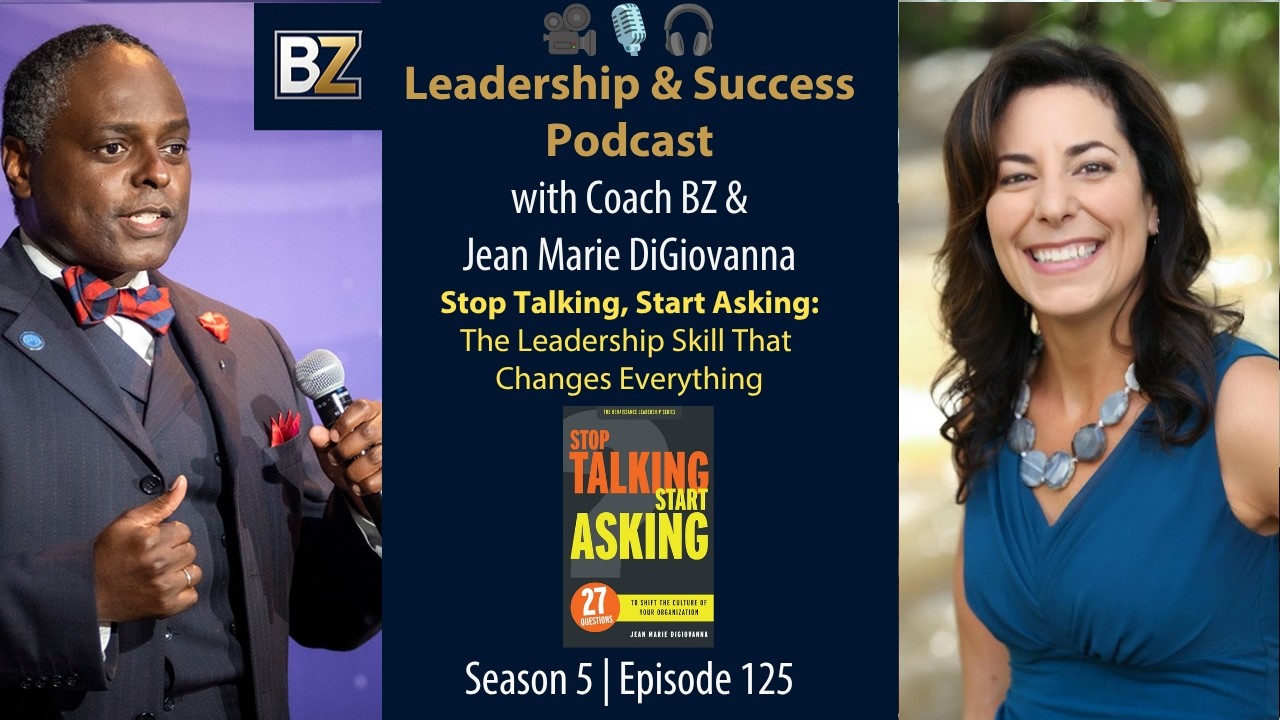
Jean-Marie DiGiovanna introduces Renaissance Leadership, a framework that replaces command-and-control with curiosity and questions. Her sketch-note question framework went viral and was adopted by CISA and federal agencies. Leaders who judge rather than stay curious make the biggest mistake.
Chapters
Hi, I'm John Maxwell. When the top companies in the world are looking for trainers, speakers, and coaches, there's one name that stands above the rest, and that's Maxwell Leadership. Our certified team members have gotten proven results for companies all over the globe, and our reputation, I'm proud to say, is second to none. Some of our members have risen to the top of their profession, including the one you're going to meet today. I proudly introduce you to my friend, Bob Fabien Zinga. Welcome to the Leadership Success Podcast with your host, Coach BZ, where we help you lead with purpose and succeed with impact. If you're ready to grow into the kind of leader others want to follow, this podcast is for you. If you're determined to elevate your success and leave a lasting legacy, this podcast is for you. As my mentor, Dr. John C. Maxwell, reminds us, everything rises and falls on leadership. Our goal is simple: to inspire you, challenge you, and equip you with insights that can transform the trajectory of your leadership journey. Welcome aboard to another episode of the Leadership and Success Podcast with Coach BZ. We are living in the most transformational time in history. The model of command and control is outdated. People aren't just looking for a job, they want meaningful work. They want to be valued for their gifts and talents, not just the results they produce. We are in what I call a rebirth of humanity. What I assert is we're going through our—
All right, welcome everyone to another episode of the Leadership and Success Podcast. This is your host, Coach Bizzy. I'm so glad that you are here with us, and good morning to Daniel. Thank you so much for watching from Metland, Florida. And Daniel is a very active member of our tribe here. Great to see you again, Daniel, really. I appreciate that. So if you guys have a question, please type it in the comment and my guest will be answering live. Also let us know what you are grateful for and where you are joining us from, what city, what state, and if outside of the US, which country. So as you know, it's our tradition here, I like to start with what we call our moment of gratitude. This is where we take just a moment every single time we meet to be grateful for something. And for those who've been watching the show for a while, we do this because in the military, it's about 22 veterans and service members who commit suicide in America every single day. And we believe that it's not possible to be suicidal and grateful at the very same time. So if you would maybe close your eyes and Put yourself in your happy place, take a deep breath, and think about one thing you are grateful for right now. Today, I think I am just grateful that I am still alive. Okay? Somebody went to bed last night, they did not wake up this morning, but I am still here. That gives me hope. That lets me know that my today can be very different than my yesterday, and hopefully my tomorrow will be different than my today. So I am grateful I am still alive today. What are you grateful for? Type it in the comments. So let me see if I can properly introduce our guest today. I am really excited to welcome Jean-Marie DiGiovanna to the Leadership and Success Podcast with Coach Bizzy today. Jean-Marie is an internationally recognized keynote speaker, leadership development expert, executive coach, bestselling author, creator of the Renaissance Leadership, and one of the world's leading voices on curiosity, communication, psychological safety, and organizational culture. Throughout her career, Jean-Marie has helped leaders and teams across the globe unlock hidden talent, foster innovation, strengthen trust, and create cultures where people thrive. As one of the founding partners of Cambridge Technology Partners, she helped grow a startup from 90 employees to more than 4,000 worldwide before dedicating your career to leadership development and transformation. All right, part of what we're going to be learning today is on why great leaders ask great questions, but also practical leadership lessons for military officers, cybersecurity professionals, engineers, and executives. Because, uh, Jane Murray often reminds us that culture change doesn't begin with a strategy, it begins with a question. And sometimes the question nobody is asking is the one that changes everything. Stop talking, start asking. The leadership skills that changes everything. All right, without any further ado, please help me welcome to the Leadership and Success Podcast, the one and only Jean-Marie DiGiovanna. Good morning, Coach Jean-Marie. How are you doing today?
I'm doing great. Thank you.
So great to be talking to you today. I think we tried, I think we scheduled this 2 or 3 times. It's been a while, but I'm so glad you are finally here. Man, we have so much to learn. I guess just to get started, what is one thing you are grateful for today?
I am grateful for my health, my wellbeing. I'm also grateful for being alive and the opportunities that I have to help other people.
Wow, that's so wonderful. We have a user from India, but because of their LinkedIn security, I have no idea what their name is. Looks like it's Kamal Saxena from India. Welcome to the show, Kamal. And if you have a question for Coach Jean-Marie, please go ahead and type it in the comment. Really glad to hear that. Is there something about you, Jean, that most people may not know when they first meet you?
Um, actually, that I also am an artist and I love to salsa dance. So I love that you put in the Latin music at the start of this session. Yeah.
Wow, that's amazing. Have you been on Dancing with the Stars?
No, not yet.
Wow, that is, that is really wonderful. Well, you have spent decades helping leaders ask better questions. What's one question every leader should ask themselves today? That most leaders almost never ask?
I think one question is, how can I enable my team to think for themselves? Because so often we want to give the answers, right, as a leader.
Hmm, I like that. Enable your team to think for themselves. Okay, as a leader, how would you do that?
Well, instead of, for example, answering questions, right? Your team members come to you and they say, hey, I've got a problem, or I have a challenge. How would you handle it? And usually the first thing we do is we answer it because we want to help them, right? It's easy, it's fast, they get what they need, we walk away feeling happy. But guess what? There's a huge opportunity that's missed. Because if we actually, instead of answering it, we actually respond with a question like, what are your thoughts? What have you thought about this? What's an angle that you've challenged with? So yeah, it's just shifting telling to asking.
Wow, that is so powerful. I guess it takes, uh, patience, but it also makes you more of a coach, I think, than just someone who gives direction, which is really Powerful. So you have worked with executives across the globe. What is the biggest leadership mistake you consistently see regardless of industry or geography?
Yeah, great question. I would probably say the biggest thing, and this is for all human beings, whether we're at work or at home, is judging versus staying curious. And that can happen in our conversations. It can happen when we're trying to resolve issues. It can happen when we're, you know, when we're just helping somebody and that little voice that judges others or judges ourselves comes into play.
I love that. And you are the creator of Renaissance Leadership, which I think is really, really cool. But then again, Renaissance is really a French word, which means being born again. Of course, no, the English sometimes, they steal French, French, French word, just like your first name is very French also. So the question I have for you is, you often talk about Renaissance leadership and you do have a trademark on that, I believe. What does that mean?
Well, Renaissance leadership is really about, if you think of the Renaissance as a period of time, it was a rebirth. Of humanity. And I feel like we're going through that right now. We've been going through that. And so Renaissance leadership is really about taking some of the core skills and expertise from that period of time and bringing them into today. For example, asking new questions, staying curious, listening for what's not being said, making connections where others don't think to make, and then magnifying the value and cross-collaborating instead of always working with the same people, the same team members, right? And so, um, even at that time during the Renaissance, uh, Medici, who was a famous banker, he would bring all these different people together, right? Writers, artists, engineers, scientists, because he knew that when you bring all of these beautiful minds together, innovation happens. So it's part of that as well.
That's powerful, yeah, including the great Leonardo da Vinci, right? It's amazing. So we do live in a world that rewards specialization. Why do you believe leaders need both depth but also breadth of knowledge?
Yeah, there's, um, it's interesting because I, it's not that everyone has to have both. It's I value, we need to value experts, right? I mean, we're not going to have someone you know, do open heart surgery who's a generalist, right? So we need the experts in our businesses. However, one thing that has been happening in the last few decades is everyone strives to be the expert. And then what happens is what I call the expert syndrome, which is the more you know, the less curious you become.
Yes.
And then the learning stops. And so what, what specialization can do is actually halt creativity and halt, um, self-expression. And so the beautiful thing about generalists— and I think I've always been a generalist, even though I would say I'm— it's kind of like being a coach. You're an expert at knowing the questions to ask. You're an expert at an overall process versus a domain area. And that's really important today, especially when so much technology is taking over, it's the strategy that's important.
Wow, I love that. So how has artificial intelligence changed your thinking about leadership development?
Um, oh, it's, uh, it's been a journey, I will say, not only with myself but also with my clients, um, and really trying to grasp what this impact is because it's far beyond what you know, the World Wide Web came out with. It is so much more intense. And I, I truly believe that it has been shining a light on where we as human beings, what we're actually here to do.
Wow.
So it questions everything, I think, about our work, which is a good thing, um, in a way.
Wow. So you are relating that to purpose?
Yes, purpose. And also, what do we as human beings bring that no other machine can? Purpose, emotions, relationships, connection. That's all the stuff that's been missing anyway. So in a way, AI is just shining more of that light to say, hey, let's bring all of this back and even more deeper.
I love that because there are definitely things that only human beings can do that can never ever be replaced by artificial intelligence. Wow, I like that. What leadership qualities do you think will become more valuable as AI automates more technical work going forward?
Yeah, yeah. I've seen this so much more in my own business. And it's funny, it's ironic because it's something I've always been teaching for, for decades before AI came out. Before, I mean, we didn't even have— I'm really dating myself now, but, you know, the internet came out when I was, you know, in at work. And yes, what I would say is the most valuable leadership quality is emotional intelligence. And it's not just about how we handle emotions, but also how are we listening, how are we aware, are we truly aware of the impact we're making, of the things that we're saying and what they actually mean to other people. So I really think, and when I say EQ, I'm probably focusing a lot more on self-awareness because that to me is the, that's the key. That's the key that unlocks so much our ability to change and grow.
True. Now there was a time where people used to call that soft skill. I don't know if that's really what they should be called today. What do you think?
Oh, I agree. They are definitely not soft. I think they're one of the hardest skills that we could learn as human beings. And they're critical. They're essential. And they're the thing that's missing the most today.
Yeah, because I live here in Silicon Valley and of course, I came here in 2014. What, almost 12 years ago. And in this country, software engineers are at the very, very top. I mean, they are like mini gods here, the most important asset in every Silicon Valley company. But today, most of them can be replaced by AI. It's incredible. And just a couple of years ago, they said, no, AI will never replace jobs. But actually, big companies, Google, Meta, they've been able to get rid of many of their software developers because they felt like they didn't need them. Any longer, which is really, that would have been completely like a, I don't know, like a great scene or heresy just 10 years ago, but it's happening now. It's just incredible. So I think it's very important for people who are listening to really develop those skills that a machine will never ever be able to replace. Like I'm sure you've heard, right, during the commencement this year in most universities, whenever a commencement speaker mentioned AI, kids were booing that they don't want Yeah. To anything to do with it. I have two Gen Z daughters myself, and my first daughter, she graduated what, May of last year. She has a bunch of part-time jobs, but she can't find the full-time work with benefits and all of that, partly because of AI. It's not just AI, but it's partly because of that. So she absolutely doesn't like AI at all, and many of her peers too. I guess a question I have for you, for young leaders who are listening to the podcast and My daughter Naomi is probably listening right now. They are trying to really build their career. How do they avoid becoming a one-dimensional expert in the edge of AI?
Yeah, well, a couple of things. One thing I do want to say about the reaction to AI is, in a way, it's kind of like when I work with organizations through change, I always talk about how do you relate to change? Because how you relate to it has everything to do with how things show up for you. So the same with AI. If we continue to resist it, the reality is it's not going away. But what if we actually embraced it and explored? And you asked for what are young leaders trying to— what do they most need to build their careers? The greatest skill you could have is the ability to continuously learn. And that requires staying curious and trying not to judge technologies, trying not to judge the economy. Like, what— you know, we've got to think bigger, and that requires curiosity. It requires asking new questions. So I would really say continuous learning. And when we fail, especially when young leaders fail, Instead of— I learned a phrase, oh my God, decades ago. There's no such thing as failure. There's a produced result. You either produced it or you didn't. And what there is to look at is what's the learning? What am I getting out of this? Then you've got something. You've got gold instead of viewing it as failure, right?
I like that. Before I go to the next segment, so I already said Kamal is watching from India. We also have Mohsen. From Iran. Wow, thank you for being here, and hopefully things are working out in Iran. I really pray that this war is ended very, very, very soon. It's very strange. I am in the military, I'm an information warfare commander, but I train and prepare for war, but war is the last thing I ever want to do because every time a nation goes to war, it is just terrible. I think nobody ever really, really, really wins. But thank you, thank you so much for for watching from Iran. And again, I hope you are safe there. And if you guys have any question, please type it in the comment and I will be asking our expert here live on the show. So let's talk a little bit about emotional intelligence and psychological safety, because I feel like this is becoming more and more critical as we live and we try to survive in the age of artificial intelligence. Because one of the themes throughout your work is creating environments, right, where people feel safe, and they feel safe enough so they can contribute. So what is psychological safety, and why do so many organizations struggle to create that environment?
Yeah, psychological safety, the way I define it, is basically the capacity for people to— the willingness for people to speak up and the environment that creates that. And so when you have a psychologically safe environment, then what you'll see is people contributing, people challenging each other, people being okay with making mistakes, also giving feedback that's not so easy to give, constructive feedback, pointing out where the problems are and not feeling judged or like getting repercussion for it. And so the interesting thing though is what I say is psychological safety is like two sides of a coin. And it's interesting. I think when I read Amy Edmondson's work, it's like we both thought that way. It wasn't like I took hers. I think we're all like sort of in the same ethers and thinking this. But I just want to say one thing about that, which is you could have the most psychologically safe environment. But if the individual isn't comfortable themselves to speak up, then that's a challenge. So we have to, as leaders, be able to do both, create the environment and create and work with individuals to let them know it's okay, right, to share.
I like that. And by the way, Dr. Amy Edmondson from Harvard University, I've been trying to get her on the show. Hopefully she's listening now. But yeah, I really love what you're saying because I think In this age, it is very, very critical and important for people to really develop that, to create environment where people can feel psychologically safe. So one of my mentors told me, right, that rank is rented, but trust is earned. And I feel like building trust is probably one of the most critical things we need to do going forward. What role do you think does emotional intelligence play in building trust?
Oh my gosh, a huge role actually. When you think of trust, trust is built from, I would say, genuine care. Like when you care about someone genuinely, that starts to create trust. When you're authentic with people, you do what you say you're going to do. That starts to create trust. And then when you start to tame your own ego, right, that, that requires the EQ. That's the biggest role of EQ is taming our own ego so we can be 100% present to other people.
Yes.
Have you ever trusted someone that's like in their ego or super distracted? We can't trust that. So it's really, um, When I mention EQ, when I, I think of self-awareness. Like, we have to actually be aware of ourselves enough to notice, oh, I'm no longer present, or I'm listening to the voice in my head. And if I'm listening to the voice in my head, I can't be here with you 100%.
Wow. So being present, that's powerful.
And it's hard. It's a rigor. It's a mind rigor every moment.
Yeah, I think it was Steve Covey. I believe we have a book was the Seven—
what's it called? Seven Habits of Effective People.
Yeah, where he talks on people listen so they can respond, right? And that's what many people do when they hear someone speak, they're thinking about what they're gonna say as a response instead of actually listening to understand. And it does take discipline and practice. Now, Jean-Marie, one of the things that caught my attention was the former CISA director, Jean Easterly, another great person, and I wish she would be on the podcast soon. I just met her a couple weeks ago. I think she's now the CEO for RSAC in San Francisco. Anyway, she used the framework on psychological safety during the pandemic as part of the leadership initiative at CISA, and those 6 questions were later shared publicly, and ultimately they led to additional work with federal agencies and some of the nation's largest organizations. So before we dive into the questions themselves, tell us the story behind how your work ended up influencing leaders at CISA and the federal government.
Right. Well, when COVID hit, you know, I think all of us— to me, it wasn't, I guess, it wasn't a huge shift because I've done virtual work before. I work I'm a, you know, entrepreneur, and so I'm used to working at home. And, you know, none of that was really new. But what I did do is I committed to taking on, um, being— having a presence on LinkedIn and really sharing my tools and sharing my knowledge. And, and I love it. I love writing. I love sharing tools and helping people. And as I started doing that and I was gaining more followers, and it's like this, um, I wouldn't say addiction, but like the more interaction you get, the more you want to help. And So it was just this really incredible time for me. And I started noticing, okay, what do people most need right now? And how can I help them? And also, how can I design it in a graphic way, an image or an infographic that can really land with people? And I know at the time, sketchnotes were really big.
Yes.
They're fun. Questions and the sketch note. And I hired— so I designed it and then hired someone to put it online. And I actually have 4, 5, 5 of them total on different topics. But this one in particular, um, did not even realize— I mean, this was probably the third one I posted, you know, in a few months. And next thing you know, uh, a colleague of Amy Edmondson had posted it and he had about, I don't know, let's say, uh, 50,000, 25,000 followers. And I thought, whoa, that was, you know, to me that was a lot at the time. And, and then I was like, oh my God. And I wasn't used to this, right? Like, I don't know. And then next thing you know, Amy Edmondson forwards his, uh, post, and then I'm just like, oh my God, this is— and then I get a message in my LinkedIn message from someone I didn't know who we're connected with, but he said, um, hey, Hey, I saw your, your sketch note on Twitter and I'm not even on Twitter. And that sort of led to all this huge— it went viral basically. And I think that's how, and that's how Jen found it and she ended up using it. And then I only found out that she used it because a colleague who facilitated that session shared a post and then I responded to it. I was like, great, so glad you used it. And then Jen asked me, you know, do you speak for the government? And I said, absolutely. And then one thing led to another.
So it's amazing.
Yeah. And it's a joy to work with, you know, cybersecurity leaders. And I mean, I come from tech, so I had a computer science degree, so it's sort of like my people.
Well, that is really powerful. Let's look at the first question. What's the thing you see me doing that's helping me best contribute to the team? That's a very, very good question. So I guess the question I have for you is, why is it so important for leaders to understand how others perceive their strengths?
Well, and first off, I just want to say that just for context, the questions are really best used when there's trust has already been built with your team. And then you're actually bringing these into your one-on-ones with your team members, and you're asking them in advance to think about them and then having a conversation. So one-on-one is great, or you can bring them in for a team meeting and bring a couple of questions in. But this specific one, you know, as a leader, if you're asking your team member, someone who reports to you, hey, you know, what's the thing you see me doing that's really well? Then now you're getting really great information that you can then keep doing more of. So that's really the first one.
I like that because the next question says, what's the thing I do that's distracting from our success? I really, really love that because I feel like many leaders really struggle to receive candid feedback, right? Why is this question so powerful and how should leaders respond when they hear something difficult?
Yeah, it's really powerful. And a lot of leaders, honestly, it's hard for them to ask that because Or they'll say, oh, I'll ask it, but then they really don't want to know the answer. And so don't ask it. It's hard to ask for really candid feedback.
So I see why trust needs to be in place before you ask that, for sure.
For sure. And many of these, for sure. And also, just as a side note, there are about 4 questions I have that are for creating psychological safety that kind of come before these, because there has to be some of that. There's got to be a level of trust. But when we ask what's detracting, distracting from our success, again, these are things like, oh, maybe I should consider stop doing these things in order to have our team environment even better. And we've got to be willing to, to hear the answer, right? Stay open, hear it without judging. Like, just stay objective. It's just information.
That is so powerful. I think to me, the one I like best is the last question, number 6. What motivates you and how can we bring more of that to your work? Because one thing some people don't really realize is everybody isn't motivated by the same thing. For some employees, you give them more money, it's not gonna make a difference. They want more time off or they want more flexibility with the schedule or something, something else. And I think as a leader, that's why I feel like it's kind of simple, but it's also very, very hard because you cannot treat everybody exactly the same, right? You've got to know your people, but really, really get to know them. So I guess for that question, why do so many leaders assume they know what motivates people without ever asking?
Right. Well, it is ironic because most teams I work with, that when I ask them, do you know what motivates your people? They'll often say yes. And then of course, I follow it up with the next question, which is, have you ever asked them directly, each one individually, what motivates them? And often they haven't. And so we just, because we're human beings, we assume because of how someone operates, how they behave, what they've— what we think they value, that we know them. But actually we don't know until we ask. And by the way, I could ask you this question, and then a year from now I ask you the same question, and you could give me a different answer because Because everyone's life changes, their priorities change over time. And so while it seems like a basic question that we all probably should be, and it's been a question forever that has been on the board, we don't ask it. We just assume we know it. And so it's a great question to start asking our team members. And even if we did ask a year ago, ask it again.
Yes, because things do change. I really love that. I think great leaders really ask insightful questions. Actually, we have our first question from the audience. Daniel Young says, in my work, I talk about moving leaders into honor mode, where they build behavioral infrastructure instead of relying on personality and willpower. How do you help leaders translate powerful questions into actual structure structure, cadences, agreement, and habit that hardwire curiosity and psychological safety into the culture, especially in high-risk environments like cybersecurity and defense. So how do you help leaders translate powerful questions into their structure?
Great question. Thank you, Daniel. So a couple things. One is there's a tool that I teach in every program I do.. And this is a great foundational tool to help answer your question in terms of the structure and what do you do in your environment. And it's flipping the question. So typically when a challenge comes up or when we're in conversation, our mind automatically likes to respond with why.
Yes.
Why did you do it that way? Why can't you do this? Right. And those why questions, and I'm talking about the why questions that put others on the defense. Not like, why is this important to you? That's a great question. And the biggest impact that you can make as a leader is to stop, notice that why question, and instead flip it to a what or a how question. So instead of why are you doing it this way, or why didn't you come on time for the meeting? What's a what or a how question that's more powerful? Right? What gets in the way of coming in on time? Or how can we ensure— is there anything we can do? Right? How can we ensure that you're here on time?
I like that.
What are you most challenged with right now that's really impacting your schedule? So we get— and so here's the thing. When we flip the question, it's requiring us to be more curious. It's almost like we, we have to get more curious if we've got to come up with a new question. And so that's a really powerful tool that can start to make that shift regarding your question that you asked in terms of what can we do on a day-to-day basis. Now I get that in the environments that you're in, things are rapid. Like, you, you know, you don't always have time to, to respond with a question. But I would, I would even challenge you to, to start doing that, because what happens is your people will start thinking for themselves, and then they will start coming to you with less of those issues, less of those challenges, because they're learning on their own.
Yeah, I guess that's really what makes you a leader, doesn't it? Because for some people, they feel like I am the leader because I am in charge and without me, everything crumbles, right? Everything depends on me. But really, if you're a good leader, what you're doing is you are building other leaders so that you don't have to be there. Basically, you're working yourself out of the job so that in your absence, everything still goes well or even better than you being there. So I was going to do this later, but I think it's probably the best time to ask you now. On your website, and people can, can go there, stoptalkingandstartasking.com, and click on Send Me the 10 Questions. What would they get if they do that, and how can they get, uh—
Oh yeah, so, and this, this is my website, so it's the Jean-Marie Speaks website. The Stop Talking Start Asking is the website for my book, but you can always get that on Amazon. So at JeanMarieSpeaks.com, if you click on the Send Me the 10 Questions. You'll get a tool into your inbox of 10 questions to help unlock new talent and ideas on your team. And then every month I send a newsletter with, um, different leadership tools. And then at the end of the month, if you're on my newsletter list, you will get a bonus tool at the end of the month that are usually 10 or 12 questions for different things that you have to handle with your team. So, um, there's never a shortage of questions in my world.
That is really great because for the leaders who are listening right now, if they wanted to implement these 6 questions immediately, where would you recommend they start?
Yeah, I would say start in your one-on-ones and know that people process things differently. They take time. Some people can answer a question right away when you ask them. So it's really important if you're going to pick a few of these questions, like in the psychological safety list, Pick a few, reach out to the team member before your one-on-one with them and say, hey, I want to ask you a few questions, but I'd love to give them to you in advance. Think about them, come to the meeting with your answers. Now they use their time, and that's the best way to use it. Same with the team. If you bring a question to the team, throw out the question in advance. Hey, think about this before you come to the team meeting, and then we'll start sharing the answers together.
Wow, that is so powerful. So let's talk about your best-selling book. The book is Stop Talking and Start Asking. So, uh, in the book, I guess you have 27 questions to kind of shift the culture of any organization. So what inspired you to write this book?
What And there's a little bit of a caveat. There's actually more than 27, but if I put like 127 on the COVID people would be like, whoa. So there's 27 key questions and then there's a lot of supportive questions. What inspired me? I knew there's many books in me. The next book I'm writing, actually I'm currently writing, is around leading with curiosity. We can talk about that later, but But this book was inspired because as I was working with more teams and leaders across the globe, I was thinking, how can I get my tools out to more people and faster? And then I started thinking, well, what are the questions? What's the thread through everything I teach? And they were always questions that shifted things immediately. And so what I started doing is I started pulling out the questions. And the next thing you know, the questions actually, um, moved me to topics for chapters. And then I started creating the chapters, and I ended up doing it so that it's a, it's a resource. So each chapter is standalone, and then the chapters kind of, um, unfolded where each chapter is some aspect that you want to foster more of in your culture. So you simply just go to that chapter And there, the side of the book has all these tabs. So it's like a dictionary, I guess. And wow, and just go to what you need and you get the questions right away. And I had someone actually send me a picture of all these little tabs in the book. And I was like, wow, I've never seen someone put so many tabs. So it's a, it's really a resource.
Wow. That is really, really powerful. And I think for many of us, I remember when I was just transitioning from being an individual contributor to becoming a manager, delegation was something I really had a very hard time doing because I always felt like it'd be so much easier and better if I did it. I know how to do it. Let me just do it and be done with it. Again, as a leader, your job is to really develop other leaders. So why do so many leaders kind of default to giving answers instead of actually asking the question?
Well, first of all, it's easier. It's actually more rewarding. It feels good because you get that kind of dopamine hit, like, oh, I got to help this person because of my expertise. And then they go away happy and you go away happy. But, but I always say, you know, we're missing an incredible opportunity, which is the opportunity to enable another person's growth. So while that's all great, it doesn't last. Like, the learning actually stops at that level. As soon as we just keep telling and telling and telling, that's when the learning stops. We don't even recognize it, but it's happening.
Wow, I like that. Even for those who read the Bible, I just thought like Jesus in the New Testament, every time they ask him a question, he always answered with another question, which is very challenging. And also for those who read philosophy, what Socrates was, was the same thing. They would ask him a question and then he would ask a question too, because it really makes you think and you're able to connect all of the dots. It's not just having an answer, but understanding why this is the right answer. Now in your book, you do argue again, everyone, the book we are talking about and Everybody needs to get a copy. Stop Talking, Start Asking: 27 Key Questions to Shift the Culture of Your Organization. This is kind of intriguing too, right? Shifting a culture with questions. I don't think I've ever quite heard it put that way, because you do argue that culture can be shifted through questions. How does one powerful question change an organization culture?
Yes, I think one of the most powerful that's in the book is in the chapter on shared success. And this is a question we actually don't ask another person. It's a question we reflect on. And the question is, what would make you successful? And here's how you use it. So let's say I'm working with you. You could be my manager, you could be my peer, you could be my direct report, whatever. It does not matter. But what if I looked at you with this question in mind and thought, oh, how can I make Bob successful? And then whatever answers pop in— oh, I could help him with this. Oh, I could share this resource— just go do those things.
Yes.
And the way that that question can shift an entire culture is, can you imagine if every single person ask that to themselves about every other person they work with, what kind of culture would you create? And that's the power, right, of one simple question.
I really love that. Actually, one of my mentors, that's one question he told me that really changed, I think transformed my career. Because once you become in charge of a pretty big function like me, cybersecurity, or IT, sometimes you feel like you're almost like the king of that silo and then you have all of the other businesses. But the thing is, for you to become successful, you really need to find ways to add values to all of the other business functions. So how can I make them successful? Because if you go to them and you're like, I want to be a partner and I want to help you be more successful, then they're going to open up and then you're going to be able to work together and do something great for you. Your organization. But if they feel like you are going to them just to steal away their resources or get in their way or prevent them to do their job like cybersecurity used to do 20+ years ago, we used to be the department of no, then you are not gonna get anywhere. So I really like that. So of the 27 key questions you have in the book, which one do you think consistently creates the biggest breakthrough for leaders?
Um, actually, I think that one does. Yes, that's a biggie. I mean, that is a biggie. Uh, it's really hard because there's so many questions.
Yes. Okay, I, I agree with you. Okay, which one do you think would be the runner-up? Which one would be the second?
The runner-up? Um, uh, oh gosh, that's really hard. I don't have the book right in front of me. Yeah, I'm not— for some reason, I'm not— I know there's like a million.
For sure, hands down, that one I think really makes a really, really, really huge difference. But also—
Oh, actually, sorry, I have one. So it just popped in. So at the beginning of the book, I talk about what is culture. And one of the most powerful questions we can ask when we're trying to achieve a goal is who do we need, who do I need to be to achieve that goal? And I'm not talking about a specific person, like I need to be, you know, I don't know, Steve Jobs or no, the way of being. Do I need to be more patient? Do I need to be more brave, courageous, persistent? And I guarantee if you focus on that way of being, focus on practicing that way of being, you'll achieve that goal even more, even easier. So it's about being before doing.
I love that. Yeah, because another question I like to ask myself is, uh, who do I need to become in order to become successful? Yeah, that is powerful.
So it's just the same. Yeah, yeah.
Wow, wow, I love that. And for those who are watching, one thing I love about this podcast and why I read so many books, sometimes you You just need one idea. And sometimes it's not very difficult, but just one idea, if you can hang on to it and start putting it in practice, it could literally change your entire career. Wow, that is quite a very, very insightful question because your book does focus on increasing engagement, improving communication, and creating happier, more productive teams. Which of those challenges is most urgent today, you think?
Think? Oh, um, honestly, I would say engagement, because that drives everything. When we can open the dialogue with our people, get them more engaged, get them more excited and thinking, then all of those other things are impacted positively.
Wow, I like that. In the book, I think one of my favorite questions— there are so many, but one is, uh, is there a brilliant idea you have thought of but been afraid to share? Why is that question so key?
Well, because it points to humanity. It acknowledges something that we might be afraid of, so it creates a bit of vulnerability. Yes. I think one of the most powerful kinds of questions we can ask is the one that nobody asks, the questions that no one is asking. Like, what's the thing you would want to say that you've been holding back on?
Yes.
Wow. You know, yeah. And the question in and of itself creates safety for the other person to step in and say, oh, actually, I'm going to answer that because you were vulnerable with me. I'm going to be vulnerable with you. It's really, really powerful. Yeah.
That's how you just made me think of Brené Brown too. Yeah. Because I guess when you create that environment where people can feel safe and it's okay for them to share their idea and not fear retribution or being made fun of or anything. That, that really, uh, helps the team a lot. So if there is a senior executive or a CEO listening right now and, um, they would like to implement only one concept from your book, what would you recommend a person in charge?
Um, what I would recommend is probably this one question, which is as you're in conversations with people is to ask yourself, if I were to get a little more curious in this conversation, what would I ask?
Wow, I like that.
Because we don't go deep enough in our conversations, or we end when we know, when we have the answer. But actually, we're missing out on so much more available that we're not diving into. Like, what if I got a little more curious about my team, each team member? What would I want to ask?
Wow, that is powerful. I like that. Is there anything that has surprised you about readers' reaction to the book?
Well, what surprised me is who was reading the book. So I wrote it for leaders, Honestly, I wrote it for leaders, but actually I came to find out that a lot of other coaches and consultants use the book and they love it. They use it with their clients. Great. I didn't really think of that, but excellent.
Wow. The impact you're having is incredible.
It's always fun when you do something out of passion and it's just from that pure place of wanting to help, and then it sort of expands into something that— yeah, bigger.
Yeah, that's really powerful. Looks like we only have about 10 minutes left. I could be talking to you for hours and hours. Let me talk about artificial intelligence for just a moment, because right now in the age of AI, organizations rush to adopt artificial intelligence. And what human leadership skills become even more important? As if it's rushing toward AI?
Yeah, I think, um, I would emphasize, like we talked about earlier, especially emotional intelligence, um, specifically the skill of self-awareness.
Yes.
Um, because, you know, when we start using AI more— I mean, I've run into this myself. When it started coming out, I was like, oh, I'm gonna help have it help me with this and that. And then next thing you know, I start realizing I've just gave my brain over to this thing and I didn't feel creative anymore. I was almost letting it do too much. So we've got to have enough of that self-awareness to recognize, oh, you know what, I need to stop here, regroup, go within. What are my thoughts on this? And aside from EQ, absolutely, uh, listening, listening from a place of staying open, listening to accept, not to reject, staying curious, having empathy, and then really practicing being present with people.
I like that. I know a lot of people are very afraid that AI will be replacing them or taking away their jobs, but I really think AI is here to make us more effective, maybe enhance humanity and not replace it. How do you think leaders can ensure that technologies like AI does that in enhancing people's work but not replacing?
Yeah, I think kind of like what I just said, which is heightened self-awareness. Like knowing, like as soon as you notice you're allowing, you're allowing the tech to take over your own mind, that's the trigger. It's like, oop, no, let's take a step back. We have to do that, right, as humans, because otherwise things can get out of hand.
So for this question, then, I want you to look at it from two different angles. First, from the senior leadership in an organization. So I am a CEO, what advice would you give me when I'm trying to balance innovation, productivity, and employee well-being in my organization?
Well, of course I'm gonna answer it through the lens of curiosity in question. So first off, I would say take on practicing asking new questions, a few new questions every day. Practice in your conversations Make a commitment that in 3 conversations a day, or even just 1, I'm going to respond with a question instead of an answer. And it forces us to just stay more curious.
I like that. That works most of the time with me, except with my wife. She always tells me, "I ask you first, but you have to answer first," which is okay. So now I want you to answer the same question, but this time from a, uh, I guess entry-level employee. I'm thinking about my daughter. She just got a bachelor's degree. She's excited about going to work, but now she feels like the AI is taking away all of the entry-level, uh, position. What would you advise someone like that?
So I think this is where it requires a bit more, um, inquiry, self-inquiry, to, uh, sit down and say What makes me unique? What can— what, what is the— what are the things only I can do in a way that I do it? See, we do— each of us have incredible gifts and talents, and sometimes we haven't even spent the time to uncover them, which is why, like, I'm so passionate about uncovering people's hidden talents that we don't even realize they have. Your daughter has I'm gonna guess many hidden talents that come so naturally. They're usually the things that come so naturally we don't even think about it. We don't think of it as a talent. Well, once she can identify those, or any young person start to uncover those, and then look to see how can I add value with those gifts and talents.
I like that. I like that. Wow. Okay, we have more response from our live audience. So we have James Cummings III. He likes what you are saying. And James, if you have a question for my guest, go ahead and type it in the comments. We're going to try to answer those live before we end, although we don't have much time anymore. So for the last segment here, let me ask you this: what do you believe is one of the greatest lessons you have ever learned, just in life, in leadership in general?
I love that question. Oh my goodness. Oh my goodness. There's so many lessons.
What's one of them?
One of them is to stay open to what you don't know. Like I learned when I was young, it's like my whole goal was to learn, to know, to get to certainty, right? And then that creates a little more control. So we, we, we get get to plan our goals and all that. And but the thing is, when we get to that place and it becomes so intense to know everything, then we lose out on all the, the journey that can happen along the way. And so I would say one of the biggest learnings is when, when I, um, I was in some intense growth and development programs when, uh, several decades ago in my 20s, and And I remember one of the facilitators said, "What would be possible out of not knowing?" And that really, in fact, yeah, that one question was like, what if I don't know? What if it's okay not to know? What's possible from that place?
Wow. I like that. I guess another way to think about this, Brian Tracy is the one who taught me, What would I do differently knowing what I know now?
Yeah.
And, uh, sometimes you just have to cut your losses and really do— yeah. Wow, that is powerful.
Yeah. And the other learning lesson for me was to, um, remember to get the lesson.
Yes.
Instead of dwelling on the failure or the thing that didn't go well, or, you know, the expectation that didn't happen. We can dwell in that, or we can mine for the lesson and the gold.
Yeah, because one of my favorite commanding officers gave me this coin. It says failure on one side, success on the other. We almost always dwell on success. We never talk about failure. So they're kind of like two sides of the same coin. How has failure shaped your life?
Ooh, well, it's never easy, right? At the times I look back when I failed, they were humbling. They reminded me that I'm human and gave me permission to be more human in the future. That's probably the biggest thing that failure has done. Because I'm kind of a recovering perfectionist. It does creep in here and there. But you know what? We're human. There's no perfect.
Yes. To err is human. Yeah, that is so true. I used to be a perfectionist too. And now I guess I'm an excellentist. You don't have to be perfect, but you can be excellent at what you do, as long as you are always learning.
Yeah.
So powerful. What do you think then is the secret to your success? You've done so much in your life and your career and impacting so many people across the globe. What makes you so successful, you think?
I'm committed to evolving. I always say the learning stops when my breathing stops. I am sort of a a learning junkie, but, um, it's something I've always been committed to, um, is learning and growing. And so if something feels off or it's not going right or something like that, I'm always looking for, okay, what's happening here? Um, so I would say the biggest, uh, secret to what continues to create success in my life is that I'm willing to to learn and apply that learning and try things out.
Yeah, that's really, really powerful. So what are you learning these days?
Oh, I'm learning, uh, to balance, um, client work with my own internal, uh, like, what do I say, uh, business infrastructure, all of that. I, I, I love working with clients, and so I can kind of just go in that whole direction and then leave the business part of my business, whether it's updating marketing or any of that, to the side. And, you know, it's like, okay, it's important to take the time. So now I'm actually taking the time to upgrade my marketing, to align all of my messaging. And as you know, it's never easy because you have to take a hard look, um, but It's clarity is so wonderful to get.
So I like that. So if you could choose 3 people to have dinner with, they could be alive, dead, or even fictitious characters, who would you choose and why?
Ooh. Um, Mahatma Gandhi.
Mm-hmm.
Because there's a presence he has.
Yeah. You don't need to say more for that one.
Yeah. Okay. Um, Uh, Dr. Wayne Dyer. And I just, I say that because he was a big influencer in a part of my life at a time in my life where I was, I needed that help.
Yeah. I miss watching him on PBS. He was really great. He's written so many books about positive thinking and things. Yeah.
Yeah.
I like him. Um, who else?
I mean, the other one is, would come, that comes to mind is Nelson Mandela.
Yeah, yeah, you don't have to say much about him. No, Madiba. Yeah. Oh, that's powerful. Okay, uh, is there maybe like a song, a book, or a movie that would be your life's theme or anthem?
Um, yes, the song called Brave by Sara Bareilles, and the, the phrase I love is, say what you want to say. Let the words come out.
I like that. Sarah Bareilles. Got it.
Yeah.
Wow. Powerful. Powerful. Is there a book you would recommend to my audience, not your own? And by the way, when you publish your next book, please come back here. Please, please, please.
Yes, I will.
It'll be a bestseller. But is there another book you would recommend?
I mean, it's probably on your list already. I love a lot of Brené Brown's work.
Yes.
Daring Greatly.
Yeah, yeah, yeah. So that's another person I'd like to get on this podcast. Anybody who knows her who's listening, please, please, please have her. That's really powerful. Okay, uh, what is one action you are thinking about taking that you believe will positively impact your life?
For me personally, To let go more.
Hmm, I like that. That can be difficult.
It's not easy. Like, I would say let go and trust. Trust in the process. Trust in a higher being. Um, trust that all is well and all will work out well.
Wow, that's powerful. So if you had one and only one day to live, what would you have liked your final contribution to be?
Wow. Um, to help another person breathe easier because of who I've been for them.
Wow. I think you're definitely doing that with your work, for sure. Uh, making a big difference. So when you wake up in the morning, what is one problem you'd like to solve? You had the magic wand, you could solve any problem.
What is the one thing you'd like to solve tomorrow? Hunger. No one should be hungry in this world.
Yeah, I— that's one thing I really don't understand. With all of the wealth we have, I come— some people don't even have food to eat, even right here in America, which is— doesn't make any sense at all. Even right here in Silicon Valley, uh, we are probably one of the most expensive zip codes in the world, but we do have some people who are homeless and who don't have food, and that doesn't make any sense. Okay, um, all right, we have definitely run out of time. So as we end, uh, what— actually, before I do, is there a question I should have asked you I didn't get a chance to ask? Anything else you wanted to share today?
Oh God, no. You have been an incredible questioneer, if that's a word. Questionologist.
I have read your book, and everybody should get a copy. So how can we add value back to you? How can my audience add value back to you?
Well, I mean, first of all, I'm always open to learning, so I love to hear your lessons. Um, I am interviewing leaders for my next book, so if you feel or you know of someone who you feel truly leads with curiosity, um, definitely open to interviewing them. And of course, always welcome to explore what your needs are at your company and how I can help them through leadership and leading with Renaissance leadership and curiosity.
Fantastic. Wow, that is powerful. Okay, uh, can you give me a couple more minutes before we end? Okay, sure. Let's, let's do this. I'm— what I'm going to ask now, uh, I want you to answer as quickly as, as you can, right? Um, rapid fire, like lightning round. So don't Don't take too much to think, whatever comes to your head. What is your favorite leadership book besides your own?
Um, oh, I love the Brené Brown one, the one I mentioned.
Very good. Most influential mentor?
Oh, first my father.
Okay, one leadership habit you never skip?
Setting my daily intention.
I like that. One question every leader should ask every day?
How can I be a bit better today than I was yesterday?
I like that. One word that defines great leadership?
Curiosity.
What did you want to be when you were a kid?
Oh gosh, um, probably an artist.
Well, in many ways you are, right?
You said I am.
Yeah, fantastic. Okay, 3 adjectives describing you as a child: playful, curious, um, One more. Fun. Okay, what about as an adult?
Oh, confident. Oh, this is hard. I don't know. 3 qualities as an adult, right? Okay. I would say warm. Um, insightful.
Yes, very, very insightful. I think your EQ is off the charts. It's so easy to talk with you. Okay, what is the most powerful question anyone has ever asked you?
Oh, well, actually, the one I shared before, which was, what would be possible out of not knowing? But I will share something else. Else that was powerful, which was, um, they were basically asking me, what am I committed to? And, uh, and then followed that up with, look at what's in your life and you can tell what you're committed to. And I was like, that's a deep—
that is life-changing.
Yeah, how aligned.
Yes, that is really life-changing. Wow, that is powerful. What are you committed to? Because the truth is, for many people, we are really not committed to anything because the minute you have a challenge or friction or something, you just give up. I think I learned that from one of my mentors, Tony Robbins. He's the one who taught that to me. People say, I should, I should, I should, I should, I should. I mean, they say I should all over themselves. But what you must say is not I should, but I must. Because when you go from a should to a must, then absolutely nothing can stop you. Commitment. Wow, that is powerful. Again, just an insight, an idea like that could potentially change the rest of your life. What are you committed to? And then how do we see it in your daily practice? Wow, powerful, powerful. Okay, we need to end the show. Thank you so much for everything you have taught us today, Coach, in français, Jean-Marie. So grateful you are here So I wanna end on a positive note. What is something you are feeling optimistic about these days?
Oh, what's possible.
What is possible?
In our world and what we can create because of who we are.
It totally reminds me of that child innocence. Most people when they are a kid, they feel like the universe is so big, they're so curious and they learn. But then as you become an adult, you have responsibilities, your lenses get smaller and smaller. We need to get back to that. Wow, powerful, powerful. Okay, the very, very last question, and this is the end of it. What represents our shared experience, this podcast today?
What represents the shared experience?
One word.
One word. Beauty. I don't know why that comes in, but beauty. It's been beautiful.
I think I am usually extremely grateful, but I'm so overjoyed. It's really so easy, simple to be talking to Again, bestselling author of a book everybody needs to have, which is Stop Talking, Start Asking. So powerful. Well, Coach Jean-Marie Givana, thank you so much for being our master teacher today. Really appreciate your time with us. Thank you.
Thank you. Thank you. Wow.
That's one of the most insightful time we've had here. Thank you so much. Well, everybody, again, please get a copy of the book and follow Jean-Marie on LinkedIn. LinkedIn.com/ianjeanmariadegiovanna. And also go to stop talking and start tasking.com to register for our newsletter. Okay, that's all we have for today. I have a couple more interviews set up for this week. Thank you so much for watching today, and I hope to see you again tomorrow. Bye for now.
Thank you for tuning in to the Leadership and Success Podcast with your host, Coach BZ. If today's episode added value to your leadership journey, be sure to subscribe, share, and join us again for more wisdom nuggets on how to lead better and achieve greater success. Remember, leadership is the most critical skill of our time. The world will always need leaders to inspire others, drive innovation, and execute meaningful strategy. So why not count yourself among the bold leaders shaping the 21st century? Until next time, stay inspired, stay committed, and keep leading with excellence.
More from Bob

S250:E4🎙️LIVE 🇺🇸America 250: President Barack Obama Leadership, Service, and the Power of Hope






S5:E157🎙️ LIVE with CMD CMSgt Dennis L. Fritz, USAF (Ret.)(Multi Tracks Audio)



S5:E156🎙️ LIVE 🇪🇸 Leadership Lessons from the FIFA World Cup 2026 Champions (Multi Tracks Audio)

S250:E3🎙️ LIVE Leadership Lessons from America’s First Documented Family of African Descent 🇺🇸📖