S5E28🎙️ LIVE with Senior Chief Martin White, USN (Ret.) (Multi Tracks Audio)
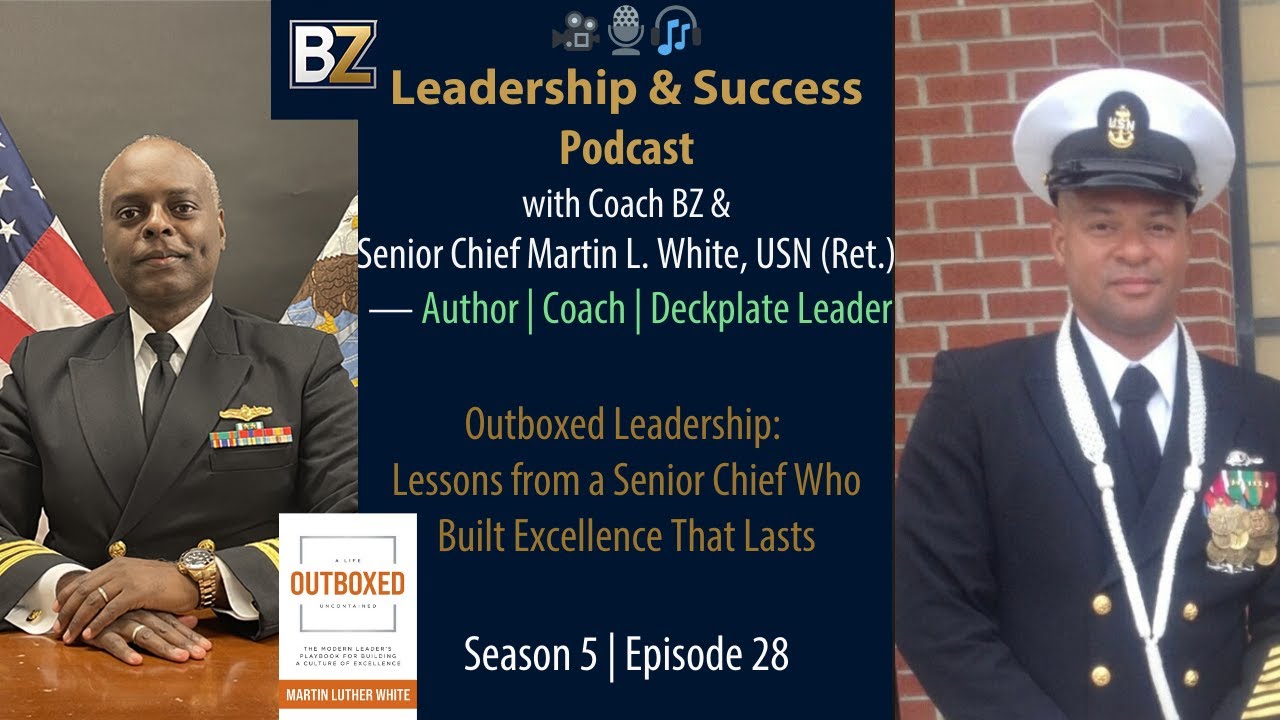
Retired Navy Senior Chief Martin White discusses servant leadership and organizational culture with host Coach BZ. He emphasizes that discipline beats urgency, warns against misaligned excellence, and advocates for the "next-man-up" succession model to avoid creating bottlenecks. White's book Outbox offers frameworks for middle managers on building trust and leading through scarcity.
Chapters
Hi, I'm John Maxwell. When the top companies in the world are looking for trainers, speakers, and coaches, there's one name that stands above the rest, and that's Maxwell Leadership. Our certified team members have gotten proven results for companies all over the globe, and our reputation, I'm proud to say, is second to none. Some of our members have risen to the top of their profession, including the the one you're going to meet today. I proudly introduce you to my friend Bob Fabien Zinga.
Welcome to the Leadership Success Podcast with your host, Coach BZ, where we help you lead with purpose and succeed with impact. If you're ready to grow into the kind of leader others want to follow, this podcast is for you. If you're determined to elevate your success and leave a lasting legacy, this podcast is for you. As my mentor, Dr. John C. Maxwell, reminds us, everything rises and falls on leadership. Our goal is simple: to inspire you, challenge you, and equip you with insights that can transform the trajectory of your leadership journey. Welcome aboard to another episode of the Leadership and Success Podcast with Coach BZ.
I'm Boatswain Senior Chief Martin White. I'm currently assigned to Maritime Civil Affairs Security Training Command out of Dam Neck, Virginia. Can you tell me what your role and mission is here today? We are currently assigned to support the relief efforts from Hurricane Sandy in the Northeast region. Can you tell me some specifically operations that your personnel are conducting? Specific operations, currently we have two teams along the coast of the Jersey Shore that are doing assessments for infrastructure damage, bridge damage, debris, and anything that would hinder normal operations. They're going to take that information and bring it back and hopefully we can coordinate efforts to be of assistance in one of those areas. Can you tell me how many personnel you actually brought up from Virginia? We brought 20 people from Virginia. I have 2 8-man teams and a 4-man civil military operations unit. This is where we coordinate all the movements of the teams. And the teams will then actually go out and do the assessments and report back. What do you expect your teams to come up with? Don't wait for the right time.
Make it right by showing up. Alright everyone, welcome to another edition of the Leadership and Success Podcast. I am really grateful to be here today. We have a very special guest waiting in the green room, but I'm reminded, let's do a moment of gratitude. But for those who've been watching this entire month, every day pretty much, I am really grateful for Black History Month because Black history is American history. So we are celebrating Black History Month every day this month with two different type of posts. One is I talk about today in history. For example, today was February 4th and we talked about what happened in Alabama, I think it was 1845. And then I also talk about the first African American who did something significant in the US military. And today we talked about the very first major in the US Army. But anyway, I am really glad to be here, proud to be an American. And let me introduce my guest really quick. Let me see if I can do this right, because this man has accomplished so much and it's very difficult to talk about him and everything he has done. But I'm talking about the one and only Senior Chief Martin White, Senior Chief in the US Navy, retired now. He's a leadership coach, organizational development practitioner, bestselling author of Outbox: A Life in Content, and also certified project management professional. So across the military, federal, and private sector environment, Martin has built a reputation for steady leadership under pressure, systems thinking, and developing people who outlast the mission. His work challenges leaders to break free from inherited constraints, ordered knowledge, and outdated leadership models, and replace them with clarity, stewardship, and culture of excellence. So Ladies and gentlemen, please help me welcome to the Leadership and Success Podcast Senior Chief Martin Luther White. Good afternoon, Senior. How are you doing today, sir?
I am doing great, dear Commander. Thank you for that introduction. That was the best introduction I have ever had, so thank you for that.
Thank you. I guess to get started, I always like to start with a moment of gratitude. What is one thing you are grateful for today, Senior Chief?
Well, I think, uh, I'm grateful every day, right, for, uh, not only my relationship with God but for my family. I'm grateful for my family. I think that's where my true strength comes from, um, my wife and my two daughters as well as my extended family. I'm the youngest of nine, and we could go on a whole journey about that, but that's what I'm really grateful for is just my family.
Well, is there something about you, Senior, that most people do not know when they first meet you?
That would be it, that I'm the youngest of 9. They don't know that, but here's a little military kind of trivia for you. I've been to Antarctica twice.
Wow.
So that's something that people don't often do. So that was part of a mission that I was with Navy Cargo Handling. So that was kind of unique.
How long were you gone for, like a year?
Uh, no, for Antarctica we did, uh, month-long trips in the, in the summer. Uh, you had to do, I think it was 60 days total or something, the actual ribbon. Yeah, I was, I was in Africa for a year though.
Uh, wow, amazing. Because my, my, my wife is a military brat. Uh, dad retired as a, um, tech sergeant. I think she was maybe 5 or 6 years old, her dad went to Antarctica for like an entire year. So she was pretty much almost like an orphan or something. But anyway, she always remembers that and she was like when we got married, you know, I will never marry a military man, which I wasn't when we were married, but after 9/11, I heard the call. I'm like, I have to serve. So I asked for permission. Thank God she gave it to me, but—
Thank God. I thank her and thank you for your service.
Thank you. Thank you, C.J. So when you look back on your Navy career, what moment most clearly shaped your leadership philosophy?
Yeah, so that's a good question. I think the moment that most shaped my leadership philosophy was, uh, I, I'm— when I was a second class, I spent a long time at that particular rate— rank because of quotas and my lack of commitment to actually studying and advancing. But during that time, the reason I say it really shaped me is because once I stopped blaming others or blaming the system for me not advancing. And I started looking at it more as an opportunity. Okay, while I'm here, what can I do? Who can I help? Who can I serve? How can I better myself professionally? But how can I bring others along also? And when I made that shift in my mind, instead of getting bitter, I got better. It changed everything. Wow.
Maybe you can Take us back. Why did you join the Navy? What was your journey there?
Well, I would love to tell you it was clarity of thought, but I was a wayward 17-year-old. My mother actually had to sign me in. So I joined when I was 17. I didn't have a plan. It was, you know, I didn't want to go to school anymore. Not to mention that they didn't really want me to go.
Oh, don't show that guy.
So that was it. Uh, my sister at the time was a recruiter. She— I believe that they had a plan all along. She put me in the Navy, and as they say, the rest is history. So I wish I could say I was clarity of thought and I knew what I was gonna do. No.
Wow, that is really something. So there are already people here, they're making a lot of noise. So we have, uh, Daniel Young, uh, he's an active member of our community. So, uh, he's coming from Florida. He's ready for the Honor Mode Insight. From Senior Chief White. And we also have Stacy. Hi, Stacy. Matt Quick, me too. So let us know where you are coming from, what city, what state. And now our podcast has gone global. So if you are out of the US, which, which country, and also what you are grateful for. And if you have any question for the Senior Chief, let us know. We will answer live. So another question I have for you, Senior, is Senior Enlisted Leader, SEL. That's E7, E8, E9. They often carry influence without formal authority. How did you learn to lead up, down, and across simultaneously?
So the best way I can explain that is like in real estate, right? They say location, location, location.
Yeah.
When you're talking about leading and, you know, up, down, and sideways, it's all about communication, communication, communication. Education, right? Um, I learned very early in my Navy career that networking and providing service for others often, you know, pay dividends later on. And that's how you kind of— I kind of navigated that space where I wasn't necessarily in charge of you, but, um, I would, I would network you know, have relationships with people. And one of the things I, I kind of developed or thought about then was it's— everybody talks about, or people talk about win-win or win-lose situations, and I kind of frame it in, uh, win, not lose, which means no matter, you know, if I'm getting what I want, I still don't need to leave you feeling like you lost.
Yes.
Yeah. So You might not necessarily get everything you want, but you're not feeling like you lost. It's kind of like Maya Angelou said, people don't necessarily remember what you did, but they remember how you made them feel, right? So when you're in relationships and you're networking or you're trying to get things done across different working groups, you don't always have to— it doesn't always have to just be win-lose. It can be win, not loss.
Wow. That is, that is powerful. Very, very insightful. So what did your career in the Navy teach you about discipline that civilian leadership maybe often misunderstand or underappreciate?
Oh, okay. So for me, discipline beats urgency, right? Discipline wins out all the time. And, and we see it in the, in the military. Also, but on the outside in corporate space, what I mean by discipline outweighs urgency is kind of like, take for example, training or professional development in the corporate space. That's not often budgeted well. Because, you know, it's, it's not really a revenue generator, or you can't put your finger on the revenue it's generating, per se. But when it becomes an emergency or when training needs to happen instantly, then the urgency kicks in and they need to, you know, pour money on it instead of consistently developing their people over time. It will win out when that situation becomes chaotic. And now, you know, you don't have to spring into action or do anything, uh, Herculean to make this work. Wow.
Really insightful. Now, one thing you've said, some people may think it's a contradiction, but people in the Navy understand what you mean. You've spoken about a moment where excellence was actually misaligned. People, how can excellence be misaligned? So, how do leaders actually distinguish between personal performance and team effectiveness?
Yeah. So, what you're talking about there is a story I shared where excellence was misaligned and it had to do with an inspection that I was a part of. And as you know, in the Navy, but in all military, you know, inspections are pretty big deals. So I was going through an inspection. I was kind of a junior, uh, sailor at the time, but the senior inspector that came on board, he liked me. I could answer all the questions. So he brought me from station to station, and I kind of answered everything for everyone, even though other people had prepared and done things. I kind of answered everything for everyone, so I felt like I was operating in excellence.
Yeah, the go-to guy.
Yeah, go-to guy. I'm, I'm here, I know everything. But after the fact, my chief kind of explained to me in a 30-minute vocal conversation, one-way conversation, that I wasn't operating in excellence. I was actually operating out of selfishness because not only was I taking the opportunity away from others to show what they've done or, you know, what they know, I also didn't take that time to train anybody. At this period in my career, I wasn't as, you know, enlightened, let's say. I wasn't thinking about other people or the team. I was just hoarding all my own knowledge and I know this and you don't. And let me show you what I know. Um, so that's where my excellence was not aligned properly with the team. And as leaders, we need to recognize that, right? We can give compliments and we can, uh, uplift individuals without losing the team cohesiveness or spotlighting individuals, uh, over the team all the time. You can have a moment, everybody has their moment, but as a whole, we got us here, you didn't get us here.
That is really powerful because you remind me something my primary mentor told me when I became an instant. He says, you are not a good leader, right? If you step out of your department for like a week or two or whatever, and then by the time you come back, everything is broken down, everything is on fire, nothing is working. Really, the test of your leadership is when people actually know what to do even when you are not around. That is so powerful. Can you talk about that? Because it seems to me like in the military and in the industry, there's a big difference in the way people treat each other. There's a lot of competition in the industry. Not to say that there is no competition in the Navy because there is too, but in my experience, we really tend to help one another. And actually, like I told you before the show, right, when I was a seaman recruit, from seaman recruit to lieutenant commander to O-4, I've really been, you know, nursed and trained and mentored by a chief. So one thing my command chief taught me when I was just a seaman recruit was you need to learn how to replace yourself. Basically, you have to work yourself out of a job. That's what makes you a leader, when you can have someone on your team who then takes over what you are doing, because that means now you are ready for higher and greater responsibility. Can you talk about that a little bit?
Yeah, so We learned that, you know, and, and I, I, I was mentored by some great chiefs myself, believe it or not, and some great, and some great officers. I'm not going to leave them. I have, I have quite a few of those that I can, uh, give shouts out to. But so we learned that, and this is the, this is the, this is, uh, here's, here's, uh, something that a lot of military members struggle with when they transition, right? You said it, uh, in, in, in that statement. When you trade, when you, uh, transfer to a new unit and whoever sits you down, they say, what do you want to do? It's okay to say, I want your job, I want to be you, right? In the military, that's a go-getter, that's very motivated, and that works. In the corporate space, if I walked in in an interview and they say, what do you want to do? And I tell them I want their job, well, are they going to hire me? Uh, hmm, I don't think so.
Yeah, right.
So You have to switch the mindset also from being indispensable to being invaluable. And so it's not a play on words. Indispensable means they can't get along without you, right? If you leave, it all falls apart. That's, that's one way. That's one way. But invaluable means that the value you add to that organization is immeasurable. So you've trained so many people, you've shared so much knowledge, you brought so many people along. That they realize they can't get rid of you because— not because if you leave everything will fall apart, but if you leave, they couldn't keep innovating and, and growing and being that, you know, excellent, uh, organization that they are. That's what you bring to the table. So change that. I'm going to be invaluable or irreplaceable to— I want to be invaluable, right?
Yes.
Wow. Value that I bring to an organization is immeasurable.
That is really powerful. So we have quite a lot of comments here. I'm going to read some of them. I love doing this because first time I did this 5 years ago, it was a podcast of one only, me, myself, and I. Nobody was listening. Nobody was asking questions. So we've got Ariel McCoy coming from Austin checking in.
Thank you.
And I believe this is Angel. The name doesn't show up. Angel says, thank you for your service.
Thank you.
Thank you. And Daniel has a question. I'm going to come back to it in a minute. So we have Kelly. I really like this lesson from the book. Letting everyone shine. And I think the book she's talking about is this best-selling book right here, and we are gonna get back to it in just a moment. But thank you so much, Kelly. And then we also have— this is another IET, but not from the Navy, but from the US Air Force, and hopefully I'm going to be talking to her soon. She says, "Good evening all." Thank you so much, Signora. And then we have another user. This might be Angel again. Self-service, great value to process when you don't care who gets the credit, everyone wins. That is so true. And that's something Colin Powell talks about a lot. Because if you want to get all of the credit, then really nothing gets done. But if you don't care who gets the credit, then people really achieve at the highest level. It is quite amazing. So our first question from the audience. Daniel asks, Senior Chief, how do we architect succession system in the corporate world that mirror the next man up discipline of the Navy? That's a good question.
That is a good question. So like, like we talked about in the corporate space, saying I want your job doesn't really— doesn't get you as far as you think it would. But my, my suggestion here would be, as you, as you move up in your organization, you make sure that you're pouring into someone else. You're identifying leaders, uh, in your organization, and you're pouring as much as you can into them. I— there's a, there's a saying, uh, that, you know, which measures leadership on a scale of 1 to 10 and says, like, if you're 5, you can't raise anyone beyond a 5, or if you're a 7. I don't believe that. I believe that if you really care about individuals from the beginning and you identify these traits early, you can, you can raise them above where you're at by identifying opportunities. Kind of similar to how we met— someone identified an opportunity or a resource for me, and they allowed me to connect with you. And now I can do, you know, I can lean on your credibility, on your platform, and I can do other things. So the succession plan in and of itself, yes, has got to be a part of the culture. And not just this guy or that person or that girl, in my opinion.
Wow. That is really powerful, senior, because you reminded me of something my primary mentor said, Dr. John Maxwell says a lot, there is no success without succession. If you are a leader and after you retire or die or something happens to you and the organization goes to hell in a handbasket, then you are a very, very bad leader. That's not leading. At all. Wow. So what do you think then is the most dangerous leadership blind spot you see in high performers today, especially those promoted for technical excellence only?
Oh yeah. So that would— I can equate that both militarily and civilian. And the military side, you know, nowadays people advance kind of very quickly. And I used to tell people the most dangerous person to be is the one that believes their own evals. Now you're believing all the hype. You think you're that person without, um, without a foundation to build on, right? You, you advance quickly because of technical knowledge. Hats off, I'm proud of you. Now take the time to really learn the people side of your job and really lean into the, the emotional intelligence side.
Yes.
And, and learn how to lead. The one thing the military does do well though is provide leadership training, leadership opportunities, all these things that that fit well, even though you've advanced fast, you can, you can lean into these resources and train yourself or get training. Now, on the corporate side, what they call that is individual contributor, right? So yes, I'm an individual contributor, I'm doing a great job, my boss promotes me, I haven't shown any leadership skills, I haven't shown the ability to duplicate what I can do in others. Right. So that's the danger of just being a technical expert or individual contributor, and then you're promoted up to manager or director, and you haven't developed your leadership skills or tried to, you know, there's resources out there if need be, and your organization's not paying for them, but you know, pay for your own professional development. You, if you feel like you're lacking in certain areas, seek out that knowledge. Because that's the danger. That's the blind spot. I'm good at this, that means I'm automatically a good leader. No, no, it doesn't.
Well, you already said a lot and it's so, so critical. And for those outside of the military, when he says eval, that's your annual performance, right? Evaluation. And the officer, we call it fitness report, but same thing. And somehow in the Navy, we have this art where even when you get a bad eval, the person doesn't know it because we use a lot of flowery language, right? Great American and a bunch of things like that. It doesn't really mean anything, but it makes you feel good. And you're right. And if you believe you're only valid, that's probably extremely dangerous, especially if you happen to be below the average mark from your reporting senior for your pay grade. But anyway, but something else you said, right? Education is so important. And I know in the Navy, in the military, it's really, really crucial. And also the opportunity we get to lead even at the lowest level, even when I was a seaman recruit, I mean, I wasn't a leader. I didn't have anybody under me, but even then the chiefs were expecting me to lead if nobody else, myself. So I think those opportunities, I think, really make a huge, huge difference. So how do you, Senior, personally learn the difference between being indispensable and being a bottleneck? Because sometimes people confuse the two.
And yeah, we discussed it a little bit, indispensable versus invaluable, right? So A lot of times we become the, uh, inadvertent or accidental bottleneck. Uh, I don't, I don't believe that everyone sets out to hoard knowledge or to, you know, use it as some sort of lever. I think most of the time, especially in the corporate space, but even in the military, most of the time You know, we have our head down and we're working and we're learning stuff, but we don't have the time, the capacity, or people to train or pass this knowledge on to, you know, there's always in every organization that one go-to person that's been there for years. And there's no time to, to do that until, you know, it's— you have to make time, right?
Yeah.
I think as a leader, you need to identify when it— when are you not sharing knowledge? Or better yet, when are you not documenting those processes and those lessons learned and things that when you're not here, somebody can pick up that notebook, that SOP, that— what— click on that file and still follow the procedures. You might not have time to do it all at once. But you can find time over time to do that.
That is quite powerful. And as a chief, right, a member of the GOAT locker, you guys really are the greatest of all time, that is for sure. How do you build that culture of excellence but making sure that your sailor, your white hat, right, don't get burnt out. And also, how do you build that culture in such a way, like even when I was again, a Siemens recruiter, a Siemens, I always felt like from the chief, definitely I am valued, I am respected, and I'm treated with dignity. I feel seen. How do you create a culture where even the most junior people on your team really feel valued? And then again, making sure nobody burns out no matter how high tempo or critical your mission is?
So for me, it's two things, right? It's trust and transparency. That's the— those are the foundations of an excellent culture, right? Yes. Or a culture of excellence, not just an excellent culture. An excellent culture means if somebody leaves, the culture may change. But a culture of excellence is it's always going to be Uh, the standards are always going to be high. That's what the people expect. That's what the people are used to. And that comes from the trust and transparency. And what do I mean by that? Um, people need to trust that you show up to work consistently and not emotionally all— you know, I understand things happen all the time, right? But I don't need to be worried about whether or not you're going to be in a good mood or not, right? You should be consistent in your, in your behavior. Right? I should be able to trust that. I should be able to trust that I can come to you with a problem or something that's not going right, and you're not gonna emotionally lash out at me about things that were beyond my control or whatever. Um, because we know bad news doesn't get better with time. But if I'm afraid to come to you, if I don't trust you, then, you know, that bad news is going to wait until I have to, because you're going to scream at me regardless. And then the transparency part is, and we learned this in the military, but also in the corporate space, if you don't know, it's okay. Say you don't know, right? Nobody expects you to know everything, but they expect you to have, you know, the empathy to either listen to their situation or listen to the problem and then try to find a solution either together or through other resources, right? And that transparency of me saying, I don't know, and I'm human just like you. Then that pulls you closer as a person to like, oh, he's, you know, she's, she's just like me, he's just like me. Everybody makes mistakes. It's not a zero defect world. So that's, that's kind of how I approach it, with trust and transparency. That should, um, be the foundation of any culture.
That's definitely, um, worth the price of admission— trust and transparency. And what you said, I remember, I call it a Powerlism, right? Colin Powell once says that bad news is not wine. It doesn't improve with age. That is so powerful. So let's talk about your best-selling book, Outbox and Contain. So the Modern Leader's Playbook for Building a Culture of Excellence, which is what we are talking about now. Actually, before we do, let's tell everybody, for those who live in the Norfolk, Suffolk area, what's happening on February 21st?
So we're having a book launch event, um, at the Slover Library. That's downtown Norfolk between, uh, 1 and 3 o'clock. If you're in the Hampton Roads area, please show up. Uh, you notice that it doesn't just say, uh, book signing or anything. It's a— it's an event. Uh, I hope to be able to network with people, talk to people about different leadership challenges, bring other people in to have discussions around leadership. So, uh, if you're in the area, show up. Wonderful.
Thank you so much. So first question I'm going to ask you about the book, Senior, is why did you think, or how did you find out that there was a need for somebody to write this book?
There was a need for me to write it because it was inside and I had to get it out. But also, uh, I've done a couple of speaking engagements and talking to people and realizing that certain questions always come up Certain things, situation always come up. And one of my, uh, I guess if you know me, uh, my signature style is I try to provide actionable, uh, information, not just theoretical information, or not just, you know, uh, what I— a wish or whatever. I try to give you tools, tools that you can use in order to develop that skill or whatever you're trying to do. And I say that to say that the book itself, uh, A Modern— A Modern Leader's Playbook, is just what it is. I have 12 chapters. After each chapter, whatever leadership, uh, topic we were dealing with in that chapter, there's a framework, and then there's a playbook that has actionable things you can do to build those skills. And I say this also, it's not necessarily Uh, everything isn't very complex, uh, tools or what— some of them are really simple, some of them you might have heard before, but it's designed that the playbook can be used independently, each chapter, or together as a whole. And no matter where you're at in leadership, I think you will get value out of this. Because another thing that I believe is, I believe we're all middle managers. I don't care if you're the CEO or the president or the janitor. You're a middle manager. What does that mean? You have people that you are responsible for and you have people that you report to. You're in the middle no matter where you're at. You're in the middle. So this book is for everyone.
Wow, that is powerful. I remember when I had the really great privilege and honor to become a commanding officer in this most powerful navy. You feel like you are on top of the world. But yeah, it's true because every commanding officer as an ISIC, right? Immediate Superior in Charge. They may not be in your building, they may not be in your, in your command or in the vicinity, but you do report to them. They're going to write your fitness report. So everybody has someone, even the president, I guess, is going to be the people because we can vote you in, we can vote you out too.
Exactly.
That's so, so powerful. So what does outbox really mean?
What does it really mean? So For me, it's, it's the easiest way I can explain openness and willingness to explore, to change, to be open and willing to adapt. You know, everything— sometimes the box is fine, I got it. You know, it's not always necessary to think outside of the box, but when I say outboxed as a lifestyle It's, I'm always open to the possibility that there's a better way or there's a different way or there's something that I'm missing. As long as you're open to that and able to embrace, you know, change and embrace things that aren't the same as they were yesterday, then you have the out-of-the-box mentality.
Wow, that is quite powerful. Which one of those chapters you think was the most difficult? For you to write? Uh, and why?
Well, um, so to describe the book, it's like I said, it's, it's a playbook, right, based on lived experiences, my lived experiences. And because it's based on my lived experiences, the, the most difficult chapter I, I would say is probably chapter 2 that talks about, uh, when I was younger and my family and going through a period of lack and loss, but the leadership lessons that I gained from that after the fact, obviously, you get these leadership lessons as you're sitting and you're thinking about it, but again, writing it and then reading it over and over and editing and all this kind of brings those feelings up. And it's kind of, you have to deal with, yes, the situation that you gain the lesson from. So that, that's the most difficult part.
Thank you so much for sharing, because you do have a 12th chapter. You talk about chapter 2, which is very touching, Leading Through Scarcity. Uh, you don't have to say anything now, but people can just read, read the book. But if you could share just a little bit, I believe it had to do with your father and you having to change arms, and you went through a very difficult time.
Um, yeah, so one, one of the things that is the foundation of who I am is the fact that I have, uh, a very strong and close-knit family there. We were, uh, the youngest— I'm the youngest of 9. But, um, at the time when my father was alive, and in the early '40s and '50s, he was a highly educated Black man, highly for that period. He had his associate's degree, We were pretty well off, you know, he was taking care of 9 kids and my mother and him on his salary and he was one of the few, the only Black supervisors at the local warehouse. So we were, you know, vacationing in Martha's Vineyard and all that. I was only 3 years old when he passed away. So these are stories that were told to me and pictures that I saw, but Then when he passed away, my mother, who was mainly, um, she was a stay-at-home mom, she wasn't really, uh, the one handling the finances, this, that, and the other. And through various, you know, uh, situations, some, some of which she was taken advantage in, we, you know, pretty much lost everything. And so we had to learn how to not only lean on each other, but make do with the resources that we had. And so when I talk about leading through scarcity, and I equate that to, you know, the corporate space or even in the military, I, I put it in the framework of what is absolutely necessary to get the mission, the job accomplished. And sometimes that's not pretty. And sometimes it's a little painful. But that's kind of the mindset of, or that cha— of that chapter. Kind of.
Yeah, yeah, such a traumatic experience. Uh, just, just a second. Did we lose you? Uh, hold on.
Hello?
Okay, here we go. Sometimes these things happen. Sorry, sorry for, for that. But I was saying Senyia, thank you so much for sharing such a traumatic experience. And especially recently this year, so many people have lost their jobs, especially Black women, and people have been affected by the economy, everything that is happening around us. Going back to that period, what do you think you really kind of learned through it? What did it teach you?
It taught me what servant leadership really looks like. Uh, you mentioned, you know, uh, the economy and specifically, uh, the burdens of Black women. Um, and I can speak to that as far as my father passed away when I was 3 years old, but my mother was there, a Black woman, you know, going through the '70s, '80s, '90s, whatever. And the amount of, uh, what she showed me through sheer willingness to do whatever she had to do in order to make sure her family survived. And, you know, sometimes you have to put your pride aside just to get things done. And that, to me, was not only the first—
my first Uh, let's see what's happening.
Uh, did he leave?
I am very sorry, this usually doesn't, doesn't happen, but you were saying something very important about the great resilience from your mom.
Yeah, yeah, and that, that's really it. It was resilience. And again, my first experience with servant leadership, even though I didn't have a name for it at the time, uh, that, that really showed me what servant leadership is. We all say we're servant leaders until we have to serve. And then, then we're just leaders.
Man, throughout my life, I've really been lucky and blessed to be surrounded by very, very strong women. My mother, my grandmother, especially my maternal grandmother, things that they went through. Where do you think your mother found that strength, that resilience, that grit to go against all odds to take care of her 9 children?
So I would say I don't know, but I kind of do know. Um, her strength came from what she passed on to us too, is family. Her family, her children initially, right? Her children were her motivator, her motivating factors. She didn't want to let us be separated. She didn't want to, you know, let us go without, or at least let it— made sure we had the minimum. And that's what she just— that's what drove her. Was her children, and then later on in life it was her grandchildren and their great-grandchildren and their great-great-grandchildren. When, uh, when she was alive, you could not talk about that lady's children in any capacity. But, but you said something that was really, uh, profound, and, and I realized this about my mother. Even though she went through that period of time, she was, you know, alive and during segregation and all that, She used to call her house the United Nations, and all were— and I, growing up, I would see all races of people, all ethnicities. She had no— she was truly just someone that loved you through it. She would love you through it, and that, that was the sign of, uh, true, true resilience, um, yes, in action, I would say. And I, I would be, I would be remiss— I'm just this I also have 6 amazing sisters. So if we want to talk about strong Black females, I can go down the list of each of them and give you example after example.
Well, thank you. Thank you so much for sharing. Because the thing with people, especially when we talk about leadership and success, we always look at all of the glamorous things, everything you've done, your achievement and so forth. But the truth is you cannot really be who you are today if you didn't go through some difficulty. And when you speak about leadership, now we're talking about scarcity, loss, and constraint. I know everybody at some point in their life, they kind of go through it. So thanks so much for sharing and really inspiring us today. How can those experiences then become leadership advantages instead of liabilities? For example, why don't you feel like, no, you are a— which word am I? Looking for, a victim. Why don't you have a victim mentality? I mean, you joined the Navy, you was all the way to the rank of E8 from E1, and now you are doing your thing in the corporate world, being a bestselling author and all of that. Why don't you have a victim mentality?
Again, several— that's a layered question and a layered answer, right? Several reasons. My family, my mother, you know, she, she never instilled in us that we were victims or the world was to blame. It was always within our capacity to change our situation. So there, there was that. Um, also, uh, I talked a little bit about it earlier. It's— I made a mental decision to get better and not bitter in whatever situation. And, and what— that's not a play on words. It means if you're in a waiting period in your life What could you be doing in that period? What professional development skills? What personal relationships could you be pouring into? What could you do to make yourself better, your surrounding, your environment better, instead of just getting bitter or blaming the environment or society? Yeah, like, the one thing, um, I can tell you, and I'm pretty sure you'll agree, life's not fair. So once you get over the fact that it's not fair and you operate from the perspective of I still have faith and I still have favor, I don't need it to be fair.
Yes. Wow. It's one of what you said earlier about getting better, not bitter, no matter what life is throwing at you. That is so, so powerful. So for those who are going to purchase your book and read it, uh, what is one principle from this book's outbox you think would create the greatest long-term impact for, let's say, a mid-career leader?
The greatest— okay, so there's a chapter in there that talks about leading like Bruce Lee. And what, what it— what that means is, those of us that know Bruce Lee, he was, you know, an actor, but he was a martial arts practitioner. He practiced Wing Chun. He was— there's this legend or this story, he was in a fight with another Wing Chun practitioner.
He won, chapter 9.
Yep, he won the battle, but it took him too long, so he went away and he developed his own style called Jeet Kune Do. And why did he do that? Because he wanted to have options next time he battled this component— this opponent. I say all that to put it together for leaders is you want to have multiple skill sets, multiple options, right? You can't lead today's generation of everybody. There's multi-generational in the workplace, right? Multi-ethnicities, diversity, generations. So if you only have one leadership tool, you're failing. You can't apply a hammer to every situation. So to be adaptive, to be, you know, uh, open, like I said, to learning new skills and, and having the emotional intelligence to, uh, bring to bear other techniques, because leadership is situational. It's never going to be the same. It's always going to be situational. And how are you going to meet that situation? With, ah, varied tools, I would hope. If you only have one tool, you're only going to win one time.
Wow, that is so powerful and so insightful. Maybe one last question I'm going to ask about the book, if I may, is in your own personal life and career, where have you accepted a box that it's time to break, or that, you know, you decided at some point in the past you needed to break, break out of?
Yeah, so that's a, that's, um, it's ongoing, right? I have— sometimes I look up and I say, okay, I've placed myself in this box or this situation, and I need to adjust, and I need to change, and I need to do things. And I will offer you this: the reason that, that happens, in my opinion, or it's hard, is because when you adjust and you change, that doesn't necessarily mean the relationships with people that you are in, they see you differently or they're going to respond to you differently even though you are now different. So it's easier to stay the same, keep status quo sometimes, than to adjust and to change and to grow and to develop because the relationships that you are in at work, at home, or wherever aren't really, they're not adjusting, changing, and growing as fast as you are.
Hmm. That is quite powerful. Now, since you've left the Navy, like even many of the chiefs I had when I was enlisted, of course, most of them are retired now, but I still reach out to them from time to time. Like beyond mentorship, they still have an impact on my life today. What do you think today's senior leaders owe the next generation beyond just mentorship?
So beyond mentorship and throughout, like, my thought process is leadership is multiplication. You're trying to create more leaders, better leaders, more empathetic leaders, than you are, right? So just being a mentor to someone is, is great, but you're— the true legacy that people leave behind is not the buildings that they build or the structures, it's the leaders that they leave behind. How many leaders have come from you? And then how many leaders have come from the leaders that you've created? And how, how much better are they than you? Because we're not trying to create clones. We need people that are more adaptive than us. We need people that are, you know, more, more sensitive to the environment than us. So I think as leaders, that's, that's the goal. That's the one thing we should be trying to do is create more better leaders.
Wow. And how do you want people to lead differently because they were impacted by you and your work, including your book?
Uh, I think leading differently, I would say just being open to the possibility that, you know, something could be different, or you're not right, or, uh, the situation has more than one, uh, possible solution. I think after reading my book, if that's what we want to base it on, you should be able to recognize when you're being inflexible or you're not being adaptive, or you're not really recognizing the opportunity to— in the moment, in the moment. And I say that, I say that, and kind of hypocritically, because the book is all about what I realized later. I realized it later, uh, but I try now to realize it in the moment.
Wow, powerful. So we're gonna go into the last segment of the podcast. Okay, we have about 10, 10 minutes left. Uh, what do you think is the greatest lesson you have ever learned in leadership, in life in general?
The greatest lesson I ever learned? You're not in it alone. There's this— this is not a solo journey. I always lean back on my faith and my family. My family is what gets me through everything. And I'm not even saying sometimes they don't want to, you know, they don't want to deal with me in that space or that time or that moment. But that's the biggest lesson I think I've learned in life is when I isolate and don't lean into my family, it's a lot more painful and a lot less effective. So, and when I say family, for others, it can be the family you selected, not the family you were born into, but you need a tribe, you need people, you're not in this alone. This is not a solo journey. It takes a village, they say.
Wow, that is powerful. And what do you think is the secret of your success? You started from very humble beginning, very challenging growing up. Now you've become a senior chief in the most powerful Navy in the world. Now you're doing your thing. You have so many certifications, I can't even name all of them, and you have a bestselling book. So why are you so successful? You think? What's the secret of your success?
Ah, consistency. I do small things over time. Um, none of this happened overnight. What did they say? It takes 10 years to be an overnight success. So it's, it's consistency and not giving up on yourself. You can set a goal, um, whatever that goal is, and the path may change, uh, and as long as that's still your goal, what are you doing towards it? I have— yes, every year I try to set a goal like professional, just for professional development reasons. That's why I have those cert— I was gonna, oh, I'm gonna get this certification, oh, I'm gonna do that. And it's just to keep me moving forward. And in the process of getting some of those, I discovered other things that were interesting or useful to me. And so I started pursuing other things. But that would be my, that would be my secret, if it was a secret, is just be consistent, just stay at it. Keep chipping away.
Talking about personal and professional development, what are you learning right now?
I'm learning that podcasts are hard. No, right now, I'm in the process of getting certified. What is it? International Coaching Federation certified. So I am a certified organizational development coach, but I'm not ICF certified. So International Coaching Federation certification, it's kind of like the PMP where PMI is the governing body. It's similar to that. Did you lose me again?
No, we've, we've got you back. Okay. It's like the—
Yeah, PMP. So the PMP, PMI is the governing body, the certifying body. The gold standard. Same with coaching. International Coaching Federation is the gold standard. So I want that.
That's powerful, man. You're never going to stop learning. This is really, really great. So is there maybe a fear you've had that you can share that you overcame? One of the greatest fears you've ever had? And can you let us know how you were able to overcome it?
Ah, so I think my greatest fear, my great— my greatest fear honestly is that I would let my family down. I would do something that would, you know, be detrimental to my career, my marriage. I would let them down. Um, and that's not something that necessarily goes away. But it's something that, um, I strive every day not to do, not to let them down, not to let my family down, my daughters, my wife, you know, my siblings, the people that are close to me. Uh, that, as you can tell, it plays a big part in me. And yes, it's hard, it's hard to say, well, you're never going to let anybody down, you're never gonna— but consistent action breeds consistent results. So if I consistently operate with the thought that I don't want to bring hurt or harm to these individuals, then over time, hopefully I won't.
That is, that is powerful. Basically, it's kind of like me. Sometimes you kind of ask before you make a stupid action decision, right? It's like, what is the worst thing that could possibly happen? And then make sure that doesn't happen. That is quite powerful. When you went through boot camp many years ago, did you have any trouble passing the amphibious class swimming test?
So no, I could swim. I could swim.
Okay, you are one of those exceptional black men.
Yes, yes. I'm not negatively buoyant. My family would tell you it's because my head's so big it floats to the top. But you know.
Wow, that is powerful because most people I see is like, Man, that swimming thing, it took me almost an extra 6 or 7 months before I was able to pass the swimming test, but thank God I did.
Wow.
Okay. And who are maybe some of the people you know or some of the thought leaders you listen to that we should know as well?
So Jeremy Anderson, he's a next level speaker. Um, I listen to, uh, John Maxwell. I listen to, uh, well, some of the thought leaders that are— I think they're on here. There's a Matt Quick. He's an amazing, uh, individual, prior military. There's Stacy, uh, boy, she's on here. I think I didn't— I think I saw her. An amazing individual. Yeah, amazing things in project management space. Helping veterans. Stacey's a veteran spouse, and Matt, like I said, is a retired veteran. But they, they are doing amazing things, amazing things. So I would, I would definitely, if you're on this call or whatever, look them up on LinkedIn and follow them. So those are, those are the individuals that are really, you know, influencing me right now and are powerful right now.
Wow. So if you could choose 3 people to have dinner with, who would you choose and why? They could be alive, dead, or even fictional.
Well, of course— not of course, but I think it's obvious— Martin Luther King, right? My name is Martin Luther White. I would love to have dinner with Martin Luther King just because, you know, we share a name, a leg— and I would— I'm fascinated by his legacy.
Yes.
Uh, so I would definitely love to, to have dinner with him. I would love to have dinner with Jesus, with Jesus, you know, maybe not the Last Supper, but be, you know, at the wedding party and just sit and talk to him because so many people say he said so many things. I would like to just sit at his feet and listen to that in real time.
One more?
One more. So you know who I really, really wish I had the opportunity to talk to before he passed away? It's Colin Powell.
Yes, yes.
As from a military strategic perspective, I think strategically his mind was amazing.
Yeah, amazing. You don't need to say anymore. He was a very exceptional man. Yeah, I still miss him today, but the great thing is he's written two bestselling books and I can read those and I get his mentorship over and over again. It's, it's really incredible. So, uh, what is one action you are thinking about taking right now that you believe will positively impact your life?
Action that I'm thinking about taking that will positively impact my life? Um, I'm, I'm thinking about the best way to structure a business that will incorporate my two daughters, uh, in it. I think that that's what I've been thinking about over the last couple of years, how to structure a business that leverages their strengths because they're both amazing and convince them to come and work with me.
Wow, that is, that is powerful. If you can make it happen, it's really a blessing. Like I, I tell my, uh, my last one, my youngest daughter, One day she's going to manage the Zinga Foundation. Her full-time job will be to give away money. So yeah, it's going to do it. But now, outside of your book, whichever book do you recommend? It looks like on your LinkedIn page I saw this one. Why should people read?
Oh, oh yeah, that's, that's amazing. That's an amazing book. May Lin, she's a good friend of mine. So that book, I think people should read it because we're also AI adverse or there's a lot of misinformation about AI and that kind of breaks it down. Into a really user-friendly way and even enterprise-wide. So I would suggest, you know, using it. AI is not going to take your job unless you let it.
So powerful. Yeah, definitely living on the edge of AI. We all— it's almost like learning how to read and write in 2026.
It's— yeah, I remember, remember when you were a kid and they came out with, you know, Excel? That was amazing.
Yeah.
This is like that.
Hmm.
Powerful.
And, uh, is there maybe a song, a book, or a movie that would be your life's theme or anthem?
Uh, so a song, a book, or a movie. My— one of my, uh, well, I'm a, I'm an old school rap head, uh, and I love Nas. And he has a song that says, um, I know I can. So that, that would be one.
Uh, even in the face of adversity.
Yeah, yeah, yeah, you can.
Yes, you can.
Um, I don't— movies, I'm sci-fi, so there's never, you know, I don't really have a movie. Um, I've read a lot of different books. One of the books, though, that I think resonated with me, not because it aligns with my personal life, but more so because I like the leadership of it, was Maxwell, John Maxwell's 360 Degrees Leadership. I like that because it's, it tells you that it structures it so that you can, if you're trying to lead from any position you were talking about, Oh, you have it? Yeah, that one. Yeah, 360 Degree Leader. Yeah, I like that. Um, some people, uh, talk about the fact that it's not— again, I don't like complex, I like simple, I like, uh, things that are digestible. And even though that's a lot of pages, it's very digestible. Yes. Um, so that was like one of the first leadership books I read. That thing's been out for a while.
Yes, yes. Developing Your Influence from Anywhere in the Organization. I love that. So if you had one and only one day to live, Senior, what would you have liked your final contribution to be?
Wow.
My final contribution. I would try, besides to spend every waking or last minute with my family, I would try to get as much as I have in my head out. It took me 5 years to write this book, but just with notes and notes and notes. I would like to get as much as I have in my head out. Not because I want, you know, I feel like everybody should read or know what I'm thinking, but I feel like everyone has value in their lived experiences.
Yes.
And if you can articulate those and you can put them down and those lived experiences live beyond you and they keep training, like you said, Colin Powell is a mentor of yours, even though he's not no longer here. You can continue motivating, mentoring, training, leading well after you're gone.
Bo, he be dead yet he speaks.
Yes.
Powerful. Wow, that's legacy. So when you wake up in the morning, let's say if you had the magic wand, you could solve any problem in the world right now. What is one problem you'd like to solve first thing tomorrow morning?
Division. Why are we all so divided and divisive? That's a— it's most of the time unnecessary and misplaced, you know, misinformation, mis-whatever. So if we could get rid of the division, I think we would go far.
Yes, yes, yes. We definitely need that. And Daniel says he had to go, but he says, what was the highlight of your workday?
Today, besides this podcast. Okay, it's the podcast.
Yeah, thank you.
Yes, it's the podcast.
I didn't pay you to say that, did I?
No, you did not. You did not. I love, I love, I love this platform. I'm, I'm gonna be here watching every, every chance I get.
Thank you so much, Senor. So all good things come to, to, to an end. So we are getting, um, toward the end of the podcast, and we do need, uh, to kind of give back to you, senior? What can we do to give value back to you? And thanks so much for spending so much time with us and teaching us from your experience and your wisdom. How can we pay you back in some small ways?
Yeah, just connect with me on LinkedIn. If you're, again, if you're in the Hampton Roads area, show up on the 21st of February to the Slover Library. That would be great. Obviously, if you know anyone that would like or needs the book, please purchase one and send it to them. Also, if you go to my website, you can request a signed copy. You leave me your information, we'll connect after, and we'll discuss how to pay for and get it shipped to you. So that's how you could give back.
Thank you so much, Senior. So I'm going to ask you one of the most important questions I ask. Hey, every guy, so we're gonna go back to this picture. If you could go back, give a piece of advice to your 17-year-old self, standing at the edge of this incredible life and career you've had, what would you say to 17-year-old Martin Luther?
First of all, put down the Doritos, young man. You don't need to eat anything else. You're good. You're not hungry. Um, but I would, I would tell, I would tell him don't miss the opportunities. There's so many opportunities that he lets go by, uh, from fear, lack of knowledge, or just out of ignorance. Don't miss the opportunities. They're not, they're not coming back. So, um, I would— I couldn't even imagine where I would have been or what would have happened had I, uh, seized on opportunities that were presented to me very early in my career, but I just let it slide. Wow, powerful. He's hard-headed. You can look at him and tell he's hard-headed.
Well, it's intentional, I can imagine. So before we end, is there a question I should have asked you I didn't get a chance to ask? So, Jeff, anything else?
No, you cover— you're pretty thorough. You covered everything.
All right, so we're gonna end in a couple minutes, and thank you so much for giving us extra time, uh, yes sir, today. But as we end, what are 3 adjectives describing you as a child?
As a child, uh, hard-headed, uh, inquisitive, inquisitive, and talkative.
Okay, as an adult?
As hard-headed. Um, as an adult I think more measured.
Yes.
Still talkative and now even more inquisitive.
Okay, I'd like to end on a very positive note. What is one thing you are optimistic about?
The world. I'm optimistic about the world. I think that despite what we're being shown on a daily basis on every platform, the negative, I still believe in the positive. The power that, you know, Jesus Christ and the love of God can, can just change everything. So, you know, amen. I'm not, I'm not one, I'm not one to give up.
Yes.
So I hope no one else does. Wow.
Thank you. Thank you so much for being our master teacher today. The very last question I'm going to ask, and this is it: what is one word, Senior, that represents our shared experience on this podcast today? One word?
Amazing. Well, enlightening. Yeah, it was, it was, it was awesome. You were an awesome facilitator. Awesome podcast. I don't know what they call podcasters. But you're awesome at it. I appreciate the opportunity to come on your platform. I hope I added value to you. And I thank you for everything you did behind the scenes to make this possible. So thank you.
Thank you so much, Senior Chief. Well, everybody, this is it for today. I am so grateful. So you've heard from the Senior Chief today. So make sure to get a copy of his instant bestseller, White Hat Box. You can get it everywhere books are sold, including Amazon or your local bookstore. And if you live again in the Norfolk area, please go to the Oslova Library from 1:00 to 3:30 PM on February 21st. He's going to be there, he's going to sign your book, it's gonna be a great event. So I am really, really grateful for all of the illustrious guests that we've had on the show. Hopefully it is adding value to you. So I'm gonna be back here tomorrow, February 5th, and we are doing a study of the Book of Proverbs. Actually, we did this last month. We went through Proverbs chapter 1 through Proverbs chapter 31. Not a religious study, just focusing on ancient wisdom and the leadership lesson from a book written more than 2,000 years ago, but it is still relevant today. So tomorrow we're gonna do chapter 5. I call this Season 31, Episode 5 AI Recap. So I will use artificial intelligence to give us a 10 to 15 minute recap of the hour-long presentation we had on January 5th. So we're gonna do that until the end of the month. Since we only have 28 days in February, then we're going to finish by March 3rd. So tomorrow we're going to do chapter 5 and then day after tomorrow chapter 6 until we go through the entire book of Proverbs again. But again, instead of going through for a full hour, it's going to be about 10 to 15 minutes recap from artificial intelligence. Okay, that's all I have now. We have— now I have about 4 guests that I have confirmed for next week. I'm going to be letting you know. But thank you so much for watching. And this is it for today. And thanks again. And I hope I'm really adding value to you. And many, many thanks to Senior Chief Martin Luther White. What a name! All right, bye for now.
Thank you for tuning in to the Leadership Success podcast with your host, Coach BZ. If today's episode added value to your leadership journey, be sure to subscribe, share, and join us again for more wisdom nuggets on how to lead better and achieve greater success. Remember, leadership is the most critical skill of our time. The world will always need leaders to inspire others, drive innovation, and execute meaningful strategy. So why not count yourself among the bold leaders shaping the 21st century? Until next time, stay inspired, stay committed, and keep leading with Excellence.
More from Bob

S250:E4🎙️LIVE 🇺🇸America 250: President Barack Obama Leadership, Service, and the Power of Hope






S5:E157🎙️ LIVE with CMD CMSgt Dennis L. Fritz, USAF (Ret.)(Multi Tracks Audio)



S5:E156🎙️ LIVE 🇪🇸 Leadership Lessons from the FIFA World Cup 2026 Champions (Multi Tracks Audio)

S250:E3🎙️ LIVE Leadership Lessons from America’s First Documented Family of African Descent 🇺🇸📖