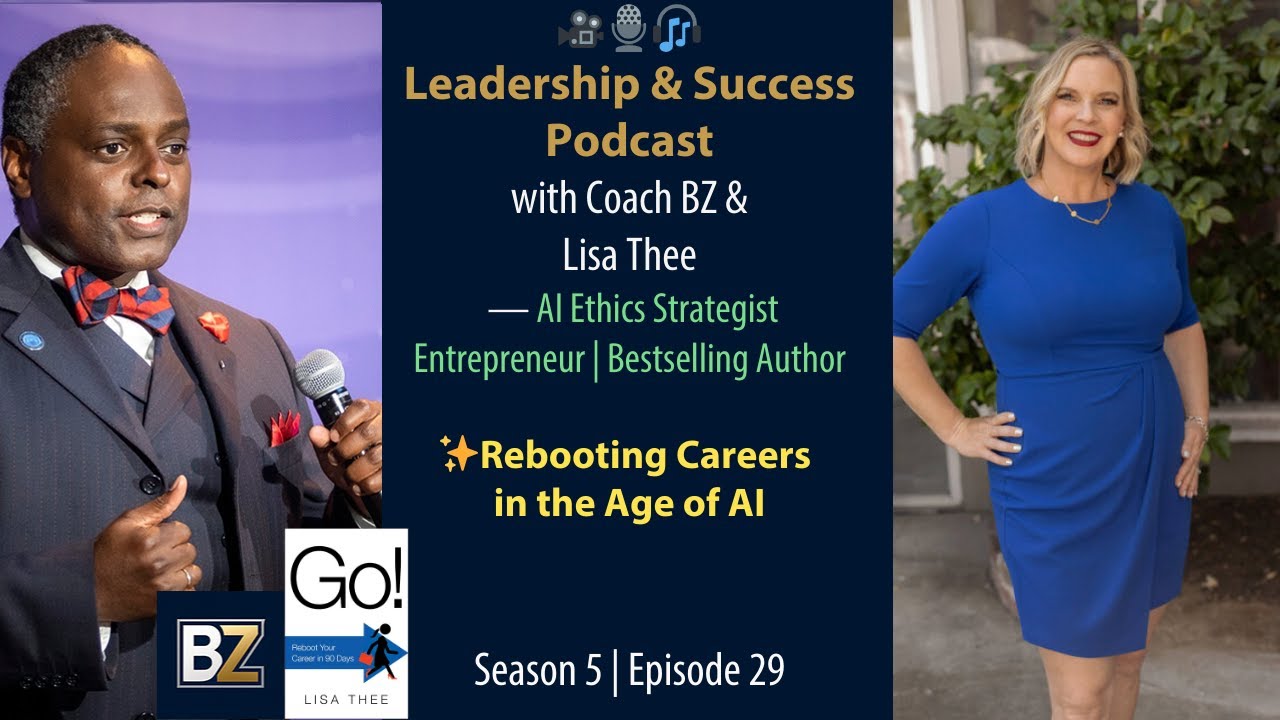
Lisa Di, an AI ethics leader who worked at Intel's AI-for-Good team, discusses how deep learning improved child-trafficking victim identification from 70% to 99% accuracy. She shares her career reinvention from Detroit auto plants to entrepreneurship in her 40s, her rare autoimmune disease, and her framework for burned-out professionals in her book Go Reboot Your Career in 90 Days.
Chapters
¡Hola!
Hi, I'm John Maxwell. When the top companies in the world are looking for trainers, speakers, and coaches, there's one name that stands above the rest, and that's Maxwell Leadership. Our certified team members have gotten proven results for companies all over the globe, and our reputation, I'm proud to say, is second to none. Some of our members have risen to the top of their profession, including the one you're going to meet today. I proudly introduce you to my friend, Bob Fabien Zinga.
Welcome to the Leadership and Success Podcast with your host, Coach BZ, where we help you lead with purpose and succeed with impact. If you're ready to grow into the kind of leader others want to follow, this podcast is for you. If you're determined to elevate your success and leave a lasting legacy, this podcast is for you. As my mentor, Dr. John C. Maxwell, reminds us, everything rises and falls on leadership. Our goal is simple: to inspire you, challenge you, and equip you with insights that can transform the trajectory of your leadership journey. Welcome aboard to another episode of the Leadership and Success Podcast with Coach BZ.
AI is everywhere. You can't flip through the channels, listen to a podcast, or come to a conference without hearing all about it.
First of First and foremost, I want to ground everyone.
Everybody talks about AI and everybody shakes their head like we all understand it, but even as somebody who's been doing it for years, either in corporate America, as a startup founder myself, or now advising multiple founders globally, I can't keep up with everything that's happening every day. AI is really having a transformational effect on societies. It does require people to really understand the that they're trying to solve. I chose to focus my area of expertise in anti-human trafficking. I was the founder of the AI for Good team at Intel Corporation, where I partnered with Google, Microsoft, the National Center for Missing and Exploited Children, and THORN to recover human trafficking victims by using artificial intelligence technology to find them faster. We're able to help go from a 70% accuracy level for identifying these victims to a 99% accuracy level. And what that allowed was that detectives were able to minimize the amount of time they spent scrolling through page after page after page looking for a specific child. I hope that gives you examples of how having a human in the loop has accelerated partnering with AI versus having the fear that it's going to take people's jobs. In fact, it's estimated by 2025 there will be 463 exabytes of data created every day. So by partnering with artificial intelligence, you can start to ingest and get the wisdom out of lots of information sources that would just be something that sat to the side that nobody knew how to take advantage of. As somebody with a rare disease myself, My hope is that we will see more diagnostic speed with AI. And the reason for that is for people like me that maybe have a disease that maybe a doctor will see once or twice in their lifetime, they're not going to necessarily have the experience beside it, beyond the textbook to recognize the clinical symptoms of what they're seeing in front of them. People with my disease tend to be men. They tend to go blind and they tend to have a certain number of markers in their blood work. So it took me 11 years to find a specialist that can help me to finally get the life-saving treatment I need to be on the stage today. So I'm really passionate about helping to accelerate this space. But just remember that we're all in this together. And if you embrace AI as a human-in-the-loop partner with you, you're going to go farther, faster, whether you're an investor, an entrepreneur, or an employee.
All right everyone, welcome to this special edition of the Leadership and Success Podcast. We have a very special guest waiting for us right now in the green room. Before I bring her on, as you know, we, as is customary, we want to start with our moment of gratitude. And before I do, please Let me know in the comments where are you joining us from, what city, what state, and since we've gone global now, which country. And also, what is one thing you are grateful for today? And of course, if you have a question for my guest, for Lisa, please type it in the comments and we will answer live. And I want to say hi, looks like Daniel is already here from Midland, Florida. Good to see you. Thank you, Daniel. So as you guys know, every day this month, I am so grateful for just Black History Month, right? Really all of the work that African Americans have done to really build this country from the times of slavery to today. So I am grateful. For that this entire month, and I definitely want to celebrate the achievement of Blacks here in America. All right, so before I bring in my guest, let me see if I can properly introduce her. So today we are going to be speaking to Lisa Di. She's a globally recognized AI ethics leader, tech for good entrepreneur, a professor, and the best-selling author of Go Reboot Your Career in 90 Days. Her work sits at the intersection of artificial intelligence, ethical leadership, career reinvention, and human impact. And she's helping leaders navigate disruption without losing their humanity. So in this live episode, I hope that we're gonna be exploring what it really means to lead when the rules are changing, technology is accelerating, And trust is on the line. So ladies and gentlemen, please help me welcome to the Leadership Success Podcast, Lisa Di. Good afternoon, Lisa. How are you doing today?
Hi everyone. What a lovely introduction. It lifted my spirits. Thank you so much.
Great. Just to get started, is there one thing you are grateful for today that you'd like to share?
Yeah, I think today I was grateful for some discretionary energy and time to reflect on how I wanted to show up for this podcast today in preparation for it. It really made me reflect on some of the work that I've really thought about in a while. And, you know, that happens to align with some times in my life where I truly got to experience the awe of working with a team of people who are mission-aligned technology forward and empowered to truly make a difference in the world. And I appreciate the opportunity to relive some of the feeling of what it feels like when you're really in your flow, because I'm just like everybody else and not all days look like that. Not all years look like that, in fact. And so I'm grateful that we have this chance to talk today.
Well, thank you so much. We are so glad and honored and privileged to have you here today. Is there maybe something about you that most people may not know when they first meet you?
Well, maybe what people wouldn't know about me when they first meet me is that, you know, I— there's nothing in my background that suggested that entrepreneurship was in my path. It's not something I even explored until my 40s. And it was never one of my goals, to be honest with you. But a mentor of mine who was really pivotal in my career development in corporate America put a question to me, a challenge to me. And he said, you know, based on this idea that you have of how you'd like to see this landscape, you know, changed over time and the impact that you want to have, how would you feel if you never stepped out and tried this as a business owner? If I'm at your funeral tomorrow and, you know, you're looking back, back that you never tried. And as somebody who's relatively risk-averse, to be honest with you, um, there was not— it was not a question for me. I knew it was okay if I didn't succeed, but I couldn't live with myself if I didn't try.
Wow. That is very, very insightful. I think most people watching us now, most people in the world, They have a lot of great ideas, but it's fear that paralyzes them. It's like they are afraid to fail. And what they don't understand is if they don't try, they will never know how successful they could be. You already know. Yeah.
You already lived your worst case scenario.
Scenario. Yeah. Wow. That is, man, we are starting off from the very beginning with quite a lot of powerful wisdom, Jen. Thank you so much for Sharing that and talking about kind of how you become who you are today. Every leader does have an origin story. What early life or career experiences most shaped your leadership philosophy?
Yeah, so I grew up in the Detroit metropolitan area. So like many people there, I cut my teeth in the automotive industry. And some of the lessons that I learned working in manufacturing there really still define today how I lead. And so what I learned in that union management environment with a lot of structure to who plays what roles is that when, as a leader, I saw managers lead from a union versus management rulebook, they ran at about 70% efficiency on the production line when things didn't go the way that they expected. Maybe a machine faulted out and needed a reset, or maybe somebody needed to get backfilled to go take a break for bio, what have you. But what I saw was people complied, but they didn't commit. But when I, I was stepping into my leadership, I, I really wanted to focus in on showing, um, integrity and treating people with dignity and respect. And the results of that were the same people with the same systems were able to run at 99% efficiency.
Wow.
That commitment and bringing completely different results. And so what that taught me is that most of performance is a human trust issue far before a technical one. And you can't policy your way to excellence. You have to earn it from showing up every day and leading from integrity.
Wow, that is so powerful. But there is one thing you say quite a lot and it's all over your website, you describe yourself as a rule breaker when it counts. I really love that. And one lens I want to put on this is also part of the reason why I do this show. I feel like this world was definitely, you know, let's be honest, created for men, especially white men, definitely not for women. But I kind of joke a lot in my house, of course I'm married to a woman, I have two daughters, So if it wasn't for our family dog, I would be the only male in my entire household. But really, part of the reason why I do this, I really want to put the spotlight on women and people of color because I feel like we are undersung and underrepresented and sometimes completely overseen for whatever reason. So knowing that, so you as a rule breaker when it comes— what rules did you have to break or rewrite to build your career.
Sure.
So I call myself that for exactly the reason that you alluded to in your introduction of your why of why you do this show. And so, you know, I learned early on that a lot of the systems that I needed to function in weren't designed to include me. So if I followed those rules perfectly, my contributions could be discounted before I even started. So I, when I stopped optimizing for approval and started optimizing for impact, that's when things shifted for me in my career. For me, rule breaking isn't about rebellion. It's about refusing to let legacy systems limit what's possible. And it's also about getting a seat at the table, but then having the courage to change the conversation once you're there. So that the system works better for everyone and what comes next, not only in those rooms, but also in the products and services that are available in the public marketplace, because, uh, talent is equally distributed. And if you're leaving out over 50% of the population and your product and service design, you're probably being left behind, especially in a world that's moving as fast as it is today.
Wow, that is really Incredible. Probably in my own life, my mother probably had the most impact throughout my entire life. But I like Amelia Earhart. She has a lot of great quotes I love, and every time I read them, she reminds me of my mom. But one thing she said was, "Women must try to do things as men have tried, and when they fail, sometimes we do, their failure must be but a challenge to others." I really like that a lot. Very, very inspiring. So Was there maybe a defining moment when you realized that technology could be used as a force for social good, not just business growth, especially the work you've done with law enforcement? It's just so inspiring.
Thank you. Yeah, I think there's a pretty big social media trend these days about going back a decade to 2016 and thinking about what you were doing back then. And I think that really is my defining moment in my career. And so that's when we started as a team at Intel looking at using deep learning to help identify currently missing children that are being trafficked in America. And this wasn't theoretical AI. This was real-world deployment. We were building tools that would be going live in partnership with AWS, Microsoft, and Thorn, and the National Center for Missing and Exploited Children. And the goal was to be able to help them to evolve tools that they already made public through a tool called Spotlight that Thorn administered, and still does, to integrate more image-based analytics into that tool versus just the text-based platform that it was in 2016. And so in, in that endeavor, we really wanted to help investigators to identify victims faster, be able to act sooner and coordinate more effectively. What we were able to deliver as a result of the work that we all participated in with modernizing the tech stack of Microsoft's facial recognition to perform as well as it did on middle-aged white male faces, which is primarily what it was trained on based on the amount of available labeled data out there. To perform at least sufficiently on the diverse female, teenage faces that were primarily the, the volume of what was being sorted through. And so we built something called using a nearest neighbor approach at the time. So instead of trying to just make a perfect match of, you know, this child is definitely this child, that's just different lighting, different makeup, different, uh, all those things, which wasn't very effective because we are typically using images from the National Center for Missing and Exploited Children who do all the Amber Alerts for the country that were dark and grainy and dated. Did. And we were comparing them with escort advertising photos, which tended to be well-lit and lots of makeup and different hairstyles and all the things. And so what nearest neighbor allowed us to do is instead of looking for perfect, we looked for the percentage of likelihood match. And so the detectives, instead of just aimlessly scrolling through page after page of escort ads, now had the ability to have them organized for them so that the most likely match right in the front top line for them. And so we were able to recapture all that dead time where you're just aimlessly looking, um, to be actionable time to be applying their value-added skill sets as detectives of being able to set up a meet, recover that child, build a case, and collaborate with prosecution to get that offender off the street. And the results were profound. What we found is in the first month that that technology went live with this collaboration across the industry, over 130 reported missing children were recovered that month alone. And that helped me recognize that technology could become a force for social good, not because of the model, but because of the outcomes. AI, when responsibly focused, designed, and deployed, can dramatically shorten the time between harm and rescue. Of vulnerable people. And that woke me up. And I could never go back to sleep and just earning a paycheck for the sake of supporting my family again.
That is so powerful. And one thing you mentioned, why is it so important to make sure that there is no bias in the data that we actually use to be training these AI algorithms? Why do you think that is so critical?
Because when we tried to use the donated technology at the time, on the use case that we were designing for, it was at 70% accuracy. So there were so many false positives that detectives— we would never put that in production. It would just frustrate the users of the tool too much. Too many wrong answers before you got to anything useful. What we were able to do by implementing that more modern approach than what was available in the original tool was to increase the accuracy level to 99%. And by doing that, we were able to get the results of actually finding these children who were primarily US citizens, products of our foster and child protective services systems, and get them back to families that were looking for them. They had people that wanted to— that wanted them and wanted them back. And So that's why I think that is important for people to understand. There are a zillion little problems like that, low-hanging fruit in almost any industry or national or public purpose, uh, whether you're in the public sector or the private, where you don't have to solve the entire issue. If you can do something that can have a big impact and relentlessly focus on solving that, you can you can make an impact that will echo through generations.
Wow, that is quite profound. And also to remind people, you do teach a class, Leadership in the Age of AI. We're going to be talking more about that at the University of Michigan. Sometimes I wonder really where you find time because you do so much. We're going to be talking about your book as well, and you also have a podcast. I mean, you are like all over the place. Do you have time to sleep? My goodness. It's incredible.
In fact, I have plenty of time to sleep because I do have a rare disease that was mentioned in the, the, the intro video. I was forced by my body situation and my doctors to find health. Burnout was a real thing. And you are seeing the results of 10 years of work that I've created over time. None of this happened in the last 2 years. This is all a culmination of bringing everything together. And the reason I'm really focused on doing that at this point is now that I'm past my management consulting days and my entrepreneurial CEO days, I really want to be a visible role model of that tech elder, so to speak, so that the next generations that are picking up the next step of this evolution especially in this really impactful season of how work is going to get done. With AI coming into everywhere, we're seeing transformation like we did back in the '80s when computers, personal computers came into the workplace. It's a huge sea change. And so I want to make sure that people that have that little idea in the back of their mind that's tucked back, that they barely say out loud to anyone because it seems like it's not part of their day job or, you know, they they wouldn't even know where to start, or maybe people would think that they weren't capable of doing it, um, that, that they get that, that momentum to, to at least start thinking about trying. Because I would have never believed you in a million years when we started this a decade ago where, where I would get to today. It sounds really shiny and perfect, but none of it was. And That's why I wrote the book. I wanted other people to see what it really feels like to do it when you're doing it, not in hindsight with shiny rose-colored glasses. And also to capture all the learnings that I had to pick up quickly to transfer from an 18-year career as an engineer in corporate America into the CEO of an AI software startup and how to make that happen, how we got the funds to do it, how we got an exit into a larger player in the market, and ultimately the impact that is the legacy that I feel, um, I came onto this earth to do.
Wow, that is so powerful, so inspiring, just your resilience and your story. Uh, thank you so much for, for being here. It's, it's just awesome. Wow. So let's talk— you already mentioned one of your mentors who pretty much challenged you to kind of get into entrepreneurship. Who were some early mentors, maybe others or leadership influence that kind of impacted your life and how did they kind of shape the leader you become today?
Yeah, so my most influential mentors, the first I mentioned is Greg Dashmaker. And Greg stepped in not only as my angel investor, my first angel investor, but also a board member for the company.. And he really helped me learn how to lead at scale, govern responsibly, and build something that can endure. The second person that really rose to the occasion in helping me to see what I was capable of, maybe beyond what I would have perceived myself, was Mohamedul Hassan. And they really helped me to bridge that gap between my experience in corporate America into entrepreneurship. But they didn't do that from the sidelines. They jumped off that cliff with me. So Hassan became a co-founder at Minerguard, bringing his deep technical expertise from leading global teams for AI for fraud detection and manufacturing at Apple, where he had helped the company recover over $150 million in fraudulent spends from things that he was able to identify in the manufacturing process. So having somebody that's already leading a team of 800 developers at a top-tier global tech company quit their day job after launching the iPhone X to come help you with your idea about how we can make kids safer online and in real life really gave me that moral clarity from work that we can all do something that we're really proud of.
That is so inspiring, man. Just living angels. Daniel has a question. He says, Lisa, as we architect these new AI AI-driven workforce benchmark, how do we ensure the human operating system, specifically ethics and honor, remain the primary substrate rather than an afterthought? I like this question.
Yeah, that's a great question. Um, can you repeat it one more time for me? I want to make sure I addressed it properly.
Basically, I think the gist of this question is, uh, as we architect this AI-driven work workforce, how do we make sure that ethics and honor remain primary substrate rather than just an afterthought? Because it seems to me like, especially in America— in Europe, I think we do it a little bit better than we do— but ethics is kind of in the back burner. We don't think much about it. We just want to go to AGI as quickly as we possibly can, regardless of the consequences. Even when 14-year-old boy in Florida commits suicide for having a amorous relationship with AI, we don't really give a care about that. It seems we don't care about privacy for, for sure. And, uh, how do we ensure that these things are actually built into the process, pretty much baked into AI as we develop it, and not just, uh, something we're gonna work on later?
Yeah, and I want to touch on a little bit of, um, some of the color you added in your question for the repeat, and that is that Uh, it is true in different regions of the country and the world, we have different perspectives on whether AI is a good thing or a bad thing.
Yes.
Um, whether it's help us or hurt us. Uh, from hosting the main stage of the World AI Festival in Cannes from 2021 to 2024, uh, what I learned from, uh, spending time with some of the, the global audiences of the, the key leaders from both academia and corporate America is we do look at it differently. And I, I do see a more, um, concern and risk-based approach out of Europe, but also America. I think there's a lot of people that maybe don't have the power to change what's happening but are concerned that this is going to be problematic for society, whereas you see a lot of, um, optimism and enthusiasm for how much it can improve things for the masses coming out of Europe— excuse me, Asia and the eastern regions of the globe. And the reason for that is when you, you know, think about it, they, they're not expecting privacy. That's already part of their regular experience that the government has control over what they can and can't see and, or their medical records or all of these things. And so we don't have the, the same barriers of what you'll lose. Really what they see it as is the way that they can get more to the masses in a more effective way. And I think they're, they're absolutely right. And so it all comes back to culture and what you value. But I think that, you know, in, in where we're going from the original question, which is how do we make sure that there's ethics involved in the decisions and the things we're making, you achieve what you measure. So I think that there are a lot of places where people are looking for levels of transparency and accountability through a governance model that is not really aligned with what the technology is capable of providing. AI does not work like traditional programming, and so it's very difficult to get the level of why it's making the recommendations in a way that humans can fully understand. Because most of it is math, it's statistics-based. It's looking at huge datasets and patterns and, and making the invisible visible, finding those pearls of wisdom in oceans of, of information. And so I think that it comes back to getting back in the basics, things like having KPIs that require you to look at the implications that it's having on vulnerable populations, for example, or looking at, you know, an oldie but goodie example is that AI is really not good or bad. It's really just trying to make predictions, especially generative AI, based on what's happened historically. And what's happened historically is primarily what's captured on the internet. That's where most of the training data came from. And we've all been on the internet. A lot of it's user-generated content, and that doesn't mean it's actually accurate or well-intentioned. So with that in mind, I think it's important to recognize that it's a great rough draft generator, but probably not a great final answer generator. There's definitely a role for humans in that. And so you need to be doing some of the basic things that we, we have done for a long time with data to make sure that we are having some oversight and some governance. And then last but not least, simple things like being transparent about how the data and the AI are being used, making sure that there are some ethical guardrails, not just return on investment, as AI is making recommendations that the humans are applying, making sure there is security with the data that's being trained and the data that's being produced, accountability. And then last but not least, you know, making these systems to amplify human judgment, not to just be a get-out-of-jail-free card to automation, because we're going to start having some unintended consequences that are probably not very tenable in that if we don't.
Thanks so much for sharing. You reminded me of what Peter Drucker— I guess they call him the godfather of modern management, right? What gets measured really gets managed. And that is so true. And also sometimes people overlook the impact of AI, or at least AI development on the environment as well. It's really amazing how much electricity and water it actually needs. It's crazy, but okay. Let's talk about your best-selling book, Go Reboot Your Career in 90 Days. Why did this book have to be written? What compelled you to bring this book to existence? Which problem were you trying to solve?
Uh, a lot of personal problems, to be honest with you. Uh, at the time that I started writing the book, I had been searching for an answer to my rare disease, uh, for 11 years, and the doctors had given up on me. Um, they couldn't come up with any reason beyond very simple things that wouldn't cause the amount of, um, symptoms that I was having. Uh, and I knew that if I didn't come with an answer, uh, I wasn't gonna be here to raise my kids. So I started writing this book, um, to document what I learned in my, my 30-year career of coming from a middle-class family in the suburbs of Michigan who didn't know anybody in Silicon Valley and had no connections. Um, I was raised by a social worker and a union assembly line worker, um, early in their careers. Uh, they did evolve into some other things later, but those were my foundational years. And so I wanted to make sure I helped make that my kids knew who I was and what my work was defined by and why we did it and what I learned along the way. Um, in the midst of doing that, um, Muhammad Hassan, my co-founder of my company, went back in-house to Apple at the time and was leading Apple University and there he had developed coursework on male allies for women technology leaders as something they were rolling out across the company. And he had traveled to 4 different geographies to start doing the training, the trainers on that. And so he really pushed me to invest in writing the book so he could license the content for Apple. And it was incredibly tragic in that the day after I signed the publishing contract for Fast Company, to this going from being something that I, I wrote in my nights and weekends and from bed when I was really sick to something I was going to put out in the world, that my co-founder unfortunately had a heart attack the next day and didn't make it. And so, wow, um, this book evolved. It became, uh, something that I wanted to make sure was out in the world so that his children, when they grew up, knew what a good man their father was.
Yes.
And, um, the impact that he's had because he was very modest and humble.
Wow, I'm really sorry to hear that. That must have been very difficult.
It was, it was heartbreaking. Who would have thought a, a guy from Bangladesh who grew up on a chicken farm and a girl from Detroit working on auto factories would come together and create a technology roadmap that is followed today to prevent the abuse of children at scale?
Wow. Is there something you could share about what you learned from that very difficult experience?
You know, I always leaned on him as my, um, ride-or-die person that, like, whenever anything at the van, whether it was personal, professional, whatnot, you know, we, we knew each other through our children. We met when our kids were in preschool together. And they're now high school age, to give you some context of how much time had passed. And, you know, I didn't— what I learned from him is this: confidence is quiet. I also learned that it's, it's not enough just to be successful for yourself. He did so much for lifting others up into opportunities, including some of his family members that were able to work at some pretty big companies and have awesome opportunities after he was the first from his country to be allowed to go to college in Canada at the, um, in Windsor there. He, he didn't just, uh, break through for himself. He brought everyone through that same hole and, and and really expanded with scale. And so, you know, when he decided to take on the— my vision of what we could do to make the world safer for kids online and in real life, he not only did that, but he continued to expand and scale by bringing that information back into Apple about how they can help other women leaders to step into their power. And also, he helped me to make sure that we wrote this book so that people that maybe don't work in these big companies can have access to the information. And at the end of the day, I thought we were creating a legacy for my funeral. But we— I know in my heart of hearts, deep in my soul, what we did together is the proudest legacy that he left beyond his children. And nobody— he wasn't sick a day in his life before he got COVID for the first time in 2022. And he survived his first 2 heart attacks from the complications he had from the infection, but unfortunately he didn't survive the third.
Thank you for sharing. What a legacy, a life well lived. I guess the Bible says, "Tomorrow is promised to no one," but the light that you are while you are on this earth and the impact you can have, it definitely Good. Wow. Because really, when I read your book, it really resonates, I think, with a lot of professionals who navigate disruption. And I guess in 2026, we live in the age of disruption right now. And thank you for sharing so many things that kind of triggered your own career reboot moment. But I feel like for some of the people listening right now, they may feel like they are stuck. But they are afraid of reinvention. So what mindset shift must happen before a career pivot becomes possible?
Yeah, I think a lot of it is, is the game of resilience. And so I think a lot of it is figuring out, you know, thinking through what do you need to strengthen Your Resilience and Persistence and The Age of Dysfunction. And so, you know, that, that helped. I strengthened those, those settings in myself by forcing me to really think about, you know, what is my purpose and how do I lead with clarity and discernment under pressure? And it wasn't an easy journey. I spent a few years of my career working in the darkest corners of the internet. I'm doing human trafficking content and child sexual abuse material. I got some pretty good PTSD that first-line and frontline workers tend to pick up from doing that work. And, you know, I am insanely proud of the contributions that we made to helping to accelerate the recovery of over a million children today from the worst day of their lives and making sure that we were more effective at identifying, um, the moments that matter for those kinds of situations. When we were able to help the National Center for Missing and Exploited Children go from a 30-day turnaround for their reports from tech companies to law enforcement down to 24 hours, um, by using a combination of AI and automation that we custom built alongside with Google and Palantir. Um, but, you know, I, I had to take a few months off and contemplate my toenails to even get my sense of self and safety back. I don't recommend anybody follows the path that I was on working from, you know, the hospital on morphine drips because I injured my back so badly. I was hospitalized for 3 days, but I'm still on stage at South by Southwest 2 weeks later. I got really mixed up in my sense of responsibility and not recognizing that I'm only human. And so I think, you know, for anybody that's worried about making changes, amen. I sit there with you. I worry about it too. But what I learned through resilience is it's really a lot less about titles and it's a lot more about being steadfast and courageous and having the ability to turn adversity into action. And that's why I wrote this book. Because when I hit that level of burnout where something had to give and I've had it more than once in my career, I'm Type A by, by temperament. It takes a lot of work for me to stay within the boundaries of what is the right thing for myself and my family. I needed a recipe. I didn't want to— I needed somebody to walk me through how do I go from complete burnout to transformation in a reasonable amount of time that it's even worth trying. And so that's why I really kept it to a 90-day process, because it's so hard to have the willpower to change, especially for something that scares you. And stepping out of my safe, secure corporate job into entrepreneurship, especially with a rare health condition and two children under the age of 3. That took a lot of faith that even if the branch breaks when I land on it, the bird, the bird can fly. The bird has faith its wings will work. I wasn't sure my wings would work, but I knew I had to try. And so I went looking for the book that would give me the answers of how to do this, and it didn't exist. So If I couldn't find it for myself when I needed it the most, I wanted to make sure that the people that came behind me could find it.
Wow, thank you so much for sharing. Of course, you also mentioned that you are a professor at the University of Michigan and you teach about AI ethics and leadership in the age of AI. If you were advising a board, let's say tomorrow, what are the first 3 governance guardrails they must implement what we think.
Okay, yeah, governance is such an interesting topic that I think will be evolving for the rest of time because as soon as you make a rule, then the technology changes. Yes. And then you have to start all over again with how you're going to govern what's happening today. So take everything with a, with a grain of salt. You can imagine these things will be changing as, as, um, the landscape changes. Uh, and so I think that, uh, what I would be encouraging them to focus on is really thinking through, um, the technical and reputational risks that they are introducing as a company by integrating AI solutions. Uh, I think they want to make sure that they have good, um, ways to measure and monitor the implications on the culture and maybe some of the, the implications of more marginalized groups, whether that be within their company or within their customer base to make sure that the AI decisions that are being made are transparent and fair and accountable. And if not, pulling those decisions back from AI and putting them back in the hands of humans. And then also aligning the technology with human values. Compliance and brand trust. Because at the end of the day, security, you know, ethics without security is vulnerable, and security without ethics can cause harm at scale. And so there are two inseparable sides of responsible AI leadership. You need both security and the ethics.
Everything. Wow. Because I know you're in Silicon Valley a couple of years back, when AI really took over, started to take over the world, they were saying AI is not going to replace your job, it is just going to make you more efficient. However, companies like Google, Meta, they started firing all of their engineers to have AI do everything. That might work perfectly, I guess, in a little lab, you know, a controlled environment, but when they went to production, they found out pretty quickly they needed those human beings back. So they started hiring them back really quickly. So in your opinion, How do we ensure that AI scales human potential but doesn't replace it?
Yeah, that's the million-dollar question now, isn't it?
Yeah.
And it takes me honestly back to the beginning days of my career, which was working in the auto industry in the '90s when automation was really coming in heavy and blue-collar workers were getting disrupted. As a result of some of these innovation steps and some of the fear that caused, but also some of the comfort that I had from having this union structure where they had kind of an umbrella thing overlooking for the employees. The challenge that got— I learned from that was watching if you only prioritize the people and you don't recognize the business forces that are all compressing, with globalization, the company goes belly up. So the answer can't be, you know, all one thing or the other. On the other side of that, we are going to see some pretty significant disruption, especially— it's going to transfer this time now from being the blue-collar workers to the white-collar workers.
Yes.
And it is a very uncomfortable time to have a skill set that feels like it could be automated. The days of, you know, set it and forget it on your career, getting one job and waiting for your time to fully be able to retire are over. I think that everybody is going to have to reskill and upskill on a regular basis. That's not going to— today is the slowest that will ever be. And so it's important for people to recognize that as machines are making more decisions, we need to shift as leaders from more of a command and control kind of element to a judgment and oversight element. And so, you know, leaders are there to guide AI outputs, ensure that there's that ethical alignment, and take responsibility for some of those unintended consequences. You know, the machines may be deciding the what, but the humans kind of all— it's going to be the most important. They're deciding the why and the how. So I think that, you know, success in this AI age is really around stewardship, adaptability, and applying human potential to your work. And that's why I created the course, so that not just the technology— if you want to go learn how to build AI tools, I am not your professor. My course is for the people that are in business roles maybe they've worked in things like supply chain for the majority of their career, finance or legal or healthcare. Name your, name your industry, name your vertical focus. Um, for those subject matter experts to learn how to bring in AI tools into how they do their work, to see the opportunity and decide whether they're going to, um, be an entrepreneur by bringing some great ideas for thinking as a business owner to how they get their jobs done today, or maybe stepping into their own leadership journey and creating their own company to take advantage of this wave. Because I do think that we are in a unique opportunity where people have a pretty low bar to enter starting their own companies. And the last mile problem is going to be something that is going to be going on for a very long time, which is, yes, we have this huge capacity, that uplift that just happened with generative AI, but it doesn't work well per industry or per vertical segment yet. And so people that can take all of that lived experience, what we used to think of as that almost tribal knowledge of the person that, you know, the apprenticeship model, right? Where the wise elder can have the younger employee shadow them and learn over time how they do the troubleshooting and how, what, what they need to know. You can be that for an AI agent and then build a business to scale that you can solve really big problems in your own industry. And why not step into your power and be the CEO and drive that ship?
Wow. That, that is fascinating. I guess it allows us to dream even bigger, you know, what's, what is possible out there. So What doesn't it?
We all have choices. You can focus on what you lost or you can focus on the opportunity ahead. And I think that that's why I want to go Reboot Your Career in 90 Days to Exist, because I'm the kind of person that, left to my own devices, focuses on what I lost. And sometimes you have to write the book so you get forced to eat your own dog food. And when I started writing that book back in 2021, I'll be honest with you, I thought for sure I was writing that book because I was going to have to retire and I wouldn't be able to keep up in the workforce with the impairments that I had as a result of autoimmune disease married with a COVID infection. And I have never been more wrong. Some of these AI tools that are just everyday today keeps me employable, keeps me on the edge of learning. And now I'm still— there's still a place for me. So I think it's really cool that, you know, the disabled community, for instance, has been marginalized from the workforce since the beginning of time. And they're— but they're the third largest users of technology, and they tend to be very tech-forward out of, out of, uh, necessity. So wouldn't it be cool if we saw, you know, this, this next era where we democratize opportunity for the people that are willing to be lifelong learners and, and take a chance?
Yes, yes. Wow. And I like that, especially in the military community too, we do have quite a lot of disabled, and I think more and more now we are changing our mind on how we look at it because they are definitely able to do so much more even though they may not be physically limited.
With accommodations, I can thrive is my mantra.
Yes.
And you know, it's sometimes it's hard to ask for special treatment, especially when you've never needed it before. Before, and I didn't need it before I was 45 years old, but I have something valuable to add to the world, and a little slight amount of accommodation keeps my voice relevant. And there are— I am, I'm, I'm not the exception, I'm the rule. There's a lot of people that can add value if we just create space for them.
That is just amazing. So, uh, What keeps you up at night from an AI risk perspective, whether it's technical, ethical, or even societal?
That is a deep and good question. Um, let me take a pause and just breathe on that. I think what keeps me up at night the most is, um, really just the AI risk perspective. It isn't about the rogue algorithms or the Terminator, uh, movie kind of images that keep me up at night. It's the human side of adoption. How do we make sure that people understand that this is truly a technology inflection point that is going to change the workforce and society permanently. There's no going back to another time.
Yes.
That's out of the bag. Um, and the impact on the how, when, and where we work is going to be dramatic and it's only going to get faster.
Hmm.
So as a parent of teenagers and for the next generation of technologists and business owners, I stay up at night trying to think about how do I steer them towards careers that can adapt. Complement AI, create value humans can't be replaced on, whether that be creative problem solving, ethical leadership, human-centered design, the roles that require things like judgment and empathy and complex systems thinking. I don't think that's going to go away. And so I want to make sure that we are bringing people along with this change so that we can all create a society we actually want to live in at the end of this grand experiment we call life.
Wow, that is really something. Now, you do teach the class, like I said, on leadership in the age of AI. What do you believe are leadership traits that will matter most in this AI-enabled future?
Yeah, I think, you know, leaders are going to need to treat digital trust as a strategic asset, not like a checkbox to not get in trouble with regulators. And so I think that's going to be important in terms of, you know, making sure they're prioritizing ethical decisions, not just return on investment. Making sure that security and accountability and oversight are in place and being transparent about how AI and data are being used, as well as designing those systems that amplify human judgment. I think, you know, trust is what's going to drive loyalty and talent and long-term value in an AI-driven workplace. Wow.
All right, so we have about 5 minutes left, so I'm going to get into the last segment of the show where I focus more on leadership and leadership lessons that you've learned that help you be as successful as you are today. What do you believe is the greatest lesson in life, in leadership in general, that you've learned so far?
Hmm, good question. I think that the biggest lesson that I've learned is even when you get to the top of the mountain, nothing stays the same forever. And so it's, it's great to pause and enjoy the moment when maybe some of your dreams come true. But leadership today, to me, success as a leader today feels very different to me than it did, you know, when I was 30 years old and it was about my, my income and where I've traveled and, you know, job titles and kind of going up that traditional success ladder that I think my parents maybe instilled in me from their, their experience coming up. And I think today leadership is showing up authentically, speaking truth to power, and living your values. It's about being a real example that we can contribute in our own way to heal, protect, and improve the world. And I think when you show up that way, you find people that truly engage in solving problems with you at a level of fidelity and commitment that is irreplaceable.
Wow. What do you think is the secret to your success overcoming the challenges from the rare disease, becoming a number one best-selling author? And a professor at University of Michigan, and then also what you've done with Tech for Good. I mean, think about it, you've affected the life of more than a million children. You've turned their very bad day into really a life of hope and purpose. I mean, that's God's work. If that's not God's work, I don't know what is. Why, why do you think you've been so successful and impactful?
I think it's because I took the time to slow down get back in my body, recognize what my values are, see how— collect some data about how I'm spending my time versus how that stacks up against those values, what skills I have, what, what are my natural talents, and mapping out a path that required a lot of persistence. I get a lot of nos before I get a yes. My life philosophy is failure is just the first part of a negotiation. No is the beginning of a negotiation. Excuse me, that's what I meant to say. And failure is the ticket to the path to success. You have to be comfortable failing. You have to be comfortable hearing no. You can't let it deter you when you know that you have a value or a vision for ethical innovation. That needs to be explored. And so I think that what makes me successful is that even when I'm scared, even when I'm down, even when I'm exhausted, I, instead of going to others, I ground myself back in the basics of, um, getting quiet time, taking walks with my dog and looking at the of the trees and the blues of the sky and remembering that the whole world doesn't revolve because I made it so. Um, and, you know, tapping into my own inner wisdom of what it's going to take to get it over the line, because, you know, when I can align my head and my heart and be back in my body and use that level of discernment to make decisions I already had the skills from things like engineering school or business or the things that we've cultivated over time of how we influence people to tell a compelling story when I believe it. The trick is getting to a place where you passionately believe in what you think needs to happen in the world that you know is your own calling and doing your best to make it happen. And I think that from my experience in leading in this in this industry, in this space, I, I've pulled a lot of people together where they are the leaders in their field. Maybe they're principal engineers, they're data scientists, they're doing all these really cool jobs, but they don't have a lot of mission or meaning in their work, and it's soul-draining. And so giving people a chance to participate with you, even when you're not fully sure it's going to work. I mean, it strengthened bonds with people that are way above my pay grade, um, because they finally had something they could show themselves in their heart and their caring through with their skill sets and their networks and all of those things. So I think, um, my final answer to your question on my success is persistence, people and possibility. And bringing those things together to make things better for marginalized women and children is my life's work. It's a continuation of my grandmother and grandfather's legacy of having to build their lives post-Holocaust after surviving concentration camps. Yes. And I learned from their lived experience that atrocities can— like, that can only happen when good people stand by and do nothing. And so I do believe that data is the way that we make the invisible visible and can take true action. And that's why leading in the age of AI was exciting and invigorating to me, because we can make real impact in the world.
Well, that is definitely worth Price of Admission, and this is a masterclass on leadership and progress. Thank you so much for sharing that. We are almost out of time. I was— yeah, I guess I need to bring this because there was a couple more questions I wanted to ask, but we are definitely out of time. So let me ask you this then. Thank you so much again for adding so much value to my audience. What can we do to add value back to you?
Oh, thank you. You know, first and foremost, the things that really energize and liven me up, and also I, I notice kind of spread that spark to others, is being present to be a lived role model of what responsible AI and ethical innovation can look like. And so opportunities to do keynote speaking for audiences is always something that I really appreciate because it, it really is a see it to be it world. I didn't have a lot of role models that were senior women leaders when I was coming up that had lives that I really wanted to emulate or replicate. And so I've been intentional on being a public figure this way for that reason. Frankly, I don't particularly like being a public figure. So, um, if you can help me to bring my message to more audiences, especially for audiences of people that have the authority and the power to change the trajectory of spends for the products and services we all will live with in the future. That's a great opportunity. I would love to get my book out there to more people so that I don't see them suffering the way that myself and my, my co— my cohort of Gen Xers I see a lot of right now we're doing, which is the workplace has changed and the rules are out the window. And how do we stay relevant? I want to make sure people feel empowered to step into this as opportunity. And last but not least, my request is that you pick a topic that you're passionate about. It doesn't need to be— mine's human trafficking. It doesn't need to be my topic. Maybe it's animals, maybe it's elder care, maybe it's the loneliness epidemic, maybe it's divisive, uh, you know, politics. Whatever is your topic, and spend some of your time looking at ways that you can apply your unique skill set to volunteer in that space to make positive change in the world, and ways you can take some of the opportunities into the workplace to help, um, make better decisions scale.
That is so powerful. Tell us about, um, Leading in the Age of AI. How can people sign up for your class?
Sure. Um, the Leading in the Age of AI certification course is being offered through the University of Michigan Engineering Department through their continuous education program. It does come with a digital certificate and CEU credits, uh, and is an 8-week self-driven course, um, that you can take online. So it's all virtually available content, and you can go to the website at University of Michigan to sign up and get inspired with the next click down of detail of how we really did these things. You can see the case studies, you can see, uh, the conversations, and, uh, by the end of it, you can have a capstone project of your own on how you want to bring AI back into your current workplace, or maybe step into your own power and a new company.
That is really powerful. And of course, everybody, don't forget to get a copy of the book Reboot Your Career in 90 Days. I think, I guess you wrote the book 2021, that's when you were finishing up, but it's so timely right now. I think people need to read it like yesterday. It's just amazing. Well, thank you. Thank you so much for coming here.
The ethics, it's timeless.
So, uh, evergreen. I first wrote it when I was writing for the Forbes magazine, every article you send, they want it to be evergreen. Doesn't matter when in time, they want whatever you're talking about still remain relevant. So that is so powerful. I have a lot more questions for you, but I am going to stop there. But before we end, is there a question that I should have asked you that I didn't get a chance to ask? Anything else you wanted to share today?
No, I think you did a beautiful job, and I really just appreciate the space to democratize the message, which is if you are leading a team, if you're leading yourself, if you're leading a family, we all have leadership responsibilities and the world is changing. So let's look for ways that we can bring about the change that we want to see in the world.
Yes. And I guess to end, I'd like to end with something that is positive and optimistic. A lot of challenges happening right now around the world in this age of AI. What is one thing you are optimistic about?
Out?
Um, I am optimistic that we are going to get to a day and age where we no longer tolerate, um, the cost of doing business is taking advantage of groups of people and, um, I pray that we get to a more just society where more people can thrive. And I think AI can be the tool to do that. Just the same way that the abuse of children has been happening for generations and thousands of years, we now have the tools to be able to identify it and intervene quicker and get better outcomes for these poor victims. I hope that that comes into more of a workplace mindset. Where a lot of people have put decades into developing their skill sets. I want to make sure that we can lift everyone as this change happens, not just the people that were already benefiting.
Thanks so much for helping us leave the show on a positive note. The last question I ask all of my guests, just one word that will represent our shared experience. In this podcast today? One word that comes to mind?
Uplifting.
Uplifting. Well, I am always so grateful. Thank you so much, Lisa. I really appreciate you being here and being our master teacher. We've learned so much from you. Really appreciate that.
I appreciate the opportunity to connect with your audience, and it's inspiring how much you're doing for the cybersecurity community. We are hand-in-hand colleagues on this trust and safety journey. So thank you very much.
Good. Thank you. All right, everybody. This is one for the book. Again, get a copy of her book, Go with Butcher Career in 90 Days. It's available everywhere books are sold. And also make sure to follow Lisa, lisabee.com, and of course on LinkedIn. And also AI class at University of Michigan. You're going to get AI certified as well. Which is really great. So tomorrow I'm going to have another wonderful conversation with an ADCR, and you don't want to miss it. It's going to be tomorrow morning, so I definitely look forward to it. He's a veteran lieutenant. His name, he goes by Sree, but it's Andrew Sridhar. He's going to be here tomorrow. He is now a tech leader and also an executive coach, so you absolutely want to be here. That's going to be tomorrow morning. We're gonna be talking with Lieutenant Andrew Sreedhar, US Navy SEAL veteran. He's an elite executive architect, a coach, a speaker, a warrior poet, and we're gonna be talking about strength, reflection, and execution at the SEAL Elite level. You don't want to miss it, it's going to be a lot of fun. Okay, and also, I didn't have a chance to do it today because I am at the conference in Atlanta, but in probably about 30 minutes, I am planning to continue our study on the book of Proverbs. Today is February 10th, so we're gonna do Proverbs chapter 10. This is not a religious study, it's just about ancient wisdom and the leadership principles from the book of Proverbs, which I believe are very much still relevant today in 2026. And tomorrow, after I talk to Lieutenant Sridhar, I'm gonna do chapter 11. Okay, that is all I have for today. I want to see if there is one more comment from the audience. For founders building a legacy, what is the most critical governance guardrail we should implement on day one? Okay, thank you for asking the question. Maybe I'm I'm gonna answer that when we do in about a month or so, I'm gonna add the AI recap of the conversation I had with Lisa. I'm gonna make sure we answer that question then. Okay, until tomorrow, have a very good rest of your day and thanks so much for watching. Bye for now.
Thank you for tuning in to the Leadership and Success Podcast with your host, Coach BZ. If today's episode added value to your leadership journey, be sure to subscribe, share, and join us again for more wisdom nuggets on how to lead better and achieve greater success. Remember, leadership is the most critical skill of our time. The world will always need leaders to inspire others, drive innovation, and execute meaningful strategy. So why not count yourself among the bold leaders shaping the 21st century? Until next time, stay inspired, stay committed, and keep leading with excellence.
More from Bob

S250:E4🎙️LIVE 🇺🇸America 250: President Barack Obama Leadership, Service, and the Power of Hope






S5:E157🎙️ LIVE with CMD CMSgt Dennis L. Fritz, USAF (Ret.)(Multi Tracks Audio)



S5:E156🎙️ LIVE 🇪🇸 Leadership Lessons from the FIFA World Cup 2026 Champions (Multi Tracks Audio)

S250:E3🎙️ LIVE Leadership Lessons from America’s First Documented Family of African Descent 🇺🇸📖