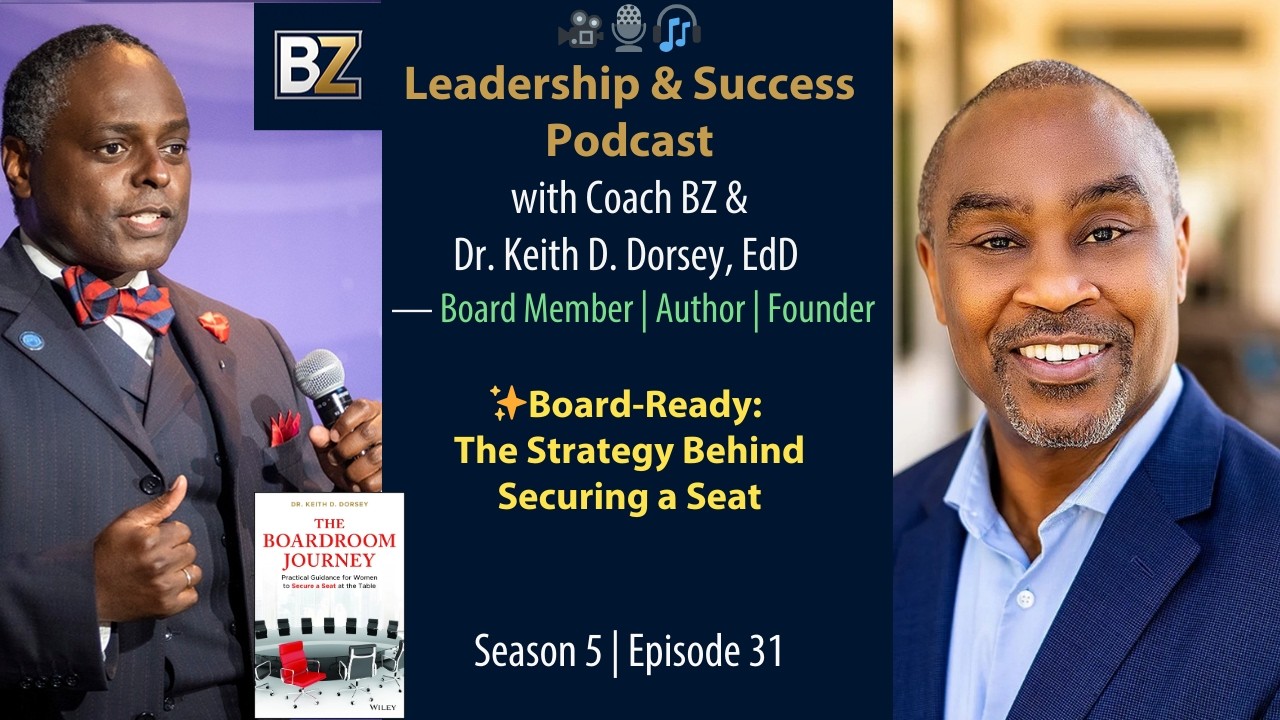
Dr. Keith D. Dorsey, a board member and former military officer, explains his Five Capital Framework for director value and how to land a board seat through networking and personal branding. He defines critical mass as three people or 30% representation of women and people of color, and argues that courage is essential for boardroom effectiveness.
Chapters
Hi, I'm John Maxwell. When the top companies in the world are looking for trainers, speakers, and coaches, there's one name that stands above the rest, and that's Maxwell Leadership. Our certified team members have gotten proven results for companies all over the globe, and our reputation, I'm proud to say, is second to none. Some of our members have risen to the top of their profession, including the one you're going to meet today. I proudly introduce you to my friend Bob Fabien Zinga.
Welcome to the Leadership Success Podcast with your host, Coach BZ, where we help you lead with purpose and succeed with impact. If you're ready to grow into the kind of leader others want to follow, this podcast is for you. If you're determined to elevate your success and leave a lasting legacy, this podcast is for you. As my mentor, Dr. John C. Maxwell reminds us, everything rises and falls on leadership. Our goal is simple: to inspire you, challenge you, and equip you with insights that can transform the trajectory of your leadership journey. Welcome aboard to another episode of the Leadership and Success Podcast with Coach BZ.
My name is Keith Dorsey, excuse me, and I truly appreciate being a part of this program. I feel blessed and honored honor to be associated with this first cohort as well. A little bit about myself. I currently serve on one corporate board and one university board. I'm a global business executive with expertise in sales leadership and growth strategies. I spent 30 years in corporate America helping organizations experience consistent double-digit growth. I specialize in uncovering root causes as well as having and ability to successfully attract, develop, coach, and retain key talent. My superpowers are my analytical and leadership skills. I help businesses aggressively grow their bottom line and shareholder value during significant periods of change, including mergers, acquisitions, divestitures, turnarounds, and startups. And over the past 5 years, I've been able to effectively transfer to the boardroom My passion for learning, inquisitive nature, strong listening skills, and my ability to build collegial relationship with people.
All right, that was a short reel from our guest today, Dr. Keith Dorsey. I will be introducing him in just a moment. First, our moment of gratitude. So for those following the show, as you know, every single day this month, I am so grateful for Black History Month because Black History Month is American history. So I really would like to spend the entire month, every day of this month, celebrating on LinkedIn and my social network, the contribution of Black Americans, because African Americans have built this country and they have really contributed so much, right, to what has now become America, the most powerful country in the world. And I wanna make sure we highlight and celebrate that. So let me see if I can properly introduce our, guest today. Today I am really privileged and honored. It is the third member of the BCBR here in Santa Clara, California that I really have the privilege to interview. I'm just going to provide a few of the credentials of my guests. So Dr. Dorsey is the NACD directorship certified and recognized as an honoree of the 2023 NACD Directorship 100, if you can believe that. He's been mentoring aspiring directors for the Executive Leadership Council, active board service, and decades of experience as an executive leader, corporate advisor, and governance expert focused on leadership, diversity, and strategic growth. He's also a member, mentor, advisor, and sponsor and ally with board readiness organizations such as the Executive Leadership Council Black Corporate Board Readiness Program. And he is part of cohort 1, so the OG. I was, uh, Court Number 6, part of the National Association of Corporate Directors and Private Directors Association, 50/50 Women on Board and Women Corporate Directors, and many, many more. Of course, I said he's a doctor, he has a doctorate in education, organizational change, and leadership with a focus on corporate governance and boardroom composition. So really, we are gonna be speaking to a legend today, I believe, because I think this discussion is very important because in today's leadership landscape, Securing a corporate board seat is not about luck. Well, it's about strategy, preparation, execution, and capital. I'm gonna be talking about his bestselling book, uh, also during this conversation. And I believe very, very few people understand that better than Dr. Keith Dorsey. So he's a board member, like I say, NACD directorship certified governance expert, author of The Boardroom Journey: Practical Guidance for Women to Secure a Seat at the Table. But whatever he's going to teach us about women is going to apply to men as well. So Dr. Dossé is the founder of Boardroom Journey and a senior advisor in CEO and board services with over 25 years of experience in corporate leadership and active board service across private, municipal, university, and nonprofit sector. He equips executives with a framework needed to earn and excel in board role. Man, is there anything else we can say about him? So ladies and gentlemen, please help me welcome to the Leadership Success Podcast, Dr. Dossé.
Seen that video of me. It's been a good 5 years. Wow, how did you find that?
We have a pretty good research team. If anything is on YouTube or social media, we are going to find it. Such a great, great honor to talk to you. Sometimes I refer to you as my big brother from another mother. Definitely a trailblazer We are standing on your shoulder, and thank you so much for everything you do for diversity and for really advancing corporate board governance, especially in the Black community. So what a great honor and privilege to speak to you, Dr. Dorsey.
Thank you, Bizzy. It's great to be here. I'm looking forward to our conversation.
Fantastic. So maybe to get started, what is one thing you are grateful for today?
I'm grateful just for being here. I'm grateful for this opportunity to interact with you and your members. It's a beautiful thing.
Thank you so much. And we have an active member of my audience, Daniel Young, is just saying hi and great to see Dr. Dorsey today. So people are excited. Of course, if you have questions, please type them in the comments and also let us know where you are joining us from, what city, state. And since we've gone global now, which country as well, if you're outside of the US. So thank you so much for watching. So, Dr. Dorsey, is there maybe something about you that most people may not know when they first meet you? Anything you're willing to share?
You know, just a quick intro there. I have 3 sons, raised a niece and a nephew, and I'm married. We have 7 grandchildren ranging between 4 and almost 20. So I will say many people don't know that about us.
Yes, man, what a blessing that is. Wow. Yeah, you must have been married when you were a 5 or 6-year-old.
Wow.
That's really amazing. My firstborn, she's 24 now. She just got her bachelor's degree last year. I'm like, I don't want to be a grandfather until she's about 50 or something.
There you go.
I'm with you. But it's nothing like it, let me tell you.
So Dr. Doshi, you have led at Fortune 500 scale and now operate in boardrooms globally. What was the earliest leadership lesson you learned that still shapes how you think? About governance today?
You know, it's interesting that you had an advertisement about Maxwell early on. You know, one of the early lessons that I learned was that people don't care how much you know, they know how much you care.
Yes.
And oftentimes, and whether it's in the military or corporation, we have an objective that we have to go after. And some leaders really just want to focus on just that objective. I believe when you focus on understanding an individual that reports to you their personal motivations, as well as their professional aspirations, and you begin to help them in both of those areas, they will do anything for you as well. And wow, goes right back to people don't care how much you know, till they know how much you care. So every one-on-one that I have with the individual, the first 5 to 15 minutes is really about them. How are you doing? And if they give me a trite response, I'll ask the same question again. No. How are you doing?
Yes.
Then we dive into their family, whatever. And we'll work our way into business. Wow.
That is so insightful. I really wish my first boss was just like you, because I found that, especially in Silicon Valley, Many people, they would ask you, how are you doing? How was your weekend? But they don't care about the answer. They want to just go right back to work. Yeah, it's really rare to see people who truly, truly care. And I think bosses and friends like that, you would be loyal to them until the end because it is so rare to see. Now, one thing I didn't know until I did a little bit of research in the background is just like me, you are a veteran as well, a US Air Force vet. How did that come about? Why did you join the Air Force? What was your journey into the military?
It's interesting, BZ. I, as a very, very young kid, there were two things I wanted to do. I wanted to go to military school, or I wanted to study martial arts with the monks in Asia. And I started the martial arts when I was 6. And I've been in the martial arts since that age. But probably around the age of—
Do you have any black belt now?
I do. I do. And, and I remember around the ages of 8 or so, 8, 9, I would bug my mom when I would get the Boys' Life magazine to send me to one of these 4 or 5 military schools.
Wow.
Or send me really, because Kung Fu, the show Kung Fu was on, David Sterling, and I just wanted to go study with the monks.
Wow.
From that early age, I knew And before my senior year of high school, the summer before my senior year of high school, I enlisted in the Air Force. So I started my last year of high school. I knew what day I was going to basic training, which was 6 weeks after I graduated from high school.
Wow. That's amazing.
It's just something I've always wanted to do. So I've been involved in different things that require a tremendous amount of discipline, whether that was the military.
Wow.
My whole life.
That, that is really, really fascinating. So how did the martial art and military discipline shape your philosophy on execution and getting stuff done today?
You know, it really— because when you think about the military and the martial arts, it's about overcoming obstacles that are in front of you. Life's gonna put obstacles in front of you. And the saying there, life is 10% what happens to you, 90% how you react. That 10% is going to happen regardless. It's just you have a choice as to what you will do. And that's the 90% with, you know, the 10% that was put in front of you. And when it comes to discipline, those two areas that have been a part of my life, like I said, since the age of 6, taught me how to go over, under, around, through any obstacle, find a way, because that part I control. God has fun with me too, a bit, because God will put obstacles in front of you at times, because he doesn't want you to go that direction. My gift is to find ways through obstacles. And so later in life, I had to learn to get— allow myself to get to a a silent place, a calm place to really listen and, and try to figure out, is this an obstacle that I should overcome? Or should I back up, do a 180, and then go another direction? So that's what I'm still working on. But so your gifts and your strengths can become a weakness when overused. And my gift was to plow through any obstacle that was in front of me. Whether I should have gone that direction.
Yes.
Wow.
That is really something. And again, on this show, maybe because of my military background, I really love to honor the military service of anyone I get the privilege of speaking to. Even if you've only served in one of the branches of military for just one day, in my mind, you are an American hero because it's less than, what, 2%, 4% of people in America right now who volunteer to join the military. And I believe our military really makes our country great. And you learn so much about discipline and leadership once, once you are in service, whether you are junior enlisted or a senior officer, it doesn't matter. It is really a great privilege. But I couldn't find a picture of you in uniform. If I did, I would have definitely put the spotlight on it. But it's definitely a great, great honor to speak to another veteran, sir. Thank you for your service. This is—
wow.
So when did you then first realize that the boardroom wasn't just a destination but also a strategic responsibility?
You know, for me, it was a bit of a serendipitous journey. You know, in my 20s and 30s, I couldn't even spell the word board. Fortunately, I developed in a serendipitous way the human capital that boards would be interested in. Yeah, that's why I wrote the book, The Boardroom Journey, is to help more executives and senior-level government officials to do the things throughout their career to be best prepared for board service, because mine was more a serendipitous journey. After I completed my doctorate— not my doctorate, my MBA at Pepperdine University, I was in what they call a President and Key Executive MBA program. It's like executive MBA on steroids. The average age of the students in my cohort of 14 was 45.
Wow.
Because we were all senior executives or presidents and key executives in our own companies. And we decided for oftentimes, you know, just oftentimes just reasons to fill our needs, you know, Maslow's hierarchy of needs, self-actualization, to go back to school to be even better leaders at our company.
Yes.
And it was after I completed that President and Key Executive MBA program at Pepperdine was when they reached out to me and said, Keith, we loved your leadership throughout that program. We would like to put two things in front of you. One, would you consider being an adjunct professor in this program as a class advisor moving forward with the cohort? And two, would you consider joining our Pepperdine University Grazie a Dio Business School board. And I said, what is this board you speak of? And at that particular point, I started to learn more about governance. I joined their board.
Wow.
And I decided at that particular point that that was something I wanted to have in my next chapter.
Yes.
And do more board work. And since then, I've served on a total of 6 boards. I'm on 5 active boards now, and 2 private company, SaaS companies. Yes, boards, one municipality where I chaired their financial advisory commission for the city that I live in. And, and, and I also serve on the Pepperdine board, and then one private— I'm sorry, nonprofit board.
Wow.
Pacific Crest Trail Association, which is the 2,600 a 50-mile trail that goes from Mexico to Canada through all of our states.
That is really awesome. I definitely want to follow up on your boat journey, but first, you do have a lot of education. You are highly, highly educated. Why is education so important to you? You know, like you say, you have an MBA from Pepperdine University and then the education doctorate organizational leadership. Why, why is education so crucial, you believe, to success in life?
Education is something that no one can take away from you, you know. That's something. And I believe in continuous learning, continuous improvement, and there is no finish line. And so I believe we should, whether it's going for a formal degree or certification or just the having the mindset that I want to read 2 how-to books a month.
Hmm.
Because life is dynamic, business is dynamic. And if we stop learning, life will pass us by. There isn't a finish line. And no one can ever take that away. I don't care how much you're disliked or whatever the case or a target or whatever. Yeah, education is there. For us to consume and continue to improve. So that's why it's important to me, BZ. And to be quite honest, you know, that's— I didn't get my formal degrees until, you know, much later in life. I went right into the military from high school. But I immediately started taking college classes while I was in the Air Force. It was important to me. But nevertheless, there's always a time. There's— it's never too late.
Yes. Yes. Well, that is really, really important. And I know I have a significant portion of people who listen to this podcast, who follow me, who are in the military. And it's really amazing how many education benefits you get, Montgomery GI Bill and TA and a whole bunch of benefits. But sometimes those sailors, soldiers, service members, they just don't take advantage of it because really the military would be willing to pay for your degrees. Like for me, they pretty much paid for two master's degrees, which is pretty amazing. So you absolutely have to take advantage of that.
My books used to cost more than my classes.
Wow, that's incredible. But talking about your journey, there are many people who are listening right now. They are an executive, they are an operator, but they just not know how to kind of transition from being an executive to becoming a governance leader. What did you have to unlearn throughout your journey for this transition?
You know, a lot of people think being an exceptional board member or exceptional executive will make you an exceptional board member, and that's not necessarily the case. It's often a prerequisite but you do have to shift your mindset. And, you know, as an executive, you have a team of people out there that you're leading to actually get the job done. Well, as a board member, you have three remits, you know, basically, you have the management side of being a board member, and that's the hiring and firing of the CEOs. That's, you know, looking at the compensation of the executives, that's reviewing the strategy, You know, so that's the management side. And then you have the advisory side, where you're bringing your human capital to the board and helping them, you're asking questions to help them see around the corner, walk the mile oftentimes in their shoes. And so you could help take them from looking at a situation like this to something much more broader. And that's the advisory side via the questions that you actually ask and the advice that you actually give when asked. Then you have the oversight side. And, and the executive doesn't always have all those things. And executive is actually diving into the nitty-gritty, they're paid to get the job done. A governance professional is paid to ask the right questions. Because once the right questions are asked, often change ensues. But you have a, you have a team of executives out there who are paid to do the job. And oftentimes, unfortunately, board members can get it wrong and think their job is to also lead and do as an executive for that company. And that's not our job. Our job is around management, advisory, and oversight, but management to the tune of asking the right questions and bringing on the right CEO so that he or she can lead that company. You know, many of the board readiness groups say, fingers out, noses in. Yes, noses in, fingers out, or heads in, hands out. And that's a mindset shift that you have to essentially make to be an effective board member versus an executive.
That is, uh, so, so powerful. So let's get into your book for a little bit. Even in the introduction, I said, right, uh, something that you, you say quite, quite a lot, which is, um, uh, securing a board seat is not luck but a strategic journey.
Yes.
So what are executives getting wrong about how boards actually select directors, you think?
You know, I touched on a little bit, Bizzy, that Oftentimes, executives think just your entry into the boardroom is to be an outstanding executive. And that's table stakes. Your competitors trying to get on the board, you know, the people who are also— the other people trying to get on the board are also exceptional. That's, you know, that's just a check the box. You have to be able to articulate the value that you will bring to that board. And only way you're really going to be able to articulate that value is to spend time.
Yes.
Reflecting on what makes you, you.
Yes.
When you win, these are the reasons why I win. I am successful because of these reasons. My strengths are X, Y, and Z. My secret sauce is this. My superpower is that. And to truly understand your strengths is important. And many people don't reflect enough on their strengths. And Gallup puts out, you know, they have the book Strength Finders and the assessment that goes with that.
Yeah.
And it measures 34 different characteristics. And, and the premise behind that book Strength Finders is is, if you focus on your top 5 strengths, and make certain that whatever things you get involved in are really utilizing those top 5 strengths, you don't have— it doesn't take as much energy to get stuff done. When you are focused around those top 5 strengths versus your bottom 5 strengths, number 29 through 34, it doesn't mean you can't do it. Yes, you can do them. It just takes more energy to do them. And you don't understand the difference between your top 5 strengths and your bottom 5 strengths, and how your energy is impacted when you do those things. It's not until you truly understand how to utilize your top 5 and how to surround yourself with things that your top 5 truly affect.
Mm-hmm.
Not until you understand that— or the best way to say it, once you understand that, you can find your vocation, you can find the right things. And so I ask board members to truly— and aspiring board members and executives to truly understand where they show up, how they show up, and what their 5 Strengths are, and then seek boards that are— that will maximize your strengths. And understanding the value you bring, you then are able to articulate in an interview your, your best path and, and what you can actually do to help that board.
Yes.
And executive doesn't do those things, they show up at the interview because on paper, it looks like they can do it.
Yes.
But the way that they're presenting themselves throughout the interview may not be as exciting and passionate as the person who found their sweet spot.
Yes.
Understands their secret sauce, who can articulate their values via their board readiness story and different things like that. And that becomes the big differentiator between the person who was selected and the person who wasn't, when they both looked exceptional in writing, and they both really can do the job. But I have to choose one. Yes, I want to choose the one that I vibe with more, who has— who is more effervescent, who is more passionate, and understands exactly how they fit because they connected the dots for me, the interviewer, versus just showing up and throwing up all the great things that they have done in their past and expecting me, the interviewer, to connect the dots for them.
Yes. Wow. That is really, really key. I think this is worth the price of admission right there. Wow. So what is the difference between being board interested and truly being board ready? And I know the program we both went to, Black Corporate Board Readiness, they really focus onboard readiness. Of course, you've had involvement with NEC as well, and you really have an outstanding background and experience with board governance, both in profit and nonprofit world. But what, what do you think is the real difference between just being interested and being board ready?
You know, being interested is oftentimes about saying that this is the next step for me. And I will often, you know, as a search professional, I would ask questions when someone says, Keith, I want to be on a paid board, is what they often say. And I said, tell me more. Well, I want to be on a private or public board, preferably a public board. Well, tell me why. And what type of board? And they will say, Keith, I don't care. As long as they're paying me, I don't care. And, and that, you know, someone that's interested in being on a board because it feels like the natural next step. Being board ready is understanding the value that you bring, understanding your why, why do I want to be on a board, and being able not only to understand it, but to articulate why I would like to be on the board. And these are the reasons Why? And these are the— and this is the value that I will bring to a board.
Yes.
Because of that, that's being board ready and, and understanding what type of board it makes sense for me to be on. And I'll give you an example there, BZ. When you think about those 3 areas that I mentioned before that every board member need— will focus on as a, you know, as a board member, every individual will focus on. That's management, advisory, and oversight. Yes. Well, many different boards at many different business cycles, life cycles will have a different mix of the management, advisory, and oversight that they expect their board members to have. And so if you're with a VC startup, founder-led organization, 80% of your time on that board is going to be around advisory.
Yeah.
Let's just say for simple math, 10% is going to be around management and 10% is going to be on oversight. Versus if you're on a large-cap public board, 85% of your time is going to be around oversight or governance.
Yes.
And the rest is going to be around that advisory and, and management side of things. Well, the catch here is you have to know what makes you tick. You have to know what brings you joy. And if advisory brings you joy, but your ego says, I want to be on a large-cap public company board because I want to tell everyone that I am on that private 50 or Fortune 50 board, for ego reasons, that's not a good fit for them. And it's not a good fit for you. And that's what I would say, you know, and how to respond to your question.
Wow.
So our audience is pretty active. We have, uh, Solomon who's saying, uh, so I was saying, uh, Solomon is saying, I love the insight, uh, articulate your value of what makes you you. That is so true. So, uh, for those watching, again, let us know where you are coming from, uh, what you are grateful for, and if you have a question for to Darcy and type it in the comment. Now, for some of the people who are watching now, because I am in the cybersecurity field, so I'm gonna use that as an example. How should the senior cybersecurity executive, for example, reposition their experience, right, into board-level value instead of just operational credibility like they are so used to doing?
It's a great question, Bizzy. And you know, for so long, the entry onto a corporate board you really came from two areas. You were either a former or active CEO, or you were a former or active CFO. And that, you know, those two titles were the two titles that got you on, that secured a board, helped you secure a board seat. Well, you know, now boards are looking at functional experience, and that functional experience can be around cyber, AI, talent, general counsel, you know, risk mitigation, supply chain. So when you begin to think about those areas and the titles that go along with those areas, like Chief Procurement Officer, CTO, CIO, CSO, Chief Security Officer, CHRO, Chief Human Resource Officer, When you begin to think about that functional experience, and more specifically, what you were talking about, cybersecurity officer, in that case, you— the best way in now is to be able to articulate what you do in your functional area of expertise, whether that's 1, 2, or 3 areas. But then, and I call that being I-shaped, you can dive deep You can go a mile deep into your functional experience. And that's an area that your board is seeking so that the second, third, and fourth level questions can be asked of the C-suite during the board meetings. And there's someone on the board that will understand what the C-suite is actually saying.
Yeah.
And so to be able to challenge thought processes and understand the answers that they're getting. Boards are no longer interested in just someone that can go deep in one area, and then practically fall asleep during all the other conversations that the board is actually involved in. Don't want to be that person that when they say something about cyber, you wake up. Yeah. Yes, I'm about cyber. Okay, I'm in. And then you go back to sleep during the rest of the conversations. That's not going to work.. And so we are challenging people, active board members today and aspiring board members for tomorrow, to be more T-shaped and not I-shaped. I-shaped is where you can go deep in your area of expertise. T-shaped is where you can not only go deep in your area of expertise, but the T is you can go an inch deep and a mile wide. Yes, many other board-related topics. Now you're going to add value in many other areas. Yes, that are germane to corporate board service. And you're going to ask different questions than the person that can go deep in another functional area. You're, as a T-shaped individual that understands enough to be dangerous, will ask questions that a person who can go deep will say, huh, you asked that question, because I've never heard someone ask that question before. And that's how you widen the aperture with diversity of thought by surrounding yourself with T-shaped individuals as opposed to I-shaped. So my advice to a cybersecurity expert is throughout their career, make certain that they are developing from a director capital standpoint, other areas, not so much expertise, but to be bilingual in other areas so that you can understand the conversation and contribute to the conversation, if not by any other way.
Yes.
I think thought-provoking questions.
Well, I'm glad you mentioned the director capital because you talk a lot about the Five Capital Framework, one being director, one being cultural commitment. So there are— maybe you can give us just a brief overview of the Five Capital Framework, but also, uh, maybe walk us through which capital you believe do high-performing executives most commonly underestimate.
Oh, okay. Well, the two capitals that whenever you're talking with someone about a board role or you're talking with a board and what are they seeking, the two capitals you hear most often about is human capital. And human capital is really taking It's the sum of all your education, your expertise.
Yes.
That you've had throughout your career. And, and that's the human capital that the board will be interested in. I talked about your functional expertise. You know, a board will do a skills matrix that might have 12 to 14 different skill sets, and they will give it to every board member once a year. And they want to know how out of those 14 attributes or skill sets. How many of those do you possess for each board member? And that's really thinking about your human capital and also your competencies that you bring to the table. Are you collegial? Are you, you know, what kind of— what's your EQ? And different things like that. So that's human capital. Then you have social capital. Social capital is really around your network. That network is the network that you can use to to actually get on boards and to be seen and known. And that network is something that boards are interested in because you can help that company via your social capital, your network. It may— whether it's around M&A activity, funding activities, different things like that, they will lean on your human capital to find the next board member, to find the next CEO. So, um, social capital. I mean, so they will lean on your social capital for those reasons. And so you often hear about those two capitals. The next one I will mention that you don't hear much about is, is that director capital. Director capital looks a lot like human capital, but director capital is forcing you to analyze what board members typically, what characteristics and skill sets and competencies do board members in the industries that you're interested than typically have. And then how does your, your experience line up with the board members on the type of boards that you would like to go on? Where do you have a redundancy of experience and where do you have gaps? And it's in the area of gaps from a director capital standpoint that I would expect someone that wants to fine-tune their director capital if they know that a typical board member on, in, on the, you know, with the companies that you would like to serve on, their type of boards, those, um, the director capital or their experience, if you have gaps, then you need to actually do the things you need to do to fill those gaps. That's what director capital is all about. Yeah. One is cultural capital. We don't talk much about cultural capital, but that's really looking at your, your experiences throughout your life. I'm talking from grammar school, middle school, high school, college, your favorite auntie or uncle, your parents, these people who you looked up to, you admire. What type of things did you learn from them? That you innately do today. Think about the obstacles that you faced as a very young child and a young adult and how you overcame those obstacles. When you can reflect and figure out the things you innately did, or things that you intentionally do, and you can reflect and understand your cultural capital during other times of stress and other obstacles that you will face throughout your executive career or your military career, or, or just throughout life, when you're able to tap into those things, because you reflect, and now you're no longer unconsciously competent, or now moving it back to a consciously competent phase where you intentionally do things to get past those obstacles. And ask people to understand their cultural capital so that they can tap into what they need to do to accomplish what they're trying to do now, which is get on a corporate board. And also, once you're on that corporate board, to be able to understand your cultural capital so you bring your whole authentic self, self to the table. And, and many board members don't do that. Many board members are chosen because they think that they— the board thinks they will be a good fit for the board. And we need to do our work as aspiring board members to see if that board is a right fit for us. Then once you're on, instead of trying to adapt so much to their culture, make certain that yes, there's a part of adapting, but to also be reminded to bring your whole authentic self. Well, by tapping into your cultural capital, it's now fresh, and you're consciously competent about that. And because of that, you bring your whole authentic self to the table, and not just assimilate to whatever culture they have there today.
Wow.
Cultural capital. And the last one is the one that most executives have a hard time with, and that's commitment Capital. Yes, capital. You know, Simon Sinek talks about if you have a strong enough why, you can do anything. And there's some truth to that. But occasionally, even with an extremely strong why, we hit roadblocks. And those roadblocks are sometimes hard to get by. And commitment capital forces you to reverse engineer what it takes to get to your goal, and then execute a plan to actually get there. Well, execution of the plan to get there, you may hit a roadblock in one area. And Commitment Capital is about reflecting on that roadblock and really trying to figure out what resources you need to get through that roadblock. Yes, more money, more education, more delegate various things, outsource various things to get past that roadblock. And when you're on that road on your boardroom journey, you will hit roadblocks. The average person takes about 5 years to get their first board. And that's a lot of resilience, a lot of commitment to actually get there. And so it takes commitment capital and understanding your strengths and your weaknesses. And then doing the things you need to do to get past that roadblock. And that's what commitment capital is— and most executives have been delegating things for so long, and they have people that will do things for them, and, and that commitment capital muscle atrophied. And you don't even realize it because your boardroom journey is also the journey that you make alone. There aren't a lot of things you can delegate. You have to build those muscles that got you there to where you are today, you have to rebuild some of those muscles to be able to do the things you did 20 years ago to get to the floor today, to do it now for this next chapter, which is your boardroom chapter. And, and so that requires building the muscles and making trade-offs. And those trade-offs are things that you have to intentionally make. And some executives aren't intentional enough about realizing where they are and understanding what they no longer have because those muscles atrophy. And then once you understand it, make the appropriate trade-offs to do the things you need to do to get different results moving forward.
Wow, that is so insightful and important. Now, another thing that you do, which I really love and fully aligned to, is your work, you know, with diversity governance and strategic renewal. Myself, I still serve on two nonprofit boards, one for women in tech, especially cybersecurity, and another one for underrepresented minorities to get into STEM, like science, technology, engineering, and math. I feel like we really need to have greater number accessibility for women and people of color. So your doctoral research did focus on board composition and diversity. What structural barriers still exist in board selection today, you think?
Ah, the barriers that exist today. Well, first of all, during the social justice movement of 2020 to 2024, um, many boards and search professionals learned to fish where the fish were. And, you know, there was the myth that, that I would hire more women, I would hire more people of color, and bring them onto my board if there were more qualified people out there. And unfortunately, people didn't know where to find those qualified people. If the prerequisite was for Qualify was that you had to be a CEO or a CFO of a Fortune 300 company, yeah, then right, you're not going to find the diverse individuals that seeking because there weren't many diverse women and people of color in those roles. Yes, Fortune 300 or 500 company. But when you began to look at the functional areas that I mentioned before, whether that's a general counsel, chief procurement officer, chief people officer, and to look in those areas, you now had a pool or fishing pond where you could find so much more diversity at that particular point. And that's what boards needed to do and they started doing that. Now you move into this anti-DEI sort of move where the executive order is we're going to move from meritocracy to— or move from diversity to meritocracy and people are thinking, you know, that you can't have both. Well, foundation of diversity or DEI is meritocracy. Often, you know, that's the foundation. You start there and then you fish in the right ponds. Well, at this particular point, there's, you know, people are afraid to ask for, I want a woman for my next board seat, or I want a Hispanic male for my next board seat, or I need an Asian or a Black person. They're not asking, they're not using those sort of adjectives anymore. And so what people can do and what obstacles are out there right now because of the social justice movement, you have You know, 30-some percent of the board seats are held by women right now. 6% of the board seats are held by Asians. 11% of the board seats are held by Black individuals. Only 2% of the board seats right now are held by Hispanic. But the bottom line of my point here is that we have found the business case and the business imperatives about having diverse perspectives on the board.
Yes.
That's the ultimate goal with the demographic perspective, demographic diversity that we were seeking or observable diversity that we were seeking was to really bring differing perspectives. Well, now you have the percent and the mixture of diversity on the boards. It's not quite where it needs to be. Step in the right direction. We've already proven that there are business imperatives in having diverse perspectives on the board. And as a board member, it's our fiduciary responsibility to do what's right for the business.
Mm-hmm.
Having diverse perspectives in the boardroom helps us better mitigate risk, helps us better disrupt ourselves, helps us find and seek blue oceans moving forward.
Yes.
And it's your fiduciary responsibility, regardless of what gender you are, what ethnicity you are, what race you are, it's your fiduciary responsibility to do the right things for the business. And then having differing perspectives on the board is the right thing for the business because we do a better job mitigating the risk and disrupting.
Yes.
Then let's continue to do that. Wow. Then that means let's continue to fish where the fish are. Meritocracy is so important. Find the very best people. Yeah, your boards, just fish in many different ponds.
Mm-hmm.
Make certain you have differing perspectives. That's what I need to do right now. And that's what people should see. It's our responsibility as board members to keep that fiduciary hat on. It's our responsibility as board members to continuously have a continuous learning mindset. Join all those board readiness organizations so that you can continue to keep your education going. Because the world is dynamic, business is dynamic. And it's our role to make certain that we continue to learn so that we continue to add value. And it's, it's our, it's our job to continue to look for people that will help us do that. So whether you call it diversity, whether you call it DEI, it doesn't matter. It's our job to reflect. I don't care if you're a white male, I don't care if you're Hispanic female. It's our job to reflect, to understand the value we bring to the board and bring our whole authentic self and bring our differing perspectives, because that's what's important.
Well, thank you so much for sharing. I think that is so critical, especially right now, because I feel like DEI diversity is under attack in our country. But I think the research shows very, very clearly those board and organizations that are diverse and do a lot better, fiscally speaking, than those that are not. So a little PSA announcement here, if you are looking for qualified diverse board members, go to BCBR, right? That's santaclarauniversity.edu, Executive Education BCBR. You cannot go wrong. Because I believe it was this former CEO of What was that bank? Wells Fargo, I believe, who said he couldn't find qualified Black people to hire. Well, you don't have an excuse anymore. Again, BCBR, you can find all the qualified people you want. So one question I'd like to ask you, Dr. Dossi, if you could mandate one governance reform across all of the public companies out there, what would it be?
Wow, that's a, that's a deep question, Bizzy. Um, one governance reform as a board, or— okay, as a board, one of the first questions that we ask when we're thinking about succession planning, not just for the CEO but for future board members, is who you know. Who do you know? And, and we often think about the person that's about to leave the board. That person that's about to leave the board, let's just for this sake call that person Bob. Well, Bob is a qualified financial expert. Bob was a CFO and Bob, you know, one other comment about Bob. And so we tell the search professional and we tell the nominations and governance committee members to find someone to replace Bob.. And that person needs to be what Bob is.
Yes.
A qualified financial expert, a CFO.
Mm-hmm.
And, and one thing I would change with all boards is to truly understand the competencies of every board member you have today. Understand the skill sets of every board member that, that you have today. Think about your strategy for tomorrow. And where do I have a redundancy? Competencies and redundancy of skill sets. And how do they align to my strategy for tomorrow? And because of that, where do I have gaps? Bob may be a qualified financial expert, but out of the 9 members you have on your board today, you may have 7 qualified financial experts.
Yes.
Do you really need another? Or you may have 8 former active CEOs. Do you really need a ninth with this next board member? You know, can any of your, your CEOs that you have on your board today spell AI? You know, you may need, you may need a talent expert, you may need a risk mitigation manager with a general counsel member, you know.
Yeah.
And so, so really, instead of replacing the individual who is leaving, think about where you have gaps based on your strategy moving forward in this dynamic world, and recruit to fill the gap.
Yes, because I believe it was our Secretary of Education who confused AI with A1 sauce. So some people may not be able to spell it. Which is correct. The world is changing and we definitely need leaders, like you say, continuous education who can really add value. I wasn't going to ask this, but I think I need to at this moment. What is board refreshment and why do so many boards avoid it?
You know, board refreshment is really what I was talking about right there.
Yes.
Taking the time to go through the assessments, self-assessments, peer assessments, and board evaluations. Some organizations, some boards will do those things. And they check the box, done, done, and done, and do nothing with the data that comes from it. Board refreshment is about doing those things, analyzing the data, and making the tough business decisions on that data to surround yourself with the people that you need moving forward. Because what got you here may not be what will get you there.
Yeah.
So these very qualified board members that made their way on your board during that certain business lifecycle did their job, but are— do they have the right skill sets and attributes and competencies that help do— help you do the things you need to get to where you ultimately want to go? That's board refreshment. The obstacle there is when you ask the question, who do you know, you often end up surrounding yourself with people you trust, which is good. But oftentimes, friends. And unlike hiring your next CXO, that person's not often your friend. You met them during the interviewing process, you brought them on because of the human capital that they bring. Fortunately, for many years on boards, you bring on your friends, it's hard to let go of your friend. And so the way that I challenge boards to actually do this during the board refreshment process is bring an outside company like mine or others to come in, analyze your board, analyze the data, and have the tough conversations with the people that you need to have tough conversations with to bring on, to have them exit themselves and bring on the talent that you need to help you work more towards your strategy. Sometimes, because they are your friends, because your spouses are best friends, um, you need someone from the outside to help you do what you need to do, but it's too hard to do because it's a 30-year relationship you have with that person.
Hmm. Okay, one quick question from the audience. Uh, Daniel says, and Dr. Dorsey, as DEI faces pressure, how do we protect matriarchal infrastructure and diverse signal value via governance rather than just acronym? Wow.
Daniel asked deep questions.
Yeah.
You know what, it comes down— when it comes to DEI right now and dealing with the anti-DEI world, and maybe the acronym needs to go away. Stan and I challenge people who say I really don't like DEI, and I ask them a question. Let's really call it out. What about DEI don't you like?
Is it diversity?
Is it equity?
Yes.
Or is it inclusion?
Yes.
And people have a hard time answering that question. And then what was the ultimate goal with DEI is using observable diversity typically will also guarantee diversity of thought or cognitive diversity. And why did you want diversity of thought and cognitive diversity is to bring differing perspectives in the door so that we don't necessarily or accidentally get into groupthink. The best thing to do right now is remind people of the overall objective, and it's around that fiduciary responsibility, mitigating risk and disrupting ourselves at the appropriate time and taking advantage of and finding opportunities that are presented. When you think about a SWOT, those external opportunities and threats, by bringing in differing perspectives, you can find more opportunities to capitalize on. You could better see the threats that are coming. They're coming, they're external, and there's nothing you can do to stop it from happening. But if you surround yourself with people With differing perspectives, you could do a better job mitigating that threat or taking advantage of that opportunity. And that's the beauty of it. And so when you focus on the overall outcome, then it doesn't matter what you call it.
Yes, yes. No, that is so true. I think it was Pete Buttigieg who said, right, the opposite of diversity is uniformity, the opposite of equity is inequity, and the opposite of inclusion is exclusion. Is that really the world you want to live in? Been? I mean, if you just ask yourself that question, I think most people will say no. So we are coming toward the end of the podcast. We're running out of time. We have so much to talk about. I could be talking to you for hours, but I do need to land this, this plane soon. Maybe you can give me just 5 minutes. We're gonna shut this down. So I wanted to ask you, just generally speaking, sir, what do you think is the greatest lesson you have learned so far, whether it's leadership, or in general, or just in life, the greatest lesson you've learned so far?
How about if I say something around boards? The greatest thing from my research that I uncovered is if you're very interested in a board seat, you have to tell— let anyone and everyone know that you're interested in a board seat. What I found from many executives and aspiring board members, that's their greatest secret, is that they want to serve on boards. They will tell the people in the board readiness training program that they're ready. And, and that's an insular group of people. They— everyone you're surrounded by wants the exact same thing. But they won't tell everyone that they encounter throughout their life and lives that they're interested in a board seat. It's the greatest secret. And the way that I tell people to do this is in our culture, you go to any event, the first question the person that introduces themselves to you ask is, what do you do? And then the next 23 seconds, we tell them what we do in our vocation. And if you really get out of your auto— automatic autopilot mindset and really listen to what you just said. You probably don't know what you just said. But if you rewind it and listen, it was all about your vocation. I ask people to take it one step further by adding 7 to 11 more seconds to their autopilot speech about what they do and let them know. And I serve on 2 nonprofit boards and I am looking for a private company board in this industry where I know I can add value because of this this and this. How long did it take me to say that, BZ? Yes. But tell your whole story in 38 seconds as opposed to a partial story in this autopilot sort of way.
Wow. That is definitely a gold mine. Thank you so much for sharing that. So what do you believe is the secret of your success? You've been so successful, education, so many credentials and all of your board work and now a bestselling author. Why, why do you think you are so successful?
Talk Darcy? I think I do. Thank you for asking. I think I be really set goals out there, aspirational goals. And I don't only set the goal, I truly reverse engineer the goal to the tiniest of steps. Yes, then I execute like crazy. And because of that, if I was a baseball player, I have a batting average over And that, if we get out of the sports talk, I know over 90% of the time I hit my goals, because I reverse engineer what it takes to get to the goal. And then I execute and I don't let anything stand in my way. And, and that's that mindset of finding a way through obstacles over, under, around, through, and, and make the appropriate trade-offs because that's the 90% that I can control. And that's how I accomplished the things that I've accomplished. Now, I've gone down roads I shouldn't have gone down. Yeah, I overcame objections I shouldn't have over— and obstacles that I shouldn't have overcome. But I will take this 90% and that reverse engineer mindset to get things done. Yes, that's what I call GSD. That's how I get stuff done.
Yeah, get shitake done. Got it. That is, that is so, so powerful. So what are you learning now? I know our leaders are learners. What you're learning this, this day, sir?
You know, I'm, I'm learning more about AI. I'm, I'm learning more about geopolitics. I'm learning more about just business at a global nature. I used to be Executive Vice President of Global Head of Sales for a Fortune 500 company. And so I, you know, I'm not US-centric in the way that I think. And I want to continue to understand what makes business tick. I want to continue to understand many other components out there, because that's how we're going to ask different questions.
Yes.
How we're going to challenge thought processes. Going back to what I said before, just by asking questions, change ensues. And I want to make certain that I ask thought-provoking questions, not to show that I'm smart there. I want to learn things so that I can continue to be inquisitive and curious, curious, and show up in scenarios where I am more interested Very interesting.
Wow, powerful, powerful. And especially me as an information warfare commander in the Navy, geopolitics is so important because many of our fellow Americans, they think America is pretty much the center of the world. There is a world outside of America for sure. What happened in China, in Asia, in Europe, in the Middle East will affect our national security here too. So it's, uh, wow, that is very, very insightful. Now we talk a lot about your successes. What about failure? How has failure shaped your life?
I am a huge proponent of failing forward fast. And teams that reported up to me were not punished for failing. They were encouraged to share what they learned, what they did, why they did it, what they learned, and what they would do differently as a result of it. Yes, failures are good, as long as you recognize that what led up to that failure and you reflect it and you now thought about what you could do differently to prevent that failure in the future, even if it just propels you more towards a different failure. But, um, I am a proponent of failing forward fast.
Wow. Yeah, definitely something my primary mentor, Dr. Maxwell, talks a lot about. Even wrote a book, right? Uh, Sometimes You Succeed, Sometimes You Learn. As long as you are learning from your failure, you are failing forward. So if you could choose 3 people to have dinner with, they could be alive, dead, or even fictitious character, who would you choose and why? 3 people.
One is right there on your bookshelf, right there, Colin Powell.
Yes.
I would have loved to have had dinner with Colin. That's one.
I would say, Ah, more, more about this one. He definitely was a living legend. I remember meeting him in 2017, I think, in Atlanta. Is this guy— when he enters the room, the molecules change, reorganizing the room. It just has so much charisma, and just every word comes out of his mouth had a lot of weight. It was just incredible.
Absolutely, absolutely. I, I would love to— I said Mother Teresa is one to just understand that giving from the heart, that sort of mindset, just to really peel that one back. I would love to sit down and have a conversation with people, a person that really doesn't understand us. And, you know, maybe sit on a flight with them for 11 hours flying to Europe, and, and just have a conversation in a safe environment to stay. Without meeting this group of people, how can you dislike them so much and really have a conversation?
Wow.
And understand what makes them tick and give them the opportunity to ask me questions.
Yes.
My gut says by the time we land 11 hours later, we'll both have different perspectives.
Wow.
I've never heard someone say that. Thank you so much. That's, that is very insightful. Thank you. Now I want to ask you about books that you have read, or at least one. Of course, we want everybody to purchase your book, The Unbought Room Journey: Practical Guidance for Women and Men to Secure a Seat at the Table. But you have mentioned this one during the interview, Strengths Finder from Gallup. What should people read this one by?
You know, Strengths Finder is, if you have an hour-long flight somewhere, take StrengthFinders with you, you'll finish the book during your flight. And then you can't wait to get back to the hotel after whatever reason you went on that flight, so that you could take the assessment. Understanding your third— those 34 characteristics and where they fall within you based on your strengths is a game changer moving forward and helping you figure out your purpose, and your why, and how to best add value in the world moving forward, so that you're not just taking that next promotion because they tapped you on the shoulder and made you feel good. You're orchestrating your career no matter where you are in your career, wow, based on your strengths, and not so much on, on the things that you struggle with. It's almost like taking— thinking about Shaquille O'Neal, who had the hardest time hitting foul shots. Why doesn't he just practice foul shots? Said, because foul shots are further down the line. If you just focus on the things he's great at and becomes even greater, he's going to be an even better basketball player than the person that can occasionally hit more foul shots. Yes, that's what Strength Finders is really taking you learning what your strengths are and doubling down on that and using that to orchestrate your career. And, um, ultimately, uh, orchestrate a career that's based on intentionality and not just being tapped and liked. And that feeling that you get by doing romance because they're— they like you, that may not get you ultimately where you ultimately would like to be. And that's what I write about in the book.
Yes, that is so, so powerful. Now, the way you show up, especially on a board, it's not just because it's going to be a check mark on your resume, but because you know who you are, you know, your secret sauce and the value you bring to the table, and why this company, why this industry. That's so powerful.
That's it, Bizzy. And the same that goes along with that is just because you can doesn't mean you should. Yes, we could do a lot of things.
So true.
Wow.
But you've also mentioned this a couple of times, Simon Sinek, Start with Why. Why should our people read this book?
Because it really takes things that seem like it should be common knowledge, but it puts it into our conscious mindset. And it affords us the opportunity to start with why. And that's, seems so It's so simple. But it's— and it can be once you understand it. And I think that's a great book.
So is there maybe a song, a book, or a movie that would be your life's theme or anthem? Wow.
I've never been asked that question. And, and I don't know the answer to that right offhand, unfortunately. But I— what gets me going is when people are faced with trials and tribulations, and they find ways through it. I enjoy the Winter and Summer Olympics, not just because of the sport. I watch almost any sport, to curling, because I like the stories that those athletes share. The trials and tribulations, what their parents did and sacrificed to help them get there. Um, I think there's a lot from life we can learn.
Wow.
Learning about the way that people overcame obstacles and objections.
Yes. Well, I think that's probably one of the reasons why people love the movie Rocky, uh, so much, because it's, uh, a hero who's very human and vulnerable, but keeps trying and you kind of see yourself in people like that. Thanks so much for sharing that. That is so powerful. If you had one and only one day to live, Dr. Dorsey, what would you have liked your final contribution to be?
Wow.
You know, when I think about this chapter that I'm in right now, Bizzy, this chapter is about— it's about making a difference. About generative work, leaving a legacy. And, you know, family is important. I would want that one day to be with family around my loved ones.
Yes.
But the legacy I want to leave is I built a career being a turnaround specialist. And, you know, making the necessary tweaks to fix something from a people, product, or process standpoint. And when I think about the wicked problem we have today around corporate board diversity, around diversity in general, you know, I want to help get us to parity. I want the things that I am doing right now to help people who can't spell board today think about a board tomorrow. I want to help that 25-year-old individual do the things they need to do in their career. Yes, best position themselves to not only be, um, seen but known and best prepared for whatever they wanted to do because they put it out there, they reverse engineered it, and they orchestrate their career throughout their career to do the things they need to do to not only be seen but I'm—
wow—
parity, and that's what I want to be known for moving forward, that work around parity.
Very, very attention— that is incredible. And if you had a magic wand, you could solve any problem in the world, what is the one thing you'd like to solve first thing tomorrow morning?
I would like to get rid of hatred. Yes, yes, we're called to love. Yes, we're called to love. And right now we're so incredibly divisive. We're calling each other names. Yes, we're hating people we don't even understand. It's the 11-hour flight that I was talking about.
Yes, yes.
People, people are good. Yes, mainly, mostly. And good people make bad decisions. It doesn't make them a bad person. I would love to get rid of this divisive hatred sort of mentality that we're in. And I'm afraid too many young people are thinking that's the only way to get to the top is by stepping on others. Yes, I would love to have people lend a hand and help others. And love.
Yeah, the only thing really greater than hate is love. And I remember for members of my generation, Gen X, two events really marked us: 9/11 and the global pandemic. But 9/11 was very, very bad, but 9/12 was one of the best days I've ever had in this country. Just to see the solidarity, the love, and people not caring about Black, white, Muslim, or whatever, but just being American and together. That was really, really powerful. And I hope we find our way back there. Wow. Okay. We are coming to the end. Thank you so much for being so generous with your time. So now is where I I ask, what can we do for you? How can we add value back to you, sir?
Well, there, there are several things. Um, you know, when I think about, um, my, my company, um, there's the, you know, Boardroom Journey. Go to my website boardroomjourney.com, learn more about what we're doing. Um, go to my LinkedIn, uh, Dr. Keith D. Dorsey, and, and follow me on LinkedIn And because we continue— I continually put out articles, posts, and different things like that, as reminders to help people stay on their journey. Buy the book, The Boardroom Journey. Within the book, The Boardroom Journey, I have 4 protagonists: a 25-year-old brand new manager in a company, a 40-year-old brand new senior manager in a company, a 55-year-old executive who says she's going to retire in the next 3 to 5 years, and the 62-year-old second-generation CEO of a family business who's been CEO for the past 12 years, turning the business over to her much younger brother. All four women, a 25-year-old, 40, 55, and 62, all said at some point they're going to want to serve on a private or a public board. What should they be doing at 25, 40, 55, and 62? What tweaks should they be making to make that journey.
This—
their lessons will be in a case study behind every chapter so that you're not reading a chapter.
Yes.
Just learn the theory. You're actually going to do exercises to make it real to you. And you're going to hear a case study from 2 or 4 of the protagonists as to how they executed the things from the chapter to make it— to help you understand it and turn it into something you can immediately do differently tomorrow. So buy the book, share the book with others. And it's not so much for sales. It's so that you can be best prepared to do the things you would like to do, and to do it in a different way based on research to get different results. And this book is for people aspiring to get to their first board, or trying to get to their second, third, or fourth board.
Yes.
That's what it's for.
Wow. Thank you. Thanks so much. Okay. Again, very, very grateful for your time today, Dr. Dossie. We are coming toward the end of the show now. Is there maybe a question I should have asked you that I didn't get the chance to ask? Anything else you wanted to share today?
BZ, your questions were incredible. I love the conversation. I love how they continue to unfold. They go deeper in certain areas and I hope I was able to add value.
Absolutely.
In a novel sort of way based on my background of being a researcher, interviewing hundreds of people, being an executive for many, many years, being an actual board member myself, and being a search professional.
Wow. So I guess one question I really like to ask every guest, it's important to me, is if you could go back and give a piece of advice to your 17-year-old self. I guess at that age, that's when you enlisted into the Air Force. What would you say to the young Keith Dorsey, a 17-year-old standing at the edge of this incredible career you've had?
Wow, great question. I tell you this, I had an incredible military career and I loved it. I, you know, was a noncommissioned officer, and we need great noncommissioned officers. What I would have told myself was, Keith, do the things you need to do to get into the academy. Whether that was West Point, Air Force Academy, Naval Academy, doesn't matter. To get into the academy, I still wanted to serve my country. But I know I would have loved, loved the academy and experiencing my military career at that level. Yeah, well, so that's what I would have told myself. Do I have any regrets? Absolutely not. But I would have tweaked it slightly.
Yes.
Wow.
But at least you wanted to get into martial art and you are a black belt now, which is pretty amazing. And you did serve in uniform, and thank you for your service, sir. It is really incredible and what a great honor and joy to be speaking to you. I always like to end with something optimistic and positive. So what is one thing, something you are feeling optimistic about today?
I'm feeling optimistic about where we are when it comes to board. Boards. You know, we have— we're at critical mass on many boards, and critical mass is if you bundle women and people of color, and critical mass is where you have at least 3 or 30%, whichever is greater, on the board. And I'm excited by that because I think that's the right thing for— and, and to continue to be intentional about making certain that you do what I call optimal diversity. You look at observable diversity combined with intentional cognitive diversity is optimal diversity. And optimal diversity applies to anyone and everyone regardless of gender, regardless of ethnicity, regardless Regardless of race, it's about bringing differing perspectives. Wow. I'm optimistic about focusing on making certain we have differing perspectives on boards. We have the genesis there now. We just have to execute regardless of the climate we're in right now, because optimal diversity applies to anyone and everyone.
Wow, that is so, so powerful. Thank you so much for sharing. Definitely part of your legacy and So grateful for all of the work that you do. The very last question we're going to end the show is one word that represents our shared experience on this podcast today.
For me, courage. Yes, courage. It takes courage to do the things we talked about today. Courage to make the proper trade-offs. Courage to learn the things we need to do. Courage to do things differently to get different results. Courage to be brave and to say the things we need to say in the boardroom. To challenge status quo when status quo needs to be challenged.
Well, Dr. Dorsey, thank you, thank you. And I am always, always so grateful and appreciative. Thank you so much for your time on the Leadership and Success Podcast today, sir. Thank you.
Thank you, Bizzy. Take care.
All right, everybody, uh, this one is for the book. Uh, that was, uh, Dr. Dorsey. And, uh, make sure to get a copy of his The Boardroom Journey. Follow him on LinkedIn and his website as well. And he did tell me that if you do reach out to him, he is going to be able maybe to even send you a signed copy. So please make sure to do that. So I am going to end now, and I want to remind you that tomorrow I'm going to be speaking with Elinor Sturtz. She's a best-selling author, international best-selling author, I should say, keynote speaker and top 1% influencer. We're gonna be talking about Believe, Become and Empower, right? The leadership journey of Elinor, wonderful woman. And she was also named a woman to watch, woman leader in 2026 by the Times of Fortune magazine. And sometimes today too, I'm gonna continue with my study on the book Proverbs. It's not a religious study, but what we're going to be doing is really going to be focusing on the ancient wisdom and the leadership lesson from Proverbs. So today is February 12th, we're going to be studying Proverbs chapter 12, and tomorrow chapter 13. Okay, that's all I have for you today. Thanks again for watching the Leadership and Success Podcast. All right, bye for now.
Thank you for tuning in to the Leadership and Success Podcast with your host, Coach BZ. If today's episode added value to your leadership journey, be sure to subscribe, share, and join us again for more wisdom nuggets on how to lead better and achieve greater success. Remember, leadership is the most critical skill of our time. The world will always need leaders to inspire others, drive innovation, and execute meaningful strategy. So why not count yourself among the bold leaders shaping the 21st century? Until next time, stay inspired, stay committed, and keep leading with excellence.
More from Bob

S250:E4🎙️LIVE 🇺🇸America 250: President Barack Obama Leadership, Service, and the Power of Hope






S5:E157🎙️ LIVE with CMD CMSgt Dennis L. Fritz, USAF (Ret.)(Multi Tracks Audio)



S5:E156🎙️ LIVE 🇪🇸 Leadership Lessons from the FIFA World Cup 2026 Champions (Multi Tracks Audio)

S250:E3🎙️ LIVE Leadership Lessons from America’s First Documented Family of African Descent 🇺🇸📖