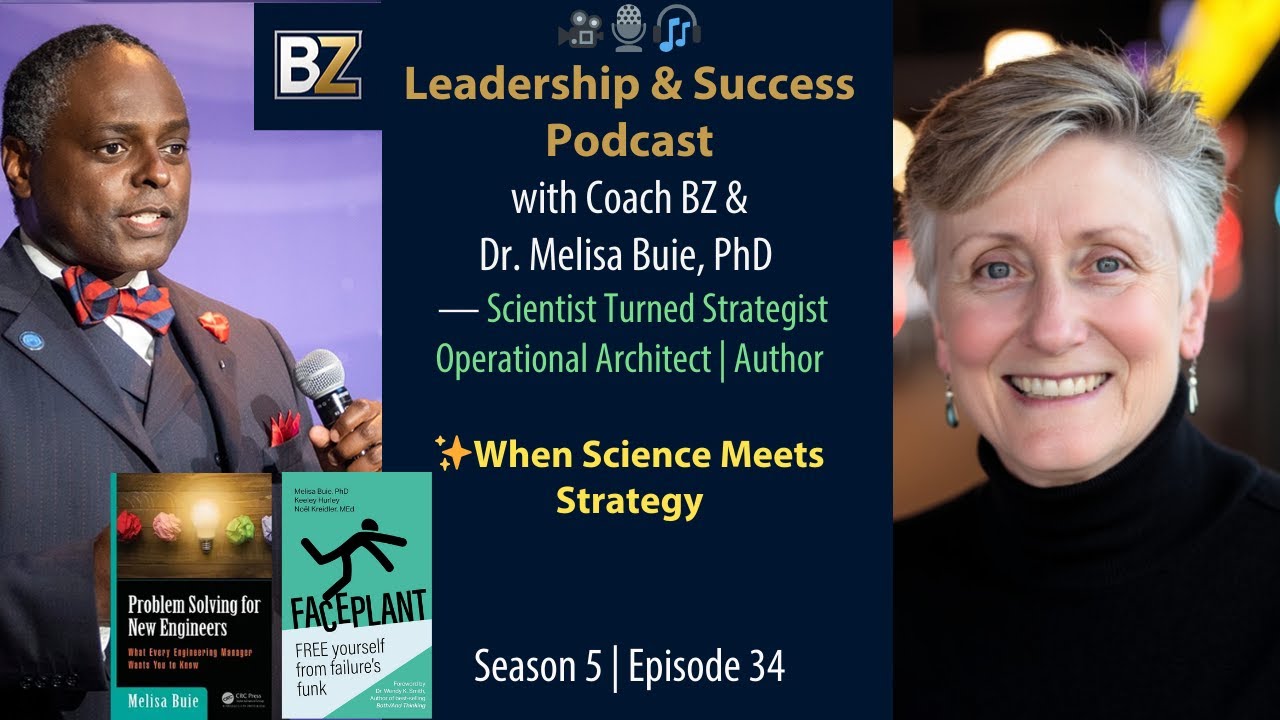
In this episode of the Leadership and Success Podcast, host Coach BZ (Bob Fabien Zinga) interviews Dr. Melissa Bui, a nuclear‑engineer‑turned operational‑excellence leader and bestselling author. The conversation weaves together Dr. Bui’s personal journey from scientific research to leadership, her development of the FREE framework (Focus, Reflect, Explore, Engage) for turning failure into freedom, and the way she applies a scientific, systems‑thinking mindset to culture, psychological safety, and continuous improvement. She explains how she built a personal brand on LinkedIn using Lean‑style experiments, shares practical advice on emotional intelligence (quick apology, owning mistakes), and discusses the gaps she saw in engineering education that led to her book Problem Solving for New Engineers (emphasizing control of variation). The dialogue also touches on courage in innovation, the importance of visibility for under‑represented groups in STEM, and her broader leadership philosophy that growth happens in the “messy middle” rather than at finish lines. Throughout, Dr. Bui offers concrete steps for handling personal failure, cultivating curiosity, and fostering a culture where failure fuels innovation.
Chapters
Hi, I'm John Maxwell. When the top companies in the world are looking for trainers, speakers, and coaches, there's one name that stands above the rest, and that's Maxwell Leadership. Our certified team members have gotten proven results for companies all over the globe, and our reputation, I'm proud to say, is second to none. Some of our members have risen to the top of their profession, including the one you're going to meet today. I proudly introduce you to my friend Bob Fabien Zinga.
Welcome to the Leadership and Success Podcast with your host, Coach BZ, where we help you lead with purpose and succeed with impact. If you're ready to grow into the kind of leader others want to follow, this podcast is for you. If you're determined to elevate your success and leave a lasting legacy, this podcast is for you. As my mentor, Dr. John C. Maxwell, reminds us, everything rises and falls on leadership. Our goal is simple: to inspire you, challenge you, and equip you with insights that can transform the trajectory of your leadership journey. Welcome aboard. Welcome to another episode of the Leadership and Success Podcast with Coach BZ.
I liked the acronym FREE because it really was a way to— once we're on the other side of failure and we're comfortable, we're free to fail, then there is so much freedom to just be yourself. So the framework stands for— it's an acronym that stands for Focus, Reflect, Explore, Engage.
Oh, okay. I think I had my mic off. All right. Welcome to another episode of the Young Leadership and Success Podcast. Thank you so much for joining us today. And what you just heard on Dr. Bui, she talked about about the acronym for F.R.E.E. Focus, Reflect, and Engage. And we're going to be talking more about that throughout the show today. So if you have a question for Dr. Bui, please go ahead and type it in the comment. Also, let us know where you are joining us from, what city, what state, and if you're outside of the US, which country. And what you are grateful for today. So I am reminded of our moment of gratitude. Every time we meet, we want to spend just a moment to be grateful. Part of the reason why we do this is because in the US military, about 21, 22 service members commit suicide every single day. And I believe it's impossible to be suicidal and grateful at the same time. And for those who've been watching throughout this entire month, Black History Month in the US, and I'm really celebrating the exploit and the contribution of African Americans to this country. I am so grateful for those who have come before me and on whose shoulder I stand today. Really, African American slaves, we pretty much built this country and done so many things that are not celebrated. One book I am going through right now, encourage everybody to get is this African American First: Famous Little-Known and Unsung Triumphs of Blacks in America. And of course, I want to acknowledge just yesterday another giant passed away, Jesse Louis Jackson Sr., civil rights leader, but also a global influencer. And people like him have definitely, I believe, moved us forward toward a more democratic and fair and just country. So we definitely salute Reverend Jesse Jackson for all of his contribution to our national security and really the civil rights of minorities in this country. All right. So let me see if I can properly introduce our guest today. So we're going to be talking to Dr. Melissa Bui. So, uh, uh, philosophy really is about life being for experimenting. I think that's because of science and engineering background. Dr. Bui is a problem solver and bestselling author and operational excellence leader who makes complex things work better, uh, from lasers and semiconductor equipment to global manufacturing system. So, she's really transforming how organizations solve problems. Dr. Bui is passionate about Lean and continuous improvement, not just as manufacturing practices, but as fundamental approaches to engineering and business excellence. So, she's dedicated to democratizing problem-solving across all organizational levels, working with global leadership teams to drive cultural transformation through Lean methodology. Now, another thing about, Dr. Bui is at— so she wrote the book which we are going to be talking about, Problem Solving for New Engineers: What Every Engineering Manager Wants You to Know in 2017, a book born from her dual experience in industry and academia for nearly a decade. She taught graduate-level courses in the Department of Biomedical, Chemical, and material engineering right here in Silicon Valley at San Jose State University, shipping the next generation of engineering problem solvers. And her second book, Fast Plants, which we're going to be talking about as well, Free Yourself from Failure Funk, launched in November 2025. So she has a PhD in nuclear engineering, radiological sciences from the University of Michigan, a Master of Science in physics from Auburn University. I used to live in Tuscaloosa, Alabama. I got my degree from the UA and We don't like Auburn, but we're gonna make an exception here. And she got several certifications from Stanford University, Santa Clara University. I used to be the Chief Information Security Officer for Santa Clara University. What a small world. And also American Society for Quality. And today we are really going to be talking about a lot of things, including what I believe you're gonna learn, how to transition from technical expert to transformational leader. And why courage, not talent, separates problem solvers from problem avoiders, but also how to build cultures where failure fuels innovation. All right, I've already spoken too much, but there is so much more to say about her. So without any further ado, please help me welcome to the Leadership Success Podcast, the one and only Dr.
Lisa Vu.
Good morning, Dr.
Vu.
How are you doing today, ma'am?
Good morning. I'm doing well.
Well, we really have a whole bunch in common. Both lived in San Jose. Looks like you work for Santa Clara University as well, and I did too. And I almost got a PhD in microbiology from the University of Alabama. So I am, I guess, what you would call ABD, all but the dissertation. But I can't believe you went to Auburn. My goodness. Why not just drive a couple of hours and come to UA? It's the best school in Alabama. My goodness. There's got to be a story to that. I don't know if you remember, I was a student. There was so much rivalry between our football team. I believe somebody from Alabama went to Auburn and poisoned a tree or something crazy like that. I'm like, how crazy can people be? But anyway, in Alabama it's God, it's football, and then everything else. But anyway, exactly. But I am really, really glad that we've been waiting for so long to speak to you. You have so much to teach us. Maybe to get started, Dr. Bui, uh, what is, uh, one thing you are grateful for today?
I am very grateful that I have my family so close and that they're healthy and that I'm getting to see them grow up and become amazing adults. So, um, the, the young ones.
So yes, no, there is nothing more important than that. We have two, two daughters. Our first one, thank God, she, she got her degree last year, so She's pretty much an independent adult now. Now we have one more. She is in high school, so it looks like she's already got a bunch of scholarship money. So we have an idea which college she's going to go to. But yeah, once she's out of her house, I think my wife and I will be very, very happy and elated. But wow. And is there something about you that most people may not know when they first meet you that you're willing to share?
Okay. Well, Most people know that I have a black belt in Six Sigma. What they don't know is that I also have a black belt in Tang Soo Do.
Really?
Yes. So I haven't practiced in years, but yes, that takes a lot of discipline.
How long did that take you?
It took, um, probably about 6 years. Wow.
So better not mess with a doctor. Congratulations. That is Outstanding. Wow. Yeah, I thought maybe one day I'm gonna get into martial arts as well. I know part of the Navy, especially special operations like Navy SEALs and things like that, they have to qualify in at least one martial art. The general sailors, they do not have to. But I think it really teaches you about, I guess, focus, discipline, mindfulness, and all of those good things. That you could apply everywhere else, right?
Yes, definitely.
Wow, that's amazing. Amazing. Okay, maybe we're going to talk about that too. So I guess I kind of broke the podcast today into 3 phases. Phase 1 will be from scientist to leadership, just kind of going through your journey, exploring for this first phase identity shift, mindset evolution, and leadership awareness. So the first question I have for you, more specifically about transition. You began your career as a scientist in plasma physics and nuclear engineering. Wow. How did you go from being a scientist to teaching leadership? That's not a typical career path.
No. So I didn't leave science to do this. I actually expanded what I considered scientific. So it happened because I kept seeing patterns. And, you know, that's what we're, that's what we're good at, right, is, is seeing patterns. So I've been working on technical problems, process optimization, and experimental design. And I realized that, you know, the bottleneck wasn't the science. So it was actually the people dynamics. It was how we communicated. It was how decisions got made. It was how we handled failure. So I remember one project that everything should have just been like smooth sailing, right? We had brilliant engineers, we had solid data, we were using all the right methodologies. But the project was stalling. So when I dug in, what I realized is it wasn't a technical problem. It was the fact that people didn't trust each other. And so the teams didn't feel safe raising concerns. So issues would fester and then it would become a crisis. And I've seen this everywhere in the world that I've been. It's if people don't feel safe, it eventually rises to the top. That's when I realized that you can have perfect processes, but if the leadership and the culture aren't right, it's just not going to work. So I started studying leadership the way I started science, right? Just really systematically going about taking courses, reading research, reading books, running experiments on my teams. Wow. So, yeah. So what started out as my, my own problem is something that I actually have used to teach others.
Wow, that is really fascinating because you really made me think of psychological safety, which is so important today. Kind of what did you learn through that process?
Well, so I learned that if we don't have psychological safety, then when failures happen, you're essentially going to shut the team down. There's going to be— it's a variable that really, if it's not there, then the team will completely stop performing. And this is such an important cultural aspect. And I am so glad that we're finally having these conversations today.
Powerful. Now, from my own experience, like I said, I almost earned a PhD in microbiology when I was at the University of Alabama. But being a graduate student, I think my superpower, what I really learned throughout that entire time was asking the right question. Because I felt like if you ask the right question, you pretty much half solve the problem already, right? And just the ability to be inquisitive, ask questions, and then figure out really how to solve problems, which I was able to apply in technology, cybersecurity, and even in the military and everything I've done ever. Ever since. So if you put your scientist lenses on, what does a scientist see in an organization that others might miss?
So I think there's probably a handful of things that really make it, you know, a scientific approach, right? So one is looking for patterns.
Yes.
Looking for, looking at systems and looking at root cause. So if you look at a leader who comes at it from a, you know, I'm going to call them a normal leader, right? They're looking for isolated problems. So this person isn't performing or this team has a conflict or we're missing, we're missing deadlines or on-time delivery isn't where it should be. So they treat each of these as separate issues. But a scientist, when they come in, they're looking at the system that's creating that outcome. What are the conditions that produce this result? What variables are at play here? So, for example, I worked with a team that had persistent on-time delivery issue. So it was at 45%.
Hmm.
And so I could have gone in and we could have just focused on, OK, what's causing this on-time delivery issue? Do we need better training? Do we need stricter oversight? Do we need more quality inspectors? We could have looked at each one of those individually, but instead we said, okay, this is, this is a big problem. This is a system problem. In addition to that, they had, if you looked underneath the hood, what you saw is that this new product they'd introduced had 100% rejection by the customer. So it was, it was a big, big problem. And if we would have just taken one of those, we never would have solved all the issues. So what we did was we took this really scientific approach and started identifying all the gaps that could potentially contribute to this problem. It took us about a year. But we were able to bring on-time delivery to above 95%.
Wow.
And we brought yield above 95%. We were at our first new product introduction was at 100%.
Wow. So you can get a bit of a 100%. Wow.
Right. It was so— yeah. And so that scientific mindset is what really allows you to, you know, look beneath the symptoms and look for the system. So you're not just actually— you're not just putting Band-Aids on symptoms. You're actually fixing what's going wrong.
That is really powerful because I guess with my scientific mind too, I look at leadership as a science experiment. But sometimes I feel like you— there is some of it is more art than science, I guess, some aspect. I would say. Anything surprise you in leadership? Was there maybe anything about moving into leadership that surprised you or didn't quite fit your analytical approach?
So yes. So the biggest surprise was all the emotions. So not just everybody else's emotions, but mine too, right?
Yes.
And as a scientist, you know, we're trained to put our emotions aside, right? Remove emotions from the equation, be objective, follow the data. Don't let, you know, don't let feelings cloud your judgment. But yes, the difference is in leadership, emotions are data. They're a part of the data. And so how someone feels about a decision matters more than like the logical soundness of the decision. So those, you know, feelings, whether it's fear or pride or belonging or resentment, they're not noise that we need to filter out. They're actually signals that we need to understand.
Yes, that is so true. I guess in leadership, they say people are our most precious asset, but sometimes you feel like, if I didn't have people, I wouldn't have any problem. That human ambiguity is really something we have to deal with over and over and over again, don't we? Was there maybe, when you went through that experience, did leadership force you to unlearn anything?
I definitely had to unlearn that emotions were weren't important, that emotions didn't come from— like I had to develop a whole new toolkit to be able to deal with emotions, right? Because if we remove emotion from the decision-making, then we're actually removing— like, we might as well be removing the people. And well, then we're not going to have anybody to do the work. So it's, it's really important that we be able to integrate that emotional data and the analytical data. We need both when we're making decisions and we want to create a culture that allows people to contribute at a level where, you know, they feel strong and good about what they're, what they're contributing.
Absolutely. I really think emotional intelligence is key. Where I live and used to work, Silicon Valley, I feel like our IQ is completely off the chart, but the EQ, we have a lot of work to do. And even for myself, initially when I first got married, I was very logical, scientific. I didn't care much about emotion. I mean, I guess I was aware of myself somewhat, but didn't care much about the feelings of others until I got married. So to me, getting married is probably one good solution to learn how to care about somebody else's emotion and become a better human being, and I think a better leader. Is there anything you would advise people listening to us right now who want to improve their emotional intelligence so they can better deal with people, all kinds of people? Something that helped you?
I think the biggest thing is that when you try something and it doesn't work, apologize as quickly as possible. Yes, really. I still, I still will screw up. I will hurt people's feelings. I will say something that, you know, I didn't intend it to come out that way. And you know what? Just owning it.
Yes.
And apologizing right away. Because, you know, we're, we're in the end, We need to be responsible for how things show up for the other person. And whether that's a spouse or a coworker, a friend, a colleague, it doesn't matter. Just own it and apologize as quickly as possible so that you get the air clear.
Yes, that is so powerful. I really had a great privilege in my life to be a commanding officer in the U.S. Navy. And for the 2 and a half years I was, uh, you know, at the very, very top of my billet, one thing I truly learned was lead with humility. Because the more responsibility you get, the more people you have under you, sometimes, you know, you tend to have a big head. Oh, I've made it, I am such a special person. And you think that people are working for you, but the truth is, if you have a leader, you are working for them. It's really the other way around. So that's one lesson I've definitely learned in my time in the Navy. So, let's talk about continuous improvement as a personal operating system. So, phase 2 of this podcast, I guess we're gonna be talking about your experience on getting your black belt in Six Sigma, which again, it's not easy. So, congratulations for that. Thank you. But I think it's very important to also get philosophical and practical as well. So, continuous improvement as a way of life. You talk about continuous improvement not just as a business methodology, but also as your personal operating system, which is a pretty interesting way of looking at it. What does that actually mean in practice?
It means that I never assume that I've got it figured out. So I'm always learning. And, you know, for most of us, we reach a certain level of success or experience accomplishment. And we say, we essentially like say, okay, well, you know, this is my formula. And we lock it in, right? And so we say, this is how I do things, or this is who I am. And sadly, when that happens, we stop experimenting. We stop trying new things. So I, frankly, I can't do that. I cannot do that. Even so, especially when something's working, I'm asking, you know, could it work better? What am I not seeing?
Yes, yes.
What could I test next? That's continuous improvement as identity, not some organizational methodology. I'm not trying to be perfect. I just am trying to be curious about myself and stay that way. So I constantly run small experiments, try to, you know, how to structure my day, my calendar. How can I handle conflict? How can I learn new things? How do I show up as a parent? How do I show up as a spouse?
Wow.
Some experiments work. And some are complete faceplants. But, you know, they all teach me something. So the alternative is stagnation.
Powerful.
And that we could go there. We can live in our comfort zone. That's certainly an option for all of us.
Yes. Wow. That is really powerful. So this book, you mentioned first plan. So Free Yourself from Failure Funk. And I believe you had a couple of co-authors. Offers for this one. Why did this book have to be written? Why did you have to write this?
This is— there's two reasons. So one is there was a curiosity about it. And so I realized as a scientist, I, in the lab, I was perfectly happy failing. I could— I learned very early on that failure was just, okay, we're going to build a model, we're going to— yes, you know, we're going to learn something and everything's going to be great, right? We'll, you know, we'll know which direction to head. So failure in the lab was never something I had a problem with, but when it came to my life, I would— failure would completely stop me in certain cases. And it was— and I saw it as a pattern in— back to patterns— I saw it as a pattern in my whole life. I would be like, I'd be stopped by certain behaviors. And when I failed, and I knew that there was— I knew there was something there. And I started seeing these patterns, not just in my own life, but yes, in, in other people's lives as well. And they would face the same, the same situation. I'm like, okay, I gathered two of my friends and colleagues, and I said, hey, This is a— this is the problem. Let's solve it together. Let's see if we can't figure this out. And so, and so we did. We spent— we didn't even spend the first year writing the book. We spent the first year figuring out our own failures and looking at them and really going through and figuring out this process that we call FREE, this, this framework that you mentioned. So it, it, it was a message. It was a learning that we had, the three of us had. And we saw this in our friends and our family. And we're like, oh my goodness, there's so much freedom that's available out there on the other side of failure if you're willing to take the chance. And We gave up our evenings and our Saturdays and our Sundays with our family and with our friends so that we could write this.
Yes.
And we just, we just felt really passionate that this was an important message to share and it would be valuable for anyone who would read it.
Wow, that is really, really powerful, man. So back to Fes Plant, how would you define a failure funk? It's in your book title.
Well, so this is something we don't— in Silicon Valley, we didn't talk about very much, right? We had all these platitudes out there, right, that we'd gotten from Seth Godin and all these all these amazing people, but it, you know, fail fast and, and fail forward and all these, you know, all these things about failure.
Yes.
But nobody talked about how really awful failure felt. All the emotions, all the, you know, the just nastiness that made us want to, that made us want to shrink away, that stopped us. Nobody wanted to talk about that. And so we're like, okay, well, let's talk about it. Doesn't it doesn't feel good. When we were working through our own failures, failures that had impacted us from childhood. When we were working through those, there was a lot of tears.
Wow.
There was a lot of tears that we, that we shed. Because we were still impacted by those failures.
Wow.
So it's something that we don't talk about but is a really powerful— it has a really powerful hold on us.
Thank you so much for sharing that. For that alone, I think everybody who's listening to us should Get a Copy of a Book. Why do you think it's so important to face your failure head-on and not ignore them? And also, kind of, what did you guys learn through that process?
So I think the reason that it's so important to face those failures is because you don't know if you're stopped by a failure You don't know what's available to you on the other side of that. You don't know what freedom and what just like the ability to breathe. You don't know that until you're on the other side of it. And taking a chance and working through those failures with the process, with the framework that we talk about, the FREE framework, makes all of that available to you.
It—
no, it may be that you don't want to do anything with it. It may be that you decide, oh my goodness, I, you know, I'm going to change my life completely now.
Yes, yes.
So those are— you just don't know what's available until you really work through those failures. And I mean, I've had people tell me, talk to me about their failures. Somebody picked up our book. She's over 70. And she's like, you know, I realized when I started reading it, that there was a failure that happened when I was in kindergarten. Wow, that has stopped me from exploring this area of my life.
Wow.
It's all because The teacher hung her picture upside down.
Hmm.
So that must mean she's not an artist. That must mean she's not creative, right?
Wow.
And like, these things open up for us.
Hmm, powerful. So what would you say to someone who's listening right now who just experienced a public failure and feels stuck? Of course, the country right now, everybody's talking about the Epstein file. Hopefully nobody's listening right now. Is in the Epstein file, that's really public total failure and disaster. But for someone who experienced some type of public failure right now, what should they focus on, you think?
Well, so working through the free framework is a really great place to start. So the first step is focus on the failure. So it really is get clear about what the failure was. Disconnect it from the story that you're making up about it. Disconnect it from the emotions that you have about it. What was the failure?
Hmm.
Get really clear about that. Once you're clear about the failure, You can then start the process of look at the, look at the emotions, look at what was going on for you. What was happening? What's the story that you're telling yourself about this? No, I think it's important to look, look at that story and identify, oh yeah, I made it mean that I'm not lovable. Because my marriage fell apart at, you know, after 17 years. That's what, that's what happened to me. I'm not lovable. But that's not what it meant, right? And but I didn't get to that point until I spent time in reflection. And as human beings, we are awful about reflection. We hate it. It's more pain. We'd rather have electric shock than go through reflection. But it's such an important, such an important step. Once you've done— once you've got clear about the failure, you've got clear about the emotions, and you're dealing with those. The next step is really to start exploring What's out there? So, okay, this happened. This is how I feel about it. What are my options? What can I do? What could I have done differently? You know, what can I try next? So explore what your options are.
Yes.
And there's a lot, there's a lot out there. How might I have behaved differently? Or what might be opening up for me? And once you're on, once you've gone through that process, the second E is to engage. So go try something. Go try something different.
See what happens. Just do it. I love Nike.
Yeah, go run an experiment.
Yes.
Wow.
That is powerful. And that's how people find their freedom. I think something that is key, that's how you can have two people go through similar experiences, challenges in life, where one of them just thrives and almost doesn't even bother them. And then somebody else, they just fall apart. It's really your mindset, how you interpret what happened to you, right? The story we tell ourselves. Wow, that is, that is so powerful. I mean, this is definitely, uh, worth the price of admission for those listening right now. It's amazing. Wow, man. Let me, let me, let me go back. I guess you published this book, uh, earlier, on problem-solving for new engineers. One question I wanted to ask you about your first book is, what gap did you see in young engineers that made you write this book, "What Every Engineer Manager Wants You to Know"? And I like the word manager there.
So, What I saw in the, um, at the time I was an engineering manager and then I moved into an operations director for, for a company and I was hiring a lot of young engineers. I was also teaching at San Jose State, so I was interacting with 30 to 60 to 90 engineers per semester. So these were typically master students. And one of the things that I saw is that we don't have time in our curriculum. We need to, we need to communicate all this knowledge of subject matter.
Yes.
And so that's what we focus on. But there's— and so the way we treat real problems are that we boil them down into kind of pretend situations in our labs. And then because we've got limited budgets and we need to make sure our equipment's safe, we essentially create a recipe for our engineers to follow. And so they're, they're following the recipe like they're cooking, following that recipe. And oftentimes when they get into their first job, it's the very first time they've been handed a problem and said, go solve it.
Yeah, all on your own.
They've got to figure out the tools. They've got to figure out the real problem statement. They've got to plan what to do. And yeah, and oftentimes what I would see is it was like deer in the headlights with these new engineers because they, you know, what do you, what do you do? And so I wanted to dispel some of the myths that we have, or perceptions that we have about experimentation and make some tools available to our engineers so they could better understand how to approach problem solving.
Wow, I see. I guess this is quite different from a traditional engineering textbook, isn't it?
Yes, it is. So this is very, very practical. It's very applied. I try to blend a little bit of my sense of humor in there, which probably falls flat most of the times, like my jokes did in class. But yeah, I wanted to bring— I wanted to bring a really practical approach to, to this. So you're not going to see a bunch of big words and terms. You're not going to see a bunch of acronyms. It's really focused on what you need to know and how to eliminate variation so that you can run an experiment and get the maximum result.
Solve problems.
Solve a problem. Yeah.
So if you had to summarize this book in one principle, what would it be?
Control variation.
Yes. Yeah, I guess that's something you don't always learn in class, is it? Wow, thank you for sharing that. So how do problem solving and failure intersect in your opinion? And reading both, both books, the one about New Engineer and Fast Plant, I wonder if maybe courage is kind of like a thread that runs through both.
I wouldn't say that I've called that out in, in the first one, but it, it certainly comes into, comes into play. So anytime you're in the lab and you're running an experiment, if something's not failing, then chances are you're not looking outside what's safe.
Yes.
And if you're not looking outside of what's safe, then what's happening is you're gonna— you're really looking at evolution versus revolution. So if you want to do, you know, like, this is Silicon Valley talk, but if you want to do 10x, if you want to do that moonshot, you need to fail.
Yes.
And you're gonna have to do some things wrong to get it right. Failure is inevitable. And so the more we can practice and learn and then just get into, oh, well, that didn't work. What's next? And it's just our default mode of, oh, okay, that didn't work. What's next?
Right.
Then we just— then that allows us really to just keep moving forward. And not get stopped.
Hmm.
All right. So for phase 3 of this podcast, let's talk about the visibility pivot because you've spent pretty much much of your career, right, in sciences and behind the scene leadership work. So now you are learning about marketing and personal branding and all of that. Seems like a 180. I guess one question I have for you is how does personal branding fit with continuous improvement philosophy. Are you applying the same framework?
Absolutely, I am, I am definitely applying the same, the same framework. Um, I'm treating building a personal brand like any other skill I've learned, very systematically and experimentally with very clear learning goals. So here's what it looks like in practice. I started posting on LinkedIn in July of 2025, at first only on weekdays, and then in September I started posting every day and I haven't missed a day since.
Wow.
So I started recently studying. So essentially my experiment was to really develop a public you know, a personal brand and let people know that I'm here because I consider invisibility a failure.
Yes.
If I'm invisible, my important message is not going to get to people there. It's not going to reach them. They're not going to know who I am. So if I want people to know about Faceplant, if I want them to know how to handle failure in their lives, I need to be visible so they know they can learn about Faceplant. So I started studying the people who do this really well. What patterns do I see? You know, what works in my field versus other fields? I'm not copying anyone, but I'm learning the principles and applying those, and I'm running a lot of experiments.
So that is awesome. I believe, Dr. Bui, you are on track becoming a top voice on LinkedIn. Which I think is a pretty big deal. So keep doing your good work. But now for a lot of engineers out there, I know when I first started, I was feeling the same way. Pretty much my training taught me that your work should speak for itself. You don't need to market, you don't need to do branding or any of that. What advice would you give a young engineer who's listening to you right now who believe the same way I used to, just let your work speak for itself?
Well, if people can't find your work, yeah.
Yeah.
You know, it's, it's, you Yeah, if your work is really important, if your work is worth spending your life investing in, and if it could make a difference in the world, wouldn't you want everybody to know about it?
Yes. Wow.
Wouldn't you want to be visible?
Simple but profound. All right. So I'm going to get into the last segment of the show now where I kind of try to understand the leadership principles that allowed you to be so successful, and maybe you can share your wisdom with our audience. To get started, what is maybe the greatest lesson you have ever learned in life, in leadership, in general?
Okay. So I think one of the biggest lessons that I had to learn is that growth doesn't happen at the finish line. So if you focus on outcomes, right, and I was very focused on outcomes most of my life. Making good grades, hitting targets, completing projects, achieving goals. Like, I was like, oh yeah, you know, the finish line, that's where I want to be. But growth happened in the messy part, in the middle part, where you're failing and you're stumbling and you're working hard.
I—
so one of the things that, that happened for me is early in my life I was a physics major and I made a C on my first, very first physics class in college. I had never had a C in my life, never. But what happened? I was goofing off. I was in college, I was free for the first time in my life, and I was goofing off. Guess what happened? So, but if it weren't for that C, I wouldn't have resolved to work hard. Yes, to work really hard to make sure that I knew the material and I could make— do better in the classes. So yeah, success isn't the destination. It's— success is those tiny experiments that get you to that finish line.
So when you look over your career, has your definition of success changed?
Yes, because I think I now— for me, I think I lived a lot of my life where success was the goal. It was the, you know, it was the goal that I, that I had. It was getting that black belt. In, you know, in Tang Soo Do. It was getting that black belt in Six Sigma. It was getting that PhD. And I just lived my life from goal to goal. And now, I'm like, I changed that philosophy. And success is really how I handle all the messy bits in the middle. It's how I stumble. And recover. It's, it's the experiments that I'm having fun with. It's the play.
Wow. That is very profound. Thank you so much for sharing that. Now, when we look through your career, right, you've been extremely successful, right? Science, your PhD, engineer, leadership, and, uh, um, no best-selling offer to boot. And now you're getting into marketing and branding. Like, is there anything that you haven't done? Like, you are one of those few people I was trying to introduce you to my audience, but I'm like, This is taking too long. Let's go ahead and stop and just introduce you already. You've achieved so much. So what do you think is the secret of your success? Why do you think you've been so successful?
I think it's all based on hard work and really like the core value that my parents taught me is keep your eye on the goal, focus, keep working toward it, and stick with it. When things get tough, just keep working hard.
Yes, powerful. So I know leaders are learners. What are you learning these days?
I am deep in the world of personal branding right now and marketing. So, which is completely outside my comfort zone. So I spent, you know, as we've talked about, I've spent most of my career in the sciences and in, you know, operations and marketing was this mysterious thing that other people did.
Yes. Wow. So I guess I will advise everybody in the audience to be following you on LinkedIn very closely so we can learn with you. That's really cool.
Wow. Yeah, I think the big thing is for me is if If I want my impact to scale, if I want my message to get out there, I need to be visible. And so that's what I'm trying to learn right now is how to be visible, how to reach people. And it is really humbling.
Yes.
Being a beginner again.
Well, hopefully this podcast is going to help just a little bit. Part of the reason why I did this is to really put the spotlight, especially women and people of color, because many times we are underestimated and underrepresented and sometimes completely ignored, even though sometimes we achieve a lot more than our white male counterparts. So thank you for everything you do, and hopefully you're going to get a lot more followers after this podcast. But I am just impressed by all of your achievements. So if you could choose, uh, 3 people to have dinner with— they could be alive, dead, or even fictitious characters— who would you choose and why?
So the 3 people I'd like to have dinner with, um, so it's 3 of my currently favorite authors. So first of all, it would be Francis Frye, who is, I think, one of the intellectual giants in the world right now. And she has this amazing gift of being able to take really complex problems and make them feel simple. Her trust framework has, you know, it's got 3 elements. And then she, like, because she was able to break it down, trust feels like this really, you know, actionable concept rather than just this abstract thing. The second would be Annie Laurie Lecomte, who is a neuroscientist and wrote this book, Tiny Experiments, that came out last year. And like, it's such a beautiful complement to Faceplant. I just— her work has been really instrumental in changing my view about, about life and chasing linear goals. Like, you know, stop all this linear stuff. Let's go nonlinear now. Yes, it's time. And the third person would be Wendy Smith, who wrote Both/And Thinking. And she teaches us how to hold paradoxes. So innovation and execution, autonomy and alignment, rather than having to choose one or the other. And that is such an important skill for us to develop.
Wow!
So what connects all three of these people? It's like challenging the old playbook, right? And giving us these frameworks that allow us to explain complexity.
Wow, that is powerful because we do read a lot here. I started with a digital bookshelf, I think it was May of last year. With all of the guests I've had so far, we already have over 305 books. On the digital bookshelf. So I'm going to add those 3 books you just mentioned. Thank you. Thank you so much. I guess I am a little bit selfish too. Part of the reason why I do this, I want to know what is the next book I need to read. So thank you so much for letting us know about those 3 wonderful offers. Is there maybe a song or a book or even a movie that would be your life's theme or anthem?
My life's theme, it would have to be— so it's a book. If I had to choose a book right now, it would be Tiny Experiments. Live freely in a goal-obsessed world, you know, like, yes, don't— and free in capital letters. So don't be afraid to fail. Go after it.
Powerful.
Stay curious.
Alright, if you had one and only one day to live, what would you have liked your final contribution to be?
I may get emotional on this one. So if I had one day left, I'd want to spend it with my son. Not just being together, but, but truly passing something on. So he's grown from this tiny little peanut, you know, in the first pictures that I saw of him, to this amazingly articulate, gracious man. But if I had one day, I'd want to tell him how proud I was I wanted to give him something that he could carry forward, like, you know, the stories that I haven't told him up to this point, what failures shaped me, the moments where I almost quit but I didn't. And I want to listen. I want to hear all of his dreams. I'd want to hear his fears. I'd want to hear his questions. And I want to know what— not, not telling him, but I want to hear what it is that he wants to be fully himself in the world. So that's my legacy. Not so much what, what I've accomplished, the books I've written or the degrees, but who I've helped him become.
Wow. And for those listening right now, I am sure you have somebody in mind. I think kids want to be affirmed, especially by their father, because when I was growing up, my dad never told me he loved me. My mom did. She loved me too much. But my dad never. And everything I've done throughout my life, every achievement, I wanted my dad to see it and say, I am proud of you. That's all I wanted. Eventually he did, but it took too long. So for those listening right now, you probably had someone in mind when Dr. Bui was talking about your son. Call them right now and tell them how you feel about them. Wow, thank you. That's very touching. I don't know if we can continue this interview, Dr. Bui. You're messing me up. Okay, let me ask you, when you wake up in the morning, let's say you had the magic wand, you could solve any problem in the world, What is one problem you'd like to solve first thing tomorrow morning?
I would— I'd like to figure out how to bring the United States back to one country.
Yes, yes, you are not alone. Yeah, I know people from my generation, 9/11 was quite traumatic. I think 9/11 and the global pandemic. But 9/11 was very, very bad, but 9/12 was the best day of my life as a resident of the United States of America. Yeah, we were one country under God. It didn't matter if you were a Democrat, a Republican, Black or white. We were all Americans that day.
Yeah, yeah.
Wow. Well, thank you. We are coming to the end. How can we add value back to you?
Well, so if anything I've said or shared today speaks to you, the idea of treating leadership as experiments, applying continuous improvement in your own life, any of that, share it. Tag me, tell someone, write about how you have applied it. The ideas that create impact, they can only do that if we share them and we spread them around the world. So make it happen.
Wow, thank you. Now, is there a question you wanted me to ask you I didn't get a chance to ask? Anything else you wanted to share?
I know I can't think of anything that— I think we've covered a lot.
Yes, we have. So let me ask you the most important question then. If you could go back and give a piece of advice to your 17-year-old self at the edge of this incredible career you've had, Dr. Melissa Bui, what would you say to 17-year-old Melissa?
Like I said earlier, I think I've spent so much time, so much of my life, focused on the goal and, um, you know, just kind of going through the process without really paying attention. And which meant that, you know, like, oh, I've got to get a PhD, so You know, let's not, let's not get distracted and have fun along the way. Right there. So I think I was so focused on goals and accomplishing those that I forgot to like live in that messy middle part. And that is a really important part. So I'd want to tell my 17-year-old self, hey, enjoy those moments because that's where you're learning and growing the most.
Wow.
Thank you, thank you, thank you. Two last questions. What is something you are feeling optimistic about? I always like to end on a high note.
I, you know what, I feel really optimistic about all of our new engineers that are coming through the pipeline. They're doing amazing things and they're so freaking smart. I love that. I love talking to them. I love learning from them. I love listening to their stories and challenges. And I am so grateful that we have young people interested in science and engineering. And they want to solve problems. So whatever I can do to help them, I'm in.
That's beautiful. As an Information Warfare Commander in the US Navy, to me, this is a national security issue when we have nobody in America who wants to do STEM and they all want to do history, math, I mean English writing or whatever, which is fine, social science, nothing wrong with that. But when I look now at the world stage and where we are now, where we could be, we definitely need more American kids interested in STEM. So thank you for all of the work you do. So to end the show, this is the very last question. What is one word that represents our shared experience on this podcast today? One word.
Experiment.
Experiment. Yes. I love that. And I am almost always grateful. Thanks so much for your time, Dr. Melissa Bui. We really appreciate you sharing your wisdom and being one of our master teacher today. Thank you.
Thank you for the opportunity.
Wow. All right, everyone. This is one for the book. Again, I encourage everybody to follow Dr. Melissa Bui. And also get her latest book, Faceplant: Free Yourself from Failure Funk. And for those especially who are engineers, even cybersecurity engineers and IT engineers, who I care the most about, Problem Solving for New Engineers, I think is gonna be a book you are going to learn a lot from. All right, so this is it for today. In about 5 minutes, I'm going to have one more interview. If you can believe this, I'm gonna be talking to senior master surgeon, Chervonne Chevie Maxwell, US Air Force retired. And we're gonna be talking— she's a federal execution partner. And we are going to be talking about leadership at the deckplate and also how she's transitioned into a leadership coach and all of the work she's doing with federal grants. So we're gonna be starting in about 5 minutes or so. Thanks again for watching and see you in 5 minutes. And later today, I'm gonna go through the book of Proverbs. I think we're doing chapters 16 and 17, uh, today. It's gonna be like a 15-minute, uh, AI recap of what we did, uh, last month. Again, it's not religious, it's just about focusing on wisdom and leadership lesson from the book of Proverbs. It would be great if you could join us. All right, until, uh, later today and tomorrow, have a great day. Bye for now.
Thank you for tuning in to the Leadership and Success Podcast with your host Coach BZ. If today's episode added value to your leadership journey, be sure to subscribe, share, and join us again for more wisdom nuggets on how to lead better and achieve greater success. Remember, leadership is the most critical skill of our time. The world will always need leaders to inspire others, drive innovation, and execute meaningful strategy. So why not count yourself among the bold leaders shaping 21st century. Until next time, stay inspired, stay committed, and keep leading with excellence.
More from Bob

S250:E4🎙️LIVE 🇺🇸America 250: President Barack Obama Leadership, Service, and the Power of Hope






S5:E157🎙️ LIVE with CMD CMSgt Dennis L. Fritz, USAF (Ret.)(Multi Tracks Audio)



S5:E156🎙️ LIVE 🇪🇸 Leadership Lessons from the FIFA World Cup 2026 Champions (Multi Tracks Audio)

S250:E3🎙️ LIVE Leadership Lessons from America’s First Documented Family of African Descent 🇺🇸📖