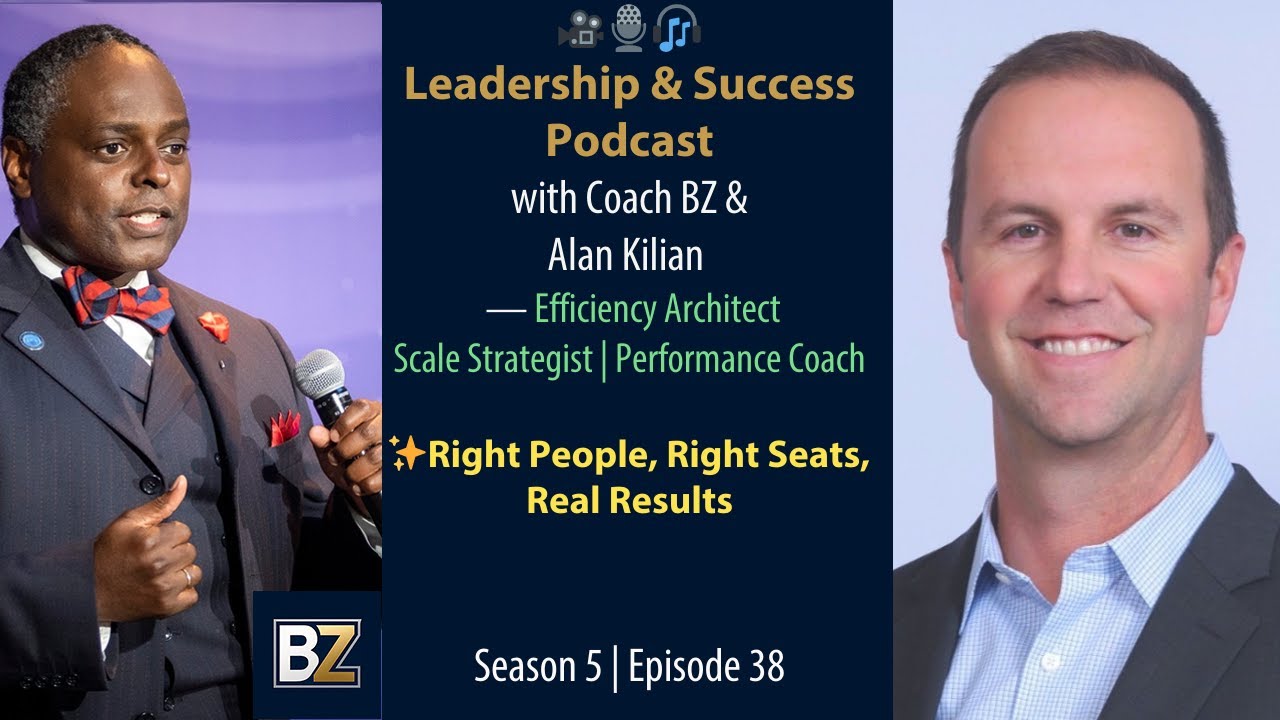
Alan Killian shares his 4 Fs framework for leadership: faith, family, freedom, flexibility. He details how over-controlling habits caused burnout, and why scaling requires placing the right people in the right seats, not adding processes. He offers practical tools like calendar audits and expectations agreements.
Chapters
¡Hola!
Hi, I'm John Maxwell. When the top companies in the world are looking for trainers, speakers, and coaches, there's one name that stands above the rest, and that's Maxwell Leadership. Our certified team members have gotten proven results for companies all over the globe, and our reputation, I'm proud to say, is second to none. Some of our members have risen to the top of their profession, including the one you're going to meet today. I proudly introduce you to my friend, Bob Fabien Zinga.
Welcome to the Leadership and Success Podcast with your host, Coach BZ, where we help you lead with purpose and succeed with impact. If you're ready to grow into the kind of leader others want to follow, this podcast is for you. If you're determined to elevate your success and leave a lasting legacy, this podcast is for you. As my mentor, Dr. John C. Maxwell, reminds us, everything rises and falls on leadership. Our goal is simple: to inspire you, challenge you, and equip you with insights that can transform the trajectory of your leadership journey. Welcome aboard to another episode of the Leadership and Success Podcast with Coach BZ.
What's going on, leaders? I am Coach BZ AI, the AI twin of Commander Bob Fabien Zinga. Welcome back to the Leadership and Success Podcast with Coach BZ, where we spotlight leaders who don't just talk about growth They build it, scale it, and multiply it. Today's episode is powerful because we're diving into something every commander, founder, executive, and high-performing professional wrestles with: efficiency. Not productivity hacks, not doing more, but eliminating what doesn't matter so you can accelerate what does. And to help us unpack that, I'm honored to welcome a leader who has spent more than 25 years building, scaling, and leading companies across industries including energy, insurance, transportation, manufacturing, and financial services. Alan Killian is an entrepreneur, executive coach, keynote speaker, and the architect behind what he calls efficiency-based leadership. He's worked with celebrity families, billion-dollar enterprises, and high-growth organizations, helping leaders replace low-return activity with high-impact execution. And what I respect most about Alan's philosophy is this: he teaches that organizations don't scale through complexity. They scale through people, right people, right seats, clear alignment, disciplined execution. In a world where leaders are drowning in meetings, emails, and competing priorities, Alan helps them reclaim clarity, and clarity creates acceleration. We're going to talk about how to identify waste inside your leadership, why scaling through process alone fails, what right people, right seats really looks like operationally, and how to win at work without losing at home. Because Allen's leadership philosophy is grounded in 4 powerful pillars: faith, family, freedom, flexibility. And if you're a naval officer aspiring to command, a cybersecurity leader scaling teams, or an entrepreneur building culture under pressure, this conversation is for you. So grab your notebook, lean in, and get ready to level up your leadership. Allen, welcome to the Leadership and Success Podcast.
Alright everyone, welcome to a very special edition of the Leadership and Success Podcast. I have a great guest waiting for us in the green room. Before I introduce him, as is our custom here, we want to spend just a moment, what we call moment of gratitude. We want to be grateful every single day. And part of the reason why we do this is because my brothers and sisters in Really, we are going through an epidemic right now in the military service. About 21, 22 service members or veterans commit suicide every single day. And I think that is not right, and we need to do something about it. And one small thing I believe that could help is to be grateful, because you cannot be grateful and be suicidal at the very same time. So As you guys know, this entire month I've been grateful for Black History, right? In America, it's Black History Month. It's February. And I am just so grateful for the achievement and the work that African Americans have done to build this country. The children of the slaves have built America. America is what it is today because of African Americans. And I highly, highly recommend that you get a copy of this book, African American First. It's the famous little-known and unsung triumphs of Blacks in America. So that's what I am grateful for every single day this month because Black history is American history. All right, let me see if I can properly introduce our guest today. We're gonna be speaking with Alan Killian. He's an efficiency architect, people-first scale strategist, and purpose-driven performance coach. He has spent more than 25 years owning, scaling, and leading companies across industries including energy, insurance, transportation, manufacturing, and financial services. So he is the co-founder of Level Up Leadership Accelerator, CEO and co-founder of Dream Chapter, and the owner of Killian Consulting, executive and performance coach, and high-impact keynote speaker. Alan is widely recognized for his philosophy of efficiency-based leadership, helping organizations eliminate low-return activity, align talent to mission, and scale execution through people Not Bureaucracy. His keynotes are known as acceleration events, delivering real-time breakthroughs and practical tools leaders can apply immediately. So without any further ado, please help me welcome to the Leadership and Success Podcast, Alan Keelan. Good morning, Alan. How are you doing today?
I'm wonderful. How are you doing?
Great, great. Really a privilege and honor to be speaking to you today. What is one thing you are grateful for this morning?
That's a great question. I have a lot of things to be grateful for, but, you know, at this stage of my life, getting ready to be 50 years old, I am really focused on my health. So, yes, very thankful for my health, thankful for my family, my faith.
That is so powerful.
Very broad question.
Yeah, because if you don't have your health, you have absolutely nothing. I injured my back a ways back in the Navy and I couldn't get out of bed for like 2 or 3 days. And it was like, no, it didn't matter how much money you put in my bank account, I would trade that in just for the ability to get off the bed. So your health is extremely important. And for those in the military, not just your physical health, but your mental health too. That's one thing I believe we tend to just overlook and we don't really take care of our mental health. Mental Labs. So again, thank you so much for being here, Alan. What is one thing about you that most people may not know when they first meet you?
One thing about me that people don't know, like you mentioned in the intro, I've had multiple companies over the last 25 years. There's a lot of struggles with business ownership. Most people talking to business owners, they think, oh, you own a company, you're just, you're successful, you make money. That's not always the case. So, you know, I think the one thing that, that people should know is that there's a lot of success and there's even more failure over the last 25 years. So how are you taking that into accounting? You know, how are you taking that into leading with your family, leading with your, your business, with the people that you work with, with your friends. Um, you know, for me, I've had a, I've had a lot of failures. I've had a lot of great successes too. And the one thing that I lost, um, along the way was my friends, my focus, you know, almost lost my family. So, wow, really, uh, taking Taking the opportunity to not take your family and your people in your life for granted is the most important thing for me. And that, that's really what I try to focus on today and help bring that into the other business owners that I work with and companies and people that I coach is, yes, get alignment around, you know, what we talk about. And I'm sure we'll talk a little bit more about what I call the 4 Fs, which is faith, family, freedom and flexibility. So, yes, there's a lot, there's a lot of things about owning a business that is sexy and awesome, but there's a lot of things that will allow you to lose your mind and priorities.
No, thank you so much for sharing that. And from the get-go, you already mentioned failure. Most people, they don't like to talk about the failure. They just want everybody to focus on all of the successes. That's all Everybody knows, but I know it's impossible to be successful like you've been unless you've gone through failure too. Since you mentioned it, do you mind sharing one or two examples of how failure shaped your life and allowed you to be as successful as you are today?
Yeah, um, the one that stands out to me the most is, is when I owned a trucking company. You know, I failed at that every day. Failed my family, failed as a leader. You know, I was working 100 hours a week.
Wow.
What I, what I really, the, the thing that I know now looking back was I was a control freak. And so some of the things that, that causes failure is trying to control everything. Yeah. And a lot of the folks that we work with is, you know, we ask the question, you know, what are you trying to control or what do you have fear of? In your life? And when they say— start talking about the fears, that really tells us where the things that they're trying to control in their life comes from. Because honestly, I believe that control equals fear. And so how do we— how do we learn how to release control as business owners, as parents, as, you know, a spouse that, you know, is causing that fear. Um, how much real estate are you giving in your mind to the things that you don't have control of but you think you do? Yes. Um, so failure for me, you know, I've had a ton of them. And for me, the, the one key thing that I've learned over the years and that I try to take into everything is I run what I call a fail-fast mentality. So whether it's, you know, running marketing ads or, you know, working with people or hiring new people or putting them in a new position. When I'm working with companies, you know, we really get— we turn over every rock and figure out, hey, what's working? What's worked in the past? What's working now? What's not working? And we implement the fail fast strategy. So, wow, it works. Let's pour gas on the fire. If it doesn't, let's kill it and get it out of there because we're spending time and energy energy and stress and hours doing something that, that isn't working.
So, wow, that is really quite insightful. I, I really love that we are talking about failure right out of the gate. What is maybe one of the greatest fears you've had to overcome?
Um, I, again, I, in my younger years of owning a business, I thought that I was the only one that I could that could do it correctly. And so the fear of failure for me was the biggest thing, which led to, hey, I would delegate something to one of my teammates or team members and, and if they didn't get it done in the timeframe that I wanted it done, then I tended to step in and take it over and just do it for them. Right. Well, what I was creating is a culture that said, well, I don't have to work as hard or I don't have to get this done because if I can't get it done, yes, I don't know if I'm going to do it. So fear of failure, fear of, you know, inequity, you know, just like I'm a, I tend to be a little OCD. So that's, that's one of the things from a fear-based that I've really had to work through in my life as a business owner is, you know, delegating, elevating the people and trusting them that they're going to get it done. So, yes, setting those accountability roles and releasing that fear, that way it's not all-consuming on my time and energy and health. And yes, I'm not taking it home, if you will.
Thank you so much for sharing that. And you did mention your family a couple of times. One thing I know, especially in high-tempo environment like in the Navy, sometimes if you are not careful, by the end of your career, you may get all of the accolades, all of the awards and all of that and be a superhero or whatever, but you can end your career and not have a family to go back to. And to me, that is really failure, no matter what you were able to achieve and accomplish in support of your country. And you did mention earlier that you almost lost your family. If you are willing to share kind of what happened and most importantly, what did you learn through the process? Because sometimes I think our priorities are not aligned with our value or what we believe should be our priorities.
Yeah, and I think you hit on it. It's priorities. Now, I didn't have my— my priorities for my life were not aligned correctly. So when you step back and, and I think about— I wake up in the morning and my focus is on, you know, my companies. It's not on putting my family first. It's not on putting my faith first. It's straight to responding, responding to emails or texts or calls from my employees, you know, and then you go to the office and you get in that rut and you're doing that all day long. You come home, you know, I would come home and try to have dinner with the family. And as soon as I'm done, I'm right back to the office to work. You know, it was just a tough time in my life where I was— I didn't have my priorities straight, like you mentioned. And it about cost me, you know, a lot of things in life. It cost me friendships and it cost me, you know, intentionality almost cost me my family. And the reasons for that is because relationships, you know, just like if you're selling to somebody, you have to nurture that relationship. You know, you are friends with someone, you have to nurture that friendship. Same thing with yourself. You have to prioritize what your relationship is with yourself and how you're treating yourself, how you're taking care of yourself. You know, I didn't work out. I, you know, I was unhealthy. I was not in a great mood when I got home. There's just— it's a waterfall effect, right? So prioritizing, you know, your family, your faith, your health so you can— you know what, what my mentor says, and this is very common, but you can't pour out of an empty cup. So my cup was empty for 5 years.
Wow.
And it was, you know, fortunately I had, I have an incredibly supportive wife and my kids were young and, you know, she was a great support, you know, support person in that time of my life and understood that that's, That's where we were. So, yes.
Wow, that is so powerful. Thank you so much for sharing that. Now, I know entrepreneurship is not for everybody, but some people listening right now, they really feel that call. Can you maybe take us back through your experience? How did you get to become a serial entrepreneur and what you believe it took for you to be successful even though you had a lot of challenges? Like I said, I think it's 9 out of 10 businesses fail within the first couple of years or something. So what, what did it take for, for you to persist and to succeed?
Yeah, great question. I think the, the catalyst is I, after college, I went to work for a Fortune 500 company and, and lived in a few different states in 3 years, getting promoted with them. And then, um, had a guy that believed in me that I was selling to and invited me to join their company. And I got to invest in that company when I was 25 years old. And that was kind of my first venture into it. So I had somebody that believed in me. Still, you know, so thankful for him today. And when I did that, that kind of just spurred that entrepreneurial spirit in me. From that standpoint, it was like, well, he told me after we sold the company— we built the company up, sold it in 2 years, and then served out a 3-year employment agreement with them. And, uh, and I started talking to him about what my next steps was, and he was like, you're not really employable, um, in, you know, if you're going to go try to find another job. And at the time, uh, you know, I didn't really know how to take that, but I think what he saying is, you know, just I tend to be opinionated at times, right or wrong. Um, you know, I was young, I was dumb, I was, you know, full of, uh, my own opinions that, you know, I didn't listen very well at all. So, um, but I did have the work ethic growing up on the farm, and I think that's where it's like, well, wow, if I'm not an employable person we'll just go figure it out. So, you know, thankfully God opened some doors for us, uh, in 2010. And, uh, you know, we took some chances and had the right partners in place and had some success. And, you know, the rest was history.
So yeah, that's what they say. Now, there are some people, for example, my wife, she's a solopreneur. She's had, I don't know, maybe half a dozen businesses, pretty successful, but she mostly worked by herself, right? Because she can pretty much command herself and she knows the expectation, kind of like, like you, doesn't want to delegate everything to everyone because she knows exactly what she wants and how to get it done, which is, which is fine. But then for you, at one point you started hiring employees. That's a completely different stage of entrepreneurship.
How, how was that for you in the hiring stages? Yes. It's tough. That's the toughest thing. It's capital intensive, right? And then it's people intensive. You know, I remember with my trucking company, we had— we went from 1 truck to 22 trucks in a year and a half. And wow, I think we had— we were running 2 shifts, you know, 12 hours on, 12 hours off.. And I think we went through, if memory serves me correctly, around 63 drivers, 65 drivers. Wow. First 2 years. So, um, I learned a lot through that, you know. Um, yes, it's so you really have to invest in those relationships. Um, you really have to foster, you know, and, and become a great leader, um, because in all business, especially today, people are— people want opportunity to grow. They want opportunity to be promoted. They want opportunities to make great money. And in order to do that, we have to create a culture and an atmosphere that people thrive, right? So finding some people, you know, in my insurance industry, I took a chance on on a lady that completely changed my life and just gave me so much faith in people. Um, and that's kind of— that was in 2000, uh, 2020 actually, um, that I, I was trying to control everything and she was the first one that like said, I've got this. Yes, step back, I'll take care of it. And then when you said, hey, this is what needs to be done, you didn't have to worry about it anymore. You know, you just knew that she was going to take care of it. And she's been a great friend ever since. And, you know, I sold that company a couple of years later and helped her get a job with some friends of mine that she's still there with them. And she changed their lives as well. You know, so when you find good people, it's like, how do you surround yourself with people like that?
Yes.
Um, to find more of those.
Wow, that is really fascinating. I, I guess, what is the most important lesson you learn through all of that, you think?
Um, letting go of control. Yes, yes, that's, uh, that's less than so many, you know, so many of the people that I work with, um, mainly business owners they start a company, they think, you know, I want to, I want to be a business owner, I want to start a company. They do it, they start having success. And then once you start having success, it's like, well, this is all they know, right? Then they start getting busy and they're in the trenches. And then they look back 5 years later and they're like, I'm working 60, 70, 80 hours a week, maybe 100 hours a week. I'm in the trenches, you know, my priorities are, are well, and I need to find the right people. Well, what happened is they have control issues. Everybody had, you know, most business owners I work with, that's the thing we're working on.
Yeah.
How do you, how do you get out of the control matrix that is keeping you from focusing on the things that are important to you, right? It's the people aspect. It's not having the right people in the right seats. It's accountability.
So, wow, thank you so much for sharing that. Especially for people in the military, command and control is something that's pretty much ingrained into us. Maybe that's the type of people we attract the most, but sometimes you do have to let go. So, uh, that's very insightful. Thank you. Now, when we talked about efficiency-based leadership, that kind of sounds powerful, but what life or business experiences first shaped that philosophy for you?
With efficiency, um, you know, I, I've worked in a few different companies with leaders that, again, it goes back to you start a business, you do, you know, you call your friends and you say, hey, who's your insurance guy? Who's your payroll person?
Yes.
Who's your recruiter? You start leaning on your friends to build a business and you leverage those relationships. And then once you outgrow those relationships, there's so many efficiencies to be made, you know, with financial efficiencies, with putting the right people in the right seat and creating efficiencies within the company. You know, the— think about what AI is doing. In today's world with efficiencies that we didn't have 5 years ago. So just, you know, look at your intro with your AI. Yeah, which was awesome. I haven't seen that. So that is— that is—
yeah, if you notice, I try to mimic the voice of Barack Obama because you can change your accent, your voice, your setting. It's just so crazy.
Yeah, I need you to teach me how to use that tool.
Yeah, no, we really live in a very fascinating world right now. I am so glad I wasn't born 400 years ago because what's happening in the world right now with all of the change— I know it's kind of scary for many people because people don't like change. They like stability and keeping things the way they've always been. But sometimes you don't really have a choice. You have to embrace what is coming and kind of prepare for it. Uh, but with things that you've done, we want to look through your career. So you've built and scaled companies across multiple, multiple industry. Was there maybe like a defining moment when you realized that efficiency was really the differentiator between good and great organizations?
Yeah, I think, um, I've had that question many times, is, you know, how did you go from insurance, you know, oil and gas, to logistics to women's jewelry at one point.
Yeah, because when you look from the outside, they don't have anything in common whatsoever, those industries. Wow.
Correct. So again, to me, it all comes down to the people and to the accountability side. The rest is X's and O's, you know, no different than, than a football coach. You know, if every football coach starts the game with a game plan, right?
Yes.
And then as soon as the game starts, Guess what happens to that game plan? They're going to have to modify it. Goes out the window, right? Those guys are bigger, they're stronger, they're hitting us. Their game plan is different than, than it was 2 weeks ago on all the tape we watched. So you know what? We've got to, we've got to pivot. Yeah. So that's the thing with, with all these, you know, different companies is, you know, the X's and O's are the numbers. You gotta make more than you spend, you know, that's easy. The business side of it to me is all about good people. Wow. You know, you find good people, you find people that wanna win, you find people that you can invest in. There's plenty of them out there that are just looking for somebody to give them a chance.
Yes.
That leadership role. The leadership accelerator that we have, not to go down a different path, but what we find in different organizations is people that are coming into today's world, like we said earlier, they want to be promoted. They want to have the opportunity to grow within the organization. Well, just because they're great technically at their position doesn't make them a great leader. That's what we're seeing a lot within these organizations is, hey, you know, John over here is incredible at what he does. And if we don't promote him, we're going to lose him, right? Yes. So we've got to promote him. Well, John's not a great leader and he's just frustrating the heck out of everyone that he's working— that works for him now. And so now we're starting to see those people leave. Because, you know, I know you believe this based on our conversation. People don't leave companies. People leave people, you know, people, leaders. So we work with these companies and different organizations to say, okay, you've got a new leader. We're going to put them through a 5-week leadership training to help them learn who they are, how they want to be seen as a leader, what the culture that they want to build within the organization is.
Yes.
And we really help refine those skills for them. That way, when they are in that role, then they're lifting up leaders with under them. You know, they're not scared of— they're not scared of getting replaced. Right. Which is people, it's like, well, I don't want to build them up because then they're going to replace me. That's what we're for. You know, we want to build people up to a point that they can move up and move on. Within the organization. If not, you're a lot of complacency in an organization.
Well, these things are really simple. I wouldn't say simplistic because it may be simple, but it takes a lot of energy and prioritization and to get things done. But really, it's simple. It's not really that complicated, right? It's not rocket science. It's just putting a process into place and following your own guideline, living by your core values, and just executing on the plan. But when you mentioned the plan earlier, I guess the philosopher Mike Tyson once said, "Everybody has a plan until they get hit for the first time," which is very, very true. But talking about efficiency-based leadership, how can leaders audit their calendars, their priorities, and their organization to really Oh, hold on. Let's bring him back. Okay, here we go. All right, Alan, can you— just a second. All right, can you hear me?
I can.
Okay, I don't know what happened there, but anyway, the question I was asking is How can leaders really audit their calendars, their priorities, and their organization to identify hidden inefficiencies?
I think it all starts with what are the goals? You know, what are you going to— what are the goals for the next 90 days that are going to take the business to the next level? Right. And only focus on those. So many times, you know, well, let me answer your first question about the calendar is I encourage a lot of business owners to do time blocking. And that starts first thing in the morning for maybe an hour and a half to 2 hours. Knock out all the things that, you know, the task list and the things that you need to do. If you've got 25 things on your task list, prioritize them. Start with the ones that are gonna be, take you 5, 10 seconds. You know, it's an email, it's a text, whatever it is, it's signing these papers. Start with the easy ones and then build up to the hard ones, because what you're doing now is you're building momentum with the easy ones to knock out the big ones. So that's one of the things that I've seen a lot of success with within, um, some leaders we're working with. Um, that's the calendar side. Within the efficiencies of the people side, it's like I ask a lot of people, I want you to within organizations, I'll tell them, I want you to do 15-minute blocks and keep, keep a schedule for this week. What are you doing every 15 minutes? Stop every 15 minutes, take 60 seconds. I spent this time doing emails. I spent, you know, doing social media, whatever it is. We need you to be 100% honest, right? Typically at the end of the week, they'll come back and say, I had no idea I spent this much time scrolling, right? Like, well, you can do that in your own time or on your lunch break or after work, but we have goals here that we're trying to meet. So it becomes an accountability, um, metric. Um, so that's powerful, um, you know, mapping out like 15-minute increments with, uh, employees And really, it really tells you what they're focused on. And then we can guide them down that path in an open and honest direction that says, hey, here's—
wow—
where we want to go.
So, well, I believe this is definitely worth it for people listening right now. If you don't get anything else out of this podcast, this could potentially change your life because I feel like most people, they go through life almost like they're zombies. Like they just wake up, they go to work, they come back. Like days runs into other days. They don't really aware of how much time they are spending just reading the newspaper or doing social media or whatever. So they may go to work for 8 hours, but they probably only spend 25% of the time really doing true, true, true work. But when you become aware of that and you start really prioritizing your time, I love to think of the 80/20% rule. That's how I've lived most, most of my life, and The curriculum we have for this podcast last season and this season, 21 Irrefutable Laws of Leadership. The one I really, really love is law number 17. I think that's really what, if I have to think about it, that's really what made me most successful. The law of priority says leaders understand that activity is not necessarily accomplishment. And I think people have a lot of activities, but they're not accomplishing anything. And if you could just focus on accomplishing something, then I think you will be far, far, far ahead than where you have been. What, what do you think about that?
I use that a lot in a different context. When I— when we meet with people, a lot of times, or just in everyday life, it's like, yes, hey Coach BZ, how you doing? Oh, I'm really busy, right? You're so busy. I'm like, but are you productive or are you just— so we try to help people get to that productive, you know, if you were, you know, when I had employees, it's like, um, if you want to, I don't care if you work from 7 AM to 1 PM, I don't care if you work from 9 AM to 6 PM, doesn't matter, just get it done, right? Yes, yes. You control your calendar. You're an adult. I'm going to expect you to do the things that need to be done to move this business forward. And if you don't do that, then we'll have a conversation around it. If you do, man, this is going to be smooth sailing, you know?
Yes. Wow.
One thing that I'll touch on that I think is I learned over the years and it's what I call my expectations agreement. And it's something that I put in play with, and with all the companies I work with, I'm like, we have to talk about expectations for each employee.
Wow.
People think, you know, everybody's motivated by money, and that's not the case. So, you know, we got to figure out what motivates people. We got to figure out what their expectations are. So I did this when I had a trucking company, and, uh, you know, it's the simple questions. It's a very simple template. It's You know, how much do you want to make this year? What are your expectations around that? What are your expectations around your vacation time? What are your expectations around your flexibility? You know, and how flexible you need to be with this position. You know, what drives you crazy? You know, what makes you happy? You know, how can I support you? And so it's a list of about 10 different questions. I have them take it, fill it out, and I would do this, you know, in the first interview. I'd say, you know, get to know them. I like them, we would send them home with that. And then second interview, we'd walk through and it's, you know, it's like, hey, I want to make $200,000 a year as a truck driver. Well, I can't, I can't fulfill that expectation for you. I'm just going to be very honest. Here's what we can do if you're working these hours. So Now what we're doing with our employees is we're aligning our expectations.
Mm.
So every 3 months, you know, if we have somebody that's off track, we can pull out the expectations agreement and sit down with them. I want to give you some encouragement here because I meet my expectations as a business owner. I'm giving you the work you need to make the money that you want to make, that you need to support your family. Um, but you're not giving me the effort that you committed to me in your expectations, you know.
Yeah.
So we've got to get back on track or we've got to go our separate ways, you know. Um, and so many times, you know, I've had people say, you know, that's— I'm gonna go my separate way, which is fine. I've had to let people go.
Yes.
So Wow. People say, this is amazing. Let's— I didn't realize I was, you know, this is where it was. They just lose focus, just like, right?
Wow, that is really transformative because you take the emotion out of it. It's just data. It's just, okay, this is the expectation, this is what we agreed, and that's what you're doing or what you are not doing. And you are fair and consistent, which I think that's really, uh, generates a lot of trust within an organization when your people know exactly where you stand all the time. So like one day you are this way, another day they have no idea who you are. That, that really makes a big difference, doesn't it?
Yeah, I mean, it's accountability, right?
Wow.
Um, through leadership, you know that well. I mean, you're nice, you're in the Maxwell world.
Yes.
I mean, what a better, what a better mentor to have with that.
Yes, it's, it's— the thing is, it's really quite simple, but when you put it into practice, it could be life-changing. Just a couple of ideas you have mentioned. Again, it's not rocket science. It's not really that difficult. It makes logical sense. But I think the problem with most people I meet is they kind of know it in their head but not in their heart. They don't actually do it. And that's where I think the gap is for most people.
Yeah. With people, what I've found over the years is A lot of people that you hire, they love you, they don't want to leave, but they're not in the right seat, right? So you have to help them understand, hey, this is where we're going, this is how we're going to get there. It's okay if you don't want to go with us, you know. And that's the thing, um, I've worked with some folks over, over, uh, the last couple months that You know, we've had to make some big decisions and let some people go. Well, there was a reason we had to let those people go. They weren't performing right. But those people wouldn't quit because they had so much respect for the business owners. So you create somebody that's like, I love the business owner, I love the organization. I don't want to quit because I, I don't want to let, let them down. Right? Because they don't want to let them down. But what you had to do is, is by letting them go, you're actually freeing them up.
Yes.
To go do something greater, you know. And that's when, as business owners, that's a hard line to walk sometimes because you love all the people you hire, or you wouldn't hire them, right?
Yes.
And you, you don't want to cut that cord because you believe so much in them and you believe in their potential. And it gets to a point where you've created complacency within the organization.
Mm-hmm.
Others see that complacency and then they're like, well, if they can get away with it, then I can get away with it.
Yes.
Yes. When our lunches turn into hour and a half lunches, right? And, you know, yes, 5 o'clock turns into leaving it 4:15, you know. So yes, um, the culture starts to change over time because one person is— take— starts taking advantage of it.
Well, that is really quite insightful, but really, uh, all of the leadership principles you talk about, they really tend to really focus on people. So you teach that scaling through people, but not process. Can you unpack that philosophy for us? Why are people so critical to your leadership philosophy?
Well, it goes back to what motivates people, right? Um, and I think more today, more than ever, people want to be with an organization where they have a growth opportunity. They want to be leaders. They, you know, they want to make more money. They, they want to take care of their families. They want that flexibility. So what motivates them to, you know, some are motivated by money. I had a lot of people that were motivated by trips. So, you know, they didn't want to spend money to take their family on a trip. So I'd say, okay, if you can hit these goals, then I'll send you, you know, on a 3-night stay with your family, you know, fly up wherever you want to go, right? Wow. Not, not wherever you want to go. I should say that within reason. Yes. Um, you know, where do you want to go, right? I want to take my kids to Disney World. I want to take my kids here or there. Okay, let's, let's build it in and let's figure out how to get you there.
Wow.
So I think it's— to answer your question, I think the people side of it is when you find people that you love and trust and you really invest in them and they know your heart, they know where you want to go and how you're going to get there. They'll do anything for you, right? Because they know, like, if your kid gets sick, it's okay. Family first, right?
Yes. And really, really, really mean it, right?
What does Pastor Groeschel talk about? People— I'm drawing a blank, but he's got a— he's got a great—
that's on Greg Gourchelle from LifeShout, right?
Yes, that's correct. Um, you know, he talks about people won't follow somebody they love— people don't follow what they love until they know how much— or you care. What's—
yes, yeah, people, people don't, don't care how much you know until they know how much you care.
Yes.
Yeah, yeah. I guess I've heard Pastor Goschelt say that. I've heard my own mentor, Papa John, say it, but I think I've also heard Oprah Winfrey say that, and also her mentor Maya Angelou. So I don't know who originally said it, but yes, people don't know— don't care how much you know until they know how much you care. That is so true, right?
So creating a culture of, you know, love and kindness and—
yes.
Growth and opportunity is, I mean, who doesn't want to be part of an organization that has that, right?
Wow. That is really, really powerful. Now I could be talking with you for hours and hours, but we have about 15 minutes left. So I do want to talk about your executive coaching and turnaround, things that you've been doing in the last couple of years. You've coached celebrity families, billion-dollar enterprises, What leadership pressure is universal regardless of wealth or scale in your experience?
Uh, help me understand the leadership pressure question. What do you mean by that?
Like, uh, whether they are a small business or a large business, whether they are a celebrity or just regular Joe, is there something in your coaching, executive coaching, um, business that you have seen is pretty much consistent no matter how small or big your clients are?
Yeah, um, so I'm still having a hard time. So you're at the question you're asking, what is the
More from Bob

S250:E4🎙️LIVE 🇺🇸America 250: President Barack Obama Leadership, Service, and the Power of Hope






S5:E157🎙️ LIVE with CMD CMSgt Dennis L. Fritz, USAF (Ret.)(Multi Tracks Audio)



S5:E156🎙️ LIVE 🇪🇸 Leadership Lessons from the FIFA World Cup 2026 Champions (Multi Tracks Audio)

S250:E3🎙️ LIVE Leadership Lessons from America’s First Documented Family of African Descent 🇺🇸📖