S5E51🎙️ LIVE with VADM Joanna Nunan, USCG (Ret.) (Multi Tracks Audio)
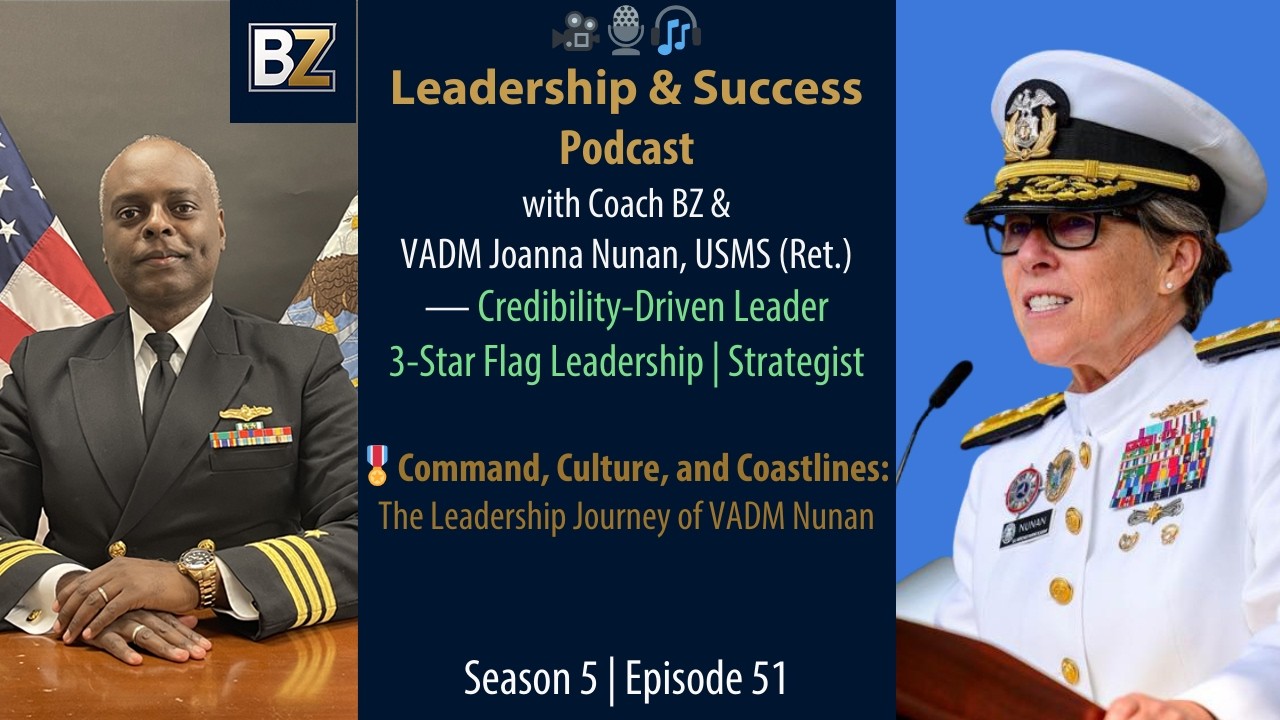
In this live episode of the Leadership and Success Podcast, host Bob Fabien Zinga (Coach BZ) interviews retired Vice Admiral Joanna Nunan, USCG, the first female superintendent of the United States Merchant Marine Academy (USMMA). The conversation opens with a moment of gratitude for service members and a remembrance of soldiers who died in the Iran conflict, setting a tone of mental‑health awareness. The interview weaves together historical context (World War II SPARS recruitment film), personal anecdotes, and professional milestones. Admiral Nunan reflects on the legacy of the SPARS, her own path from ballet to the Coast Guard Academy, and the pivotal decision to choose the Coast Guard over the Naval Academy, emphasizing purpose over prestige. She shares early leadership lessons about respecting the chain of command and the mentorship role of the chief’s mess. The dialogue explores operational command at sea, transitioning from the historic buoy tender USCGC Ironwood to the modern cutter USCGC Spar, and the challenges of leading through ship decommissioning and commissioning. Admiral Nunan discusses earning a merchant‑marine license, the interplay between the Coast Guard, Navy, and Merchant Marine, and her strategic‑level experience advising two cabinet secretaries during crises such as Hurricane Katrina. Themes of gender equity, imposter syndrome, and the importance of mentorship for women in male‑dominated environments recur throughout. She describes the cultural transformation she led at USMMA—modernizing facilities, strengthening accreditation, and preserving tradition—while staying connected to the “deck” through visible presence and open communication. The conversation concludes with advice on authenticity, resilience, and supporting high‑performing women, as well as personal reflections on defining success through family and balance. The episode ends with announcements of upcoming podcasts and a call for listeners to share takeaways.
Chapters
Hi, I'm John Maxwell. When the top companies in the world are looking for trainers, speakers, and coaches, there's one name that stands above the rest, and that's Maxwell Leadership. Our certified team members have gotten proven results for companies all over the globe, and our reputation, I'm proud to say, is second to none. Some of our members have risen to the top of their profession, including the one you're going to meet today. I proudly introduce you to my friend, Bob Fabien Zinga.
Welcome to the Leadership and Success Podcast with your host, Coach BZ, where we help you lead with purpose and succeed with impact. If you're ready to grow into the kind of leader others want to follow, this podcast is for you. If you're determined to elevate your success and leave a lasting legacy, this podcast is for you. As my mentor, Dr. John C. Maxwell, reminds us, everything rises and falls on leadership. Our goal is simple, to inspire you, challenge you, and equip you with insights that can transform the trajectory of your leadership journey. Welcome aboard to another episode of the Leadership and Success Podcast with with Coach Beasy.
The oldest of our fighting forces, with a tradition of courage second to none, the United States Coast Guard carries the war to the Axis on the seven seas. But nowhere do men of the Coast Guard wage more bitter and effective warfare than in the sub-infested waters of the Atlantic sea lanes. The U-boats must be battled to the death. The stuff of production must go through. For upon the Battle of the Atlantic depends the success of assaults in the making, the success of invasions to come. The men of the Coast Guard do their job and do it well. Yes, the SPARS have a job to do too. Perhaps our jobs are not, for the moment, so exciting as sending a depth charge over a cutter's side or seeing a telltale oil slick rise from a blasted sub. But they are vital jobs which must be done. Vital jobs done by women so that men may fight. That's why you join the SPARS. Basic training doesn't take long, only a month, and your pay begins at once. You learn to take orders and to carry them out. You acquire new vigor, new confidence. You learn to march with others and to work with others. And you learn too that to do your best is the proud tradition of the Coast Guard. You get good food, plenty of it. And boy, how you stow it away! In school, you learn the lore of ships and aircraft, the language of the sea. Then, almost before you know it, you pass in final review, no longer a boot, a full-fledged spa. Now, A man can go to sea. You take over his job with the same ratings, same pay, the same privileges, and the same responsibilities. These are the jobs which must be done by spars. Movement of ships and men entrusted to paper is also entrusted to you. There are many jobs the Coast Guard needs you for. Each one helps to win this war. And then too, the skills learned today will mean better jobs tomorrow. You won't get to be an Admiral, but you may be the Admiral's Secretary. If you are a laboratory technician, A dental hygienist, a dietitian, an engineer or a draftsman, the spas need your knowledge, your skill. This chemistry major found her berth, all right. Here too, a spa takes over. And one more pharmacist's mate can go to sea. You may be assigned to duty at one of many busy ports or stations. It may be Boston or New York, Miami or New Orleans, San Francisco or Seattle, or even at Coast Guard Headquarters waters in Washington. As men go to battle, SPARS take increasingly important assignments. Radio technicians are being trained to maintain the Coast Guard's contact between ship and shore. If you want to hear history History in the making, you couldn't pick a better spot. Out of this room go the commands to the men on the ships, to the men in the planes who carry out the missions which help defeat our enemies. The mission will be accomplished because the Coast Guard is always ready. More SPARS means more men on ships. More men on ships mean more missions accomplished. Join the SPARS and release a man for sea.
And we begin tonight with the history being made at the U.S. Merchant Marine Academy in Kings Point.
The world-renowned school has appointed its first female superintendent.
And the move comes as the academy continues to combat allegations of sexual misconduct surrounding a prestigious training program. In a field dominated by men, the U.S. Merchant Marine Academy in Kings Point will now see a woman step step up to be the first female superintendent. Her name is Joanna Noonan, and News 12 was there when she attended today's football game against the Coast Guard Academy. She's expected to officially start in a few weeks.
All right, the legend, the Admiral, is in the green room. So before I, uh, bring her in and do a quick introduction, uh, I wanted— this is the second podcast for the day. As you guys know who follow me, we always want to start with a moment of gratitude. And part of the reason why we do this is because in the military, it's about 21, 22 service members and veterans who commit suicide every single day. And we believe it's not possible to be suicidal and be grateful at the very same time. So this morning, I was grateful that I know two specific sailors. One, when I was a CEO, I sent to Djibouti, which is a combat area not too far from Iran. And I know another sailor who worked with me before who was in Bahrain. So I am so glad that so far they are okay. And my prayer is that they come back home in one piece after serving their country. But having said that, we took a moment of silence this morning. I just wanted to remember the 6 soldiers who died during this current conflict in Iran. That's Captain Cody A. Cork, 35 years old, US Army. Sergeant First Class Nicole Amore, 39, the only female so far, US Army. Sergeant First Class Noah Tijan, 42, US Army. And Major Jeffrey O'Brien, 45, US Army. And Chief Warrant Officer Robert Marzan, 54, US Army. And for me, It is really the one soldier that really broke my heart was the one who was only like 20, 20 years old, right? That's because that's the age of my daughter. I have two daughters, one who's 24, the other one who's 18, and my heart really breaks for him because at 20, you just getting started, you know, at life, trying to figure out who you are, what you wanna be, you have dreams, going to college. And in addition, he was actually going to, I believe it was Drake University, working to get a Bachelor of Science in cybersecurity, which is my field. So maybe one day he would have become an information warfare commander or maybe a Silicon Valley tech executive, who knows? But anyway, his life has been cut short and I do want to remember them and their family at this time. All right, having said that, let me introduce our guest who doesn't need I don't need any introduction. Today I'm really honored and privileged to be speaking and hosting Vice Admiral Joanna Noonan, US Maritime Service retired, former superintendent of the US Merchant Marine Academy, senior executive service leader and Rear Admiral in the US Coast Guard retired. So a proud graduate of the US Coast Guard Academy and 35-year operational leader, Vice Admiral Noonan commanded cutters from Alaska to the Pacific. She served in the office of two cabinet secretaries, led the Great Lakes District, and ultimately became the first woman to serve as superintendent of Kings Point. That's where I went to school there twice, actually. I love Kings Point. But at Kings Point, she really strengthened accreditation, modernized infrastructure, and elevated maritime leadership for the next generation. And she also did something about sexual harassment, which is just amazing. Everything she's been able to accomplish from cutter decks to cabinet-level strategy. From crisis response to institutional reform, from operational command to cultural transformation. This conversation, I believe, will challenge you to think differently about what leadership really requires. So without any further ado, please help me welcome to the Leadership and Success Podcast, the one and only, the legendary Admiral Joanna Muñoz.
Thank you.
Thank you.
Good afternoon, Admiral.
That was over the top, over the top.
Thank you. Well, we are so grateful you are here. Maybe to get started, ma'am, what is one thing you are grateful about?
Well, that's easy. And thank you for showing that video of the SPARS. I am so grateful for the SPARS that really set the stage for women who are serving today. They did an amazing job in World War II and were so successful. And so we are all standing on their shoulders.
That's right. And one, one, one line that made me laugh, they said, you may not become an admiral, but you're gonna be a secretary. I guess they didn't know about you.
Yeah, that was funny. Actually, there was a SPAR who was over 100 years old who came to visit Cleveland when I was having my relief week with Admiral June Ryan, who was the Great Lakes District Commander. I worked for her. And so we showed this movie in front of our SPAR, Mabel, and we just thought that was, uh, very funny. And then another woman replaced me, so there were 3 district commanders in a row that were women, and we were able to thank our SPAR for showing the way.
But I can't believe we are in 2026 but there's still inequality when it comes to pay, you know, gender pay equity. Even when I moved to Silicon Valley not too long ago, 12 years ago, I remember there was an advertising about a woman software engineer and a bunch of those white males just went crazy. They went berserk. Like, no, a woman cannot be an engineer. Of course they can. Of course they can. My goodness. Like, I'm married to a woman. I have two daughters. If it wasn't for my dog, I'd be the only male in my family. But I just don't understand how people don't understand that a woman can do everything a man can do, if not even better. It's like, come on already, man. Anyway, so grateful you are, Iyomam. Is there maybe Something about you when people first meet you, they may not know that you really care.
Well, one thing they may not know, and this is sort of, uh, right now. So after I, I, you know, left, uh, Kings Point and we've settled here in Mystic, Connecticut, I am on a bit of a sustainability mission. So we got solar panels on our house, we have two fully electric, uh, cars. I am— I composting, trying to reduce plastic, making my own chicken broth from chicken carcass. So I am on a mission, and probably most people do not know that and would be surprised.
Well, thank you for what you do to help preserve our world. We only have one world, although Elon Musk thinks we should be going to Mars or something, but I don't know about that. But yeah, I guess for us it happened when we moved to California. Of course, we love the environment. I used to call them tree huggers, but What we do in California, it does make a difference. Electric cars, solar system, and all of that. So thank you. So, uh, you once dreamed of becoming a ballerina, I understand. What did ballet teach you about discipline, composure, and leadership under pressure? That's pretty interesting.
So yeah, that was my original career plan, and ballet does teach you all of those things because you spend hours upon hours in, um, you know, in class. And part of the goal is to continue to improve. You become very good at taking critical criticism because you always can do better, jump higher, have better turnout, you know, movement, what, you know, turns. And so, and part of it is to try to make it look easy, and it is anything but easy. You know, sometimes you may be in your pointe shoes and your toes are bleeding You even think about when something beautiful happens on the stage and the ballet dancer is departing the stage, no matter what, you know, you sort of try to depart, you know, in a graceful way. So all of those things are just about discipline. When I was applying to the Coast Guard Academy and they looked at my background, they thought that actually it was the admissions officer said, you know, I'm looking at your record. You're at a Catholic girls' school, you're ballet. Cheerleading, you play the flute, you're taking Latin, you have 3-foot long hair. He's like, I think you should be going to Yale. That's what he told me. He tried to steer me towards another direction. And I thought, you don't realize, like, everything I have done actually sets me up for the Coast Guard Academy. I'm wearing a uniform, I have the discipline, I have the physical fitness, I have the academic training, and I can cut my hair. That's easy. Yes, there it is. There's my—
Now, talking about the Coast Guard Academy, what about the Naval Academy? I understand that in your family there was a little bit of a rift about that.
So that's my, that's my grandfather, uh, Tom Griffin. And when I came up— Captain Griffin. When I came up with the idea, uh, when my ballet teacher sat me down and said, you're not going to be a prima ballerina as much as you are the most most dedicated dancer I've ever trained. You know, she had a long list of why I wasn't going to make it as a prima ballerina. So I had to come up with a new idea, and I really thought about my grandfather's career. And he had served in the Navy from '42 to '75. Wow. And, uh, he went right from flight— right from high school to flight school. He graduated 1943. He was at the time the youngest aviator to graduate from flight school, except in the junior class there was a guy named George Bush. When he graduated, he was slightly younger than my grandfather. Yes. So I did originally think about the Naval Academy, and when I was looking into the Naval Academy, I discovered there was a Coast Guard Academy down the road, and I just visited both, fell in love with the Coast Guard missions. And my grandfather and my grandmother, they were like, you know, my grandfather's like, don't you know the Naval Academy is more prestigious than the Coast Guard Academy? And I said, I know, Papa, but I really want to be in the Coast Guard.
Yes.
So they said, so they, you know, obviously supported me and over the years they came to visit me in so many of my duty stations. They didn't pass away until 2014, so they got to see me in many places. And it was funny when my grandparents retired in Virginia, Waynesboro, Virginia, I was having, we were at the club for brunch and I was a captain at the time and my grandfather introduced me to some friends there. It's like Oh, this is Captain Newton, my granddaughter. And when she was applying to the Naval Academy and the Coast Guard Academy, I told her she would have a lot more opportunities in the Coast Guard. And I'm listening to my grandfather. I look over at my grandmother to see if she's reacting to this new reality. And she kept a straight face. So I'm going with it. He has changed the story.
Wow.
He gave me the good advice to go to the Coast Guard Academy.
That is really fantastic. It reminded me a little bit of— sorry. I guess she, she's the first African American woman who joined the Coast Guard, but she really, really wanted to join the Navy, but the Navy had some type of technical difficulties. I think it was racism, but anyway, she ended up joining the Coast Guard. So we've lost another one of those great female warriors, but it's just amazing how the Coast Guard has been so open to women and equity and really helping advance our society. It is, it is quite incredible, really being a leader in that front. Anyway, I am very grateful for that. So when you did choose the Coast Guard Academy over the Naval Academy, what principle kind of guided that decision for you? And what does that tell us today about choosing purpose over prestige, especially since you mentioned Yale?
Well, at that time it was a different time. So when I started it was 1983. When I visited the Naval Academy, I would meet midshipmen and some of them would say, oh, the women have it so great. They get to get the good shore jobs or something like that. Or the women have it so bad. We get to go out to sea and they have to stay on the little ships near the shore. And, you know, at that point women could not be on combat ships. They couldn't be on combatant planes. They couldn't be on submarines. And then you go to the Coast Guard Academy, and at that time, everyone graduated and went to sea. So that wasn't even a question. And they said to me, you know, if you want to go to flight school, you're going to need a 2-inch waiver, since I was 5'2". And I thought, that's cool.
Wow.
So I just loved the idea that I was not going to have any constraints because of my gender.. And I really thought the Coast Guard missions of search and rescue and law enforcement and really environmental response, uh, and the idea of small ships, yeah, appealing to me. So this is, um, the Coast Guard Cutter Spar, uh, crew of today. And I was the first commanding officer of the Spar, which kind of also ties back to the World War II women. But yes, that was why it was the missions, it was the equity. And, uh, and I did like that it was actually a small, smaller school. And so you don't really get lost in the crowd. Um, so those were some of the things that just became pretty obvious. That's what I wanted to do.
That's really amazing. Let's go back to your, uh, intern year. So as a young intern circa, uh, this time, uh, what type of mistakes did you make that you learned from? Because I know every intern makes a whole bunch of mistakes.
One of the first ones I can think of, and believe me, you know, we could use up this whole time talking about that, but one thing I remember is I was in charge of the galley. That was one of my jobs.
Yes. Very important.
The third class officer. So it was one of those times where we had some junior food, you know, cooks, and then we had a first class. And I remember at one point going right to the third class petty officer to give him some instructions or some ideas of things to do. And I had left out the chain of command. And I very quickly realized that was not a good idea. It works out way, well, you know, way better if I talk to the E-6 who then passes the word to the E-5 and the E-4 and the non-rates. And so that was definitely one of my first lessons. You know, another lesson was just the power of the chief's mess.
Yes.
And, you know, just that is a really tricky thing sometimes for junior officers to understand. And one of the beauties, I think, of going to a ship is that, especially if the ship's big enough, you do have a chief's mess. And there's so much wisdom in the chief's mess, and they want the JOs to be successful. They want them to be good senior leaders one day, and they really are trying to support you. At the same time, you're sort of navigating the fact that they're— that you're technically senior to them.
Yes.
You know, they are calling you ma'am or sir. So How do you manage that relationship and really make the most of it? Because it's a very great partnership.
Wow.
And for those outside of the maritime services, so the chiefs are the senior enlisted, E-7, E-8, E-9. And in my opinion, they are the anchor. They run the Navy. No questions about that. And they also mentor all of the JOs, right? Ensign, Lieutenant JG, Lieutenant, Lieutenant Commander. We've all been mentored by chiefs. If I didn't get accepted to be an officer, I was definitely going to retire as a chief. That was for sure. But anyway, thank you so much for mentioning that. But even today, even as a commander, I still have chiefs that mentor me. I really look up to because they really are the anchor. So let's talk a little bit about operational leadership at sea, which, you know, in the maritime services, there is nothing like it. It's really the apex of command. I had the opportunity and the privilege to command on shore duty, right, the Global Network Operations Security Center there in Suffolk, but being at sea, that is really what command is all about for all of the maritime services. So you commanded both the World War II-era Ironwood and then its modern replacement, SPAW, which of course has special meaning for you. What did commanding two different ships teach you about leading through transition?
That is a great question. It was a great privilege, you You know, if you think about it, when I got command of the Ironwood, I had previously been a junior officer on board a similar buoy tender. I had been an operations officer of a medium endurance cutter. Then I had been an XO of a World War II buoy tender. So by the time I got to the Ironwood, I really, I did feel that I had the preparation to do that. And, you know, the World War II vintage buoy tenders, you really get to learn things kind of the old-fashioned way because there was no bow thruster, there was no stern thruster. So you, but you're doing a lot of ship handling because you're setting buoys, you're coming in and out of port quite a bit. You have a pretty good-sized crew for 180-foot ship. You had, you know, 55 or 60 people on board. And just, you know, and especially being in Kodiak, Alaska, you're not necessarily always out in the best weather. So really planning, uh, your your trips, taking into account the weather, then planning for this decommissioning because that was something we had to— we were not going to be doing our mission for, you know, 6 months or so, so we had to really front-load a lot of our work before we decommissioned the ship. And then transitioning to the brand new ship, it was a pre-commissioned ship. So we went from being one of the oldest ships in the Coast Guard to the newest ship in the Coast Guard that was technologically advanced. It was a bit of a smaller crew, actually a bigger ship, and we were the first of the B-class. We were going to be sailing the ship out of the Great Lakes, and nobody on board, you know, the ship that was, uh, you know, in Kodiak had ever sailed in the Great Lakes or really done icebreaking. So really, how do you get ahead of that so that you are prepared for missions that you've never accomplished, sailing in an area that you never—
wow—
closing out one chapter which had so much history that Ironwood had served in, World War II all the way to the present, honoring that ship and those crews, that was really special. And then, you know, commissioning this new ship that was also, you know, named for these women in World War II, so that was a whole special piece of it too.
Absolutely.
So We were able to, to do that and sail around, you know, from the Great Lakes out through the St. Lawrence Seaway, down through the Panama Canal into Kodiak, Alaska. So this was in 2000, really before you had the internet. And so the SPARS figured out where we were going to be when somehow, and they would meet us in ports around the country. And it was so exciting to share That's amazing. With them. And I think it really gave the crew such an appreciation for, you know, what— who our namesake was and why that was pretty special.
Wow. That is really, really, truly amazing. What do you think was one of the hardest command decisions you ever had to make and how did you carry the weight of it?
Hmm.
Um, gosh, I— I don't know if it was the hardest one, but one that sort of, you know, kind of, I'll just say, tugs at your heart. At one point there was a junior officer that just could not figure out how to be a deck watch officer. He just couldn't get qualified. He didn't really understand how to, you know, sort of integrate what you're looking at on the radar with what you're looking at, you know, outside the ship. The chart, and he was really, really struggling. And we gave him so much help, and, you know, the quartermasters were trying to help him, and we gave him multiple times. And it was really hard because you want everyone to succeed, and he wanted to succeed. It just— he just couldn't get it. And it was very hard, you know, to sit down with him one day because I couldn't let him stand, you know, the enlisted watch, the quartermaster of the watch you know, he needed to stand the deck watch officer.
Yes.
So when I sat down with him and had the conversation with him, you know, the thing that happened, which was really great, is he was so relieved. He's like, yeah, that was really hard. I'm, you know, he said, I just couldn't get it. And it was very scary. It's like hard for me to sleep at night because I was just always worried that I didn't have it. So he did leave the ship. He went on and had a successful career ashore.
Wow.
And it's a good story because sometimes that's one of the things that a lot of us struggle with is actually giving someone constructive criticism. And in some cases, they are not suited for this position.
Hmm.
That is so true. Really, leadership does make a difference. Now, I guess you are just a superwoman, ma'am, because you ended up earning your merchant millionaire license, which you didn't have to. I guess just to show off, I guess. Why does credibility matter so much in leadership?
Well, it's funny. I don't think it was that I was trying to show off. I think it was a little bit of shame. I'll just tell you this story. So my husband and I were moving from— we were— I was on a ship in Guam, and then we got stationed in Alaska. And we were on the Alaska Marine Highway on this ship. And so I had just come from being XO of a buoy tender in Guam. So you know, I was a lieutenant— no, a new lieutenant commander. I made my way up to the bridge to say hi because I'm a fellow mariner. And it turns out the captain of the ship was an old-timer, and he had graduated from the U.S. Merchant Marine Academy.
Wow.
And he started giving me a hard time, and he's like, what is it, you know, you Coast Guard people, you can't even have ships, you don't even need a Coast Guard license. And so I was starting a 3-year tour ashore in Ketchikan, Alaska, And I thought, you know what, he— there's something about that. I think I should be able to earn a license. I should be able to match what I've learned so far in my career with the folks that are required to get a license. So I just— it was just one of those things I decided to do, and I did it during that tour. I met a woman who was upgrading her license from third mate to second mate. She had graduated from Cal Maritime, so the two of us studied together Wow. And we taught each other. There were some things that I knew that she wasn't so up on, like celestial navigation. There was a lot she knew that I hadn't really studied. Yes. Boat handling. And so I, I earned my Third Mate Unlimited, Second Mate 2,000 tons, and Master.
Wow.
Amazing. So really, BZ, I didn't really know what— how important that was. I got the certificate, which I have right behind me.
Yes.
You can see it's suitable for framing.
Well earned.
I put it in a box. I never even thought about it. I never even put it on my resume. And then many years later, I became the captain of the port in Honolulu. And I thought, you know what, I bet somebody might care that I had gone to the effort to do that.
Yes.
So I'm looking through all these boxes, I find it, and it had expired 2 weeks before I found it.
Oh no.
So I— someone said, well, go to the Coast Guard office and ask them if they can put it in continuity. And why you're asking for that. So I explained the situation. It was only 2 weeks, and continuity essentially means I can't run off and sail on it. I'd have to get some recency and take some classes over again. So the Coast Guard said, yep, we'll put your, your license in continuity. And so amazing. And I can tell you, people do care about that. I, I went, I did that. I understood what they were going through. I can tell you the King's Pointers they don't take it over a 3-year timeframe. They take all of those tests in like a 4-day period.
Wow.
It is challenging. So I'm very— I'm happy that I did that. And this is not the one with the continuity stamp on it. That was the original.
That is really amazing. I had the great privilege, I think it was last fiscal year, to actually sit on a board for the Navy Reserve from '03 to '04. And there were a whole bunch of merchant mariners who are in the reserve, but big difference between them and all of the other active reservists, they don't actually go to drills or do their 2-week safety or anything like that. But those certifications you're talking about, extremely, extremely important. So they explained to us, yeah, you won't see much as far as fit to weapon things, but if they have those qualifications, you absolutely have to promote them to the next level, which was pretty interesting. Which brings me to the next question for those listening right now, all of the maritime services, right? So we have the US Navy, which is under DOD, the Coast Guard, which is under DHS for some reason, except during times of war. And then we have the Merchant Marine, which is under the Department of Transport. Can you tell us how they are all related? Because we all pretty much wear the same rank. We have the same structure.
Yes, actually, yes. The US Maritime Service back during World War II and before that, that it was a truly, uh, you know, U.S. Maritime Service. The Merchant Marine was sort of under a, you know, one umbrella. Now it has really gone away from that. So the U.S. Maritime Service ranks pretty much— you'll, you'll mainly see them at the maritime academies. So you have the U.S. Merchant Marine Academy, the Federal Academy, then you have 6 state maritime academies.
Wow.
There's one in Maine, Massachusetts, New York, Texas, California, and the Great Lakes. And so at those maritime academies, people will be in uniform. They will be able to be promoted in different ranks. But there is some conversation that if we really do want to strengthen the Merchant Marine as a whole, should we bring that U.S. Maritime Service back where, you know, the Maritime Administrator is, you know, kind of honorarily, he he is the Commandant of the U.S. Maritime Service. And would you, you know, do something to tie that all back together? I don't know. But, you know, like the Coast Guard has been under several departments, the U.S. Maritime Service, I think, has, you know, also been under different departments. So it just sort of— but it's very similar. The uniform is very much like the Navy with with some different buttons.
And wow, that is amazing. And also, for the junior officers listening right now, I think it's important to know that you could have some potential opportunity in the other branches of services too. Like me, for example, I was enlisted when I first went to Kings Point. My only mistake is I went there during the winter, so I shouldn't have gone there in the winter. But, but anyway, they taught me network security, which, you know, later on became pretty much the way I made a living and I became an information professional and then information warfare officer. But again, they didn't even teach network security to me, the Merchant Marine did. So there could be a lot of opportunities out there that could later in your life and your career become very important. So you could be preparing for an opportunity you don't even know about by hanging out with the Coast Guard or the Merchant Marine.
So, well, there's definitely a need for more merchant mariners, and I would say enlisted personnel or officers, you know, should look at when they're transferring out of the Coast Guard or the Navy, look at opportunities to use their skills in the Merchant Marine, which are so many different types of ships and things that you can do ashore as well.
Wow, that is really amazing. Let's talk a little bit about crisis and national security leadership. Like I said in the introduction, ma'am, you advised two cabinet secretaries. What is different about leadership at the strategic level compared to tactical command?
So as an incident commander in the field, you essentially have, you know, your disaster or emergency, whatever it may be. Some of the things in the Coast Guard at a more junior level that, you know, I dealt with had to do with, you know, hurricanes, whether they were when I was stationed in Puerto Rico. We had a tsunami when I was the captain of port in Hawaii. We had a, basically a vessel that was suspected of carrying drugs. That was a very large vessel that came into port that we boarded when, as an interagency team when I was in Puerto Rico. But when you get to the departmental level, you're just looking at a much bigger scope. So I could tell you when I was at the Department of Transportation as the military assistant to Secretary Mineta, That was when I was a commander and he was my, you know, became my mentor and dear friend. We had Hurricane Katrina during that event. So that was a really big deal because some of the things that we were talking about is, you know, how port closures were affecting the fuel being moved in and out. And there were some pressure, some phone calls being made to the Secretary like, hey, can you get the Coast Guard to open up these ports? And that the Coast Guard had actually moved to DHS, uh, recently before I got there. And I, you know, I let him know, I said, sir, you know, the Coast Guard, believe me, the captain of the port is going to want to open the ports as soon as it's safe. Yeah, but you can't do it before then because you don't know if there's things that have, you know, that things that need to be cleared out of the waterway. One of the things that happened then, which is a really interesting story, is that one of the people who worked for the Maritime Administrator had graduated from Kings Point. And in New Orleans during, you know, Hurricane Katrina, a lot of the hotels were flooded. There was no place for the response people to work. He came up with the idea of using the state maritime academy training ships to assist in those response efforts.
Wow.
And I just thought that was such a great idea. So the two of us went in, briefed the Chief of staff. He's like, I think that's a great idea. We went in and briefed the Secretary. Next thing you know, I'm writing a letter that was signed by Secretary Mineta and Secretary Rumsfeld, which was the first time the U.S., you know, sent those ships for a disaster on U.S. soil. Some of the training ships went to New Orleans, became basically housing for the response after a few months. I got a call from one of Admiral Allen, he was the coordinator of that. His chief of staff called me and said, "Hey, this is really working out well. Can we keep the ships for a little bit longer?" So the cool thing about this story is now you have 20 years later, that model of those state maritime training ships being available for a large-scale emergency in the US helped them create these new training ships that are rolling out for each of the state academies, that that is one of their missions National Security.
That's amazing.
Wow.
Really, we have a history-making legend in the green room. That's incredible.
Wow.
And that's one thing, you know, when you look at whatever is happening in the industry, generally speaking, they make a lot more money than people who are in the service, but you just cannot get that joy, that satisfaction working toward the national security of the most powerful country in the world and really the impact you could potentially have just serving and focusing on your team. It's just unbelievable. Now, I must also say, ma'am, I'm sure many times throughout your career, you've been the one and only woman in the room. I know when I first started in cybersecurity, I used to be the one and only African American. It was mostly white male. And then I started to see women more and more, but we still are not where I think we should be. But I guess the question I have for you is what leadership muscle must be strongest when operating in a politically charged environment, especially when you are almost always the minority in the room?
Well, yeah, definitely. I have experienced that. Of the 5 cutters I've been stationed aboard, 4, I was the only woman.
Wow.
And it was the 5th one where there were other women on board. And, you know, I don't know about you, but you sort of kind of get used to that sometimes. You know, when I would show up on the ship, I would realize that in some ways it was more stressful for the men because I would find out later that they were all worried, oh, you know, she's going to come on board. Do we all need to get matching robes? Do we all have to stop swearing? You know, what is it going to be like? And then you get on board and they realize that you are, you know, just a normal person. And so the stress level goes down. But I can tell you, when I was on the final ship with other women, It was so great. It was just felt much more normal. It just felt like the women, you know, having several women just really kind of, I think, raised the standards.
Yes.
Raised the, um, just the, I don't know, uh, the professionalism and also just the enjoyment. It was just a very nice kind of interaction amongst the crew. And I thought, wow, I don't really want to be the only woman. Help it.
Yes.
But I think one of the things that you, you know, I think this is really for anybody, but I think sometimes if you feel like you are the only one sitting there, how do you use your voice? Because I think sometimes people don't want to speak up because they feel like, you know, what if I get the answer wrong? And sometimes that is, women definitely have that issue that, you know, you've heard about it where you have a classroom with boys and girls and the boys are like always raising their hand like, whether they have the right answer or not, they're ready to say something. And the, and the girls are sitting there like, they only really want to raise their hand if they're 100% sure they know they have it right. But I think each person really needs to be thinking about what they have to add, what is their voice. Sometimes if you're a junior person, you can prepare your boss ahead of time because with some of the preparatory work that you're doing. But sometimes you're going to find yourself in the room, either on the back row or at the table, And if you realize you are the only person with a perspective that needs to be shared or information that needs to be shared, you have to share it.
Yes.
You have to share it. And I think that sometimes I've even seen senior people who are not a minority in the room not saying anything.
Mm.
You know? So I think we need your voice to be able to make the best decisions and to be able to have these conversations. Because otherwise, if you're silent, then, you know, there's some of the perspectives that need to be in the room are not heard.
Yes, that is true. I don't know, maybe it's cultural because I've noticed even with my first kid and even my wife too, right? Sometimes men, when we see a job description, we only qualify maybe 30, 40% of the job, we apply for it. Okay, but women, they tend to wait until they are 100% qualified, know every single requirement of a job. Yeah, I meet that, I meet that, now I can apply. So that might be a disadvantage when you just have to be so careful and wait to be fully qualified before you even try. I don't know if you have a comment on that, but it's just something I have noticed.
I think it's really helpful if you have some mentors or some colleagues or friends that do push you so that beyond your comfort zone, because you're never going to be 100%, you know, ready.
True.
And, you know, I think that's one of the things that we learn when we're going through those at the Coast Guard Academy. It was SWAB summer or boot camp or OCS or whatever it may be. I think those opportunities that we have to put ourselves in a very uncomfortable position where we definitely do not feel ready. There are definitely moments of failure, but at the end of it, you come through and you realize you can do things that you didn't think you could do. And I feel like that foundation that we all have in the military is one of those things that does set us up for success. Because I feel like, you know, and then you get moved around every couple years and you're in a new job that you may not know that much about with people that you may or may not know. But what do you have in common? You have a common mission, you have a common, uh, you know, work ethic. And I think, you know, sort of humbleness goes a long way, and admitting when you don't know everything and really using the expertise of your team, um, is little bit like you keep jumping in the deep end, but you keep popping up. So you get more and more confident about doing things that you are not 100% ready for and figure out how to prepare, how to use your team and ask questions. Even to this day, I am never afraid to ask a question if, even if it seems like something I should already know, or maybe it's something I learned and I forgot. You have to be willing to do that.
Wow, so that's humility and courage. Now let's talk about, uh, historic institutional transformation and culture. And I wonder what prepared you for Kings Point, because that was quite an historic assignment. You took over Kings Point, you really focused on accreditation, modernization, and culture. They truly were in trouble and you turned that around. Uh, what do you think prepared you for such an assignment?
Um, what prepared me? What was the last part?
Yes, um, for y'all, King's Point. I think you were like the 14th superintendent, right? And the first and only female so far.
So when I was retiring from the Coast Guard, that was in 2022, and I found out that the job was coming open. Somebody, you know, brought that to my attention and said you should think about applying for it. Uh, in the 2023 National Defense Authorization Act, uh, that had about 73 recommendations for Kings Point. And it had to do with, uh, some of it had to do with culture, some of it had to do with sexual assault, sexual harassment prevention, uh, the facilities, um, the accreditation. And so at that point, you know, I mentioned, you know, getting the, the license, but the fact that they had sailed in the Coast Guard that I had been in charge of, you know, larger facilities, whether it be, you know, aging facilities in the Great Lakes, facilities in Hawaii, you know, both ships and stations, having that captain of the port experience, having that national security level experience. And then really my last 3 years in the Coast Guard, I was really focused on HR and training. I was CG-1, which is the assistant commandant for human Human Resources for 2 years, and then my last year in the Coast Guard, I was the Deputy for Personnel Readiness, which oversaw the HR and the training of the Coast Guard. So, so many of these issues that were in the National Defense Authorization Act, whether it was diversity, equity, inclusion, sexual harassment, sexual, uh, you know, assault, uh, really talent management, you know, uh, facilities. Yes, so many things. I felt like that is what I have been working on, and I felt at that moment uniquely qualified to be part of the solution and just realizing how important the U.S. Merchant Marine Academy is. And I even realized it more when I got there because, of course, I was always aware of the Merchant Marine Academy. That was the Coast Guard Academy's rival and football and whatnot. And I knew several, like you, I knew several Merchant Marine Academy graduates in the Coast Guard. Yes, and I never really knew why they all happened to be so impressive, but when I got to Kings Point and I saw what their program was— very challenging program— and they're just so qualified, you know, they're spending during their 4 years or going to sea for, you know, pretty much a year of that in a 4-month chunk and an 8-month chunk, getting this unlimited license, having these very challenging, um, majors. So I— it just really felt like at that moment for what they were being driven to do, very clearly what the goals were, I thought I could be helpful.
Wow.
But also for the junior officer listening now, especially female, they may be very intimidated, right, by all of your accomplishments. And some of them might wonder, have you ever felt that imposter syndrome, even though you are fully qualified and you plan and prepared for this type of mission, but once you get on the seat, you kind of maybe have some self-doubt. Am I— do I really deserve to be here? Or anything like that. Yeah, anything you want to share?
Yeah, no, I absolutely, uh, think that that is a very common thing. I have it, you know. And even if you're not doubting yourself, very often you know that other people are doubting you.
Yes.
And so how do you continue to believe in yourself, continue to move forward, be your authentic self, improve and learn, and address people, you know, address people's concerns or even your own concerns. So I think the best thing you can do is show up as who you are with what you know, ask questions, you know, work with the team, but not be afraid to keep moving forward. Because I, you know, one of the things I tried not to do too much over the years is let that kind of take over my mind. My mind, like, you know, do people really think I belong? Do they think I can do a good job? Because if you start doubting yourself, it just keeps you from doing your best. So you kind of just— I think you have to be yourself and you have to stay positive. And that, I think, is one of the things that has helped me out along the way is not necessarily believing that I'm, you know, the most qualified person, the smartest person in the room, but believing that I do belong there.
Yes, that's really insightful because there are two popular quotes from you, ma'am. I call them "Yoonanism." One of them, you said, "You can't stay in your office, right? You need to walk the deck, talk to your people, and listen." The most important thing is to know your people, where they come from, what motivates them, and what they need to succeed. So again, going back to King's point, you focus on accreditation, modernization, and culture. Where should a new leader kind of start when they inherit a struggling institution like you did, and how you were about to bring all of that turnaround?
Well, I think you have to come up with you know, sort of what are our priorities? And then how are we going to go about them? You have to have a clear mission so that the things that you do make sense, that you're not just reacting, you're not just, I'll just say, transactional, that you have some underlying beliefs in what you're trying to do so that everything makes sense. And then you're keeping people up to date on the progress because a lot of things are about communication. You can never— it seems like even when you think you're communicating all that you can, it's never enough. Finding opportunities not only in the small groups but in the bigger groups and even just to share your story outside the gates so that people know. That was one of the deputy Rear Admiral Dave Wolfe and I and the other senior folks, we really wanted to tell Kings Point's story There's some really great video work that was done to just let people know why they should know about the Merchant Marine Academy, why it is important, why if you didn't have a Merchant Marine Academy you need to create one, because yes, that is where the strategic sealift officers come from. You mentioned that early. I mean, most of the Navy reservists who are strategic sealift officers are Kings Point graduates.
Wow.
So they understand you know, logistics. Every phase of the operation, you're not going to be able to win a war without strategic sealift officers from Kings Point. And so I love the fact that the Merchant Marine Academy, the payback, uh, for 5 years after you graduate is mainly people serving as strategic sealift officers in the Navy Reserve, but they can also serve in any of the other branches on active duty.
Wow.
And so I love the idea that there are some, you know, Kings Pointers out there in the active duty Navy and the Marines and the Air Force, the Coast Guard, because those folks really get it and they can bring that knowledge to their service about how it all works.
Wow.
But I guess the other question I had, because you really had the mission to modernize, but as we all know, especially in maritime services, we have a lot of customs and tradition. So how do you modernize without alienating tradition, and how did you walk that path?
Well, definitely one of the most significant things that needed to be done at Kings Point, which is a process, it's not like I just fixed everything, you know, so one of it is the facilities. I mean, it, you know, they're over 80 years old, the investment that has been needed in the facilities over the years hasn't happened yet. So one of the things I was very proud that, you know, the Deputy Reverend Wolf and I left was a long-term master facility plan. We signed a 10-year MOA with the Army Corps of Engineers, and those are the pros that are going to be able to get all that work done. So through that long-range master facility planning, we were able to do just what you're talking about. How do you keep the historical, beautiful, cool things at Kings Point— that there's so much history there— But how do you also modernize that and how do you have a, you know, sort of so that it flows and it makes sense and that it's, it's very appealing but you don't, you know, get rid of all those historical, you know, pieces. So I think it's something you think about every day and I will tell you that Kings Point has a lot of really neat traditions and that are super, super special that you don't want to let go of. But at the same time and that midshipmen will be the ones pressing forward on— they want to learn the latest and greatest on AI or nuclear power, you know, you know, and have the experiences to set them up for success. So it is a, it's a great challenge to have to modernize while keeping your traditions and history. Wow.
I guess something I mentioned earlier, one of your unionism, right, walking the deck and knowing your people That's pretty easy to do when you have a small boat or, no, small command, but a great command like Kings Point. How in the world do you do that in large organization? How does a senior leader stay connected to the deck plates?
Well, one thing that you do is that you are present. So I'll just say one of the most fun parts about the job is to be present when the midshipmen are doing the things that they love to do, whether it's sports or sailing or music or different clubs that they do. So my husband Tom, you know, he and I really just went all in. It's a very, I'll just say, 24/7 type of lifestyle. You're living on the campus, you're going to their basketball games, their wrestling tournaments, their, you know, events at the chapel.. So we would be there. So, and we're, you know, typically I'm showing up in my Kings Point, you know, wear. I'm there in the audience or in the stands cheering people on, trying to wander around, saying hello to the midshipmen, their parents, and just being accessible. So that was a little bit part of my plan, like to be there in, in times where I am very approachable and, you know, cheering them on. So that was one part of it. Part of it is, you know, there are definitely formalized ways, you know, we had a faculty forum, so I tried to be extremely available to the faculty forum. We had, you know, regular meetings, but then there were times that they wanted to present something to me, so I made sure that they knew that that was a high priority. If they wanted to meet, I'm there. So it's not, it's not as big of a place as you might think. So you can get around. There's so many touch points where there's opportunities to engage formally and informally. So I tried to really do that because that was one of the really highlights of the job.
Well, that's, that's really putting a priority on it. So we only have about, what, 5 minutes left. So I'm going to end with women in leadership and barrier breaking. So like we've said several times, you are the very first woman to lead the US Merchant Marine Academy. How do you carry the weight of being the first without letting it define you?
I guess I didn't really spend too much time dwelling on that. Again, I had had so many opportunities during my Coast Guard career where I was the first. And, and so you, you get very good at just being yourself. And you hope that other people, men and women, see that if you are, you know, yourself, you're leading from a place of, you know, just, I guess the word is authenticity.
Yes.
Excited, you're positive. You want to support them. And help them be successful. You know, you just don't— again, I just didn't really spend a lot of time dwelling on it, but you are very, you know, you're very conscious that you are a role model. And that is part of what I, you know, want to leave, you know, as I guess a legacy of being a role model for people to see just, you know, the impact of being in public service, whether that's in the military or in the federal service. And how important that is and also that it is fun. I mean, I really, really hope that people saw me enjoying what I was doing.
Yes. So what advice then would you give women navigating male-dominated environments?
Yeah, I would say keep going.
Yes.
Don't be afraid. And because— and look at our history. There are so many women who have done amazing things for our entire history of our country, and that's just our country. And so don't be afraid. You can do it. There's nothing you can't do.
Yes.
You know, and just keep going and, and don't be discouraged. And find friends, colleagues, allies, mentors, people that believe in you, even if when you don't believe in yourself.
Yes. And, uh, how would you say, Admiral, how can male leaders better support high-performing women? In their organizations?
I think sometimes it's things that they can do when they're in the room with you.
Yes.
So they can reinforce your good idea at the table. Because sometimes women have experienced the opposite where they bring up this good idea and nobody really responds. And a little bit later, the man brings it up and everybody thinks it's a great idea.
Yes, I've seen that.
Be on the lookout for that. Don't let that happen. And then also And also, what do you say about the women when they're not there?
Yes.
When you're in the locker room, when you're in the gym, like if people are saying things that are not professional, not supportive, speak up for them. Because I think that is so important. And also, you know, talk, you know, find out how they can, you can support them and they can support you. It's a team.
Wow.
All right. All good things need to come to an end. Admiral, is there a question I should have asked you I didn't get a chance to ask today?
Gosh. Well, what I want to say, BZ, is I really appreciate this platform that you have. And I love that you are just giving different leaders a chance to tell their story. Because I think your audience, they're going to relate to something that they hear from me or I enjoyed your conversation with Marcus Kennedy and my good friend, Reverend Melissa Burt. And so each person is kind of going to give them the idea that leadership isn't just one cookie cutter. It's really each person navigating this and not by themselves. So how you define success is really kind of personal. And for me, it's been doing it with my family every step of the way, every time we're about to get transferred again. Checked in with the family, like, hey, are people still ready for another move? Yes, they were. Because at the end of your— at the end of the day, at the end of your career, you do want to be with your family team, uh, together. So you have to really keep that in mind too, what success means. So I could have felt like I was a complete success as a commanding officer of a buoy tender, as a lieutenant commander. That was kind of my goal. Just the fact that I made it further is great. But the reason why I feel very successful is that I did it in a way that at the end of my career, I felt like I'm here with my family and really happy.
Well, thank you. Thank you so much for your time, Admiral Berry. Last question I'm going to have for you. I think you were about 17 years old here. What would you say to your 17-year-old self?
Self?
Yeah, um, you know, it's one of those things where I think it's good that your 17-year-old self doesn't know what the future holds, because I think it's better that way. It's better that you are living your life every step of the way. So I guess I would just say, you know, work hard, uh, don't get discouraged, have fun. And, um, you know, uh, it'll probably work out. And also, also, always don't put all your eggs in one basket. So one of the things I have talked about before is this idea of a graceful exit. And that wasn't just the exit at the end of my career, it was like during my career. I always wanted to feel like if I was staying in the Coast Guard for all that time, it wasn't because I didn't have any other options, it was because that's what I really wanted to do. But each step of the way, I thought If for some reason my career ends, you know, tomorrow, what else do I want to do? I think it's very helpful because sometimes I think people get their whole, uh, being wrapped around one title or one job or one service, and that could, that could, um, not be the best thing. So always think about who you are, what you can do in the service, doing other things, helping other people. And being part of your community. So I think look at yourself in a broader way because you are a whole person.
Wow, that is really powerful. Thanks so much for your time, Admiral. It's been an hour now and we really, really appreciate it. Man, this has been quite an insightful conversation. Thank you.
Thank you, Bizzy. Okay.
Bye. All right, everybody, you've heard from the legendary Admiral and I really love what she said, right, to your 17-year-old self. Work hard, have fun. Make sure to have fun because sometimes we forget about that. We take ourselves way, way too seriously, right? Don't get discouraged and don't have all of your eggs in one basket. I think that really does it. All right, thanks again for everybody watching live. And I also want to acknowledge we had someone— sorry, I didn't look at the chat earlier, but, uh, Mustafa, uh, CC from Sweden, right? Uh, the World Maritime University. Thank you for, uh, um, being here. It's an honor, uh, to have you here on the Leadership and Success Podcast. So I want to remind everyone that, uh, tomorrow I will have a leadership conversation with, uh, Gaelle Kowanda. She's a champion for women in cyber, cybersecurity, and global community, uh, builder. She leads tech. She— that's gonna be the title of our show tomorrow, Empowering the Next Generation of Cyber Leaders. And it's really amazing to me, and I love to see, to see more minorities and women in cyber, in tech, in the military. I really believe our country should reflect our diversity, and that is just wonderful. And also, whenever I get the chance next week, I'm gonna go back to the book of Proverbs. We're gonna be studying now Chapter 18. This is not a religious study, but it's about ancient wisdom and leadership lessons from the Book of Proverbs, a book written more than 2,000 years ago, but it's still very much relevant today in 2026. All right, that's all I have for you. The replay is available immediately on YouTube and LinkedIn, and it should be available on your favorite podcast player by the end of today. And have a wonderful rest of your day. And as you are watching, please type in the comment 3 takeaways from today's podcast and one leadership principle you are going to be able to put in practice this weekend. Now, thanks again for watching. Bye for now.
Thank you for tuning in to the Leadership and Success Podcast with your host, Coach BZ. If today's episode added value to your leadership journey, be sure to subscribe, share, and join us again for more wisdom nuggets on how to lead better and achieve greater success. Remember, leadership is the most critical skill of our time. The world will always need leaders to inspire others, drive innovation, and execute meaningful strategy. So why not count yourself among the bold leaders shaping the 21st century? Until next time, stay inspired, stay committed, and keep leading with excellence.
More from Bob

S250:E4🎙️LIVE 🇺🇸America 250: President Barack Obama Leadership, Service, and the Power of Hope






S5:E157🎙️ LIVE with CMD CMSgt Dennis L. Fritz, USAF (Ret.)(Multi Tracks Audio)



S5:E156🎙️ LIVE 🇪🇸 Leadership Lessons from the FIFA World Cup 2026 Champions (Multi Tracks Audio)

S250:E3🎙️ LIVE Leadership Lessons from America’s First Documented Family of African Descent 🇺🇸📖