S5E64🎙️ LIVE with Aarti Gadhia (Multi Tracks Audio)
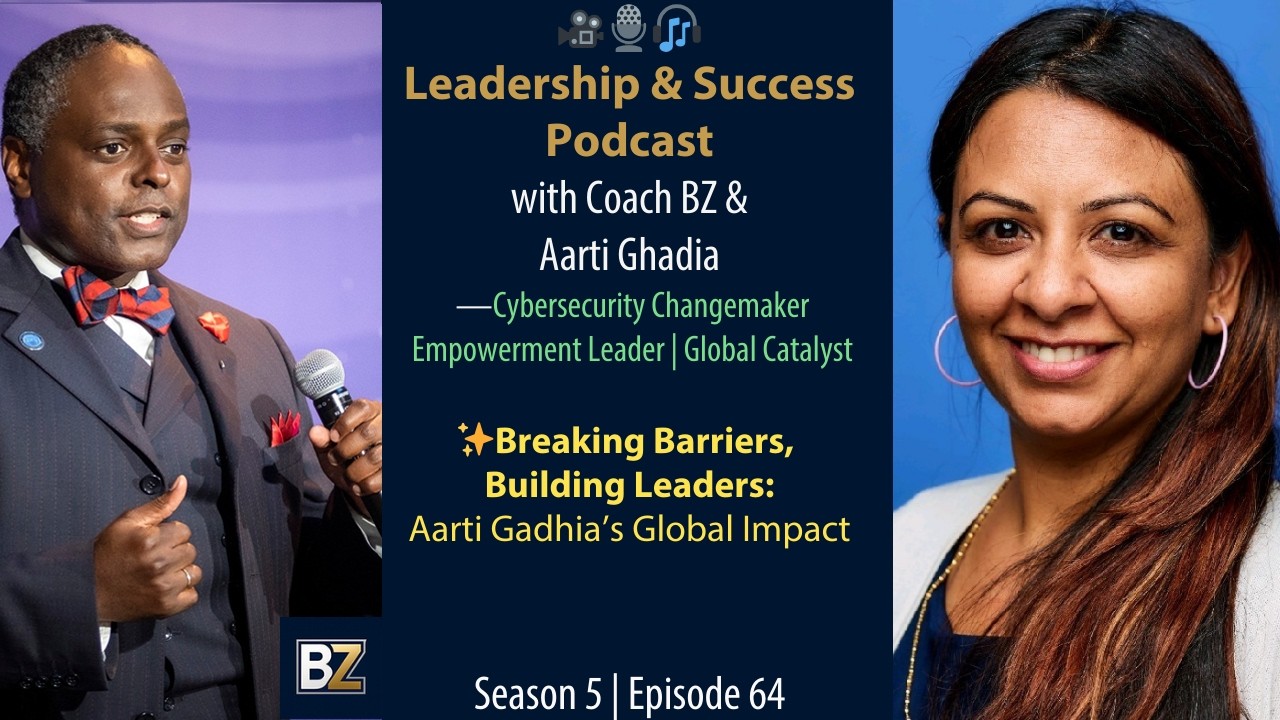
Aarti Gadhia, a 25-year cybersecurity veteran, talks about building inclusive teams, challenging biased hiring, and five leadership principles: purpose, authenticity, networking, champion building, and personal branding. She shares how she moved from credential-based to skill-based hiring and what cybersecurity leadership looks like in 2030.
Chapters
Hi, I'm John Maxwell.
When the top companies in the world are looking for trainers, speakers, and coaches, there's one name that stands above the rest, and that's Maxwell Leadership. Our certified team members have gotten proven results for companies all over the globe, and our reputation, I'm proud to say, is second to none. Some of our members have risen to the top of their profession, including the one you're going to meet today. I proudly introduce you to my friend Bob Fabien Zinga.
Welcome to the Leadership Success Podcast with your host, Coach BZ, where we help you lead with purpose and succeed with impact. If you're ready to grow into the kind of leader others want to follow, this podcast is for you. If you're determined to elevate your success and leave a lasting legacy, this podcast is for you. As my mentor, Dr. John C. Maxwell, reminds us, everything rises and falls on leadership. Our goal is simple: to inspire you, challenge you, and equip you with insights that can transform the trajectory of your leadership journey. Welcome aboard to another episode of the Leadership and Success Podcast with Coach BZ.
It was a Tuesday morning. I was a student at the University of Toronto and getting ready for class, saw the news out of the corner of my eye, and it was the Twin Towers crumbling. The industry has changed incredibly. When I first joined IT, all men, you know, I was always the only woman in the room.
Now, today, when I go to conferences and things of that nature, I see more women.
It was my experience at the United States Military Military Academy at West Point that introduced me into national security and protection of the country at large. I chose security and it chose me back, and we've been choosing each other ever since. In my career, I have dealt with sexual harassment. I have dealt greatly with discrimination. I have dealt with violence. I have been assaulted. That is not because I'm a woman in the security profession, but just because I'm a woman, period.
It was very important for me at the time to be successful and to be included and to be credible in the industry. So I worked probably harder than most people. I didn't want to focus on the fact I was a minority, which I was.
But I see the challenge as an opportunity just to continue to shatter glass ceilings and inspire those coming in behind me. 5 things, key takeaways. I found my voice at the age of 16, and that was what built my purpose. First thing is think about what your purpose is and start building your purpose. It will take a journey, but again, as you'll see why it's important. The second thing is don't change who you are. Be authentic, be yourself. Third one is network. Network as much as you can. Build those connections because you never know, even someone on the bus, you never know what that connection is going to be as part of your journey. Build champions. Find mentors, yes, but build champions. Those are the people who are talking about you when you're not in the room. And the last one is build your personal brand, but tie it back to the first thing, which is around what your purpose is. These 5 tips, I hope— my hope is that you take 1 or 2 out of these and start working with it. With that, I want to say thank you. Arigato gozaimasu. Merci beaucoup. Asante sana. Thank you.
All right, welcome to the third episode of the Leadership and Success Podcast today. All right, uh, this is the third time around, so as you know, we like to start with our moment of gratitude. So you already know, today I am grateful to really be standing on the shoulder of giants, all of the trailblazers, people who have gone ahead of us and who have made it possible for somebody like me to become a commander in the United States Navy, the most powerful navy in the world, but also a cybersecurity executive here in Silicon Valley. So I am so, so grateful. I stand on the shoulders of giants. So let us know in the comment where you are joining us from. So we've become an international global podcast. So let us know which city and state if within the US and which country if you are outside of the United States of America. Let us also know what you are grateful for. And if you have a question for our guest today, go ahead and type the question in the comment and we will try to answer your question live. Okay, let me see if I can properly introduce our guest. I am really honored and privileged today to be speaking to the one and only Aarthi Gadiya. She's a cybersecurity leader with over 25 years of global experience spanning organizations like Microsoft, VMware Carbon Black, BirdCloud, Trend Micro, and so forth. She's the founder of Stand Out to Lead and She, S-H-E, S for sharing, H for her, and E for empowerment, Share Her Empowerment. These are initiatives focused on empowering women and underrepresented groups to step into leadership and boardroom roles. She's recognized as one of the top 20 women in cybersecurity, and top 20 cybersecurity women of the world. This was just last year. Board director, advisor, speaker, mentor, author of Rise of the Cyber Women— I should say co-author— a powerful advocate for authentic leadership, inclusion, and opportunity creation. She's also been featured in the trailer I just showed you just a minute ago, and everybody needs to support this documentary and watch it, The Women in Cybersecurity. Documentary. I mean, I wonder if she even has time to sleep sometimes. It's like she's so busy doing everything, but she's really adding a lot of value into our industry. And it's just a great, great honor for me to be speaking to her today. Right? Her mission is simple and very, very powerful: break barriers and build leaders and create access. So without any ado, please help me welcome to the Leadership and Success Podcast, the one and only Aarti Gadhiya. All right, good afternoon. How are you doing today, Aarti?
I am good.
Oh, what a great honor to have you on the podcast today.
Likewise, really grateful for you to, uh, give me this platform to join you and share my voice and story. So thank you.
Absolutely. Is there something else you are grateful for today? And it's Women's History Month too, by the way, which is pretty cool.
Yes. Well, definitely grateful for everyone who has supported me in my journey. Specifically today, I know there's some viewers who are watching. So grateful that you're taking the time to listen. So thank you.
Wow.
Is there something about you that most people may not know when they first meet you?
Um, I guess it would be my background. Uh, when people meet me, uh, a lot of people don't know my background, my upbringing, you know, move different countries. Um, so there's, there's a lot, a lot of things that people don't know that I'm happy to share today. Definitely looking forward to it.
Well, they may not know is you were born in Kenya, so that's East Africa, and I was born in the Congo, Central Africa. So you are my African-American Canadian sister from another mother. I mean, we both speak about 5 5, 6 languages or so, which is pretty impressive since American and Canadian hardly speak one language. But really, really, really glad and so proud to be speaking to you. So let me ask you, your journey really began in Kenya and moved through the UK and flourished in Canada, the 51st state of the US. I hope not. Okay. How did those early experiences shape the leader you are today?
Oh my gosh. Yes, that's a great question. Firstly, jambo. Namaste, bonjour, konnichiwa, and greetings. That's all the languages which you do speak.
Swahili also, which is an African language that is quite popular in East Africa, Central Africa too.
But exactly, yes, thank you. I haven't been to Congo, but definitely the next time I visit back home, I want to see a lot more countries there. So Congo is on the list. Yes. Absolutely. So back to your question. Definitely, I like to start with my roots, which is my upbringing and the values that I got from my parents. So full credit to why I'm sitting here today is because of my mom and dad. So mom and dad, if you're listening, I am here. I'm grateful for, for what you've done. And it's the values that my parents instilled from me. And that's those early experiences have helped shape me for who I am, for what I believe in, and the values. So they gave me that foundation, you know, that strong, solid foundation that my parents gave me. And one of the things I always learned from, from this whole journey and what they've taught me is be who you are and don't change your values. And that's something I've always carried with me from, from my parents, um, because it's something that always I remind myself every single day.
That is so powerful. Be who you are. Wow. Yeah. I guess you didn't really have to deal much with peer pressure being a teenager, huh? But that is really great, great advice. Now, what most people may not know, you shared with me, you're actually an introvert. But looking at your success and everything you do, it's like you're always out there. But at 16 years old, you spoke in front of 500 people. Wow. About the lack of women in leadership. I'm sure that took a lot of courage. What gave you that courage, you think? And what did that moment teach you about leadership?
Yes. You know, what was really interesting is that my mom threw me into that opportunity and I hated it every moment. I'm like, Mom, why did you do this to me? And it was a good thing, actually. I mean, you only see the good thing afterwards. But she said, you know, I've put your name in to go and speak to the local community. And I'm like, great. I've never done a talk before. Like you called out, I'm an introvert here. And it was not something I was comfortable doing. So what happened, what actually gave me that courage actually was it got me thinking, you know, like my aunt who's no longer here, but she was a significant inspiration to me. So after she lost her husband at a very young age with 2 children, she was financially dependent as she was a homemaker. And back home, you know, a lot of the women didn't work because they were homemakers and they looked after the household. And in her case, you know, once she lost her husband and she was fully dependent, I actually saw what— I witnessed what happened to her and how she had to build herself up. And it wasn't easy, especially since you don't have that foundation. And that's what actually— when I saw my parents supported her and she went to college and she picked herself up, I saw that transformation. She learned English. She started her own. She built a very successful career.
Wow.
That experience, actually, that gave me that courage, that showed me the power of that independent woman You know, no matter what situation or circumstance you're in, she picked herself and she achieved a lot. And, you know, it's, it's too bad she's not here, but, you know, she was definitely a big inspiration when I saw her journey. And that's what really sparked that initial thought. If— is it got me thinking when I was preparing, of course, as much as I hated going out and speaking on that stage, it got me thinking. And I was like, well, I've got to figure out what I need to do and what I need to say. And One thing that really bothered me for a long time is I saw the committee, they were all senior leaders and they were all male. And that bothered me a lot, right?
Yes.
I was like, why don't we have, you know, that curiosity? Why don't we have women on that committee? Because look at the powerful women in our community and what they can bring into this community board. And so when I went on stage, I actually said, you know, I'd like to see more women onto the committee. And I paused and I literally looked around the room and I'm like, I don't know what— how people are going to take this. Uh, you know, at 16 you're like, you're not sure.
Wow.
But it was really good because, you know, as I walked down and people clapped and I was like, yeah, okay, I'm 16, maybe they just thought that was nice. Whatever. The best thing was that same year, the committee appointed 2 women on the board.
Wow.
So that was phenomenal. And this is kind of, you know, to the viewers, is my advice is find opportunities where you can use your voice and you can make that positive change. It can be anywhere. It doesn't have to be on stage like in my situation. It could be, you know, at school with your kids, you know, or amongst your friends, amongst your co-workers. Find that opportunity where you could use that voice.
That's, that's really powerful. And being an introvert doesn't mean you can't speak in public, but usually it takes you a lot more energy than those who are extroverts. So how do you usually kind of recharge and refill your tank? What kind of activities do you do?
Yeah, what kind of activities I do is I do yoga. And so that's really good. So whenever I'm not traveling, I'll go Oxygen Yoga. It's my 4:45 class. I go Cool. Every time. The other thing as well is I've got a dog, so he fuels my energy. Nice. As introverts, we like our quiet one-on-one space, right? And that's how we get our energy. And that's some of the ways I get that energy. But more importantly than that is what keeps me going is having that clear purpose. And that's why I do this. It's getting out of my comfort zone.
Yes.
Because I have a clear purpose and I'm excited about the impact it creates.
Wow.
So because of your why, you get in uncomfortable position because you know the impact you might have on just one being. That is powerful.
Wow.
Okay. So was there maybe like a defining moment when you realized that your purpose was to advocate for underrepresented voices?
Yeah, you know, I only fully realized I was actually advocating for underrepresented voices, like specifically immigrants and women, while I was searching to build my brand. I didn't know I was already doing this, right? It's like you don't realize this until I, I got to that point when I'd had a situation and a CEO had told me you need to work towards building your personal brand because I was trying to figure out what am I not doing, why am I not getting that promotion.
Yes.
And so, this process was actually a journey because through it, I was able to define my purpose. And that's once I started learning how to build my brand. It's back to what you mentioned, the why, right? And that why was what was— I needed to know that. And the way I got to know that was when I was building this personal brand. And this is back to the advice I'll give to the viewers is build your personal brand and make sure you align it to your purpose. And the best way to do this is just ask a few examples. What do you value the most and why? What do you want your network to know you for and why?
Well, since you are coming to us from Canada, let me ask you this. If there is a young immigrant woman listening right now in North America, what would you ask them to do? Let's say tomorrow you have about 60 Second, what is the first thing they should do?
They should network. If someone's new, expand network, get to know more people because that's what I learned the hard way. I didn't network in the beginning. So new immigrants, go network, go volunteer.
Powerful, powerful. All right, let's talk about your career mastery, really excellence in execution. You have consistently been a top performer across companies like Sophos, Trend Micro, VMware. By the way, I work for VMware. VMware sister company, back then we were under EMC, Pivotal, but Carbon Black, you know, Bugcrowd and Microsoft. So what separates high performers from average performers, you think?
Yeah, that's a really good question. So I currently work, I joined this new company here called Centra. And, you know, back to your point is you're new and you still need to show your value. You're not yet a top performer because you're new, right? And so, here's the biggest thing I like to share is that building trust and ensuring transparency. That's really key of what has made me consistently that top performer is just like with all customers I speak to. I make it a point. I tell customers I was just on a call earlier today and I said, we figured out this is not her role and we are speaking to her about how we can solve a solution, but it's not under her area. So we cut it off and we just said, you know what, actually, we don't want to waste your time. And let's figure out what is it that matters to you and just being upfront. Because what I feel is that, you know, that relationship that I had with this individual earlier on today, for example, is she'll remember because I gave— I didn't do this whole boring all-call and tell her my pitch. It wasn't relevant to her. And she'll remember that. So next time, if I change, you know, a role, or if we have an extended offering that would be of value to her, now that I know what she does and she knows what I do a little bit, and I ended it early, giving her back time, which she appreciated.
Wow.
Just letting her know. And she'll remember me. I'll remember her. And we'll remember that conversation. And a lot of times, I like to say is that even if you think about shopping or your own personal experience. You always have your favorite mortgage broker, or you have your favorite store that you go to. And a lot of the loyalty stems from trust. It's, it's that positive experience and the confidence you've built over time that I know sometimes I'll go to the same store even though I know sometimes they charge more than driving further else, just because experience and the trust they built with me.
Wow, that is really, really powerful. Now, you've also led across global markets, US, Canada, APAC, and on and on. How do you adapt your leadership style across different cultures?
Yeah, and I love this cultural one because, you know, you and I have moved around, right, from Africa and then come to the Western world. And the answer is so simple. You know, it's just cultivating that learning mindset. And as we moved, that's one of the things we brought with us. You know, when moving from Kenya, as we were chatting before, did you enjoy the move initially, right? And it was, there was a lot to learn when you're moving from Kenya or from Africa into the country, right? And, you know, just in general, I would say it's just creating and cultivating that mindset and I share this example, like before the pandemic, you know, this is the second time I was trying to go to Japan. First was when I was in university and I couldn't go to do that exchange program in Japan because of my passport. And so the second time I tried to go to Japan and it didn't work out because then the pandemic hit, unfortunately. But it's on my wish list to go to Japan. But one of the things is, you know, as I was preparing this before the pandemic hit, I was preparing for that trip. And you know, it's just learning about the different cultures. And one of the advice that this champion had shared to me as we were organizing this event in Japan with him, and I usually like at the end of my talk, raise your hand if you've got any questions. And you know, I was role-playing this, this is what I'm going to do because I want to learn what's going to resonate with the group there. And You know, the first thing he said is, don't, don't end with that. Don't, don't ask about questions because the culture there— change it to, if you have any questions, come, come here in the front and ask me those questions. So it's, you know, like different areas, different regions. And it was really good because you're still going to get what you want to get out of it, but it's just, it takes a different form, right? Um, versus, you know, if I were to do it here in the US, for example, then I would say, who has questions and raise your hand, right?
Yes. Wow. Because looking over your career, another reason why I'm so proud and really privileged to talk to you right now, you've broken a lot of barriers throughout your career. For example, you did encounter a biased hiring system early in your career, but unlike most people, you actually chose to challenge it. So what did that experience teach you about influence and really change inside an organization.
Yeah. And just to highlight a little bit about what the bias I encountered is, this is earlier on my career and new in Canada. I was first year in the job and I'd applied for a senior role. That was my next step is to move into that role in sales. And I had to take this terrible personality test. And I knew that Going back, I'm an introvert. And my manager at that time hinted to me, "Hey, by the way, in this personality test, the people that are successful in the next stage have to be in that top quadrant. And that fits the extrovert." I was in the bottom quadrant. And so, I had two choices. Do I fill this? And my manager had hinted this to me. Do I fill this based on you know, that one. So at least I push on to that next stage and then have a conversation. At least they'll get to see who I am. Or do I answer it truthfully? And so sometimes, you know, like in that scenario, I answered it truthfully. I didn't get the role, and I was afraid. I didn't know how to speak up because I was still earlier on in my career. I didn't know how to speak up. I didn't know what to do at that moment because I felt that was wrong, right, in the recruitment system. But I thought I had to figure out how do I make a difference that's going to change this eventually because I've got to figure out how to get rid of that personality test. I wasn't ready to speak up and that's okay, right? And so, for me, as an introvert, my goal was I took that approach was I need to prove to the director that Even introverts are actually top sellers. It's not about who has the gift of the gab, right? It's what I had said, right, is I was determined to figure out how do I remove that barrier. And if I remove that barrier, there's many people, not just myself but other individuals who are like me, who are and will be successful, but they're just not getting that opportunity. And so what I did was I led by example. I joined another team. Another manager gave me this opportunity. I became the number one representative. And that changed. And, you know, that's what I learned along the way was how to show your value within the organization. And by doing that, I was able to influence change because at that moment, I was able to find that inner voice. And in fact, I didn't even have to say anything because I led by example. His director actually felt, well, there's a flaw in my system, my recruitment process. And he removed that personality test. Open doors to so many other people like me.
That's amazing.
Yeah, who have a different approach to selling because I felt it's, you know, diversity is important. You don't always have to be in that top quadrant. Every individual has their unique strengths and, you know, they can contribute and everyone can be successful.
That is so insightful. Let me ask you, because in your career and your life, this theme keeps recurring over and over and over again. First of all, just to be frank, this world was meant really for white male. That's how it was created, who it was created for. So you are a woman, maybe you had an accent and you are a person of color. Most people in your position would be like, let me just shut up and I have nothing to say. Let me just zip it and suffer through the consequences. But you, people would label you as a troublemaker. It's like you just want to change things and you have that idea that things can be better and you help make them better. What, what do you think is really driving you? That courage, that grit, that confidence, that, uh, I don't know, uh, what should I call it? You— there is something in you that just would not give up until things are right. Why? Where do you think that comes from?
The confidence? Um, confidence actually comes from the purpose, right? Um, bringing it all back to my why. And when you are very clear and you know what your network— you want your network to know you, you want people to know you for what your why is. And just by, you know, back to that example, when that personality test was removed, I still didn't know that was my why, but it just felt so good.
Yes.
It just felt so good because it's like I was able to remove that barrier. And even though I didn't do it, which, you know, now I have found that confidence over time as I've built my brand. That's the second piece I would like to highlight is when I started learning how to build my brand, I started learning how to do that, and that helped me find my inner voice. That right now, it's like when I see something's wrong, I will speak up and I'll find a way to speak up in the right way. You know, you don't want to, you know, do it in the wrong way because the message will not land. So you have to be strategic in how to make sure that you want to create that change in that individual when you've seen something wrong. And you don't want to put them in a position where they're going to build that wall and not like what you say. You want them to take that and absorb that feedback. It's just like giving feedback in a review. You want that person to take that feedback well. And by doing that, it's just through that process of, you know, making sure it's messaged correctly to them. And, you know, at the end of the day, what I look at it is, you know, what are they going to do? Like, if it's in the workplace, they're going to fire me, that's okay. Yes, yes, out there, right?
Wow, that is quite a different mindset because today still on average, right, women only make what, 80 cents on the dollar compared to men with the same experience. They're kind of that glass ceiling. And women in cybersecurity right now represent only about what, 25% of the workforce? So what are some of the biggest barriers today and what are leaders getting wrong, do you think?
Yeah, it's still the basics and the unconscious bias. And this is what I see a lot is leaders tend to hire individuals who resemble themselves in their background and thought. Look, I'm the first person to put my hand up. We all have a bias. Each one of us has a bias, right? But the difference is actually recognizing your own bias. And so, what I've seen is there's still a huge bias, an unconscious bias if you want to call it that way, is, you know, you're going to favor candidates with who you have a personal relationship with, someone who you have a social rapport outside of work, right? And unfortunately, that's where the biggest problem is. And we've got to get leaders to break out of that. Go hire somebody who doesn't look like you. That's step number one, right? And I've seen the other issue is also that I've seen in this industry, you know, as much as what I'm seeing is I've witnessed Many women also are failing to champion other women. And I don't know why this still happens today. So we're so few women. We need to lift each other up, right? And so we've got to continue building this. There's only 25% of us. Let's continue this, having that one voice.
Yes.
So back to your question on what are some suggestions that we can do is definitely First and foremost is, you know, back to what I said is leaders need to move away from seeking candidates who are already similar to them, right? Or let me give you an example. Research yesterday and I was just looking at jobs, job descriptions for CISOs, right, in roles for CISOs. And a few of them already said, we're seeking an experienced Chief Information Security Officer to join our team. So that means you're already looking for today CISOs in that leadership level. There's even less women. So what is your pool candidate going to go into? You're going to get more male who are going to— yes, I— for those jobs because they already have that title and that role. And this is where the problem is, is fixing that broken rung. And this is what we need to do is change it. Why not change it instead, rephrase it to We're seeking someone or candidates who are interested in a CISO role. Now change that. Why does it always have to be somebody who's already in that role? What if somebody doesn't have that title but are already pursuing the work? Yeah, yeah, their leadership style and skills, and they're already ready for a CISO role, just that they haven't been given that opportunity.
Yes, and I believe it was Madeleine Albright, right, the first woman Secretary of State under Bill Clinton, who who once said that there's a special place in hell for women who don't help other women. But you are correct though, we really need to help each other and lift each other up. That's really the only way to go. So for leaders who are listening right now, what are maybe 3 practical things they can do today to build more inclusive teams?
Yeah, I'm curious what the chat is saying. Definitely, I'm looking forward to hearing that.
Yeah, so what, what do you recommend leaders do to really build inclusive teams? In their organization.
Yeah. The other one I would put is be a champion. I would definitely put that. Be a champion. This is, you know, leaders are in a position of privilege, right? I know when I am in a position of privilege, we all have the responsibility to advocate and share positive feedback about individuals. And think about, you know, high-performing women, you know, share that. I don't see this happen often, right? I rarely see, you know, when I'm in meetings and I start leading by example because I'm in a position of privilege having worked throughout the years, is I make sure that if there's a woman on my team or someone, you know, who, an underrepresented group for that matter, and if they've done a great job or a great exercise or things like that, I would definitely raise that and bring that up because that's what being a champion, being a sponsor is, is you're talking about them when they're not in the room. You're helping. I know I've got several sponsors in my journey that I worked through along the way, and I didn't realize they were sponsors until later on. Somebody said, you know, this— they were talking about you. And I was like, oh, wow, that's really nice. And that's helped me in my career progression.
Yeah, I guess you really live that out throughout your career because I even mentioned in the intro, right? You are really building a movement from idea to impact. You founded SHE, right? Sharing Empowerment and Stand Out to Lead. What inspired you to move from just your own personal success to now building a platform for other women?
Yeah, what really started me off was, It actually initially started off with me personally. I wanted to figure out how to create more visibility because, you know, initially the CEO had said, go build your, you know, one thing that you need to work on or try to think about is building your personal brand. So I was like, okay, building a personal brand means I need more visibility. How do I go get more visibility? And so it started off, it stemmed with me, right? Solving a problem for myself. And then I was, as I was going through that process, I learned many women were in the same boat, raising their hand but didn't get the opportunities because I always raised my hand. And that's when I decided I needed to start this off. You know, it was actually at a conference where I'd asked for an opportunity. I got several nos. Sorry, we already got our speakers. Oh great. And then it was just like, okay, you know what? I'm going to create my own opportunity. I knew there was nothing happening at lunch. And so I reached out to HR and I said to HR, hey, uh, can I get this, uh, lunch space? And this is what I want to do. I want to call it as a Women Who Inspire and, and talk about certain critical things. And HR loved it. So I went to the right team to help me and advocate for this. And it was so interesting because in that, that scenario while it started off grassroots style where they were giving us a room with 30 to 40 people, it was crazy because 100 women already signed up in under 10 minutes.
Wow.
And so I said, here you go, what do you want me to do? And so the impact was amazing. And that's where it got me thinking, well, we've got to create this platform because We got a bigger room, first and foremost, in that scenario. Lunch was brought in, right? I wasn't expecting that. And so from that, I realized, well, there's a lot more I can do. And by creating a platform like SHE or Sharing Her Empowerment, it's not just about me going through that challenge. I've seen how so many voices, that power of a collective voice, And even though we were only 20% in that organization, that power of how we were able to change. Wow. And that is where I was like, I've got to create this, this platform. And we've got to create this. It was called— it was an employee resource group. This was even before ERGs existed. And so that's where I sat. And I was like, let me start this up. And that's how I started the first ERG or employee resource group within that organization. And it was just amazing, just when you're seeing how collectively, number one, you're not the only one who's going through this. If you talk about it, you'll know so many others. And why solve it just for yourself? You can solve it for everybody else.
Yes, always thinking in system because you've also helped dozens of women begin their board journey. Why is board representation so critical, you think? And how can more professionals position themselves for board positions?
Yeah, having diversity improves decision-making for sure, right? And this is what I'm all about. It stemmed actually from about, I would say, almost 8 years ago. I actually felt like I wanted to get on a board. And it's because I was at a conference, we were just the 4 of us women. Back, you know, 8 years ago. We were all talking about what is that next step. And it was like, hey, we all want to get onto boards. And, you know, the big thing that's really important for many boards as you're looking to build a board is representation matters, right? Women bring a different perspective. I've seen it in the boards I've served. I've called things out that oftentimes the rest of the board members haven't thought about. Right? Because who are their customers? The customers are not just men, right? And their customers are women, their customers are children, the customers are elderly people, the customers are, you know, it's a whole wide range. So when building your board, don't just look at— and this is what was interesting that sparked this interest for me to start up Stand Out to Lead, which is to have that training for for many women in cybersecurity to start their board journey. I was actually told at that time, 8 years ago, well, you don't have enough experience. And I was like, what do you mean I don't have enough experience? And yeah, I didn't have the CEO or whatever, the C-suite title, um, and I don't have to have gray hair to be on the board. And so it, it bothered me, right? And so I was like, okay, you know what, I've got to do something about it. I've got to fix this.
Yes.
Fixes mentality. I can be on the board and you don't have to wait till you retire to get on.
Right, that is really, really powerful. I, I really love, um, the, the way you, uh, think. I, I think, uh, it was Shirley Chisholm, right, who said, uh, if they don't give you a seat at the table, bring a folding chair, right? You just will not take no for an answer. I, I really love Love, love that. But it's really a theme that goes on throughout your career over and over and over again. So when are people going to learn to just let you have what you want? And this is just amazing.
I'll keep bringing my seat wherever I go because I'm so used to notes and I know exactly what to do.
Yeah, that— since we are living in the age of AI now and you are a cybersecurity expert, let's talk about about the future of cyber in this AI-centric world. So AI is pretty much transforming every industry, including cybersecurity, these days. What excites you most and what concern you most have about this shift?
Yes, um, the excitement, of course, is the efficiency it introduces into my daily life. Things that I don't enjoy doing, things that used to take me so long. Um, I was actually a very early adopter, uh, to AI, using it, leveraging it, And I was super excited. And, you know, that's what I'm super excited. What concerns me about the shift, of course, there's obviously, you know, cyber, like the unethical hackers are using it. And, you know, we all have to be really careful. We all know the risks of AI, right? We know what's happening. But for me, I'll bring it from a different lens.. And so through my own personal research, actually, just within my own friends, my own colleagues, my family, actually, when I used it on my family, I was doing some research. And I saw that the women within my own family, we were embracing and utilizing AI faster than, you know, my husband, my brother-in-law, and, you know, all the others, right? And I was like, oh, this is interesting, right? There's me, my sister-in-law, we're busy chatting about this, right? And this is actually something really interesting because the positive to it, it's leading to a significant skill development among women, right? And of course, my hope is that ultimately it will generate more career opportunities for women in the tech industry. However, where I'm concerned is that, you know, will this— will we still be in that age whereby leadership will fail to recognize this trend? Of, a) women are adopting this faster than men because there's also third-party research, not just from my own family and friends that I notice. But will they fail to recognize this trend and continue to rely on that outdated traditional hiring practices? And that would be my concern because I'm hoping it opens up the talent pool and opens up diversity. That's what I'm really excited that I'm hoping it will do. But I'm concerned that you know, the old traditional practices will still continue and still create those barriers for women.
Now, you've also spoken about a shift, right, from credential to skills. How should leaders and professionals kind of prepare for the future workforce in cybersecurity?
Yeah, I mean, I like to bring this up because even like from— for all of us, many of us, we've actually come from a different background. I mean, maybe let me ask you, what did you study?
Uh, actually, my, uh, initially it was, uh, I was pre-med, so I did biology and chemistry, and then I almost earned a PhD in microbiology before getting into technology.
Yeah, right. And so many viewers today, I'm sure they'll all share that I did financial economics, right? And it's interesting, I always bring this up, is, um, how, you know, like that shift from credential to skills is it's so easy to learn the technical processes. It's easy to learn the theory, the procedures, and those are things you can teach as a leader. That's easy. Shouldn't be a problem. It's easy to teach somebody how to use this tool and things like that.
Yes.
What's really hard to teach is those soft skills. It's harder because they actually develop over time. And things you learned when— where you were in the biomedical space.
Yes.
Things that the skill set you learned in there. That you can apply it into this industry to be able to solve the problem because you're coming at it from a different lens, right? And so this is where I, you know, like leaders to, you know, prepare for is that really focus on that skill set, right? Don't just look at credentials, credentials, credentials. I mean, it's good to have those credentials. It's important. I'm not saying don't do that. What I'm saying is that the skill set is definitely what they should be looking at.
Hmm, that is quite insightful. So in your view, what does the cyber leader of 2030 look like?
Oh my gosh, that's a tough one.
Well, 2030 is only 4 years from now. Now, 6 years ago, it sounded like it was far, far, far away in the future, but that's really right around the corner.
I'm barely believing that I'm in 2026.
Exactly.
And that's a really good question, actually. I really like that one because, you know, I think, I think what a cyber leader looks like in 2030, it shouldn't change dramatically from today. But what I would say is maybe, you know, now with AI, the transformation of AI, maybe cyber leaders will become more business enablers or business collaborators, right? Because what I've seen, and I just ran a CISA roundtable in Calgary just in December, and one of the things they were all saying is that, you know, with AI transformation, still so many teams are operating in silos, and this is, this is not good practice. And so maybe this is, this is where I see the cyber leader of 2030 is, is that person who's that business collaborator, um, and that's kind of what's going to break these silos so we can to work together because AI is involving everyone in the business. It's not just one part of the business, right? And so I'm hoping that, I'm guessing this 2030, there's not going to be those silos. Maybe they still will be, who knows? But I'm hoping with AI that silos break and we start collaborating more and again, bringing the strength of women is women are great collaborators.
Absolutely. Yeah, I wish we had our first woman president in the US already. We almost did twice, but it didn't quite work out. But we'll see. We will try again. Now I'm gonna get into the last segment where I kind of try to get into your mindset and some of the leadership principles that have helped you achieve the success that you have so far on your journey. One question I want to ask is, what do you believe is one of the greatest lessons you have ever learned, whether in life, in leadership, or just in general?
The greatest lesson that I've learned, um, I would say, I would say definitely a couple of them, but I'm trying to pick which one is the greatest lesson.
You can, you can share two.
Yeah, okay. So first and foremost, greatest lesson that I've learned in life is just, you know, really, like, when I was first in Canada, my first move to Canada, the biggest lesson I learned was network, you know, build your network. And then the second lesson that I learned, I mean, maybe even this is more first, is just be yourself, which is what my parents instilled in me about knowing your values.
Yes.
And so being authentic, being yourself was was really, really important for— based on my values, right? Don't change who I am. So in conferences, I'll wear my Indian outfit because— or I'll bring my African jewelry, right? So just, just be who, you know, be who you are. And then the other lesson that I learned is about building your personal brand. It's so important. If I look at individuals, for example, what What could you do? Like, spend the time, invest in yourself.
So, awesome. Wow. Now, looking over your career, why do you think you've been so successful?
Yeah, the reason I've been so successful, I would say, and again, success is, the definition of success is different in everyone's mind. I think it's about the impact, the impact that I'm most proud of that I've been able to create. To me, that is what defines success versus, you know, success can be like, you know, in sales, it's so easy to measure success in sales. It's you hit your target, you exceed your target. Yes, it's black and white, right? But for me, it's— for me, I measure success based on the impact I've been able to make, even if it's just that one person. Like, giving you an example, um, I do these talks on negotiations. And, um, again, back home in, in Africa, negotiation is in our blood. We're always negotiating, right?
Every—
on the streets, we've got a huge, huge—
remind me of my wife. She, she's always like, no, just go to the counter and pay whatever price they ask. I'm like, no, no, there's always room to negotiate. It's just a suggestion.
And, you know, and that's why I did this workshop. I do these talks on how to negotiate because I was severely underpaid when I first moved to Canada. And oddly enough, negotiation was in my blood, but I didn't know how to negotiate in the workplace. I knew how to negotiate when buying groceries, not in the workplace. And I learned along the way how to go about negotiating better pay. Because as you talked and mentioned this earlier, is women aren't paid well. So, it's two parts. One is the industry needs to do something about it. Organizations need to do something about it. But let's look at the other side is also we need to do something about it. We need to start making those asks too as women is ask for the right pay and do it appropriately. So, There's a great impact whereby a lot of people don't think about negotiations during a layoff. And so, I brought that up. And there was this woman who had just got a layoff and she called me and she was in tears. She was worried because she was the main income generator in her family. And she's like, 'I don't know what to do.' And I'm like, 'Okay, stop the crying first. Did you sign any contract?' And she goes, 'No, I have to do it. I'm going to do it later tonight.' I'm like, 'Stop, stop, stop,' right? And I reminded her of, hey, watch my video because I don't know what you've got. But think about it. You feel that this is a fair amount. And so, she negotiated her layoff package and got double. And that eased her because the amount she was initially given was a lot less. And that's why her worry was, how am I going to support my family? What am I going to do? And for me, that impact. So, when we talk about Success to me, that is success.
Wow. That is powerful. That's really another reason why I really love hosting this podcast because sometimes you just need to get an idea like, is it possible? Right? Because for most people, they've never seen it. They've never heard about it. So to them, whatever offer they get, they get it off. Okay. I am lucky. I got those crumbs, right? I'm just going to be okay with it. But now you hear, oh no, you can actually do something about that. Right? So it just opens up your your mind. Thank you so much for sharing that. We are quickly running out of time. I could be speaking to you for hours and hours, but what are you learning now? I know leaders are learners. What are you learning these days?
What am I learning? Oh, wow. Big thing for me is definitely just adopting more AI. I'm learning that outside of work is my yoga, bettering my yoga practice and flexibility. So that's, that's basically what I'm doing. And of course, the other big thing though that I really want to push hard and push forward for is about how leaders can try out reverse mentorship. So that's another piece that I, I learned along my journey is how can we do more reverse mentorship And I can give you an example at another organization. There was one leader who said to me, "Arthi, can you mentor me?" And I'm like, "You've got way more experience than me, right?" And so, I'm actually practicing. The key thing is go to individuals who, you know, that reverse mentoring is people who are earlier in their career and learn from them. In fact, even just another example, our founder, I work, as I mentioned, I work at Centra and our founder Asaf. We finished this meeting with a prospect and we had a debrief. And the first thing he asked me is, is there any feedback you can give me? And I'm like, you're the founder. You're asking me for feedback. Yeah. And that just showed me like I was stumped. But that just showed me back to, hey, we can all learn from each other. It doesn't really matter what level of experience you've got. And that's to your point, what am I learning? I'm learning from as many people that I can meet regardless of the level of experience you have because there's something or the other that I learn from you.
That is so powerful. Actually, for those who've been watching the show for a while, they know two quick things is when I became a commanding officer, dream job in the Navy, but one problem I had is about a third of my sailors were all Gen Zs. And they are not cut the same way as Gen Xs or millennials. So I was having a lot of challenges with them until I got my daughters who are Gen Zs to mentor me how to treat them, how to motivate them and get them going. And that was just a godsend. And another thing, I had a very big problem I couldn't solve by myself with my senior leadership team, with all of my department heads for almost 60 days. And then I opened it up to the entire unit, the command, and a junior enlisted person gave us the answer in less than 5 minutes. And we're able to implement that and it worked just like magic. And it's like we would have never come up with that solution if I wasn't humble enough to actually get feedback from the most junior people in my own company. So what you're saying is definitely true. Okay, powerful. We're running so much out of time. Can you give me an extra 5 minutes maybe? Yes. Okay, thank you, thank you. If you could choose 3 people to have dinner with, right, they could be alive, dead, or even fictitious character, Who would you choose and why?
Oh, that's a good question. I would choose—
Oh, by the way, like we said in the green room, don't say that's a good question anymore. You are taking half of my time every time you say that.
Sorry. Okay. 3 people.
I'm just kidding. I'm just kidding.
I would choose Nelson Mandela.
Yeah. Yeah. You don't have to say why for that one. Next.
Yes, we all know. I would choose Madiba.
That is right.
Yeah. Mahatma Gandhi.
Yeah.
And I would choose Mother Teresa.
Fantastic. All right. So I know this is a book that you called, I believe you wrote Chapter 13. Can you tell us why we should purchase this book, why we should read it?
Yes, I would highly recommend. There's different versions, Volume 1, Volume 2, Volume 3.
Volume 2 is the most important one.
Volume 2 is where I am. And yes, there's several of us. You've got it there. But several of us, you'll see in this book, we've shared our stories. I'm in Chapter 13. Highly recommend getting this book because we are actually sharing tips. We're sharing our journey. We're sharing valuable lessons we've learned. One of the things I wish in earlier my career that I had this book because it would have helped me, A, find my voice. It would have given me tips that, you know, I would have picked up on from other women. So it's just amazing. Even while writing this book, I actually opened up a lot more.
That, that is really, really powerful. Can you tell us about the documentary Women in Security?
Yes. So first and foremost, this This was 5 years in the making and it took us so long. And it's many times I was like, if it wasn't just women, I would have been able to do this faster. Getting sponsorship, getting funding, getting this executed. So the producer, his name is Richard Tico, and he came up with this initial thought process and put it out on LinkedIn. And I straightaway jumped on it because it aligned with my value. So the documentary is sharing voices. Of 21 women across the globe, and we're sharing our journey, we're sharing our purpose, we're sharing some of the things that have helped us along the way. There's some powerful stories, amazing stories from so many of the women who are in this documentary. I'm in it as well too.
That's right.
And it's just amazing because, you know, this is the first ever documentary We're also premiering it at several different cities, and literally just yesterday we announced that it is on— it will be on Prime by the end of the month. But first, uh, if there is one playing at a city near you, as you'll see on the website here, if there's one playing at a city near you, please attend it. RSA, we have two screenings on the 24th and the 25th. If any of you are attending RSA, please come join us. And celebrate the women as we're celebrating International Women's History Month. So come watch this, man.
That is really powerful. Yeah, right there, San Francisco premiere. That's going to be next week, so make sure to get your, your ticket and let's support this. This is—
and it's free. Yeah, it's free. It's open for everybody. Bring your kids too, because the power of this is, you know, bring your kids because they might want to join this industry. Give them a different lens through a movie. So there's going to be popcorn. There's so many of our sponsors. Uh, Centra is a major sponsor here. Of course, I'm so proud to work here because the biggest thing is bringing this here to RSA, and I'm just so proud that we have two screenings for the users, and it's free.
So popcorn, a little, you know, that's amazing, amazing, amazing. Is there anything you cannot do? Wow. Incredible. Okay. Thank you for giving me an extra 5 minutes. I wanted to ask just this few questions before we end. One is, if you had one and only one day to live, what would you have liked your final contribution to be?
Final contribution if I only had one day to live, it's back to my values. Going back to what I said earlier on is just build it, give, give to the community, build a community, be that changemaker, right? And, and, you know, lift each other up. That's what I would say is just, let's— if the last few hours of your life, what do you want to do, right? Leave on a high with a positive, right? And make that impact.
Powerful. So if you had a magic wand, you could solve any problem in in the world, what is the one problem you would like to solve first thing tomorrow morning?
First thing that we get more women in cybersecurity.
Yes, yes, yes. Now there's been some improvement for sure, because I know when I joined cybersecurity, I started this full-time, what, 2005? There were hardly any women everywhere, and I was almost always the one and only Black person in the room. But now I definitely see more people of color and more women for sure, but not enough. We need to do more work for For sure. Thank you.
Yeah, this would be the big one, right? There's so much happening out there in the world. So yeah.
Now, if you could have the ear of every young woman who wanted to get into the cybersecurity field right now across America and Canada, what would you tell them to do first thing tomorrow morning?
Invest in yourself. That's the first thing I would say. Invest in yourself, because a lot of times you get— you, you keep putting excuses that time is an issue, like building your network, like building your brand. Time is your biggest enemy. So invest, put, dedicate time every day or every week in yourself, because you know what? You are— if you invest in yourself, you're going to see the returns.
Powerful. Okay, all right, uh, we are getting to the end of the show. All good things need to come to an end. So what can we do to add value back to you, Ari?
Oh, thank you for asking this question. Really appreciate it. First and foremost, follow me on LinkedIn. You'll see that on the screen. Um, come watch the documentary. Uh, buy the book, right? Make sure you buy this book. And, uh, what else would I say? I would say, uh, lift each other up. Let's, let's change what every day is. It's, it's It's tough out there. And just by lifting somebody up today, make that commitment every day, lift somebody up. You never know what they're going through. So let's, let's change that environment.
Powerful. Okay, one of the most— actually, before I ask this, this question, is there anything else I should have asked you I didn't get a chance to ask?
No, I mean, thank you. This has been so beautiful. Really grateful for giving me this opportunity to share story and my voice.
So let me ask you, how old were you when you came to Canada?
I was 26.
Okay, okay. I was about 17 when I came to the US. So if you could go back and give a piece of advice to your 26-year-old self standing at the edge of this incredible career you've had, what would you say to 26-year-old Ari?
Build your brand, right? That's what I would say. You are consistent.
Okay, if— so just if I can take on only a couple of minutes. Let's do the light, light lightning round, and we're gonna end this. Uh, so give me a very short, short answer and quick, first thing that comes to your head. All right, what is, uh, one word that defines great leadership? One word.
Authentic.
Okay, what is your morning routine or practice that keeps you grounded? Um, yoga.
Uh, yoga, uh, and my dog. My dog keeps me grounded.
All A book or a quote that changed your life?
I would say the, uh, the quote from Winston Churchill: never, never, never give up.
Yeah, yeah. Okay, who inspired you most, most days?
Most days, I, I love listening to podcasts. Um, you know, I like Mel Gibson, I like, uh, Dr. Michael, uh, Greer Weiss. Um, different podcasts. I love listening to those podcasts that inspire me every day.
Very good. And what is the leadership habit you refuse to compromise on?
My value.
And what is the question every leader should ask themselves frequently?
Uh, why? Every leader should ask themselves why. Why are they doing this? What is their purpose?
Yes. And what did you want to be when you were a kid?
When I was a kid, I wanted to be a stockbroker. I was not thinking cybersecurity or sales. Okay.
Okay. Yeah, I don't think anything close. Okay. What are 3 adjectives describing you as a child?
As a child, naughty initially. Naughty. I was family first, friendly, and authentic. Authentic stayed with me throughout.
What about as an adult?
As an adult, I would say authentic. I would also say as a changemaker, inspire and influence because I like to influence change.
Absolutely. All right. I like to finish on a positive note. So what is something you are feeling optimistic about these days?
I am optimistic about just, just life in general, like health, you know, good health. We're past the pandemic.
Yes.
And yeah, just grateful for every day.
All right, the very last question: one word that represents our shared experience on this podcast today.
Fun.
I loved it. Yeah, I almost always say grateful, and I'm grateful that you are here, but yeah, this was fun. So thank you so much, Ati and Adya, for taking the time out of your very, very busy schedule. Pretty soon I won't even be able to reach out to you. You're going to be so high up there and so famous and wealthy and all of that. But you are doing a great work and I'm really, really grateful for what you are doing because you are impacting lives all around the world just by your example. So thank you.
Thank you. Well, asante sana, shukriya, merci beaucoup, arigato gozaimasu. Thank you.
Merci. Bye. Bye. All right, everybody, this is one for the book, and I hope you really got a lot from this. I think I'm gonna have to listen to this podcast again. Okay, so this is it for today. I'm gonna be back tomorrow, and I'm talking to another cybersecurity expert. Tomorrow we're going to be speaking to Sergeant, uh, Staff Sergeant Jill Peterson, U.S. Air Force, uh, yeah, veteran. She's a trusted cloud cybersecurity advisor, a trailblazing leader an industry influencer. We're gonna be talking from intelligence community to the cloud, which is what she used to do when she was in the Air Force, her leadership journey. So I hope you can join us tomorrow. And then I believe it's gonna be on Sunday, I'm gonna return back to the series we started on the Book of Proverbs. This is not religious at all. It's just about ancient wisdom and leadership lesson from an ancient book about 2,000 years old, but how it is still relevant today. Talking about the leadership principle. Okay, that is all we have now. And like you saw from the two previous podcasts today, we are continuing Black History Month. We call it Black History Year. So until the end of 2026, every day we're going to celebrate Black history. And today we are celebrating the Golden Thirteen. These are the first Black officers in the U.S. Navy. Actually, today, March 17th, 1943, is when they all earned their commission. And without these people here, there is no Commander Zinga, and we want to celebrate them. Okay, this is it. This is the end of the podcast, and I hope to see you tomorrow when we speak to Joe Peterson. Thank you so much for watching, and bye for now.
Thank you for tuning in to the Leadership and Success Podcast with your host, Coach Coach Beezy. If today's episode added value to your leadership journey, be sure to subscribe, share, and join us again for more wisdom nuggets on how to lead better and achieve greater success. Remember, leadership is the most critical skill of our time. The world will always need leaders to inspire others, drive innovation, and execute meaningful strategy. So why not count yourself among the bold leaders shaping the 21st century? First Century. Until next time, stay inspired, stay committed, and keep leading with excellence.
More from Bob

S250:E4🎙️LIVE 🇺🇸America 250: President Barack Obama Leadership, Service, and the Power of Hope






S5:E157🎙️ LIVE with CMD CMSgt Dennis L. Fritz, USAF (Ret.)(Multi Tracks Audio)



S5:E156🎙️ LIVE 🇪🇸 Leadership Lessons from the FIFA World Cup 2026 Champions (Multi Tracks Audio)

S250:E3🎙️ LIVE Leadership Lessons from America’s First Documented Family of African Descent 🇺🇸📖