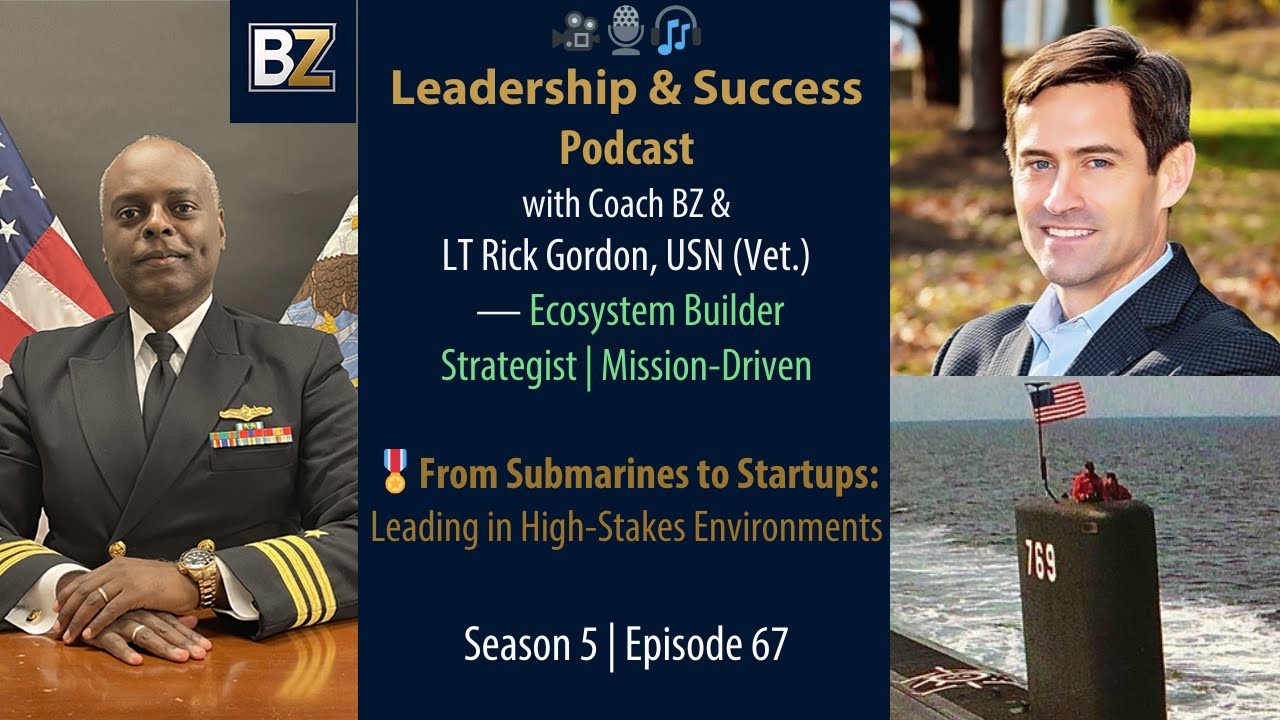
Rick Gordon, a former Navy submarine officer and founder of Tidal Cyber, explains how military discipline translates to cybersecurity leadership. He argues CISOs should focus on residual-risk reduction over compliance, and shares how to evaluate founders by balancing technical depth with soft skills.
Chapters
Hi, I'm John Maxwell. When the top companies in the world are looking for trainers, speakers, and coaches, there's one name that stands above the rest, and that's Maxwell Leadership. Our certified team members have gotten proven results for companies all over the globe, and our reputation, I'm proud to say, is second to none. Some of our members have risen to the top of their profession, including the one you're going to meet today. I proudly introduce you to my friend Bob Fabien Zinga.
Welcome to the Leadership and Success Podcast with your host, Coach BZ, where we help you lead with purpose and succeed with impact. If you're ready to grow into the kind of leader others want to follow, this podcast is for you. If you're determined to elevate your success and leave a lasting legacy, this podcast is for you. As my mentor, Dr. John C. Maxwell, reminds us, everything rises and falls on leadership. Our goal is simple: to inspire you, challenge you, and equip you with insights that can transform the trajectory of your leadership journey. Welcome aboard. Welcome back to another episode of the Leadership and Success Podcast with Coach BZ.
Welcome back to the Leadership and Success Podcast with Coach BZ. Today's guest represents something I deeply respect: disciplined service, strategic clarity, and the ability to build impact that outlasts titles. It is my honor to introduce Lieutenant Rick Gordon, United States Navy veteran. Rick began his leadership journey in the silent service, serving as a submarine officer, managing the safe construction, testing, and operation of a U.S. Navy nuclear submarine. And for those who understand submarine culture, you know, that is leadership where precision is non-negotiable and accountability is absolute. From the engine room of a nuclear submarine, Rick transitioned into the world of cybersecurity, venture capital, and ecosystem building. He went on to become the founding managing partner of MAAC37 Cyber Accelerator, helping launch and scale some of the most respected cybersecurity companies in the industry. Later, he served as Managing Director of Programs at MITRE, helping scale the Center for Threat-Informed Defense and ATT&CK evaluations, initiatives that fundamentally reshaped how defenders understand adversary behavior. Today, Rick is the co-founder and CEO of Tidal Cyber, where he continues advancing practical, threat-informed defense for organizations around the world. But here's what stands out most to me: Rick doesn't just build companies, he builds builders. He understands risk from a military lens, he understands innovation from a venture lens, and he understands execution from an operator's lens. For our naval junior officers listening, this is a roadmap of how operational discipline translates into industry impact. For our cybersecurity engineers and aspiring leaders, there— this is a masterclass in how technical depth becomes strategic influence. Rick, welcome to the Leadership Success Podcast. Let's dive in.
All right, welcome to another edition of the Leadership Success Podcast. We have a very special guest with us, uh, today. And, um, before I bring him on, as you know, our, um, custom here is to always start with what we call moment of gratitude, right? We wanna make sure that we are grateful every single time that we meet. That is so important to us. So if you would maybe close your eyes, put yourself in your happy place, maybe take a deep breath and slow down your nervous system and think about one thing you are grateful for right now. And today I am really grateful for people like Lieutenant Rick Gordon, because it's not easy to be a submarine officer, right? Spaces are extremely, extremely small. I don't think I could do it, but I am glad that there are people like him who are willing to do so. And I am so grateful for that. Just like I wasn't born to be a Marine or special operation forces. That's not for me. But I am so glad that there are people who raise their hand and who are willing to do that for the benefit of our country. So I am so, so grateful for that. All right, so let me see if I can properly introduce Rick to the podcast today. All right, Lieutenant Rick Gordon, a Navy vet, former U.S. Navy submarine officer, Naval Academy graduate, and venture builder and co-founder and CEO of Tidal Cyber. He previously served as the founding managing partner of MAC 37 Cyber Accelerator, launching companies like Antares, Blackkite, and Adlumen. So he has scaled Freight Informed Initiative at MITRE, including the Center for Freight Informed Defense and Attack Evaluation. Rick doesn't just build company, right? He builds builder for naval and junior officer cybersecurity engineers. Founders, and aspiring leaders. This episode is a masterclass in disciplined execution, strategic clarity, and long-term impact. So ladies and gentlemen, please help me welcome to the Leadership and Success Podcast, the one and only Lieutenant Rick Gordon. All right, how are you doing today, Rick?
I'm doing well, thanks for having me.
Fantastic. So, um, maybe to get started— oh, What is one thing you are grateful for today?
I mean, at the top of my list, family. You know, a wife and 4 kids. I couldn't have asked for anything better.
Yes, yes. And is there something about you that most people may not know when they first meet you?
Oh, probably a lot of things. Maybe, you know, one interesting fact I think a lot of people don't know, I was a Division I wrestler.
I didn't know that.
Yeah, it was, you know, it was sort of, uh, you know, it probably, um, you know, sucked up most of my cycles, you know, from the time that I was, let's say, 14 till I was 20.
Wow, yeah, that is pretty amazing. All right, okay, so, uh, let, let me ask you this just to kind of get, uh, started. What did, uh, serving as a submarine officer kind of teach you about leadership under pressure that kind of shapes the way you run companies today?
Yeah, great, uh, great question. Um, you know, maybe, uh, maybe the answer that I have is, uh, um, maybe less expected. I, I think one of, uh, one of the things I learned in particular in submarine and nuke power in particular is that, um, you know, the having domain expertise, like the more knowledge you have The better you're going to be. It is never a disadvantage to know more. And that, you know, in particular the Navy, you know, even since I left, one of the things that I've always missed is the Navy is really good at training people.
Yes.
Whatever your discipline might be, they make sure that you're equipped. And even as a young J.O., right, that level of responsibility they put in our hands, either operating a reactor or you know, driving a submarine with, you know, 40 people. Yeah, that was nuts to be a 24-year-old kid with that kind of responsibility. But I never felt like I was not equipped for it. It was— I was really well trained.
That's really amazing because it was something, what, $4 billion or so? That is quite a huge responsibility for just a young kid to be responsible for. So on the sub, there is no room for ego. How did that environment kind of influence your decision-making style as a CEO?
You know, there were a couple of things. One, you would— certainly it was higher pressure. I remember having, you know, being a junior, I think I was maybe Lieutenant JG, and having to sort of do a reactor recovery with NavCOA, like the Admiral, standing right behind my left shoulder. No, it's just, I'm not quite sure. I mean, certainly it was stressful, but, you know, I also knew that I was, you know, my crew was great. My team was great. Even if I screwed it up, we were, you know, it wasn't going to be devastating. I didn't. And everything went well. But I, you know, I, it was I never once worried that I wasn't going to come out of that, you know, that experience in a positive light. And, you know, I think that was well-founded. You know, I don't know whether or not that was being— I suppose it could have been being overconfident, but I actually think it had more to do with sort of recognizing that, one, I was ready for that, and then, you know, two, it wasn't just all about me anyway. It was, you know, in maneuvering, you know, 3 other guys, and in the engine room, you know, in order of magnitude— well, order of magnitude more maybe, especially if we're, you know, doing drills. So, you know, we were never going to fail.
That is really amazing. I've been on a couple of subs, but to me it almost looks like a casket. I don't think I can sleep on a sub. It's so small, tiny spaces.
It—
it— you only get used used to it. Many junior officers, they tend to struggle when they transition right out of uniform. What type of mindset shift helped you most when you transitioned from the Navy to the industry?
You know, I do think it takes a bit of time, but I also think that the professional decisions that I've made have also sort of been informed by the same sensibilities that actually led me to serve in the Navy. The, you know, I was— I think it was a very smart decision for me to go back to school when I, when I got out. You know, I, I did have an inkling of what I wanted to do with my life. I think it was a few, you know, I'll just say a few years of really sort of honing in on that post-separation from the Navy that ultimately led me to where I needed to be. So school helped me sort of figure that out. I was actually supposed to be a joint JD/MBA, ended up just doing the MBA, had a really interesting opportunity to, one, learn about business and entrepreneurship in particular that I really didn't come from that background. Uh, and then, you know, over the next couple of years sort of figured out exactly where I needed to be. Um, and so that was, you know, about a lot of that was sort of leveraging those, that same sort of focus that I had even in the military. It was sort of, you know, I mean, table stakes are whatever it is that you're doing, you do the best you can do and you make sure that you're successful at it no matter what. Um, and so, um, And then good things seem to happen. And I think that, you know, that certainly has served me well and it did early on in my career post-Navy.
Yeah, especially on the sub. I mean, operational excellence is a must. So what does operational excellence look like in both the engine room and the boardroom as well?
So it's meeting expectations. I think, you know, one is You know, uh, sort of understanding, uh, the environment that you're operating in, uh, you know, and being an expert about it. Um, it's a little bit different as a junior officer than, for example, being a CEO of a company, but it is always, um, sort of, you know, setting expectations of, of those that you work for. In the case of a junior officer, it's, you know, uh, at the end of the watch, it's reporting to your skipper. Yes. Um, in some cases you report what you did, and then, uh, it's funny Even then, I had one, uh, one, uh, really important moment as a JO that I learned a ton from, uh, my commanding officer, Bill Burke. And, you know, and up to that point, I'd always said, okay, this is what we've done, this is what we're preparing for, request permission to. And I remember the first time when, after the change of command, he just stopped me right there. He said that anywhere. What he said was, I don't want you to ever ask me for permission. What I want you to do is Give me the lay of the land and make the recommendation. And if I agree with your recommendation, we'll take it. And if I don't, I'll ask you questions, right? And I still did— I did that today with my team.
Yes.
Where they'll, you know, it's complex environment, it's imperfect data. I have— my team is amazing. They're professionals, but they— it is comforting to them to be able to give me the data. Me to make the decision. And I refuse to do it.
Wow.
It is it for me, it's always, I want your recommendation. You're the expert in this area. That's why we hired you to do this. Your recommendation. Yes, I will hold you accountable if it's a wrong recommendation. But I'll also give you credit.
Yes.
Right. In an environment that's, you know, when you're making a difficult decision, that, that was all Bill Burke., you know, and back in, you know, the, the 1990s.
Crazy. That is really, really fascinating. And I think most people— I think it was Steve Jobs, right, who said, uh, why in the world would you hire the best people in the world and then tell them what to do, right? That doesn't make any sense. Yeah, it's, uh, wow, incredible. So you have built companies, but you have also built ecosystem. What's the difference?
I mean, they're similar. You know, I think you're— I mean, here's two classic or two good examples. One is building Title Cyber, which, you know, we've been super successful. It's a reasonably young company, but definitely top desktop performer for our stage. And then before that was Mach 37, where I did— I mean, I had to build that as a company too.
Mm-hmm.
But that was really more ecosystem building where what we were trying to do is, you know, with support from the Commonwealth of Virginia, create an ecosystem of innovation around cybersecurity in, in the Northern Virginia region in particular, but more broadly the D.C., Maryland, Virginia region. Both of them were super similar in my approach. And it was, it had started with, okay, what are the objectives? What are we trying to achieve? And, and, um, what are the things that must be true, uh, for us to achieve those things? And just literally working backwards. And so it is, um, you know, it's one of the— another Navy principle. I mean, Navy— the Navy is really good at planning. And it isn't the plan, it is the planning that is the important part, because you force yourself to say, in order for this to happen the way that everybody wants it to, what are the— what are the milestones that we have to achieve? What are the ingredients that we need to assemble in order for that to work? And then how do we hold ourselves accountable as we move through this process? And it takes years as we move through the process to know, one, is it working? Do we need to course correct? Or do we, or do we need to double down on the things that are actually working better than the other things? And that is, that's just fundamental, right? And it's worked, it worked really well in both of these cases, where in the case of of Mach 37, we did. We, in a way that, you know, I had not seen in this region before, really sort of assembled these ingredients of technical expertise in cybersecurity, investors that wanted to harness that expertise, policy people that really cared about cybersecurity as a mission area, folks that were subject matter expertise experts in not just cybersecurity in particular, but how to commercialize more advanced capabilities. And we put the region on the map in a way that, I mean, you know, one of the things that in that early research that I knew we had was expertise. And we had, I mean, so just quick back of the envelope math demonstrated that we had more cybersecurity experts between Herndon and Fort Meade than I think all of Israel had. And of course Israel was getting all up, you know, it's a national economic development strategy for them. It isn't for us. This is a national security set of interests. But we had all of those ingredients that we needed just in this region. What we were missing was capital, you know, capital that cared about the mission and folks that knew how to commercialize businesses together. You know, the same, same approach, maybe a little bit easier in building Title because Some of it was less about herding cats and more about sort of, you know, executing really well, instrumenting our business. If you ask my investors, they'll tell you, you know, that OCD when it comes to planning. And, you know, I've had a 5-year financial model built since before we started the company. And it wasn't that I thought that those numbers were right. It was I forced myself to state the assumptions upon which the business was going to be built. And then I forced myself to instrument our business to know whether or not we were just kidding ourselves. And turns out we weren't. And that, again, just more sort of Navy discipline. Let's build the plan, execute the plan, adjust course when we need to, which is, in some cases, monthly. But, um, you know, the process of the discipline really worked.
Yes. Wow. You, you said it was like herding cats. My, uh, one of my mentors said it's like herding wet cats, so that's even more difficult. But, uh, yeah, it is, it is quite, uh, uh, amazing what you've been able to accomplish. So let's go back about, uh, Mark 37. When you were like launching that? How did you evaluate founders? Kind of what separates the one who would scale from the one who would not?
Yeah, it's— I mean, it, um, so it's not as— the process is super formulaic in building a business. Um, the, uh, you know, the humans that are involved are incredibly important, uh, in, in sort of predicting the success of a business. I always like to say, by the way, necessary ingredient to have strong technical capabilities if it's a technology-based company and minimum requirement to have someone that could complement that technical skill that sort of had maybe the softer skills. You know, extroversion is something that we look for, people that can communicate well. You don't have to be an extrovert, but you have to be a really strong communicator.
Yes.
And, you know, a level of enthusiasm and a belief. And then that intangible, it's difficult to find. Just people that won't give up. And that's why I like military people, because I think it's just all about, you know, the mission and the commitment to the mission and the ability to operate in austere environments when you're poor and your wife is angry because you're poor and you stick with it. I think all of that. Difficult to screen for it. I think the best startups that we invested in at Mach 37 were at least two founders. One was highly technical, the other one had softer skills and know-how, never a complete set of capabilities. There are like, I mean, you know, my company's much bigger now. We still don't have all the skill sets we need because you can't just, you just can't afford them all. And so you've, you know, pieced these things together. Eliminating whatever the next constraint is at the time. But at least at the very beginning, at least two founders that had those levels of domain expertise in both of those areas with a high prejudice toward the technical founder, someone that actually suffered a problem that was worth solving that they had come up with an approach to solve. The one thing I do think we always look for proxies around sort of grit, you know, people that, that were gonna make it. I think in the introduction, you mentioned a couple of, I mean, Huntress, Ad Lumen, and Black Kite. All three of them had it. Callahan-Sloan was an NCO in the Air Force who worked at Fort Meade in some of the, like, the coolest programs. He's just intellectually a stud. Um, and, uh, but also sort of had like his pathway to that point was like, I mean, he wasn't priv— he was not a privileged person. Like, he really did it on his own.
Wow.
I like that. Uh, um, Bob Johnson and Ed Luman, Navy wrestler, Marine. I mean, that's a— I mean, I check, check. Wasn't going to quit, right? And the same is true for Blackkite, different, not military background, but an immigrant from an environment that was difficult. Moved here from Turkey. And I think that, you know, had a set of experiences that you were like, this guy's not afraid of anything. And I know he's not going to quit. All three of those really successful businesses were founded by individuals that had, you know, one or two of those sort of skill sets, but that grit was something that I just knew they weren't going to quit. And in every case, it was required. And all of them struggled until they didn't.
Yes.
And, and, you know, and so I think there are a lot of companies that have struggled and, you know, with if they had had that level of grit and, and, you know, inability to quit, uh, they, they might have had different outcomes, uh, but without it, I mean, it is a necessary ingredient because it's never easy for anybody, at least the first time. It's just never easy.
Yeah. And, uh, I know some people listening now who are transitioning out of the military would like, like you, right, um, get into entrepreneurship. Uh, is leadership in a startup more about vision or discipline?
Ah, discipline. It's just discipline. I mean, look, um, you, um, you know, I really like early stage as an investor. I love being an entrepreneur in tech. I do think having a, uh, a solid idea of a way to add value does require a certain amount of vision The— but ideas are a dime a dozen, just if I'm being super candid. What, what isn't a dime a dozen is the ability to one, have the humility to go figure out whether or not your idea is dumb. Because most of them are. But it's no— it's knowable. You know, and I think it takes Some people would say it's courage. I just think it's humility to go and talk to a number, a statistically relevant sample of prospective customers and ask them, okay, do you have the, like my pro— would you work?
My—
so, you know, hopefully I answered your question.
Yes, absolutely. So what do you think is the most common blind spot you see in first-time cyber founders?
Oh, they don't go talk to customers. It's in any founder, especially technical founders.
Yes.
I mean, I haven't met a technologist that didn't think they knew they sort of knew what their customer needed and they may not be wrong, but timing might not be right. My first startup, I was probably 10 years too early and what we were building is now a very large market, but it's just, you've gotta get that timing right and that's an art. It's really hard to know. You could be number 10 on the top 10 things they need, and, you know, and your target market has, you know, budget for top 4, right? Yeah, right. And, you know, it's not a terrible idea, maybe not the right timing. And so I think that that matters. And you can get to that level of insight by having conversations with, with people that you want to sell to. And they're out there. I mean, they're definitely out there. That, uh, and they're guys like me or guys like my, um, early adopter customers and, and previous companies that, you know, they're in the security space, they're CISOs that just love innovation and they'll work with you. But, you know, and sometimes the good ones will tell you, yeah, that doesn't make sense. Problem solved. Doesn't make sense because, you know, that's not— I got, you know, I have 5 other things that are way more important than that. And that, that I think is where entrepreneurs, because we're sort of wired a certain way, like we know better. I mean, the best entrepreneurs are always contrarian, right? Otherwise, you'd be doing something everybody else is already doing.
True.
You know, it does require this strong balance between, you know, having a contrarian view about what needs to be delivered into the market that's not being delivered today, and the market may not really know it yet. And then, you know, being intellectually honest and having those interactions with those buyers to basically get to the bottom of whether or not you're just smoking crack.
Yes. Wow. All right. We, we have our first question from our audience. Uh, Daniel Young says, uh, Lieutenant Gordon, uh, in the Navy, every sailor is responsible for the integrity of the ship. In our current digital landscape, how do we move cyber risk out of the IT basement and, uh, architect it as a behavioral infrastructure so that a non-technical manager sees a security lapse not as a glitch, but as a bridge of leadership honor?
Yeah, I mean, great. It's a great question. And you started with, I mean, communicating it within the context of risk in general. So it's Daniel, right?
Was that Daniel?
I don't have his background, whether he's sort of, you know, in the mission area, in government, or, you know, commercially oriented. I think they're all slightly different. But I, in the case of where I spend most of my time is in large commercial enterprises who are my customers.
Yes.
It's really, you know, communicating to leadership in terms of business risk. I mean, at the end of the day, an enterprise is in the business of delivering value to an addressable market and generating a return on investment for shareholders. Both of those stakeholder groups are incredibly important to the success of the business. Both of them are impacted by a lapse in security. In some cases, if from a third-party risk perspective, if you're holding your customer's data and it's exfilled from your environment, of course, that's not great for your customer, certainly not great for the business when you have to report it.
The—
but I mean, I've never met anybody outside of the security industry that wanted to spend money on security or make those investments that are required. And so it's— the onus is on the security leader or leadership in the security organization to be able to tell that story within the context of the business leaders will understand. And I think that's something that we've definitely struggled with. I think especially, I mean, we got, there was probably in the '10s that, I mean, the 2000s we were just sort of getting our feet wet in security. In the '10s, I think we started to really over-index on compliance with what were at that point in time, I think, improved standards, whether it's NIST 800-53 or ISO 27000 or whatever the standard might be. I think that they leveled up the minimum standard of care The problem is, is that I think we maybe went too far with those where the security team was just essentially saying, you know, they were just solving a compliance problem and it's not a compliance problem. It's a business risk problem. And then ultimately, which means that ultimately that, you know, to get beyond checking boxes and actually making the investments that are required to reduce the likelihood that the adversary can actually get to encrypt, exfil, or disrupt my business. We need to be able to tell the story to our business leaders. This is why you have to make this investment because it will cost our business X if we don't, you know, with enough empirical data to be believable.
Wow, that is so fascinating. So in your view, what are Chief Information Security Officers still getting wrong about security strategy these days?
It's— we don't understand that our job— what our— I mean, I have to be really careful how I say this.
Yes.
Whether it's cybersecurity, physical security, national security, whatever the security domain is, the responsibility of a security manager, security leader is to continually ask and answer, who are my adversaries? What tradecraft are they using to attack my business? And how do the defenses that I have deployed in my current environment effectively mitigate or ameliorate the risk associated with that tradecraft? And if not, and here's the important piece, how do I optimally allocate the resources that I have been given? Because most of us have a pretty fixed budget. The, you know, the amount of money that your business can invest in a thing doesn't vary that much from year to year. So how do I, as a security leader, optimally allocate that to reduce the probability of success of the adversary by the greatest amount, i.e., how do I reduce residual risk by the greatest amount?
Yes.
And so that requires us to have an understanding of who's attacking me with what. And threat intelligence is still pretty much in the third inning, especially behavioral threat intelligence. Like, what is the tradecraft? Can we defend against it? You know, up until recently, most of the tools that we were deploying were pretty opaque as they relate to what am I actually detecting what am I actually defending against, that's changing dramatically. And then more specifically, like, what do I do next? Yes. Like, we like to— I like to talk with my customers about residual risk in terms of sort of an elephant, because there's a lot, there's a lot to comprehend around residual risk. And that, you know, the old saying, well, how do you, how do you eat an elephant? Well, the answer is always the same, one bite at a time. But the trick is when you're given a limited amount of budget to actually do all the things you need to do. And I don't know a CISO that has enough people or enough money.
True.
Take the biggest bites first, which means you have to know what the biggest bites are, or at least the biggest bites per dollar spent first. So, and that requires leveling up the way we think about what we're doing. The risk isn't being out of compliance.
Yes.
Risk is, can the adversary get through the attack pathway, or have I effectively stacked my defenses to reduce the probability of success to virtually zero?. And we just as an industry, we don't think that way. We have— it is residual risk thinking and it's just not something— it's new. And I mean, it's like if I would say this about my company, Tidal, if there's one contribution I think we can make to the industry, it's getting people out of this quagmire of sort of security policy or checking boxes for compliance and getting into understanding What's the residual risk and have I effectively reduced the probability of success of the adversary to zero?
Yes. Wow. Powerful. Okay. If you were advising a new CISO stepping into a board-facing role tomorrow, what would you tell them?
Oh, sorry, ask the question one more time. I want to make sure I heard it.
Yeah. You are advising a CISO who's stepping into a board-facing role tomorrow. What would you tell them?
Yeah, for sure. Communicate, communicate within the scope of risk. I think that's just understand residual risk. Understand that's what your job is. You know, I think organizations want to know, boards want to know. I mean, what they really want to know is how are we, like, how are we stacking up against our peers? Because I think there's an implicit minimum standard of care associated with that. So if we're above the mean, we're better than than average? I think everybody wants to know that on the board, but you also wanna know how you're improving your exposure picture or your security posture vis-à-vis the adversary, or vis-à-vis adversary tradecraft over time. So how are we doing against ourselves over time, and how are we doing against our peers over time? That I think are important things that will move the needle for a CISO. And if you can't do that in sort of a normalized way that the board will understand, I think it's really difficult. I think you're going to have a hard time being successful in the role.
True. So we are living in an artificial intelligence-accelerated threat environment these days. How should leaders think differently about risk?
You know, great. Well, it depends on what application of AI you're talking about. For sure, you know, AI is You know, maybe data, the potential for data loss on steroids. I mean, it is, you know, significant amount of third-party risk associated with using AI applications, you know, and if you don't have the right level of policy internally, I think your data gets exfilled, you know, by asking the wrong set of questions and, or providing the data to answer the wrong set of questions. So I think a lot, most larger enterprises are trying to get, you know, a grip on that. And it's actually to the point where it's actually maybe limited some of the ability to adopt AI in some cases, especially we've seen that in the financial services. I think there's a level of skepticism around, okay, like, let's be super careful about what we're doing with our data because it's super sensitive. So that, that I think is, you know, I haven't run across a company that doesn't ask us, okay, how do we understand our our posture, uh, you know, in the application of AI. Um, and there are great frameworks. Even MITRE came out with a great framework to help, help think through that, and we work with that, that framework as well. I think that's useful. The other— you're hearing a lot more around, um, sort of the application or the use of AI by adversaries, and it's mostly agentic. I don't think there's a— I haven't seen a ton of use of AI. I'm sure it's happening, but I haven't I haven't seen a significant level of success of the use of AI in creating novel, like, novel approaches or exquisite exploits yet. I'm sure it's happening. We just— we aren't seeing it in threat intel yet.
Yes.
What we are seeing is the use of Agentic to, like, make attacks incredibly speedy. There's not— if there's if they can automate most of the process, then if those— if you have got weaknesses against specific behaviors that can be automated on the part of the adversary, once they've gained initial access, those, you know, let's say an adversary, if they have, let's say, 2 or 3 lateral moves, they probably have to execute successfully, let's say, 20 to 30 things inside your environment. If it's a ransomware group, APTs are slightly different. They're trying to be quiet and lower and slower, but generally they're still reusing the same techniques. And if you have an instrument ahead of time or a priori from the attack, they're going to rip through quickly, right? So the need to understand how to, one, take advantage of threat intelligence and stack your defenses before the adversary gains initial access is actually more important than ever because they're going to zip through. It's, in the case of ransomware, it's going to be pretty noisy. And so the chances, if you've instrumented correctly, of you detecting it are really high because they have a number of things to do, a number of things to do and be successful at that. And that— so you can win, you can definitely win that way. Yes, you can't, you can't bet on, you know, detecting the initial access and then reacting in a way that allows you to catch them before they get to to payday, right? That, um, that I think is, is really shifting the way I think a lot of us are thinking, and it is requiring us to, to do more around prevention, prevention, or predicting what the adversary is going to do and stacking your defenses effectively so that you can— you'll see them as they're traversing your network.
Wow. Well, let's talk a little bit about, uh, venture risk and decision-making. You have invested in multiple successful cybersecurity companies. What do you look for first? Is it the market, product, or founder?
Market opportunity first. For me, it's my— I am solely early stage, you know, pre-seed investor. Just because I like moving the needle more, I, you know, That, and then something out of nothing is just always something that I've been inspired to do, and whether as an entrepreneur and an investor. So you start with, is there white space in the market? And I touched on this a little bit ago, is the timing right? As a pre-seed investor or seed stage investor, I think my philosophy is you try to be about 2 years too early, If you're any earlier than 2 years, you're likely gonna run outta money before the market matures enough to get the rounds that you need to build a business. If you're later, any later than that, it's likely that there's somebody else that's, even if they're after you, has better funding. They can claim the white space before you can get there, or they'll, there's already somebody there. He's already there and sort of claiming the white space. You just haven't seen him yet, right? It's hard to know. I've been wrong as much as I've been right about those things. And which is why, you know, in seed, you need to, as an investor, you need to cast multiple bets. As an entrepreneur, you got to be willing to live with that risk.
True, true. But now, especially with AI, I think there was a lot of hype. I think. How do you distinguish between hype and durable innovation?
I mean, I just had a conversation today with my head of product marketing. That was really good. You know, and we're sort of at an inbound request from one of our investors saying, well, how are you guys positioning with AI? And her response was actually spot on, but it was maybe a little flippant. She was like, we don't. We talk about customer problems and how we use technology to solve those customer problems.
Yes.
And by the way, we lean heavily into AI on the threat intelligence side in a way that nobody else does, in a way that's created a significant competitive advantage for us. The fact that it's, you know, machine learning trained algorithms and then automation that can shrink 6 hours of work into about a minute and a half.
Yes.
I mean, and that's like democratizing the access to, you know, threat intelligence, whether it's structured or not.
Yes. Right.
So I mean, that's the impact. The implications of this to the market are not lost on me. We do not sell that as AI, AI, AI. I actually, you know, I've been around the industry as an entrepreneur long enough or as an investor long enough. I remember the internet boom.
Yes.
Right. And I remember blockchain, like these, these things that were going to change the world. In fact, Goldman Sachs just came out with a I read a report a couple of days ago, they were like, yeah, you think it's going to drive the economy? It's not. It might be a big nothing burger. I wouldn't go that far. But what I do think it is, is an incredible enabler to solve problems that existed before we ever were talking about AI. That's where we lean into because those problems are real. People will pay for them. There's nothing ambiguous about it. We know what they cost us and we know if we can eliminate them, what the benefit is. That's sort of our perspective and how we definitely lean into it and it's definitely competitive advantage. But I'm all about the customer and the customer problems. And there are, to be sure, there are some customers that have boards that are like, we want to tell an AI story, we want you to invest in AI.
Yes.
I mean, whatever, that's, you know, that's up to them. What I want to do is solve a customer problem that's legitimate, that's caused by an adversary, that's costing them real money, or, you know, has implications to national security. Those are the problems that I lean into.
Makes, makes sense. Okay, we have about 15 minutes left. Let me, uh, get into the last segment of the show where I try to get, uh, into your mindset to kind of understand which leadership principle have helped you be as successful as you are. One question I want to ask is, uh, what do you think is one of the greatest lessons you have ever learned, whether in life, in leadership, or just in general?
Well, um, uh, yeah, this one, uh It's tough for leaders, right? When you're speaking and you're communicating, whether it's with a customer or somebody else, exhibit the confidence that you— because you've done the work, right? You're prepared and you've got real conviction around the way that you're— like what you're trying to bring to market, the way you're trying to change a market.
Going back to planning, yeah.
But when you're listening, listen like you might be wrong. And I think it's difficult for some leaders to sort of embrace that. It's like, I've never—
Yes.
It is not a sign of weakness to ask people to, you know, what we're doing. In fact, I had a made a really smart hire, senior product person. She did some consulting for us. And, you know, this is the first interaction we had after that. I was like, my first question was, okay, I want you to tell me everything we're doing wrong. Right? And, and, and that has always really served me well, because, you know, I'm coming to a conversation willing to learn from people that actually know more about a thing than I know about that thing. And I'm always going to learn something. Now, I may not change my perspective or lose my conviction, hopefully not, but what I am going to learn is I'm not doing everything exactly right, and these are the areas that I need to improve on. You know, that I think is probably the— and that's applicable in anybody's life. I mean, it's not even just in business.
True. So the biggest one, leading with humility, that is so Powerful. So what do you think is the secret to your success, both in the Navy and all of the businesses you have launched? What— why are you so successful, you think?
Um, so two, two things. One, the, uh, humility is a big one, uh, and it's not— uh, most people, or a lot of people smarter than, than I am that won't do what I do. Um, because, uh, what I do is just— it has a high risk of failure, and I fail plenty.
Yes, right.
The, uh— and I had even a high school classmate of mine was, you know, said something about courage. I was like, I don't think that's it. I think it's— it is humility, because I, I like— what I know is that, um, I might fail. In fact, I'll probably fail, especially like early stage tech companies. Most of us fail. Right? Um, but I also know I'll be fine, and the next thing that I do might not. Yes, right. That's just— that's a humility is the only way you get through that. I'm saying in the Navy, like, if you really screw something up, you're like, well, they can't take away your birthday. It's true.
Yes.
Like, it can only be so bad, right? And but if you've got like the other parts of your, your life, like strong family squared away, you're like, I mean, that's safety net. Like, yes, no, we're gonna go do this because it needs to happen. If not me, then who? We might fail, but that's not, you know, but it's gonna take a lot to get me to stop. Right? That, that I think is important. And the other, the other part is just grit. It's like, I mean, it is everything. There are good days and bad days. And then there's some really bad days that you think you're not going to make it out of it. But I mean, I mean, learn this as a wrestler, it's like I can always do one thing, it's work harder.
Yes.
So that's what you do, right? Wow.
So where do you think that grit, that resilience come from?
Hmm. Ah, you know, as an athlete, as you know, I lost plenty. Uh, you know, and I'm sure that was a lot of it. Uh, there, you know, if you're, uh, you know, if you're not falling forward, then you're not trying hard enough, right? It's like, you know, the, I mean, I used to give the speech around like, you know, you know, you're an entrepreneur when, and in some cases it's, you know, I really love athletes that continue to like, you know, are always like maybe mediocre athletes, but, but reach, um, a pretty high level of performance and has, is because they just wanted, they were always trying to figure out like what their limits were. And it turns out you find them because, you know, you hit the point where you just can't, can't get to another level. I like that. Or like folks that like to ski black diamonds when they shouldn't be. Yes. Yeah, there's an example of somebody— what you're trying to do is test your limits. Um, you know, those are, those are two, I think.
Now you kind of mentioned failure. How has failure shaped your life?
Smart. I mean, you just get smarter. You definitely— I mean, there's always, there's always, uh, there are always signs early, or maybe things you didn't know, or lessons that you hadn't learned yet that, um, you know, when you, you rinse and repeat, you, you know, you, you don't make those same mistakes again. So for sure, I mean, I learned more. My first startup that I created in 1999, you know, financially wasn't a huge success. It actually— I mean, I was really still really super proud of it, um, but I learned more from that one than any of the rest, for sure. It's like, I'm, you know, it's the first time I'd done any of this, and it's, it's super formulaic, but it's, it was really—
yeah.
I know many people are kind of afraid, right, to try something new, something they've never done. Before. What is one of the greatest fears you've had to overcome?
I mean, uh, it's a great question. I think, um, there are those people that you— I mean, people that rely on you, people that you care about, that, uh, especially it's hard, like, you know, I, you know, if you're sort of not born with money.
Yes.
Um, it's— and you've got a family, it's tough. I mean, it takes a lot of courage. Uh, you know, strong family helps, uh, in those cases overcome it. But that's probably the biggest one is like, if I fail, then, you know, who am I letting down? And I think for a lot of us, um, you know, a lot of us, I think you, you sort of gotta— you've got to overcome that. I, I do think, um, Setting realistic expectations about where you're going to, like, what you need in order to be happy helps. And the more modest that is, the more liberating that is.
Yes. Wow.
Right.
So I know leaders are learners. What are you learning these days?
I mean, so a ton, a ton. I think as my company continues to grow, you know, the sets of problems that we have to solve are just, you know, significantly different. And just let me try to encapsulate that for you. So Title Cyber is a 4-year-old company, right? We're definitely top desktop performer, but we're still young. But the, like, the every year, like, the objective is dramatically changed. The first year it's, you know, can we demonstrate that this problem is we're solving and then raise the money to actually start building a capability. The second year is, can we build a capability and can we get companies in our target addressable market to even buy it? The third year, it's okay, well, that worked. Can we sell a lot of it?
Yes.
And what does that motion look like? And then the fourth year is like, okay, well, can I hire a team to sell even more of that at scale and how to do that more efficiently, continue to scale. And it's, um, each problem is difficult. It's an incredible analytical process, right, to sort of ask yourself, what data do I need to collect to make sure that I'm actually making these right decisions? But I will say the problems get more strategic as you progress. And so for me now, it's okay, well, I have a really thriving business and it's growing very quickly. What is the next thing? Like, what do we do next, right? And then you, you— because I've got a— before it was, I, I wasn't even sure about a product anybody would buy. Then I was like, okay, so sell it. I can sell a lot of it. Now the question is, what do we do next, right? And that, um, it's fun, but it's just, you know, and literally we're always trying to one-up ourselves. It's like, what do I have to do next, uh, in order to, you know, carve out more space create defensive moats, create this sustainable enterprise and continue to grow and solve problems for our customers. All of those are sort of different problems that we're addressing.
Yeah, I really love that you always focus on your customers. That is so wonderful because some people, they do innovation just for innovation's sake. They don't really have a specific problem they are trying to solve, which doesn't make sense. But yeah. I like that. So if you could choose 3 people to have dinner with, uh, it could be alive, they could be dead, they could be fictitious character, who would you choose and why?
Oh my goodness, um, Gandhi. Martin Luther King.
Yeah, one more. Jesus. Yes. So is there a book you would recommend, um, my audience to read?
Oh, I mean, they're so— I mean, um, for sure. The question is like, for what? The, um, I'm trying to think of the books that, I mean, I loved fiction. But I think what I, the book that's had the greatest impact on me, it was actually biography. It's about, I mean, but this one's super personal. So I don't know that it was gonna have the same impact on everybody else, but it was a biography on Ross Perot, who had a similar, came from Texas, went to the Naval Academy, and then found his pathway as an entrepreneur. And I think, and I had a similar pathway. I didn't grow up in Texas, grew up in rural Virginia. And, you know, found my way to the Academy, super proud of the fact that I, that I did that, you know, and it was able to be independent when I was 18. That, but then, you know, seeing somebody that had gone through that path, and had gone and he went and built EDS. And then we— then he went and built Pro Systems, which is somebody that was just like me, right, that he could go do things, right. And he, you know, he's— I mean, just a midshipman, right? I don't— I'm not even sure he performed that exceptionally when he was in the ship, right. But what— yeah, he's definitely an exceptional— was an exceptional individual, right. Those are, um, you know, so I think it's For me, it's like, you know, look, read a biography about somebody that came from where you came from.
Yes.
That has gone on to be successful. And I think what it'll help you do is see yourself in that role, like, and believe. I mean, half the battle is showing up.
Yes.
Right? Just believe that, you know, you could do that. So it's funny. I speak to kids a lot about entrepreneurship, as I mentioned. And I think a lot of folks, if you're not like lean, you know, you don't lean that direction, I think what you'll ask yourself the question, you'll, it'll be why, and then not me. And it's just a very subtle difference. An entrepreneur will see those exact same words and say, why not me?
Yes. Wow.
And I think that when that book really got me to lean in that direction, like, yeah, I, you know, not much different between us. Yeah, I can do that too.
Wow, powerful. So is there maybe, I don't know, a book, a song, or a movie that would be your life's theme or anthem?
Oh my goodness. Um, you know, I don't know. Um, The, uh, I will say my, my favorite movie, um, was Fight Club. It has, I mean, it's, there's, it's a great commentary for a lot of social reasons in area, you know, maybe areas that I lean toward. Um, the, uh, that I, I think might be, but there's one, one line in it that I really loved. And I, and I actually, I, you know, I've, uh, embraced this. I imbue this into my kids. And, and I share it with everybody. And it's— the line is, the things that you own start owning you. And it's— and, and I, I think it's sort of this sort of an environment where, you know, people think they see what you have and they see what you drive and they see where you live.
Yes.
And you see where you send your kids, um, and somehow that's a proxy for your, your worth. I think you've missed the point.
Wow, powerful, powerful. I like that. Okay, uh, if you had one and only one day to live, what would you have liked your final contribution to be?
It's, it's gonna be something for my kids.
Yes.
I mean, what, uh, look at all this is interesting.
Yes, yes.
And it's, and, you know, and I have great ambitions and I, I want to, I do want to change the world, but at the end of the day, I might not, I might not. Am I like— what's with the things that we really do that for? For like our family.
Yes. Right.
And you know, like what they think of me, you know, when I'm about to die, I think is probably the, like, the most— the only important thing, really.
Yes. And, uh, if you had a magic wand and could solve any problem in the world, what is the one problem you'd like to solve first thing tomorrow morning?
Oh man, how do I do this without being political? Um, uh, bigotry.
Yes.
Just, I mean, I think, uh, there are two things: greed and bigotry, I think, are the source of almost all evil, most of the problems that occur in the world.
Yeah.
Um, and, you know, eliminating either or both, I think, would— the world would be a much better place.
That is so true. And, uh, for, uh JOs and enlisted folks who are trying to transition out of the Navy or the military to do like you, become a tech entrepreneur. If you could have their ears for the next 60 seconds, what would you tell them to do first thing tomorrow morning?
If they want to be a tech entrepreneur? Mm-hmm. Um, uh, go seek out other technical entrepreneurs that came from the background that they came.
Uh, go ahead.
Them, ask them if they have any other friends that are just like that.
They—
we all have different pathways. We all want to help them. Um, I think when I, uh, and I, I would say the— if you want to learn how to be an entrepreneur, go join one.
Yes.
Go work for one, be relevant, um, contribute, uh, learn the pathway, uh, it's, you know, and establish the credibility with the ecosystem that they have.
Yes.
Because you made it, you made a positive impact, and you're getting credit for it so that when you decide to do this on your own All of those things that typically take people a lifetime to build, you can be built within a few years.
Wow.
That's probably the best advice I could give anybody.
Powerful. All right, we need to bring this to an end. What can my audience do to add value back to you?
So, yeah, for sure. I would love for them to follow us on LinkedIn for sure. To the extent that you need help, are you thinking about making a transition, reach out to me. You know, I, I'd love to be helpful.
And, uh, is there a question I should have asked you I didn't get a chance to ask?
No, I think you covered most things.
Yeah, very good. Okay, the last question I have for you is, if you could go back and give a piece of advice, uh, to your 17-year-old self while standing at the edge of this incredible career you've, you've had, uh, what would you say to 17-year-old Rick?
Sarek, that, um, that destination that you think you want to reach, it's meaningless. Yes, I think it's the pathway that you've got to enjoy. Chances of you getting that, I mean, you may get there, you may exceed it, you may not. But whether even if you get there and you did not really appreciate the pathway of getting there and enjoy it is a waste. You just wasted your—
your powerful— okay, uh, the last question I will ask, uh, I want to end with something optimistic. So what is something you are feeling optimistic about?
Um, uh, I'm feeling more optimistic about the economy, more optimistic. And that's new. That's new. I've been— I have not been optimistic for the last 12 months. I think we're starting to move in the right direction.
Good. Good. Okay. The last, very, very last question, and we're going to end here. What is one word that represents our shared experience on this podcast today? One word.
Enjoyable.
Enjoyable. Well, I am so grateful. Thank you so much, Lieutenant Rick Cordon. Thank you for being one of our master teachers today. I really appreciate it. Thank you.
Well, I enjoyed it. It was great to see you, and thanks everybody for your time.
Thank you. All right, everybody, this is one for the book. So tomorrow is Saturday. I will go back to the book of Proverbs. It's not a religious podcast, but it's going to be ancient wisdom and mentoring from the book of Proverbs, right? Ancient wisdom and leadership lesson. We're going to be studying Proverbs chapter 20 tomorrow. So thank you so much for watching our show today, and I hope to see you tomorrow. Bye for now.
Thank you for tuning in to the Leadership and Success Podcast with your host Coach BZ. If today's episode added value to your leadership journey, be sure to subscribe, share, and join us again for more wisdom nuggets on how to lead better and achieve greater success. Remember, leadership is the most critical skill of our time. The world will always need leaders to inspire others, drive innovation, and execute meaningful strategy. So why not count yourself among the bold leaders shaping the 21st century. Until next time, stay inspired, stay committed, and keep leading with excellence.
More from Bob

S250:E4🎙️LIVE 🇺🇸America 250: President Barack Obama Leadership, Service, and the Power of Hope






S5:E157🎙️ LIVE with CMD CMSgt Dennis L. Fritz, USAF (Ret.)(Multi Tracks Audio)



S5:E156🎙️ LIVE 🇪🇸 Leadership Lessons from the FIFA World Cup 2026 Champions (Multi Tracks Audio)

S250:E3🎙️ LIVE Leadership Lessons from America’s First Documented Family of African Descent 🇺🇸📖