S5E79🎙️ LIVE with MCPO Jamie J. McCoy, Ph.D., U.S. Navy (Ret.) (Multi Tracks Audio)
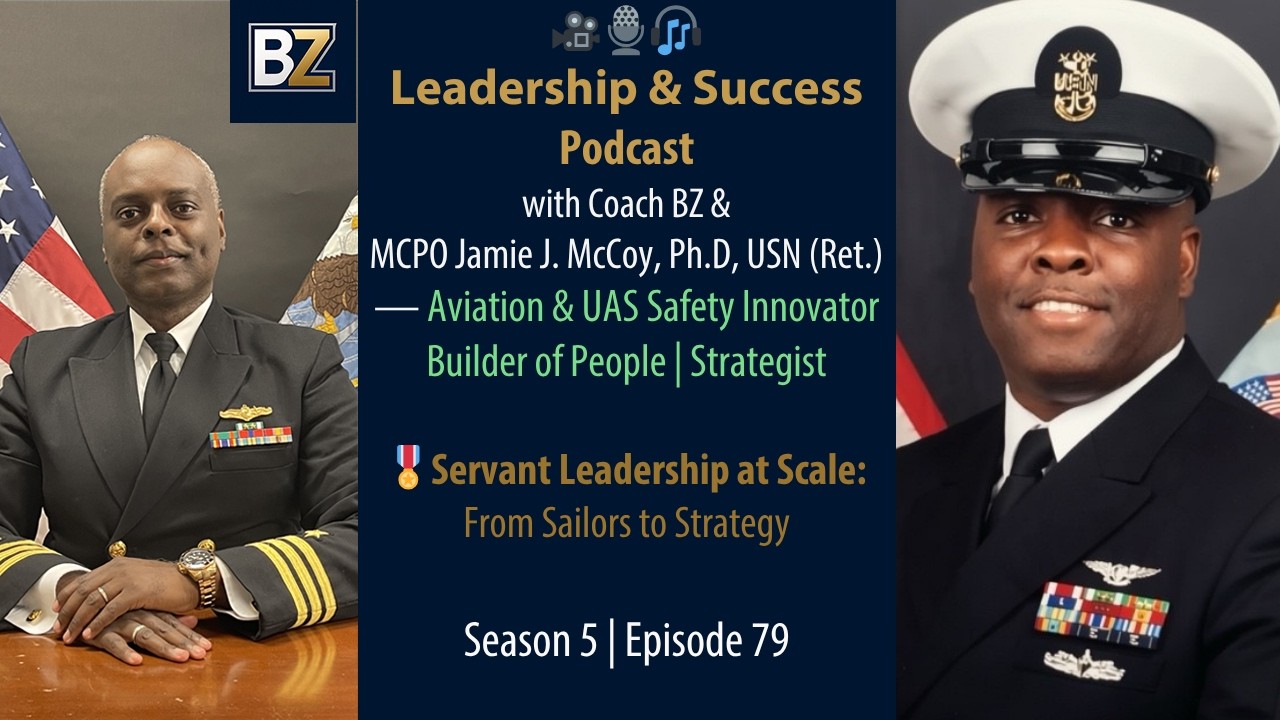
In this episode of the Leadership and Success Podcast, host Bob Fabien Zinga interviews retired Master Chief Petty Officer Jamie J. McCoy, Ph.D., a former Navy aviation electronics technician, Master Chief, and senior executive in aviation and defense. The conversation covers McCoy’s early fascination with flight, his path from a GED‑earning, low‑income background to the highest enlisted rank, and the mentorship that propelled him. He explains the core of servant leadership at scale—humility, trust, empathy, and hands‑on presence on the deck plate—and how those principles translate to corporate environments, especially in cybersecurity and technology. McCoy shares concrete practices for building trust, handling toxic leaders, and developing junior enlisted and junior officers, emphasizing listening twice as much as speaking. He discusses the moral tension of a Christian serving in combat, his reliance on faith, and how he balances family, education (two PhDs in progress), and service. The episode also touches on integrity as a non‑negotiable cultural pillar, the importance of process, and the optimism he feels about emerging technologies and the next generation of leaders. The dialogue ends with personal advice to a 17‑year‑old self, a one‑word encapsulation of the experience (“grateful”), and a call to action for listeners to follow McCoy’s work.
Chapters
Hi, I'm John Maxwell. When the top companies in the world are looking for trainers, speakers, and coaches, there's one name that stands above the rest, and that's Maxwell Leadership. Our certified team members have gotten proven results for companies all over the globe, and our reputation, I'm proud to say, is second to none. Some of our members have risen to the top of their profession, including the one you're going to meet today. I proudly introduce you to my friend Bob Fabien Zinga. Welcome to the Leadership and Success Podcast with your host, Coach BZ, where we help you lead with purpose and succeed with impact. If you're ready to grow into the kind of leader others want to follow, this podcast is for you. If you're determined to elevate your success and leave a lasting legacy, this podcast is for you. As my mentor, Dr. John C. Maxwell, reminds us, everything rises and falls on leadership. Our goal is simple, to inspire you, challenge you, and equip you with insights that can transform the trajectory of your leadership journey. Welcome aboard to Welcome to another episode of the Leadership and Success Podcast with Coach BZ.
Hello everyone, welcome to another episode of the Leadership and Success Podcast with Coach BZ. I'm honored to have you joining us today from around the world. Today's conversation is about something every great leader must master: servant leadership at scale. Because leadership is not about rank, it's about how many people you develop, how many systems you improve, and how much impact you create long after you leave the room. And today we are joined by a leader who has done exactly that. It is my honor to introduce Master Chief Petty Officer Jamie J. McCoy, PhD, United States Navy, retired. Reverend Dr. McCoy served over 26 years in the United States Navy, beginning as an aviation electronics technician aboard the USS Enterprise and rising to become a Master Chief Petty Officer and Executive Director of Air Traffic Control, UAS Integration and Safety. Throughout his career, he led in some of the most high-stakes environments imaginable, where precision, discipline, and trust are not optional. They are mission critical. And he didn't just lead teams. He transformed systems, reducing safety incidents by 80% through human factors leadership, modernizing training systems that saved the Navy millions, leading the integration of UAV and UAS operations across the fleet. But what makes Dr. McCoy truly exceptional is not just what he accomplished in uniform; it's how he continued to lead after it. After retiring from the Navy, he transitioned into senior executive roles across the Federal Aviation Administration, Department of Defense, and leading defense organizations. Today, he serves as a senior executive supporting Navy and U.S. Marine Corps accounts, driving innovation in air traffic control systems, unmanned systems, and mission-critical technologies. And while doing all of this, he earned a PhD and is continuing his journey of lifelong learning because great leaders never stop growing. Dr. McCoy is the embodiment of what we talk about on this show: disciplined growth, service, and leadership that scales beyond the individual. So today we're going to dive into his journey from the deck plates to the boardroom, from sailors to strategy, and the lessons he has learned leading people, systems, and missions at the highest level.
All right, everyone, welcome to another episode of the Leadership and Success Podcast. So my AI twin just introduced our guest today, Master Chief Jamie McCoy, US Navy retired. But as is our custom, before I bring him on, we are going to spend just a moment to be grateful. We call this our moment of gratitude. Just like yesterday, I am just so overjoyed that America is not a rogue nation. We are not a terrorist state, right? In the Navy, our core values are honor, courage, and commitment, and they really do mean something, right? We are a country of law. We respect the Constitution, the rule of law. International law and human rights, right? So I am so glad and so, so, so grateful we didn't kill millions of innocent Iranians because that is just not who we are at our core. We are American and it needs to mean something in this world. So I am so, so grateful for that. All right, let us know in the chat where you are joining us from, what city, what state, and if outside of the US, which country. What you are grateful for today. And if you have a question for my guest, please go ahead and type it in the comments. So ladies and gentlemen, without any further ado, let me welcome to the Leadership and Success Podcast, the one and only Master Chief Jamie J. McCoy. Just to get started, sir, uh, what are you grateful for today?
You say that again, sir?
What are you grateful for today?
Oh, sir, I'm so grateful. For starters, just to have the honor of being here. That alone is— I'm so grateful for that.
Well, thank you. Thank you so much for sharing. And is there something about you, Master Chief, that most people may not know when they first meet you?
So I think there's a couple of things that they don't know. So what— Just starting out, like my beginning, right? That's a story in itself. You know, I was— my quest and my journey to where I am now started when I was 6, and I didn't know about it.
Hmm. Can you tell us one significant event that happened then?
Yes. So when I was 6 years old, I looked in the sky and I saw planes in the sky. All I knew was I was fascinated about how those planes got up there. Wow.
That is amazing. So that gave you a clue about your future, probably in the Navy, yeah?
It gave me a clue into being in aviation. Wow.
That is pretty inspiring. So if you could take us back, what inspired you to join the Navy in 1991?
Well, it was a long journey. So basically, when I was growing up, you know, I was in a very humble household.
And why did you want to join the Navy?
I'm hearing— it seems like we're going back and forth here.
Hmm. The question was, why did you want to join the Navy?
Okay, so my rationale for joining the Navy really was because I went to, well, first and foremost, I didn't graduate out of high school. I got my GED. And then from there, I went on to go to Aerospace Institute for Aeronautical Engineering. And at that point I said, well, this is quite a good, quite expensive for myself and my mom. And I decided at that point it was time for me to do something, um, to change the paradigm of where I was to help my mom out and my dad. So I went into the Navy.
Wow. And what is really, uh, interesting in the Navy. So you did aviation electronics, which is quite, uh, fascinating. But then after the Navy, you earned a PhD and you became a senior executive. What was that like?
That was, I think that was part of God's plan. It really wasn't my plan. I think it was God's plan to do that. I just knew that with the skills that I learned while I was in the Navy and the leadership that was posted upon me there, I knew I could do great things once I left the Navy. It was just what avenue I was ready to pursue once I left. But I always knew that I was going to stay in aviation some way, somehow. Regardless, I knew I was going to stay in aviation.
This is really amazing. For those who may not know, who are not in the military, a Master Chief, that's the highest enlisted rank. So that's the very, very top of the chain of command. Did you know when you joined the Navy as an E-1 at boot camp, that's where you were heading?
I knew after I had a conversation, which is profound. I had a conversation with one of my Master Chiefs as soon as I got to the Enterprise. That was my first duty station. And when I got there, he basically took me under his wing and said, listen, this is what you need to do to succeed in the military. This is where you want to— these are certain people you want to go. A little mentoring. And then I was in there. He introduced me to this guy named 81 Smith, who was the embodiment of everything that I wanted to be in the Navy at that time. Wow. But because of that interaction with Master Chief and his direction, he basically sat me down and said, you have to— he sat me down for 2 weeks when I got there before I went down into the tunnel. And he said, I want you to learn every one of these articles in the UCMJ. Because what you're going to face down in the tunnel is different than anybody's going to face. So you need to know the rules in order to enforce the rules and make sure that everything, the people that's under you or over you understand that you know these rules. Because of that plant, I knew then that I wanted to be a lap sitter because I didn't see anyone else actually take that effort to be with me on that deck plate level. So I said, wow, okay. I talked to the OIC, I talked to the captain, but it wasn't as personable as it was with Master Chief. Yeah. And that's what gravitated to me.
That is really, really amazing. Throughout my career, because I started enlisted as well as E-1, the Chiefs, they really, really took care of me. I was like a little babysitter and they wiped my butts. I mean, they did everything for me. They showed me the way and it was just amazing. I was like, one day I will even become Chief. That's what I decided when I was at boot camp, Great Lakes. Or become a commander. It just happened I had the opportunity to become a commissioned officer, but I have huge, huge respect, respect for the anchor because you guys absolutely run the Navy.
Wow.
That is really amazing. What, what difference it really makes when a senior enlisted leader really takes interest in a little or nobody really, in the, in the Navy rank is extremely important. You're an E-1, E-2, E-3. Nobody even thinks about you, but a chief definitely will because they see a future leader, they see a sailor. What do you kind of learn when you guys go to chief school that makes you care so much about your junior enlisted, all of the white hats?
So I think, well, first, we don't really go to, we don't really have a chief school. We have like 6, We are Senior Leadership Academy. So we would go there in Rhode Island, no different than what the officers would do as well. But prior to that, it's just something that's in you, right? As a chief, you're bound to develop and lean towards sailors. That's up and down the chain. So that is something that's very crucial in the delivery of all things Navy is how Chiefs have to be on the deck place. They have to be in both places at the same time. So you have to be in the wardroom and you have to be on the deck place, right? And you have to be one of those people who understands, as you are the technical smith, but you also have to be that leader that lets your chain of command know that, hey, this is not the right way of going. You've given your recommendations. Also giving a plan of action and milestones. You're giving a strategy, but at the same time, you're bringing on sailors to be better than they even know they could be. And that is the main thing that she's— that I really loved about being a chief. It's just, you are intimately involved in these sailors. And some of these sailors, right, they look to you as being their, you know, their mom and dad because some of them don't have Right. Yeah. So they look to you to bring that strength to them and to bring that, that thing outta them that gives them the ability to be the best them.
Yeah.
Right. Not the best you, the best them. So you have to learn them. Some people say, you know, it's a buzzword about inclusive leadership. Mm-hmm. You know, Drexel Azie, all those are, are, are buzzwords. Yeah. But at the end of the day, it's about being compassionate, having empathy, knowing how it's the, the way you were treated. When you were going through the ranks, good or bad, I hope you learned from those.
Yes.
And you took that and you moved the needle to now say, these kids are mine now, right? You have to take ownership of those kids and say, I just love them and I want to see them progress. I want to see them grow. If you could do that, you will be a great chief.
Wow.
And that's what I strive to be because I saw great chiefs. So I kind of, I try to look to them and everything about my philosophy really was built towards what they were doing to me and vice versa.
I think one keyword you just said, Master Chief, is love. Because as a junior enlisted person, I really felt the love. I felt the connection. Because sometimes, when you, a senior officer or department head, yeah, Zinga, go do this, blah, blah. You only focus on the tasking, on the mission. And I understand. We have a mission to do, but the troops, not only they wanna, they make sure the mission is done, people have all of the training, the competence and everything else qualified to do the work, but they really, really truly care about the people. I guess one of my best leadership mantra in the Navy is, you know, mission first, but people, people always. And you really see that care for the people at the E-7, E-8, E-9 level. Level like I've never seen it before. It is really, really powerful. So Master Chief, you have led sailors across ships, air stations, and complex ATC environment. What does good leadership look like at the deck plate level, you think?
So to me, good leadership is like somebody that is involved, right? We had this thing called cleaning stations. You probably know about it, right? And the best chiefs or the best leaders that I know, they never sat in the office ever. That was not the mark of a great leader. They walked the deck place, they understood their sailors, they talked to their sailors, they trained their sailors, and then they actually engaged them in times where most sailors will say, "Master Chief, what you doing? You're not supposed to be here." on, grab this bucket with you. I mean, if you out here, last sheep could be out here too, right? Uh, last sheep could help, you know, shine the brass, work with you. And it was just to learn them and just get to know them, and so that they know that they got somebody that's humble enough and has a sense of humility to say, you know what, young man, young lady, I've been there, I get it. Yes, I haven't left you all, I'm still here. And just to get to know them. And that builds a trust and a culture that they can talk to you freely and they will, right? A lot of people don't understand that little things like that, just patting somebody on the back for just doing something simple, you don't even know the gravity that that may have brought to them that day, 'cause you don't know what went on in their house when they left. So just doing those things, those are the best leaders that I have seen. Someone that's been very much involved into the sailors, their lives, their workings, and being humble enough to say, you know what, I'm going to make sure that, you know what, I can clean the toilets with the sailor. I can do this with the sailor. So that's the things that I think that makes a mark of a great leader. Humbleness and humility, being steadfast, building trust in your team, and actually just kind of being that person. You lead by example. I mean, you shouldn't tell somebody to do something they do not want to do.
Yes. Yes. That is, that is so powerful. Uh, really these are great keys of leadership, humility and, um, building trust, uh, with your team. Because sometimes what I, what I see, uh, some people as they go up the corporate ladder of the chain of command or more accolade and accomplishment and promotion and rank and so forth. They tend to have a big head and become a little bit arrogant, and they feel like they are so special. But really, the core of leadership is not for you to be served, but it's for you to actually serve the people under you, take care of them. Wow. Can you tell us more about that servant leadership? Because I feel like in the industry, in corporate America, they don't always gets that. They think, oh, I am the VP, I am the director, I am in charge, I get the corner office and all of that. But really, that's not the point of leading, is it?
No, it's not. It's not. So, um, to be a servant leader, it's inside the word. It's about service, right? And, but between, underneath service, you have to have a sense of, like I said, that humility part.
Yeah.
So if you don't have a humility and an empathy and a compassion for people, you will not be a servant leader because you have to think like you're actually serving them. Like my mindset has always been, and we still to this day, is how can I do something to make you better? How can I help you? How can I be of service to you? Yeah. And that's regardless if you know, when I was in the military or now in corporate America, it's all the same to me. It's like, how can I move the needle and help you do something? But if you don't have a sense of compassion or the ability to do that, then you will not see how important that is to drive, you know, P&L. To drive. To drive the O&I, you know, that's corporate America, but There's a finite realm on how that corporate America and leadership and how you can bridge the culture. And a lot of it is about people. You can have the best technology, but if you don't have the best people, it's just still technology.
Yes.
So you have to build that trust and build that atmosphere of culture around just that. And that's how you do it. And being a servant leader to me is by far one of the best, uh, they say leadership styles is one of the best to me because I love to serve people. I love to serve you. I love to ensure that you are the best at what you do, and I will give you the tools to do that. But once again, that drives back to the teachings and the, uh, the atmosphere of being a chief. That's what you do as a chief. Wow. If you want to be an effective chief, That's what you do.
That is, that is really quite powerful because I know in cybersecurity we talk about people, technology, and, uh, processes, but really the most important of the triad is really truly the people. Now, when you go from first class to chief, I feel like there is a huge transition happening because as a first class, usually you are known as the expert in your, in your rate. But when you become a chief, you become more of a, uh, a strategist, right? So I've, I feel like you, you go from being a technical expert, which you still are, but you become more of a strategic leader as well. How did that transition happen for you?
So for me, the transition was, it wasn't too bad for me, right? Mainly because, um, I learned very early to like kind of chase like, what's your rank is, right? And I didn't know, I was not the one to chase. I need to do everything to make chief, or I need to do everything. I didn't really think of it that way. And very early on, I was mainly built on sailors. I mean, since a third class, because that's when I really got this message from, and I'm going to say his name because it was truly where my life changed when I was a third class petty officer. His name is Admiral Porter. Admiral Porter was the first person that I ever met. And I was in A school and he came to the mess, our regular mess, to have lunch with us. And I said, this is a 4-star admiral, chief of naval operations. And he was the first person that I've ever seen that went from E/1 to 4-star admiral. And after speaking with this man, who gave me a sense of clarity that I never ever had, he basically told me, Listen, what we're going to do in facing the Navy is going to be, it's going to be a whirlwind of things. But at the end of the day, you have to be here because I asked him, why are you eating with us? Well, you have— y'all got— and he specifically said, you have to— this is where the decisions, a lot of my decisions are made right here because you all are the ones that's going to tell me the truth. I have a lot of people that like to tell me what they want to hear., but as a sailor, you will tell me the truth. And that's why I do this like this. And I was like, wow, this admiral really takes our opinion towards decisions, right? On everything else. So it was remarkable for me to hear that from the CNO that at the time I didn't know any CNOs. I was a third class and all that, at the inner part right there. So I was flabbergasted, but because of that influence, and the Master Chief prior to, and my M81, I was on the set of the Quest of Lyssa. I knew what I wanted to be. I wanted to be a Master Chief Petty Officer. How does a Master Chief Petty Officer walk? How does a Master Chief Petty Officer, you know, how did they maneuver themselves? So at that point, it was already instilled in me. So I never really, the transition from, you know, First Class Rukshi to me, it was for about just uniform change. But the mentality of that was always there, right? So take care of your sailors regardless of what's happening, making sure that you line it on the mission, ensuring that everybody is growing. And I have a thing I used to say, and I even have a t-shirt made that's called EVE. It's Everybody Keeps. And anybody that knows me knows what that means. Basically, it means that don't worry about trying to be, you know, be all the super person and all that. You don't need to do that. Everybody's going to get you on this train. So what we do is we develop each other. So everyone from the top down will develop the next person. And then when it's time for you to move up, you're already ready for it. You're already in place for it. So going from first class to chief, it was a uniform change, but the key thing was it's a mentality change because now most first classes, they want to, they doing anything they can to put on chief.
Wow, that is killing.
They become a chief and think they independent. You went from first class to chief. Now it's expected more of you because now you are on both sides of the throne. You're the enlisted technical advisor expert person. So your officers above you are expecting you to give them the expert decisions on certain avenues regardless of where we are, wartime or not. But there was on St. Chubby, you need to be able to give the toolings and the guidance to all those younger sailors and bringing them up. So you're in the middle, but it's a lot of creeps that don't forget, they forget that you in that middle spectrum, right? Once you become chief, you don't stop. You got to keep going.
So that is talk. It's kind of long, but I'm no, that is good.
I just love doing what I do.
Absolutely. And, uh, if you can see the screen, we have a lot of people, uh, who have questions for you and commenting on what you are saying, Master Chief. You do have to write that book. I know you are working on a book. Whenever it's published, we need you back, back here for, for sure. If I may, there are some questions from, from the audience. Let's go to, uh, Lakisha McCoy. Huh. She has a very familiar last name. Okay. She says, uh, good morning. As a retired coach myself, how can you inspire your leadership peers to keep moving forward through the ebbs and flows of day-to-day team building? Good question.
That's a great question. And, uh, that's my wife right there. So, uh, but the way you inspire people, you really have to know what they're, what they're, what they're looking to do, right? And then you hone in on that. And you have to talk to them, right? And I'll tell you one of the greatest things about leadership that a lot of people don't understand, and it's a phrase I like to say, you got two ears for a reason and one mouth. You should listen twice as much as you talk.
Yes.
So I will say listen to the people that you are trying to mature and in charge of or that you are with. Or that you are engaged with. And then from there, just talk to them and try to bring out whatever it is in them that's the best. Now, it's a caveat to that too, because inspiring people is a big thing in leadership. So you have to walk the walk, right? You have to lead by example. But at the same time, you have to maintain a sense of confidence, maintain a sense of jovialness. And guess what? Things are not going to always be perfect. But you have to make sure that even in those trying times that you still stay positive because don't think that any person that you are leading or engaging or any sailors, when something goes wrong, they are looking directly at you. And if you're a vegetable thief, that if you go down the toilet, they are going to go down the toilet. But if they see that you stay fast, they see that you are just still working, they see that you have a plan, then it eases them, and then you move. And that's the same thing I'll say in reference to what Miss Leticia said, is we have to motivate people. Yes, we have to motivate people every day, right? Sometimes you don't, but you definitely have to give them the tools and give them the energy to just say, hey, you have my undivided attention. Yes, what can I do for you? And actually execute on it. And people have to also be willing to accept that feedback, whether they're bad or indifferent. They have to be willing to execute on their end, right? Because a lot of people like positive feedback, but then they're ready to handle the negative feedback. You got to get both, and you have to be able to adjust and execute.
So, Master Chief, let me ask you this. It seems to me like trust is really the cornerstone that makes people want to receive your feedback, whether good or bad or indifferent. So how do you build that trust, especially in the Navy, you know, high-tempo environment and the stakes are very high? How do you do it quickly before, you know, the stuff hits the fan? What do you advise?
So to me, to build trust, it's about knowing your people. You have to, they have to buy in. And that's a good phrase to say, buy in. They have to buy in to whatever it is that you're trying to do. And how do you do that? You have to be self-aware in that, you got to be charismatic, but they have to believe in what you're saying and you have to walk that too, right? So once again, you can't just say things and then you go, we're not ready to walk it. You have to ingest yourself and we're in that thing that you're doing. So as a chief, you have to be ambitious in these statements, and they have to believe that, yes, you are fighting for them, that you will do war for them, that you are here for them. In terms that builds that trust that they will go into the fire for you. They literally, as long as they know that Master Chief, he is always here for us, Master Chief is taking care of us. Master Chief is on the dead place with us. Master Chief is humble enough to know, hey, he was wrong and he admitted it. Master Chief was wrong.
Yes.
But you have to be able to have someone to actually do that. And when sailors understand that you're not so high on the totem pole that you don't think that you yourself can do something wrong. You see it quite often. I'll be like, hey man, you know what, y'all was right on this one because, uh, Master Chief was wrong. And I laugh and they laugh, but they know I meant every diddler. Because it take somebody that has a sense of humility to know and say that they were wrong about something, especially in front of people that junior they am, right? Yeah, you don't want to do that. But guess what? They really appreciate that and they trust you because they know that you have that ability and you're telling them the truth.
That is really, really powerful, Master Chief, because that's really what I have seen. Now, I'll tell you the truth, I would say 99.999% of chiefs throughout my entire Navy career, last 21 years, have been excellent, you know, just above and beyond anything I could have imagined. However, There is that 0.0001% in my own experience, one or two chiefs that I was like, how in the world did they make chief? Because they don't love sailors. They think about themselves. It's, they're so proud and arrogant. And I'm like, where in, how in the world did they need to promote these two people? It's like, where did they come from? It's almost like alien because it's very easy to see because you see chief's greatness and, and just know the care for the sailor, the humility and the love and the compassion. And then all of a sudden you see someone that just doesn't fit. It's like, where do you come from? How does that happen? I don't know if you've ever met a chief, a kaki, who just didn't care much about Serra, but they just cared about their own self. But I've only seen it once or maybe twice in my entire career. So they're very rare. You don't see a lot of them, but how does that happen?
Well, you know, it happens on every spectrum of of leadership. I've seen bad chiefs, I've seen bad officers. Let me just be honest. And I say, how did this guy get promoted to this? Are you serious? It happens, right? And it's not for standing who they are, but it is what you put on their fit reps. And chiefs get promoted by what's on their fit reps. You go to a selection board, I've been to And what's happening is selection board is what's on their fit reps. And if people are explaining their fit reps, then they get promoted, right? Not saying that they deserve it or not, but most do deserve it. But at that point, if you see— and I have seen a couple— a suit that's unbecoming of where they're supposed to be, okay, once again, here you go. They gonna have to pull this cheek to the side and pull this coattail and be like, look, man, or young lady, What you're not doing is, you know, acting like the cheek at So Anchor is short. It's sometimes got to have that hard conversation with me, and it is, and that doesn't matter. Same thing with an officer. There are hard conversations that I know I have to have with O-4s, O-5s, it doesn't matter, O-3s, O-2s, listen.
Yes.
What is not the right avenue that you're doing here, and I don't understand why you're doing— maybe you would have a hard conversation about your leadership style. And a lot of people don't want to have that conversation, but that's part of being real, right? Can't be— you can't be an all-around leader and just say, I'm gonna be a leader when it's good. You have to be a leader where things are kind of complex and there's some conflict. But at the end of the day, once you get done with that and you— and I say slap the table— everybody should walk out of there on one accord. Right. So, wow. That's the way it happens. But it happens.
That is, that is really powerful. Now, my, my C Daddy normally logs in and, and watch, um, my podcast, especially when I have somebody from the military. Isn't he? But one question he always, always asks is, how do you handle a toxic leader? How do you handle a toxic leader?
I think, I think a toxic leader really has been toxic for before they were a leader, and they were someone who did not do the mentorship, did not feel like they were valued as a person, or they didn't get input, they didn't have somebody to talk to, their voice was not heard. And when we have somebody that goes in like that, that's ingrained in them from the beginning. Then once they become a leader, or once they become a certain rank or a certain place in corporate. Now, instead of them like looking at everything to the point where this is what I don't want to be, they wind up being that person. And it's a psychological thing to that, but that's where the toxicity comes from. It's also mimicking the people that were toxic in your life, and instead of you breaking that toe, you have been, and you are now that person. But if a toxic person can change if they have a very strong person that's with them, that's actually guiding them and mentoring them and showing them, listen, this is where you're going. Let's, let's, let's, let's talk about this. This is something else that she could— that she probably need to think about. But don't just tell somebody that they're toxic. We got to show and tell. We have to actually guide somebody. And it's a long walk for some toxic easy. It's not a foot walk, but you have to have the energy and the space and to give them the same type of energy that you would give somebody that's not a toxic person. So leadership, like I said, leadership is not easy, but if you want to be great at it, you have to be great at all of it, not just the good, but also the bad people too. So you have to be both.
Yeah, yeah. Wow, powerful. Okay, another question from the audience. Daniel Young, who's a very active member of our tribe here, he says, Master Chief, in emergency management, we talk about the human firewall. Navy perspective, how do we patch the leadership culture so that integrity is a functional requirement and not just a buzzword? I like the question.
I like that because integrity is not a buzzword. You have to have the highest integrity, I mean, period, right? And I don't, it doesn't matter if you were Chief or an officer. The way I see it is, um, there's a whole lot of factors that go into this, but integrity is definitely one of them. Because you don't know everybody's motivation, right? But the one thing that should never be in question is your integrity. Because if you are someone from integrity, the words that's coming out of your mouth are going to be the words that you live by.
Yes.
So, and you have to walk in that. So This is the highest of insanity. People have to understand, and people got to know that if Master Chief McCoy said it, or whoever said it, that is what it is. He's not making this up. He's not— he don't have an ulterior motive. This is him. This is exactly what he said. I believe in him, and I believe in what his words are because the way he walks, the way he talks. So you can't say that you're going to do one thing, and then when you close the door, You saying something totally different. You can't do that. That's your integrity. Yes. You only have so many things that you walk through every single day. And if you can look in the mirror every morning or every evening and you say, I did the best that I could be today and I did not break anything, you standing up straight with your chest out and saying, I live with integrity with this and my actions behind it. Then nobody else will question your integrity because you are someone who walks in that integrity all the time. And that's what you have to do. And that person is absolutely right. Integrity is the cornerstone of— one of the cornerstones of being a great leader. And some people fall short because they have their own ulterior motives.
Wow, Master Chief, this is really a masterclass in servant leadership, I must tell you. I'm so glad I'm talking to you today. All right. Uh, Coach Lakisha has one more question for you. This is the million-dollar question. Your LinkedIn profile reads quite extensively with your educational successes. You have one PhD, but you're working on the second one. You must just be crazy, Master Chief. How did obtaining education, top military leadership, and the wavering balance with family life? That's the million-dollar question. How do you balance it all? Do you have time to sleep too?
Yeah, it's very hard because, um, um, I've always been, always tried to be someone who balance, you know, work-life balance. Sometimes I'm great at it, sometimes I'm bad at it. I've always been someone who will not stop trying to achieve something. I think the leader that stops living, the leader that stops learning, you think you're going to be a damn leader, right? You got to continue challenging yourself to the next thing and the next thing and the next thing. But when it comes down to work in the military, it's a little different because in the military you have an op tempo that you have to go out to sea. We have to go on different IAs. Those days you don't have any type of, you don't have a say so in that. If the ship's out for 11 months, then the ship is out for 11 months. If you out on a high a year, then you out for a year. But even getting out for that time, you still have to go and make sure that your family is okay as well, right? So that thing with calling your wife and your kids, it doesn't work these days. It's every day. Back in the '90s, you really didn't have that option. You're right. So, but you still have to make time for that. And when you come back home, you really got to take that time and make quality time. And I would like to say, when I say quality time, anytime that you're with your wife, kids, family, that's quality time, period. What you do in that time, and then, uh, to add in being, you know, a reverend and, and all of that, um, that alone is, is something that's a little different because your spiritual mind is a whole lot different than sometimes it conflicts with what the mission is, right? And it's true, but you have to weigh the risk behind that. And you can— there's a lot of praying that go into that too, right? Because you're a spiritual-minded, a Christian-minded person, these decisions that you have to make, don't think that it's not in the back of your mind, how does this affect me and the way I view and God is viewing me? Always sitting there, and that decision is always in there. So I try to balance that out and say, okay, at the end of the day, when I'm talking to God, will he still be happy with me on the decision that I made today? And I have this thing that I say a lot, a lot of my sailors know it. I say, God, family, service. That's my mantra. And you just go down the trough on that. So if God and me are linked together and we are spiritually connected, then my family is going to be perfectly okay. If my family is perfectly okay with the way I'm maneuvering, because I'm communicating with them, I'm talking to them, yeah, I'm making sure that they are happy, and vice versa, then guess what? My service in sailors are going to be great because I have done good and my family— literally, let me flirt with that— So I can give 100% towards my sailors and the service. That's just my mantra. I have always been a mirror by that. Sometimes it's peace between the family and the service side because your family miss you, you miss your family. But at the end of the day, when you out here with these sailors, you have to go into a quiet space. My quiet space was always that aft on the fantail. I would go out there every morning and every sunset, and I'mma sit and talk to God watching the behind the reactors moving the propellers. That was my place, and I did it every single day. So because of that, I was pretty grousey, and that way when I left back there in the morning at 0700 to go do cleaning stations, the sailors had a 100% Master Chief saying GG. Yes. And then at night, at night I'll do the same thing, and then the sailors will have— and the pilots, because that's where we own this blue. That's right. K3 was always up until like 2, 3 in the morning. So they had the best of mastery scene 2, 3 because of that. So I try to disconnect myself. God, which we did, allowed me to do it with my family. It would give me the benefit of being there with the sailors to give them exactly what they needed and the tools to be successful.
That is really powerful. I love that. God, family, and service. And I understand in the Navy, in the military in general, sometimes you have to be away. For a very long time. You miss out so many, you know, birthdays and, and, and things, but you are doing it for your family. That's why you still have to keep America safe. So because you are a reverend, I have another question I would like to ask you a little bit later. Uh, because I felt like when I went through boot camp, it was not just a physical experience, one of the most challenging physical experience I've ever had in my life going for boot camp. But it was a spiritual experience too. And, uh, I would definitely like to, to talk to you about that. But before I do, let me ask you this. We are really being mentored by a master chief right now. Now, you guys as the, uh, chief mess, you mentor all of the junior enlisted, but you mentor junior officers too, O-1 through O-4. So throughout my entire career, once I finally met O-5, I'm like, okay, these chiefs have been mentoring me all the way up to now. Why should they stop? So I, I I'm still being mentored by the Chief, Master Chief. It's just very, very wise. So I guess if you had the ear of every O5 all the way down to E1 across America listening to you, all the services, what would you tell them, Master Chief, in a couple of minutes? I know you're a preacher, you could go for hours, but just give me a couple of minutes. What is the best advice you would give to junior enlisted and junior officer?
Subjection to junior officers and this and this. It's a couple things, but I'll be brief. Don't think you have to do everything, right? You have people around you. You don't have to be Superman. Utilize your kivo and develop your people. Empower your people and to build that trust. A lot of times junior sailors and junior officers, they think they have to do everything. They have to be the one. Sometimes it's good really to, for starters, don't be the one that's always talking, right?
Yes.
Sometimes it's great to shut up. I will say that like that because silence is a beautiful thing when you need to learn who are the movers and shakers in an environment. Wow. So you don't have to be the one that's talking all the time. You can be the one that's sitting back and you're learning. You're learning the people that's on this this platform, you're learning how to maneuver and strategically maneuver. Who's the people that are the movers and the shakers here?
Yes.
Who's the people that you need to, because most of the time you don't have a great voice when you're a junior sailor or junior officer. Well, guess what? You can still have your voice with somebody else that's in that room if you know who is the mover and the shaker in that room. So you can utilize them by knowing them and talking to them. And guess what? Now you are in the room and that person don't even know about it.
Yes. Wow.
They don't know that you were, that you have just strategically put them in this room for your thoughts because you are talking to them. Because now you recognize who is the movers and the shakers. So I would say just don't try to do everything, you know, you develop your sailors, you know, You don't have to do everything. Empower your sailors, because that's something that even in Flipgrid America, I see problems with that, right? Everybody, single points of failure. You have to empower people that way, and it's not taking away from you leadership to develop other people. That's making your leadership grow, right? And I said, if they trust me enough to know their job and know all these things, some people feel that that takes away from them, or they scared that they're going to take their job. No, that builds your leadership. And builds that trust. So to your sailors, I say, learn all you can, but you don't have to do everything. Junior officers, the same thing. Learn all you can, but you don't have to do everything. And learn how to be silent and listen and know where strategically it's time for you to speak or where it's time for you to really be quiet, right? Because there is a time to speak. So I will say that. And for And I will base that opinion on I've spoken to many admirals from 2-star to 4-star, and I will tell you each one of them, when I was CMC or Master Chief, all of them said, and they have one thing in common, I'm not a joint for smoke and mirrors. So in my brief room, they would say, Master Chief, I appreciate what you're doing. I appreciate what you're saying because I know if it came from you, it ain't smoke and mirrors. It's either what it is or it's not. If he wasn't bashful about saying it, and they appreciate that. So for junior officers, senior officers, captains, or those that the admirals that you're trying to strive to be, they appreciate non-smoking mirrors. They want the facts, they don't want any two-papers. Right? And executive summary.
And all that stuff.
Just give it to them. And they'll respect you more.
Bottom, bottom line up front, but this really ties into what you said earlier, what everybody eats.
Everybody eats.
Wow. Powerful. Powerful. Okay. We are already running out of time. We only have about 10 minutes left. So, uh, let me do this for the last segment. Let me ask you, what do you believe is, uh, one of the greatest lessons you have ever learned? Just in leadership, in life in general.
One of my greatest messages that I ever learned was maintain humbleness.
That's a—
with everything that's going on and transitioning from Master Chief to this, to outside, have to maintain a sense of humbleness because you could get lost in it, right? And a lot of things I've seen it where you've been on this high spectrum and now a lot of people starting from the bottom again, because all of our care about your rank when you get out. Yeah. So maintain a sense of humility and humbleness throughout the process. And one key thing I think also is there is a process, right? So get into the process, learn the process, Honest process. A lot of people want to go from 0 to 100 without going through the ebbs and flows of different processes. You have to ingest yourself in that process and know that it is one, and it will make your life a lot better. Because I didn't have a bad time transitioning from military to remote Siberian, but mentally I did have a bad time because I was like, now Where's all these people that's supposed to be here to help me? I'm building PowerPoint slides and I'm doing a lot. Hey, spell Sprint. I have people to do that. L-U-R-T. So that's a huge objection. So I would just say that.
Wow. Okay. Uh, we have another question from the very active audience today. Uh, one of the young seniors say, what was one of the biggest challenges and rewards you dealt with while in the military? And do those challenges and rewards shape your leadership style in the civilian sector?
So one of the biggest challenges that I had on when I was in the military, I was a first-class petty officer, right? And I was, I know it, I can say it is, I was on the USS Enterprise and one of my best friends ever, uh, Ronnie Brown, he can contest them, Ronnie, Ronnie, y'all, he can contest this. He checked on, I checked on, and I was not the one that was chosen to be the leader of this division. They had so much in mind and there was 6 of us, but that didn't bother me. My job was to take care of the sailors, period. But the leadership did everything in their power to try to say, okay, knock me down off of whatever I was trying to do for the sailors just to provoke this one person. But how did I overcome that? Once again, I dealt with a bunch of people way before this, so I was ready for this challenge. Yes. I wasn't an astronaut in control at the beginning. I was an A-Team, so I knew how to run things on the deck place outside of astronaut control. Astronaut control is more inside. They stay in capsule actually. Me, I floated around the ship, so I had connections to other master chiefs, other senior chiefs that already knew I was on DSEC, which is damage control training team. I was a fire party. I was the 3OC on the ship. I ran insert on another ship.
Wow.
Dude, if you learn how to be a sailor, if that's what they need, the reverence of saying, okay, I have some people outside of this division that will take care of me. And they did. They absolutely did. Well, my leadership didn't see it because they were looking for someone else. And at one point I had to pass the torch, which I did, but no big deal for me. But I still strive and was still considered one of the tough ones out of there. Why? Because of everybody else. So that thing there taught me something. That taught me something at another level that everybody's not going to like you, but you have to learn to adjust to that scenario.
Yes.
And still strive and still try to win, if you will. How do you do that? How do you strategically do that? That is how— that was one big lesson that I had to learn. Everybody's not gonna like you, Jamie, regardless of how well you are with sailors.
Yes.
Even your peers not gonna like you, and your leadership may not gonna like you. Why? Because it doesn't coincide with what they want and who they want to promote. But you have to strategically put yourself in other places that you have people that's gonna talk for you when you're not in the room.
Yes.
So that's what I did. So I had other chiefs and senior chiefs and master chiefs that were like, no, we not doing that. Jamie is here. Here, here, he turn where? And that's how I did it. Wow. So strategically you were creating that.
Wow. That is, that is really powerful. You've given us, uh, so much wisdom, man. We're running out of time so quickly. Can I get 5 more minutes, Master Chief? This is so good. Okay. Uh, let, let me ask, ask you this. So as a leader, what are you learning these days?
Well, what I'm learning these days as a leader, really there is, uh, I learned a lot more about the EBITDA, the P&L, the O&I of just the corporate side of America, right? That's what you have to learn outside here. So understanding how those different things affect the company's bottom line, understanding that, you know, what drives the mission, what drives back office technology.
Yeah.
Those are the things that you have to know in, in now, in these days, right? What's the need of the company? You have to be very strategic in understanding the customer that you're going for. How does that align with your core competencies to move the needle and for us, you're profiting the losses, New York Habitat. That's what you have to do. So as a leader, you have to know where we are as a company as far as our assets, What is our overall core competencies and how does that align with the mission of the customer? And if it does, then you okay. But now we have to go into thinking, okay, what is the company's, what is the customer's needs and how do you build your technology around what that customer needs are? Because that's, that's the person that you're gonna be looking for. And that customer intimacy, you have to know those customers. You have to know the, you know, what they're talking about, what they're doing. You have to reach out to them. You have to have meetings just with them so that they can start trusting you.
Yeah.
And say, okay, it's more than just the technology that I like. I absolutely like the person. So most companies, you know, you have to invest in just that, right? You got to invest in the people that's going out here and that's doing the business development, the intelligence.
Yeah.
All of those things for those companies. You have to learn that and you have to teach that. So I see that and I see that as now as a thing for me as a leader to teach, you know, others how to do that, right? How to be that person to not just understand the bottom line, but how do you maneuver that bottom line? How do you add to it in a way that your customer will always want to come to you? Because not just you have a wonderful product and that you deliver on time, but they like you.
You.
And that is what I'm thinking.
That is really powerful. So really leading with humility and caring, whether it's in the Navy, in the corporate world, not just for your own team, but for your customers as well. That's really powerful. Now, Reverend Dr. Master Chief Jamie J. McCoy, since you are an ordained minister, every time I have a chaplain here, I do have to ask the question. So for those who are Christian, right, they believe in God, the Bible, and all of that. We just celebrated Easter, the holiest week in Christendom. How do you justify being in the military and then being put in a position where you have to kill someone when the Bible clearly says thou shalt not kill? How can a Christian justify that? But no, I didn't say that. 21 years in the Navy, I really, really thank God I've never, never been in a position where I had to, but of course if I was, I, I would. But, uh, I don't know how my conscience would be, how I would be able to sleep with myself knowing that I took out a life.
Right. Well, I will tell you, um, that is Something that you deal with, die with that one, right? Because at the end of the day, we are there for a mission. No one wants to have to pull the trigger on someone else, but the way it kind of looked at it, but I'm very truthful, we talked about a lot, and in the morning I absolutely did, even when we was overseas. Pray for all the people that was on heavy wars that I was in at the time. But it's about going home at night, and that's how I had to put my mindset. The people that I talked to that I had to go on IAB, they have to be out there, it's either them going home at night or me going home at night. And if I can keep it in context, that I will consistently talk to God and ask God to forgive me for my transgressions and everything, but I have a wife and 2 kids, and now I have 2 true grandkids. I would rather go home to them than they put me in a body bag, shoot me back to Dover, and now they're mourning me. So I put things in context, and I know it's kind of dark, but it's the truth. Because over there when you overseas and you're dealing with insurgents and things, they utilize kids. That's immoral for us to think like that, but they do. You come back from war and now you don't just have an issue with what you had to do, now you may have an issue with who you had to do it to, because that's not something that we do. Once again, if you pulled out a weapon, the way you're no longer a kid anymore, you're a grown person, and I have to adjust to that. So it's either I'm coming home to my family or you're going home to your family, and I will come back home to my family.
Yes, yes, yes.
Bottom line, me and Dog, we have a conversation about it, and he will tell me whatever he needs to tell me, and I hope he forgive me. But I will be coming home with my family if I had a choice. And I do have a choice. And I'm coming home.
No, that makes perfect sense. I guess a follow-on question I will have for you, since it's out there in public media, our commander-in-chief did threaten to commit a genocide, which is illegal. It is a war crime. So I ask you something, but right now I am not physically Um, what do I say? Uh, I guess the Navy doctor said, yeah, I'm no longer physically qualified to stay in the service. So I know for sure I personally am not going to be sent out. I will not be in the position, but many of my mentees, people who are serving right now on active duty are. So it is your job, you get orders to kill innocent civilians. What do you do? You are a Christian. Now again, I understand, no, in war, fog of war, we make mistakes, you think. It is a military base. It ends up being a school for children and you kill innocent. But Theo, you are being ordered to do something that is absolutely immoral, illegal, and unethical. What do you do? You are a child of God.
Or me, actually, Jamie, I won't do any illegal orders. And I understand, and enough, but listen, I did my time in the military and there are certain things that I've I will do. But I told you, the master chief from the beginning told me to make sure you learn every single part of the UCMJ so you know what rules to break and what rules to build and what rules that you meet. So if it's an unlawful order, I am not going to do it. And it's okay with me if they said, okay, it's okay, well, you need to retire and you go home. I'm perfectly okay with that. Act because once again, that goes back to my integrity. It goes back to understanding that at the end of the day, I'm not going to take an innocent person's life for something that, to be perfectly honest, I don't even understand why we're doing this. It's not a clear direction or vision on why we even doing some of these things. If it's an unlawful order, I'm not going to do it. Now, I'm not saying that someone else, that may be something that you will do because you chasing a star. Or you may be chasing the next rank, or you don't want to make waves. And I understand all of that, but Master Chief LaFoy will not do it because it's unlawful, and I'm just not going to do it. I would rather retire and make sure that my kids know that, hey, I did something. I fell on, I didn't follow my sword and say, oh, I'm done, or I do this. I want them to know that I was at the highest point of integrity I felt that that was an unlawful order and I didn't follow it. I want them to understand that as they grow up in life, they too have a choice. That's my choice and that would be my choice. Wow.
Okay.
I don't care if this is Democrat, Republican, or a president. I don't care. Who's president? It doesn't matter. To me, it's an unlawful order for certain things and I will not do it, but that's just Janie.
Yes. Yeah, because I do think as a sailor, we really do stand on great values: honor, courage, and commitment. And I think they really do mean something. There is a difference between a professional military like we are. I believe a force for good and mercenaries or terrorists or rogue nations out there. We have rules, we have law, we have a Constitution. Now, as, as you know, Master Chief, that's what we give an oath to. Our oath is not to a man or even to a country, it's to the Constitution of the United States of America to support and defend. And it really, really does mean something, law, order, human rights, international law, and the law of armed conflict. But okay, very, very, very good to know. Thank you. Thank you so much for sharing and being so morally clear about that because I feel like sometimes I'm a little bit worried. And this is partly, part of the reason why I do this podcast because I'm looking at the next generation. I am going to retire this year. I'm going to be done with the Navy, but who is going to be the next information warfare commander. And I want to make sure they really take the time to listen to people like you, Sermon Khedr, who've been there, who've done that. And you can really give them just an insight that could potentially change their life and help them really stay in the straight and narrow and develop into men and women of character, which we desperately need in this country, especially now. So thank you, thank you so much. I know I've already taken too much of your time. We, we need to close the show, but before we do, we do read a lot. And I believe on your LinkedIn page, you had this book, The Discipline of Market Leaders. Why should we read this book by Michael Tracy and Fred Wirsing?
Yeah, that's a, that's a wonderful book on just the microcosms of theory on leadership, right? It's one of those books where it doesn't matter where you are in the scheme of where you are in leadership. You can get something out of it. I read it very, very early, but I always kind of go back to it just to kind of retool myself. Between that book and the one that really made me who I am is really like, um, um, The Golden 13. You know, those guys with the resiliency of what they did, of what they had to go through. That's where the book said, when I do fall a little bit on something, I go back to that book and say, you know what, If these guys here could make it through what they got through, I can get through it too. So it's not that bad. So for leadership-wise, I would say that that book was one of the books that kind of put me on the right path for understanding what leadership means on a grand scale. But then the 13th, the GOAT 13 was the one who made me say, okay, these gentlemen right here paved the way for me. These are the ones who I look to, and they, you know, they the ones who made it very, very keenly aware that they had to go through some adversities that I did not have to go through. And it's one of those guys are heroes to me. And it was something that, uh, former that Colin Powell said as well on that book, it's the same. That's what made him feel that exact same way. You know, every time I have a cabinet, I go back to him because I listen at Bacon. I can do it. And so I kind of go through that, uh, powerful book. Both of them are powerful.
Yes.
Thank you for asking that question. I appreciate it.
The Golden 13: Recollection of the First Black Naval Officer. Yeah, forwarded by General Colin Powell. Really, really powerful. And, uh, the, the truth is it really should have been the Golden 16 because all 16 of them passed, but they decided, uh, do, do you happen to know why they only promoted 13 and not All of them?
No, I don't at this point, but I find that's why. First, it was really 12 of them, but the 13th one was a woman. So, yeah, it was, I'm still kind of wondering what happened.
I found out the reason is because of white supremacy, because up to that time, when white people would go to, uh, the, uh, naval school, it was 16 weeks. They only got 8 to do the same thing. About 80% of them would pass and 20% would fail. So they couldn't fail, they couldn't pass 100% of Negroes to become all officers because it would prove that white supremacy is a lie. Therefore, they gave them the same passing rate. So they just decided 3 people will not become officers, even though they passed every test. And also, if you remember, when you read the book, they had to take the test twice because they felt like they had cheated because their average was above, uh, all of the average of any officers before them. But yeah, it's true because without the Golden 13, there would be no Bob Fabien Zinga. So that is for sure. We owe so much to these people. It's incredible. Wow. Okay. I don't want to take up too much of your time. Is there a question I should have asked you, Master Chief, that I didn't get a chance to ask before we end?
No, sir. I think we did a great job. I think you did a phenomenal job. I would like to tell you one once again, I'm so grateful to you and what you're doing to move this leadership and success message alone. I've been watching you at some of your programs and it's so insightful. And I think that it's really a grateful commitment to you. It's a testament to you for doing this for us. And I really appreciate you serving in that manner because This wasn't out there a long time ago for some people, and I really truly believe that you are opening the eyes and softening some hearts because of what you're doing. And you are giving the future, you know, some guidance for how to be real great leadership by the people that you are interviewing and allowing to be on your podcast. I just say thank you to you. Thank you for everything that you're doing and moving forward. And I just think this is outstanding for anybody out there who wants to build on their leadership or learn from others' mistakes or past lessons or anything like that, this is an excellent broadcast to actually do it because it's an honest view into what is leadership and what people who have already done it, right? So thank you. Thank you.
Well, I guess one of the last questions I'm going to ask you, Master Chief, is what can we do for you? Right now on the screen, I have your LinkedIn profile and I'm asking people people to follow you. Anything else the audience can do to add value back to you, sir?
No, I think the audience is doing— if they would like, they can take this and they can repost it, uh, once it's online. And, you know, maybe they can get some out of it. But as long—
if I—
if from this, if I can touch one person and say, okay, I'm in that battle right now and I've learned a thing or two to try to get out of it, then that's more than enough for me. This is more so for the people, and I appreciate them just being on here and just hearing my thoughts. And I hope that by doing so, I helped one person to say, okay, I know Master Chief. Now I can get a little bit of what's in his mind once it's time for me to get out of a transition in the military. And like I said, if I can help one person, that's all, that's everything for me. So I just bless them with that. And that's all. I don't have anything else more about that. It's a service.
Right. Thank you. Thank you, sir. I guess I want to ask, uh, uh, two more questions and then we are, we are done. One I think is important for those listening right now, because you said you started really, you had very humble beginning and look at what you've become now, a senior executive, a Reverend, Ordained Minister, you have a doctorate, of course, Master Chief Petty Officer of the most powerful Navy in of the world. My goodness. So if you look back at your life, what piece of advice would you give to your 17-year-old self standing at the edge of this incredible career you've had? When you were 17 years old, what would you say to 17-year-old Jamie?
I will say to 17-year-old Jamie, be still, just be still. Everything that you thinking is going to come to you. Just be still and rely on God and rely.
Wow.
Don't worry too much about your outside. Work on your inside, right?
Yeah.
That's what's gonna drive you to the heights that you don't even think that you're gonna go to. Wow. I will tell that 17-year-old self, stand still, just be still. That's what I will tell you. And rely on your inside. Also, You're a very smart guy, but you have to just slow down a little bit and just—
Wow, powerful. Be still and know that I am God. Wow. Yeah, I wish I had more of that stillness when I was younger, but powerful, powerful. Okay, this is really it, but I do like to end with an optimistic note because sometimes we talk about some pretty heavy stuff, but What is one thing you are feeling optimistic about these days, sir?
Oh, I'm optimistic about hope, right? I think we are, as a country, I think we're at a place where it's a lot of turmoil, but I feel quite optimistic that this too shall pass.
Yes.
And we will get stronger and we'll be better for it. We're learning a lot of things out of technology. We have a bunch of things like we have autonomous vehicles now that we didn't have before. We was thinking like the Jetsons, Jetsons way back, that would never happen. But guess what? We're doing it now. We have faith, you know, right now where that's getting, you know, certified or verified by the FAA. So we can now take, instead of us being in a brick and mortar tower, it's all innovative. I feel so optimistic that, you know, we have these things now. We have like Kalamity Reyes. We're getting stronger in defense by doing things like that. So I'm so optimistic about our technology and how smart our young people are. You know, if you talk to them, way smarter than me. I'm okay, I'm okay. But these kids, brilliant. I talk to my grandkids and I'm like, what? But I'm optimistic about that because they are just, they're way outshining who I was and where I was at in my time. So I think that it was, I'm so hopeful for the future and I'm so optimistic that we're going to be at a great crazy time as life go on. So I say kudos to technology, kudos to innovation, kudos to people Yes, well, Reverend Dr.
Jamie J. McCall, thank you for lifting our spirits today. This has been really, really powerful. The very last question, and this is it. What is one word that represents our shared experience on this podcast today? One word, sir.
One word I would say, grateful.
Yes. Well, I am so overjoyed, grateful, and humbled that the Master Chief of the US Navy is here teaching us, mentoring us, and really sharing your life experience. Thank you, sir. I, I, I say, sir, you have to write that book. And once you do, I need you back here, please, because you have so much wisdom and knowledge that we really need right now. We need more leadership and we need that to be people of integrity, character, and honor. So thank you, sir.
Thank you so much.
Thank you so much. All right, everybody, this was Master Chief Jamie McCoy, and I am just so, so honored and privileged to have had him on this podcast. So we are done for today, but let me tell you, let's see, we are going to have another guest. Let me see, actually, it's today. In a couple of hours, I'm going to be back with Andres. Andrew is a Chief Information Security Officer, cybersecurity strategist. We're going to be talking about the CISO mindset, strategy, influence, and impact. He's also the bestselling author of The CISO Playbook. You do not want to miss this. And then tomorrow I will be back. Let me see, I believe I am speaking to another CISO, Christopher State, organizational resilience architect. He's the bestselling author of Scaling Pyramids. So we're going to be talking about Beyond the Pyramid: Leadership Isn't About Title, It Is About Impact. And tomorrow I will be back again with Shana Fougere, relationship life coach and certified life coach. And this is going to be quite powerful. And I believe on Sunday I will be back with Coach Rachel Knott, Dr. Knott. She's a keynote speaker, trainer, and higher education leader at Maxwell leadership. So that's what I have planned for this week, and I believe on Saturday I will be back and I will be talking— we're gonna go back to our Ancient Wisdom series, the Book of Proverbs chapter 22. And again, this is not a religious broadcast, but just looking at this ancient book more than 2,000 years ago and see how ancient wisdom and leadership lessons we can learn from that book that is still relevant today. All right, that is all I have planned. And finally, as you guys know, we celebrate Black History Year on this podcast. And the two things for today, one is I talked about, and you can find that on my post, but the very first African-American woman lawyer in the US, and her name was Charlotte Ray. And you can read all about it on my LinkedIn post. But today, which is April 9th, a date in history was April 9th, hold on, let me see, 1939. That is the date when a voice refused to be silenced. We're talking about the one and only great singer, her name was Marian Anderson. She was invited to come to Washington, D.C. to sing by Howard University, but people didn't want to give her an auditorium anywhere because of racism. She was completely shut out, but she ended up actually singing at the Lincoln Memorial. So instead of just singing to 3,000 or 4,000 or 5,000 people, more than 75,000 people showed up to hear her voice. So that's what we're celebrating. I think I have a short clip to show about her life. And that's gonna be the end of the podcast now. And again, I hope you join us in a couple hours when I talk to Andress and Andrew about the CISO mindset. Okay, bye for now. Marian Anderson. Marian Anderson was an American contralto known as the Voice of the Century. She performed a wide range of music from opera to spirituals all over the world. She was born on February 27th, 1897 in Philadelphia, Pennsylvania. At 6 years old, she became a choir member at the Union Baptist Church where they nicknamed her Baby Contralto. In 1925, she won a contest organized by the New York Philharmonic Society which gave her the chance to sing at Lewisohn Stadium in New York. 3 years later, she performs at Carnegie Hall Carnegie Hall for the first time and receives a scholarship that takes her to Europe. By the 1930s, she is well known on both sides of the Atlantic. In 1936, Anderson is invited to perform at the White House, becoming the first African American to receive this honor. However, in 1939, the Daughters of the American Revolution denied her request to perform at Constitution Hall because of her race. There was a public uproar that led Eleanor Roosevelt to resign from the DAR in protest. And she invites Anderson to perform at the Lincoln Memorial on Easter Sunday. On April 9th, Anderson gives a moving performance. In 1955, Anderson became the first African American to perform as a member of the Metropolitan Opera. At age 68, Anderson gives her last concert of the farewell tour at Carnegie Hall. Marian Anderson died in 1993 in Portland, Oregon, at the age of 96.
Thank you for tuning in to the Leadership and Success Podcast with your host, Coach BZ. If today's episode added value to your leadership journey, be sure to subscribe, share, and join us again for more wisdom nuggets on how to lead better and achieve greater success. Remember, leadership is the most critical skill of our time. The world will always need leaders to inspire others, drive innovation, and execute meaningful strategy. So why not count yourself among the bold leaders shaping the 21st century? Until next time, stay inspired, stay committed, and keep leading with excellence.
More from Bob

S250:E4🎙️LIVE 🇺🇸America 250: President Barack Obama Leadership, Service, and the Power of Hope






S5:E157🎙️ LIVE with CMD CMSgt Dennis L. Fritz, USAF (Ret.)(Multi Tracks Audio)



S5:E156🎙️ LIVE 🇪🇸 Leadership Lessons from the FIFA World Cup 2026 Champions (Multi Tracks Audio)

S250:E3🎙️ LIVE Leadership Lessons from America’s First Documented Family of African Descent 🇺🇸📖