S624:E1🎙️ Industry Guest Speaker Unmesh Suryawanshi
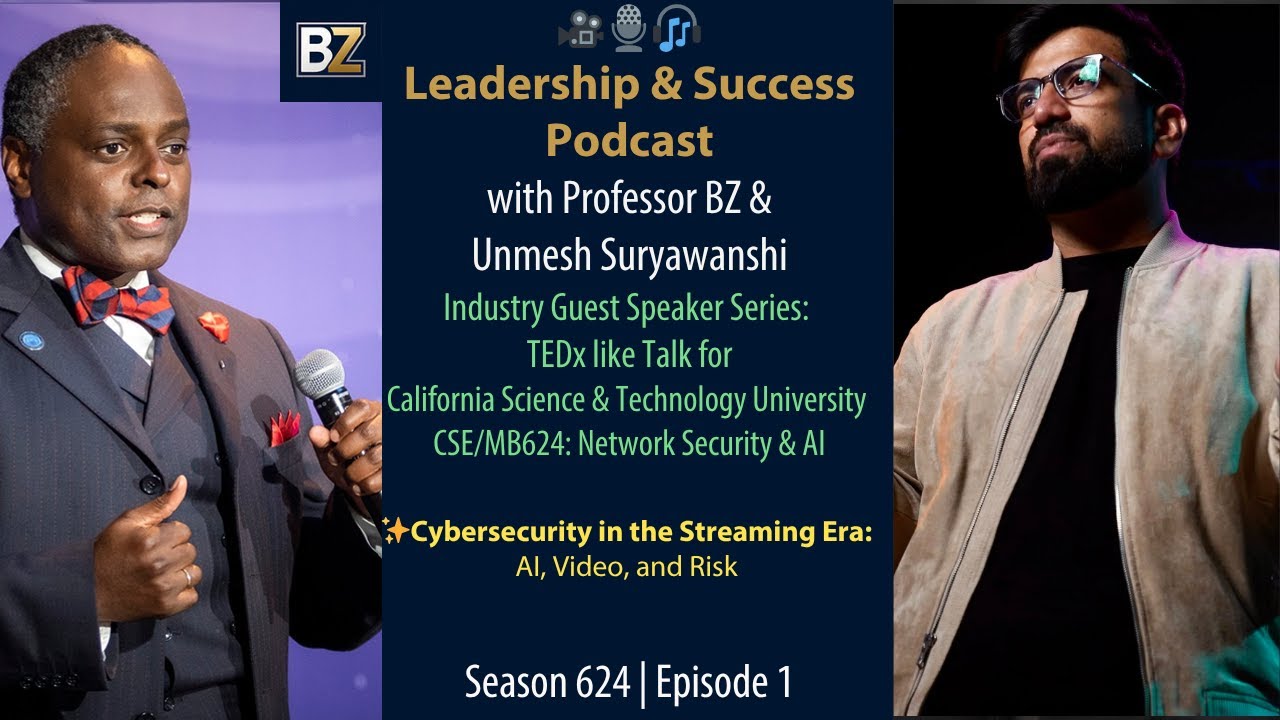
Unmesh Suryawanshi explains how video-first communication creates new cybersecurity vulnerabilities at physical, logical, and endpoint layers. He covers AI threats like deepfakes and metadata leaks, defenses including C2PA watermarking standards, and advises students to master OSI-layer fundamentals and cloud expertise for careers in AI security.
Chapters
Hi, I'm John Maxwell. When the top companies in the world are looking for trainers, speakers, and coaches, there's one name that stands above the rest, and that's Maxwell Leadership. Our certified team members have gotten proven results for companies all over the globe, and our reputation, I'm proud to say, is second to none. Some of our members have risen to the top of their profession, including the one you're going to meet today. I proudly introduce you to my friend Bob Fabien Zinga.
Welcome to the Leadership and Success Podcast with your host, Coach BZ, where we help you lead with purpose and succeed with impact. If you're ready to grow into the kind of leader others want to follow, this podcast is for you. If you're determined to elevate your success and leave a lasting legacy, this podcast is for you. As my mentor, Dr. John C. Maxwell, reminds us, everything rises and falls on leadership. Our goal is simple, to inspire you, challenge you, and equip you with insights that can transform the trajectory of your leadership journey. Welcome aboard. Welcome to another episode of the Leadership and Success Podcast with Coach BZ.
Hello everyone. Welcome to this very, very special edition of the Leadership and Success Podcast. If you notice, we are on our regular season, we are at season 5, but this one here is going to be season 6, 24. That's because that's the class I am teaching at the California Science Technology University here in Silicon Valley. I'm teaching network security and AI. And really this is going to be more like a TEDx talk or fireside chat really for my students, right? Graduate students learning tech so they can really get exposed to so many industry leaders that we have here in Silicon Valley and across America. So this is going to be the very first broadcast we are doing for this. It's gonna be no more than 30 minutes. It's going to be a little bit different than my regular podcast. So without any further ado, let me introduce the speaker. And then we are going to have Anmesh really take his time and speak about cybersecurity in the streaming era, AI, video, and risk. Now, just like my regular podcast, for those who are watching live, you can still tell us where you are coming from. And also, if you have a question for Anmesh, you can type it in the comments. So here we go. Let me see if I can— do a proper job to introduce my industry guest expert today. So today we really have a privilege of learning from a leader who sits at the cutting edge of streaming technology, cybersecurity, and artificial intelligence. So Anmesh Surai, Wanqi, is a streaming and security leader in media security innovation with a focus on AI, cloud technology, secure video infrastructure, right? He works span secure global media ecosystem, AI-powered streaming, translation, transcription, personalization, security architecture, and privacy by design, and also large-scale cloud and broadcast infrastructure. But I believe what makes his journey even more powerful is how early it started. At just 11 years old, Anmesh was already assembling computers, if you can believe that. By middle school, he had built his first network, laying the foundation for a career that would eventually influence global fintech infrastructure and secure digital media at scale. He's not just a practitioner, but also a thought leader shaping how we think about cybersecurity in a video-first, AI-driven world. So today's session, Cybersecurity in the Streaming Era: AI, Video, and Risk. This is not just about technology, but it's also about how leaders must rethink risk privacy and governance in a world where video is the new data layer. So for my students, as a future cyber security leader, engineer and technologist, pay attention to 3 things during this session. What new attack surfaces are emerging beyond traditional IT systems? How AI is both an enabler and a threat in modern architecture? And also what leadership decisions, not just technological controls, are required to manage risk. So without any further ado, let me bring Animesh. Good afternoon. How are you doing today?
Good afternoon, Bobby. How are you doing?
Great. All right. So the floor is yours, Animesh. Whatever you want to share to my students, I am so, so grateful for it.
Yeah, no, thank you so much again. And Bizzy, definitely you did a fantastic job, right, in terms of switching the video broadcast coming from that particular background. I'm pretty like, I, I know in and out of everything, right? So it's, it's, it's pretty challenging. So thank you for having me here. Um, good afternoon, students and, uh, the thought leader. Um, uh, I'm based in California. Uh, a little bit of intro about myself. Uh, I came from the business family, uh, uh, like Dizzy mentioned about, uh, playing with the networks and everything, right? So I started my career more on a software and hardware engineering. Um, I know we are focusing more on network security here, so in a way I can say that I was using a private IP address, but I didn't know because I was just a kid. I didn't know that it was actually a private IP address or a Class C address. I just know that, oh, this particular address can work and I can basically connect the two different dots, right? I started my journey, uh, using a 56 kbps internet divided by 8, so I was literally getting a 7 kbps internet. I came from a very small town, uh, that's how That's how I started my journey. But later on, of course, I pick up my interest more into the software engineering and hardware engineering. And then I put more research into the image processing and regular AI. That was like 10 years back. And then I put my more interest into the development side. And then I came to the States. California is my home now. And I did basically did my master's in ethical hacking and network security. That's where I pick up my interest. After my graduation, I joined Visa, and it's focused more on streaming and video innovation and media AI, right? So, and now we are talking about generative AI. So I am basically wearing multiple caps. Personally speaking, I'm a big fan of data privacy, and that's something that I'm working on currently. But at the same time, I also care about the privacy at all. So wearing multiple caps, but at the same time, video AI risk It's all interconnected, and that's why we're meeting today.
Wow, that is really powerful. So we often think of cybersecurity, right, in terms of network and endpoints. So for my student, how does the shift to video-first communication fundamentally change the attack surface, you think?
Yeah, I think it's a really good question, right, Bisi? Think about this way. In the old era, people were talking about textbook, right? So 20 years back, a lot of organizations were trying to scan all of the documents and they are at least like putting that one into their digital footprint, right? So the moment that we switch into that era, think about this way, uh, initially the people were talking about like, uh, physical loss. But so they basically, just to prevent that one, now they added a virtual layer. But the problem with the virtual layer is Now we are into the digital era, so we added a multiple virtual door, right? We are, we are focusing more on a physical side, or whether it's a hardware infrastructure, and now we are focusing on IP-based. The moment that you talk about IP, that's where you are having a multiple attack, right? So from the physical to the logical, that's, that's the one shift that we see in a traditional IT system. We talk about text data, and today is a video, but video is nothing but the text. Whatever we are talking right now, when we talk about transcript or translation and everything, we are coming back to the old school, which is nothing but the text data. So at the same time, video is nothing but the data, which is again important for you, right? The third thing from this particular attack surface, uh, it's about endpoint, right? So in a generic world, like, what are the endpoint? Endpoint could be anything. It's your mobile, it's your laptop, it's your TV. Or in a corporate land, you can talk about like a larger display. You're talking about any kind of like a video processing unit. Or right now we are having a streaming conversation right now, but logically speaking, there are multiple hubs that is also connected just to make sure that whatever I'm speaking through my camera and from my mic is also delivering to the rest of the audience, right? So think about this way, this is completely video streaming. So we are We are having a conversation on streaming platform and we are talking about streaming security, right? So from the, from the attack surface, can you just imagine if someone just hijacked this particular session? So whatever I'm trying to achieve, and if you are having millions viewers right now on this particular podcast, so if someone hijack me, not from the physical side but also from the virtual side, it can create also the positive negative influence completely, right? So that's how the video is shifted. So it's not about text versus video, it's all about like what is particularly the, the motivation is, right? And the last but not least is now we are talking about virtual layer. The foundation is same, it's still an OSR layer. We are still talking about from layer 1 to layer 7, right? We are talking about a multiple protocol that are working in the video industry and how that protocol particularly get open into the vulnerable attack surface and how people can basically use those ones to harm the network or harm the end user experience or give a different alternative methods. So it's a vast area basically.
Wow.
That is quite fascinating. And I really love this because not too many people really focus on streaming, especially when you think about security. Just as an example, on this podcast, as of last year, using YouTube, we are able to take this podcast, translate it in about 20+ different languages, including my native French, and not just translate it with a caption, but also do the auto-dubbing. So I can listen to this podcast in my native French. And even if you don't speak a word of French, people will be able to listen to you in that language. It's just mind-boggling what you can do with AI. So I guess the question I have for you is AI is now pretty much deeply embedded, right, in streaming. I said translation, summarization, personalization, and on and on. Where does AI introduce the greatest security risk in video ecosystem, you think?
I think it's a really fantastic question. And I think, uh, busy every single day, my answer will change. So as of today, right, as of today, I will give the answer. Um, so let me tell you like what's happening right now, what was the past, and what should be the future, right? It's more on a prediction. So in the past, we are talking about all of the, the regular AI ecosystem. Nothing but, again, the video— video is a data, right? But people were pushing a lot of video editor or video producer, content creator, to create multiple videos, right? So in the old era, people were trying to put some kind of like, uh, a JavaScript payload or any kind of like additional malware inside the video. So when that video is basically going out to the internet or destination platform If the intention is right, that can damage the platforms. That, that was old school, right? And I also did the research in there, so that's why I was again going to refer. What's currently happening today is there are a lot of AI tools in the market. Uh, the corporations are basically pushing to use AI, but at the same time we also need to see like how we can use AI to protect our own ecosystem, right? Yes. So the challenge number one that we have is a deepfake, right? Everyone talk about deepfake and everything. But when we are going to deliver this particular video, consider this way, not every single person who is watching your video is technical enough to understand, right? Think about this way, how you can explain to your grandma about the deepfake, right? So you, you have to convert that particular analogy to the non-technical folks as well. So the deepfake is one area where we are seeing a lot of security issues and synthetic media basically. The second one is more about a lot of AI models, right? They are capturing the sensitive information through the large volume of videos and audio, right? And then they convert into the data. Again, we are back going back to the basic, right? Uh, the third area in, in specifically AI model attacks, right, it's kind of like, uh, advertised ingestion. Right, so yeah, if you are having a podcast and we are live, but what if someone basically hijacked the session and put some kind of like advertisement that was not in the plan, right? But now they are having that type of injection, right? Um, in a similar way, man-in-the-middle attack, similar way, but you know, more on AI and video call, right? Um, the fourth one we can talk about, um, the user behavior or the preferences, right? So what exactly the user behavior is, very generic word. So think about this way is like creating a privacy risk, right? When you create this type of like AI-related videos, different countries having a different regulation. So you have to be really mindful of that one. When you are using this particular tool, are you really using a client's data or user data with their consent, right? Have the humanity in there. Not only just because you can— you found the data, that means you cannot just leverage that data, right? So follow those, follow those principles, right? Like follow those protocols from defined by different organization, different countries. Different, different private— like whether it's a government or private or public, right? There are, there are a lot of aspects of it, and that comes with what? Accountability and transparency too, right? The AI system is so huge that we are thinking about like backbone of the video is nothing but just the multiple servers, right? But at the servers, they are hosting your entire information. So in the old era, we— and this is my favorite, uh, statement, right? In the old era, we are talking about, oh, time is money, right?
Yes.
Right now, or time is a power. Today's world, information is the power. And this is the same dialogue that I also heard from one of the movies 20 years back. But yeah, in today's world, information is power. So your goal is how you can protect your own information. Everything is going publicly, so you have to consider what type of information should go public should be visible to the audience which you are not a part of, versus what type of information should be private. So always ask a question, right? If someone is asking 5 different things, hey Unmesh, can you basically give me your first name, last name, email address? Why do you need it? It's because it's technically a PIR data that someone can associate it with something else. Like, okay, Unmesh is having a podcast at 3 o'clock, he's having first name, last name, and email address. I know what he's doing at 3 o'clock, right? Someone can definitely relate my lifestyle, everything. Right? So it's not about collecting 3 or 4 different data points, but it's also about additional metadata. So what is the additional metadata we are talking about? Oh, podcast is having 3 o'clock, podcast is having on LinkedIn or YouTube, right? It's 3 o'clock, okay, he's having a conversation with one-on-one, right? So this type of, uh, data matters the most. And so this is a current state. What's the future, Steve? Right now, if you see the entire background for me is like very plain, right? If you, if you notice, and I'm not focusing on a specific company, but in the past when you capture the image, it was very difficult to read what's happening on the wall, right? So you basically just convert what I'm speaking, right? In today's world, you can basically go to your Photos app or image app on your mobile devices, and you can search a string and that can give you the answer, right? That's happening on image world. Tomorrow, it's also happening on video world. So camera is trying to capture all of the other information, not through the audio only, but also from the video point of view, and then it can read, right? But again, nothing to worry about, BC. All of what I see is just a fancy book, so don't worry about it, right? But that's what the future is, right? So if you think about like the past was more on text, today is image and AI, tomorrow is video. It's actually here, but it could go more and more and more whenever, yeah.
That is really quite fascinating. A couple of quick things. Once you say time is money, I remember when I was in college back then in the mid-'90s, I was designing websites and stuff. Not many people did that, especially student. But anyway, I had, if you remember, IRC chat, where every week, maybe 2 or 3 days a week, I would spend there 30 to 45 minutes and people would come and want to talk to me. That's actually how I met my future wife. And one of the first things I told her when I first met her is like, okay, my time is money. What do you want, young woman? But anyways, it's kind of funny, but time is really money. But you're right, in this day and age, it's really information, right? We are living in the information age and information has grown so exponentially. But let me ask you just one follow-up about deepfake, because it seems like 3, 4 years ago, it was very easy with a naked eye for you to know this is deepfake and this is reality. Usually pictures would have like 6 fingers or things like that. It was very, very easy to tell. But today, like, even if you just look up, there's a nice AI video about Will Smith, I think, eating spaghetti or something. If you look at the video that was made 3 years ago and one that was made this year, it's going to be impossible for you to tell what is reality and what isn't. So much so that even the chief AI architect at Meta, I think it was last year, right? It was a picture, I think, of ICE officers, and he thought it was real, but it was completely deepfake. The entire thing was fake. And me being in the military, we do a lot of propaganda and psychological ops as well. And during a war, you could have fake pictures of a building being blown up or something to affect the mental state of your adversary. And with AI, it's so much easier. And again, like I say, almost impossible for you to know if what you're looking at is reality or completely fake. Do you have any tips for my students on what ways potentially they could know if especially a video is fake? Or not?
Yeah, yeah, I think, uh, to be honest, that is absolutely a really, really great question. Another great question, right? So again, like, let me give you the past, present, and future agenda, right? So in the past, we are talking about like watermark, right? Simple analogy, right? Like, no one wanted to steal my image, I put like a watermark. That was the past, right? What's happening today is—
which I can remove now by, uh, by, um, yeah, exactly, exactly, right?
So it's a similar thing. So if you are a technical user, so my answer could be different. So if you are a technical user, you can definitely like have to find out like, okay, who is the source? Okay, even though like someone basically made my AI-generated video, but think about like video distributions. Okay, this video is coming from Unmesh Facebook or LinkedIn account, or it's actually just coming from something else, right? So, but ultimately people are talking about like distributing the video. They can create the video and again redistribute it again, right? So So it's very difficult to also tackle, but that is one way to do it. But how you can tackle is think about this way. Even though when the distribution happen, there is a video signature that you can definitely find out. A lot of C2PA is another organization, by the way, right now. A lot of big companies, they are enrolling into that particular organization. Just like in a traditional IT system and security system, multiple organizations are there. They are creating more policy and governance. Just like that, content credentials is another area where people are going in, a lot of streaming platforms going in. So with that one, they will have some kind of like a signature. So you don't need to be technical enough to know whether the video is actually created by AI or not, or whether it's a deepfake. But think about that when like having that type of signature, that is one area. The second area that I can, uh, analyzes. And again, it's today's answer, tomorrow AI will be faster, right? Is, uh, think about like additional metadata into the AI. So AI is not smart enough right now, uh, and it's still listening, so it will be get smarter. But AI is not smart enough to add a lot of metadata into my video as of today, and that's why the metadata is important. Once AI is going to figure it out, like how I can insert additional metadata, what's happening behind behind the scene, that's metadata information. So easy to identify what's happening behind the video, right? So you can, you can basically see mainly on the naked eyes, like about the graphics and everything, but again, it's, it's not enough. So I think there are multiple ways. One is a content credential, see about the watermarking, see about the video distribution, who is sharing the video, right? And last but not least is protect your own information and protect your additional metadata. So less is more, basically, right? Like, if someone is trying to again like ask some information, and if you wanted to really deliver the information, give the limited one, right? And the last but not least is— and this is really favorite topic, right? A lot of users are creating, uh, AI-related videos, but they are creating AI-related videos based on what? Based on your digital footprint that is already available into the internet, right? So there are two digital footprints. One is a private and one is a public. Private digital foot— and there is also the gray area, by the way. So the digital footprint that is private, meaning you submitted a specific government application or private application, and that particular organization is bound to protect your data. That is one area, right? The second area is All of the things that you submitted to a website, but you basically submitted because they are asking you to do. But is it really worth it, right? So think before you submit the information. And last but not least is the public information about you that is already available into the internet. Think about that way, like, is it really necessary to put every single information on public? Of course, we are in the digital world, so it's very difficult right now to remove your public information. So yes, your public identity will be there, it's okay. But like, on at what cost you wanted to share that private information and you are going to declare as a private, right? So think about that way. So always ask the question, why I need to put it on social media? Why I need to put it on public network? So there are multiple ways where you can identify Uh, it's a similar way where there are tools available in the market that can create a deepfake video, an AI-related video, and there are always tools in the market to basically track the AI-related video. So this is the future right now. So the bat— no one is going to win the battle, right? It's all about who, who is ahead, right? Like, it's, it's about that, and that's the whole industry is going now.
That is really amazing. And, and of course, now everybody knows about North Korea, how they were able to actually to get IT jobs, remote jobs, going online and Zoom, and they would use AI and deepfake where instead of you looking like a North Korean, they would look like a white person and they're gonna be able to speak and talk and go for interviews and everything and get an actual job in some of the Fortune 100 companies actually in the US, which is pretty, pretty amazing, all using AI. So what kind of world do we live in these days? Incredible. We are running out of time, but I think I need to ask this one. You've led security at scale, like we said in the intro. How should executives think about governance in a video AI ecosystem?
Yeah, I think the answer is very simple, right? What type of data we are collecting, why we are collecting, and how we are going to use that particular data. Right, so the data, meaning what, it's a client data or user data? No, right, it's all about your infrastructure. So let me just give you the very simple example. If I really wanted to buy something, I'm going to check a couple of things about that product, and then and then only I'm going to buy. Same way, if I'm going to deploy any kind of technology, or if I'm going to use any kind of software, I do the analysis, I do the architecture review, I do a threat modeling. These are all of the principles that you will see on OSI side on risk control and cybersecurity control, right? You have to do like a proper security architecture of that particular product. And this is my favorite quote: think like an attacker. When you design the product, think like an attacker. That's how you're going to basically protect your own asset. So that is from the technology security point of view. From only the governance standpoint, again, if you are really need to use XYZ functionality, Do you really need to like introduce this type of functionality to your product? Because whenever you are going to sell your product, your client is going to ask you, why do you need this, right? So don't put like unnecessary details just because you think that that is the right way to do, right? So there are a lot of other governance in place in terms of data privacy. The GDPR regulations in California is different, US is different, Europe is different, right? There are compliance information as well, right? All about like, are you collecting any medical information? Are you collecting any PII data, right? So we usually check, like, we should definitely check all of the boxes, not because like, okay, I work in XYZ industry, I care about only that. No, you have to think about like how you can infuse everything, whether it's transparency, whether it's data privacy and accountability. Last but not least is We are speaking of the AI. It's AI prompt engineering that is also coming. So if someone is basically having some kind of like a chat with the chatbot, do you really know whether are you getting a real answer or not? Right. So there are multiple variations of that one. But the short answer is your security architecture and threat modeling. That's how you should start your own demo, basically.
That is powerful. I could be talking to you for hours, but we're going to need to stop. Let me ask you this one last question for my students, which, by the way, is about We had 80% computer system engineer and 20% MBA. So one thing we are doing now, working on our last final project, I'm getting the MBA to become the bosses and then all of the engineer to be the worker and to kind of see how they're gonna work together, kind of simulate what it looks like in a Silicon Valley company. But for my students who are listening, again, mostly technical, but some MBA student, What career advice would you give someone who wants to operate at the intersection of AI, cybersecurity, and emerging tech like you?
Yeah, I think the answer is again, very simple. Focus on your foundation, right? That's, that's pretty much it, right? So if you are working on a tech stack, whether it's security or networking, your OSI model should be strong enough. Entire tech stack is focusing on OSI. If you are focusing more on ML and machine learning and AI, Uh, then you have to think about more on our data, right? Data engineering, data warehouse, data analytics, right? If you are thinking about expanding your portfolio into streaming, it's just like a one area, but think about like API streaming or any other application layer, right? Think about like how you're going to again develop your knowledge into the integration. Again, that is not rocket science. You can learn literally within 8 days or 15 days. It's getting worse and worse. Uh, another area where you can also target is more on a cloud. People will have questions a lot. Oh, should I go with the GCP, Azure, Oracle, Microsoft? Okay, there is no right or wrong answer, right? So build your foundation, focus on one cloud. If your desire is to go into the XYZ company, try to see if that particular company is using which type of cloud infrastructure. Every single company, it's a diverse environment right now. So I would recommend focus on one, that will be 80% of your foundation. And then the other cloud platform, their syntax are changing., but the concept and the core of the cloud infrastructure, it will remain same. So that is, that, that is mainly the answer for not like a technical users, right? Like our technical students, um, the non-technical, or like if you are focusing more on a business side or machine, uh, uh, no, like, uh, executive side or leadership side, right? You still need to know like how the technology operate. You don't need to know in and out of everything, but with the help of AI and everything, you can definitely like build your foundation And that's, that's pretty much it. So you can focus either on software fundamentals or network fundamentals, like get any kind of like a certification. But even in the certification, I will tell you this, and this is again another favorite quote from my other colleague that told me, uh, don't marry the company but marry the technology.
Hmm, says that one more time, please. That's one.
Yeah, don't marry the company but marry the technology. Wow, that's powerful.
That is the best advice I've heard for a long time. Thank you so much, Anmesh. We are so, so grateful you took the time to speak to my students today, and I really appreciate that. Thanks again.
Yeah, no, thanks for having me. Thank you, guys.
All right, so this is it for our first episode of season, like I said, 6, 24. The Industry Guest Speaker Series. So just a quick reminder that tomorrow I'm going to be back here live and I'm gonna have a full regular interview, season 5, episode 77. Yadi is coming back to the Leadership Success Podcast. She's now an Amazon best-selling author, international best-selling author. We're gonna be talking about her new book, Hardcore Soft Skills: A Guide to Work with Humans. You don't want to miss this. And then on Wednesday, I'm going to be speaking with a keynote speaker, international best-selling author, Her name is Elinor Sturtz, and she's all the way from the East Coast. And we are going to be talking about Believe, Become, and Empower: The Leadership Journey of Elinor Sturtz. And then on Thursday, I have also confirmed I'm going to be speaking to Master Chief Petty Officer Jamie J. McCoy. He has a PhD in theology and is a retired United States Navy Master Chief. So we're going to be talking about servant leadership at at scale, from sailors to strategy. All right, that's all I have for you, and thank you so much for watching. And I hope to have the next episode of our industry guest expert series soon. Thank you so much. Bye for now.
Thank you for tuning in to the Leadership and Success Podcast with your host, Coach BZ. If today's episode added value to your leadership journey, be sure to subscribe share, and join us again for more wisdom nuggets on how to lead better and achieve greater success. Remember, leadership is the most critical skill of our time. The world will always need leaders to inspire others, drive innovation, and execute meaningful strategy. So why not count yourself among the bold leaders shaping the 21st century? Until next time, stay inspired, stay committed, and keep leading with
More from Bob

S250:E4🎙️LIVE 🇺🇸America 250: President Barack Obama Leadership, Service, and the Power of Hope






S5:E157🎙️ LIVE with CMD CMSgt Dennis L. Fritz, USAF (Ret.)(Multi Tracks Audio)



S5:E156🎙️ LIVE 🇪🇸 Leadership Lessons from the FIFA World Cup 2026 Champions (Multi Tracks Audio)

S250:E3🎙️ LIVE Leadership Lessons from America’s First Documented Family of African Descent 🇺🇸📖