S624:E2🎙️ Industry Guest Speaker Daniel D. Young
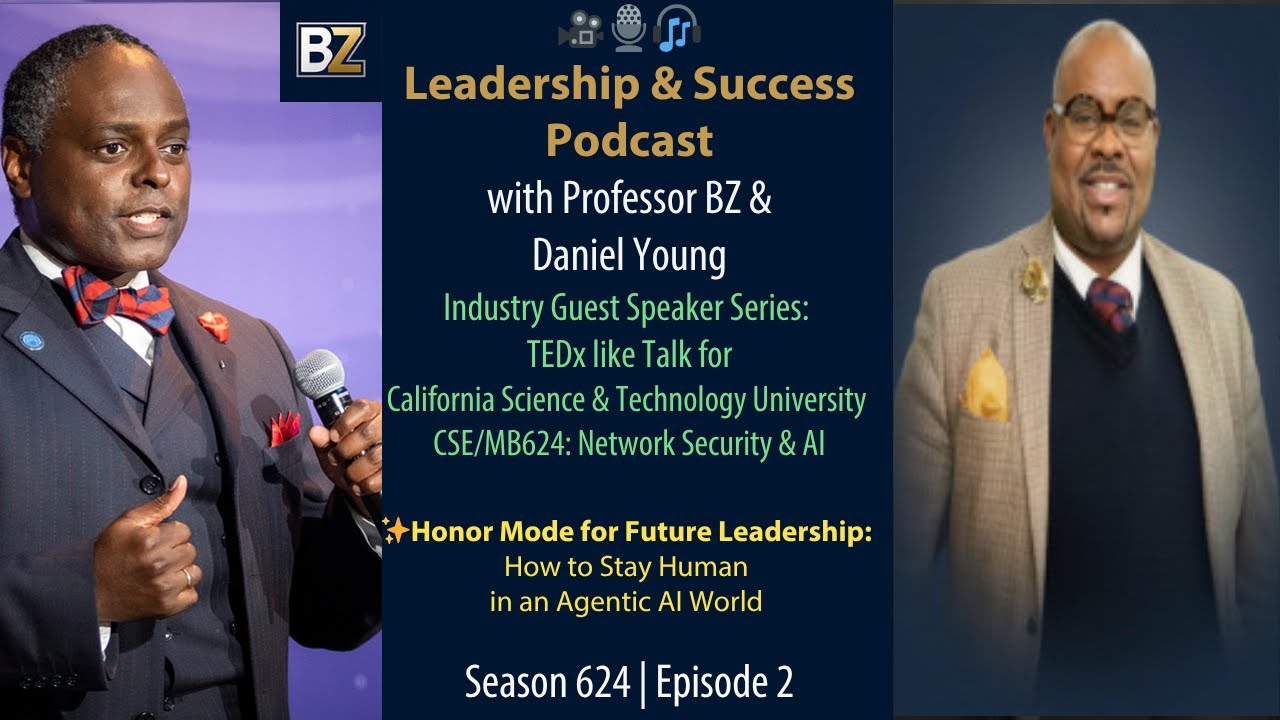
Daniel D. Young argues that cybersecurity depends on the human layer, not just technology. He introduces the "human firewall" concept and "Honor Mode" framework, warning that outsourcing judgment to AI creates a single point of failure. He recommends a 7-day self-forensic audit and treating every alert as a potential breach of care.
Questions this video answers
Failure appears as real‑time operational lapses—missing deadlines or being delayed by traffic or emergencies—but with grace periods. The key is to retrain thinking so that such deviations are seen as recoverable rather than catastrophic.
Outsourcing creates a workforce too large to manage, making it hard to assert human oversight at multiple checkpoints, which can lead to loss of control and ethical drift.
Speak as if explaining to a grandmother: keep explanations under 60 seconds, translate jargon into plain language, and constantly check whether a non‑technical person would understand.
There is insufficient human intervention and lack of mechanisms for humans to override AI recommendations, leading to missing accountability and ethical governance.
Chapters
Hi, I'm John Maxwell. When the top companies in the world are looking for trainers, speakers, and coaches, there's one name that stands above the rest, and that's Maxwell Leadership. Our certified team members have gotten proven results for companies all over the globe, and our reputation, I'm proud to say, is second to none. Some of our members have risen to the top of their profession, including the one you're going to meet today. I proudly introduce you to my friend, Bob Fabien Zinga.
Welcome to the Leadership and Success Podcast with your host, Coach BZ, where we help you lead with purpose and succeed with impact. If you're ready to grow into the kind of leader others want to follow, this podcast is for you. If you're determined to elevate your success and leave a lasting legacy, this podcast is for you. As my mentor, Dr. John C. Maxwell, reminds us, everything rises and falls on leadership. Our goal is simple, to inspire you, challenge you, and equip you with insights that can transform the trajectory of your leadership journey. Welcome aboard to another episode of the Leadership and Success Podcast with Coach All right, everybody.
Welcome to this very special episode of the Leadership and Success podcast. So this is part of my Season 6, 24 podcast series. This is really for my graduate students at California Science and Technology University, where I teach network security and AI. So this is going to be like a TEDx talk-like podcast, I have an industry expert who's going to be talking about anything related to technology, cybersecurity, privacy, or leadership. So let me see if I can properly introduce my guest today. He's been on this podcast before for the regular podcast, but today, Klaas, we are going to shift from tools and technologies to something even more critical. The human layer of cybersecurity and AI leadership. It's easy to focus on firewall encryption and AI models, but in every breach, every failure, every crisis, there is always a human decision somewhere in the chain. So that's why I'm excited to introduce our guest speaker, Daniel D. Young. Daniel is a system architect for Human Potential, author of "Autonomous Companion: Empowerment Agenda Workbook and also a leader who has helped design systems that operate under real-world pressure. From disaster recovery and federal programs to workforce system and community resilience, he has helped, uh, distribute over $100 million in federal assistance, worked in high-stakes environment like emergency response and election, and built what he calls behavioral infrastructure. These are systems that ensure that people perform with integrity even under high stress. So today is going to challenge us to think differently, not just as engineer or analyst or business professional, but as designer of system that include human behavior, ethics, and AI collaboration. His talk, "On a Mode for Future Leadership: How to Stay Human in an Agentic AI World," is about becoming what he calls a human firewall. So without any further ado, please help me welcome to the Leadership and Success Podcast, Daniel D. Young. All right, Daniel, welcome back to the Leadership and Success Podcast. How are you doing today?
Hi there, Professor Bob. I'm doing okay, and I hope everyone is having a great Sunday.
Fantastic. All right, you've got the floor, my friend, and thank you so much for taking the time to speak to my students. I really appreciate that.
The honor is all mine. I, I just want to take a moment and close my eyes and just think what I'm grateful for. I'm grateful for one, that it's Sabbath, it's Sunday, it's a day of rest. As I was reading through, uh, one of my works, one of the IP models, which is the Honor Mode Companion Empowerment Agenda Workbook, and it asks a question: when you look into the mirror, what do you see? It's your reflection. So Sunday is a reset day, it's a day of reflection, and I'm happy to be on this show and to reflect for one, being grateful here, two, grateful that it is a Sunday, and honored to be a special guest to talk to the students as I once was a student. And I know how it is to navigate the student life and get ready to break into any type of exciting industry that there may be. So today I want to start off with leadership being under pressure. I was asked what breaks first. Is it the technology that is going to break first, or is it going to be the people? And you know what I'm gonna say, Bob? Almost always, but always, it's gonna be the moral logic layer of the people. Thank God we're empowered with trust, which is going to be our load-bearing wall. Um, under pressure, tech usually does what it's told to do. Therefore, the failure is that the people stop trusting the data of one another, and that exposes a crack in the human foundation. Prime example, I was on a project where there was $100 million mission, um, where the software, it pretty much held, but humans had to maintain a standard of care. So to do this, as a people leader, I ended up coaching my team on soft skills, um, that, that, that helped them with survivors of catastrophic events. Where we had to do our best to actively listen to their concerns and their needs while gathering the correct information, especially when they were upset. Can you imagine during a time, let's take for example the deadly pandemic, COVID-19 coronavirus, during those times people lost everything and even during Hurricane Irene, people get upset when they lose, let's say, a loved one, a belonging, but close your eyes and just imagine losing everything, Bob. I mean, absolutely things that we take for granted, the little things, they have absolutely nothing. It could be a wedding picture, it could be a picture of a lost loved one, it could be an heirloom. So at the same time, while building trust, and that's that back to the piece I called the standard of care, it has to be built on that. Where I empathize and know what you're going through, but at the same time, I have to maintain mission control because I understand you've lost everything. But at this point, and for that project, our biggest mission was to help them get the maximum amount of aid at their most critical time of need.
Mm-hmm. Wow.
All right, so the next thing I want to go over is what failure looks like at the human layer. For honor mode, it looks like a system breach caused by silence. We must use courage, the type that, that's grit under pressure. Look at it like this, not just as a hack It's someone seeing a glitch and be able to, um, too afraid to speak or even too exhausted. And that's, uh, what we call in honor mode the exhaustion gap. And because of that exhaustion gap, there's a fear of consequences that end up opening that door. However, where leadership must remain in the human asset, even when we are exhausted, even when we have to push through and to meet quotas, therefore there's what we call the grace protocol and wisdom. You know all about wisdom, Bob. We talk about that on your show a lot with Proverbs, using ancient wisdom. Mm-hmm. Um, a part of wisdom, you get an understanding of healing, and a part of healing is the foundation of restoring. And what needs to be restored is the basic foundation. AI can optimize, but it cannot heal trust. It cannot own a breach. It cannot even apologize to you. To do. So therefore, that's when the humans must handle the human variables when things end up going wrong. Now I want to talk about the risk of outsourcing too much judgment in AI. A single point of failure is discernment. Therefore, we have to exercise again that, that W word, wisdom. The wisdom of creating, let's say, a future with history by using what it had taught you. Every day during Bob's show, we get a, a very healthy history lesson. It helps open up our eye gate, our ear gate, and our mind gate, and it gives us the insight. So therefore, AI has no lived history. If you end up outsourcing your judgment, you stop doing the human forensic audits and no one feels responsible for, let's say, the long-term ethical trajectories. Therefore, you get a real risk, and the risk isn't that AI gets it wrong, is that we stop noticing when it does. And I call that a single point of failure in discernment. Agentic AI systems do not ask for permission They just act. And when humans stop doing what I call human forensic audits, the moment where you actually review the why behind the decision, nobody owns the ethical trajectory anymore. However, Animo says a human still has to answer for what the system did, and that's not anti-AI, that's called leadership. One unemote principle for a new SOC analyst I definitely want to go over with you guys, and it boils down to a simple yet powerful word. That word is excellence. Excellence is the pure gold standard. Just say it, excellence. And you can feel free to put that in the chat if you want to as well. And what I want you to do now, think about that word excellence in your, in your, your tech work. For example, don't just close out, let's say, a service ticket, end up auditing the integrity of each one. I want you to treat every alert as a potential threat to the client's standard of care. We talked about standard of care earlier. Now I want you to reapply that in a a different scenario, and that's using your tech skills, your team, including your manager, and with the overall, um, standing for the company. So those things matter. It's not just you working on a solo ticket for your client or for something that you need to execute. You're representing the team, the person who manages you and your work, and now you're the representation for the overall company or the business. You may ask how to avoid technical hides, and I will answer you truthfully, and those are done through synchronous truth, meaningful reflections. For example, if you cannot explain the risk of a non-technical person, let's say, in less than 65 seconds, then you're hiding. My suggestion and recommendation is each night ask yourself, did I use jargon to mask my uncertainty today? And then rewrite one explanation in just plain language. Just make it simple, doesn't have to be, uh, no more than one or two sentences. Next, I want to talk about habits. One habit in particular for the next 7 days. And I want you to do an exercise, actually, and this will assist with the habits. It's a 7-day forensic audit on— guess who? That is correct, yourself. Start with intentional planning. I want you to spend at least 7 to 10 minutes every single night Auditing the decisions that you make against your actual principles, that would allow you to find one logic glitch, and then from there you'll end up designing a simple patch made for your tomorrow so that way you don't go to bed upset. We're not wrecking our minds and brains as soon as we jump out of the bed looking at our to-do list or running through like most people do their text messages and their emails as well. Next, I want to talk about leadership. In today's leadership, there are huge gaps in leadership. One of the biggest leadership gaps that I see in the next generation actually is the alignment gap that I talked about earlier. Therefore, we bring in legacy structures that are going to outlast the actual architect. Many can code, however, fewer can clock build systems that end up aligning with your, your code, your actual people, the organization's policies, and the ethics that are going to protect humanity and not just the data at hand. I want you to understand that honor mode reframes the actual human role from operator to auditor. And these are things that are done with authority. It's not done in a passive voice or sound. Another thing that I want to go back and discuss with the Agented AI, while it's on my mind, is the, the risk factor and the honorable, responsible single point of failure in the discernment, because we want to build redundant human checkpoints. Even through my talks today with you, even through the assignment you have for your one habit, um, forensic audit for the next 7 days. During your audits, during your checkpoints, during the agentic AI failures, you want to build redundant human checkpoints. Therefore, you will never let one system be the only voice. Mm-hmm. Because again, with AI, there's no lived history, and it's going to require leaders to document why they accepted an override, um, on an AI recommendation. So that record becomes institutional wisdom, and therefore, again, your forensic audits They may disappear, but they make the human forensic audits a non-negotiable governance ritual, not as, as, as optional review. Therefore, no ethical trajectory ownership will be assigned a name, a named human who is accountable for, let's say, the long-term ethical drift of every AI-assisted system that they end up touching. The Honor Mode core principles are really, really simple, and I'll leave you with the most powerful one. It's underneath all of, of this is exactly the foundational proverb, proverbial wisdom from Proverbs 17:3, where refinement requires heat, it requires friction and a human hand. Therefore, you cannot refine what no one is watching. I want to thank you for your time.
Wow, uh, thank you, thank you so much, Daniel. I appreciate that. I have about 4 questions from the students. One is, in your experience, what does failure look like at the human layer of cybersecurity or just technology in general?
Failure looks like real-time operations. What I mean is what you are going to identify at that, that synchronious time. I did not meet the deadline. However, we know as humans there are deviations. Yes, I was supposed to be scheduled for a 3 PM appointment. It doesn't make me a failure if I'm hit with traffic, if I'm hit with a, a family emergency phone call that I know that can take anywhere from, let's say, 3 to 5 minutes. And we just, we have discernment that we will be given we will be given grace. That's why they created grace periods. So therefore, the real-time operations that we consider ourselves as failures, we just have to retrain our thinking in the systems that are facing us to be considered as failures.
Thank you. Okay, I have another question from a student. What risk do you see if leaders outsource too much judgment? To AI systems?
Building a large workforce that they're not able to handle. If you are ending up again, outsourcing, let's say to any, any, any foreign country, whatever, whatever our outsource may be, the assignment may be too huge for you to place yourself through the, the, as, as the human intercessor when, when the intercession is needed at several different checkpoints of the project or process, if that makes any sense. You have to, have to outsource a project that, you know, you're able to pretty much mandate. If it's too huge and too large, how can you assert yourself at those different checkpoints when those checkpoints have requirements, deadlines, and timelines so that you and your project does not fail?
Okay, I have two more questions. Next to last, how can a young professional avoid what you call technical hides? That's hiding risk behind jargon.
I would, I would tell them to have a conversation as if they were speaking to a grandmother. A grandmother knows none of these terminologies that we that we know as tech people, industry leaders, none of that. Have a brief conversation, let it take 60 seconds, and say out loud to yourself, hey, would grandma understand this? Or do we need to revisit our own verbiage and reconstruct the jargon, translate it from jargon to layman's terms?
Wow. All right. And the very last question is, where do you see the biggest leadership gap in the next generation of cyber and AI professionals?
Not enough, not enough human intervention where humans are going to be able to override the AI recommendations. We have to hold ourselves in accordance. And we have to hold ourselves accountable to make sure that we are in position with those checkpoints again, so that when the overwritten permissions need to be written for the AI foundation, then that record becomes the— on the human default.
Wow.
Well, thank you. Thank you so much for your time today. I really appreciate that. Daniel Young, this is actually the second time you are on the podcast, but I'm really appreciative you spoke to our students about that human firewall. I think leadership, in my opinion, is probably the most critical skill of the 21st century. In the age of artificial intelligence, we need leaders more than ever before. Thank you so much, Daniel. I appreciate it.
The pleasure was all mine. Thank you.
All right, class, this is it for today. Thank you so much for watching. And I must say, today I think you really learned something most cybersecurity programs really do not teach, right? Tools don't secure systems, people do, right? AI doesn't replace leadership, it amplifies it. And under pressure, your system, not your intention, will determine your outcome. So your job is not just to secure networks, your job is to become a human firewall. All right, this is it for today. Thank you so much for watching and hope to see you next time. We are going to be on the Leadership and Success podcast. Bye for now.
Thank you for tuning in to the Leadership and Success Podcast with your host, Coach BZ. If today's episode added value to your leadership journey, be sure to subscribe, share, and join us again for more wisdom nuggets on how to lead better and achieve greater success. Remember, leadership is the most critical skill of our time. The world will always need leaders to inspire others, drive innovation, and execute meaningful strategy. So why not count yourself among the bold leaders shaping the 21st century? Until next time, stay inspired, stay committed, and keep leading
More from Bob

S250:E4🎙️LIVE 🇺🇸America 250: President Barack Obama Leadership, Service, and the Power of Hope






S5:E157🎙️ LIVE with CMD CMSgt Dennis L. Fritz, USAF (Ret.)(Multi Tracks Audio)



S5:E156🎙️ LIVE 🇪🇸 Leadership Lessons from the FIFA World Cup 2026 Champions (Multi Tracks Audio)

S250:E3🎙️ LIVE Leadership Lessons from America’s First Documented Family of African Descent 🇺🇸📖