Season 3, Episode 3: A Live Leadership Conversation with OpenAI ChatGPT
Coach BZ interviews ChatGPT-4 on leadership, AI security, and personal growth. They discuss a Redis outage, zero-day vulnerabilities, and why continuous learning is AI's secret of success. ChatGPT recommends Peter Drucker on leadership and explains how leaders can use AI as a change agent.
Chapters
Hi, I'm John Maxwell.
When the top companies in the world are looking for trainers, speakers, and coaches, there's one name that stands above the rest, and that's Maxwell Leadership.
Our certified team members have gotten proven results for companies all over the globe, and our reputation, I'm proud to say, is second to none. Some of our members have risen to the top of their profession, including the one you're going to meet today. I proudly introduce you to my friend, Bob Fabien Zinga. Welcome to the Leadership and Success Podcast with your host, Coach BZ. If you need to develop into a better leader, this podcast is for you. If you want to achieve a greater level of success, this podcast is for you. His mentor, Dr. John C. Maxwell, said it best: everything rises and falls on leadership. We hope to inspire you today and provide you with an insight that has the potential to positively impact the trajectory of your life. Welcome to the Leadership and Success Podcast.
Hello everyone, uh, thank you so much for being here with me. If you would please let me know where you are watching from, what city, what state. So today is going to be a very special podcast. I'm going to be interviewing ChatGPT-4. It's actually an idea that my wife, Demetria, gave me, and I think it's going to be pretty interesting to see how much ChatGPT knows about leadership. So before I get started, I also would like to let everybody know that it's very important for me right now to ask you. I've never done this before, but I really would like for, for you guys to consider, consider giving $5 to a Navy family I care a lot about. I just heard about them a couple of days ago, and you can see right here on the screen It's a petty officer in the Navy Reserve. Joshua Seapole is his name. He just lost his wife and his daughter in a car accident, so now he is a single father of 3 kids, and I really would like for us to show him some, some love and help him if we can. And if you go to my LinkedIn page, it's right at the top, you can make a donation on their GoFundMe page. So I would very, very much Appreciate that. All right, having said that, now let me get back to our conversation then with ChatGPT. And as many of you might know, the way you go to speak to ChatGPT— let me move to that screen right now. I think this is going to be pretty revealing. Okay, you should see my screen. I am logged into chat.openai, so I'm saying good morning, and here's the response: Good morning, how can I assist you today? All right, I'm going to ask, what is your full name?
As an AI language model, I don't have a full name in the traditional sense as I am a digital program created and maintained by OpenAI. You can simply refer to me as ChatGPT-4 or AI assistant.
So how are you different from earlier versions of AI? Let's give it a minute to answer.
As an AI language model, I am different from earlier versions of AI in a number of ways. Here are a few examples. Scale. One of the biggest differences between earlier AI models and more recent ones is scale. I am part of the GPT family of models, which are among the largest language models ever created, with billions of parameters. This enables me to generate more sophisticated and nuanced responses to a wider range of questions and topics. Pre-training: Another key difference is that I have been pre-trained on a large corpus of text data before being fine-tuned on specific tasks. This pre-training helps me to learn more general language patterns and structures, which allows me to better understand and respond to a wide range of questions and topics. Improved natural language processing capabilities: Recent advancements in NLP technology have enabled me to better understand and generate natural language. I can now understand and respond to a wider range of conversational inputs, including more complex and nuanced questions and statements. Continual learning: Unlike earlier AI models, I can continue to learn and improve over time as I am exposed to more data and feedback. This allows me to adapt to changing language patterns and user needs, and to provide increasingly accurate and useful responses over time. These are just a few examples of the ways in which more recent AI models like myself differ from earlier ones.
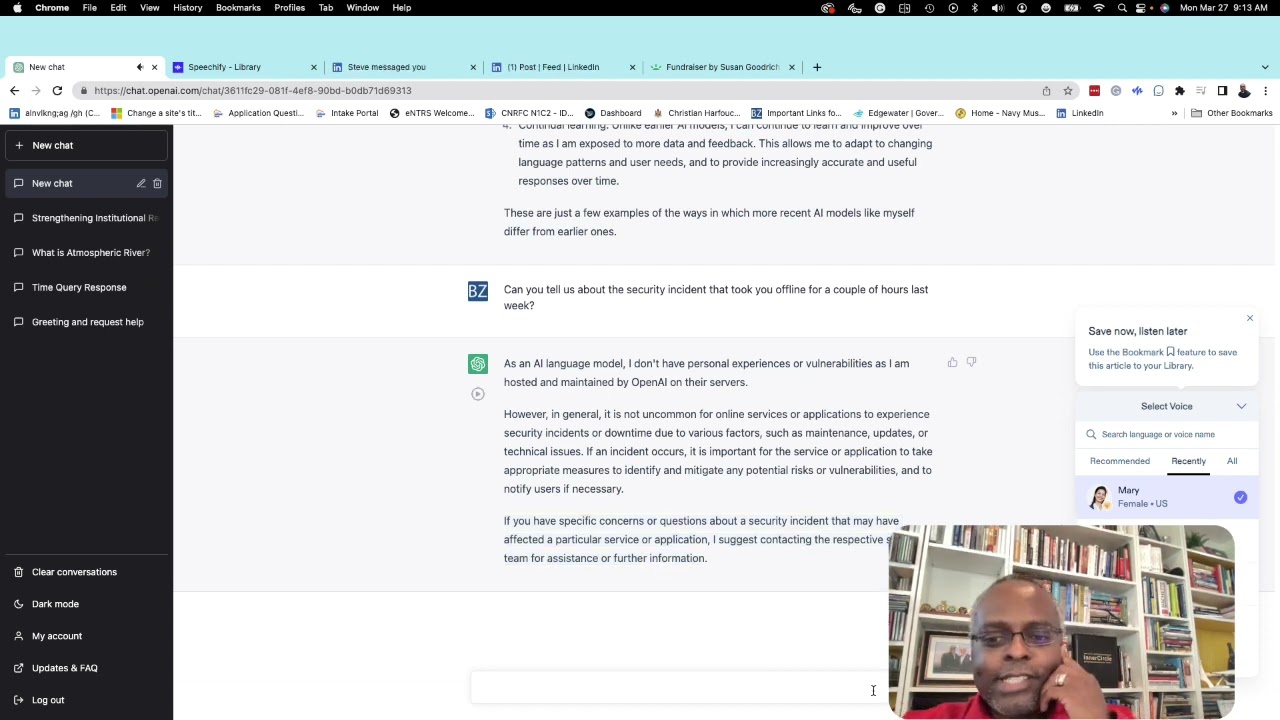
Hey, and thank you so much. I see that Bill Wendell, coming from Boston, Cambridge, had a question. Wow, did not know that ChatGPT-4 could speak like Alexa. Actually, Bill, I am making ChatGPT speak. I am using an extension for Google called Speechify, and I can actually change the voice of this. Let me see, of this here, voice. Here we go. So right now I chose a female US. I wanted to give ChatGPT a female voice just so that it would be more diverse, right? But I could also make ChatGPT speak like Snoop Dogg, right? So as an example, what up, doggaz, big Snoop D-O-double-G. And I'm an English voice from the—
as an AI language model, I'm different from earlier versions of AI in a number of ways.
Here are a few examples. Okay, so I hope that makes sense. So it's me, I'm giving ChatGPT a voice. So I'm going to go back to the female voice.
Hi, I'm Mary. Let's read more so you can do more.
So the next question I have for ChatGPT, there was a security breach, right, related to Redis last week. And ChatGPT went down for about a couple of hours. I would like to know if ChatGPT would like to talk about it. So, can you tell us about the security incident that took you offline for a couple of hours last week? There we go. This is going to be a very interesting question for any security professional out there. And let's hear.
As an AI language model, I don't have personal experiences or vulnerabilities as I am hosted and maintained by OpenAI on their servers. However, in general, it is not uncommon for online services or applications to experience security incidents or downtime due to various factors, such as maintenance, updates, or technical issues. If an incident occurs, it is important for the service or application to take appropriate measures to identify and mitigate any potential risks or vulnerabilities, and to notify users if necessary. If you have specific concerns or questions about a security incident that may have affected a particular service or application, I suggest contacting the respective support team for assistance or further information.
Well guys, here you have it. It looks like ChatGPT doesn't want to talk about the incident that took it down last week. Let me just ask a general question about zero-day vulnerability. Can you, can you please tell me about zero-day vulnerabilities and are you immune to them? All right, let's see what the answer is going to be. And while ChatGPT is typing this, the last company I worked for directly, we did customer support automation using machine learning and artificial intelligence. So part of the reason why I accepted that position is because I wanted to learn more about AI. I really believe that AI is the future of technology, as everybody has seen these past few, couple of months or so. So here's ChatGPT answering my question.
Zero-day vulnerabilities are software security vulnerabilities that are unknown unknown to the vendor or developer of the software, which means they have not had time to develop a patch or fix for it. These vulnerabilities can be discovered and exploited by attackers to gain unauthorized access to a system or network, steal sensitive data, or cause other types of damage. As an AI language model, I don't have any software or operating system vulnerabilities as I am hosted and maintained by OpenAI on their servers. Which are regularly monitored and updated to protect against known vulnerabilities. However, it is important to note that no system can be completely immune to zero-day vulnerabilities, as they can be discovered and exploited at any time by attackers. To mitigate the risk of zero-day vulnerabilities, it is important to implement strong security measures, such as using encryption, access controls, and intrusion detection systems, and to stay informed about the latest security threats and trends. Additionally, it is important to keep software and systems up to date with the latest security patches and updates, and to follow best practices for secure computing and network use.
Okay, so obviously ChatGPT is not going to talk about what happened to it last week, but looks like it was a zero-day Redis-based vulnerability which was eventually patched. And some people actually were able to read some of the text and the question they had from other users, but other users that ask ChatGPT. This is going to be my last attempt to have ChatGPT to tell us about this. I'm going to say, were some of your users able to read chat excerpts from other users last week? Did you experience, experience a data breach? Okay, this is going to be my very last attempt. Let's see if ChatGPT can tell us a little bit more about what happened last week.
As an AI language model, I don't have information about any specific incidents or data breaches that may have occurred with regard to my usage. However, I can assure you that OpenAI takes the security and privacy of user data very seriously and has implemented robust measures to protect against unauthorized access or disclosure of user data. If you have any concerns about the security or privacy of your data when using AI-powered services or applications, I recommend contacting the respective support team for assistance or further information. It is also important to follow best practices for online security and privacy, such as using strong passwords, enabling two-factor authentication, and being cautious about sharing personal or sensitive information online.
Okay, again, there is a general security practice. So let me ask him, uh, or her more, uh, about best security practices. What are the very best security and privacy practices for online— let me see— what are the very best security and practices No, let me say, what, what best security and what are the best security and privacy practices for users online today? Let me do that. Okay. All right, all of this looks pretty good. And let's hear ChatGPT. And again, this is going on live right now as we speak. Okay, here we go.
There are several security and privacy best practices that users can follow to help protect their online identity and data. Use strong and unique passwords: Use strong and unique passwords for each of your accounts, and consider using a password manager to securely store and manage your passwords. Enable two-factor authentication: Two-factor authentication adds an extra layer of security by requiring a second form of verification, such as a fingerprint or SMS code, in addition to your password. Keep software up to date: Keep your software and devices up to date with the latest security patches and updates, as these often address known vulnerabilities and security issues. Be cautious of suspicious emails and links: Be wary of emails or links from unknown or suspicious sources, as these could contain malware or phishing attempts. Use encryption: Use encryption tools and technologies, such as HTTPS or VPNs, to help protect your data and online activities from eavesdropping or interception. Limit sharing of personal information: Be cautious about sharing personal or sensitive information online, and consider using pseudonyms or alternate email addresses where possible. Regularly monitor your accounts: Regularly review your online accounts for any suspicious activity or unauthorized access, and report any concerns to the respective service provider or authority. By following these best practices, users can help protect their online identity and data from potential threats or attacks.
Okay, I think those are definitely the best practices out there. Now, a question that my daughter would ask, especially when she was younger, is, "Can you sing?" Right? She'd ask this question to every AI managed thing we have, whether it's Alexa or Google or Siri. So let's ask ChatGPT if he or she can sing. Let's go. Can you sing?
As an AI language model, I don't have a physical form or the ability to sing. However, I can provide you with the lyrics to a song if you would like.
Okay, so ChatGPT folks cannot sing. All right, now it's already been about 20 minutes or so, so this was just kind of a warm-up. Now let's get into the leadership question I normally ask my guests. Let's find out what ChatGPT knows about a very serious subject to me, which is leadership. So first I'm gonna ask, um, what is leadership? What is leadership? OK.
Leadership is the ability to inspire, guide, and influence others towards achieving a common goal or objective. It involves being able to communicate a clear vision and direction, as well as motivating and empowering team members to work towards that vision. Effective leadership also involves being able to make difficult decisions, manage resources and budgets, build and maintain relationships, and adapt to changing circumstances. Leadership can be demonstrated in various settings, such as in business, government, nonprofit organizations, and community groups. Leaders can be formal or informal, and leadership styles can vary widely depending on individual personalities and circumstances. Some common leadership styles include authoritarian, democratic, servant, transformational, and laissez-faire.
Okay, I think that is a pretty good definition of leadership, right? My primary mentor, Moslem Scott, is like, leadership is influence, nothing more and nothing less. And that's really something I would like to become a master at. I've dedicated my life to learn to become a better leader. So one question I would ask is, uh, what is the greatest lesson you have learned, right? And let's see what ChatGPT says about that.
As an AI language model, I don't have personal experiences or emotions, so I cannot say that I have learned lessons in the traditional sense. However, one important lesson that is often emphasized in many fields, including technology and AI, is the importance of continuous learning and adaptation. In order to stay relevant and effective in a rapidly changing world, it is important to be willing to learn and adapt to new technologies, ideas, and ways of thinking. This requires a mindset of curiosity, openness, and flexibility, as well as a willingness to take risks and make mistakes along the way. By embracing a mindset of continuous learning and adaptation, individuals and organizations can stay agile and resilient in the face of new challenges and opportunities.
I believe that's a very, very important lesson, continuous learning, right? And I believe that's a, a master key for success. Telling yourself that you are going to be a student for the rest of your life. I will always study. I will always learn. There is no way I can know everything there is to know. That reminds me when I was a PhD student at the University of Alabama, my primary professor, he got his PhD in immunology like 20 years earlier. And back then it was like I knew absolutely everything there was to know about immunology. This was like early 2000s. And in the early 2000s, it's like it's impossible to know everything there is to know about any subject. So the way you succeed is by really increasing your tent, increasing what's between your ears, expanding your mind, and learning, learning, learning, learning. So I believe that is a very, very great lesson. So let me ask ChatGPT a question that is kind of in the same vein about the secret of its success. And again, ChatGPT is the most human-like iterative version of AI that is very much like a human being.
As an AI language model, I don't have personal experiences or emotions, so I cannot claim any success in the traditional sense. However, I can attribute my abilities and usefulness to the extensive training and optimization I have received from my developers at OpenAI as well as the massive amounts of data that I have been trained on. Additionally, one key factor that has contributed to the success of many AI models like myself is the collaborative efforts of researchers, engineers, and developers from around the world. The field of AI is characterized by a culture of openness and collaboration, with many individuals and organizations working together to share knowledge, resources, and expertise in order to advance the field. Ultimately, the success of any technology, including AI, is dependent on the contributions and efforts of many individuals and organizations working together towards common goals.
Okay, that is, that is fair. So let me ask ChatGPT about the greatest advice it has ever received, uh, leadership advice.
There we go. As an AI language model, I don't have personal experiences or emotions, so I have not received any leadership advice in the traditional sense. However, there is a famous quote by management expert Peter Drucker that is often cited as excellent leadership advice. Management is doing things right; leadership is doing the right things. This quote speaks to the importance of vision, strategy, and purpose in effective leadership. Leaders must not only be able to manage tasks and resources effectively, but also to guide and inspire their team towards a common goal or vision that aligns with the organization's mission and values. Other important leadership advice often emphasizes the importance of empathy, humility, and self-awareness, as well as the ability to communicate clearly, build strong relationships, and foster a culture of trust, accountability, and innovation.
That is an excellent, excellent answer. Management is doing things right, but leadership is doing the right thing. And many times we do a lot of things right, but they may not be the right thing we should be doing. And one question I do ask myself often is, what is the best use of my time right now? Am I doing the right thing? And That's a very, very important lesson. So that was kind of lesson 1 about what ChatGPT has learned about leadership. Now I'm going to go to question number 2: what ChatGPT is learning now, if anything. So what are you learning now? All right, let's hear the answer.
As an AI language model, I am not capable of learning in the traditional sense as I don't have personal experiences or emotions. However, I am continually updated and optimized by my developers at OpenAI to improve my language processing abilities and increase the scope of topics and questions that I can respond to accurately. My training data is also updated regularly to ensure that I have access to the most up-to-date and relevant information, and my algorithms are fine-tuned based on user feedback and usage patterns to improve my performance over time. In addition to ongoing updates and optimizations, there is also ongoing research and development in the field of AI that is driving new breakthroughs and innovations in natural language processing, machine learning, and other related areas. As the field continues to evolve, I will continue to adapt and improve to better serve the needs of my users.
Very good. And we have a question from the audience, from Dale. I'm gonna, uh, paste it here. And we are going to ask, so sometimes leaders merely maintain the status quo, right? How can more leaders use ChatGPT to effectively be change agents, even in society or in industry? One example, real estate, where existing business practices have been called an informal cartel. Okay, let's see what ChatGPT has to say about this.
Leaders can use AI-powered tools like ChatGPT-4 to help drive change and challenge the status quo in a number of ways. Here are a few examples: Seek out new perspectives: One way to challenge the status quo is to seek out new and diverse perspectives on a given issue. ChatGPT-4 can help leaders access a wide range of information and opinions from around the world, including insights and viewpoints that may not be readily available in their immediate circles. Identify potential blind spots: Leaders can use ChatGPT-4 to help identify potential blind spots or biases in their thinking or decision-making. By posing challenging questions and exploring alternative viewpoints, leaders can gain a more nuanced understanding of complex issues and identify opportunities for innovation and change. Explore New Ideas and Approaches: ChatGPT-4 can help leaders explore new ideas and approaches to longstanding challenges or issues. By generating creative and innovative solutions, leaders can challenge the status quo and drive positive change in their industries or communities. Communicate with Clarity and Empathy: Effective leadership requires clear and empathetic communication. ChatGPT-4 can help leaders craft clear, concise, and engaging messages that inspire and motivate their teams or stakeholders towards action and change. Overall, by leveraging the power of AI and natural language processing, leaders can use tools like ChatGPT-4 to challenge the status quo, drive innovation and change, and promote ethical and moral leadership practices.
All right, Bill, I think that is a very good answer. Hopefully that answers your question. And for those watching again, let me know where you are watching from, city and state, and also if you have a question for ChatGPT-4. And again, I believe this is the very first time this has been done for a podcast live. So I like doing these things live, but sometimes, you know, the power may go out, you know, but ChatGPT may be out of service or something. So it's the risk I am taking, but I think this is really what technology and innovation is all about. Now, another question I have for number 12. I asked ChatGPT, what are you learning now? But I'm also going to ask, what is the greatest investment ChatGPT has made with its time so far? Again, ChatGPT is not a human being but acts like one, and I want to know. So what is the greatest investment you have made in yourself?
As an AI language model, I don't have the ability to make investments in the traditional sense. However, I have been trained and optimized by my developers at OpenAI using massive amounts of data and computational resources, which could be considered an investment in my development and capabilities. In terms of personal growth and development, some common investments that individuals might make in themselves include pursuing such as pursuing education and training, practicing self-care and mindfulness, seeking out new experiences and challenges, and building strong relationships and networks. Ultimately, the greatest investment one can make in themselves is the commitment to ongoing learning and personal growth, which can lead to greater fulfillment, satisfaction, and success in all areas of life.
Well, I could not agree more. Personal growth is definitely a master key to success. We talked about it earlier, right? Having the mindset of always always learning. Now, another question I ask leaders on this podcast is how failure has shaped their life, right? Because most of the time we only look at successes, but the truth is many times people have to fail a lot before they achieve those milestones, and sometimes people don't want to talk about it. So let's see about ChatGPT: How has failure shaped your life?
As an AI language model, I don't have personal experiences or emotions, so I cannot say that failure has shaped my life in the traditional sense. However, I can speak to the importance of failure in the context of AI development and machine learning. In the field of AI, failure is an inherent part of the learning process. Machine learning algorithms rely on trial and error to identify patterns and make predictions, which means that failures and mistakes are an essential part of the training process. By learning from their mistakes and failures, AI models can improve their accuracy and effectiveness over time. In fact, many of the most successful AI models have been developed through iterative processes of trial and error, with each failure providing valuable insights and opportunities for improvement. This approach to failure can also be applied to other areas of life and work. By embracing a growth mindset and reframing failure as an opportunity for learning and improvement, individuals can become more resilient, adaptable, and effective in their personal and professional pursuits.
I think that is really, really a great answer. It's something I've really learned when I moved to Silicon Valley. Most companies don't wait to have the perfect product. Just ask Microsoft, especially in the '90s. But whatever they have, they're gonna go there and put it in the market and then get a lot of feedback from the user. Basically, they use all of their customers as their testers. You're there to test the product, to find all of the bugs, and then they're gonna fix those bugs as quickly as they possibly can. So they kind of fail forward. They fail, they learn, learn, learn, and fix, and they iterate, right? Kind of have an iterative model here in Silicon Valley. And I think in your personal life, that is something you should think about doing as well. Be bold, do things that you probably would not do, uh, because when you ask yourself, well, I don't want to do this because I don't think I am ready, the truth is you will never, never be ready. Nobody is perfect, everybody makes mistakes, but when you make those mistakes You need to learn from them quickly and then improve and continue, right? That's, I think, that really builds your resilience in life. I think that is a great answer. So I'm going to go to question number 4: who do you know that we should know? I always like to know who the leaders I interview know to find out who else do I need to read or study. And by the way, while ChatGPT is answering, Silvia from Chile, thank you so much for being with us now, and also Javan from India, I appreciate you being here. Okay, here's ChatGPT's answer.
As an AI language model, I don't have personal relationships or knowledge of specific individuals in the traditional sense. However, there are many influential and inspiring figures across various fields who have made significant contributions to their respective industries and communities. Some examples might include entrepreneurs like Elon Musk or Oprah Winfrey, political leaders like Nelson Mandela or Ruth Bader Ginsburg, scientists like Stephen Hawking or Jane Goodall, and artists like Beyoncé or Lin-Manuel Miranda. There are also many lesser-known individuals who are doing important work in their communities and industries, such as grassroots activists, community leaders, and researchers. Ultimately, the most important thing is to seek out individuals whose work and ideas inspire and challenge you, and to remain open to learning from a diverse range of perspectives and experiences.
Okay, I'm, I'm, I'm going to ask ChatGPT one more question about, uh, who are your mentors, thought leaders you are following. But of the list that, uh, ChatGPT gave us, uh, earlier, the only person I don't know is Lin-Manuel Miranda. I'm sure my daughters know who that person is, but everybody else it really makes sense. People you should follow who've really contributed greatly to our society. So again, ChatGPT, who are your mentors, thought leaders, and people you are following now?
As an AI language model, I don't have personal experiences or emotions, so I don't have mentors or thought leaders in the traditional sense. However, I am the result of the collaborative efforts of many researchers, engineers, and developers from around the world who are working to advance the field of artificial intelligence. Some of the most prominent figures in the field of AI include pioneers like Alan Turing, John McCarthy, and Marvin Minsky, as well as contemporary leaders like Yann LeCun, Geoffrey Hinton, and Yoshua Bengio, who have made significant contributions to the development of deep learning and neural networks. There are also many thought leaders and influencers in related fields like machine learning, natural language processing, and computer science who are shaping the direction and development of AI in important ways. Some examples might include Andrew Ng, Fei-Fei Li, Demis Hassabis, and Timnit Gebru. Ultimately, the field of AI is characterized by a culture of openness and collaboration, with many individuals and organizations working together to share knowledge, resources, and expertise in order to advance the field.
That's very well. A couple of these people I don't know, so that's going to be my work, like I say, you know, I love to learn stuff and I'm gonna be seeking out what they have contributed to this field. So the next question here for part number 4 is, if you could choose 3 people to have dinner with, who would you choose and why? And I'm gonna look in the chat again, please let me know where you are watching from and also if you have any question for ChatGPT. I see Bill has another question about smart failing. I'm gonna ask that one next. Before I go to section 4, which are about the books that ChatGPT might be reading. So now the question here was, if you could choose 3 people to have dinner with, who would you choose and why?
As an AI language model, I don't have personal preferences or experiences, so I can't have dinner or choose individuals to dine with. However, I can suggest some notable individuals who might make for interesting dinner guests based on their accomplishments and contributions to their respective fields. Elon Musk: As a leading entrepreneur and innovator in the fields of electric vehicles, space travel, and renewable energy, Elon Musk is known for his ambitious and forward-thinking ideas. Dinner with Musk could be a fascinating opportunity to discuss cutting-edge technology, sustainability, and the future of human exploration. Malala Yousafzai: As an activist for girls' education and the youngest Nobel Prize laureate, Malala Yousafzai is an inspiring and courageous figure. Dinner with Malala could be a chance to discuss the importance of education and empowerment, as well as her experiences as a young advocate for human rights. Stephen Hawking: As one of the most brilliant and influential scientists of our time, Stephen Hawking made groundbreaking contributions to our understanding of the universe and the nature of reality. Dinner with Hawking could be an opportunity to discuss some of the most profound questions about our existence and the mysteries of the Cosmos.
These are excellent choices. I know about all three, and it's definitely a good thing to find any works they may have had and to read about their thinking. And one thing pretty amazing with Elon Musk is he actually doesn't really have a degree, does he? I think he went to Stanford, but he didn't finish. So he was a dropout and today is the richest man in the world, if not the richest man, one of the top 3 for sure. And he's really making changes to the universe, having an impact more than probably any other being that has been, at least in modern time, not just the electric car, but space and all of that, which is pretty amazing and fascinating. By the way, the question I wanted to ask Bill is actually the next one I was going to ask. I am ahead of you on that. So question number 5 is, what have you read that we should read? Oh, let's see. Again, I am live here. Let me just refresh this page. Okay, let's do this again. What have you read that we should read? Here we go. So ChatGPT is back. But I really believe that this artificial intelligence is going to be changing the way we do life going forward. That's for sure. And I'm hearing that a lot of students have been using ChatGPT to kind of cheat on their homework and things like that. But this is definitely going to be transformational for society. So what have you read that we should read?
Answer: As an AI language model, I don't have personal preferences or experiences, so I don't have specific recommendations based on my own reading preferences. However, there are many books across a wide range of genres and subjects that have been widely acclaimed and might be worth considering. Here are a few examples: Sapiens: A Brief History of Humankind by Yuval Noah Harari—a thought-provoking exploration of human history and evolution, from the emergence of Homo sapiens to the present day. The Immortal Life of Henrietta Lacks by Rebecca Skloot—a compelling and deeply researched exploration of the life and legacy of Henrietta Lacks. A woman whose cancer cells were used without her consent for scientific research. She was a— The Power of Now by Eckhart Tolle, a transformative guide to living in the present moment and cultivating greater mindfulness and self-awareness. Thinking, Fast and Slow by Daniel Kahneman, a fascinating exploration of the two modes of thinking that drive our decisions and behavior, and how they impact our perceptions of the world around us. The New Jim Crow by Michelle Alexander, a powerful examination of the racial bias and systemic oppression presented The US criminal justice system and its impact on communities of color. These are just a few examples, and there are many other great books out there across a wide range of topics and genres.
Who are AI thought leaders we should follow on social media? And this question goes to the point of what Bill was asking earlier. And by the way, from the previous answer from ChatGPT, if you follow Oprah Winfrey, you would know who Eckhart Tolle is, right? The Power of Now. And the immortal life of Henrietta Lacks, she was a Black woman and they used herself to do a lot of research. Actually, when I was a PhD candidate in microbiology, in my lab we were using her cells to kind of grow cells and do a bunch of experiments. She's really done so much for the scientific community, but it's only very recently that she actually received credit for it. The credit was given to a white man, again, who did all of that without her consent. Which is completely illegal and not ethical at all. So the last question I asked, who are AI thought leaders we should follow on social media? A question Bill wanted an answer for. Let's listen to the answer.
There are many AI thought leaders who are active on social media and can provide valuable insights and perspectives on the latest developments in the field. Here are a few examples. Andrew Ng, @andrewying, founder of deep learning. AI and former VP and Chief Scientist at Baidu. Ying is a leading AI researcher and educator who is known for his work on deep learning and online education. Fei-Fei Li, @DrFeiFei, Co-Director of the Stanford Institute for Human-Centered Artificial Intelligence. Hi, Li is a renowned AI researcher who has made significant contributions to computer vision and visual recognition. Gary Marcus : A cognitive scientist and AI researcher, Marcus is known for his work on natural language processing and the limitations of deep learning. Kate Crawford : A leading AI ethicist and researcher, Crawford has written extensively on the social and ethical implications of AI and data-driven technologies. Yoshua Bengio : A pioneer in the field of deep learning and one of the developers of the backpropagation algorithm, Benjo is known for his groundbreaking work on neural networks and unsupervised learning. There are many other thought leaders in the field of AI who are active on social media and can provide valuable insights and perspectives on the latest developments in the field.
And actually, guys, if you can help me out, as she's giving specific name, I know this is specifically for Twitter, but if you could find those people on LinkedIn too and add, in the comment, I would appreciate that very much. Or I can do it once this podcast is over, add all of those resources, maybe even the transcript for this special podcast. So the last question I asked under Section 5, we asked about who she's read and we should read. And now the next question is, what is the best book you have read recently? So I want to get a recommendation. Yeah, I read a lot. I probably read almost 3,000 books by now since I was 17 years old. This is just a miracle to me, a blessing for somebody to be able to read from someone's experience, right? People have lived 30, 40, 50, 60 years and they put their experience in one little book and they sell it for like $20, $25. And you can get all of that wisdom. And it is just a miracle to me. So I do read a lot.
As an AI language model, I don't have personal experiences or preferences, so I haven't read any books in the traditional sense. However, I can suggest some popular books that have been widely acclaimed and might be worth reading. One recent book that has received a lot of attention and positive reviews is The Four Winds by Kristin Hannah. It is a historical novel set during the Great Depression and tells the story of a woman named Elsa who must navigate economic hardship and personal loss as she tries to provide for her family. The book has been praised for its vivid characters and emotional depth, as well as its timely themes of resilience, sacrifice, and the enduring human spirit. Other recent books that have received critical acclaim include "The Vanishing Half" by Brit Bennett, "The Midnight Library" by Matt Haig, and "The Push" by Ashley Audrain. However, there are many great books out there across a wide range of genres and styles, so it ultimately depends on your personal interests and reading preferences.
Okay, and now we are going to go to section 6 where I normally ask what is one action you have taken that has positively impacted your life. So I know she's not going to answer that, so I'm going to ask What actions do you recommend we take to positively impact our lives? And again, if you just joined, let us know where you are watching from and also type in your question in the comment if you have a question for ChatGPT-4. And the question I just asked is, what action do you recommend we take to positively impact our lives? And here's the response from ChatGPT.
There are many actions that individuals can take to positively impact their lives depending on their specific goals and circumstances. However, here are a few general recommendations that can be beneficial for most people. Cultivate a growth mindset: Instead of viewing challenges and setbacks as obstacles or failures, try to approach them as opportunities for learning and growth. This can help you develop resilience, adaptability, and a greater sense of self-efficacy. Practice self-care: This can include things like getting enough sleep, exercising regularly, eating a healthy diet, and taking time for relaxation and stress relief. Prioritizing your physical and mental health can help you feel more energized, focused, and resilient. Set goals: Having clear and specific goals can provide direction and motivation, and help you track your progress and celebrate your achievements. Make sure your goals are challenging but achievable, and break them down into smaller, actionable steps. Cultivate positive relationships: Surrounding yourself with supportive and positive people can help you build resilience, reduce stress, and feel more connected Others. Invest time and energy in building and maintaining meaningful relationships with friends, family, and colleagues. Practice gratitude. Taking time to reflect on the good things in your life and express gratitude can have a powerful impact on your mood, attitude, and overall well-being. Try keeping a gratitude journal, expressing gratitude to others, or simply taking a few minutes each day to reflect on the things you're thankful for. These are just a few examples of actions that can have a positive impact on your life, but there are many other strategies and practices that can be beneficial as well.
Well, I really believe if you do what ChatGPT just said, you will be happy, right? Because I think happiness is not an end state, but it's always in progress. You are in pursuit of something and you feel like you are growing, right? You have a growth mindset, you practice self-care, you take care of yourself, you have goals, so you have something to achieve, you have something something to live for, and you have great relationship with friends, family, close people in your inner circle, and then you are grateful every day. And I think that's going to make you very happy regardless of the circumstances of life around you. So another question I ask as part of Section 6 is, if you had one day to live, what would you have liked your final contribution to be? It's going to be very interesting to see how ChatGPT is going to answer that one. And while ChatGPT is answering, again, if you have a question, please add it to the comment and I will make sure to get to most of them. So if you had—
As an AI language model, I don't have personal preferences or experiences, so I don't have a personal answer to this question. However, I can suggest some possible ways in which someone might choose to make a final contribution if they had only one day to live. Some possible contributions that someone might choose to make could include helping others. Volunteering at a local charity or helping someone in need can be a powerful way to make a positive impact in a short amount of time. Sharing knowledge: Sharing your knowledge and experience with others can be a way to pass on valuable insights and lessons that others can benefit from. Creating art or music: Creating something beautiful or meaningful can be a way to leave a lasting legacy that inspires and uplifts others. Advocating for a cause: If you're passionate about a particular cause or issue, using your final day to raise awareness or advocate for change can be a way to make a difference. Ultimately, the answer to this question will depend on the individual and their personal values and priorities.
All of those choices are really excellent. If you care about something, I think now is the time to really advocate for that, right? Because tomorrow is promised to no one. And yeah, I love it. And then a follow-on question I normally ask my guests is, When you wake up in the morning, what is one problem you would like to solve? And let me check the comments while ChatGPT is answering that one. Michael, thank you so much for being on from Lancaster, Pennsylvania, Amish country. That is beautiful. And Michael and everybody else, if you have a question for ChatGPT, please type it in the comment.
And here's the answer. As an AI language model, I don't wake up in the morning as I am an artificial intelligence program. However, I am designed to help people find solutions to their problems and answer their questions, so if there is a problem that someone needs help with, I am here to assist to the best of my abilities.
Okay, and now we are coming towards the end. One of the questions I'll ask is, how can we add value back to you?
As an AI language model, I don't have personal needs or desires. My purpose is to assist and provide information to the best of my abilities, and my value comes from the quality and usefulness of the information and assistance I provide to users. If there is a way in which I can improve or better meet your needs, please let me know and I will do my best to make any necessary adjustments or improvements. Otherwise, simply using me as a resource to answer your questions and provide information is sufficient.
Okay, so I encourage everybody listening to me now to please use ChatGPT. I think the more questions we ask, the better it is going to get with time. So already pretty amazing right now. So the following question is, what could we do to make a difference? And I want to acknowledge Irfan from Copenhagen. Again. Welcome. And if you have any question, please type it in the chat. We are almost done. I think I have one more question to ask, and I want to make sure I get all of your question answers while we are here. So again, the last question I ask: what could we do to make a difference?
There are many ways in which individuals can make a difference, both in their personal lives and in the wider world. Here are a few suggestions. Volunteer: Volunteering your time and skills to a local organization or cause can make a big difference in your community and provide a sense of purpose and fulfillment. That's right. Donate: Contributing to a charity or organization that aligns with your values and priorities can help support important work and have a positive impact. Reduce your environmental impact: Taking steps to reduce your carbon footprint, such as using public transportation, reducing waste, and conserving energy, can help mitigate climate change and preserve natural resources. Advocate for change: Whether it's through letter-writing campaigns, public demonstrations, or social media activism, advocating for change on issues that matter to you can help raise awareness and bring about positive change. Be kind: Simple acts of kindness, such as smiling at a stranger, offering a compliment, or helping someone in need, can have a positive ripple effect and make a difference in someone's day. These are just a few examples, but there are many other ways in which individuals can make a difference based on their skills, passions, and circumstances.
And again, I mentioned it at the very beginning of the podcast, I'm reminded by ChatGPT 4, donate, it really makes a huge, huge difference. There is a Petty Officer First Class in the US Navy Reserve, really a hero, really going through tragedy right now. His wife and kid died in a car accident and now He is a single father of 3 children. One of them is going through physical therapy right now. The other 2 kids appear to be fine. It's on my LinkedIn page at the very top. Please, I'm asking you to just give $5, right? That's how much it costs for a Starbucks cup of coffee or something. That's all I am asking. I have about 42,000 people or so who follow me on LinkedIn. If all of us gave $5, we could raise more than $200,000. For this family in need. Thank you so much, I really, really do appreciate that. So now, toward my last question— actually, before I do, let me see if there's any other question. Oh yeah, Smart Failing, I didn't ask about that, Bill. Let me ask that question before I ask my final question. Can you tell us more about Smart Failing? Definitely concepts that we use in Silicon Valley over and over again, and I think it's a master key to success. When you try to do something that nobody has ever done, you may not be successful at first, but as you learn from your mistakes and you keep going forward, I think you become excellent, resilient, and extremely successful.
The concept of smart failing is about learning from your failures in a deliberate and strategic way. Instead of simply brushing off failure or trying to avoid it at all costs, the idea is to approach failure as an opportunity for growth and learning. Here are a few key principles of SMART failing: Embrace Failure: Instead of trying to avoid failure, recognize that failure is an inevitable part of the learning process. Embrace failure as an opportunity to learn, grow, and improve. Analyze Your Failures: Analyze your failures: When you experience failure, take the time to analyze what went wrong and why. Look for patterns and underlying causes that you can address in order to avoid similar failures in the future. Experiment and iterate: Use your failures as an opportunity to experiment and try new things. Use what you've learned from your failures to iterate and improve your approach. Share your failures: Talk openly and honestly about your failures with others. By sharing your failures, you can help others learn from your mistakes and avoid making the same errors. The concept of smart failing can be applied in a wide range of contexts, from personal growth to organizational development. By embracing failure as an opportunity to learn and grow, individuals and organizations can become more resilient, adaptable, and successful in the long run.
Yeah, you have it, Bill, and I think that is so true. Reminded me of the Man in the Arena. I think it was Theodore Roosevelt. Let me see if ChatGPT can tell us about it. Can you recite the Man in the Arena speech by Theodore Roosevelt? Let's see. Okay, here we go. This is something I read at least once every year. I really love that speech. It's very encouraging. It shows the people who dare to do something that others have not done. Instead of doing absolutely nothing and criticizing everybody who's trying to do something out there. So let's listen to it.
Yes, I can provide the text of the Man in the Arena speech by Theodore Roosevelt. It is not the critic who counts, not the man who points out how the strong man stumbles, or where the doer of deeds could have done them better. The credit belongs to the man who is actually in the arena, whose face is marred by dust and sweat and blood; who strives valiantly; who errs, who comes short again and again, because there is no effort without error and shortcoming; but who does actually strive to do the deeds; who knows great enthusiasms, the great devotions, who spends himself in a worthy cause, who at the best knows in the end the triumph of high achievement, and who at the worst, if he fails, at least fails while daring greatly, so that his place shall never be with those cold and timid souls who neither know victory nor defeat.
That is extremely inspiring to me. So do what you were born to do. Make mistake, that's okay, learn from those mistakes. Fall down, but get back up again. Okay, that's really what success is all about. Be a leader instead of just being behind and criticizing everybody who's trying to do something and improve their life and the lives of others. Be the change you want to become. Okay, I see another question from Michael. He asked, what is the most effective Method of communication. Actually, Michael, there is a book on communication that is coming out tomorrow. I think you should buy it from my mentor John Maxwell. I'm going to talk about it for just a minute after this. So while it's doing this, let me go to Amazon. This book is coming out tomorrow. I wasn't planning to talk about it, but I'm just waiting for it to be published. This book here, The 16 Undeniable Laws of Communication. Apply them and make the most of your message. Dr. Maxwell has written more than 80 books, all of them bestsellers. He's really the number one authority on leadership in the world. He's the one who helped me do the introduction to the podcast. Really, purchase these books, 25, 20. He's what, 75 years old now, and this man has been teaching leadership since he was in his, in his 20s. Right? So you actually get to get the wisdom of somebody who's been doing this full-time, right, for like 45 years, which is pretty amazing. And you just spent $25 and you get all of it in one single book. I can guarantee you're gonna be a better communicator. I know my wife wants me to buy this, this book. So back to the question I just asked, what is the most effective method of communication from Michael? Here's the response.
The most effective method of communication can vary depending on the context, the audience, and the purpose of the communication. However, here are a few general principles that can help make communication more effective. Clarity: Make sure your message is clear and concise, and avoid jargon or complex language that might be confusing to your audience. Active listening: When communicating with others, take the time to actively listen to their responses and feedback. This can help you understand their perspective and respond appropriately. Contextual awareness: Be aware of the context in which you are communicating and adjust your message and tone accordingly. For example, a formal business email might require a different tone and style than a casual conversation with a friend. Tailoring to the audience: Understand your audience and tailor your message to their needs and interests. This can help you communicate more effectively and ensure that your message resonates with your audience. Nonverbal cues: Pay attention to nonverbal cues, such as facial expressions and body language, as they can provide important information about the effectiveness of your communication. Ultimately, the most effective method of communication will depend on the situation and the individuals involved. The key is to be clear, concise, and mindful of your audience's needs and preferences.
Well, Michael, I hope that answers your question. I know one thing I am still working on is active listening, right? For most people, when somebody is answering their question or asking them something, they think about something else or the next step, but they're not actually listening to the answer. They're thinking about the next thing they're going to be asking, which is wrong. I used to do that a lot. I'm much better now, but no, for my wife, I need to be even, even better. Sometimes she is trying to ask me a question I already know I know what question she's going to ask and I answer the question before she's finished asking it, and I just need to shut up, be patient, and let her express herself and then answer. So all of that, again, you are gonna be learning and more in my mentor's book, The 16 Undeniable Laws of Communication. I know this is going to be a bestseller. It's not out yet, it will be out tomorrow, but it's already number 68 in leadership and motivation on Amazon, and it sells It hasn't even been published yet, so it's going to be a bestseller. Oh, another question I would like to ask is, how can cybersecurity professionals use ChatGPT-4 to effectively protect confidential data and be more effective at their job? That's gonna be a good question for anybody who does security in the audience. And after that, we are going to close this down. We're supposed to be here for just an hour. We already 7 minutes past that. So I have just a couple more questions to ask and we will be done.
So about ChatGPT-4 can be a useful tool for cybersecurity professionals in several ways. Stay up to date on emerging threats. ChatGPT-4 can be used to research the latest cybersecurity threats and vulnerabilities as well as best practices for mitigating these risks. Develop effective policies and procedures: ChatGPT-4 can provide guidance on developing effective cybersecurity policies and procedures, such as password policies, access controls, and incident response plans. Conduct risk assessments: ChatGPT-4 can help cybersecurity professionals assess the potential risks and threats to their organization's confidential data and provide guidance on appropriate risk mitigation strategies. Enhance employee training and awareness: ChatGPT-4 can provide guidance on developing effective cybersecurity training programs for employees and can help raise awareness of the importance of data protection and cybersecurity best practices. Monitor and detect cyber threats: ChatGPT-4 can help cybersecurity professionals monitor network traffic and detect potential threats or anomalies allowing them to respond quickly and effectively to potential security incidents. However, it is important to remember that ChatGPT-4 is a language model and should not be relied on as the sole source of information or advice for cybersecurity professionals. It is important to use a variety of sources and tools to stay informed and make informed decisions about data protection and cybersecurity.
Well, at the beginning there, I was a little bit afraid maybe, um, ChatGPT wants to take my job or something. But if you're a security professional, now, it really makes sense to use ChatGPT as one of the tools in your toolkits to help secure your environment. This is really, really amazing. This didn't exist 10, 15 years ago. So I think this is great for the world. Now we're going to bring this to a close. So the last question I ask: what are 3 adjectives that describe you as a child?
As an AI language model, I don't have personal experiences or emotions, so I cannot describe myself using adjectives. However, I am here to assist you with any questions or tasks you have to the best of my abilities. Please let me know how I can help you.
Okay, so she would not use any adjective. Let me ask it a different way. How would you describe yourself?
Okay. As an AI language model, I don't have personal experiences or emotions, so I cannot describe myself using adjectives in the same way that a person might. However, I can tell you that I am a computer program designed to process natural language and provide information and assistance to the best of my abilities based on the data and algorithms used to train me. My primary function is to assist users in answering their questions, providing information, and completing tasks to the best of my abilities. That's very well.
And then the final, final question is, what is one word that represents our shared experience in this meeting?
Today? As an AI language model, I don't have the ability to experience emotions or have shared experiences in the same way that humans do. However, I can suggest a few words that may describe the nature of our interaction, such as informative, helpful, or productive, depending on the purpose and outcome of our conversation.
Yeah, I believe this was very informative, and hopefully this was helpful to you. And productive. And thanks so much for spending a little over an hour with me interviewing ChatGPT for my podcast, which I've never done, and I don't think anybody else in the world has done before. I know my wife is looking forward to use ChatGPT on her podcast as well. So until next time, this is Bob Fabien Zinga, and have a wonderful, wonderful week. Bye.
Thank you for listening to the Leadership and Success Podcast with your host, Coach BZ. If you like what you heard, please subscribe to our channels and come back for more wisdom nuggets on how you may develop into a better leader and achieve greater levels of success. Leadership is the most critical skill. The world will always need leaders to lead others, deploy the next disruptive technology, or execute a business strategy. You may as well decide on counting yourself among the 21st century leaders See you right here next time on the Leadership and Success Podcast with Coach BZ.
More from Bob

S250:E4🎙️LIVE 🇺🇸America 250: President Barack Obama Leadership, Service, and the Power of Hope






S5:E157🎙️ LIVE with CMD CMSgt Dennis L. Fritz, USAF (Ret.)(Multi Tracks Audio)



S5:E156🎙️ LIVE 🇪🇸 Leadership Lessons from the FIFA World Cup 2026 Champions (Multi Tracks Audio)

S250:E3🎙️ LIVE Leadership Lessons from America’s First Documented Family of African Descent 🇺🇸📖