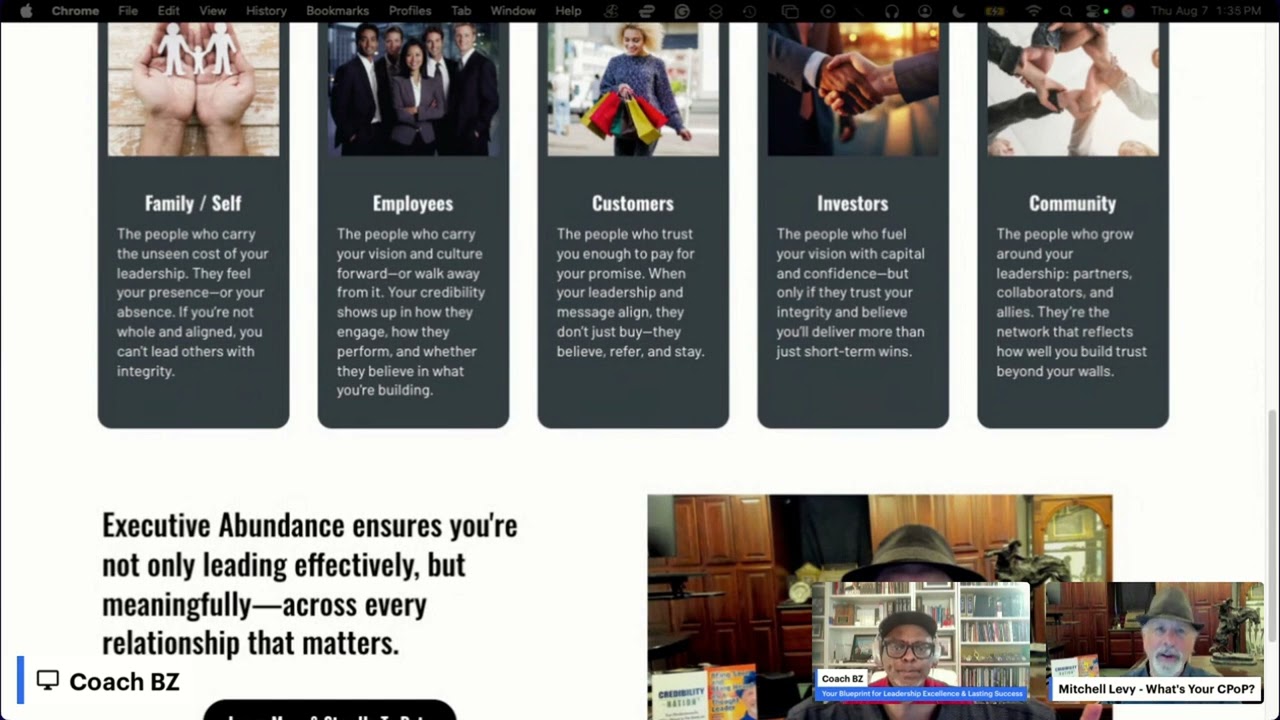
In this segment, the speakers argue that traditional boardroom focus on investor returns is insufficient when personal health, family, and broader societal responsibilities are ignored. They outline a chain of value creation: empowering employees leads to happy customers, which in turn satisfies investors. They also highlight the importance of the wider community—both virtual and physical—as a stakeholder. The core claim is that future boardrooms must adopt metrics that capture performance across five stakeholder groups (employees, customers, investors, community, and implicitly the individual leader), moving beyond purely financial earnings measures.
Yeah, like, what's the purpose of making your investors happy if you're in the hospital, right? Or if you're getting divorced or your kids don't know you. So that's one of the stakeholder groups. Uh, employees. If you do a good job empowering your employees and making them effective, guess what? They're going to do a good job of making your customers happy.
Yes.
If you do a great job of making your customers happy, guess what? That's going to turn into making your investors happy.
Yeah.
And subsequently, there's a community at large, both virtual and physical, that, that you play in, that you need to make sure you address. And so the boardroom of the future will be looking at metrics that are not just how much money, are we hitting our earnings, all of that stuff, but the metrics we need to look at need to incorporate all 5 stakeholder groups.
Wow, that is quite comprehensive. Yeah, I must say that in my experience in Silicon Valley, many times we have those lofty goals, we say these are our core values. First of all, not everybody in the company knows what those core values are. But even when we say like, one company I worked for, believe it or not, one of the core values was dinner at home. But just imagine how many times they actually allowed us to have dinner at home. Almost zero, right? Because they really wanted people to stay at the office like 60+ hours a week. But that was on paper one of our core values, dinner at home. And then of course, the very first time they have a little challenge or whatever, and their short-term solution is to just lay off like half of the company or an entire department. First time I ever saw that, like the entire QA department, they told them it was about 60, 70 people.








