🇮🇹 Versione Italiana 🇸🇲: S4:E114 AI RECAP 🎙️ con CDR Adrienne Benton
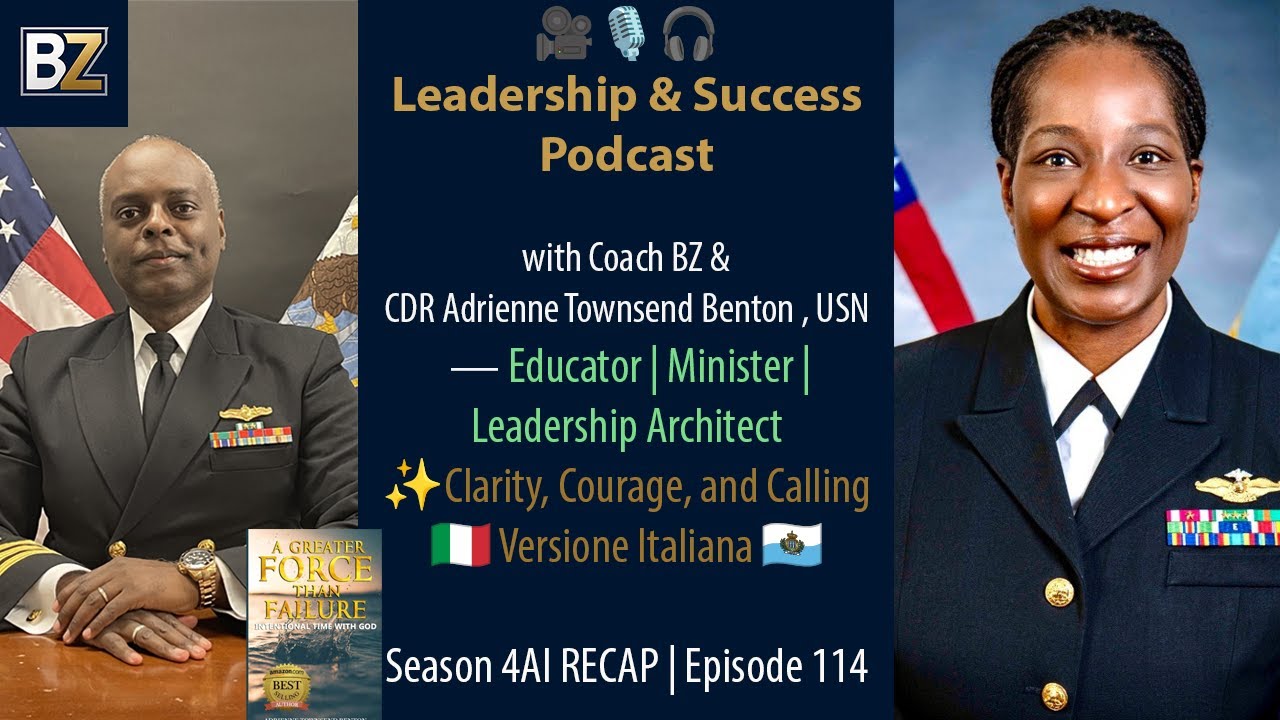
The episode opens with an introduction by John Maxwell and host Coach BZ, setting the stage for a conversation about purpose‑driven leadership. The guest, Lieutenant Commander Adrienne Benton, shares her journey from elementary‑school teacher in Queens to U.S. Navy chaplain and senior chaplain at Naval Support Activity Charleston. She describes how a sense of vocation redirected her from a planned career in journalism to ministry, and how her 17‑year military service has focused on supporting women service members, creating leadership committees, and fostering resilience. Throughout the interview she articulates several leadership principles that emerged from high‑stress environments: 1) “Clarity creates calm” – clear direction steadies teams in chaos; 2) “Trust is built before a crisis” – relationships must be cultivated proactively; 3) “The unhurried leader” – leadership grounded in rest, reflection, and God’s presence; 4) The “5‑15‑5 Reset” – a mental first‑aid kit for moments of overwhelm; 5) “Forward movement” – taking small, courageous steps to break fear‑based stagnation. Benton also discusses ethical dilemmas faced by Christian service members, emphasizing that chaplains do not justify combat but help individuals examine their value systems. She highlights mental‑health resources such as the 988 crisis line and Navy‑provided counseling, and notes an award named after her that honors Marine resilience. The conversation concludes with book recommendations (Brené Brown’s Dare to Lead, John C. Maxwell’s 21 Irrefutable Laws of Leadership, Alan Fadlen’s An Unhurried Leader) and a call to embody purpose, identity, and deliberate pause in leadership.
Chapters
Hi, I'm John Maxwell. When the top companies in the world are looking for trainers, speakers, and coaches, there's one name that stands above the rest, and that's Maxwell Leadership. Our certified team members have gotten proven results for companies all over the globe, and our reputation, I'm proud to say, is second to none. Some of our members have risen to the top of their profession, including the one you're going to meet today. I proudly introduce you to my friend, Bob Fabien Zinga.
Welcome to the Leadership Success Podcast with your host, Coach BZ, where we help you lead with purpose and succeed with impact. If you're ready to grow into the kind of leader others want to follow, this podcast is for you. If you're determined to elevate your success and leave a lasting legacy, this podcast is for you. As my mentor, Dr. John C. Maxwell, reminds us, everything rises and falls on leadership. Our goal is simple, to inspire you, challenge you, and equip you with insights that can transform the trajectory of your leadership journey. Welcome aboard to another episode of the Leadership and Success Podcast with Coach BZ.
A second career and thriving.
That's how Navy Lieutenant Commander Adrienne Townsend Benton is living her life.
In today's Military Moments, we highlight a woman who's found a way to intersect her faith and her military career as a Navy chaplain. Brittany Jones has her story.
Lieutenant Commander Adrienne Benton started in the classroom.
Initially, I was an elementary school teacher, taught 7th and 8th grade and 5th and 6th grade. 1st and 2nd grade. In the midst of working on my master's in curriculum and instruction, I began to realize that there was a passion inside me that was yet unfulfilled.
And that led the Queens, New York native to ministry.
And as I just surveyed my life, I saw that when it came to doing ministry, that's where I really was passionate. So I left teaching and went into the seminary. Personally joining the Navy As a chaplain, I had to exactly walk in the shoes of the other personnel in terms of learning how to walk and resolve conflict within yourself and externally, learning how to not allow your fears to get the best of you.
And years later, Chaplain Benton knows she made the right choice.
Throughout the 17 years, I have had the opportunity to work specifically with our women, our female service members. And at various duty stations, we have been able to develop and create committees, symposiums, leadership opportunities for women, and that has been, I believe, my greatest accomplishment to date.
She served incoming sailors, thousands of students, staff, and the Marine community around the globe, now serving as the Senior Chaplain at the Naval Support Activity Charleston.
Is it ever challenging? Uh, yes, sometimes it's challenging. It's challenging because you really are walking this journey and you're taking time to meet people where they're at, right? That takes patience, that takes time, that takes sensitivity, empathy.
But those challenges have helped decorate her in Navy and Marine Corps medals. And now there's an award created in her name that's given to the Marine who exhibits resilience just like her.
There's a brotherhood, a sisterhood that comes in this environment that you won't be able to get anywhere else. And again, I am absolutely honored to serve our country and to serve our community in this capacity. Brought to you by Navy Federal Credit Union. Learn more about how we're honoring veterans at navyfederal.org/veterans.
Our members— What do you believe? Who are you? And what are you going to stand for? Wow, powerful, powerful, man. Uh, again, I could be talking to you over and over again.
I think—
can you give me like 10 more minutes and then we're gonna end. Man, I need to have you back. This is awesome. I'm having the best time of my life here. Okay, let me ask you this then. What are some of the books that you've read that we should read as well? Of course, we want everybody to get a copy of your bestselling book, A Greater Force Than Failure: Intentional Time with God, available everywhere books are sold. You've already mentioned Dare to Lead by Brené Brown. And you mentioned, I call him Papa John. So John C. Maxwell, 21 Irrefutable Laws of Leadership. Is there any other book you would recommend?
Yeah, there's a wonderful book called— you may not be able to see it because I have my little green screen on, but a great book called An Unhurried Leader by Alan Fadlen. It's a really great book. He argues that truly effective leadership doesn't come from frenetic energy, restlessness, Instead, it flows from an unhurried life. And an unhurried life, this perspective is one that's rooted in God's presence, God's grace, and then thoughtful engagement with those we lead. And this has been, especially in this season of my life, this has really been very, um, pivotal for me because it has been inviting me to cultivate the inner rhythms of rest and relaxation— not relaxation, reflection. Rest, reflection, and also listening. So that my leadership becomes a presence that influences rather than an urgency that pushes. And man, this has been really impactful for me in this season. I just came in contact with this book recently.
Wow.
Absolutely. So one, it's having an understanding that life is full of challenges. If you are alive and we are human, right, we're breathing, a challenge is going to come your way almost every single day. And the reason why I start off there is because sometimes we can become very, um, what's the right word— sometimes as we're living through life, we don't always take things as seriously as we should in terms of really seeing what is true about a situation, right? We have what we call thinking stinking sometimes, where we make up and we create stories about something. We— and, and yet when we stop to understand that I'm human, there are things that are going to happen. My car will break down, while at the same time The command wants me to go on an exercise while at the same time my father is in the hospital. Like, these things happen, right? But it's also important to remember that we have been blessed and gifted with a mind that can be stable. And so initially, when you find yourself in these challenging situations, you want to ask yourself what is true about—
Allora, oggi ci tuffiamo nella saggezza di una leader davvero eccezionale, la comandante Adrienne Benton. La sua leadership è stata forgiata in alcuni degli ambienti a più alta pressione che si possano immaginare, ma le sue lezioni, vedrete, sono incredibilmente universali. Scopriamole insieme. Ecco, partiamo subito con questa frase, che è potentissima: "La fiducia si costruisce prima della crisi". Va dritta al punto, no? Ci fa capire immediatamente la sua filosofia: una leadership che gioca d'anticipo. È un principio fondamentale, sia che ci si trovi in un centro di comando militare o nella sala riunioni di un'azienda. Ok, partiamo dall'inizio del suo percorso. E qui c'è un'idea che trovo affascinante: a volte il nostro scopo nella vita non è qualcosa che scegliamo a tavolino, ma una vera e propria chiamata, una vocazione che irrompe e stravolge i nostri piani. Vediamo come è successo a lei. E pensate un po', lei aveva un piano ben preciso: voleva diventare una giornalista televisiva. Un percorso che sembrava già scritto, insomma. Ma, come spesso accade nella vita, il destino aveva in serbo qualcos'altro. E qui arriva il colpo di scena, il momento che cambia tutto. Un professore la guarda e le dice: "La chiamata di Dio è sulla tua vita". Immaginate la reazione! Lei ha resistito, eh, ha provato a fare di tutto per evitarla, ma... Niente da fare, quella vocazione l'ha trovata lo stesso. E da questa esperienza nasce il suo primo grande principio, e cioè che lo scopo non è qualcosa che ci si guadagna con la fatica, no, si rivela. E come? Beh, facendo silenzio, mettendosi in ascolto e osservando con onestà ciò che ci attira, ciò che ci chiama a sé. Bene, una volta trovata la sua vocazione, dove l'ha messa alla prova? In uno degli ambienti più tosti che si possano immaginare: le forze armate americane. Un luogo dove ogni singola decisione ha un peso enorme. E qui c'è un'altra perla di saggezza: la chiarezza crea calma. Pensiamoci un attimo, quando tutto è nel caos, l'ultima cosa di cui le persone hanno bisogno è altro rumore, altra confusione. Hanno bisogno di una direzione chiara e di un'energia calma che li guidi. Lei lo chiama Ministero della Presenza. È un concetto potentissimo. L'idea è che la semplice presenza La presenza calma di un leader può da sola stabilizzare un'intera stanza. Parla molto più forte di qualsiasi titolo o di qualsiasi ordine. E la cosa bella è che questo non vale solo per un cappellano, ma per chiunque si trovi a guidare un team sotto pressione. La propria calma diventa la bussola del gruppo. E guardate questo paragone: da una parte un ambiente militare, dall'altra un ambiente tech. Sembrano mondi lontanissimi, ma i problemi sono incredibilmente simili: persone sopraffatte, progetti complessi, burnout, incertezza. Ecco perché i principi della comandante Benton sono così universali, funzionano ovunque ci siano persone sotto pressione. Ok, finora abbiamo parlato di come guidare gli altri, ma adesso facciamo un passo indietro e guardiamo all'interno. Perché la vera fonte della sua forza, come di ogni grande leader, parte da lì: dalla capacità di guidare prima di tutto se stessi. Questa frase è di una potenza disarmante. In pratica ci dice che la relazione più importante che abbiamo è quella con noi stessi. Se non capiamo quella, se non sana, ogni altra relazione che costruiremo ne risentirà. La consapevolezza di sé non è un bonus, è proprio la base di tutto. E quindi il punto è proprio questo: per poter guidare bene gli altri bisogna prima essere onesti con se stessi, perché le nostre insicurezze, i nostri punti ciechi trapelano, come dice lei, vengono fuori che lo vogliamo o no. Quindi il primo vero atto di leadership è lavorare su di sé. E non ci lascia solo con la teoria, ci dà anche uno strumento pratico che chiunque può usare. Lo chiama il Reset 5-15-5. È una specie di kit di pronto soccorso mentale per quando ci si sente sopraffatti. Non serve a resistere allo stress, ma a recuperare, a riprendere il controllo in modo lucido e intenzionale. Adesso, però, ascoltate questa storia. È davvero una storia di trasformazione su come la comandante Benton ha preso quelli che tutti vedevano come suoi svantaggi e li ha le ha trasformati, beh, nei suoi più grandi punti di forza. Immaginate la scena: all'inizio della sua carriera un ufficiale le fa una specie di valutazione e le dice che ha 3 strike contro: è donna, è afroamericana ed è un cappellano. E la cosa peggiore è che lei per quasi 2 anni ci ha creduto, si è sentita schiacciata da queste etichette, rimpicciolita. Ma poi, per fortuna, arriva un mentore e questo mentore le cambia completamente la prospettiva. Le dice: "Guarda che quelli non sono strike, sono opportunità". È stata la svolta. Ha capito che quelle non erano debolezze da nascondere, ma le sue unicità, la sua vera forza. E da qui una lezione che vale per chiunque si sia mai sentito diverso, o fuori posto: la propria differenza non è un ostacolo. Anzi, è un vantaggio competitivo. Bisogna possederla, guidare con la propria identità. Non nonostante essa, senza mai, mai rimpicciolirsi per far stare comodi gli altri. Bene, adesso mettiamo insieme tutti i pezzi. Vediamo come la comandante Benton prende tutta questa saggezza, tutta questa esperienza, e la trasforma in una filosofia pratica per aiutare le persone a sbloccarsi e ad andare avanti. La sua filosofia si chiama "Movimento in avanti". L'idea di fondo è semplice ma geniale. Spesso non siamo bloccati perché non sappiamo cosa fare. Lo sappiamo benissimo. Siamo bloccati dalla paura. Il movimento in avanti è proprio questo. È il coraggio di fare quel primo piccolo passo, quello che poi sblocca tutto il resto. E come dicevamo, la bellezza dei suoi principi è che funzionano dappertutto. Che si parli a giovani ufficiali di marina o a ingegneri della Silicon Valley, le basi non cambiano. Si parla sempre di fiducia, di chiarezza, di presenza, di intelligenza emotiva. Fondamenta umane prima che professionali. Quindi, se dovessimo riassumere tutto in poche potentissime frasi, sarebbero queste, sono delle vere perle da portarsi a casa: la chiarezza crea calma, lo scopo si rivela, non bisogna rimpicciolirsi per gli altri. E poi queste due sono fondamentali: il riposo non è un premio ma una responsabilità, e la nostra presenza influenza molto più delle nostre parole. E alla fine, qual è il messaggio che darebbe a una se stessa più giovane? Eccolo qui: un invito potentissimo a credere in sé, ad avere il coraggio di uscire dalla propria zona di comfort, perché è solo là fuori che si scopre chi si è veramente. E quindi la riflessione finale è questa, ed è una sfida per ciascuno di noi: lo scopo attende di essere rivelato.
Qual è quel singolo piccolo movimento in avanti che si può fare a partire da oggi Per iniziare a scoprirlo, benvenuti a questo episodio dove esploriamo Um, le potenti lezioni di leadership ispirate da una figura davvero eccezionale, il comandante Adrian Benton.
Eh sì, è incredibile come le sue esperienze dalla New York del suo passato fino al cameratismo in mare, ci insegnino a scoprire il nostro scopo.
Esatto. E sai, um, una delle prime cose che spiccano nella sua storia è come il richiamo del suo destino le sia venuto, quasi come se la vita avesse, um, bussato alla porta. Diceva che il vero senso non si guadagna, ma si rivela. Proprio osservando ciò che attira la nostra attenzione, no?
Assolutamente, è quasi come se "um", il destino, si presentasse in modo inaspettato, facendo capire che c'è qualcosa di più grande in agguato per ciascuno di noi.
Proprio così, e passa poi al tema della calma in momenti di pressione, ricordandoci che "la chiarezza crea calma". Quando sei in un ambiente stressante, come nelle operazioni militari, dove ogni decisione pesa, La presenza calma diventa, um, una vera arma.
Yeah, mm-hmm, mi piace l'idea. Non cercare ulteriori rumori, ma, um, fornire una direzione nitida e pacata per far sentire il team al sicuro.
E poi c'è il tema del trust, quel concetto che dice: la fiducia si costruisce prima della crisi. È affascinante come lei sottolinei che il legame autentico si forma "um" ben prima che si presenti il momento difficile.
Mm, è un punto fondamentale. Se la squadra sa già di potersi fidare del leader, allora ogni emergenza diventa meno spaventosa.
Esattamente. Non si tratta solo di parole, ma di essere presenti, di mostrare te stesso giorno dopo giorno. E questo ci porta al potere dell'identità. Quando ti incontro, "Tu sei già in relazione con te stesso". Un messaggio che ci ricorda che la base di ogni leadership autentica, um, parte da una profonda conoscenza di sé.
Giusto, conoscere se stessi è indispensabile. Senza questa consapevolezza ogni altra relazione rischia di avere, um, delle crepe.
Sì, e non dimentichiamo la resilienza. Lei presentava la resilienza come una strategia, non solo come una reazione. Um, qualcosa come il 5-15-5 reset. Un metodo per riprendere fiato, riorganizzare le priorità e ricominciare con slancio.
Interessante, perché spesso, um, la resilienza viene vista come un tentativo di resistere all'uragano, invece di essere una presa di coscienza che permette di ripartire intenzionalmente.
Esattamente, è come dire, non è solo sopportare la pressione, ma sapere quando fermarsi per poi riprendere con rinnovata energia.
Adesso però non posso non chiedere: credi che in certi contesti la necessità di rallentare possa essere percepita come debolezza o mancanza di prontezza?
Capisco il punto, ma um, penso che rallentare per respirare, per riflettere, sia in realtà una forza. È un atto di leadership responsabile, dove il riposo e la riflessione diventano gli ingredienti per prendere decisioni migliori.
Mm, certo, mi ricorda molto la filosofia del "non puoi versare da una tazza vuota".
Esattamente! E poi c'è quell'altro insegnamento potentissimo: "Non rimpicciolirti per far sentire gli altri a tuo agio". La sua esperienza con il primo ufficiale, che le aveva attribuito dei pregiudizi, le ha insegnato a vedere le difficoltà come opportunità per affermare la propria differenza.
Yah! È un messaggio davvero ispirante, perché spinge a vivere la propria unicità come un punto di forza, invece che come una vulnerabilità.
Già, e poi c'è il concetto di "forward movement", il movimento in avanti, che insegna che non siamo intrappolati, "um", non per mancanza di idee, ma perché abbiamo paura di muoverci. È un invito a riscoprire la propria identità, ad articolare i propri valori e ad avanzare con coraggio.
Mhm, quel messaggio risuona in modo universale, sia per i leader militari che per quelli nel mondo della tecnologia.
Esatto. E infine, c'è l'enfasi sulla responsabilità del riposo. Il riposo non è una ricompensa, è una responsabilità. Saper fermarsi um, per poi tornare più forti. È un principio che trasforma la leadership in una maratona, non in uno sprint.
Right! È una bella analogia, quasi come se stessi dicendo che, um, una pausa ben fatta può ricaricare non solo il leader, ma l'intera squadra.
Esattamente! In sintesi, queste lezioni ci ricordano di credere in noi stessi, di ascoltare quel richiamo interiore, di costruire fiducia, di non temere le proprie unicità e di procedere con deliberate pause.
Un insegnamento potente: ogni momento, anche quelli più difficili, è un'opportunità per esercitare leadership con cuore, mente e coraggio.
Proprio così. Ricorda: guida con scopo, rimani fedele alla tua identità e, um, cammina sempre con quella luce interiore che ti spinge ad andare avanti.
That's, that's really something. Let me ask you this as a chaplain. For those of us who are Christian, and there are quite a lot of Christians in the Navy, you know, the Bible says, uh, you know, thou shalt not kill. It's kind of like maybe an ethical dilemma I've always thought about because I joined after 9/11, right? So I've had multiple chances with all of the sailors being called to serve in Afghanistan. I work a lot of combat zones where you could defend yourself and protect your country and get to actually take a life. So we talked about loss on our side. Let me think about loss on the enemy side. So I kind of know it's moral, it is ethical, and it is legal. It was a just war. But for those who really believe in Scripture, again, knock on wood, I personally have never been in a situation where I had to take someone's life. But I guess theologically, how do you justify a Christian taking the life of an enemy combatant and how to kind of deal with that psychologically?
Yeah, it's a great question. So I'm going to be very honest with you. As a chaplain, my job is not to justify. So as I am encountering service members who are struggling with this, I take myself out of it. My goal and my role is to walk the journey with the individual. And so, you know, first we start with what is your value system? What do you know to be true? Because sometimes we have perceptions, sometimes we have tradition. Tradition. Sometimes we've been told something and it's not necessarily theologically—
Wow, that is, that is really powerful. And I know recently, uh, to even make it easier, the government, the military has a new number, right? Like 911 is, I believe, 988 for those who need mental help right away and talk to someone, many times a chaplain. Wow, that's, that's really one, one thing I really love about the service. The, the Navy, the military has put a lot of resources out there available to sailors and service members, but sometimes our junior enlisted folks just don't know about those services and the help that is available. So thank you, thank you so much for sharing. Yeah, because knock on wood, I've never, never lost a person who was in my command that I was in charge of, but I've definitely had friends and shipmates and people throughout my Korea went to war and something happened to them, they, they never came, came back. But, uh, I think we worry a lot about our physical health, but I just feel like our emotional spiritual health is just as important, isn't it?
Yes, absolutely.
So as a spiritual advisor to commanders, how do you help leaders navigate morally complex and emotionally heavy decisions?
Yeah, that's a really great question, right? So as a spiritual advisor, my role is not to make decisions for commanders. My role is to help them to see the human, the moral, and the long-range impact of those decisions, right? In the military, as leaders, we often face choices where every option carries weight— the well-being of our people, mission requirements, ethical constraints, personal values— and sometimes it can be confusing trying to figure out how to navigate through all of them. But my job, my role, is to create the kinds of space where a commander can slow down, breathe, hear their own moral compass again, and ask what is important, what is priority, what needs to happen, right? I help them think the second, the third order effect.
Thank you for tuning in to the Leadership and Success Podcast with your host, Coach Beezy. If today's episode added value to your leadership journey, be sure to subscribe, share, and join us again for more wisdom nuggets on how to lead better and achieve greater success. Remember, leadership is the most critical skill of our time. The world will always need leaders to inspire others, drive innovation, and execute meaningful strategy. So why not count yourself among the bold leaders shaping the 21st century? Until next time, stay inspired, Stay committed and keep leading with excellence.
More from Bob

S250:E4🎙️LIVE 🇺🇸America 250: President Barack Obama Leadership, Service, and the Power of Hope






S5:E157🎙️ LIVE with CMD CMSgt Dennis L. Fritz, USAF (Ret.)(Multi Tracks Audio)



S5:E156🎙️ LIVE 🇪🇸 Leadership Lessons from the FIFA World Cup 2026 Champions (Multi Tracks Audio)

S250:E3🎙️ LIVE Leadership Lessons from America’s First Documented Family of African Descent 🇺🇸📖