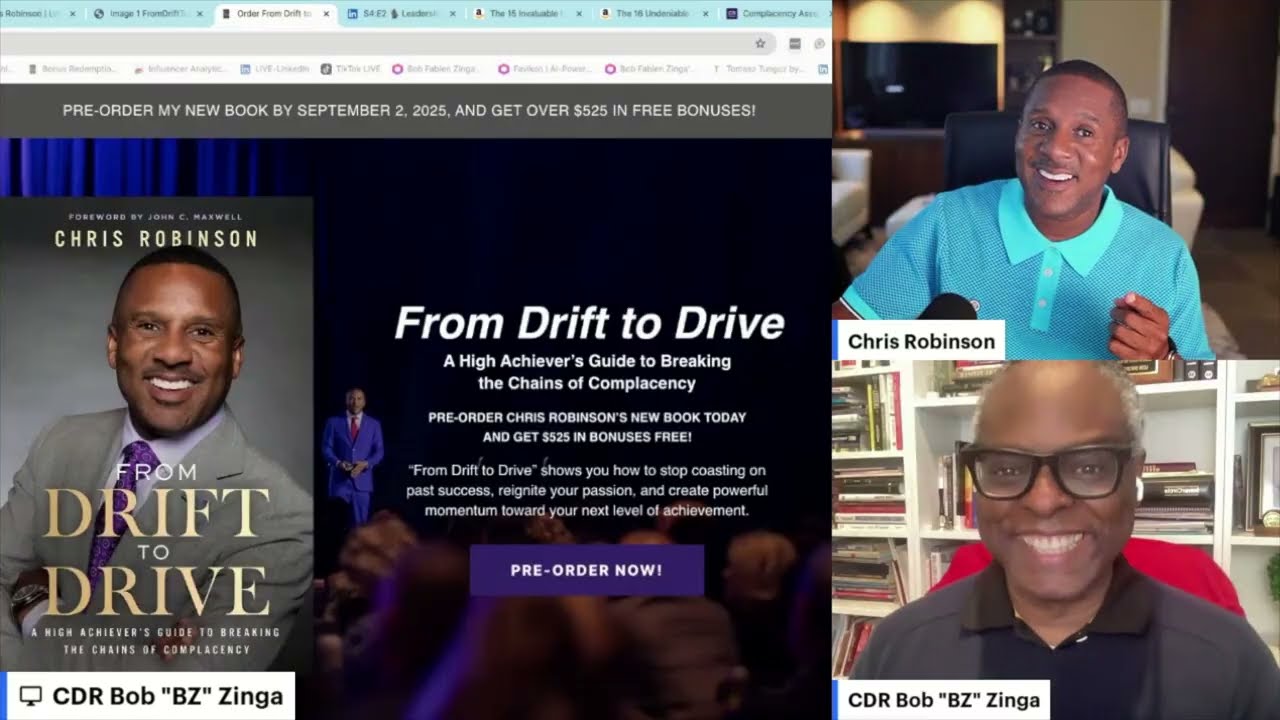
Chris Robinson outlines two ways to find mentors: pay for access through coaches and exclusive groups, or add value to earn proximity. He cites his exotic-car club and Maxwell Leadership as examples. Bob Fabien Zinga adds that books count too, and recommends spending 3 to 10 percent of income on personal development to stay in rooms where decisions happen.
Chapters
Actually, Chris, we have a question on LinkedIn from Daniela McCoy from New York. She's saying, kind of related to this, can you talk more about proximity and who you surround yourself with. I am working on developing my personal board of advisor. I am in the stage of determining who to ask or who do I want to surround myself with.
Yeah, yeah. So you gotta be highly intentional in that. So when it comes to proximity of people, you know, if you're looking for guides and mentors, there's two ways to get a guide or mentor, either seek to serve or pay to play, okay? Meaning that you're either going to pay someone to get proximity to them, you're going to pay them to be your coach, your mentor, be a part of their program, etc. Or you're going to serve that individual so you can get proximity. So what can you do, or what skill set do you have, or how can you add value to that individual that gets you access and proximity? Not to take from them, but to give to them because you just want to get in the room.. And then when it comes to, you know, uh, peers, that's simply being intentional about, hey, who are the people that I want to be around and be like, and where are they hanging out? All right, what conferences, what events, what, um, fitness facilities, what clubs, what private groups, um, you know, are they a part of? And again, am I willing to pay to be a part of that group? You know, one group that I'm a part of is an exotic car club. I'm a part of an exotic car club. Um, I love, you know, the supercars. And, you know, there's a fee and a membership and an application had to be paid, thousands of dollars just to be a part of this club. But I knew that I wanted to be around these types of owners, okay? These are business owners, these are professionals, these are, um, you know, exotic car owners. Hey, I'm intentional about that. Same thing for speaking. That's how I ended up with Maxwell Leadership. I wanted to be around other speakers. What that required, that required an investment, yes, of thousands of dollars to be inside the room. But then now I'm around the room of like-minded people. So there's pay to play and there's seek to serve. But be intentional about who it is that you want to be around.
Wow, that is, that is wonderful. And maybe the only thing I would add to this, Danilo, is sometimes you can be mentored from a distance too, just by reading a book. Like, for example, one of my greatest mentors, General Colin Powell, even now that he is no longer with us, He still mentors me through his work and his books. Like, I was, I think, 16, 17 years old when I first heard of Dr. Maxwell. Actually, back then, I believe he was a pastor in a church in San Diego talking about leadership all the time. So I started reading his book, getting it back when they had cassette tapes. My kids don't know what that means these days. But yeah, so I've been mentored from him. He didn't know my name. We never were in physical proximity, but he was my mentor. He was my guide. And then I finally met him face to face I believe it was 2007 at the Church of the Island in Birmingham. But anyway, and then later I was a member of Maxwell Leadership Coaching. But anyway, and then the other thing I want to add to this too is, it's very important, like Chris said, to really invest in what you prioritize, right? One of my mentors, Brian Tracy, says you need to spend at least 3% of your income. It doesn't matter if you only make a dollar or $5,000 a year, it doesn't matter. 3% of your income needs to go into your personal development. You need to spend it out. But I think eventually you need to spend about 10% of your income. When I started this, back when I was 17, 18 years old, I was only making maybe $15,000, $16,000, $17,000 a year. Now I make a lot more than that. So 10% of my income now is a lot, and I need to find ways to spend that money. And things like Maxwell Leadership Training and curriculum, those are the places where you need to be. You need to be in the room where decisions are being made. Anything else you would like to add to this, Chris?
Yeah, no, no, you're absolutely right. Investing in yourself is the best investment that you can make. And I think a lot of people oftentimes are scared to make that investment in themselves outside of traditional schooling. They're scared to do that because of maybe perhaps failures in the past or things that didn't work out. But here's what I found, Bob, is that I've never lost a dime in business. I've never lost a dime in business, but I paid a whole lot of tuition, right? A whole lot of tuition. And it's okay if we look at it is that every single thing that we invest in, if we can get one thing from that to shape or shift our perspective, our thought, or our philosophies, or, uh, or to get us to look at something different, that just gets us one step closer to who we're supposed to become.