Artists: Your fear of showing up online is valid.
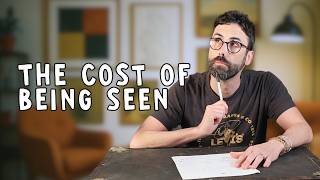
This is a YouTube video titled "Artists: Your fear of showing up online is valid." created in July 2025. It features Lennon Bone delivering a motivational and educational monologue aimed at artists about overcoming fears related to marketing, pricing, judgment, and public criticism when building an art business online. Lennon Bone shares personal insights, practical advice, and encouragement to help artists persist despite challenges such as trolls and negative feedback, emphasizing the importance of knowing one's why and connecting with the right audience.
So not every artist out there wants to make a living from their work. Not every artist wants to have a side hustle from selling their art. But, you know, a lot of you do. And I know that because you tell me, right? It's pretty simple. But if you want to sell your art, you have to be seen. And in order to be seen, you have to be willing to. To be misunderstood. You have to be willing to deal with trolls. You have to be willing to kind of battle through some of these tough things that happen when you put yourself out into the world, right? There's this really interesting concept that says every problem we have is actually a relational problem. Or. Or every fear that we have is actually a relational fear. Meaning I don't just go to the grocery store or not want to go to the grocery store, rather, because I'm afraid of groceries. You know, I don't want to go to the grocery store because I'm afraid of who I'm going to run into. I'm afraid of having to deal with that cashier that was a complete. A hole the last time that I was there, and, you know, he treated me like a big turd. Or I don't want to market. You know, it's not that you don't want to market because you're worried about not selling. It's actually you're more worried about what it'll make you look like if you don't make sales, what someone's opinion of you will be. Right. And the Internet is not a very nice place some, sometimes, let's be honest, you as a community, are proving that wrong in many ways, and I'm so grateful for that. All the comments that I get. Well, I shouldn't say all 90% of the comments that I get are very kind, very thoughtful, and very respectful, and I appreciate that so much. But, you know, there's still that 10% of trolls that we're going to have to deal with. And so how do we get past the. These fears of being judged? What does it look like for us to figure that out? So I want to talk about that in today's episode. So let's jump into it. Hey, everyone. Welcome to the Stop the Starving Artist podcast. My name is Lennon Bone, and if you're new here, welcome. So glad to have you. In the last month, we've seen over 2000 new, I think, like, 2100 new subscribers to this channel, which is just blow my freaking mind. And as the counts go up, the comments go up. And as the comments go up, the naysayers start to come out, and this is just a part of the process. And so as I've had a couple things show up, I started thinking, well, maybe this is a good time to talk about these things as I'm experiencing them, because I don't do well with them. Right. Just like you. And I don't know that I'll have all the answers, but I really believe there's a framework here that's going to help you get past this fear of judgment. So we see this a lot with our clients where they'll start to grow, and as they grow and they hit some sort of rapid succession, like, that's when the trolls start to come out to play. Right. And meanwhile, by the way, I usually do an update on the numbers for my community. We have seen over a quarter of a million dollars in art sales this year. But I'm actually filming this just the next day after my last episode came out, because I'm currently, as you're watching this, on a trip to Texas with my dad to see my cousin, who unfortunately has cancer. And so we're trying to visit with him and be with him. And it's going to be a hard time, but a good time for me to be with my dad and get to spend some time with him. So I'm looking forward to that. But. So that's why there's no update on the community. If you're following along as far as the actual number. But let's look here at the things that we're really afraid of. Right. Or the things that I hear you say you're afraid of the most. And then let's talk about how to deal with each one of these in some way. And then the sign just fell. Let me see if I can fix that. I do not know if that will stay, but we'll try. Okay, well, just trying to get through it, y'. All. All right. So I hear a lot of artists are really concerned about their price and not just their price. Like, is it the right thing that's going to help people be able to actually purchase? Like, there's a lot of fears around pricing and also, like, are you going to look too good to be true or, like, you know, over exonify, like, what you feel like your perception of yourself is, and people think you're cocky or whatever else. Let's talk about why this is, to me, such a interesting fear. This, I think, comes mostly from artists talking to other artists. I did a. I spoke at a conference recently, and it was really fascinating because a Room full of artists, right? And I literally heard one person say that she had had another artist that she should tell her that she should not sell her work for the price that she was selling it at because it was keeping the artist that was talking from making more money. So it's like me coming to you and say, you're selling your work for too cheap. Stop doing that because it's hurting my business. Let me tell you something about this. This is so ridiculous. Because this comes from a scarcity mindset. This comes from this place of, well, so and so is hurting my business. No, it is not your responsibility to price yourself in a way that helps some other artist's business. It is your responsibility to price yourself in a way that gets you business. And I love the thought of, like, price yourself in a position where you can sell it out, create demand and scarcity. Increase the price, do it again, Increase the price, do it again, right? Because there's something about building that awareness and scarcity that can really help you increase your prices. But doing it simply because you're afraid of what some other artist is going to say is absolute baloney. And artists can be real bullies sometimes. I get it from artists a lot. So when you think about your pricing, think about, well, what do you need in your business? Okay, have you made a lot of sales already? If you haven't, okay, cool, then price it in a way that's gonna work. But don't be afraid of what someone else is gonna say to you, right? And I also get this fear a lot from artists where they're like, well, I'm afraid I'm gonna come across as salesy. So the way I look at selling your work, especially online, right? Because if you go to a market or you're in a gallery, you're not worried about feeling salesy, because that's the intention. There's a culture that's been built that says, like, okay, this is what we do here. So all you have to do is build that same culture in your own community. So think about your content. And if you are consistently running a sales cycle of some sort, which is what I teach to all my clients, which is like, have a consistent sales cycle going. So you're getting new people in and. And you're always selling at some point. And if you're not being pushy. Cause there's a difference in being pushy. Salesy, like, well, please support me, Please buy my stuff. Please help me. You know, it's like, no, that is a little like, ugh, you know, but if it's more, I'm really proud of this. Like, this is what I've made. I feel really good about this. I'd love it if you love it for you to buy it. Cause I think this is gonna be an amazing value for you, right? And here's what I hope you get from it. Here's what I hope you've gotten from me as an artist, all that stuff, right? So you're not going to come across as salesy just because you're presenting your work for sale. As a matter of fact, your community will start to understand that this is part of the culture on your social medias, on in your emails. And if they don't like it, they can leave. And that's okay because you are running a business, right? That is your job. People get mad at me because I sell a course. Yeah, I do sell a course. I also give a lot of really great stuff out on the Internet for free. I do not feel the least bit guilty about selling a course, especially for the price range that I offer it at, you know, So I don't know, it's just like we get so tied up in like what someone is going to say. But don't worry about all that, right? What does your business need? And then we get into this idea of like, well, if I have a vision or I have a mission or I have a message as an artist, I'm worried people are going to misinterpret it. And I had, at a conference I spoke at, I had someone say to me, well, aren't you worried that someone's going to take what you say the wrong way or that someone's going to be offended? And I said, no, I'm not worried about it. I expect it. I expect that people are going to be offended. I expect that people aren't going to like me. Right? So what does it mean to misinterpret someone? Well, if someone sees my stuff and they're angry because they watch it, that's not about me, right? Because I'm not spewing a bunch of hateful stuff that you know. And I'm very open about the fact that people can come here and they can listen to what I have to say and they can choose to not be into it or be into it. Like they have that, their own free will to do that. I'm not forcing anybody to watch my videos. I'm not forcing anybody to be here. Right? And I say this because the only story I can tell is mine. But I want you to Think about it. If you were in your shoes, right? It's like, if someone misinterprets you, that's not about you. That's about them. Because everything that you say is actually holding up a mirror for someone else. So when someone comes at me and says, well, Lennon, show me your art that you're selling. I'm like, well, I don't sell art. You know, I just help artists sell art. And they get mad about it. It's like, well, why are you mad? Right? Usually they're mad because they've had an experience. I've held up a mirror now that makes them look at their own experience. They've had an experience of someone trying to pull the wool over their eyes, trying to, you know, take advantage of them, something like that. And so they implant that experience on me. So it's not about me. I know my intent, I know my worth. I know my value. But for them, it can be challenging. So I empathize with that, right? If someone sees you're making videos and you're doing well, if it's a family member, if it's whatever. If they're saying, like, be careful about what you do, all that stuff, like, it's really. You're holding up a mirror, and they're more worried about them than they are you, right? And this is a fascinating phenomenon. But I love this idea of remembering that everything you say is just a mirror. Everything that you put up is a mirror. And people will respond to that mirror however they respond to it. And you don't get to control that. And that's okay, you know, which leads to the next one, which is. A lot of artists are really worried about being called out publicly in some way, shape or form. This. This is scary. Like, this is. This. This could hurt in some way, right? It could feel like. Like it's gonna hurt your reputation and all that. Here's what I say. You know, most of the time, the people that try to call you out, the best you can do is put out so much stuff that shows who you are and what you're all about and what your values are, that it will overshadow anything that they say. Because, again, if you're holding up a mirror and it's more about them than it is you, then the right people will see it, and they won't. It won't matter. Now, it's a different story if you're spewing, again, hatred or you're trying to spread false things. Like, obviously, I just assume that that's not you, right? I assume the people watching my videos don't do that, but I guess I shouldn't assume we are on the Internet, right? But, you know, it's that. That idea that if you're being called out for something publicly, I am assuming that it's not because you're actually a bad person. It's a misinterpretation of that. So the more to me, the more that I can just keep showing up, keep being me, you know, anything that is a false representation of me that gets put into the world, like, all I can try to do is overshadow it by continuing to give what I believe is good. Right. It can also be really hard because we worry about being rejected from for being us. Most of us have been rejected in our life for being us. You know, I. But here's the cool thing about the Internet, right? Someone making a snide comment or unfollowing you or whatever, like, that's not. I wouldn't consider that rejection. I consider it just the choice that the person is making. You know, if you think about how we work as people, like we run in tribes, right? We have. I'm sure you have a lot of artist friends. You have people in your life that you're really close with for certain reasons. So for me personally, I have friends that are musicians. That's one of my tribes. I have friends that are visual artists. That's one of my tribes. I have friends who are part of my church. That's one of my tribes, you know, so, like, there's these different tribes. I have my family, right? That's a tribe. And so I have these different tribes that sort of scratch different itches. And so if someone is rejecting you, that means that you've given them enough information to say no, which means you've also given someone, the right person enough information to say yes. I'm going to say that again. If someone unfollows you or decides to not be a part of your world, that means you have given them enough information that they can say no. And you've given enough information that someone else can say yes. And if you're not giving enough information for someone to say no, then you're not going to stand out. There's this really interesting story where they talk about, and I've told this on the channel before, but it bears repeating, where these conservationists went out and they were following a pack of zebras and they had their little notebook and they're writing down the stuff about each zebra. And every time they look up, they'd like, lose track of the zebra, because as a pack, they're built to blend in. So what they decided to do is take the zebras that they were following and paint a red dot on their haunches. So while they were able to now follow the zebra, who else was able to follow the zebra? The lions. So which zebras were the first to get killed and eaten by the lions? The ones with the red dot on their haunches. Right. When we put ourselves out there, we are painting a bullseye on our back and we have to ask ourselves, like, there is a cost to this, right? People are not going to like me. People are going to say that they don't like me. People are going to ridicule me. Keyboard warriors and all the, like, people that don't have the guts to actually put themselves out there are going to have all kinds of opinions. But what is the reward on the other side of that? For me, the reward is helping thousands and thousands of of artists. The reward for me is thinking maybe I have a chance of being what I wish I had for someone else. Maybe, just maybe, I am going to be lucky enough that I give something to someone that changes their life. Not because I have the best. Right. Only way, not because I'm some guru or whatever. Right? But because I have experience. It's really as simple as that. And so that means we will be rejected for being ourself. It's impossible to not have it happen. Which means we will have negative comments, right? And I hear a lot of my clients, like, they'll get their first negative comments and it like, ruins their momentum, to which my response is like, no, your negative comment means you've made it. Right? Like you've actually gotten somebody to say something, and that's good. You know, when I have somebody show up and say something nasty about me and make assumptions and say, oh, look at this guy. He's just, you know, he's just a poser. He's just trying to take all your money and blah, blah, blah, blah, blah. It's fine. You know, it's like, again, that's not about me. That's about their experience of someone else. And then now encountering me in the process. And so these negative comments are going to come. And that means that I've given information that allows someone to say yes or no, and that's good. So how do we, like, hopefully even just at this, like, we've given some reframes that help you think about things a little differently. But I want to give you really a Quick formula that really, really, really helps me. Okay. And it's helped a lot of my clients, and I hope that it helps you, too. So the first thing is remember that you as the artist, plus them, your people, like, what I call your ultimate badass buyers, right? Equals success. You plus them equals success. You plus them equals success. This means you have to identify who these people are, because you can't create success in your art business and your mission and whatever it is you're trying to do if you're not thinking, how do I enroll these people into the thing that I'm trying to achieve, Right? So you plus them equals success. It's not you equals success. You plus them equals success. So you need to know your why. Why do you get up every day and do this? Not just for them, but for you? What do you get when you show up every day and deal with this stuff, Right? Like, what's on the other side of that? Because you're going to go through it for a while, Especially as you start to become more yourself. You start to do more what you need to do. You're going to go through it. It's going to be hard, it's not going to be easy, and you're not going to get the views you want. You're not going to get the attention that you want. And. And then when the attention starts to come, some people will flip, and it'll be the attention that you don't want. So you're going to have challenges on both sides of the fence. And so the question becomes, what is your why? Why are you doing this, and who are you doing it for? What do you get from it? What do they get from it? And what's on the other side? Because if you're not clear on these three things, then you're going to have a lot of problems pushing through. And let me be the first to say that building your art business on the Internet will take you time. It will take you maybe a lot of time, and that's okay. So when you know your why and you know your who, and you can start to see when those two things are happening, even right now, even when it feels small, even when it feels minuscule, even when it feels like nobody's going to understand but one person gets it now, it's a game changer, because now you understand, like, oh, this is it. This is the thing. When somebody comments on your piece of content and they're like, oh, my gosh, totally needed to hear this today. That's when you know you've made the right move. When somebody comments and sends you a DM and says, oh, my gosh, I can't afford your work right now, but I know that you are who I want to buy my xps from. That is when you know you're on your way. Is it scaled to the place that you want it to be yet? No. And that's okay. But you build your business like you're making a cake, right? And right now, you may or may not know all the ingredients that need to go into your cake. And so you may make the cake and it comes out burnt the first time, right? Or you may make the cake and it has too much salt. But when you know why you're doing this, it's like, I'm making this cake because I want my kids to see that my persistence, my resistance to someone else's opinion is the exact thing that they're going to have to push through every single day of their life. Because in this world right now, we see too many situations where kids are not learning to be resilient. And so that's why I'm going to do this. That's why I'm going to do it again and again until I get it right. Right? Whatever that is for you, you got to figure that out. Because if you don't have that vision, it is not going to be easy. And let me be real, it's not going to be easy anyway. But having something that gets you moving every day is the thing that will keep you going when things get hard. Because things will get hard. So remember, when someone shows up, whether it's a family member, a troll or whatever, and they say, well, just be careful out there, or, wow, what an arrogant asshole. Or, you know, whatever it is that they have to say, just remember that when you're putting something out there, you are holding up a mirror that they are going to look at and it is going to reflect something back on them that means nothing about you. Only you understand your intent, only you know your why, only you know who you're for. And when you consistently go after that, they will start to show up. I promise you that. So I hope you find this helpful. Please. You know, if you're thinking about getting past these fears and building your, you know, your personal brand as an artist, I got some videos here I'd love for you to check out. Go watch these. I think you'll find these really, really helpful. But remember, you don't make art. You are the art. You don't make art. You are the art. The best way to have a consistent, consistent art career is about building relationships with people. Not just other artists, right? But potential buyers. You have the experiences, the thoughts, the ideas, the beliefs, the values, all these things. And your art is a reflection of that. And so the faster you can get people to see all those things within you, the faster they'll connect with your work. You don't make art. You are the art. Sending you guys so much love. I'll see you next time.









