Can Artists Find More Buyers With A Personal Brand?
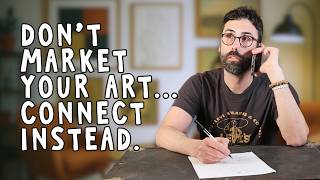
Lennon Bone argues artists sell more by building authentic personal brands instead of chasing polish. Collectors prefer artists they feel they know, and consistent tone and style drives 23% more revenue across industries.
Questions this video answers
72%
40,000 people
23% more revenue
$210,847
"Can Artists Find More Buyers With A Personal Brand?" — June 9, 2025
Chapters
72% of art collectors buy from artists that they feel they know, not ones that have the most polished portfolio. And I find this a really interesting statistic because we're seeing more and more art sales get pushed online. And those of you that are already making art sales in real life, unfortunately, I see a lot of you get stuck in how to transition those sales from, you know, markets or galleries or whatever into a real life scenario. And the truth is, is the landscape is different, right? People don't come to social media to buy art. They come to be entertained, educated, inspired. And so if that's what they're coming there for, but we know that people still end up buying there. How do we take them from coming to be educated, inspired, and entertained to being ready to buy from you? So this is the first video of a series of either three or four where we're going to talk about why.
Connection in your content is way, way better than perfection and how you can use that to build a personal brand as an artist. And what is a personal brand? Well, a personal brand is really just what people say about you when you're not in the room. And if the only thing that somebody has to say about you is, will they watercolor art or they do acrylic painting or, you know, they make abstract work, like that's not enough to stand out. It's not enough to keep people talking. And so we want to discuss in this series what that looks like. And I'm really, really excited about it. So let's jump into it.
First things first. The main thing I want you to understand is that it is not about looking perfect. It's about being real and relatable. When you're thinking about building any sort of, you know, personal brand or business online, it is not about being perfect. Period. End of story. Right. And I got some things to back this up. There was a couple of really fascinating studies. One, they took 40,000 people and they asked him what makes them, you know, buy something or say yes to something. And the answer was really simple. They bought something or said yes to something from people that showed up, that just showed up. It had nothing to do with the lighting. It had nothing to do with, with how professional something looked or the gimmicky marketing terms. It was just, oh, this person showed up consistently. Right. And another interesting study that backs that one up. They analyzed companies across different industries, and the ones that showed up with the same tone, style and story over and over again got 23% more revenue in their business. Right. Why is this? Because People.
Start to recognize you. And being recognized is the first step to building trust. And without trust, people don't pull out their pocketbooks and buy your work. So what does this say? It says that some of you are taking the wrong approach. Tell me, if you run your art business this way, you show your art in hopes that somebody likes it and in hopes that then they click on something and go to your website and they end up finding out about you and discovering, like, who you are and, you know, your art. You've got this, like, really wordy and.
Like, artist statement that's written to make sure that your professor would have been proud of you. You know, Meanwhile, it doesn't actually make sense. It uses a lot of words like, you know, color and grandeur and ideas and, you know, happiness, right? And it's like, okay, those mean different things to different people all the time, you know, so what is it? Who's it really for? Is it for everybody? Is it for nobody? Is it, you know, just for the artist? Like, I don't know. So it's fascinating because the best way to sell your work, especially on the Internet, is to do the opposite, right? Why does that. Why? Let's look at this for a second. Because that does work in a gallery sometimes. Why? Because when people come to a gallery or they come to an art fair or something, they're there to look at the work, right? But what's interesting about the Internet is it's the reverse. They're there to be entertained, educated, inspired by people. They connect with people. So we start with the person. So, you know, my whole plan, the heart based accelerator that I do, is all about starting with you as the person.
Who are you as a human first? Why do you operate the way you do as a human being? What are your values? Right. Think of it this way. And I often use this as an analogy. If you go to a party and. And you end up striking up a conversation with somebody, and that's a really great conversation, and you guys are really engaged and you're just hitting it off. And then, you know, you ask them what they do and you go, or. And they say, well, I'm a, you know, plumber and you got some issues. Who are you going to call that person? Right? Meanwhile, on the flip side of that, if you just have small talk with somebody and all you talk about is what you do, do you remember that person? Not usually. Right? Because there's no, like, real unless you do something similar. Like, unless you do the same thing as them and you hit it off based on your work. So it's no different when it comes to social media. Hint, the word social, Right. It's a really fascinating thing to think about, right? So if a personal brand is what people say about you when you're not in the room.
Then wouldn't it be great if you could get people to say, you know, so? And so is an artist who really is there to help people that struggle with anxiety, and they're on a mission to.
Give people something that allows them to think differently and see themselves as more valuable and see that there's nothing really to fear. That's a different story. Now we're thinking about a certain type of person, right? And that is different. We don't even necessarily need to know if they do watercolor or abstract art or write poetry or make music. It doesn't matter at this point because we're just like, oh, well, I'm a person with anxiety and feel like I need to, you know, have this feeling of knowing that there's nothing to actually be concerned about. Like, that sounds like me. I want to see more of this work. So this is the power. Simon Sinek talks about this. Start with why, right? So ask yourself, as a thought process, why do you follow the people that you follow?
Why do you follow the people that you follow? If you want, just pause the video and think about this for a second. Because I can almost guarantee that you follow them because you like their personality, you like their values. Can almost bet that you could tell me a little bit about them as a human, maybe not their whole life story, and that's okay, right?
You might like what they stand for, what they're trying to achieve. You might like that they offer you some sort of new information that you didn't really know before, right? Or they inspire you in some way, shape or form. And then you have to ask yourself, well, you know, if that's the things that you follow people for, how well are you doing that? You know, are you hitting those marks as well? Right? And if you're not, it's totally okay. Because the simplest way to do this is to start off by just being yourself.
And one of the exercises that I give.
My students and the artists that work with me is to just start with what is exciting to you right now. That does not have to do with your art. Is it a television show? Is it something that, you know, you're like, something you saw on the Internet that, like, got you lit up and got you thinking in all these new ways? Or is it.
A movie? Is it some music, like, whatever it is, if it's something that's got you revved up, go make a little piece of content about it. Go talk about it in a video. Let people know and let people in on who you are and what you like, what you value. Right. And what's so cool. Like, this week.
The tally for our community is at. We've seen $210,000. 847. Right? $210,847 in sales from artists in our community since January 1st.
Because we're focused on connection, not marketing. And what's fascinating, though, is that marketing is actually connection.
The best marketing is the marketing where you don't even realize you're being marketed to.
And why does that work? Well, it works because the company or the person or whatever it is.
Believes so much in what they do and are so true to who they are that you're just enamored or become enamored or become excited about the things that they're excited about.
And, you know, that's my hope, because I know a lot of artists have a lot of issues with marketing, but I freaking love it because I've seen heartfelt business leaders do it really, really well. And I've seen them change so many people's lives because they got good at marketing. And I thought, if I can be the guy that shows what it's like to market from the heart. Right. And what does that mean? Well, market from the heart means that you start again with you. Like, why do you do what you do? What is it about you that makes you excited to do this thing, and who are you doing it for? Right? Because that allows someone to say, oh, like, my heart is connected to yours. Like, we're similar. Right? And then at the same time, like, when you market from the heart, you're also doing things that are in alignment with that, keep that blood pumping, that keep you excited. You're not doing it from this place of.
Hating it and feeling burnt out all the time. Right? Like, even doing these videos in this podcast was a really interesting thing because I've been putting off YouTube now for the past six months or so because I really wanted to start this January 1st. And I did the exact same thing that I warned my clients of, which is started to let my analytical brain take over versus saying, what would it look like if I showed up as me excited and talking about the things that I love and care about? What would that change for me? Right? And I hear you. You're like, well, Lennon, I don't really, I'm not interesting. I don't have anything to talk about. I'm not an expert in anything. Listen to me, okay? And I really want you to hear this, okay?
This is not about you becoming an expert or being an influencer or being a guru or any of that kind of stuff, period. End of story.
What this is about.
Is being yourself.
And I want you to think about yourself in three different scenarios. The first one, think about yourself with your family. Think about yourself in a professional environment, and think about yourself with your friends.
Okay? Each one of these scenarios, you are going to act a little bit different. But it's still you, right? It's still you because you feel comfortable in all three of these scenarios, right? But if I put you on public stage and I'm like, all right, get out there and teach us something that you don't know anything about, like, then you're all of a sudden, you're out. It's like, no, no, no, no, no, I ain't doing that.
So what I'm saying is you get to draw the boundaries of how and what you want to speak on in the same way that you draw the boundaries of how and what you want to speak on within your family atmosphere, within your professional atmosphere, and within your friendship atmosphere.
Right? Whether I like it or not, I'm a different person at church than I am, you know, when I'm playing poker with my buddies. And some of you might be like, well, Lennon, can't believe that you do both of those things. Heck, yes, I do both of those things. And I talk about both of those things in both scenarios. But who I am in those scenarios is the same. But yet my context of what I speak about is different because it's a different type of person, right? Because all we're trying to do is connect. So in a poker scenario, we're going to connect over strategy and ideas and, like, what it looks like to play our hands well and to be, you know, it goes into more of the strategy and even business and money mindset, right? Whereas at church, we're going to think more about the spiritual aspects, like what it is that's really driving us internally. And with my family, you know, I'm going to be thinking about leadership and how I could make sure that I'm leading my kids well and serving my wife well. Right? But I'm still the same person. And so you have to ask, what are the boundaries and parameters that I want to draw around my social media brand, and how am I myself within that? Stop letting all of these gurus impose on you a plan that sucks out everything that is the most important thing, which is you. All these things, hooks, story, structure, you know, all that, it's fantastic. It is really important. But if you think of it, those are really just prefabricated houses, right? That is the structure. But the thing that makes that house unique and exciting is what you put in it.
That's you.
And if you're just sitting here thinking that you just need a good hook and a generic, you know, cookie cutter quote to put on Instagram, and it's all going to be fine and dandy, like, you got another thing coming. AI is way ahead of you, right? AI can write those all day long. So what are you going to do, right? Are you going to try to shortcut it and cut yourself out out of fear? Are you just going to hope that somebody gives you the right structure and that you can just go out and look like everybody else on social media and make it work?
Good luck. Because we're getting further and further away from that the closer and closer we get to being able to manufacture a structure that anybody can use.
So you have to ask yourself, how will you be you online? How will you be like the people that you follow? What elements do you need to bring forth to make you more predominant? And what boundaries do you need to set that keeps you safe? That keeps you from feeling like you have to share everything or cry online, Right? Because I don't want that for you. I'm not saying you need to go out there and just be sharing every single piece of information on the Internet. That is not the point. But what I am saying is that if you can't show up and fully be you, there will be problems. Because a personal brand is what people say about you when you're not in the room. So in the next episode, we're going to go over the top mistakes that I see in a personal brand and.
What'S keeping you from being visible, Right? And then in the following episode, we're going to talk about a blueprint.
On how to start structuring your personal brand on the Internet. So check out this video here. I'll see you over in that one. And don't forget, you don't make art. You are the art. Sending you tons of love.









