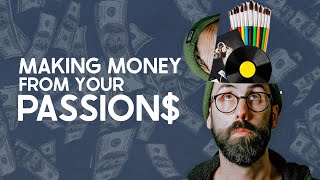
Lennon Bone (creator of Stop the Starving Artist) recounts ~20 years as a professional creative—primarily a musician—tracing a path from wanting to ‘make money from passion’ through band life (record deal, touring), studio/production work, and founding a company that helps creatives monetize their individuality. Key lesson: monetizing a passion requires treating it like a relationship—communication and compromise—otherwise it can keep you stuck or ‘poor.’ He emphasizes balancing personal integrity with adaptation, compartmentalizing personal projects, and learning to refine rather than rebuild.
Chapters
I've been a professional creative for the past 20 years or so. In the beginning, all I wanted was to make money from my passion. And now I don't know.
My name is Lennon, and I run a company called Stop the Starving Artist, where we help creatives leverage their individuality to build communities and monetize them. So this is a tricky topic. I want to preface this by saying, number one, all I can do is give my own experience and tell a bit of my story and how I navigate these waters. And then also say, like, if you are going to choose to do something that you love and try to monetize it, it will not come without a cost.
So, quick story. My first love is music. And there's a long lineage of musicians in our family, and I always wanted to make a living as a musician. And I remember my boss at one point saying, that's just not something someone does. They don't make money doing music. And immediately I remember saying, well, screw you. Like, I'm going to figure this out. You know, I was on a mission to prove them wrong. And so for about four years, I was working toward that goal. And then there came a point where I started to make money doing it. I was in a band, and it was going pretty well. You know, we had a deal on a record label. We were touring all over the country, and then eventually, a few years later, into Europe and just overseas doing a lot of other really, really cool stuff. But I can remember just before I left the group, us having conversations around, kind of succumbing to what we thought people would want over what we wanted to artistically put into the world. And I remember in that moment thinking, like, no, this is not what I signed up for. I want to be true to what I want to do. Now, that was not the reason I left by any stretch, but I did end up leaving the group. And then irony strikes where I'm actually put into a job where my whole purpose is to make music that fits into a box and get paid for it, right? It's the stock music library. No fitting inside this very specific box of what the production needed to be. And all these things, again, it kind of went against me and, like, how I wanted to do things. So I got into working in a studio and producing regional bands, and that was a blast. I was able to navigate the unknown with these artists and help them figure out, like, what they could do to make their work better. It was such a joy. Like, that was the best job I ever had. The problem with that was That I live in a pretty small market. And so at some point I was taking jobs that weren't really that fun, and it wasn't really in alignment with what I was passionate about within the work.
So now, the beginning of this year, you know, I told you that I have a company called Stop the Starving Artist. So this is only a year old. You know, building this business has taught me something very, very important. It's made me look back at all the stuff that I've done in my life and realized that when I was seeking those things as my passions and trying to make money from them, it was very much about me. It was about serving myself first. A business is a relationship. I feel very lucky. My wife and I's relationship is the best that it's been. But that happens because we are willing to, one, communicate and two, compromise. Communicate what we need and then compromise and find a middle ground. And with monetizing something that is building a relationship with somebody. And I never realized that before.
If you're coming into wanting to monetize your passion, will it keep you poor? Yes, if you're not willing to treat it as a relationship. And that's the biggest lesson that I learned. You know, I'd make it to a certain level and could have expanded and if I was willing to compromise. And we have to learn to see that compromise is not always a bad thing. And we can compartmentalize and have opportunities where we have these things that are solely for us. But then the hardest part is always getting out of our own way long enough to let things breathe and for success to start to come. Being willing to refine rather than rebuild every time. And that's a lesson I'm continuing to learn myself. I'm definitely not perfect at it, and I think so many more of us can do that if we are able to just relinquish some of that control and then keep control of the things that we don't want to give up. And that's totally okay, too.