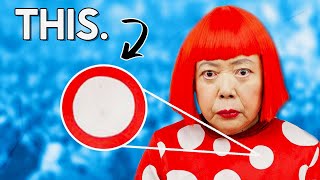
Lennon Bone's YouTube video argues that artists get noticed by intentionally telling the right parts of their personal story. Using Yayoi Kusama as the primary example (documentary excerpts describe her dot-motif origin and activism), Bone outlines three parts: 1) explain the "why" behind your work so audiences can find meaning; 2) clarify what you and your art stand for to create community and motivate supporters; 3) reject the idea that you "just make art" — instead, surface vulnerable personal motivations so the right audience connects and may be moved to support or purchase.
Chapters
Yayoi Kusama is one of the biggest artists in the world, and she basically makes a bunch of dots, or at least that's what it looks like on the surface. See, up until about a month ago, I had never heard of Kusama. And then I watched the documentary Kusama Infinity and absolutely fell in love with her and the work that she makes. But how in just 90 minutes did I go from not knowing this woman at all to being a fan of her work? There's this really simple thing that Kusama and all the other successful artists of the past have done, really, or somebody has done for them. And it's crazy to me because not a lot of artists are doing this right now, at least not with any real strategy behind it. And it's telling your story, but not just like your whole story from like your birth. I'm talking about a couple of very specific parts of your story. And when you do this right, people will not only like you and your artwork, but they'll actually buy it because they feel like there's something special here. So let's get into it. Part 1. Why do you make the art you make? As human beings, we are constantly seeking meaning for everything. Whether at a conscious or subconscious level. We want to know why things are happening. Like, why is the government making the decisions that they're making? Why does my dog look at me that way? And why the hell am I still buying all these freaking vegetables when I know they're just gonna rot in the fridge? Think about that in context to your art and Kusama's art. When I see her work, I might find some of it interesting, but I probably won't get it. I'll look at it and be like, why in the heck are there a bunch of dots on this woman and this horse? But what happens if Kusama gives us the why behind those dots? How does that change our vision of her work?
One day, Yayoi was sitting in the flower beds when all the flowers seemed to come to life. Their heads were like dots that went on as far as she could see. She felt as if she was being obliterated or breaking into little pieces and disappearing into a field of endless dots.
After Yayoi got home, she sketched lots and lots of the never ending fields of flowers. And what she'd seen in the field drawing helped her to feel calmer and more in control.
And with that little bit of a story, what was once just a dot now has depth and meaning and life. Not only do I understand why she does what she does. If I had some sort of similar experience as her, I'd probably relate to this art on a completely different level. So ask yourself, why do you make what you make? Where does it come from? And how does it relate to. To your life? How did you get started? How does art help you as a human being? Tell these stories together, separately, as many ways and as often as you possibly can. Because when you tell us these stories, you're giving us meaning to something that had no meaning before. Part 2. What do you and your art stand for? It's one thing to make art. It's another thing to make change. Now, I love Seth Godin's definition of art. He says, art is a personal act of courage, something one human does that creates change in another. And if we want to make change, we honestly have to stand for something. We can't just kind of sit around on the sidelines, right?
In 1967, she began organizing anti war protests and happenings known as atomic explosions. She painted her friends nude bodies with polka dots and demonstrated on Wall street, demanding the government bring back the troops from Vietnam. Her youth had been marked by the effects of the atomic bomb, and she was viscerally opposed to war. In another revolutionary performance of 1968, Kusama even officiated at the first gay wedding, having formed her own church, the Church of Self obliteration.
So why does Kusama being for the LGBTQ community and against the war, make her art more meaningful and valuable to us? Because we either agree or disagree with her, and we need people to disagree with us because it shows, again, that we're standing for something that means something. And when people agree, something really cool starts to happen. Number one, when we say that we support this artist, we're saying, this is the kind of person that I am. Like, I can remember in high school getting mixed up with the wrong people and my gram being like, no, no, no, you don't want to be associated with that. Which brings me to number two. You become a part of a community. As humans, this is another thing that we crave. And when we have something that we can rally behind, it gives us a powerful connection, a sense of, like, teamsmanship. Right? And number three, when we actually support the artist or buy their work, we're supporting something bigger. We feel as though we're doing something towards a cause. So again, ask yourself, what do you stand for or against as an artist? Now, I can hear you. You're like, oh, you're telling me to have some big political stance. No, no, no. This can be much simpler than that. Don't overthink this. If you said to me, lennon, I'm the kind of artist that will only use a pen because a pencil allows me to not have mistakes. Boom. Like, there's something that you believe in that you're standing for. And some people are going to disagree with that. And some people are going to agree with it, right? So start there. Talk about those things that make you mad, and let us know why.
Part three. I just make art Now, I actually don't believe this is true. You don't just make art, right? There's more to it. There's a why behind what you do. You just may have to dig for it a little bit. And I've walked a lot of artists through this process, and what I see often is that they start to dig and they get to the vulnerable bits, the little bits that feel like, oh, this is a little more emotional than I thought. You don't just make art. You are the art in so many ways. This thing that you've created, whether it's a song or a photograph or a painting, is just a vessel for your own thoughts and beliefs and opinions and circumstances. And, you know, it all lives within there and then comes out. And when you start to share those underneath bits, the bits that are a little more vulnerable, just like Kusama, you will get noticed not by everybody, but by the right people. And more importantly, you might just change somebody. And that sounds pretty cool to me.