How to give less f**ks about what people think. Dealing with rejection as an artist and creative.
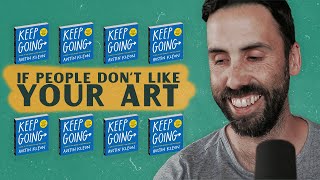
A short talk/transcript by Lennon Bone about balancing creative work and monetization, reframing rejection, and protecting parts of one’s artistic practice from market pressures. The speaker recommends separating ‘for-you’ art from monetized work, choosing the right audience/customers, and viewing rejection as a step toward finding ideal fans or clients.
Chapters
Yeah. So today we're talking about how to give less forks. I can't believe you guys thought it was something else. These are potty brains. So, you know, we explore this idea of finding a balance between creativity and making money and all of these things. And when we're trying to get somebody's attention or make money or get hired for this thing, any of that stuff, we're gonna deal with rejection. It's just inevitable. So, you know, how do we feel less worried about that? Because when we worry about it, it prevents us from putting things out. It prevents us from taking chances, which in turn prevents us from getting the things that we want and, like, being able to survive and make a living doing something we actually love to do. I hope you'll hang out. I want to talk about a couple things that I have found to be really helpful for me that I work with my clients on, and it seems to do well. So I hope you find this helpful. So in Austin Kleon's book Keep Going, he talks about this idea of protecting your valuables. He calls it so forgive me. I'm reading it from the screen because it's just way easier. He says, you must be mindful of what potential impact monetizing your passions could have on your life. You might find that you're better off with a day job. When you start making a living from your work, resist the urge to monetize every single bit of your creative practice. Be sure there's at least a tiny part of you that's off limits to the marketplace, some little piece that keeps you for yourself. So I definitely don't want to shove Austin's words into my ideas. So it's not to say that this is what he's saying. This is just my interpretation of it. The way I've lived out this idea of kind of separating two things. So before we get into that, I do have to give you a little context as to what my. What the fork I've done in my life. The first way I started making money as a creative was as a drummer and a producer, and that moved into doing commercial work, writing for different stock music sites, you know, just finding different avenues to monetize my talents. But that really did a disservice to me because there was a point where I felt like everything I made had to fit into a certain box, and it really kind of sucked all the life out of just the way that I was writing music, the way that I was making stuff. I felt like I had to fit into this thing of okay, can I, like, can I make money from this? Can I do this? Maybe I should have read this book 15 years ago. I guess it didn't exist. But, you know, that's the idea is, like, I didn't know how to make this work. So now I'm teaching people what I've learned how to do, which is figure out, like, okay, here's the thing underneath the music. Because what I found is that what I love about making music and being a producer and doing those things was digging into the unknown, looking for the things. The, like, uniqueness, unique ways to, like, show a sound or express a lyric or do something like that. That's what I love about my job now, is that I have to find unique ways to help people dig through all the dark spots and all the unknown stuff and come up with cool answers and ways to showcase themselves. And it's so much more fun because now it's opening up these opportunities for me to just create for me. Albeit it's been really challenging as of recent because I had this identity of, like, this is what creation is for me. And now I'm having to redefine that again. So how does this help you give less forks? Well, you only really need one fork to eat the pie.
Anyway, with the fork jokes. When you split things up this way and you have the things that are for you and the things that are for other people, it allows you to continue to make the art that you want to make while also, like, monetizing these other things that don't come from this, like, deep place where if somebody rejects that, that feels super hurtful. You know, we put so much of our heart and our soul into our art, and I think the art can become more of a calling card. And then you can have these other things that you monetize alongside it. Not saying you can't monetize your art or you shouldn't try. If you're willing to go in that direction, do it. By all means, do it. I've done that. And it can be really rewarding, but it can also be challenging. But you start to think about it in two ways. One, you have the things that are yours. This is just stuff that you can choose to do whatever you want with them with no obligation. You don't have to release them. You can release them. You can just, like, hang on to them. You can massage them to death. You can polish off the shine. You can make them as messy as you want. You get to just have these things as your moments. These are just. This is Just your time. And even for the next couple months, like, this is a very specific time that I'm trying to set aside for myself. Hopefully I can share some of this with you guys. But it's about just getting to do the work. That's the thing that you're falling in love with. It's not about the outcome. And then when you make stuff for other people, the big thing you have to do now to give less forks.
Is to be able to just remember that it's not for everyone. What you make is not for everyone. So you have to stop being concerned about offending. You are not for everyone. So stop worrying about offending someone. Stop worrying about having someone not like you. When you create a product or you put something out there to sell that's in your creative wheelhouse, you know you're gonna do it likely for people that you would want to hang out with anyway. That's the common misconception that I see a lot of creatives make is they feel like, oh, well, if I'm building a business, it's gonna feel like all this other junk I've done. No. When you're making your business, you get to choose who you work with. You get to make this, like, really cool thing. That is how you want it to be. You get to work with the people that you want to work with. That's what makes it so fun. And when you do it that way, those are the only people that matter. And there's so much freedom in that, because now you can give less forks because you don't need their forks in the first place. You've got, you know, the forks of the people that you need, and that's all that matters. The other people can go fork off, right? Like, let them go. I thought I was done with those jokes. Cut it out. Too young. Okay, cool. So you can then think of rejection as almost a step closer to getting to your right person. It's no longer about, like, oh, someone's turned me away. It's like, no, now they are out of my way, and I am, like, on my way to the next person. Person who is now more likely to be my ideal fan, my ideal client, whatever it is. It's like a stride toward finding the people that will care about you the most, and they're going to be customers of yours for years to come. I won't make another fork joke. But think about it this way. If you lost a family member in a crowd, you're in a city. For me, one of my kids gets lost in the in the street and it's like, packed. I'm going to yell at the top of my lungs to make sure that I find that person, and I am going to say their name, and I'm going to say it directly to them. I'm going to speak directly to them as if they can hear me, despite the fact that everyone around me may be disrupted or may be like, a little bit put off. But soon enough, they're going to realize, he's not talking to me, he's looking for someone else. And some of those people might even say, like, oh, I actually know how you can get a step closer to that person. Let me help you. I want you to think about that. Because when you approach trying to reach your person with that same urgency, you will care so much less about whether or not you're putting people off, because you know how important it is to get toward that person that matters to you. You have to know and believe that this person needs you as much as you need them. Even if you both don't know it yet. You were meant to do more. And so don't let someone giving you a weird look or someone telling you that you shouldn't try this thing, or someone telling you to be careful. Don't let someone else's insecurities and fears get in the way of your calling and what you're supposed to do. So give less and forks. We're often afraid to kind of show up and be ourselves. I actually have a video about that. Check this video out and let me know what you think about it. Leave me a comment below. Let me know what you do to care less about other people's opinions. I want this to be a conversation. Send you guys love and I'll see you on this one.









