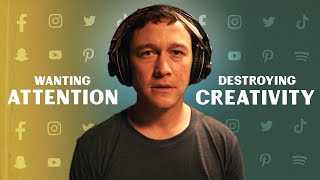
Joseph Gordon-Levitt and Lennon Bone discuss how social media can hollow out creative fulfillment. Algorithms push creators toward trends and imitation instead of original work. The real cost isn't exposure but losing the deep focus that makes something worth making in the first place.
Chapters
If your creativity is driven by a desire to get attention, you're never gonna be creatively fulfilled.
Social media is a race for second place. First place is the person with an interesting idea that becomes a trend, and then the rest of us only have to come in second to get attention from what they've created. Say that this sound makes her last video. Say that this sound makes her last biz a that this sound makes her. But what does this do to us as creative people, as creative individuals? When we're looking to be second place, we're no longer trusting that our own stories and ideas are worth being told. And so we are no longer being creative.
Technology has allowed more and more people to have this powerful feeling of getting attention. But I do think there's an unintended consequence for anybody on the planet with an urge to be creative. I think that our creativity is becoming more and more of a means to an end, and that end is to get attention.
So this video by Joseph Gordon Levitt, that was a big inspiration for this video. And the problem with that video is that it made me ask a really tough question, which is, is it bad to want attention?
So in Harriet Williamson's article, why Attention Seeking Isn't Wrong or Shameful.
Talks about this idea that we've needed attention since we were babies. We need that connection from people in our lives. Some people love to make things just for themselves, but many of us, we want to make things that connect. We want to make things that get people to feel something, that get them to change their mind, that get them to think about things differently. So feeling like attention itself isn't a bad thing. I had to look at intention instead.
Social media is designed to fragment our attention. The algorithms are literally learning what you like and serving you up more of that so that you'll stay on the platforms longer, right? It's no secret. And this is why I talk so much about this idea of being a creative contributor. Because if you're just a consumer of the platform, what do they do? Well, they feed you whatever you like and they give you more and more and more of that. But what happens when we all are perpetuating these ideas? We just start to copy one another. We look at this idea of TikTok and trends. We what do we see every single day but somebody taking the same audio and doing the exact same, like, pointy, texty thing to it, right? There's nothing inherently creative about those ideas. We're just riding off of First Place's success. Real creativity comes from what Cal calls Deep work, right in his book. And in his book he defines deep work as professional activities performed in a distraction free state of concentration that pushes your cognitive abilities to their limit. I'll say that again, pushes your cognitive abilities to their limit. These efforts create new value, improve your skill and are hard to replicate. Are hard to replicate. What do we see on social media all the time but replication? So can we take back the control but still have the connection and know the right kinds of inspiration? Because I am inspired by things online. You know, I don't fully know the answer to this question yet. I wish I did.
Alright, so I've been working on this video for about a week and I keep going back to this idea that I said in the beginning, which is, you know, if we're not using our own voice, then we're really not being creative. And I want to just kind of wrap this idea up by hitting that again. Here's what I know, at least for me at the current stage that I'm in with helping creative people find their thousand true fans do the things that they want to do. I don't get to make a lot of art anymore the way I used to. And so in many ways, like putting these thoughts together to hopefully make you feel something about what you do, that is my art right now. And I don't know that I could think of it as art before and I couldn't do that without social media. And so I think it's so good in so many ways. But as people, if you're anything like me, we get so caught up in the need for more that we allow fear to determine what we make and when we make it. Said it a bazillion times on this channel, fear is simply false evidence appearing real. I don't want you guys to hear me preaching to you here because I am talking to myself right now. When I look into this camera, I see me. Is social media ruining my creativity? Not yet, but it could. It could. If I let fear, the fear that I won't get more, that I can't trust my own process or my own voice. If, if I let that fear run what I do, then it can ruin my creativity. So I want to challenge myself and all of us here.
To do our best to strip away the fear that exists. When we are ready to show up as ourselves on social media, when we're ready to truly create something, when we have an idea that we're like, that would be so fun, but I don't know if it'll perform well or we do this thing that we're like, I really want to talk about this because I think it would help somebody, but we let fear get in the way of us doing that. So I just want to ask this with all humility, that you will make a pact with yourself that you'll put the same creative energy and excitement into the way that you promote your stuff as you do the work that you make. But can we just do it as us, with our own voice, our own heart, our own beliefs, our own ideas? What I'm coming to is we can't hide behind someone else just to get the views. It means so much to me that you're here and that you're outputting creative things into the world that matter to you, and because of that, they can and will matter to others. Verse 2.