This Report Says What I've Been Saying For Years...
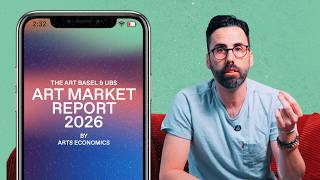
Lennon Bone breaks down the 2025 Art Basel report showing direct-to-artist sales doubled from 10% to 20% of collector budgets since 2021. Artists who show up consistently online and stay findable are winning sales galleries used to control. Bone shares his own $39,615 in 2026 sales and argues marketing is a growth skill, not a burden.
Chapters
In 2021, art collectors spent about 10% of their art budget buying directly from artists through studios, Instagram, things like that. But by 2025, just last year, this number has grown to 20%. That's double what it was. This comes from the Art Basel and UBS Global Art Market Report that dropped last week, and I thought there was a few things in here that I've been looking at that I think are really important for you to understand if you're someone who has sold your work at a gallery or you've sold your work at markets and things like that, because I see a lot of artists give their power away to these gatekeepers. And I'm always trying to encourage you to, yes, do those things, but also consider the power of selling directly to your people and figuring out how to do that. So we're going to talk about these things that I found in this report. And what you can do about it. I'm also going to give you a little quiz here that you can take that'll really, I think, shine a light on some stuff that maybe you need to work on in a really beautiful way. Hey everybody, my name is Lennon Bone. I run a company called Stop the Starving Artist where I help artists who are selling their work in real life take that online. So far this year in 2026, we've seen about $39,615 in art sales, and inside my community we're in a Sales Sprint this month, so I'm excited to see that number continue to climb. But enough of that, let's get into what we're seeing in the art market and how you can utilize this information to sell more of your own work online. So a really interesting statistic is that 42% of people say that they now actually prefer buying directly from the artist versus going through a gallery. This is a big deal, you guys, like, and, and what's really funny to me is that in this report, gallery owners are saying this, and I'm quoting this. It says, our biggest issue by far in 2025 is that artists are selling directly to customers who find the art in the gallery. So basically, a gallery has an audience, a collector walks through the doors, and then they find the artist themselves and buy directly from them. This is amazing. And I know if you're a gallery owner, you're like, this is not amazing, but I am a big proponent of any time that the artist can get back their power and not have this middleman. I think it's a beautiful thing. So what we're seeing is that artists are building direct relationships with collectors and capturing more of the market from those galleries, right? And collectors, especially the ones that are newer, or a little younger in age are actively choosing to buy that way, to buy directly from you. So the question isn't whether or not people wanna buy from artists, right? Or if they're buying from artists online, they are. The question is, if you're an artist, are you findable? Is it easy for someone to feel connected to you and your work when they find you? And number 3, will they see you as a professional when they come across your stuff. And so I think it's important to identify on the internet versus real life what makes someone see you as a professional. Because someone seeing you as a professional in a gallery or a market, it's a much easier lift. Why? Because they trust that if you're in this container, if you're a part of this gallery, if you're a part of this market, then you can be trusted, right? You can be trusted simply because you exist there. And a lot of times when artists are trying to market their work, they assume that that is the case everywhere else, and it is absolutely not. And I hear a lot of artists say like, I'm, well, I'm trying to get into a gallery, I'm trying to do this, that, or whatever. Basically, you're trying to get someone to sell the work for you so you don't have to do that part. I get it, like, it's kind of the dream. But there's one more interesting statistic here. In smaller, mid-sized galleries, the ones that you're likely going to get in, on average, 65% of all sales that that gallery makes comes from their top 3 artists. So even if you get into that traditional system, that does not guarantee you visibility. And let me be very clear with you. The majority of sales, even in my program, come from, you know, a handful of artists. Now, why is that? Well, because that's the way it always works. There's always going to be a smaller group of people that do better than everyone else, right? So when I say, well, we've sold this much and that and whatever, you know, a lot of people say, well, how many artists do you have? And it's like, well, I'm, I'm here to be very upfront that it is a smaller portion that make the biggest sales. But I want to tell you why they make more sales than the others, because there is a difference. And it's not that their work is crazy better or that they're so much more charismatic. Number 1, they are being themselves. Number 2, they are showing up consistently. And number 3, people see them as a professional. And your art, just your art alone, does not make you a professional human being. And people don't buy art from the art itself. They buy art from the human being. I mean, you have to remember, like, Even these Hannah and Nemo pieces go for on average over $1,000 a piece. They sell out almost immediately, right? But it happens because people see that they are being authentically themselves. They trust them because they're showing up consistently and they're professional. It's like, you know, the pieces are amazing. They're beautiful and they're cool. But if I'm going to spend $1,000 on you, I need to also know, like, can I trust you as a human being? Because if not, like, I ain't forking over that money. So every artist needs to be sitting with this question here, which is, if a collector finds you tomorrow on Instagram or TikTok or whatever social media platform somewhere online, or through a Google search, or if they find you through a friend's recommendation, what will they find? Are they going to find a professional? Are they going to find someone who shows up consistently? Do I mean 3 times a day? No, not at all. Right? Or are they going to find someone who has a bio that reads like, "I make art for the joy of being a creative and to showcase the form and functionality of color and whimsy." You know, all these big words that sound very fairytale-ish. It's like it's written for an art professor, right? Are they gonna find someone who posts 3, 4 times a month? And in those posts, are we only gonna really see your art? Like, we're not gonna know who you are. We're not gonna know if we can trust you. We're not gonna understand your values. Is it going to be clear how we can purchase your work? And is it going to be simple to get to that work that I want to purchase? Listen, being a professional is not about a perfect website. And a lot of you, I'm going to be very upfront, 2026 Lennon is about being direct in the most loving way possible. But all like I hear every day, Lennon, I can't do this because my website isn't ready. Do you know what a website really does for you? Your website is your last your last effort to make a sale. It is not your first line of defense. Who is the first line of defense? The discovery mechanism. Whether that's you, whether that's a friend, whether that's social media. And how do people typically go and find things right now? Well, they either hear from you somewhere or they discover you online. And what do they go do? They don't go look at your website first. They go to your socials. And what they see there matters. And here's what I wanna say. Some of you are like, well, Lennon, I don't even wanna be on socials. Then delete it. It's better to not have it at all and just let people go directly to your website than to have something that looks just half-baked, right? Whatever you wanna put out there, let that be really, really good. 'Cause whether we like it or not, what people find, it forces them to make a judgment on you. And let's be real, if you're trying to get new eyeballs on your work, right? And I know all of you are, then you have to understand that one, people don't buy your work immediately. They have to build some sort of relationship with you. This happens with everything that we purchase, right? Unless it's something that we need. Like if I'm buying a coffee cup, I don't really care where the coffee cup came from, right? If I'm buying a handmade coffee mug, something that feels more like a collectible because this is something I value, that's a different story. I wanna know where is that coming from? What are the materials? What are the things that are happening? Who's making it? And you don't need to be showing up putting all this time and effort into your socials. I'm not saying you need to be spending every waking hour doing this. Actually, what I'm saying is the opposite. You can learn how to do social media in a way that really feels like you. And that, my friend, is a skill. It's not something that you're just gonna wake up able to do. And then the argument becomes, well, Lennon, I don't have time. It's taking time away from, you know, my creativity. There's an amazing artist that I won't name here because I don't want anybody to feel like I'm bashing on him, because I'm not at all. I totally understand and hear this sentiment all the time. But, you know, he said, how long are we going to have to do this? He's like, I've been on this app for 13 years, and it just feels like there's noise everywhere, and it's you know, like, he's like, the thing I hear the most from creatives is I just want to get back to making my work. And I get that 1,000%. But what we have to understand is that if you're trying to build a business, if you're trying to make a living from your creativity, you have to market your work. And you have two options. You can stop, right? Or you can learn to see the potential of creativity and connection in the marketing itself and find the driver that gets you moving forward instead of just white-knuckling it and forcing it. Because if you just white-knuckle and force it and you show up every day and you don't really like it anyway, and all you do is say, well, I'd rather be doing something else, do you think you're gonna do it? And do you think you're gonna do it and show up in a way that feels professional? Or you think you're gonna do it and show up in a way that feels forced, right? And then what happens? Well, and then you end up quitting anyway. And then you maybe start up again, and then you maybe quit again, and then you maybe start up again, and then you quit again. How many of you have done this? I know a lot of you have done it. Actually, I got something, I got something. Watch this. Okay, since I moved, I can't find the book. So here's what I'm gonna do. I'm gonna look up a quote here. Okay, so these are a few quotes from Steven Pressfield's The War of Art, which is one of my favorite books of all time. He talks about what it is to be a professional. And the first thing that I want to bring up here is this quote where he says, "Are you paralyzed with fear? That's a good sign." You're afraid that someone's going to have an opinion about you or that trolls are going to show up or, you know, that when you share something online, like, people will judge you. Pressfield says this, "Are you paralyzed with fear? That's a good sign. Fear is good. Like self-doubt, fear is an indicator. Fear tells us what we have to do. Remember one rule of thumb: the more scared we are of a work or calling, the more sure we can be that we have to do it. Now, if you think that, "Oh, well, I'm not afraid, I'm just burning out. I'm just sick of it," I can almost guarantee you that somewhere underneath that burnout is some sort of fear. False evidence appearing real. You may not be able to see it yet, but I can almost guarantee it. Right? Because if you're burning out, you're burning out because you have an expectation. And if you don't meet that expectation, then you burn out. Pressfield says, "The artist committing himself to his calling has volunteered for hell, whether he knows it or not. He will be dining for the duration on a diet of isolation, rejection, self-doubt, despair, ridicule, contempt, and humiliation. And we can see this as a bad thing because a lot of, a lot of people come to me and they're like, Lennon Bone, literally I had somebody make a comment like, so you're telling me that I got to be on social media and I got to market my work and I got to like do all this extra stuff to like get my work out there? That sounds like a terrible career choice to me. You know what that sounds like to me? Every other career choice that you could possibly ask for. You build any business of any sort, You're gonna have to do some work. But the difference in choosing to do the work because you know what you're gonna get from it and doing it out of obligation are very different. As my coach Ellen always said, "Obligation is a breeding ground for resentment." Obligation is a breeding ground for resentment. If you're feeling obligated to do that, you will resent it. And so when Pressfield says like, "You've signed up for hell," to me that's not a bad thing. He's giving us the freedom to understand that these things are gonna come our way. It's how we choose to react to it. That gives us opportunity. He says we must do our work for its own sake, not for fortune or attention or applause. Once again, fortune, attention, applause— what are these things? These are expectations. So no, you don't have to be here marketing your work. You don't have to be here trying to be a professional. You can absolutely choose to say, I do this because I know that it gives me something. Y'all need to understand this if you don't from me already. When I think about business, especially as a creative, I don't think about it like, let's go make all the money, right? I think about it as it is one of the most ripe opportunities for you to grow as a human being as there ever will be. Why? Because when you have your own business and you treat it as such, there is nobody else that you answer to except you. And if you saw my personal video that I posted that talked about like what I'm going through, if you haven't watched that, you can. Like all of the elements of growth that I've gone through, the majority of them came up because I had to learn to understand who I was as I was growing a business that was such a huge part of who I am internally. So you have to be willing to show up and be a professional. You have to be willing to show up and do the things that other people will look at and say, wow, I'm so glad that they continued to talk about who they were, to be authentic, to be consistent, because I would have never found their work otherwise. I would have never had my mind changed. I would have never been seeing the world from this light had I not come across this artist, which is you. Now, I told you all that I was going to give you a quiz. Okay. The quiz is in the link below. There's a link to a newsletter article I did about this that goes into more detail, and at the end of that newsletter article is a quiz. There's also a signup link in that article for a cohort that I'm doing coming up soon. So if you feel like you need help with your art marketing, go to that link, read that article, and at the bottom it'll say Hey, question to reflect on, you know, if you feel like you need help, click here. You can click there and there's a waitlist that you can jump on. There's no obligation to be on the waitlist for you to buy or to be a part of the cohort. It's just an opportunity for you to get first access because I'm only opening this up to 33 artists, and we'll start at the beginning of April. So listen, there's gonna be more coming. I'm so excited to continue to talk about this idea of being a professional and what that looks









