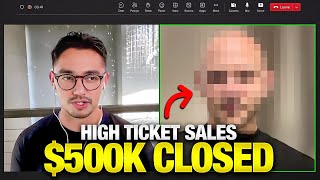
Closing a $8,000 deal effortlessly *Live Sales Call*

A Springboard coach walks through closing an $8,000 mentorship deal with Kurt, an Austin automotive shop owner in cancer remission with $80,000 liquid assets. The program covers off-market deal sourcing, BRRRR investing, creative financing, and asset protection through weekly calls, video modules, and a regional network of contractors and lenders.
Chapters
Alright, you guys, so I've been getting a lot of messages from people asking how I close 3 to 5 high-ticket calls per day. And yeah, I'm gonna show you, but the reality is you're probably not taking enough calls. Some of you may be taking 1 to 2 calls every couple of days and thinking that's enough. And it's not, you know, everyone that I know that's making a lot of money with sales, high-ticket sales, even an SMMA, they're all taking 7 to 10 calls per day. So yeah, I'm going to show you what that looks like and even show you my calendar so you could see how much volume I'm doing per day. Um, and then I'll show you a sales call that I took this past week that I closed the deal with for $8,000. So hopefully this helps. So here's what my calendar usually looks like. And the blue people I closed, the red no-shows, so they didn't show up to their appointment. Um, light green, they showed up but I didn't close them. I don't know, I like to be color coordinated. It helps me, and the purple people I took a deposit from. So yeah, I'm working 6 days a week. So yeah, it is a lot of calls, and a lot of people ask how I stay motivated. Well, I mean, my daughter's in private school, I live in LA, and Yeah, I don't really have a choice, so I'll show you guys the close call, the deal that I closed, and, um, yeah, hopefully this helps. Hey Kurt, let me know if you could hear me. I like the username, by the way. You're muted, so you just need to press the unmute button. Uh, for me it's on the bottom left of the screen. Should be for you as well.
Can you hear me?
There we go. Now I can.
All right. Yeah, it was— it had to pop up some message. I'm not really sure. I was sitting here like clicking on stuff. I don't know. So What's going on, man? Is my username— does my new username say shit?
It does say shit.
I just got to change my phone. I set it up a long time ago and I just, I keep forgetting and every time I do this, it's like, shit.
No worries. No worries at all. I thought it was funny when you jumped in. So nice to meet you, man.
You too.
All right. Where are you calling from, Kurt?
I am in Texas, like the Austin area. I'm actually sitting in my car right now. I'm waiting for my daughter. She's at dance and I'm like an hour away from my house. So this is, this is what I got.
So no worries, man. No worries. What, what does time look like, uh, before daughter's done with dance?
Oh, she's, she's not done. She got another hour and a half, so we're good. Okay.
Okay. Makes sense. Beautiful. So you're from, uh, Austin area?
So where I live, yeah. I'm, I'm originally I'm from California, but yes, let's, uh, oh, okay.
Same here, man. I'm out in Missouri City. I'm from Orange County.
Okay. I'm from San Diego.
San Diego. Okay. You're not too far from me.
When'd you make the move out to, uh, I moved from San Diego in '08, which is like the worst time to do anything. And I moved to New York.
Oh, wow.
So I lived in the city and was there. Can you see me? I mean, I don't know.
I can't see you. I was about to say that next, but it's all right.
So I'm sitting there like realizing that's got like, it's like a black icon in the corner there. So there you go. There's me.
There you go. Oh, yeah. Yeah.
So yeah, so I moved to New York. We lived in New York City for a while, then lived in Long Island, and then came out to Texas, I don't know, 2016, maybe.
Something like that. You enjoying it out there?
Yeah, it's all right. It's a little hot during the summer, but I agree. Yeah, it's not bad. I mean, I was able to open a business and buy a house out here and, you know, live fairly comfortably and stuff like that, you know?
Yeah, we have a large Texas student base, so it's— I mean, such a great market to invest in. So yeah, we have a Dallas group, a Houston group, and then also an Austin group. So every month—
yeah, well, I know that whole triangle, you know, between all of them is, is a big area.
Yeah, yeah, yeah. What, what do you do for, uh, for work as well? What's a business you run?
I own an automotive repair shop.
Okay, yeah, I saw that on your, uh, uh, application that you did. But awesome, man. I mean, what was, uh, let me know, what was motivation for booking the call? Are you new to real estate? Is it, um, do you have a couple properties already?
No, I mean, I'm new. I mean, I have my own personal property, but I'm new, you know? I mean, I read, man, I mean, I read a book probably 20 years ago. Um, I mean, I've been interested in real estate. I've just never really had an opportunity. It just never really kind of came to fruition in just until maybe past 2 years when, when I opened the business and things started to, started to get better. I'm starting, you know, I got my credit good and put a little money away, stuff like that. And then it's, you know, now just kind of coming around to it as a possibility.
Okay, makes sense. So you've always been interested, but now you're— you feel you're in the place to where, hey, credit's good and you're kind of ready to start moving forward with it, it seems like.
Yeah.
Okay, well, hell yeah, man. Well, excited to chat here. And I mean, just so you know as well, Kurt, like the whole reason why we have these calls here is just to get a better understanding of what's covered. Within the mentorship and what it looks like to be working with Thatch as well. So, you know, I'm here to just tackle any questions you have, give you all the clarity you need. I am one of the coaches here in Texas, so I joined 3 years ago as a student. Um, but yeah, with that, main reason why we have these calls, just so you know, which I'm sure you could appreciate, is to really qualify each potential student before we do bring them in. So, you know, that's kind of the good news with Springboard, just in the sense to where Someone comes in here with a 400 credit score and a bunch of credit card debt, or they're not that serious about real estate, they're probably not the best fit to have with meeting with Patch weekly to get things rolling. But, um, as far as what we are looking for in students, you know, students that we see becoming success stories, so people who are coachable, they're ready and willing to learn, but more importantly, ready and willing to implement what's being taught here. Because it is one of those things where Thatch is sitting down with you every week. He's helping you make a game plan, helping you analyze and evaluate properties, letting you know what steps to take as you proceed. But I'm sure you know you could give someone— you could lead a horse to water, you can't force them to drink. Oh, sure. So with that being said, by the way, I was looking at your application. Were you a part of the webinar we did 2 days ago? Was that how you booked this call?
No, I've been following that on Instagram for a while. I mean, and others as well. And no, I was going to watch it. Are you talking the— what do you say, webinar? I mean, he had that video with John, I want to say was.
Yeah.
So what you're talking about is it—
yeah, it was with Chris, one of our students here.
Okay. Yeah. Yeah. I was going to watch it. Then I was on the phone call with— I don't know what his name was, Sam or something like that, I think.
Yeah. Okay.
Yeah.
Okay. Makes sense. No worries.
I think I have— he sent me a link to it. I was going to watch it later. Yeah.
Okay. No worries. No worries. I mean, just so you know what Thatch does here with Springboard, he'll do periodic onboarding. So he held a webinar a couple of days ago. He opened up 20 seats for the mentorship. So of those 20 seats, we are down to the last 4 spots as of now, wrapping up the week. So I'll let you know, the only thing that's just really, really big on is just making sure everyone who was able to book a call just has equal opportunity to be a part of the team. So he does ask for me to get on the call, just 1 or 2 very honest answers, meaning like, hey, if I do see you being a good fit, of course I'm going to extend an invitation. More importantly, qualify that Thatch is the right mentor for you. You could give me that yes on your side. Other answer being a no, which, Curt, that's 100% okay. If you don't see this being a right fit, Thatch would much rather get that honest no. So it is okay when I walk you through everything, I get one of those two answers. Okay.
Yeah.
All right. Awesome. Well, Kurt, let me know, starting off, I mean, what's the game plan here, man? What's the plan with real estate for yourself?
I'd like to— I'd like to buy and rent. I don't know really. I don't know much about the wholesaling side of it. But I'd like to have passive income coming in. And I'd like to buy, you know, some houses or duplexes or fourplexes or whatever, you know, comes around. Yeah. And just have some doors, you know what I mean? That, that essentially will just pay my bills and give me the opportunity to eventually not have to run a business, you know, or at least to run an automotive shop because it is very stressful. So Yeah, yeah. And, uh, I just have something, you know, I mean, I could pass on to my kids and stuff like that.
So yeah, yeah, that makes sense. Your daughter, is that your, uh, only, only child?
Oh no, I've got 3 of them.
You got 3?
Oh yeah, I got 3 daughters.
Oh yeah, 3 daughters. Shit, man, I have a, I have a 4-year-old daughter. So, um, okay, so yeah, okay, that makes sense. So you want to build this up that way you have that passive income, set yourself up for retirement in the future, but also so you have like assets that you could pass to your 3 girls.
Exactly. Yeah. You know, I'd like to see if I continue what I'm doing now. I mean, I don't know how the business is going to fare in, you know, 20 years. I don't know, you know, with the automotive business, but it'd be nice to be able to retire a little earlier. You know, I mean, even if that possibility at this point, but just to know I could retire and not have to worry, you know, um, it was kind of the key, you know, I mean, I set, I set up all my, I set up my 3 girls with whole life policies as well. I kind of put money in there just to kind of help set them up for down the road as well.
Yeah.
You know, um, so yeah.
Okay. Okay. Makes sense. So, logically, when's like the ideal time, year for you to retire? Ideal, right? So what does that look like?
I mean, geez, I would have liked to have retired 20 years ago, but, you know, I mean, I'm 43, so I mean, you know, I say 60 or something like that, you know, I mean, it'd be nicer if I could do it sooner, you know. Um, yeah, I don't know, you know, I'd like to enjoy my life, you know what I mean? I don't want to be so old that I can't, you know, I don't do anything you know, have health problems and stuff like this, you know. Yeah, to, to get ahead of that.
So, yeah, okay, yeah, okay, makes sense. I mean, you're, you're a young man, so 43, uh, 60s. Well, listen, I mean, what we like to see for students by year 2 to year 3 coming into this is I'm sitting at anywhere from, uh, around that $15,000 in passive income per month mark. Through their real estate portfolio, right? That's really the average that we look at here. Now, we do have a lot of students that want to be a bit more aggressive with their approach.
That'd be nice, you know.
Also, students want to be a bit more conservative, so that will help them game plan for that. But I mean, year 2 to year 3 for yourself, sitting at around that $10,000 to $15,000 passive income, I mean, how does that sound to you? Would you be looking to be more aggressive with real estate?
You know, I mean, that sounds great. $15,000 in a couple of years, you know, and then I guess I just see where it goes from there. I mean, I might get hooked, you know what I mean? And say, hey, this is, this is great. And keep going. Or I might just be complacent and say, oh, you know what, I'm good with this. You know, and just enjoy my life. You know, I don't know. I'm sure you, I don't know if you're right. I mean, I, I battled stage 4 cancer a few years ago, so I don't know, you know.
Wow.
So for me, I don't know, you know, when people ask me, well, how long are you going to live? I don't know. You know, I mean, it's— I'd like to start doing stuff sooner than later, you know what I mean? Because you just never know. So, yeah, you know, God, man, having 50,000. Huh?
How long ago was that where you're battling? Everything's good now at this point?
That was 2017. So end of '17. So you figure a couple of years treatment. I've been good for about 4 years. I've been in remission for 4 years.
Oh wow. Okay. I'm sure that put a lot of things into perspective for yourself, especially with like having daughters, having kids and so forth.
Yeah. Well, it does. And that, that's kind of it. Like I said, it was not a wake-up call. I mean, I'm pretty good with money and kind of, you know, watching what I do with it. Um, but it, it definitely— I had, so I had gone through a divorce. I had divorced my, my now ex-wife when I ended up getting diagnosed with the cancer. So it was kind of a rough area, but I knew I had to get out of that. Then the cancer thing didn't help. So once I got through all that, but I knew I had to build my credit back up. I just had to put money away and kind of just get that ball rolling. Yeah. Yeah. For, you know, whenever that day comes. Yeah. Yeah.
That makes sense. I'm sure you've seen too, like money's fickle, like, you know, learning to save $10,000 a month is a hell of a lot harder than learning to make an additional $10,000 a month, you know. Um, okay, that makes sense. So I mean, the $10,000 to $15,000 is a good goal for you, uh, for year 2 to year 3. Now, like, logically, what are you looking at as far as retiring? Like, how much do you want to be making a month for to make that happen?
I mean, Honestly, 10 to 15 would be good. You know, I don't, I don't need to be, you know, I know Fats drives around in his Rolls-Royces and all this kind of fun stuff. I don't need all that. You know what I mean? I just, I'm fine with a basic car and just living in my basic house. I'd rather just be able to travel around with my kids and, you know, if they have grandkids, stuff like that, to be able to, you know, take them on trips and stuff like this. You know, I don't need to be You know, I don't need to have $100 million. I mean, I know it's, it's, I'm sure probably people think I'm crazy for saying that, but I mean, I just like, you know, cover my expenses, you know what I mean? And just be able to travel, really, you know, if I can't do that in $10,000, $15,000, there's something wrong.
Yeah. Yeah, I agree. And not at all, right? I mean, there's a lot of people that come into this that, you know, they're getting into real estate for the, the, the Thatch stuff, the Rolls-Royces, the watches, which is great, you know. But one question Thatch is really big on me asking on these calls is asking for people's why, because that's more important. Like having that overarching why of why you're getting into real estate and what's going to push you through all of that. Because, you know, the nicks and nannies only take you so far, but it's having that big picture like, hey, I battled cancer, put things into perspective. I have 3 daughters, I want to be able to have, leave something for them at some point, it's like, that's what's going to keep you pushing through everything. You know? Yeah. Well, and that's it.
You know what I mean? It's just having a legacy, you know, passing the houses or whatever I have down to them. Also, whatever I learned from you all, you know, if this is a, if this works for us, you know, is something I can pass down to them, whether or not they do that in their life, whatever. But if they do it on the side, at least it's something, you know, that knowledge is more, is, is. Worth its weight in gold right there, you know. So just having that as well is something, you know, to just pass down.
Yeah.
Yeah.
Well, I mean, do you mind if I ask you a question here? Don't get upset. I mean, what the hell's been stopping you, man, with getting into real estate? I mean, you understand everything, right? What's been stopping you?
Well, I mean, I, for the most part, I mean, I'm not a big numbers guy. I'm not. You know, whatever. But I have the basic idea of it. I, you know, man, I would— when I was in high school, there was a kid that we went to school with, and I didn't really know him personally. We just knew who he was. But his mom was a real estate agent, and he always used to talk about, oh man, when I get out of high school, man, I'm getting a condo and I'm doing this. I'm getting real estate and whatever. And, and, you know, I just— it always kind of— I would hear him talk about it, and I would do a little looking at it and reading about it. I'd be like, oh man, you know, this seems like, you know, be good. You know, make some good money, you know, houses, buy it, flip it, and, you know, whatever. Like I said, I read a book here and there, but then Yeah, I mean, I met my— well, now ex-wife— I met her when I was 25. Had a kid, not married, you know, it was like an accident, you know what I mean? It just— that just kind of set that in motion, you know what I mean? And it just— we moved to New York, you know, whatever, we got married and all this, had more kids. And it just, you know, I mean, my— so my personal— my ex-wife's an alcoholic. So she just had a hard time holding jobs and just just keeping a stable life. And it just, I would work 6 days a week and just, you know, we were just trying to keep caught up with bills and, you know, paying one bill and not paying another and just kind of going back and forth, borrowing out of paychecks to pay for this. And, you know, we did that for just, I mean, a lot of years, you know, I mean, when I met her, I had a 401k with like 20-something, like $29,000 in it, you know, I was 25. That was pretty good. I mean, like I said, I'm not, I'm not an idiot, you know what I mean? But that was, like I said, you know, one of my— when I moved out here, within like the year moving here, I just couldn't do it anymore. And I knew if I wanted to move forward in life, I just had to— I mean, to say I just had to get rid of my wife, which doesn't sound great, but that was just what it was, you know. And, you know, that just really kind of just— man, I call it like the dark ages, you know what I mean? It literally was like from like 25 to Gotta be just a few years ago, really, you know. I mean, it just, it just was like a blackout, you know what I mean? It just was me putting my head down and just slaving away, you know what I mean, for the dollar. Trying to work, you know, in my early 20s. I grew up in San Diego, man. I mean, you grew up in California. It's beaches and, you know, so it's just, that was what that was. I mean, But now here I am, it's like, you know, trying to get on the right track with it. So, you know, that's why I'm ready to do it. I'm like I said, I follow Fats and other people, you know, Fats just, I don't know, he seems to be the most grounded about it and a little like seems to be the most honest. I seems to be, seems like all these other guys are just big muscly dudes with like Rolexes, you know what I mean? That just, you know, wave the cash around and, you know, talking big game and he just seems like he's a little more legit about it, I guess. You know?
Yeah, yeah, he's more realistic about it, you know what I mean?
At least that's what he seems like.
Yeah, even with that, like, I, I agree with you, but at the same time, everything takes a little bit of work, right? I mean, oh yeah, oh definitely. Yeah, running your own business or even working with Thatch and coming into the mentorship, like, yes, he'll be meeting with you every week and helping you build the game plan, giving you guidance, helping you look at properties, but on your end, it still takes kind of that mindset shift towards like, hey, I'm ready to do this and I'm ready to take action with it. Because, you know, at the end of the day, we could hold your hand and tell you, let's pull the trigger on this, let's take the next steps, here's what you do next. But like, if you're not ready for that, then all that goes to nothing. So I mean, do you feel you're now in the place now towards like, hey, I'm ready to take action to make this happen for yourself or your daughters and so forth with real estate?
I am, yes. Okay, okay.
That's what's most important, right? I mean, you know, and with that, right, I mean, what are you looking for from Thatch to get to that point of not only doing real estate successfully but building this up to get to that point of doing, you know, $10,000 to $15,000 the next couple years here?
Well, his knowledge and guidance, you You know, it was great. And I like how you say, you know what I mean, you all are there. Like, if, if I or we find a deal, you know, I may think it's the greatest thing in the world, but you all might say, hey man, this isn't great, you should pass on this. You know what I mean? Like, that, that is, you know, invaluable on its own. You know, I am, you know, I mean, I could listen, I could read books and try to figure this out, all that kind of stuff. It's, it's for me, it's the same thing with like going to a gym. I'm not a person who could go to a 24 Hour Fitness because I'm not good doing it on my own. You know what I mean? Like if I go and do 24 Hour Fitness or whatever, I'm not going to come up with a schedule to be able to do it. I'm just, I'm not going to do it. I know I, because I've done it before. So I go to the gym and I go to a class, you know what I mean? Where there's like 10 other people in there and I go, you've got a trainer, you know what I mean? Yada, yada, yada. And I'm with other people and everybody's motivating you, stuff like that. That's what I need. And I know I need that to make things work. You know what I mean? It's not that I won't pull the trigger or I won't make the tough decisions, but having that team or something really for me helps me. Yeah.
Okay. Okay.
So having that, you know, is good.
Yeah. So having like that structured guidance and game plan, right? Someone to tell you like the ins and outs of, hey, You know, let's show you how to find these right properties, help you analyze and evaluate them from every angle possible, predetermine if it's a good deal or bad deal, you know, making sure, hey, if there's some renovations needed, that we're going over renovation quotes, you fully understand that stuff. And like avoiding costly mistakes, it sounds like.
Yeah, yeah, exactly.
Okay. Okay. Makes sense.
I leave it up to me. I'm just going to find something off Zillow, buy it, and all of a sudden we get screwed and it's going to be like, oh, this didn't work out. And then I'm going to get jaded and not want to do it again.
Yeah, 100%. We don't want that, man. And what's most important, especially with real estate, is your first property going really well. Because, hey, real estate's not something that you need hundreds of thousands of dollars to get started with. Most students come into this with usually around $15,000 to $20,000 saved for their first property. But at the same time, you really need that first deal to go well because that is what will take you, the equity you build in that, to your second, third, fourth property, uh, without sitting here and spending your own cash for every single deal you jump into, you know. Exactly.
And that's what I figured with my house. I bought my house, you know, I bought my house as is, and I, at the time, I didn't pay much for it. I mean, I feel like I got a pretty good deal on it, and now it's— I mean, it's probably worth half a million. I paid $210,000 for it.
Okay.
You know, So, okay, that's good. Well, it'll be worth— it might be worth half a million, if not more. My dog burned it down a year and a half ago, so it's being fully renovated right now. So we'll see what it looks like when it's done, get it reevaluated.
But okay, 100%.
Cool.
So you have some good equity built up in the primary home. Is that something you're looking for, I guess, guidance with as well as in, you know, hey, should I use the equity I have in my home to get into a property? Should I use my own cash?
Well, I'm open to any— I'm open to all strategies, really. I mean, I have some money socked away, you know what I mean? Liquid that I could use. And if that's a better option to do that, then I'll do that. You know what I mean? If it's like, you know, better to pull something out of equity and do it and pay it back. I mean, I'm— it's, you know, I'm— that's why I'd be talking to you all, you know what I mean? Yeah. You know, your guys' input, your strategies on this. What do you think is, you know, a good way of going about it? Yeah.
Okay. 100%.
Sorry for coughing a lot. Whatever. I'm doing my allergies out here killing me.
You are good. No worries. Okay, Kurt, I mean, you're checking off all my boxes, man, so it makes sense, right? I mean, it's just making sure that you have the right guidance, the right structure, game plan, and letting you know, hey, let's not make a left. You know, we've made a left before. Let's make a right instead. So, I mean, at this point, let's just go over kind of a couple qualifying questions. So bear with me. And this is just so we're not pulling in the wrong people to be working with that. But I know you're based out of Austin. Do you know what your credit score looks like just for getting into your next property here?
I think last time I looked, it was like around a 775, close to an 800. Depends on who you— what you look at, you know what I mean?
Yeah, that's really good though.
So, well, I mean, geez, you know, when you compare it to 4 years ago when it was like, you know, a $550,000, that's pretty good.
Yeah, yeah, yeah. A sweet spot we look at is around $700,000 to $720,000, you know, just for getting the right financing routes. But, um, okay, cool. What does time available look like for yourself on a weekly basis as well that you could just dedicate towards real estate as a whole?
Well, I mean, it depends on what capacity you're talking about dedicating. I mean, if you're talking about driving around all over the place, that's going to be a little tougher than like me sitting on a computer or something. So, yeah, you know, I mean, I mean, Monday through Friday, you know, I'm in a business 8 to 5. Now, Wednesday, Thursday, Friday, I take my daughter to dance. Like, that's— and it's a little ways away, but that's I'm pulling her out of this because I didn't— I, I never intended to be the one driving her here. So yeah, after this done in a few weeks, I'm not doing this drive anymore. And so that'll free up a lot of time. Now what gets filled in there, I don't know. I mean, I am essentially the sole proprietor of like 3 kids, you know what I mean? Like I have full custody, so I do have to, you know, at least 2 of them, one of them drives. So I mean, I do have to take them places, whatever, but I should be able to free up some good time, like in the evenings, or, you know, if I don't have a busy day, or if I have employees that like to show up, I can maybe do something while I'm at work. So it just depends on what capacity you mean with, like, you know, time. Am I driving places, or am I just, you know, looking on computers, or am I talking to people?
Yeah, no, I mean, just real estate as a whole, right? So maybe occasionally visiting a property, you could always schedule that on the weekend. I mean, sweet spot we look at is about 4 to 8 hours per week. Like a lot of magic could happen with that.
Oh, I mean, that shouldn't be a problem. I, I don't, that shouldn't be a problem. I can make that work.
Beautiful. And with that last question here, and some people get a little thrown off with asking this, but I do have to ask, what, what do you have? I guess what are you working with or what do you have saved just for the sake of getting into real estate and for your next property?
Well, so I have got— now I do have to keep in mind that I do have to buy all new furniture for my house. So I've got money put away for that. I mean, I've got, I mean, probably, probably $80,000 maybe in cash. I mean, or like liquid if I, if I had to. And that'd probably be, you know, it wouldn't be maxing it out, but it'd be getting pretty close. That's me pulling out of my business, you know, account that I just kind of keep money in. And then what I've got in cash and then the cash part of it, you know, I don't know how that works. I know when I went to buy my house a few years ago, I didn't use cash or anything for anything, but I had talked to my real estate agent and then the mortgage lender and all this. And I had said, you know, I mean, how does cash work? I brought cash into it or something like that. And they said, well, if you can't prove where it came from, that might be an issue. So I don't know how that works, you know what I mean? If that's a huge problem or not.
Yeah, not at all, man. I mean, even the fact that the $80,000 you have saved, like, I'll let you know, I'm sure ideal for you, it's like, hey, yes, you have that saved, but you prefer to— I mean, use a fraction of it.
Yeah. Yeah. Well, that's, that's it. I mean, if I, you know, I have— that's like a total close to a total number, you know what I mean? I would love to use a lot less of it if I, you know, and then be able to recoup something however, you know, that works.
But yeah, 100%. I mean, if you go the typical conventional loan route like Chase, Wells Fargo, you know, they'll be looking for 20, 30% down, which makes it difficult to be able to accumulate properties without having to save every time for every single deal. But I'll let you know, I mean, we focus on using creative financing routes I mean, Kurt, if you find the right off-market deal and we sit down with you and we could prove on paper, hey, any renovations that you add are going to force an equity raise, it's very easy to find the right financing routes where you're putting 5% down, sometimes a little less. It's covering the whole deal plus renovations as well. So yeah, you're in a good spot with that. All that to say. Okay. All right, well, cool. Well, Kurt, I don't have too many other questions to ask. I mean, okay, if you want a good fit here, we wouldn't have made it this far on the call. So at this point, I would love to just break down— you'll be surprised with how big Thatch has gotten. You know, a lot of people that we have to turn away. But all that to say, uh, funny, I feel like—
I mean, that's probably the case, you know. And like I said, I mean, there's numerous people that have programs out there and all this. And, you know, I mean, honestly, there is that little bit of skepticism in the back of my head, like, hey, is this even really a legit thing? Because, you know, you see all this, you know. But yeah, I mean, I can see that he's probably, you know, probably got a list of people that, yeah, like you said, that don't have any credit, that just want to watch these Instagram things and go, man, I could do that. And then like, sign up and it's like, oh, I don't have any money. By the way, you know, I actually live in my mom's basement, you know what I mean?
So Yeah, 100%. I mean, even with that, just people who aren't that serious about real estate or that we feel wouldn't really implement anything here, which is the last thing that he wants to deal with, just considering he'll be meeting with you every week and so forth. So, yeah, I mean, at this point, I would love to just break down the mentorship as long as that's okay with you. Yeah, that's fine. Cool. Let's do it. Now, this will probably answer a majority of questions you have, but throughout, if you do have questions, just feel free to let me know.
Okay.
Oh yes. So mentorship here, Curt, it is best broken up into 3 parts. What Thatch does here with Springboard. So just to give you a breakdown, the first part will be the education section of the mentorship. The second part will be the implementation section. And the third part is our entire network and community. Now the education section, I always break it up into 2 pieces here. The first piece are the weekly calls that you have with Thatch where you're meeting with him directly. That's the most important piece. And the second piece are the video modules on our education platform. Now, the video modules, most people just take some 3 to 4 weeks just to learn the entire ins and outs with real estate investing and so forth. And, you know, we have a lot of students that aren't always able to meet with Thatch throughout the week, so they use those video modules alone and start successfully investing in real estate. You know, which is great, but how do you get the true value out of the mentorship? It is by working with Ash and coming into those coaching calls.
So he, so he, he actually one-on-one has conversations, or is he in a group, or is it a blank? So he's, he's there having a conversation with me if I have this.
So both, right? Those calls, we'll do them Tuesday and Thursday. They'll be small groups. So, you know, each student's in that call. But, you know, a lot of times you may have like personal questions or things you want to keep private on those calls. So in that case, you could just contact him in the network, you know, he'll give you a call, send him a message with any questions you have on the side of those calls as well.
Okay. And how many people are in the mentorship? I mean, are there, you know, these Few hundred? Are these a million? I mean, these thousands?
Oh, yeah, no. So I mean, he's been doing this for 7 years. So our network, it does go from coast to coast. I believe we have a little over 20.
And not everybody does it. I'm sure people drop out. I mean, I'm just curious. And he's seen you, but the way you make this sound, it's, you guys are very particular about who you bring in. You know, I'm just curious if this is, you know, If you're so selective, I mean, how many people do you really have? And does he cap it or anything?
Yeah. So I mean, he'll do periodic onboarding. So every couple of months he'll open up some spots if he has time for it. But over the past 7 years, he's had a little over 2,200 students within the network, active students. Right now, of those 2,200, and part of the reason why we hold these calls, over 82% get into their first deal with that by month 3 to month 4. Them working together. So, okay, big thing with that are those calls, right? So on those calls, that's where Thatch will be to help you create a game plan for real estate based off your current situation. I mean, look over your shoulder and adjust whatever he sees fit, making sure you understand everything A through Z. But, you know, more importantly, analyzing, evaluating every single deal with you, but also walking you through the process of each property you get into. So now with that, the education section, I mean, what are we teaching here? So starting off, we do have to teach you how to find these different opportunities, Kurt, more specifically deals that you could get below market value. So I'm not speaking on properties that you find on Zillow or the MLS or Realtor.com.
Yeah, yeah, yeah.
We focus on off-market properties. A lot more cash flow, a lot more room to go with equity. So the type of properties we tend to be looking for, sometimes turnkey or near turnkey ready, but usually those distressed properties in nice neighborhoods that you could force additional value and equity into through renovations. Sure. Now, Thatch will be working with you. We're going to show you how to compile a list of those properties to go after. I mean, also, you being based out of Texas, we're going to be sending you so many off-market deals that you could choose to purchase on your own. But we also have to show you how to hunt and find these opportunities on your own as well. So with that, also what we do is show you how to get the contact information for the individuals who own those properties and how to speak with those individuals as well. So we just want to make sure that you sound like a smart investor on the phones. That way, for one, you could get that property under contract, but more than anything, so you can negotiate and get it at the wholesale. Discount that we're looking for. Reason being is we do want to make sure on any property you close on, you're already walking in with really good equity built into it, at least $40,000, $50,000 worth of equity, because that is what will give you the opportunity to either wholesale it, fix and flip it, or more importantly, add it towards your long-term rental portfolio using the BRRRR method. Yeah. Is that making sense so far?
Yeah, yeah, yeah, that makes sense.
Okay, cool. Well, Kurt, finding these properties, it is very important for you to succeed with real estate, these different opportunities. But what is more important is showing you how to analyze and evaluate these deals from every angle possible. That way you could predetermine if it's a good deal or if it's a bad deal before you sit here and make any decision. So On those calls, that's where we'll be helping you analyze and evaluate those deals. That will be your underwriter. We'll show you how to do this as well. Everything from analyzing the right markets, the right neighborhoods to invest in, analyzing the cost of renovations being necessary for the property to look nice, analyzing any renovation quotes that you receive from contractors that we can make sure you're not getting ripped off, and analyzing what's the best route to go for financing. So are we using seller's financing? Are we using DSCR loans, hard money lending? What's the best route to go based off your current situation? Because I'll tell you right now, just because you have a chunk of money saved for real estate doesn't mean, hey, let's go dump all of that into one property here.
Sure.
If we could get you into a really good deal with you putting $15,000, $20,000 down, have a color, cover all the renovations, it's like, hey, why wouldn't we do that? Because now you could get multiple properties with what you have saved versus just one, you know. Yeah, so that's— we'll take a look at that, uh, help you decide on the best financing route, give you guidance with that, but also help you with deciding on the best fair value offer to give on a property, you know, because, you know— you're gonna sneeze, are you good?
I don't know what I'm gonna do. I was like Pressure my head. I'm good. I'm listening.
Yeah. Okay.
Oh, trees in the springtime. Yeah.
So yeah, no worries. No worries. Cool. So we were touching on financing. That's covered also. Kurt, what's the best Fucking bet. There we go. You're muted again.
Yeah, there we go.
All right, you're good. The call dropped.
I mean, happened. I don't know, somebody tried calling me and all of a sudden, like, shut my— shut everything off. Like, like, okay, you're good.
No worries.
I'm sitting in my car, not on a laptop, you know what I mean?
No worries, no worries. Do you need to answer the call? Are you good?
No, it was my— I had sent a message to my, my service advisors in Vegas, and I had sent him a message about a really crappy customer we just had today. And, um, I just said to letting him know that if he has to deal with it on Monday, he's going to.
So there you go, there you go.
Cool.
Um, okay, uh, yeah, what we were touching on, so financing We covered that as far as best route for financing. By the way, Kurt, one thing to mention, we do have a Springboard to Wealth lending service as well. It's not necessary for you to use it at all. I've only used it once, but it is there for you to explore and to use if you choose to. So it is a bit different compared to other lending services. What you do is you actually sit down with that, you pitch your offer, he goes over all the numbers for for you, the ins and outs, make sure it's cash flowing, make sure it's a good deal for you to go down. If so, he'll approve— he will approve 90% of that property plus all the renovations as well. And there's no seasoning period, right? Meaning, do you know what seasoning period means?
Uh, vaguely.
Yeah. Uh, you know, I'm sure you've seen this with your home. If you want a conventional route, one, they'll be asking for a large amount of money down, but number 2, there's no seasoning period, meaning you can't refinance that home for sometimes a year or 2 years down the line. So with Springboard to Wealth lending, along with other lending services, we'll help you go down. There's no seasoning period, meaning, hey, as soon as you buy that property, as soon as those renovations are done, that extra equity you built, you could go ahead and pull that out right away and take it to your next deal.
Okay. Yeah.
So with that, one big thing we do focus on as well is just helping you decide on the best fair value offer to give on a property. You know, because I know you don't want to be the one here who you find a really good deal, you put an offer in, the seller accepts the offer right away, they're smiling ear to ear, and then, you know, you're sitting here thinking, well, geez, I may have been able to save an extra $20,000 or $30,000 by putting a lesser offer. You know, just like in the same breath, you also don't want to be the one where you completely lowball an offer to where you completely lose the opportunity to even purchase that deal in the first place.
Yeah, that makes sense.
Well, now, once we are able to analyze those properties from all those angles we spoke on, there's a couple of things we'll be able to determine. One, what your return on investment look like, what the cash flow would be and what your margins look like. But more importantly, deal or no deal. So is the property worth pursuing because the time, the money, the energy you're putting into it will give you that return on investment? Or is it not? You know, because maybe the property is negatively cash flowing, or maybe we could get it at a better price, or maybe the property has so many issues with it that it's going to be a money pit for yourself.
Sure.
You know, so you don't come into a mentorship like this to find yourself in one of those situations because big thing Thatch will be here to one, direct you away from the bad deals, but also guide you and make sure you take action on the good deals. Now, if it is a deal, what is the best-case use of that property? So, Curt, you do get a 3-for-1 motive here with Thatch. Of course, for someone like yourself, it's like, hey, let's focus on building those long-term assets that you have the passive income and can pass down to your daughter. But I'll let you know, there will be times where you sit down with Thatch, you're evaluating a property, he looks at the numbers with you and he lets you know, you know, hey, Kurt, this property, this isn't a good deal to add to your long-term rental portfolio. But I mean, listen, we could just renovate the kitchen, repaint the outside, go ahead and sell it off 3 or 4 months from now. And, you know, you make a killer return on your money. So why wouldn't we do that? Okay. Yeah, you could take the cash from that property, and go buy a larger, more cash-flowing deal for yourself. So with that, the 3-for-1 motive, we do teach you wholesaling. We have a lot of students that, hey, if they're strapped for cash, if their time is tied up in a different property, they'll just wholesale 1 or 2 deals to other students in the network for 1. Number 2, we teach you fix and flipping because not only is it important for you to know when to keep a property, but also when to sell it. And then the big thing is building that long-term asset portfolio using the BRRRR method.
Okay. Yeah.
Now I'm sure you've seen Thatch's content, the BRRRR method. You know what that stands for, correct?
Oh, I mean, I'd be happy to buy, renovate, something like that. Yeah. I mean, I've watched it. I haven't really gone through it.
Super simple. Yeah, I got you. Buy, rehab, rent out, refinance, repeat the process. Yeah. So that'll be by buying those off-market deals that you could get below market value and then driving additional value and equity into the property through renovations. Okay. So every step of that process, that should be walking you through it, right? Everything from analyzing renovation quotes beforehand, analyzing any quotes to make sure you're not getting ripped off, but also meeting with you and seeing you through that process. Until a job is complete. Okay.
Yeah.
Now, highlight of the program here. Once your property is done being renovated and you get it rented out, 30 days later, we are going to help you refinance that entire deal. Okay. So that additional equity that you built into the property by one, getting it at a wholesale discount, but also through the renovations that you added, which now force the value to raise. We're going to help you pull that out and take that equity to your next deal and then repeat the process. Okay.
Yeah. So that sounds good.
All right, well, let me know, is that aligned with what you're looking to learn and what we're teaching here as well?
It is. Yes, it all sounds good.
Okay, beautiful. Well, you'll like this part. Everything between the lines we do have to put a huge focus on. So, you know, tax benefits, how to put less money into Uncle Sam's pockets, more money into yours. We are going to teach you. We are going to show you how to structure your business for real estate. Right. So we're going to help you set up the right business structure, the right S corps, LLCs, holding companies, eventually trust funds that you'll pass down to your daughters. For one, is to protect those personal assets. But it's also just so that you could utilize the tax code legally, hide personal income that you're making in real estate. but we'll also help you get a business line of credit as well and then show you how to grow that business line of credit for real estate.
Sounds good.
All right, well, that covers the education section. Next piece, Kurt, is the implementation section. That's those weekly calls with Thatch. So on those calls, that's where Thatch will be to look over your shoulder and adjust whatever he sees fit, walking you through the process of every property. But you more importantly, analyzing and evaluating every single deal with you. So whether it is making the decision to purchase a property or if you want to make sure you're using the best route for financing on those calls, that's where that will be to either give you that green light for properties you purchase or that red light, as in, hey, let's get this at a better price. This isn't a good deal to go down and so forth.
Yeah. Okay.
All right. Now lastly, you're from Austin, you're not too far from me. We have an entire network and community based out of Texas as well. So like I mentioned, you're not our first student from Texas by any means. We have a Dallas group, we have a Houston group, we have an Austin group. So we host monthly meetups every month. These are in-person meetups. You could come to them, meet with other students, build your network. You know, some of these students, they already have 20, 25, 30 properties. Of course, these are people that you want to shake hands with and speak with them about how they're finding their off-market deals or how they're funding and financing their properties. On top of that, for yourself, the goal is going to be to get into your next deal by month 3 to month 4. So we do have to make sure we have the right team built around you. So we are going to be connecting you with referrals to everything from recommended contractors, fair value contractors, plumbers, electricians, AC companies, heating companies, accountants, lawyers, bookkeepers, property management companies, and then even realtors to help you get those properties rented out or sold. Okay.
Yeah.
So we have the network. For one, you could build your dream team. But number two, we want to make sure you could seamlessly go through the process without hitting any roadblocks as well. Additionally, any questions you have, any help you need throughout the entire week, whether it is analyzing and evaluating deals or anything between the lines, of course you have those coaching calls with Thatch, but hey, if you have some private information or if you just want to talk to him personally, you could just contact him in the network, get some help, get those questions answered, and keep it moving here. So, okay.
All right.
With that being said, that's a direct overview of the mentorship. But what questions did you have from that here?
So, I mean, so there's going to be a lot of cold calling, I'm assuming, right? Like finding properties, cold calling people, stuff like that. Now, in the wholesaling part of it, I mean, is the wholesaling part, you know, I mean, for the most part, know what wholesaling is, is that sometimes more lucrative than, you know, I mean, from what I understand, I mean, it's, you could, you could do it fairly quickly and it doesn't take a whole lot of effort. I mean, there's effort. I mean, you gotta find, but I mean, it's that effort is that it's just like one form or something and, you know, you're making a commission off of it or whatever it is. Right. So that's, I know a lot of people do that as kind of a, maybe an easier way to get money. You know, you guys more, what stashing it, and you guys, are they more geared towards the buy and hold aspect?
Yeah, the way we look at it, I mean, an average wholesale transaction, and I like to keep things realistic, usually it's around $15,000 to $25,000 in commission that you can make from that transaction. Although we've seen students get up to six figures and so forth with that, and that's definitely once in a blue moon opportunity. But now the way we look at it is there's always a best case use for every property you find. Yeah, you know, so let's say you have 5 properties you're looking at, Kurt. You decide to purchase one. Now you have these 4 other properties, you know, hey, let's just not turn them to the dumps here. You know, if they're good off-market deals, why not get those properties under contract and just connect you with other students in the network that you could just sell those properties to?
Okay, so I get you what you're saying. Okay, yeah, yeah, yeah, 100%. Cool.
What else? What other questions did you have?
Oh, well, I don't have a lot of questions, man. I mean, it's just, uh, it's one of those things where just once we get started, I'm sure things will pop up. You know, I mean, you've given me the gist, but that's about it, you know, what I needed.
Yeah, 100%. Okay, well, cool, man. Well, listen, I mean, uh, You know, you're obviously a good fit here coming in with a good credit score. I know you have the business set up as well for your personal business. I mean, what you have saved and set to the side is more than enough to get you rocking here. And obviously we're not going to be— make sure we're not using all that for your next property. But I mean, with that, I do always like to check in, like, what's more important for myself, especially with you thinking about real estate for some time. You know, based off what we touched on, do you feel like this is what can get you to that next step with finally getting into real estate, but also setting this up for yourself to retire, for your daughters and so forth?
Most definitely. Oh, yeah.
Okay.
Oh, yeah.
Let's do it.
Well, I think— I think I can definitely do it. I mean, it's, you know, yeah, it's a must.
All right, well, let's do it, my man. Well, with that being said, I would love to extend an invitation here to the family. But what are your thoughts? Do you accept the invitation here?
I accept.
Let's do it. Awesome. Well, Kurt, next steps are super simple. Uh, we are going to get you connected for a one-on-one coaching call with one of our Texas students, our coaches. Uh, you'll be meeting with Thatch by next Tuesday. Um, and then just to break down as well what onboarding looks like. You know, like any good education here, there's a small investment, and I don't think you'll sweat over it too much. For one, the good news is we are a— this is a lifetime mentorship, which is why we hold these calls. Number two, it is 100% tax deductible. So an education company, you could just write this all off and get a rebate at the end of the year. Now, normal investment for the mentorship usually is $10,000 for lifetime. What Thatch did in that webinar he held this past week, he's offering a $2,000 action-based incentive. That's a discount, brings it down to $8,000 for lifetime. It's for everything we spoke on, to the entire education platform, the guidance, the help you were receiving, the entire network and community as well. Um, only limitation you have, I'll let you know after year 1, most students usually have gone through the process enough to really slow down on coming to those coaching calls. So after year 1, we lower those calls to once per month with Thatch. But, you know, let's say 2 years down the line, maybe you start an apartment building or a new project for yourself, so you want to meet with Thatch twice per week again. We have a subscription. You turn it on, you turn it off whenever you want. It's $199. That way you could come in twice per week for that new project, just turn it off when you're done, and then keep it marching here. So, okay. All right, well, let's do it, man. We just need to get you logged in here and then get you scheduled with your coach, and we'll be good to go.
Sounds good.
Appreciate that. All right. Well, Kurt, what's the best number for Thaps to contact you on?
More from Braden


How She Quit Her 9-5 and Now Makes Money From Anywhere in the World (High-Ticket Sales)