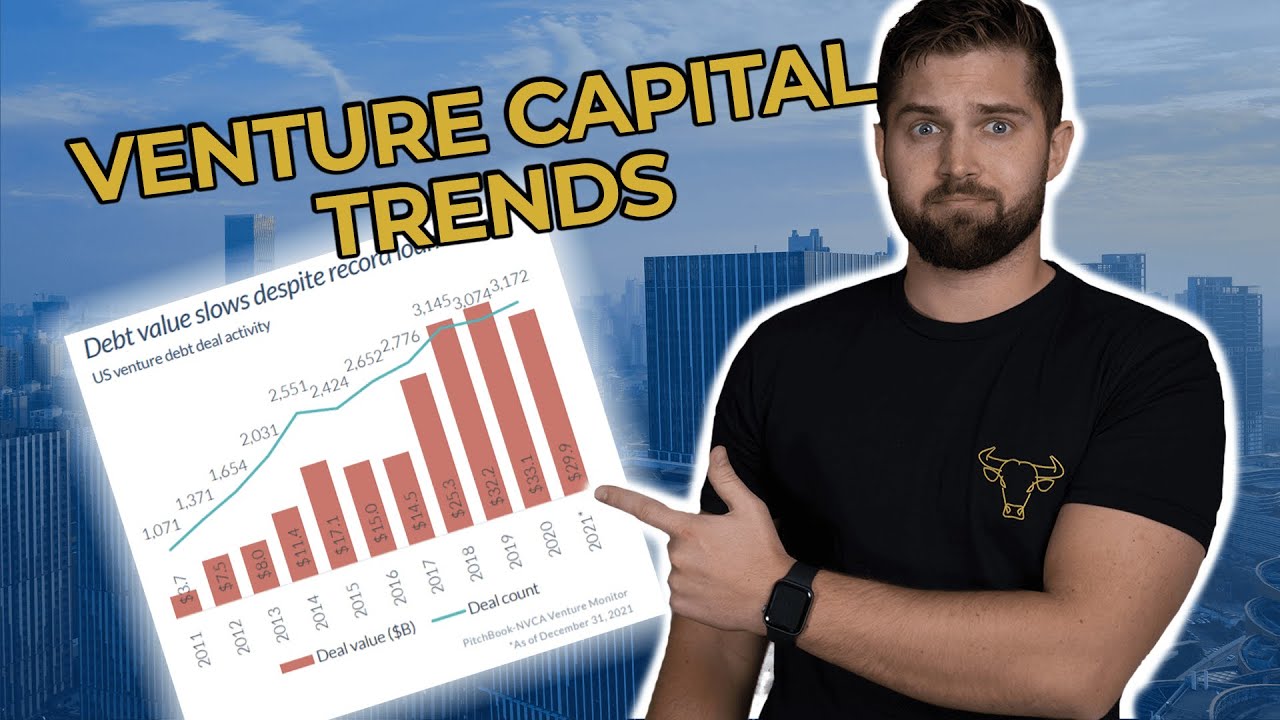
In this video, Bridger Pennington walks viewers through five major venture‑capital trends using data from PitchBook. He first shows that total VC deal value and deal count nearly doubled between 2020 and 2021, then explains that a surge of non‑traditional investors – corporate venture arms, hedge funds and private‑equity firms – is a key driver, as these cash‑rich entities seek upside in a high‑performing asset class. He notes that while the number of venture‑debt loans is at a record high, the total debt value is slowing, suggesting investors prefer equity exposure. Check sizes have shifted upward, with more than half of 2021 deals exceeding $10 million, a pattern he attributes to large institutions preferring fewer, bigger bets and the scalability of tech‑enabled businesses. Seed and angel activity is rising, with seed rounds increasingly viewed as the new Series A, fueled by a post‑pandemic “worker’s market” and supportive government policies. Finally, he observes that SPAC IPOs peaked in 2021 and have since tapered, likely settling into a modest but lasting role in public listings. Throughout, Pennington emphasizes the importance of tracking these macro‑ and micro‑trends to anticipate future market dynamics.
Chapters
What's up, guys? In this video, we're going to talk about some venture capital trends that are going on lately. I'm going to be pulling a lot of data, stats, figures from a source called PitchBook. So we actually have a PitchBook license. It's an awesome database that we use, and they've given us permission to share some of the charts and graphs and insights on the data that they collect. So let's just jump right into it. This first graph you see is, you know, year over year of deal value and deal count. For the venture capital industry. Keep in mind, these are all of the sources that file with PitchBook. It's not completely comprehensive, but it's pretty close and it gives you a good idea of what's going on. As you can see, you know, between 2020 and 2021, it almost doubled in terms of deal value and a sharp increase in deal count. Before I tell you my thoughts on why this is happening, like, why do you think this is happening? So I'll tell you what PitchBook thinks is happening and actually leads to the second graph. They alluded to nontraditional investors leaned into VC in 2021. What a non-traditional investor is, is like a corporate venture arm, like a hedge fund or private equity that decides to allocate to a venture investment. Basically, somebody whose investment mandate isn't directly to invest in venture-related startups. So we've seen this massive shift of non-traditional investors going into venture capital in recent years. Why? We talk about this in a lot of other videos, but investors are cash heavy, right? They have a lot of dry powder is what it's called, and they need to get that And venture has been one of the best performing alternative assets in the past decade. You know, some investors are saying, well, this could be a spoof because, you know, just from COVID-related issues and changes. But honestly, I think it's here to stay. I think more and more people are wanting to get allocated to venture, including retail investors. And I think this number of non-traditional investors is only going to increase. So yeah, let's go back to that first graph. You know, obviously just deal count is going like crazy. There's something to keep in mind here in terms of deal value. Just like in real estate, when you have, you know, several people buying, you know, let's call it a first-time homebuyer, several individuals that want to buy their first house, you have 10 people bid on a deal, it automatically drives the price up. And for the deal after that and the deal after that and the deal after that, that there's market support for those types of valuations. I think we're seeing similar things in venture capital right now where both traditional and non-traditional investors are bidding on all of these deals and they want access to them. It just drives the valuations through the roof. So the question is, is it here to stay? Let's look at a couple of the graphs that PitchBook provided for us. So this next one is on debt value slows despite record loan count. And this is US venture debt. So what venture debt is, instead of taking an equity position in startups, is you are— they're basically like a loan. Usually it's in the form of a convertible note. So at certain valuation milestones, you know, there's a chance to convert that debt into equity. But, you know, debt is slowing. Why? I think if people are allocating to venture, they're just, they want that upside that equity gives them. If institutions, since they're the most common allocator to venture, are gonna allocate to venture capital, I think they really want that upside there, especially where other markets are looking overvalued. This is a new graph. Over half of all 2021 deals exceeded $10 million. So you look at that trend, right? You see how the orange and green bars are growing in size and the blue ones are shrinking. That means smaller investments are less common and larger check sizes are a lot larger. You know, why is this? You know, I think we— I kind of talked about it before, and obviously this is just my opinion, guys, but these allocators have so much money. Well, let's just say you have $100 million to allocate to venture. You don't want to do, you know, $1 million check sizes to 100 different investments. It's very difficult to manage. As these larger institutions get more and heavier allocations to venture, they're increasing their check size. I think that's one reason. And I think secondly is almost everything you see these days is a tech-related investment. And, you know, I'm very, very bullish on tech. But what technology does is it— in earlier years, you know, one unit of input equaled one unit of output. The crazy thing about softwares and technologies is one unit of input, you build the tech once and then you can do it 100 or 1,000 or even a million times. Right. So it's this exponential curve on technology. So you're starting to see the, you know, the best performing sectors, traditional sector like healthcare or agriculture or finance, and you're just adding tech behind it. And that's the best performing sector. So health tech and agri-tech and fintech, right? Like it's because technology is now being implemented into these other ways of life, boosting up valuations, making them a lot more attractive businesses. And the venture model right now, like the reason people want to take so much money in the door is in the tech world, you need to have market penetration, right? You need to own a good portion of the market in order to be competitive. So the model is, yeah, we're gonna go in debt, but we're gonna acquire all the customers. So that's why we're gonna take on all these venture dollars. You know, once we've got all the customers in the door, we're gonna raise the prices. So it's the kind of the freemium model. We're gonna raise those prices and then we're gonna be uber profitable. But so I think there's a lot of reasons why that is. But check sizes are growing. That's all there is to it. Let's look at another graph here. So angel deal value and seed deal value and seed deal count. So you'll see that seed deal count is growing. So there's a lot of talk in the industry right now that seed is the new Series A. Earlier seed investments were just deemed as very skeptical, very questionable investment opportunities. Series A was like the sweet spot because they've already had, you know, an initial investment. They've already, you know, have some business infrastructure. They don't care about that. If they're allocating to venture capital, they're looking for these 20x multiples on their money. So they're more willing to allocate to these seed concepts. Now, I think venture activity is only going to increase. I think the pandemic fueled that. So many people leaving their jobs and, you know, going and starting their own businesses or going and getting the job of their dreams. Like, it's a worker's market. And I think it's going to stay that way for a while where we're just going to see a lot of new business activity. It's great for the economy. It's great for the world. Government incentives are going to align with that. I mean, government loves venture capital, right? Why? Because it creates new jobs. A brand new company, it's like easily correlated to creating new jobs and raising that GDP. Last but not least, I did want to show you this trend on SPACs. SPAC IPOs have tapered off since Q1 but remain at an elevated pace. I don't know about you, but looking at this graph right here, it's pretty clear that 2021 was a radical year for SPACs. Now, with that said, there was kind of this bull rush on it, like similar to what happens in crypto. And now investors are wanting their money back from some of these SPACs. I think SPACs, in case you're not aware, there's kind of like 3 main ways to go public. There's an IPO, initial public offering. There's a direct listing, you know, straight onto the market. And then there's kind of a SPAC, slash reverse merger. And I think SPACs are more and more appealing. I don't think they're going to remain at the levels they are, but I definitely think prior to '16, they were, you know, there, but but not very often. I think they're going to be a significant portion of how companies go public, but not this crazy trend that we're seeing. I just want to close by encouraging you guys. Like, I think there's nothing more important than staying on top of trends. Trends are amazing. Like they tell you, it's the best way to predict the future or anticipate the future, or better yet, anticipate the probabilities that different futures have. So, you know, by really studying these trends and understanding where things are going, both a macro and micro lens on your individual, you know, markets, I think that's the best thing you can do. Thank PitchBook for these wonderful insights. I hope you guys have a good one. We'll talk to you soon.