Are Financial Advisors Stealing Your Money? (Actually Terrifying)
Most people can manage their own investments and skip the 1-2% fee advisors charge, which costs hundreds of thousands over 40 years. Robo-advisors cost half as much, brokerage platforms can auto-generate your asset allocation, and you only need a tax specialist for accounts like 401(k)s and Roth IRAs.
Chapters
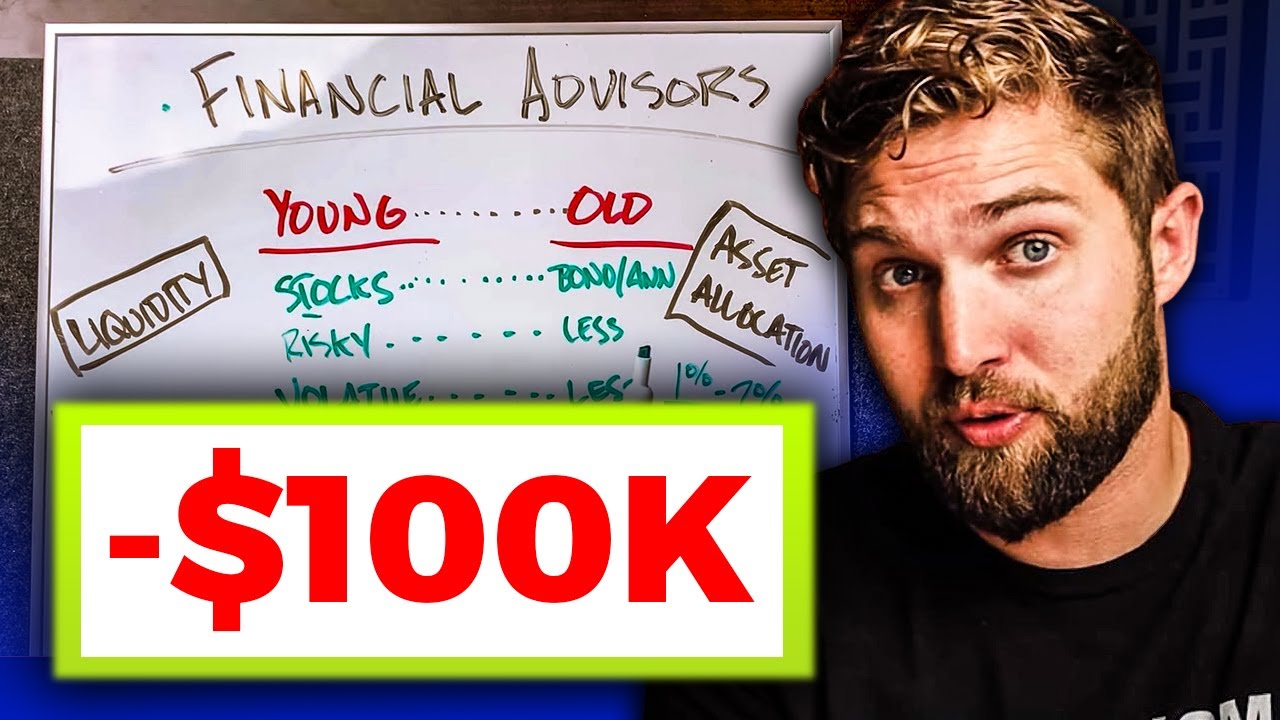
What's up guys? In this video, we're going to talk about why you don't need a financial advisor, maybe why you do, and basically how they're kind of taking your money, right? Um, so full disclosure guys, this is not investment advice. Uh, certainly seek legal counsel and, you know, tax, legal, investment advice is none of that, right? Um, just my opinions, right, about financial advisors. Let's hop into it, right? So if you've ever met with a financial advisor before, they're going to start off by asking you a couple of questions, right? How old you are and, you know, what the purpose, what your intent is with your money, right? If you're trying to build wealth, if you're trying to preserve wealth, if you're trying to, you know, things of that nature. Then they're going to kind of ask you a bunch of questions about your aptitude for risk, right? If you're okay losing 10% in any given year or even 20% or 30% and what that looks like, right? And the whole reason they're doing that is to figure out your asset allocation. So if you look at the whiteboard here, we got 2 main things, right? You got asset allocation, liquidity, probably 2 of the main responsibilities that a financial advisor will do for you, right? Um, and then like I said, they're going to ask you questions about your age. And in reality, they're trying to figure out the percentage of how much of your money should go into stocks and how much of it should go into bonds. Right? And now listen, there's a lot of other financial instruments out there. I would just say from a financial advisor, these are the 2 main, like equities, right? And then fixed income. Also annuities, right? So you'll see kind of when you're younger, you're going to have a higher allocation to stocks. Okay? When you get older, you're going to tend to have a higher allocation to bonds and annuities. Why? Because of the volatility, right? So I'm just going to write this down so you remember, right? So risky, like stocks tend to be more risky. Uh, and seriously, bonds are complex financial instruments, but, uh, for the most part they're perceived as less risky investments, right? And then stocks tend to be more volatile, uh, for the most part, right? And then of course bonds tend to be less so. And the reason why you would want a higher allocation to bonds and annuities and, you know, investments of that nature when you're older, Is because you don't want to lose your principal. Let's say you're 64, you're planning on retiring when you're 65. Just for math simplicity's sake, let's say you got $1 million, right? And if you're all like the standard deviation of the S&P 500, for example, is pretty high. It can be as high as 20, 30% in any given year. So let's say you lose 30, let's say the market's down, it's a crash, right? Down 30%. Your million dollars, just went down to $700K now that you have to live off of, right? So that's why people tend to, you know, have a higher allocation to more stable investments later in life, right? So there's kind of that aspect, right? And you're probably wondering, okay, Lincoln, well, you know, that's great and all, but I don't know what stocks to pick. I don't know what bonds to buy. And that's the whole thing is you don't really, you don't need to stock pick. You shouldn't really. So kind of for my personal investing, 70% of my portfolio for, You know, stocks and bonds are in secure ETFs, right? And then the other 30% is in, you know, I kind of play with, right? And I kind of, I think I'm smarter than the market. So I try and, you know, YOLO it in Dogecoin or whatever. But for the most part, like I said, you can allocate those dollars into different financial vehicles. So let me just tell you, the landscape for financial advisors is changing. Okay. The world as we know it is changing. It's kind of converting into this robo-advisor field is what they like to call it. So, and basically that's where apps and algorithms and these different softwares can advise you on your wealth management, right? Instead of actually having a person do it. So a financial advisor, they're going to take like 1 to 2% annualized, right? Depending on their fee structure. But usually you have assets under management. That may not seem like a lot, but when you compound that over 40 years, so actually look at this on the screen, right, from NerdWallet. It talks about the, you know, the different account values your retirement fund would be at with and without fees. So obviously in this scenario, it can be as high as $600,000, right, over a 40-year investment period. So it adds up over time. So that 1 to 2% definitely needs to be, you know, something you consider. But these, you know, these robo-advisors, they're going to take usually not as high, maybe it's 50 basis points or 80 basis points or, you know, similar 1 to 2%. Right. But I think that this is something that can be learned. Okay. Obviously, like, you know, we need financial professionals in this world. I think that, you know, obviously you shouldn't, you know, start self-medicating, you know, your injuries, right? You should go to a doctor. But for financial— and other people, you're going to totally disagree with me, but I think this is something that should be learned, right? I mean, if you look at the data, I mean, financial problems are one of the biggest reasons for divorce in this country. So I really think it's crucial for people to really understand their asset allocations and their liquidity needs, right? But anyhow, so what I propose that you do, right, is— so what I do is open up an account like Schwab, E-Trade, there's a ton of them, Ameritrade, whatever you want, and it's gonna ask you the same questions. It's gonna ask you those same questions a financial advisor would, asking you about your age and your risk tolerance and whatever, and then if you see on the screen, so this is actually mine, it's gonna give you a target asset allocation as you see in the chart on the right, okay? And then on the left you're gonna see current asset allocation, right? And so obviously I kinda try and follow the target as much, but because I'm Because I'm younger and have, you know, an aptitude for greater returns, you know, it's going to automatically put me into more equities, higher allocations into stocks, and it didn't actually recommend any bonds in my portfolio. However, I think bonds are, you know, a good characteristic in a portfolio, so I put them in there. But you can basically just follow that target asset allocation. That's essentially what a financial advisor is going to do for you. Yeah, they might rebalance on a year-to-year basis, depending on, you know, which part of the economy you're in. And, you know, if you're in a growth period or if you're troughing or peaking in the economy, right, or entering a recession. So that's what they're going to sell you on. Like, yeah, well, we're watching all these, you know, macroeconomic indicators, uh, to rebalance your portfolio. Um, but I think that you can do it yourself. Okay. That's like basically my whole thesis, but let's actually talk about liquidity for a second because we didn't get to really talk about that. So Essentially what that is, is helping you just balance your budget, right? What big expenses do you have in the coming years? Are you having a baby? Are you, you know, are you buying a house? Are you buying a second house? Are you buying a car? You know, and how much money are you going to need for that? I think that's stuff you can totally figure out yourself, right? Yeah, some people like to ask people and get the surety, but, you know, you can totally figure that out. But of course, the biggest thing is saving for retirement. Right. Let's just say you wanted to, you saved up $1 million for retirement. Okay. There's something called the 4% rule and obviously you don't have to follow it. This is just kind of a common rule that people who manage their own money kind of go off of. But what that, what they're saying is basically you can take out 4% every year and you should be able to retain your principal of $1 million. Okay. So, You know, if let's say you retire at 65 and you die at 90, you know, when you die, you'll still have $1 million, right? And, you know, different people have different intents with their money, right? Some want to pass it on to their family members when they pass. Other people want to spend every dime until, you know, while they're still alive. But, you know, the 4% is a good target, right? If that, that if you can live off of, obviously there's Social Security and other things of that nature. But I think it's a good rule to follow. Now, so 4%, $40K a year. Ask yourself, is that enough money? Right? For some people, yeah. Other people, not even close, right? Double it. You need $2 million for retirement. At 4%, that's $80K. Is that enough for you? Maybe not. That's probably pretty close for most people. But for others, not even close. Okay, $4 million. $160K a year. So you can kind of do the math here and see according to the 4% rule, you know, how much money you need for retirement. Now, I certainly think you need tax advisors and tax strategists in your life because that is a whole different story. You know, there's different tax vehicles that you can, you know, utilize throughout your life, like a 529 plan or, you know, things of that nature, whether you want to utilize a 401 or a Roth IRA. Right. And kind of understanding the tax benefits of investing. But I mean, your financial advisor really isn't going to do that much for you. I think a tax strategist is going to be your best friend. But guys, again, just my opinion. I think you can save a lot of money by managing your money yourself. Plus it's fun. I think it gives you a better perspective on your books. I know there's going to be a lot of people that definitely disagree with this, but let me know. Put in your comments below and I'd love to hear your thoughts on it. Actually, one more thing I want to touch on, right? So there's obviously stocks and bonds. I'd mentioned a lot of other alternative investments. Now this is a channel for alternative assets, right? Funds. So the core main, you know, 4 alternative assets are hedge funds, real estate, private equity, and venture capital. Okay. Now to even invest in these 4 vehicles, to be a limited partner in them, To be SEC compliant, you actually need to have, to be an accredited investor, $1.2 million net worth or $2.1 million, right? So you actually have to be at these levels before you can even access alternative assets. But alternative assets are great. Listen, I think these alternative assets are comparable to, you know, my analogy of a doctor earlier that, you know, these shouldn't be things that you try and figure out yourself. You can't, maybe real estate, right? Yeah. But I think it's likely in your best interest to, you know, if you want to invest in these vehicles, then be a limited partner in them, right? And be a, be a passive partner by investing in these, unless, you know, that's your career and that's what you want to do the rest of your life. By all means, anybody can become an expert at anything, right? So thanks for listening today. Hope you have a good one.
More from Bridger

The AI stack is trying to consolidate to a winner take all, do you think it'll stay fractionalized


Before you launch a fund, triple check your fund attorney actually filed everything.








Different view on housing affordability and the fed raising rates not lowering rates