Breaking Down The 4 Most Common Investment Funds
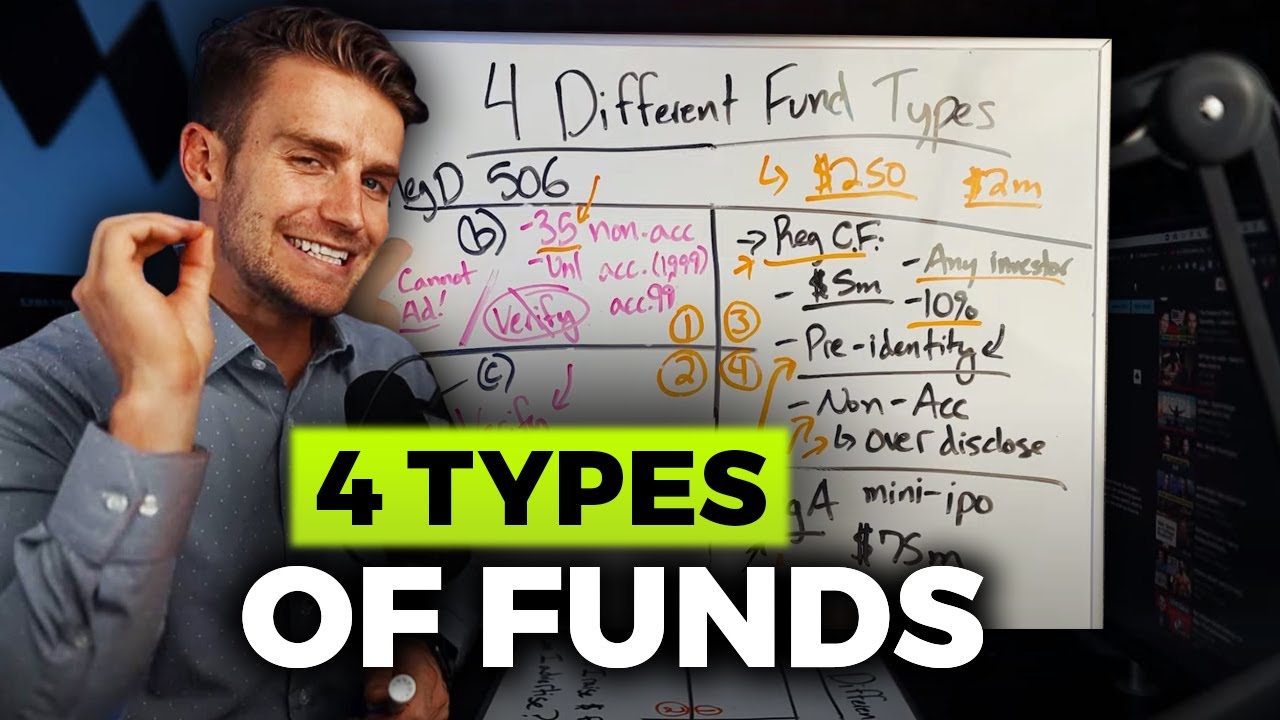
Bridger Pennington breaks down the four main fund structures in the US: Reg D 506(b) and 506(c), Reg CF, and Reg A. Each has different rules on who can invest, whether you can advertise, and how much you can raise. Blackstone and Sequoia use Reg D for unlimited capital, while Fundrise and Cardone Capital use Reg CF or Reg A to reach retail investors.
Chapters
Boom, people! Welcome back to the show. Today we're gonna talk about the 4 different fund types. I get this question a ton. Bridger, what's the difference between funds that can advertise, the funds that can't advertise? Which funds can I raise money from accredited investors from or non-accredited investors from? How does this all play together? And the answer is it depends, and it depends on these things I'm about to talk about in this video, these 4 different things. There's pros and cons to each one, and you can decide which type of fund you would like to use. Again, these funds work for real estate funds, hedge funds, private equity funds, crypto funds. I mean, really any fund type. We've worked with hundreds, literally hundreds of funds in our programs and stuff and helped them launch and scale. We've seen everything from almond farm funds to solar farm funds, all under the sun. And these are the 4 most common types of funds that get launched. And we'll walk through all the pros and cons in here. And as you guys know, on our YouTube videos, we give away $100 to some of the best comments on each video. So here we go, from Arman. He says, my key takeaways, this is from the Jimmy Rex interview, which was amazing, go check that video out. He says, giving with no expectations at all, be a dependable person that gets stuff done, and 3, figure out how to help people you wanna work with. Arman, you got $100 coming your way. Send us a message. I don't have your email, so send me a message with your email on Instagram or YouTube, whatever. We'll send you $100. And if you wanna get entered, Comment and like this video below. Every video we go back, we try to give away $100 for the best comments on those videos. All right, with that being said, let's hop into the 4 different fund types. Now there's 2 big questions on fund types you got to ask yourself. Number 1 is who can I raise money from? And number 2, can I advertise? Now you might be asking, Bridger, those are 2 weird questions. Why are you asking those questions? It's because the SEC Loves to limit what we can and can't do on who we can raise money from and how we advertise to those people. Now the first 2 fund types are how 99% of all capital in the world is raised. It's under what's called Regulation D-506, okay? Reg D-506 is how the more money— this is like the mecca of funds. Like this is where all funds raise money from. You have a 506, which I'm going to put up here, and a 506, which I'm going to put right here. These 2 fund types are the kings. I mean, 99% of all private capital in the world literally flows through a Regulation D 506. And Reg D 506, all that is is an SEC filing number for this code, okay? Reg D 506 or 506. Now over here, in just a second, we'll talk about 2 other fund types that have recently surfaced and come out and that you can use crowdfunding and other types of things to raise capital for your offering. But first, let's talk 506. So 506, let's ask these 2 questions. Who can I raise money from? Inside of a 506, you can raise money from 35 non-accredited and unlimited accredited investors. However, there's subsections that limit you. At the most, you can raise from 1,999 investors. It says unlimited accredited investors, but actually it limits you at 1,999 investors under a 3 exemption, or it's gonna be limited to 99 investors from accredited. Now, what am I talking about? Accredited investor, qualified purchaser. What's going on here? Wait no longer. Back to the whiteboard of truth and justice. So what is an accredited investor? A credit investor has a million dollar net worth excluding their primary residence, or they make two hundred thousand dollars a year, or three hundred thousand dollars a year with a spouse. If you meet one of those three definitions, you become ta-da an accredited investor. Now many of you know that. However, how many of you know? That there are 2 tiers above accredited investor. The next tier is called a qualified client. A qualified client has a $2.1 million net worth excluding their primary residence. And a qualified purchaser is the next tier and they have a $5 million net worth excluding their home or an entity with $25 million in assets. And yes, there's a few other exemptions that go into these, but that's kind of the general rule. And sad enough, if you don't fit into any of these, you are by default a non-accredited investor. People fall into the non-accredited investor category where you're just here and you are stuck with and you can't invest in these types of funds. Now, I was just on a call a few minutes ago and a friend asked me, Bridger, why did the SEC do this? The SEC did this, I believe, to protect the little guy. The SEC believes if you have a million-dollar net worth, if you're a millionaire, you have a degree of sophistication, you understand the risks of investing, what money is, and If you lose your investment, well, you're still going to be okay. However, if you're a non-accredited investor, if you're grandma and you've got, you know, $10,000 to your name and some slick-talking fund manager rolls in with a brand new crypto fund where they're going to short Ethereum and stake it against Binance, whatever crap they're going to do, and they lose your 10 grand, grandma can't live anymore. And so the SEC really cracks down on non-accredited investors because They don't want grandma to lose her money to some slick-talking fund manager. Hence, when we talk about these other funds, you're going to have a lot more scrutiny when you take money from non-accredited investors. All right, so back to a Reg D 506, 35 non-accredited investors, unlimited accredited investors, but you actually get capped on here. Now, something interesting about a 506, you cannot advertise your fund. That right there is an important rule on 506s. That's why you don't see Blackstone, KKR, Sequoia, running billboard ads or TV ads to advertise their fund because it's illegal for them to do so. And this is why most funds traditionally, you don't hear about them. You don't hear about big funds because it's seriously, it's illegal for them to advertise. They have to raise money by their influence, word of mouth, by meeting people, networking events, parties, all that kind of stuff. They can be introduced through investment advisor, broker-dealers, but really, it's that you cannot publicly advertise. You have to use it by your influence and network. Now you might say, oh, there's no way you can raise money. Well, these guys have proven you can raise hundreds of billions, billions and billions, billions of dollars through a Reg D 506. This is the most common fund offering. Blackstone, KKR, Sequoia, these $100 billion funds, Citadel, all use Reg D 506 offerings because the nice thing here is you do not have to verify investor status. Now, what does that mean? If an investor comes to you and says, hey, I'm an accredited investor, I would like to invest $250,000, they just have to check a box self-verifying that they are an accredited investor versus down here in a 506, you have to verify their accredited investor status. In a 506, you have to go through, get tax documents, talk to lawyers, whatever, get a paper from them saying and verifying that they're an accredited investor. It's a little more hassle on investors. However, we're going to move on now to 506. You can advertise. In a 506, you can run ads. So, you'll see companies now on Instagram and Facebook running ads, hey, invest in our fund. Only accredited investors. You've seen Tai Lopez do this, Grant Cardone. Hey, invest, but you have to be an accredited investor and we have to be able to verify you on that status. In a 506, all investors have to be accredited or above. There's no non-accredited like the Bs, but both of these are under, again, Reg D 506 or Reg D 506. Is that making sense? You guys following along so far? But wait, Bridger, hold on. I'm losing my mind. Do I only— I'm starting a fund. Can I only have to raise money from accredited investors? Now, the answer is typically yes. Most people do this. However, the SEC has come out with recent regulations and guidelines allowing you to raise money from non-accredited investors. So with that being said, Let's dive into the other half of the board right here. All right, the first one we're going to talk about is Reg CF, regulation crowdfunding. Crowdfunding came on the platform after the Dodd-Frank Act. So last about decade, we've seen more crowdfunding sites come online. You've seen Fundrise, you've seen Cardone Capital, a number of other opportunities online, and they're doing a lot of advertising and trying to get non-accredited investors in their offerings. So what goes into a Reg Reg CFs are capped at $5 million to raise. Again, over here you can raise unlimited amounts of money. Reg CF, you're capped at $5 million. You can raise from any investor. However, non-accredited investors, again, those are the people that aren't millionaires yet. They're less than $1 million. They can only invest 10% of their net worth or annual earnings. So if someone's got a net worth of $100,000, they can only— the most they can invest is $10,000. Additionally, You have to pre-identify the asset. So they cannot invest into a blind pool. Over here in a 506, investors can put money into a fund, a pool, and you as a fund manager say, hey, we're going to use this pool over the next 18 months. We're going to go buy real estate properties. We're going to buy 10, 15 properties. We don't— we haven't identified them yet, but we have a team over the next 18 months. We're going to go buy them. That's not the case in Reg CF. Reg CF, and if you go onto Cardone Capital, and they have different offerings, they have some of these offerings, some here and some here, but if you go onto a Fundrise, you'll see they've identified the properties. Hey, we've got a property on this address in Maine. It's 8 units and you can invest directly into the property. So that's a huge case on pre-identifying properties or businesses you'd like to buy or whatever asset you're getting into has to be pre-disclosed to the investor, which leads me to my next point. When you're taking money from non-accredited investors, you have to overdisclose to these non-accredited investors. They want the fund managers to go out of their way to really make sure these investors understand what's going on. Similar to, is what the language says, similar to a public company. If you see public companies, they have quarterly earning reports. They have a whole army of auditors and accountants and things like that to publish information to the street, to publicize what they're doing. Similar things have to happen in a Reg CF or the next group, and I'm gonna draw it, my lines are getting thrown all around over here. The next group is called a Reg A offering here, and both follow these similar guidelines. So a Reg A fund, very similar to the Reg CF fund, you have to pre-identify. You can raise from non-accredited, but you have to over-disclose, same with the 10% rule for any investor. However, Reg A has Tier 1 and Tier 2. Tier 2 is what most people do, and you can raise up to $75 million. They call this a mini IPO. I was actually on Instagram a few days ago and I saw a Reg— it said, hey, we're doing a Reg A offering for a brand new robotics company that we wanna raise money for. So they issue shares and there's a lot of ways to structure it inside of a Reg A offering, but again, they follow the same principles here. So again, back to the question, Bridger, can I raise money from non-accredited investors? The answer is yes. Okay, you can follow the Reg CF, the Reg A, or you can take 35 non-accredited here. However, you have to do a lot more work on your end to make sure those investors are overdisclosed. So I'll tell you a quick story. On one of my, actually my very first fund, I had a buddy of mine. He gave me, I think it was about $5,000 for my fund. Non-accredited investor, he was gonna fill up one of my 35 non-accredited ones. And I, you know, overdisclosed to him, all this kind of stuff. So he gives me 5 grand. And we're raising money for this thing and he gives it to me like on a Wednesday. Friday morning, He gives me a phone call. Bridger, hey, how's the fund doing? How's the $5,000 doing? I said, hey, it's great. We're just getting started. Like, don't worry about it. We're good. You know? Okay, awesome. Hangs up. He's all excited. The following Tuesday, Bridger, hey, how's the $5,000 doing? What's going on? He goes, and then he goes, hey, you know, I'm actually looking to, you know, maybe get an investment property. My mortgage payment's coming due. I don't know if I can cover it. Is there like, how soon am I going to get the money out for that? I might need the $5,000 here pretty soon. And I looked at him. I said, I love you to death, but this is just not for you. I'm going to give you your money back. And he goes, whoa, no, I don't want my money back. No, no, I'm like, this is— we're done. Here's your money back. I don't need your $5,000. If you're going to be stressed out about making a mortgage payment, this is not the right investment for you. I'm going to give back your $5,000. And it was just too much of a hassle to deal with him. Most managers that I meet with say very similar stories. The non-accredited investor, the average— by the way, we actually looked it up. Average Reg CF and Reg A investor invests about $250 is the average investment size in a Reg CF or Reg A offering. That's it. So imagine you're trying to raise $2 million for a building. $2 million at $250 a pop. Okay, think about the accounting, the taxes, the K-1s you've got to file at the end of the year. It's a lot more expensive to run A CF or a Reg A fund to set it up, to get it started. I would argue it's probably about double the cost of a Reg D fund startup style. And yes, you can vary costs all over the place, but an average Reg D fund, $25,000, $30,000 for setup fees and docs. Okay? And ongoing maintenance every year. I know, you know, we talk startup fund level, you know, you're looking anywhere from like $6,000 to maybe $15,000 ongoing maintenance for every year. Reg CF, Reg A? You're looking at $45,000, $50,000, $60,000 startup fees and probably $25,000 to $30,000 ongoing maintenance to file all those things. Now, those vary drastically. I've seen some Reg D funds that cost a quarter million dollars, half million dollars, right? They vary, but I'm talking startup fund level where you're at. Now, I'll give you my 2 cents. What to pick. If you have a strategic advantage for advertising, for building a list, for building a type of an audience, and you're going to do multiple properties or investments down the road. I mean, look at Fundrise. Look at Cardone Capital. They're building a whole brand and team around doing and cycling these properties. If that's your goal and you want to become a marketing company along with a fund, a Reg CF and a Reg A are great options. Okay, you're going to build a brand, probably your first deal, let's call it a $2 million property. You're not going to make a lot of money on that first or second deal because you got to set up the infrastructure. All the fixed costs are going to weigh you down so much that you personally won't take home a lot of money. However, if you're going to be like Fundrise and you're going to do a few, I don't know, 100 properties a year on this platform and this product offering you're building, then bam, Reg CFs are awesome. Reg A funds, if you're gonna, you wanna do a mini IPO for your company, you got a robotics company, these can be great, really a lot cheaper than going with an investment bank and IPOing, but as far as a fund, if you're trying to raise capital for, you're gonna buy businesses, you're gonna scale a crypto fund, you're gonna trade futures, options, almond farms, whatever it is, there's a reason why most funds do the 506 or 506. Over here, unlimited amounts of capital. I would recommend going after accredited investors or above just because of the disclosures and the annoyance and the just the bothersome by the nature of who these guys are. These non-accredited investors, it's just it's hard to work with them. I would I for all my funds, we've done Reg B 506B or 506C, and now you can weigh the pros and cons here. We have other videos there, but that's what I've seen, and that's why most funds this is the scalable amount. Unless again, you've got a marketing strategy, you can go Reg CF or Reg A. Hey, if you guys like this video, subscribe below, hit the like button, comment for $100 giveaways, and we'll see you guys on the next episode. Thanks. Bye. Bye.
More from Bridger

The AI stack is trying to consolidate to a winner take all, do you think it'll stay fractionalized


Before you launch a fund, triple check your fund attorney actually filed everything.








Different view on housing affordability and the fed raising rates not lowering rates