Bullish: What Makes a $100m company in 2026
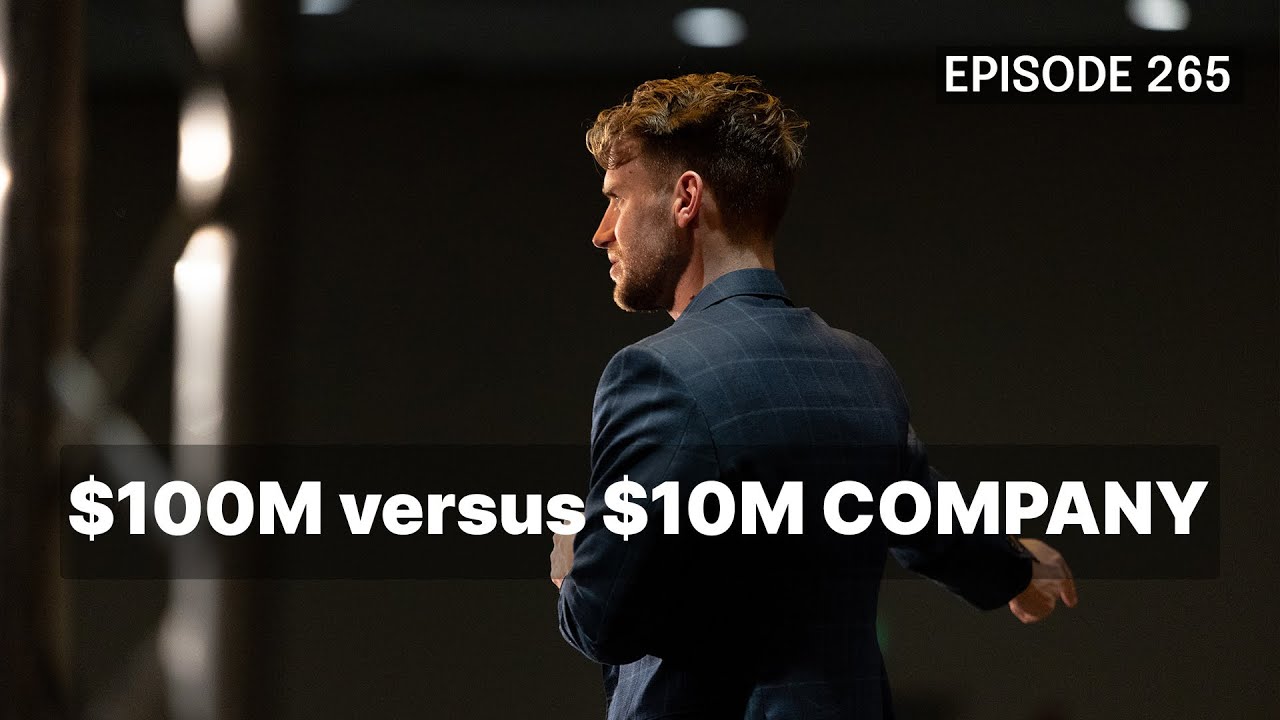
Bridger Pennington breaks down what separates $100M companies from smaller ones: founders must shift from entrepreneur to CEO, build systems and playbooks, and master people management. He shares tactics like calling employees by name and sending personalized praise videos, drawing on examples from his company Funnel Launch.
Chapters
I don't know a single business that does $100 million a year that doesn't have a plethora of employees, that hasn't figured out these systems and processes. Welcome to Bullish, where we talk about the journey and process to build ourselves and companies into multi-billion-dollar people and brands. Currently, my business and investment funds have done tens of millions in revenue, and this is the documentation of the journey to scale to the billion-dollar realm, all while we give back and do good in the world. My name is Bridger Pennington, and welcome to Bullish. So a few weeks ago, I was contrasting these conversations I was having between I have a few friends that run businesses that do between $2 and $10 million a year. And then I have a couple other friends that run businesses that do $100 to $1 billion a year in revenue. And I was directly contrasting the conversations I've had with both of these people. It was really interesting. The guys that were running businesses between $2 and $10 million— and by the way, Funnel Launch is kind of just over the $10 million mark, right in that range of doing 8 figures a year. And so I'm— and what I'm trying to do right now is transition from being a business owner that does $1 to $10 million a year, from a business owner that does that to a business owner that does $50 to $100 million a year. And there's distinct differences between the two. What was interesting, the guys that were doing, let's call it $3 million a year, $4 million, $8 million a year in revenue. Now net free, that's probably net-net, they're probably taking home maybe $1 million a year, $800,000 to $1 million a year maybe off those businesses. They were always complaining about their employees. Man, I hate hiring new employees. Direct quote. When I wake up, I don't want to hire a new employee. It's just another headache. It's another person we got to deal with. Another problem that's going to be had. Another business owner, he was telling me, he's like, man, I just— these guys don't work. They don't work like I work. You know, they're not as efficient as I am. It takes time out of my day to go manage them and the business stops growing. What happened was these 2 entrepreneurs that I was talking to that were in these business sizes, their business blew up. They grew really fast by themselves as a solopreneur. As they began to hit that second tier of growth where you either need to scale your systems and processes and people, typically all 3, to go from usually $1 million a year to $10 million a year. And they were in the middle of that. And what has happened is their businesses have kind of plateaued the last 2 to 3 years because, in my opinion, they weren't able to accurately figure out how to scale. They were good at systems, Few processes, not as good, and people they were, in my opinion, very poor at. Now I contrast that with 2 friends that I have that run, they do $50 million to about $500 million a year in their businesses. And what's funny is the conversation's totally different about their employees. They say, I love my employees. I love 'em. Fantastic. I got the greatest people on earth. And they come back to me and they're, oh, Bridger, if an employee ever needs my time, my door's always open. I'm here. I always meet with my employees, I always meet with them. And what's funny is they are way less stressed out than the friends I have that run like an $8 million a year business. The friends that run an $8 million a year business, they are, I mean, they're working, they're trying to be efficient, they're stressed out, and an employee meets with them and it's like, man, I've gotta take an hour out of my day to meet with you? Like, what's going on? And the same guy that runs a, you know, $500 million a year business apparently has all this time on his hands and meets with employees and sees it as a priority in his day. And what was funny is I was contrasting these 2 and looking at the ability to scale people. And with that, systems and processes is what drove these businesses from— because they were once an $8 million a year business to a $500 million a year business. How to Win Friends and Influence People talks about this concept that Charles Schwab, the original Charles Schwab, was hired and was paid a million-dollar-a-year salary pretty much solely because of how good he was at working with people. His people skills were so good that corporation back, and this is like 100 years ago, so that would be, I don't know how many millions today, that would be inflation adjusted, I don't know, $20, $30, $40 million because of how good he was at working with people. Now I wanna give you a tip that we've used in our companies. It's not really about something I've done. And so I actually read How to Win Friends and Influence People every year, read it on the clock, 'cause I know I gotta get better at this. My business is gonna grow to $50 million a year, $100 million a year, I've gotta get better at this game. I've gotta figure, I know, and for me, I totally understand those guys that are in the $2 to $10 million range. It sucks hiring a new employee. And then they complain and they need benefits and they don't like this and they wanna have a day off on Friday. I'm like, dude, I hired you to work, to take stuff off my plate and now you're creating more problems for me. So what we've had to figure out is, you know what, I need to lean into this. And at the beginning, I actually had some repulsion from hiring people. I had some repulsion of like, we had hired like 10 people, it went good. And when we were hiring from like 10 to 25 people, there was some, I was like, man, this is kind of annoying. These people need systems. I gotta do more updates to like, there's like compliance things. When you hire employees, you gotta have like a workplace and all these different things that go into it. I was like, man, is this worth it? I'm actually making less money by hiring employees. 'Cause the margins get compressed. And from day to day, it feels like you just cut your salary in half. And I'm sitting there and I'm like, huh. Yeah, it sucks in the moment, but I know where this business wants to be. I want to be doing $100 million a year. And I don't know a single business that does $100 million a year that doesn't have a plethora of employees, that hasn't figured out these systems and processes. I just don't know the business. So by default, I need to lean in. That's a skill set I need to learn is how to actively hire, train, and give systems to build and build a company that can do $100 million a year. This was my transition. I've talked about this on previous episodes from moving from an entrepreneur, just hustler, get deals done to a CEO. A CEO is very focused on people and systems. And entrepreneurs focused on just getting crap done. And what I realised was these 2 guys that were doing $7 to $10 million a year, they were good entrepreneurs or startrepreneurs, if we can use that word. They were good at starting and scaling the initial part of the business. They had not transitioned to a CEO yet. And that's why they were so frustrated. 'Cause they could do things faster. They're more efficient. What happened is their business plateaued to where they grew. I've said this before, but your business only grows as much as you do. And this is the exact definition of that. I've seen many entrepreneurs that cannot grow into a 2nd or 3rd tier of operations. Currently at Funnel Launch, we are at a 3rd tier of leadership. We actually are moving to a 4th tier of leadership pretty soon here. So 4 tiers from me. 4. 1, 2, 3, 4 down. When you're 4 tiers away from the founder, you've got to have really good systems in place so that things are still done in an appropriate manner. You can open up a playbook and there's the play. It's not just coming out of my brain on a whiteboard. It's in the playbook. It's in the standard operating agreements of how things run, how things are done, how you request time off, how you go and do this system, whatever it is. And that's what these guys that have— that are at the $200 to $300 million, $500 million level had figured out. And what happened was once they figured it out, it gave them a lot of freedom. They were able to hire assistants and people to delegate, and ta-da, they had tons of time on their hands. And they saw it as a priority to keep meeting with their captains and their system builders. That's pretty much all they did with their day was meet with people. And that was very interesting. You guys don't really work then? I mean, they're like, no, not in the day-to-day. Yeah, I help make big decisions, but I work with people and I help them make good decisions and I train them on a decision-making process. Pretty interesting, huh? Kind of different— differentiate on this journey. especially having a client-facing business like mine. I'm on podcasts, I'm on shows, I have Instagram, whatever. We've seen a huge benefit about once or twice a month, me and my business partner do something special. So we go out and we say, you know, who's been someone that we can reach out to? And sometimes we're getting to a company size that's decently big. We've got about 50 employees, give or take. And so what we do is we'll go out and say, you know what? Let's send some personalised messages and videos to some of the people that are working in our company. Or we'll go meet with them. We'll take them to lunch, whatever. We go out and we try to find people in our company that we can take out, that we can meet with, that we can talk to. And I want to hear about them, their visions, their goals, their plans, their dreams, what they're doing. And what's interesting is, and actually Ed Mylett taught me this. He said, Bridger, don't just tell somebody, hey, what's going on, buckaroo? How you doing? What's going on? How's the weekend? That's fine, you can say that. But if you really drive, and there's a big difference between Hey, how's it going? And, hey, how you doing? How's life going? How's that goal you were working on? How's that dating life going? How's your wife going? How's your husband doing? Let's talk about it. Sit down. Let's really dive in. There's a big difference between that and, hey, buckaroo, how's it going? Good to see you. You can dive into people's lives. What happens is there's a way bigger level of trust between you as the founder and the people that are working with you. And notice how I just said with you. They're not working for you, they're working with you to a common vision and goal. It's not I did this, it's we did this. Actually, back to How to Win Friends and Influence People, the sweetest word anyone will ever hear in their entire life is their name. Calling and knowing people's names is massive. You wanna grow a business to $100 million in scale, whatever? Learn people's names. Call 'em by name. Sit down, learn about their lives and their systems and their processes, what they're doing and how we can be more efficient. Really dig in with your people. Something else I'll share from a mentor. He said this. He said, Bridger, something that'll change my life. You can share 1 or 2 things that are uniquely specific about that person. You'll win a friend, a trust level for life. He goes, what I do is I find somebody and I sit them down or I send them even a video message. I say, hey, I was just thinking about you today and I want to let you know some specific cool things about you. I know you're loving, you're awesome, you're caring, but I noticed last week you were on the phone call with a client. I was listening in and you have an attention to detail that is remarkable. You sat down and you walked through with that client all their problems. It takes a special person to care about someone else's problems. That's what you did. You hopped on the phone with this client. You cared about their problems. And you really walked them through. And they were frustrated and mad. And you were able to calm them down and help them. And it seems like you have a special ability in your life to calm people down and really care for that person. Now, when you do this, by the way, you can't just make up BS stuff. It's got to be true. It's got to be really actually true to them and something deep inside that someone hasn't complimented for a while, but they know is true. Is that kind of making sense? So, don't just BS something. You got to really be attentive and notice small details of that person. And then if you compliment and call those things out, it'll be one of the best videos. And what does it take you? 45 seconds to film a video? Yeah. But calling out those details and sending that to some low-level employee in your company that's working with you to a common mission and goal is massive and something that they will save with them. We did this about 6 months ago. I sent this to a handful of employees. I really thought through it and said, well, let me share 1 to 3 unique distinct qualities of that person to them and really talk about examples I've seen them. And it was like a Saturday. It took me 30 minutes. I sat down and I filmed these videos and I just sent them out to my employees. And the response was phenomenal. And it wasn't just like, hey, thanks so much. Love the video. It was like a paragraph. Bridger, that's something that I've worked on for years. I've worked on that quality and ability in private and no one's really called it out. People have noticed it, but no one's called it out like you called it out. Thank you so much. I love working at this company. Thank you. I love being here. We have this amazing vision and goal where we're going. And thank you so much for all you do. And what happened was it built a bond between me and some of my employees live halfway across the country. I see them twice a year because they're remote workers. We have people all over the place. What it is, it built us a bond. Even if we're having remote work or people overseas in different countries, built me this huge bond with our company. And it's something I hope we do for the rest of our lives. And I want to share that with you as you're growing and scaling from that. Startup phase to a systems and CEO phase. It's a massive change in difference. And right now we're actually hitting our stride right now. Our systems have worked really well. I mentioned in a previous video, I left for a month to test our systems. Our systems work. They are growing, they are scaling, they're working. That's awesome. I hope this helps you guys out. If you can, share, rate, review this podcast. We don't run ads on this thing. This is the only way we promote this thing. So if you guys can do all that kind of stuff, help us out, help spread this message to more people. That's what we're here for, okay? If this benefits you in any way, shape, or form, send this to somebody else in that phase that could really use this podcast message. You guys are amazing. I'll see you in the next episode.
More from Bridger



The AI stack is trying to consolidate to a winner take all, do you think it'll stay fractionalized


Before you launch a fund, triple check your fund attorney actually filed everything.





