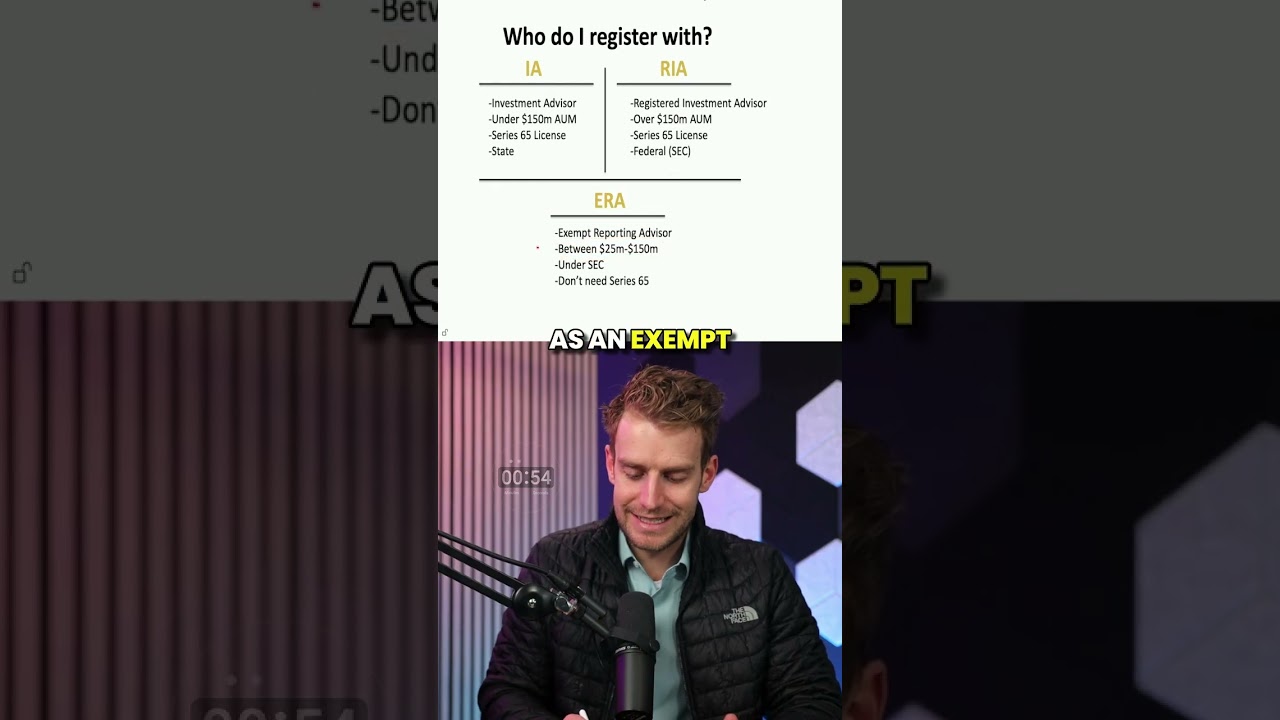
In this two‑minute explainer, the presenter answers the common question of whether a license is required to operate an investment fund. He outlines that the answer depends on three main factors: the type of fund (hedge fund versus venture‑capital fund), the assets under management (AUM) size, and the fee structure. For U.S. funds, advisors with under $150 million AUM register at the state level, which may or may not require a Series 65 license depending on the state. Once AUM exceeds $150 million, registration shifts to the SEC and a Series 65 is typically required. Funds with $25‑$150 million AUM can qualify as an Exempt Reporting Advisor, which in many states does not mandate a Series 65—this is the presenter’s own situation. Additionally, funds that charge only performance fees and have no management company may be exempt from licensing, as they are not deemed to be providing investment advice for a fee. The speaker advises viewers to verify state‑specific rules and consult legal counsel.
Chapters
Do you need a license to run an investment fund? I got this question on YouTube. I run two eight-figure funds, and we're going to answer this question in two minutes or less. So editing team, drop that timer on the screen. Ready, set, go! So the first answer is it depends, and it depends on what. So the first thing is the fund type that you are doing. If you're doing a hedge fund, for example, you are more regulated than a venture capital fund is less regulated. Apparently, these guys have better you know. I guess lobbyists, I guess. But down the line, it will depend on what type of assets you are buying in your firm. Furthermore, it depends on how large your fund is as well. So in a fund, typically you file in the United States, you have 3 different buckets. Number one here is what's called an investment advisor, an IA. This is when you're under $150 million, you file at the state level, and each state has different rules on what to file with. You can go look up your state laws. If you're in Kentucky or California or New York, it will tell you if you need a Series 65 license or not. Once you get over $150 million right here, you then file with the federal level under the SEC, and almost always you'll need a Series 65 to run a fund. That would be the license that you would need. Now furthermore, if you're in this camp between $25 million and $150 million of AUM, you actually can file as an exempt reporting advisor. Currently my fund files as an exempt reporting advisor, and we in our state And we've been advised we do not need a Series 65. Again, check with your attorneys and on your state-specific level. The last thing I'll add is the types of fees you charge in a fund. As you guys know, there's 2 main fees that are charged in funds: performance fees and management fees. In my first fund that I launched, we did not charge any management fees and we did not have a management company. Because of that, we were not getting money for investment advice because we were just earning money on performance fees. Our attorneys advised us we did not need a license to run this fund. So again, to recap, depending on the types of fees you charge, performance fees or management fees, depending on the size of your firm, if you're under $150 million or over $150 million, or if you can qualify as an exempt reporting advisor. Furthermore, what type of fund you are running. A hedge fund is generally going to be more regulated and a venture capital fund is going to be less regulated. Hopefully that's useful. Let me know down in the comments.