Elections, Rate Cuts Q4 Update | Day 1 Launch Your Fund Challenge
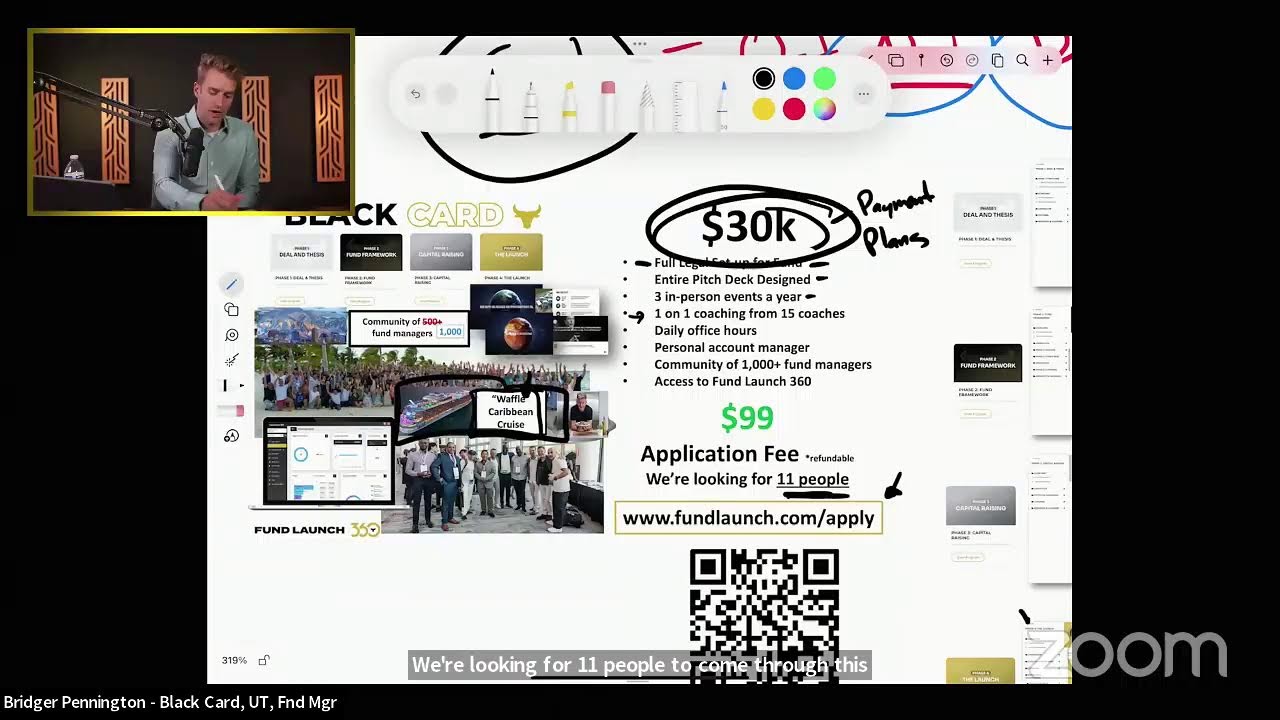
Bridger Pennington breaks down how to structure a private fund: the LP/GP roles, management fees, carried interest, and the Limited Partnership Agreement that governs it all. Fund Launch offers memberships from $99 to $30,000 with coaching and community access. Most design choices are permissible as long as you disclose them in your fund documents.
Chapters
Without a doubt, the number one value to Black Card has been the caliber of people. If you have the drive and ambition to to launch a fund, then there's no excuses once you. Otherwise, you're gonna be figuring it out. Even with Bridger's YouTube content, it's not gonna, you know, get every little piece, um, you know, put together. And the ability to just learn, like the knowledge, and nobody is— it's an abundance mindset versus scarcity mindset. And I think that is such a huge thing for anybody start— looking to start a business. The best thing is the quality of the people that are in the group, right? And that God loves you, and I wish nothing but success and happiness for all you guys. And they have coaches in place to help you with that too, and to change your perspective around things. It's just, it's very— the incentives to be in it, they far outweigh what you pay out. So the caliber of the people here has been the biggest value for what's happened in my life. The quality of the coaches, my gosh. The ability that being around the people here, it gives you Push and a drive to step up more.
Then I'd be Superman. If I fly around the world, it wouldn't take me longer than it would to be your man. I'd fight 1,000 guys, live to die 1,000 lives. Oh, oh, I'd find another way to make me smarter just so I could understand. Just so I could understand. Stomp your heels into my toes. Steal the keys right out my car and I'll find a way to forgive you. I'd fight a thousand guys, live to die a thousand lives. Oh, oh, I'd find another way to make me smarter just so I could understand. I'll find what you want.
I managed just to rewrite history 'cause I'm in the mood to label us the leaders of the leaders of the new school. This ain't for the radio, can't find this on YouTube. This the type of killing that these critics say you Victorious, victorious, victorious, victorious, victorious. In this day and age, I got time for innovation, time to be creative, time too big to waste on my time on critics hating. Flattered by your opinions, destroy you while just embracing. Now watch a early sunrise up, your daylight savings go nuts when I have to. Glazed belt my sound in this beat. On the outside we dreamin', watch me wake back up in there. Guess who my thoughts are distorted? 'Cause I recall guys were hatin' uncommonly, all of them became common denominators. Hold up. Tried to overlook a rival, all eyes on me 'cause I got no competition. Now lookin' at an idol, your dough ain't long enough to pay for my attention. Man, it's the gospel for the black sheep. I guess it got a bingin' ring to it. Quiet, we're trying for no rap league, so all of you motherfuckers can sing to it. I was born to be glorious, most definitely glorious. I'm destined to be glorious through all the hate and the slavery. Remain warriors. I was born to be glorious, most definitely glorious. I'm destined to be glorious. Avoided by the statistics, occasionally will quit it. Pay reality visits, but it was too hard to live in. Build them my confidence and deliver. Yeah, why be burning these critics? 'Cause they know they was walking their course while burning their bridges. Hold up, man, whoever thought I'd be rapping? The family ain't never think that can happen. Matter of fact, only person that ever pushed me to get out was my mother, and the only reason was 'cause I can track. Heard that Carmen's the chick that you put a ring on.
Wait, no.
And by the looks of your life, guess she's a cling-on.
Cling-on?
It's on me. Dudes had they lead on the board, but games change over time, so I evened the score. Youngins fed it up, learn how to zap it up. Must have been shafted up, fed it up. Said they didn't rap enough, giving the rest to us. Going off, so of course, baby was shown up, throwing it off.
Without a doubt, the number one value to Black Card has been the caliber of people. If you have the drive and ambition to to launch a fund, then there's no excuses once you join Black Card. Well, otherwise you're going to be figuring it out. Even with Bridger's YouTube content, it's not gonna you know get every. Every little piece, you know, put together. And the ability to just learn, like the knowledge, and nobody is— it's an abundance mindset versus scarcity mindset. And I think that is such a huge thing for anybody start— looking to start a business. The best thing is the quality of the people that are in the group, right? And that God loves you, and I wish nothing but success and happiness for all of you. And they have coaches in place to help you with that too, and to change your perspective around things.
It's very—
the incentives to be in it, they far outweigh what you pay out. So the caliber of the people here has been the biggest value for Mastermind Fargo. The quality of the coaches, my gosh. The ability that being around the people here, it gives you a push and a drive to step up more.
If I fly around the world, it wouldn't take me longer than it would to be your man. I'd fight 1,000 guys, live to die 1,000 lives. Oh, oh, I'd find another way to make me smarter just so I could understand. Stomp your heels into my toes. Steal the keys right out my car and I'll find a way to forgive you. I fight a thousand guys, live to die a thousand lives. Oh, oh, I'd find another way to make me smarter just so I could understand.
Running up the number, that's a lot of coin. Try to take it from me, must be out your mind. Big time, dollar sign. Smoky in the air, that's a lot of pine.
Pockets running over with the dollar sign.
Try to take it from me, yeah. Oh, big time, big time, big time. Big time.
All right, all right, people. Hello, welcome on, welcome on. Let me know if you can see me and hear me. Say hello in the chat if you can. Uh, what's going on, people? Hello, hello. I'm not sure you can see me yet. There we are. Hello, good to see everybody. Today we're talking Q4 update, we're talking about the election, we're talking about, uh, all sorts of fun stuff. Fed rate cuts happening tomorrow. So welcome in. There we are. What's going on, Teresa? Good to see you, Stephen. Good to see you. Hello, hello. We are live today. We are a little bit early, by the way. We are right on time here. We're going to get going. So say hello in the chat for me. Today we're going to talk about, like I just mentioned, the election cycle. We're going to talk about rate cuts. And this is all in terminology of the markets. What happens to markets if in a Harris presidency or a Trump presidency? What happens Uh, in markets with rate cuts that are happening tomorrow. We're going to talk about where the market is pricing in those cuts and how this may affect yours and my portfolio over the next 6, 12, and 18 months. Uh, we're going to talk about, uh, funds. We're going to talk about how we have gone out and actually now helped a number of new people in the last even 6 months build new funds in 2024. We want to talk about what is working, how people are raising capital, how they're deploying capital, what are some interesting strategies that they are using. to build incredible funds. Also today, I want to share some brand new stuff that we have never shared publicly before. So, this is brand new update stuff that we've done behind the scenes with Fund Launch, brand new things that you have never seen. And so, I'm excited for a few things today. Does that sound like a good agenda for today? Now, my name is Bridger Pennington. Welcome on. Hopefully, you guys have been on here before. If you haven't, I'm the co-founder of Fund Launch. I've run 3 different investment funds. We'll talk about more of my story in just a minute. I currently manage over $30 million of AUM between my 2 funds, Fund Launch Partners and Ugly Unicorn, and both have done very well. It's been awesome to run those funds. I've run 2 funds prior, and with Fund Launch, we've launched over 300 funds out of our Black Card community. Black Card is kind of our top-tier, best community. We have over 1,000 fund managers in Black Card. It's been phenomenal to be a part of, and we'll talk more about Black Card in a minute. But we've thrown a bunch of events like you guys just saw, and it's been a hoot. So, welcome on, you guys. Welcome on back, family, people that have been on here before. If you've been on a call like this before, we'll do this actually. I'm just curious real quick, where are people— where are you calling in from? Type in that first. So what's your location? I'm calling from Salt Lake City, Utah. While you're doing that, I'm going to get my screen set up here. Where are you calling in from? So we've got people from Texas, Mexico, Toronto, Canada, Ireland, Boston, Nashville, NYC, 2 people from NYC. What's going on? Hi from Haiti, California, Oregon. Utah, Tampa. Welcome in, y'all. Welcome in. Welcome in. Good to see everybody. And then do this for me, just for my sake. If you've been on a call like this before, a live call with me, type the number of times you've been on a live call with me. How about that? We do these all the time. We've done a bunch over the years. If you've done— this is your first call, type in 1. If it's their third call, type in 3. If this is your 20th call, type in 20. We do a lot of these. So type in the chat for me, 10+, 2, 1, 1. Great. So some brand new people, some people that, you know, awesome. I love it. Illinois. Okay, well, come on. Well, we're gonna have some fun today on this call. We're gonna do— and actually, I want you to kind of lead this call today. So like I said before, if you want to share my computer for a second, I've got a bunch of economic data we're gonna pull up. We're gonna talk about where the Fed is, what's going on, where we think rates might be going. We're gonna talk about national debt, CME Watch Tool. We'll talk about tomorrow's call. And additionally, though, I want you guys to help me lead this call as well. We're going to talk about a bunch of fun stuff. We're going to be talking about the mission of Founders, what we're doing, kind of how we're fighting back against a handful of big companies that are taking over the world and what this means for us during the election cycle, during all the stuff that we're doing. So, and I'm going to pull up my iPad. I got my whole iPad here. We're going to draw. And I actually want you guys to kind of lead the call today. So, let's do this. What— you can go back to full screen if you'd like. What were you hoping to get out of this 3-day challenge? Let's start with this. Let's start with the why. What are what are some topics that you hope that I hit on and talk about? Again, we've we've launched lots of funds. We've helped. I've launched multiple funds myself, raised tens of millions of dollars. What would you like to talk about? Type in the chat. It can be simple. It can be complex. Whatever you think, type in the chat. And you know, any any answer is a good answer here. Just type in the chat. Someone wants to talk about the pitch. How to find the right partners, short-term economic outlook, launching a hedge fund, funding, Regulation D offerings. Very cool. Keep going. Keep typing them in. What else do you want to— we have a lot of time here too. Over 3 days, we're going to kind of break this up. We're going to talk about all these. I think all of those are great ideas. Fund launch partners, manufacturing of setting up a fund or mechanics, excuse me, of setting up a fund, private equity funds in real estate, private equity funds in enterprise software. Very cool. Raising capital for the first time, raising capital, hiding. Sorry, my I got a squint here. Oh, putting together trusts, impact of interest rates. I love it. Okay, these are great topics. I think we're gonna hit a lot of these, if not all of these, over the next three days. So, I'm very excited. We're gonna actually let me share my. I'm gonna switch to my iPad here for a second. Again, this is not pre-recorded. This is live. You're with me today. We're gonna. Allow you guys to kind of lead in a little bit of discussion. I've got a few things planned, like for sure today I want to talk about rate cuts that are happening tomorrow. I want to talk about the election cycle. I want to talk about economic outlook. Additionally, if you want to share my iPad, we're going to dive into the Fund Launch Formula. So we're going to be talking— this is our— if you've ever been a part of anything Fund Launch, we talk a lot about these frameworks, all of these frameworks around launching, building funds, this 4-step formula for how We, and we didn't invent this, we more discovered this. We went and interviewed hundreds of fund managers and how they built their funds, and almost all of them used a similar formula. We finally put names to it and titles and, and tried to make it into a more of a scientific process to go launch a fund. So we're gonna talk about partnerships, how partners work, risk control return. We're gonna talk about international feeder fund structures, how that works. We're gonna talk about GPLP structure. We're gonna talk about, a lot of you guys said raising capital. There's 3 distinct stages of raising capital. We're gonna talk about that. Capital raising matrix. Who you're going to talk to, building and defining your edge, and how does that look in your specific asset class? We're going to talk about the regulation. Somebody mentioned Reg D offerings. We're going to talk about Reg D offerings, how those look, and I can kind of draw and go deep and we can talk whatever. And then finally, we'll talk about legal. What's the actual legal process to launch a fund? How do we fill out our fund waffle? What type of things do you need to have done in, uh, in here with your service providers, marketing partners, all of those different types of groups? So that's the plan. We got a lot of content here. Uh, waterfall structures. I mean, We're going to go deep. We have other stuff over here too. We'll talk about, um, a bunch of just, I got a bunch of stuff queued up, uh, for the next 3 days. So this should be a good time. Uh, we're going to start the same time every day, by the way. So it's 1:00 PM Eastern. It's 11:00 in Utah right now. Same time every day, the next 3 days. And to find this link, it's the same link every time. It's going to be funlaunch.com/hub. So every time that will redirect to Zoom, or if you're watching this on YouTube or Facebook, we're streaming this right now. As well, you guys can go to funlaunch.com/hub and join the Zoom room and be live with us in Zoom here. So it should be pretty fun. Sound good? Okay. I like it. I like it a lot. Let's just dive in. No more waiting around. For people that have been on here the first time too, we do a lot of— we have fun. We do giveaways. We'll have a good time. If you can't tell, finance is traditionally a boring topic and I like to make it a little bit fun, a little more spicy. If that if that sounds good. Now, for people that have never been on here before, let's I want to just talk briefly about like why we do this and and who I am as a person. So real quick, let me if you can share. Oh, I gotta switch back over. Share my computer for me. So real quick, and this this is not to talk about me, but I think it's important for you to know who is talking to you. So this is a little bit of my resume and background here. So. I first started Blackbridge Holdings in college. I started 6 different businesses in college, and I started a bunch of different businesses. I was trying anything under the sun. My dad finally grabs me and he's like, Bridger, you're kind of like a chicken with your head cut off. And I go, okay. And we grew up in a pretty normal household. I grew up in— you can put me full screen if you want. I grew up in a middle kind of class house. It was fine. Nothing wrong. But nothing that great either. And my dad drove a car with a dent in the door, 300,000 miles. My dad grabs me and goes, you need to go meet with my business partner. This guy can really help you out. And so, I go meet with this guy. Long story short, I show up to this guy's house. He lives in this beautiful, gorgeous mansion. He's got a pool in the backyard, basketball court in the basement, cars. I mean, wine cellar, like everything you can imagine, this huge home. And I walk in, I start to talk to this guy and This is my dad's business partner. And he says, Bridger, in my 20s, I was a lot like you. I started a bunch of businesses. But he goes, then I figured out the secrets of the ultra-wealthy. I figured out the secrets of the wealthiest families on earth. And he goes, the wealthiest families on earth try to get their kids into the fund space or the fund game, the game of private equity, hedge funds, venture capital, real estate funds, debt funds, or come back home and run the family office. And I was like, and he goes, I met a guy in my late 30s, or sorry, mid-30s that ran a private equity fund. And he goes, I didn't even know what the words private equity meant. But he goes, when I saw that, I go, I had to do that. I had to figure out what in the world was private equity, how to work. Because this guy was relatively young, had made a lot of money, was extremely successful. And he goes, that's the game I want to play. Anybody else feel that? Probably the reason you're on this call is like, And type in the chat, like, I want to play that game. If that's you, like, I want to play in that game of all these fund managers on TV that are making huge amounts of money. And a lot of times, they're paying little in taxes. They just get all the benefits. It's always in their favor. And how can I become one of those people? And he goes, that's the goal I set. And he goes, now, a handful of years later, we manage over $8 billion of real estate in our real estate funds. Today, I think they're over $40 billion they manage. And I was so enthralled by this guy. I'm in his house, we're talking, and I'm leaving his house. And I said, hey, can you be my mentor? I would love to learn from you. I'll bring you coffee in the morning, whatever you need. I'm your free slave. Just let me be around you. Let me just learn about what you're doing. And he then says, Bridger, that's great and all, but go talk to your dad. Your dad knows about this way more than I do. I said, no, my dad's kind of broke. We live in a small house. You live in a big house. I want to learn from you. And he goes, Bridger, sorry to break it to you, but me and your dad make about the same amount of money. And my chin dropped to the floor. I was like, huh? Come again? He's like, yeah, me and your dad are pretty much equal business partners in this. I left the dude's house. I drive straight to my dad's house. I'm like, Dad, what the heck? Like, what's going on? Like, why haven't I been able to order, you know, a drink at the restaurant for the last 5 years because it's too expensive? But yet you're managing billions of dollars. To put that into context, by the way, how much money that you make. Grant Cardone, anybody follow Grant Cardone online? Nothing wrong with Grant Cardone. They manage about $4 billion right now, Cardone Capital. This is years ago. They were managing $8 billion of multifamily real estate, the exact same asset class. To put it in perspective, how much money that is, that's a lot of money. Today they're over $40 billion or 10 times bigger than Cardone Capital. They're 10x Uncle G. Okay? So, it's a lot of money. If people are asking in the chat, how much money is that? That's a lot of money. And so, to make a long story short, my dad started teaching me about funds. I started to learn about funds, how funds are built. A lot of stuff I'm going to share with you the next 3 days is stuff that my dad taught me, and then I've since learned after that. This led me to, if you want to share my screen again, go and launch BlackBridge Holdings when I was 22 years old. I went, we had a nearby company that needed financing, debt financing. I went and talked to the owners. They loved the idea. I went and pitched them. We launched this first fund. It did extremely well. We got a 64% rate of return to investors. Now, it was a small fund. We only raised $49,000. Actually, I went and pitched my dad for money. So, I was trying to raise money. I'm 22 years old. Who would invest with me? I have no college degree, no track record. Who's going to invest? Well, my dad or his business partner, they're rich. They'll Yeah, give, just throw me some shekels and I'm a young guy. Come bet on me. And my dad sat me down. He said, Bridger, I have the money to invest, but if I invest in your fund, it would ruin the experience of you raising money on your own. And he said, this will be a crutch that you'll never be able to recover from if I invest in your fund. And he said, no. And I was a little disheartened. He kicked me out and he said, go, you got to go figure this out on your own. And you see my kind of resume here. To this date, my dad has still never invested in a single fund or deal that I have ever done. But he has been a great mentor and coach and person in my life. And I owe like everything to my dad, my dad and my mom. My mom and dad are incredible human beings. On the business side, especially my dad. And I think that was one of the greatest gifts my dad ever gave me. And by the way, all of you in this chat, you guys are probably all going to go on to make millions and millions of dollars. You're probably going to be extremely successful. And from what I've learned, I've interviewed a lot of people that have money. Giving your kids money is often a recipe for disaster. I am so grateful to my dad that he did not invest in my fund. He said, I'll give you mentorship, I'll give you education, I'll give you coaching, but I won't give you money. And now that's led us to, if you can see on the screen here, we launched Fund Launch. We had a lot of people asking myself, my dad, and my brother is also an investment funds attorney. He worked at the largest law firm in the world for funds. We started making content online called Fund Launch. A lot of you are here because of that. You've probably seen ads. We have over 98,000, we're almost to 100,000 people that have taken one of our programs at Fund Launch, which is crazy. We've done 3 over 1,200-person events. Anybody been to Fund Launch Live? Type in the chat like, I was there, if you were at Fund Launch Live. Crazy events. You saw some videos earlier. I think there's some pictures here from Fund Launch Live. That's kind of that background picture is Fund Launch Live. Anyways, over $30 million in revenue bootstrapped. Additionally, I currently run 2 funds right now. So I run Ugly Unicorn. It's a crypto blockchain investment fund. We've raised $16 million in equity. That's from investors. Last year we got a 60.34% net rate of return in 2023. This year has been a little more challenging. Mark's been up and down. We're, we're, we are just approaching the next big, we think, cycle in crypto. It's going to be very exciting. We're going to talk about the market here in a second. And we also have a GP stakes fund called Fund Launch Partners. This is actually a fund we're raising $50 million, and we're actually investing into our Black Card members, into you guys, people that are in our Black Card group, and then members outside of that as well. But funds that are amazing, we actually come and take a GP stake. We invest in their funds as well. We've invested into 3 members this year. We'll write checks anywhere from $200,000 to about $2 million per deal. We actually invest into our students, into our Fund Launch members' funds, which has been incredible. We actually just talked to a number of people at huge firms. I'm talking BlackRock. I'm talking huge institutions that love— excuse me, Blackstone— that love what we're doing. They're calling it micro funds, micro GP stakes, and we are investing into this new age of emerging managers. Now, let me go back on why that's so important right now. Why is this so important today? And this is kind of our mission at Fund Launch. Right now, there are 3 companies taking over the world: Vanguard, State Street, and BlackRock. Combined over, I have over $22 trillion of market cap. They are on pace to own 40% of shareholder vote in the S&P 500. If you wonder who runs the world, these 3 groups run the world. They own, here's another way. Here's, this is a few months outdated, but it's pretty much the same as today. Who is the top shareholders of Apple, Microsoft, Google, Amazon, Facebook, Tesla? It's Vanguard and BlackRock, top 2 shareholders of pretty much all of the Fortune 500 companies. What's the job of a CEO? If you're the CEO of Apple, what is your job? Anybody in the chat? What's your job? What's your number one job as a CEO? Return shareholder value or increase shareholder value. If your biggest shareholder is Vanguard, Your job, you serve Vanguard. That's what you do. That's your job. Increase Vanguard's value and BlackRock's value in my company. That's your job as a CEO. All Fortune 500 companies, their CEOs would tell you the exact same thing. Exact same thing. Increase shareholder value. That is their job. Point stop. So when your largest shareholder tells you, hey, we're going to promote a certain political agenda, or we're going to push an ESG agenda, You're probably going to do it, even if it goes— even if it hurts your company, you're going to do it because you have to. You serve your shareholders, especially your 2 largest shareholders, because the contrary says, well, if you're not going to do this, uh, we're going to sell your stock. That would be pretty disheartening if your largest shareholder sold and divested all their shares out of your stock. Interesting. If you wonder who runs the world, that's who runs the world. I, I'm gonna save time today. But you look at the 5 media giants, the 14 car companies that control everything, they're all controlled by just a handful of people. This is the mass consolidation that's going on in real estate. This is happening right now. 1 in 7 homes were purchased by Wall Street 2 years ago. Excuse me, 3 years ago, 2021, 2022, 1 in 5 homes were purchased by big firms on Wall Street. Last year, they did not publish the data. Estimates think it's about 1 in 3. 1 in 3 residential homes were purchased by Wall Street last year's estimate. Wild. We, if we do not figure this out, we will, I think, become slaves to a handful of companies that run the world. And again, I don't care if you're left-wing or right-wing or pro-Trump or pro-Harris, pro— I don't care who you are. I don't want 2 companies controlling the whole world. Okay. Uh, I love capitalism. I think capitalism is the greatest thing that's ever, at least greatest, uh, uh, economic system that I have ever seen. It's, I, and if you look at the stats, it's better than socialism. It's been better than communism. It's been better than alternatives. Capitalism has produced the best results ever, but we are getting away from capitalism when we get to monopolies or duopolies, and we need to somehow break these up. Now, what do we do, Wall Street Rebels? Like, what's our play on this? How do we fight back? How do we take the power back to the people? Well, we could protest, we could write our congressperson, but that happens kind of every day. There's a protest every day. There's people write congresspeople every day. In my opinion, the way you fight back, the way we the people fight back is we use the same tools that they used against us to acquire all this wealth against them. We figure out these same tools. We figure out the world of funds. We figure out how funds are built, private equity, hedge funds, venture capital, real estate, how these funds are built. I'm okay with 10,000 independent funds all competing and having true competition and driving prices lower for consumers. I'm okay with that. I'm not okay with 3 companies taking over the world. Does that make sense? And that's why, like Bridger, I make plenty of money running my funds. I don't need to do calls like this. I don't need to hop on and do this, but I think it's crucial. That we have more people like us figure out this game. If you're with me, type a hurrah in the chat or something. Uh, let me know if this is resonating at all, but I believe more people like us need to figure out how this game is played, how we can push back against the machine, you could call it. Okay. And how we play this. And this is why we have dedicated a huge amount of our life to this mission right here. And if you can move my, my camera there to democratize Wall Street. Sorry, make me full screen. Just move the, move the corner box. To democratize Wall Street, to make high finance accessible to all. That is our mission statement. That is what we are going after. And we'll pull it up here in one second when you guys can see it. To democratize Wall Street and make high finance accessible to all. We want to have these same tools in your hands, the same tools that have historically been only for the Wall Street elite or only in the Wharton School of Business or Stanford or Harvard or Yale. We want everyone to do this. And actually, it's been very successful. We have had countless people launch funds over $10 million. We have about 15 students over $100 million in our group, and actually a few students getting close to $1 billion. It's been phenomenal to see the Wall Street Rebel community come alive and to democratize Wall Street. So that's kind of our rallying cry. I'm going to skip forward a little bit. We do this in 3 ways. We educate, we incubate, and we innovate. I'm going to come back to this in a second, but I want to talk about the markets right now and where the markets are at, how we're playing this game, and what could be happening here in the next little bit. But I wanted to start with that of that's our mission, that's our goal. That's why I spend time going on calls like this and spending time with you and talking about funds and helping and going deep on funds. That's why we built this incredible new platform called AltStreet. We'll come back to that in a second. Um, and Black Card and Fund Launch Partners to help do this, uh, to a high, uh, high level. So, okay. Sorry, I'll get off my soapbox. I love it. Thank you guys in the chat. Pretty fun. And I hope this is our mission to democratize Wall Street together. This is something that we will do together, is push back and allow more people to use these incredible tools of investment funds to play back and play this game at a high level. So with that, let's talk about Q4. Let's talk about what's going on right now. Let's talk about the world. So you guys ready to dive in? If you're with me, let's do this actually. Let's do— we do some giveaways on here. You guys came on live today. If type in democratize Wall Street in the chat, I'm going to pick one of you to get $100 to Amazon. So, type it in the chat. I'm going to pick one of you in the chat. I'm just going to randomly scroll. So, type in the chat democratize Wall Street. That's your entry into the $100 giveaway for an Amazon card. If you haven't been on here before, that's what we do. Type in the chat. So you can type it multiple times if you'd like. So type in democratize Wall Street in the chat. I'll give you like 5 more seconds, 5, 4, and then I'm going to, I'm going to randomly scroll on here and pick somebody. 3, 2, 1. Uh, let's grab Julia Bergeson. Julia Bergeson, congrats. You got $100 coming your way to Amazon. What you got to do, Julia, message Adam. He's a panelist right now. Send him your email and we'll send you $100 to Amazon as a gift card. You can go buy whatever you want on Amazon. Okay, sounds good. Democratize Wall Street. I love it. All right, let's let's dive into Q4. Do you want to share my screen for me? Okay, let's talk about interest rates. So this is the big this is the big question mark of this week. So tomorrow is the FOMC meeting. Supreme Leader Jerome Powell is going to address us, and we're going to talk about rates. Now he announced a few weeks ago that they are going to be you know the time for policy change has come. That's what he mentioned at the Jackson Hole meeting. And so everyone is expecting a rate cut tomorrow. The question is 25 basis points, 50 basis points, potentially even 75 basis points. That's what Congress requested, but it doesn't look very, very incredible, I guess you could say. But we'll see. So this is where we're at. This is literally tomorrow. This is happening. So again, this is a live stream. Is this live? Yeah, it's live. You can see my, my September 17th right there on the calendar. Okay. Also, we need some more— probably a charger, man. We're going to— we're going to die here soon. If you can help me out. There's a charger, I think, down here.
All right.
So this is where we're at. We have hiked rates at the fastest pace in history. We are at 5.25% to 5.5%. Thank you so much. Now, the big question mark is this, can the Fed cut rates without causing a recession? If you look back, almost always, and you can look right, actually, we'll just look right here, the Fed cuts rates and then a recession follows. 2020, By the way, they were cutting rates in 2019. Okay, before COVID and then COVID hit and bam, we dropped rates to zero. But that— see, these, these gray bars represent recessions. We started cutting rates in August of 2007. Right after that rate cut in September and end of August, September, we had the 2007-2008 great financial crash. Boom. 2001. In 2000, we started to, we started to cut rates and then we had the dot-com bubble burst. Okay. Going back here, we started to cut, we cut rates kind of in the recession here. Essentially what I was talking to an experienced trader a little bit ago and what they were saying was I was like, it doesn't make sense. Doesn't cutting rates like help the economy? Like, yes, it does. It does help with auto loans and the real estate market for sure. But what it's signaling to the stock market is that the economy's in trouble. We need to cut rates to help the economy. Contrary, when we raise rates, what we're signaling to the market is the economy is so good, we can even raise rates. That's how good the economy is. And so you'll see rate-cutting cycles with— and I think I might have the S&P here. So this is the Fed funds rates over the S&P 500. Um, it's a 10-year chart. We can go to all chart here, but it's showing that, uh, typically the market will sell off in the short term, the mid to short term, but will be bullish in the medium to long term. Does that make sense? So if we came back, um, actually just on here, let's go back to our 10-year cycle here. Uh, usually market will sell off in the short term but then be very bullish in the medium to long term. Okay, so that's what, that's what a Seasoned trader would tell you here. Now, there's been one except not one, but there's been in the recent history has been one exception, and the Fed is going to I think try to do this. And tomorrow we'll hear what Jerome Powell says. But has been 1995. Okay, right here. The Fed cut rates without causing a recession. That's the big question mark tomorrow. Can the Fed cut rates without causing a recession? And here they did. They had a they Ray Dalio would call this a beautiful deleveraging. So here. They cut rates, uh, you know, for a number of years without a— these gray bars represent recessions, uh, here. Now, a couple things on this, and I'm going to share again my opinion. I could be totally wrong, so let me share some opinion or some data here of, of what I think. Um, the— a few things to look at, uh, now you talk to a number of people, they will tell you we're already in a recession. Now, recessions are interesting. It's, it's technically qualified as 2 quarters with negative GDP growth. We had this last, what, 2 years ago? The White House came out and remember Biden, they changed the rules on a recession. Remember this? They're like, it's not really a recession. It's like, that's how we've always counted a recession was 2 years of negative growth. But anyways, you backdate it. You actually don't know you're in a recession for about 3 quarters because then they backdate it back to the original decline of the recession. Now, another thing to point out, we have had— we had positive GDP growth this year. Q2, we had a lot of positive GDP growth. So the GDP has been growing. But you'll talk to people that are in, you know, the dealership business or in the tech. They're calling the tech recession, or there are certain industries that are having a huge. They're calling it recessions, but it's not technically a recession. One way to think about this, in my opinion, is it's hard to have a market crash when you are spending a trillion dollars every hundred days. It's hard for the market to crash. When I saw the well-respected investor online, he was talking about this, and he said his analysis was roughly 40% to 50% of GDP is tied to government spending. And he said it might be higher, but that's at least what we can track, meaning contractors, military, industrial complex, pharmaceutical, insurance, like all these industries that are tied to government spending. About 40 to 50% of our GDP is tied to government spending. When we're spending a trillion dollars every 100 days, how do you have a market crash? Do you remember a few weeks ago when the market, we had that scary Monday that we're going to call Black Monday, the market sold off like crazy in one day and we're like, man, it's a bad September. It's going to be bad. And all of a sudden, guess what happened? A bunch of money on the sidelines came back in and bought it back up. It's, we have so much capital. This inflation problem, I don't think, is going away. Inflation, the way they track inflation, by the way, is a year-over-year basis. So, we have inflation's fallen year over year. We are still roughly up 20%, all pretty much across the board. Inflation is up 20% since 2021. So, every good and service that we buy is about 20% more. Now, if inflation goes down, it's just the year over year. Over the last 12 months, inflation has slowed, but it's still 20% higher than 2021. For it to be, to go back, it would have to go negative. Inflation would actually have to fall to get back to where we were. Does that make sense? We're at a new plateau. A lot of assets may be following, and it looks like government spending is not slowing down anytime soon. It is hard to have a market crash when you're spending a trillion dollars every 100 days. That's why we've seen these flash crashes. In my opinion, have you guys remember the banking crisis? We had that flash crash. Remember even let's go back to this. Even COVID, we had that flash crash in COVID, and we started all this. We had a lot of money on the sideline that came right back. Boom! See the market right here? This during COVID it flash crash came back. We've had small corrections, but it's always been bought up. I am in the camp that it's it's going to be hard to crash. People are like, I'm waiting for that. How many people do you know? And this is just anecdotal, that are waiting to buy a house for interest rates to come down? They're like, oh, I'm going to wait to buy. Anybody? Is it just me? Type like yes in the chat if you know anybody that's like, I'm waiting to buy a house because rates are going to come down. I'm saving up. I'm going to wait for rates to come down. Well, guess what happens when rates come down? A bunch of new buyers flood back to the market. I'm going to pull up a new chart here. I'm just doing this on the fly here.
Okay.
If you want to pull my screen up. So, medium home prices for the United States. Let's just pull this up from FRED. Let's go 10 years. Okay. We have hiked rates at the fastest rate in history right here. Home prices are down 8%, 7%. It is twice as hard to buy a house today than it was like 3 or 3, I think 3 and a half years ago. And home prices have barely blipped. Imagine what happens over the next 12 months as we start cutting rates. What's the probability home prices go down? What's the probability they go up? You have a lot of buyers on the sideline waiting for rates to come down. When you have more sellers than buyers, you turn into a you know you know you excuse me when you have more supply than demand and demand than supply, what happens to your price? I mean, it's. I if if that's all we've fallen in a couple years of the fastest rate hikes in history, imagine what happens when they start bringing things down on median sales prices of all houses sold in the United States. I think we might have a boom here. Something another way to look at this as well. I had a smart real estate investor on my show. He was talking about let's do this. We should do it live with you. What percent of homes are paid off in the US? Nearly 40% of homeowners are paid off in the country, or at least from cash buyers. Maybe they have backend fines, but 40%. He then argued, he said about 30 more percent of homes, 35, are below 3% interest rates and are locked in for 20 to 30 years. So 75% of homes probably won't trade right now. You only have about 20 to 25% of homes that even could trade. Additionally, we have a major housing shortage. So hence, that's why prices aren't falling. That's how he explained this. And I was like, oh, that's actually a pretty good way to explain that. What happens when Fed cuts rates? We might have a boom in homes and housing prices. We will see. Now, this morning, I was listening to— I don't have it pulled up here. Tom Lee is talking about Uh, in the short to medium term, rate cuts can be a little volatile, but in, I think, 9 out of 10 times, rate cuts 12 months later, the market is up. Uh, 9 out of 10 times in an election year— let's talk about elections for a second— after the president is decided in an election year, markets rally. So right now we have a Biden and Harris election, and what's funny, if you guys remember back to 2020 and 2016, we had— we've had some pretty Kudos to us, by the way, just humans living through some crazy times. Okay, we're still alive. We're still here. We're still kicking. We've lived through some crazy stuff. We've had 2 assassination attempts on Trump just this year. I mean, we've had some crazy, crazy stuff. And last 2 times, remember, it was Biden-Trump and then Trump-Clinton, and there were volatile elections. Every time, once the president is decided, 9 out of 10 times the market rallies because it gives certainty back to the market. Right now there's a lot of uncertainty in the market, which is interesting because we cannot— there's only 2 options. It's either Harris or it's either Trump. Uh, and it's funny, people get so scared of like, ah, like if Trump wins, the world's gonna blow up, or Harris wins, the world's gonna blow up. Well, guess what? If either one of them wins, it's probably gonna keep going kind of how it's been going. No politician, no government's going to come save you. No person's going to come save you. Now, I have my political opinions, and I'm not going to share those today. And all of you do as well. We're not going to share those today. But in my opinion, no one's coming to save us. We need to figure out how to crush, how to do amazing for you and your family and for me and my family. And whether it's a Harris presidency or a Trump presidency, guess what? I'm going to make money. And you're going to make money. Back to the way, if Biden or Trump, If Biden wins, guess what? I'm going to make a lot of money. I'm going to figure out how to make money. If Trump wins, I'm going to make a ton of money. That's how I think, at least. Like, I'm making money. I don't care. I gotta, I gotta make money for myself, my family, what we're doing right now. I gotta figure this out. And so I gotta plan for either route. Um, but traditionally though, after a president is decided, we have lots of certainty that comes back to the markets. Um, so, uh, you have a few things coming together right now. If you want to go back to my screen here, So we have, and I'll share this as well, actually, this is from, I think it was JP Morgan just published this. So this is returns in US presidential years, election year. So that's 2016, '12, '08. So you can kind of see the returns. So '12, '16, -37%, that was 2008. '10, -9%. '23, 7%. '16, all the way down here. But generally, they are very positive years. If a Republican was elected, the average return was 15%. If a Democrat was elected, average of 7.6%. Election years were 11.28. I've been calling this for freaking last year. I'm like, they are going to cut rates right before the election. They're going to cut rates right before the election. Uh, we are one day away from rate cuts here. And actually, this is a CM— this is an interesting tool, CME Group, uh, the FedWatch tool. They'll talk through probabilities of cuts. Right now, the market is 100% certain of a rate cut. It's just which, how much. So this would be a, uh, a 50 basis point cut or a 0.5% base cut. We are about 59%. The market is— the probabilities markets are betting this much, and then a 41% probability or bets on a quarter-point rate cut tomorrow. Um, additionally, it could be a dovish cut, it could be a hawkish cut. We will see. We'll see if this, this tool is kind of broken this morning. Oh, here we go. So here, let me zoom in for you. This is looking at— again, this is— this updates every day. This is what the current derivatives markets are trading on rate cuts in the future. So this is November, this is December, looking at where things will lie. This kind of— this blue would be where the most people are estimating where cuts will happen. So these are cuts happening, and this is the cuts that would happen. So tomorrow, 65% chance of a 0.5% cut, and then another cut here, another, and then maybe a cut here, maybe not, and then a cut here, cut here. So that's what the markets are pricing or tomorrow. Um, so my synopsis is in the short term, uh, maybe some volatility, but in the medium to long term, I think very bullish. Uh, this brings back the real estate market in droves. Think of all the agents, contractors, rehab people, uh, title companies. I mean, there's a— the whole market, the GDP, I think it's around 25% of our GDP is tied To excuse me, it's around 14% of our GDP is tied to real estate directly, and then indirectly there's a lot more trickle-down effects as well. Huge relief there. Huge relief in the auto loans market. Anything that has debt, any business has debt, should be pretty fun. So interesting. What do you guys think? Type in the chat next 12 months. Well, actually, let's do this. You know what? We're live. Let's do this for a second. Harris or Trump? Type in the chat. Who do you think? Well, who? Let's say, who are you? Who are you supporting? Harris or Trump in the chat? I'm just curious. Harris or Trump? Harris or Trump in the chat? Type in Harris. Type in Trump. Okay. There's our wow! A lot of Trump. A lot of Trump people. I love it. Where's my Harris people? No Harris people. There are a couple. Okay. Hey, you're welcome. You're welcome too. Don't think you're in this this crazy spot now. Uh, different question. Who do you think is going to win, Trump or Harris? Not who you're supporting, but who do you think will win? That's a different question. Okay, I like it. Uh, stock market up or down 12 months from now? Stock market, type in up or down, up or down 12 months from now. Okay, I love it. Well, interesting. And again, we'll see what happens. Uh, I, I'm a crypto investor. Uh, we are very bullish in 2025, uh, with crypto. If you look at 4-year cycles, very, very bullish with rate cuts, with a new president that people can plan on, whether it's Harris or Trump. Um, both have, according to experts, uh, towards the economy, have pros and cons. But I think either way I'm gonna make lots of money. I think either way the prices will go up. We are spending $1 trillion every 100 days. How do things not go up, uh, in, in terms of dollars, right? How do things not go up? Um, now I'm gonna come back to, let's see. Okay, I love it. So there's a little, there's a little, uh, take on this now. Um, let's do, let's do this for a second. So, um, let's talk now about funds and kind of the timeline where we're at. I'm gonna switch over to my iPad here. So we have had, um, let me know if that— can you share that for me? So like I mentioned earlier, a lot of you are looking to do funds, um, and I love it. Let's talk, let's dive in. And I asked you before, what do you guys want to learn today? Let's— so let's, let's talk about funds. Let me give you the, the crux of a little bit how I think about funds. Um, now first off, what is a fund? What are we even talking about? All a fund is— and I'll go right here— all a fund is, is a pool of money Investors, I'll put them in green over here. Investors are putting money into a pool, and then people like me and you, I'm going to call us fund managers, are drawing from this pool, and we're going to go make investments. Whenever those investments make money, the money, I'll put it in black here, the money, or maybe yellow, the money flows back to the pool, and then it gets split between the investors and the fund manager.
That's it.
Like when we talk about the world of investment funds, it can get really complex really quickly, and it's actually not that crazy. This is one of the oldest business models on earth. Hey, let's put money together. Let's go make some investments. When those investments make money, let's just split the returns. So then, Bridger, what's the difference between a— down here— a hedge fund, a private equity fund, a debt fund, a real estate fund, a venture capital fund? The difference is What they invest into a hedge fund. We'll do a simple one here. They all are. Let's do this. I'm going to bring this over here. They are all a pool of money. Okay, here they are. They're all pools of money. The difference is what they buy. So a real estate fund, guess what they buy in their pool of money? Ta-da! They buy real estate. Okay. Ta-da! I'm going to go here and make this a little smaller. They buy real estate. What does a private equity firm do then? They're a pool of money. Instead of buying real estate, they buy private equity or private businesses. They buy, you know, a great example is Sycamore Partners on Wall Street. They own Nine West Shoes, Aeropostale, Staples Department Store, all owned by a private equity firm. There's smaller private equity. There's people that buy restaurants, they buy laundromats, they buy small accounting shops. That would be a private equity. That would be a pool of money that goes and buys small businesses. Okay. What's a venture capital fund? This is like Shark Tank. It's a pool of money they invest into new businesses or new ventures, right? Venture capital. It's a pool of money they invest into new businesses. It's not that complex. This is not that crazy. OK? Debt funds, they issue debt or they issue loans. They do mortgages. They do all different types of lending. Mezzanine. There's a ton of different types of lending they can do. A hedge fund. What does a hedge fund do? It's a pool of money. Instead of investing into private businesses or real estate, they invest into public securities or public, you know, this is stocks, bonds, options, futures, anything public. Crypto would be a hedge fund. Okay, it's not that crazy. Almost all of them run the exact same way. We have now helped launch over 300+ funds in the last few years just out of our top group called Black Card, which is where we actually help people like through the process of building their fund. We've helped do all of these. I mean, I— we— and what's crazy enough is they all run very similarly. They're actually done and put together in a very similar manner. So, over the next 3 days, I actually want to talk through how you could potentially launch a fund, what that would look like. I want to answer questions. I want to talk about regulations. I want to talk about the SEC. I want to talk about all that kind of stuff on how to put together an incredible fund, how funds are built, and how we can actually go through this process and how you, whether you, you know, you did, we do this a lot. This, it's the same process, whether you work with us or somebody else running through this 4-step formula of launching a fund.
Fund.
Does that sound good? Like a decent plan? And now I want to source a lot of questions from you guys, and you guys will help lead the discussion. But that sounds— type a yes in the chat if that sounds like a decent plan. Now do this, actually, just thanks for the yeses. Type yes. Also type in what type of fund you're thinking about doing now that we got definitions down, or what you'd be interested in. And maybe you're already doing it, uh, so type in like hedge fund or PE or debt or real estate. What one like is— are you gravitating towards? Just give me a sense here. Okay, awesome. I like it. Real estate, private equity. Yeah, a lot of them. And if you're no idea, that's great too. We'll help you figure it out. Real estate, private equity. Perfect. Venture capital. Love it. Okay, we'll talk about all these now. Let me give you an overview, and then I'm actually, I'm going to let you guys lead. We're just going to, whatever you guys want to talk about first, we can dive in. But let me give you an overview of the How we how why I why we have the fund launch formula, what we think about it, all that kind of stuff. Does that sound good? So let me go over here and I'm gonna take about that stuff. The fund launch formula. We more discovered this. I went and interviewed. I've interviewed and talked to now hundreds of different fund managers, and I've interviewed them on how they launched their fund. Like what did you do? Now if you go on Google. and literally search how to start a fund, what will it tell you? And what would you guys say? The first step to launch a fund, hire a lawyer, right? It's one of the first things it would tell you, hire a lawyer. It'd probably say like, build a team and then go pitch investors. And if it doesn't work out, well, shoot, you're, you're out $30,000 to $50,000 just on legal fees. That's a good number, by the way. And you waste a bunch of time. So shoot, you got to pay the bill. That's how most people on Google would tell you to launch a fund. Now, what's interesting is the people on Google that are writing these little blogs, guess what? They've never launched a fund before. They are just writers. They just write a freaking blog and they've never actually done it. They just go on ChatGPT and just like, how do I do a fund? And they just write a blog. Okay, and it's mis— it's terrible information. It's not actually what happens after talking to real people that were doing this. Guess what they did? They actually did it the exact opposite way. And I got all heated there, but I just, just want to just, just squeeze these little, these little blog writers over here, man. They did the, the exact opposite way. Okay, and this process WeMore discovered, um, now can you do it another way? For sure, there's lots of ways to do something. What's the most efficient way though to do something? Uh, we found after talking to hundreds of them that this is the most efficient way that entrepreneurs, people like us, go and launch funds. Legal is last. That's actually the last step you do. And by the way, I would argue that's the easiest. Easy. How do you spell easiest? Easiest, in my opinion. The harder part is what we do over here. Uh, this is what my dad taught me. He's like, step 1, Find an incredible, and I'll put this in quotes, deal. Find something, and we're gonna talk about building a team. And over here we're gonna talk about how you actually go and do risk control return, how you actually build a team, put this together. But find a deal that has asymmetrical risk, which means something that has, and it could be, it could actually be a deal, it could be a process, could be a system. We're gonna look through and find something incredible. And you're, and if you don't have it, let's go build a great team. Let's go find in these 3 types of roles in the fund. Let's find an expert investor, someone that can, that trades options in their basement every day, that can really go and build out a great model. Or let's go find a fund manager that can put the docs together. Let's find a great capital raiser, put these together. And these, by the way, can be 3 people. These could be 30 people. But all 3 of these roles need to be done. Let's go and figure out a great deal. Let's find things right here that has— you've probably all heard of like, if this was like high medium and low. You've probably heard of things that have, you know, if they— people will say like high risk. What do they say? High risk, high reward, right? You've probably heard people say low risk, low reward. You've probably heard people say that before, right? Uh, what we're trying to figure out is something that's called asymmetrical risk. Asymmetrical risk is where you have relatively low risk for relatively high return. That is what's called asymmetrical risk. Or a lot of guys, we kind of use the term alpha as a broad term. You'll find alpha, that difference right there, that difference is what we are seeking for. Now, you might argue, well, that doesn't exist. I can't find that efficient market theory. Well, it's interesting. I was actually with Ray Dalio, King of Wall Street, Ray Dalio, just last year. He mentioned in all their portfolios, he goes, we— one way we do it is diversification. He goes, I can diversify 80% of my risk away without losing any of my reward. He talks through— if you read Ray Dalio stuff, he talks a lot about how he achieves asymmetrical risk-reward. Let me give us another example. Let's say me plus you. So cute, right? Me plus you. We're going to go start a business, okay? And outside investors are coming in to evaluate this business, okay? And they've said— let me erase this for a second. They've said we've got Medium risk, medium reward. Okay, right here in the middle. Medium risk, medium reward on this new biz right here. New business. Okay, sounds great. And we're gonna go raise money at medium risk, medium reward. But then we introduce a new business partner, uh, Elon Musk. And now there's 3 business partners: me plus you plus Elon Musk. What happens to reward? Does it go up or down? Type in the chat. Would reward go up or down if Elon Musk is a third business partner? Probably goes up, right? Do you think the reward is higher or lower if Elon Musk is in it? Probably up. Reward is going to go up. Okay. What about risks? Do you think it's more risky, less risky, or the same risky? In the chat. Elon Musk has had— I mean, everything he touches turns to gold. And not just gold, like platinum gold with icing on top. Okay. As an investor, I would say it's probably less risky. You're not going to run out of money because you got Elon Musk, the richest man on earth. Now, there's a few more risks. There might be people, some people hate Elon Musk. So maybe there's some new risks. So maybe risk stays the same or goes down. But see what we just did here? Just by adding one more partner, our risk level decreased or maybe stayed the same, but our return increased drastically. And we just created asymmetrical risk just by bringing on one partner. Uh, house flippers. The reason house flippers make money is because of asymmetrical risk. The reason— A, if I went to go flip a house, it's probably high risk and low reward. I'm terrible. I don't know the first thing about flipping a house. But a seasoned— that someone has experience flipping houses, It's not risky to them. You go talk to them like, yeah, it's just we do paint carpet. We do the burger method. People in the chat, who's a house flipper in here? Anyone in the chat like type in like I flip houses in the chat. Call me at this number. Just kidding. But I'll buy your house. I'm guessing you guys when you go buy a house, it's it doesn't feel that risky to you. Am I correct? Type a yes if I'm if I'm correct here. But I have a bunch of friends that they flipped hundreds of houses. They're like, yeah, it's just it's just. It's just what I do for work. It's like very low risk because they have an expertise on— they've flipped so many houses, they understand the cost here and the miscellaneous items here and how debt— like, it's such— and they— the average house flipper makes about $60,000 per house flip because to them, because to a seasoned house flipper, it's because of their knowledge, it's low risk. Knowledge can actually de-risk an investment a lot. So if you read any investment book, they always talk about de-risking. Now, risk can never be zero, but you can de-risk. And the idea, what we're trying to do, and back to the Funnel Formula, we're going to try to find things— is this making sense— that have asymmetrical risk. And we're going to run models. We'll talk about this more in the next day or two. How do you actually run that model? How do I actually know if I have asymmetrical risk or not? How do I increase my asymmetrical risk? What's cool about emerging fund managers, by the way— what's cool about me and you? We statistically outperform funds over a billion dollars on a percentage return. Emerging and micro fund managers, on a statistical term, outperform larger fund managers, and it's because we work in smaller, more inefficient markets. When you're in a smaller inefficient market, you can find asymmetrical risk much easier. When you're playing in a multi-billion dollar market, it's a lot harder to find this because you're just so big and there's other really smart people that are bidding on multi— multiple billions of dollars. And also there is just harder to put that much capital to work. But when you're working on a much smaller scale like a house flip, you can find asymmetrical risk. Asymmetrical risk is all over the market, uh, just a lot of times it's much easier in smaller Is this making sense? Okay. Um, okay, so that's number one, step one. Now most people that found asymmetric risk, a lot of you on this chat like, okay, great, step 2, I'm gonna go hire the lawyers. And I always go, hold on, before you go hire lawyers, step 2, let's go frame the fund out. How will the fund operate? How will it run? How will it function? All the question marks. And we, we have a bunch of stuff here that we go through on frame, okay? Once that's figured out, can we drive that down into a PowerPoint, some kind of presentation? And then step 3, what I tell people to go do is actually go raise capital, go and pitch investors. And we go, hold on, Bridger, wait, I don't have my legal docs done. How would I go raise capital without legal done? And I go, well, this is at least how I've done it. I'm going to go and I'm testing the market. I'm going to go talk to some mentors or people that are wealthy in my area, and I'm going to say, hey, I'm putting together a fund. The legal docs are not done yet, but here's the idea. Let me run you through this. And I run them through, and what I'm trying to do is say, hey, it's not done yet, but if it all checked out, if once legal is done, can I put you down for a verbal commitment of, you know, $100,000? And what happens is they're going to say yes, and you say great. Or they're going to say, well, you know, maybe. Well, what's holding you back? And they're gonna go, uh, you know, what about this part of the frame? Or your asymmetric risk? And what they're going to do, they're going to give you suggestions back on your fund, and you're going to come through and iterate and rework your fund idea on— you're gonna go back to phase 1, back to phase 2, and back to phase 3, and you're going to build a fund investors And then and only then, you're going to go to step— once you've— most people in our group in Black Card, we're trying to get them raised about $2 to about $2.5 million of verbal commitments. And then and only then we go and do legal. This ensures that you launch a fund that investors want. I'll tell you a different story. I had a friend do this. He didn't do this. He did the exact opposite. He went and found a lawyer. And he paid that lawyer. It was gonna, it was gonna start out like 30 grand. He said, okay, great, that's a good price for a legal fee, I guess, for a fund. He did this process. He went and pitched investors and like, oh, can you, you know, the investors, he went here to phase 3 next. He then said, oh, can you change this part of your frame? Or can I, I don't love this part of your deal. And they went through and the lawyers, hey, what, what's an American or European waterfall? How do you want to structure your international feeder fund structures? He didn't know any of the— do you want to do a Reg A, Reg CF, Reg D fund, 503, 503, 503 fund? He didn't know any of that. And the lawyer said, great, I'll educate you. And the lawyer billed him $1,000 an hour to educate him on items of his frame. Additionally, investors kept changing how the docs were done. Oh, we want this or that. He spent over $500,000 on legal docs to set up his very first fund. He came to me years later. He's like, Bridger, I should have followed your process. It would've saved me so much money. And he goes, and, but it worked out. I think they raised over $100 million. So, it worked out. It was, he's like, it's fine. But man, we wasted so much money and time doing it the opposite way. Does that make sense? That's why this is so crucial. So, um, this is kind of the analogy I use, um, down here. A lot of you are like, oh, like I can just go build legal docs. You'll— right now, all of you could go and hire a lawyer and it's kind of like buying a platter, you know, off the shelf, like going and buying this platter for food. And you're like, I have my legal docs done. Great. And then 3, 3 months later, you're like, oh, I'm having a hard time raising capital. It's a— having a platter does not ensure you're going to raise money or be successful. The big, the crux of what we talk about is what's on the platter. What's in the— is it a stinky fish or is it Gordon Ramsay? Right? Who or what is on the platter? That's what me and you are going to talk about the next 3 days. When I talk about like the legal piece, for me at least, is the easiest part. Getting the platter off the shelf is the easiest part. The hard part is, can you build a Gordon Ramsay beautiful product of a fund or a syndication that your investors are dying to have? Or is it a stinky fish? A lot of you come to me and you're like, Bridger, I did the things. I came out. I'm doing sub-2 with Pace Morby. I see people talking Pace Morby. Spoke at our last event. Awesome dude. He's like, I'm doing sub-2. I'm doing the gator thing. I'm doing The real estate thing, I'm doing the hedge fund, I'm doing whatever, and no one's giving me money. And I go, well, and a lot of people today, I want to talk about capital raising. How do I raise capital? Which we'll talk about the next couple of days. But it's like, well, you built a stinky fish. No one wants your product. No one wants what you built. You built a stinky fish just because you have a— another example, just because you have a website does not mean people are going to come and buy from your page. Anybody can go build a website. Anybody can go build a fund. The big difference is, can you build something like Gordon Ramsay, beautiful gourmet meal? Is this making sense? Type a yes in the chat if this is making a little bit of sense. Is that— you guys following along on that? Now we're going to talk about a few more things here. I'm going to come back in a second. That's feeling good though, most definitely. And I've got a bunch of crap I want to dive into. What I want— I've had a bunch of people ask me, We, if it's okay with you guys, we have just launched a brand new version of Black Card. Actually, a lot of you guys have heard of Black Card to help you go through this entire process. So, if you give me, you guys want to see the backend? It takes about 3 minutes. Can I show you guys the backend of like how it looks and like what it looks like and all that kind of stuff? You guys want to see the backend? So, if you go back to my screen here one more time. We have now helped. So, what we do at Fund Launch, and the next few days, I'm going to talk you through all this, but we actually, finally, enough people asked us, can you just help me through the process? So, we started to build something that would take you through this process, phase 1, 2, 3, and 4, to get your entire fund set up and launched. To date, we've done this with over 300+ funds we have taken through this process and launched inside of Black Card, which is our top-tier group inside of Fund Launch. So you guys cool if I walk you through it for a second? 3-minute little like detour and then we'll come back. All right. So give me one second here. Actually, anybody in Black Card currently type like, I'm in Black Card, if you guys are in Black Card now. I know a bunch of Black Card members were coming today. Black Card is awesome, by the way. We're going on a cruise in like 2 weeks. It's going to be very fun. We got a bunch of cool stuff. So Black Card is a way that we can help build a fund that investors want. I'll go full screen here. Um, now as you guys know, and I'm going to share a bunch of new updates— by the way, no one has seen this. This has all been private. We announced this to our Black Card group last Wednesday. That was the first group to ever see that. Um, and today, uh, this is—
I'm—
this is the first time publicly I'm sharing this with anybody. So in Black Card, currently Black Card has 3 main pillars. We have advisors, network, and partnership. So advisors, we have 15 different advisors and coaches and mentors that help you through your fund. Number 2, we have network. We do, uh, 3 big in-person events a year. We do meetups every single month. We have a full Slack community. We do daily office hours and calls. And then number 3, partnerships. This is all around all the things you need— legal, tax, audit, compliance partners, website marketing, uh, capital raising partners— all the stuff you need to plug into your fund. We help you facilitate that in Black Card. So this is kind of a one-stop shop, everything you need to go and launch your fund. Now, we also recently just launched Black Card for Life. So this is now You guys, when you join with us, you're with us forever. You're in Black Card for life. You get all the community, all the events, all the stuff for free for life, which is awesome. Okay, so we have the final formula. We talked about this. Anybody can build legal docs. Can you build the Gordon Ramsay meal? That's our goal. That's our mission of what we want to do. So we have a new way. We have this whole way to refine your fund. This is what we're doing. We are helping people go through this process to flip through this. So the current portal of what we've currently done with Black Card, We've currently had an 8-stage process to launch your fund. This has been extremely successful. We've done really well. That's kind of how it looks. People have come in and joined and been part of this, and we walk through the coaches meet with you. We have initiation, all that kind of stuff in Black Card. A lot of you have seen the backend of Black Card as well. Okay. Uh, we have people that help you with the SEC or help you with all the legal stuff inside of launching a fund. Um, now we have kind of come out with a brand new portal. For y'all, this is the first time I'm publicly sharing this. You guys cool with that? Give me a little drum roll, please. This is the brand new portal to help you with all these different parts of Black Card. So let me show you phase 1. So we broke this up into 4 distinct phases, just like the fund launch form, the 4 steps. So each phase you will come in and join that phase for whatever part of the process you're in. We were trying to make launching a fund a science, more of a process. That you will step by step go through to build and launch your fund. So phase 1, this is what it looks like. You come in, all things around deal and thesis. We have specific coaches just for this section. We have a scorecard that walks you through how to score and make sure you have asymmetrical risk. Uh, we have a live calendar. We have daily office hours. If you ever need help above and beyond, you can hop on with any of our coaches. This is the calendar where sometimes multiple times a day coaches are hopping on and talking about capital raising, how to work the SEC. We have attorneys that hop on here, sales and marketing. We have speaking and how to present, how to have a pitch deck done the right way, which is amazing. All of them, you can be with them any time. You can hop on one-on-one coaching across the board. We have a full scorecard. We go through competitors, walking through risks, timing, and this is how you're scored. We also have backend material and content from me to help supplement. If you know, I don't understand this one piece, you can go watch videos that supplement this part of the process. You also book your one-on-one calls here and work. You have a full account manager that walks you through actually doing this. Okay, that's phase 1. Then you come into phase 2. Okay, similar structure. Phase 2, we talk all about the structure of your fund. How are you going to do a Reg D, Reg A, Reg CF? Are you going to do a 3, 3, 3 fund? How are you going to work the SEC? Where's your compliance partners? All that kind of stuff here. How are your financial models looking? We have a full coach that actually went to Harvard, did all financial modeling, a full track at Harvard on financial modeling. He comes and actually sits down and works through your financial model with you. Okay. All here, your scorecard, similar thing. You have a scorecard, you have videos to help supplement who you need to register, what licenses you need. Do you need a license? Do you not need a license? All that kind of stuff. Okay. That's phase 2. Phase 3, we work at capital raising where we actually, we build out your pitch deck. We have a full design team that will design your pitch deck with you to make it look beautiful and pretty. Okay. We build a go-to-market strategy with you, how we actually have an investor database. You can go and actually go after and set up calls and go and try to raise money with and get verbal commitments, then hard commitments after. Then finally, actually the launch phase. So this actually walks you through all the— if you look, if you zoom in here, compliance, audit, tax, legal partners, all that kind of stuff here. Additionally, one thing I wanted to point out was this is brand new. Okay? This is our first time doing this. We are doing a capital committee. So once you come through phase 4, we have put together a committee of real-world investors. Think like Shark Tank. You're going to have the chance. We're doing the next one on the 24th. Next week is our first group just for Black Card members. You will— we're going to have 4 to 6 people come and present their funds to right here. I'll come through here. Real-world investors, Fund Launch Partners. We have a family office coming, real RAs, and a number of different real-world investors that actively invest into emerging managers just like me and you, you'll have the chance to come and actually pitch them live. Once you come through the 4 phases, once you're done, you're a polished, beautiful fund. You got that Gordon Ramsay beautiful meal. Boom. You're going to come and no guarantee, but hopefully get real-world investors. Fund Launch Partners, for example, internally we've invested into 3 funds this year already. We've just started getting the word out. We want to do 24 more funds over the next 12 months. Okay. That's what we are pushing for. Which is pretty cool. Okay. Again, anybody can build legal docs. All of you right now could go hire a lawyer, which is fine. And maybe that works for you. But the big question is, can you build a Stinky Fish or a Gordon Ramsay email? That's the crux of Black Card. That's where we come in and really add meat to what you are doing. Now, a question, Bridger, you know, do I— should I start now or later? You can— again, you get lifetime access to all of this if you want to. Some people join right now and then they They learn from other members, they join the calls, and then in 3 months they launch their fund. That's totally fine. Launching a fund is a big deal. It's a, it's a, it's a big deal to go out and do this. And so we want to make sure that you're doing it the right way so you can join slower, later, whatever your timeline is. We want to do this with you for life. Okay. Additionally, we have Fund Launch 360. This is brand new as well. We just rolled this out. This is a full backend platform for all your marketing, email communications, LP pipeline, all that kind of stuff. Full software backend for you guys as well. Additionally, so I'm going faster, I want to get back to, to other stuff. We have the Waffle Caribbean cruise. One of our 3 big events is actually happening in about 2 weeks. Uh, we're going the first week of October on a Royal Caribbean cruise. Um, this is just for Black Card members, and so we have a few more spots open. Um, actually 11 spots open to be exact. We have 11 spots open for our cruise and for Black Card as well. Now this is not for everybody. We have Hundreds of people on this call today live. This is not for everybody. We are looking for just a handful of people that want to come and actually test drive and go through this brand new Black Card portal with us. We've now integrated over 1,000 of our current members in. We're looking for 11 new members to start the process and go through this as well. So this is, this is how it works. I'll go back here. So we have the October RSVP. So Black Card is a $30,000 program. That's one time. After that, you're with us for life. Okay. With that, you get full fund legal setup, entire pitch deck design, 3 in-person events, one-on-one coaching for junior coaches, daily office hours, personal account manager, and a community of 1,000 fund managers and access to Fund Launch 360 and much more. If you're going to launch a fund, that's the same amount you're going to spend for legal. We include your legal setup in this cost. It's your legal setup plus all of the other stuff with it. Now, what we're doing today This is not for everybody. We are looking for 11 people that want to apply to join and be with us in Black Card. So, there's a $99 application fee. How this works is you will apply to join Black Card. We have a $99 fee. We might— myself and my team are going to review the applications right after this call tonight. We will set up a call with you and we will see if you're a good fit to be in Black Card. If you are, we will give you a free trial and full backend access of Black Card. For the next 10 days, so until September 27th. So you essentially a lot of you have asked us like Bridger, can I get a free test of Black Card? Can I come in and test it and talk to a coach and meet with your team members? Historically, we've said no. For this group of people that come in, we actually want to say yes. You can come in; you can test drive the car before you go ahead and pay $30,000. And we, by the way, we can do payment plans. We can split that up. But we want to give the chance for people to come and apply and test. This, this is not for everybody. This is for less than 1% of you on this call today. But I know a lot of you have been asking about this new Black Card. Can I test drive it? Can I come in and can I get to be a part of this? So this is how it's going to work right now. You can go to funlaunch.com/apply. It's a $99 application fee. What will happen then? The next page— and actually, maybe I'll pull it up here on my screen. You would come here. We process that. And by the way, this is fully refundable. This puts you on a trial period for 14 days in Black Card as well. We're going to meet with you. We want to approve your application. If you're not approved, we'll just refund you the $99. So, $99 is not at risk. We want you to come into Black Card, test it, go into phase 1, meet with some coaches, see if you like it. We're so confident you're going to love this thing. Again, we're only looking for 11 people to come with us on the cruise and join this journey in Black Card over the next 12 months. Okay, so how this works, you come to this page, you'll put in your information. The next page after this— maybe Adam, if, if you want to send it to me privately, I'll pull it up— the next page after this, you actually book a call with our team. So we have a full, uh, a full, um, our team slots are open for tomorrow and the next day. We'll hop on with you, talk through your fund, your offering, and if it's not a good fit, we'll just refund the $99. But if you'd like to come in and do a 14-day trial of Black Card, uh, we'd love to get you a chance to hop on with coaches, meet with our team, We're so confident you will love this thing. I'm going to pull this up in a second.
On—
we last week we dropped this to— actually, there's our Black Card Slack channel. We dropped this to our Black Card team and we were asking, you know, what they thought of it. And this is what people were saying about Black Card. They were like, you should— these are current Black Card members talking about Black Card. I'm going to go— let me move this over. This is the best thing I've seen so far. It's just a matter of implementing it. You should just join Black Herb just for the in-person events. It's, it's amazing. There's an endless knowledge. This community, there's itself, it would cost you more than you can imagine in time and capital, the process and education connection. It's the best bang for the buck program there is. If you are launching a fund, it's a no-brainer. You will save time, money, and be part of the best community. From Jacques. Jacques crushing it, by the way, doing amazing things. Fund launch was already awesome. This is amazing to see the improvement. This is so good. Massive value upgrades. We really revamped the whole backend here. So pumped and honored to be part of this community. It's just amazing. This is Percy in Black Card. Just closed another 192 units of our multifamily fund yesterday. It's just, it's really cool to be a part of a community of people that are actually going, launching funds, doing all this stuff and being a part of this. Devolver wins. I work full time and Black Card has been a great accountability and support since everybody's on the same page. The combined experience on the daily calls is exceptional. It's been really fun. This is what Drew said, stop wasting time struggling and people that might take action. Just drop this investment yourself and work with people that absolutely launch you to the finish line. So again, we're going to go back. If you guys want to, we'll drop in the chat. If you want to join and be a part of this, it's $900 application fee. We're looking only for 11 people. It's not for everybody. But come join and be part of Black Card again. Thirty thousand dollars can be broken up into you know a number of different payment plans. That's that's and that's one time. Once you're in, you are in. You're part of Black Card with us for life, and be part of the community, the coaching, all that kind of stuff. Should be pretty fun. All right. With that, let's come back to to the iPad here. So that's the final point. That's how we that's how we work with you guys, and I'll let you guys in the chat. You can my Adam will keep dropping links in there. Feel free to keep going there. The next page, you guys can go book a call and, and join our, you know, test drive for 14 days, a community of incredible fund managers, and be part of our flagship product at Fund Launch. This is a— and this is the major overhaul to how we're thinking about BlackRock. We've, we've updated a bunch of stuff, new, new coaches, new staff, new people. It's just been— it's been phenomenal. And our feedback has been absolutely incredible. It's been really cool. We are the number one group on earth. For fund managers, which is just— it's humbling for me to even be a part of this. It's really cool. All right, let's get back. Okay, so we talked about the Fund Launch Formula. We've talked about— so far we've talked about Fed cuts tomorrow. We've talked about the election cycle predictions going forward. Let's do this. What do you guys want to learn next? What do you guys want to dive into next? We've got a few topics and things we can talk about, but anything like pending really hard. Type in the chat. By the way, if you drop in like spam links or whatever, we're going to— my team will delete them. So sorry, I just want to make that clear for people. If you're dropping in spam stuff, we're going to delete those. But we're happy to work with— we're just happy to be here and learn and go deeper. So, okay, let's do— okay, frame column, family offices, pitching, soft commitments, beginner capital raising. Okay, a bunch of stuff. Well, okay, we're gonna talk about all these the next three days, but let's keep typing in the chat. What else you guys want to hit on? I'm gonna erase a little bit of this. Clean this up a little bit. Cool. Somebody talking about partners. So let's yeah, let's let's talk about a bunch of this on the same thread of right. We want to build a fund that investors want, right? That's the crux of what we're doing. So. At the beginning stages, we talk about frame here. That's framing out your fund. How do we actually find asymmetrical risk and how do we find great partners? How do we go out and do this and build our edge and really make something really valuable? So let's talk about a few. I'm going to jump around a little bit. We'll have some fun with this. Let's talk about a few things. Let's talk about risk control return for a second. I mentioned that earlier. We're talking about this concept of building funds that are so good investors are dying to have them. How can we find asymmetrical risk? Right. That's what we were talking about earlier. This is a— this is a— the concept we talked about earlier. This is a framework we use to run through this. We run through all the risks that we have. We see how sensitive we are to those risks. Then we drive a worst-case, base-case, and best-case scenario out of that. Okay. So, for example, with your fund, let's take a real estate fund, for example. Here, let me make my little pen a little smaller here. So let's talk about things we can and can't control in a real estate fund. Type in the chat: What are things you can and can't control? What can you control? You can control rent, like rent rates. You control your purchase price. Purchase price. Can I go smaller here? Purchase price. We can control rehab costs. We control how much debt we put on this thing. We control our partners. Those are all things that we can control, correct? Things that we can't control. This would be like Fed, the Fed, like rates tomorrow. We're going to learn more about that. We can't control wars. We can't control macro events, right? We can't control like the weather. Like there's some big, you know, hurricane comes through and destroys your real estate property. However, they're still important. Just because we can't control something doesn't mean it's not important. So for example, how we would do this is we'd come in and say, okay, here's things that we can control, here's things we can't control. And we're going to look at and we're going to run on a model. Maybe the next couple of days we'll talk more about this, but let's run a model of, okay, all things being equal, what's a worst case, a base case, and a best case scenario for This item. So for example, let's take rents. If rents go—if we increase rents by three percent, what is our worst case, base case, and best case scenario? We're going to see how sensitive we are to an increase in rents. Additionally, if the Fed drops rates by you know negative one percent, how does that derive a worst case, base case, and best case scenario? We're going to start building a financial model here. Of how this works. Now I'm going to save this more for day three. We're going to talk more about this. But now zooming up a little bit on partners here, someone asked like walk me through like finding good partners and find the right team. I'll mention this: no one does a fund alone. Very few people, you know, very few. I actually can't think of any that really do a fund all by themselves. Almost everybody needs partners in a fund. Now, there's 3 distinct roles. You can see them here, obviously. To clarify on these roles, let's talk about partners for a second. How do you attract partners? How do you— you know, because this is going to be massive for the rest of your whole thing here. Building out your entire team is massive. Now, these are the 3 roles that every fund has to have. You have to have these roles taken care of now. Can you have 2 people do these roles? And they, you know, one person does this, one person does this, and maybe both of them do this. That's how my fund runs currently with Ugly Unicorn. So, me and Dan, Dan, my partner, is 16 years on Intel's board of advisors, multiple Inc. 500 winner. He's done over $600 million in revenue in his businesses. I mean, very impressive dude. He's also had the largest crypto mining facility in the state of Utah in 2014.
Wow.
And they were mining huge amounts of Bitcoins and Dogecoins, all sorts of crazy stuff, done very well in crypto. So he is our expert investor on the fund. I have ran multiple funds, so I'm the fund manager. This is where— this is compliance, SEC, legal operations, all that kind of stuff here with the fund manager. And then finally, money raiser. Okay, this is somebody who's a natural-born salesperson. You know, they, they have huge, you know, amounts of big networks, but a lot of times they don't know how to run a fund or how to invest, right? And similarly, someone that trades options in their basement, they're like, I'm good at trading options, but I have no idea how to raise money and I have no idea how to run a fund. I— the concept, and this is kind of cliché and all of you have heard this before, but it's very true: it's not the how, it's the who. Okay, it's— man, that was really— that was really big. How versus the who. It's not how do I go run a fund, it's Who can I find that can help me run a fund? Different way of thinking, right? Um, so let's talk about attracting good partners. I'll, I'll decrease this for a second. Uh, let's use dating as an analogy. I feel like, I feel like partnership is kind of like dating. And I'll use a— anybody, uh, you know, my wife is beautiful. Uh, and I actually didn't share a picture of my family. I have a beautiful wife. I have a son, 3-year-old son, and a kid on the way, which is awesome. My family is like the best thing ever. I love my family. I love being a family man. Like, that's the ultimate flex in life is having a great family, in my opinion. So me and my wife were dating. She was like, you know, amazing. My wife is awesome. I like, like smoking hot. Like, she's just awesome. And anybody in dating in here, what's the easiest way to date a 10? Like on a scale of 1 to 10, an 8, 9, or 10, what's the easiest way to date a 10? Anybody in the chat? What's the easiest way to date a 10? Now, I know people, it's like the people say like money, have, be, you know, be rich. Okay, that could work, you know, or be super charismatic or, you know, uh, have some smooth pickup line or whatever, right? Um, and people are getting— people, some people have maybe heard me say this before, uh, the easiest way to date a 10 is to also Be a 10. That's the easiest way to date a 10. That's it. Be a 10. Uh, now I know there are, there are examples where a 5 goes and dates a 10, right? Or a 6 dates a 10. We've seen those before. Those are kind of more anomalies. But to date a 10, the easiest way to do it is to also be a 10. Business partners that are incredible business partners that you want to partner with, guess what? They want to partner. If they're a level 9 business partner, they probably want to partner with other level 9 business partners, right? If, you know, for example, like Elon Musk, we used him earlier, or Jeff Bezos. To be honest, if I went and pitched Elon Musk to be a business partner with me, I don't know if he would take it, right? He's like, Bridger, you're a nice kid, but I'm a level 1,000 and you're like a level 6. And I'm like, man, that would be kind of— we're just in different categories. My business partner, so Bridger, people always ask me, Bridger, how did you get— my business partner, 16 years on the board of Intel. He was 4 years on AMD's Gaming Advisory Council, Dan Young. I think he's 54 years old, something like that. Why would Dan partner with you? Well, maybe, maybe I did really bad out of my league, but also I think Dan recognized that I was a level 10 on the fund management piece and I had launched a company, done over $30 million in revenue in about 3.5, 4 years. I launched multiple funds that were successful. He's like, huh, this is the guy I want to partner with. And vice versa. I was like, man, 16 years on Intel's board of advisors, $600 million in revenue. Inc. 500 member, like, yeah, I want to partner with him. And me and Dan matched up very well. It's some— it's, you know, very introspective way to look at things. But if you really want to play at the next level of business, I don't think it just magically happens. Some people think they're just going to— they're waiting for that perfect day that like Elon Musk is going to call them and Warren Buffett's going to pick up the phone and invest in their company and it's just all going to just come together. I think that day's never gonna come. A lot of people wait for this perfect moment. People wait for this ideal time. It's all of a sudden, it's just gonna magically come together. Because people, sometimes we romanticize— you can put me full screen. People romanticize sometimes entrepreneurship of like, and there, maybe there's some one-off stories of some random, he was a plumber and then the next day he was a billionaire. And I think that's very rare. Most of the time, you guys can attest this, people are building in private for years to one day then in public. Be rewarded. Overnight success, I think, is a fallacy. Most people are not overnight successes; they are 20-year successes that were recognized overnight. I believe me and you are the same way, and kudos to y'all for coming on a call today to learn and educate and get smarter and dive in because that's the exact, I think, way you sharpen the axe. And it's like I know it's cliché, and I'm gonna stop talking about it because we can talk about other stuff. But to dive in and really get into. Who you are and what you're investing in yourself and the amount of time you put into your own thing. All right, let's talk about next on the chat, people are asking about fund structure here. Put back to my— you guys cool if we dive into a little bit of fund structure? Let's talk about Reg D fund types. We can talk about Red As. That work? I'm totally just jumping around here. What do you guys think? Now, if you guys want, again, wow, before we dive into that, we'll talk about fund structures to again sharpen the axe. That you guys can all become level 10 fund managers. That's the goal. So let's talk about some of these structures here of how funds are put together, how they're built. Um, uh, just for a 2-minute break, let me get a drink of water here. Uh, if you'd like, uh, this is still open. There's a QR code as well right there, fundlaunch.com/apply. $99 application fee. Um, you can come in, get the full fund legal. I'll kind of— maybe I'll go over here. Here's our backend phases here. We have the full, um, you get one-on-one calls with coaches, daily office hours, Fund Academy. You have a private Slack channel, 3 in-person events a year, cohort to join, fund docs, all full fund legal setup and a legal pitch deck all put together here. Black Card is our flagship product. You guys have probably heard me talk about Black Card before. I'm not going to talk about it ad nauseam, but there's the application if you'd like to apply to be in Black Card for a 14-day trial. We're only looking for 11 people to come in and come through this process, come with us on the cruise, and we'll go from there. I'll leave this open for just 20 more seconds here if you'd like to join. This is totally refundable, by the way. Um, no, there's no risk to you. There's really no downside. Um, I guess you would waste a little bit of time if you really hated it, but we are so confident in this product. We've never done this before. Um, it's a brand new offer today. You get the chance to come in And test drive Black Card. Come and we're like, we'll show you everything. Come test all that. If you think it's worth the money, great. We can figure out payment plan structure, how to pay this. If it's not worth the money, we'll just refund you the $99. No risk to you. That's it. We want to work with people that are serious, though. People that want to go do a fund that really want to get into this and, and go all out. There's the QR code again. If you want to pull out your phone and apply, all you do is you pay the $99 fee. The next page, you will book a call with myself and my team. I'm going to be reviewing these applications. I'm going to try to join as many calls as I can. My team, though, are going to be talking to you guys as well, and we're going to have you onboard with coaches, with our team inside of Black Card, get the full breadth of the behind the scenes of Black Card. Additionally, we have the Waffle Cruise coming up in 2 weeks. If you can make it, we'd love to have you come out with us in the Caribbean. We're leaving off of Miami. It's going to be a really fun cruise. We're going to go very, very deep on funds and how things are built out. So there you go. Is this for people that have not found a deal yet? Yes, actually. Yeah. So if you, if you're like, I haven't found a great deal yet, awesome. Phase 1, we talk a lot about finding a good deal and vetting that good deal. Additionally, I'll zoom in here for a second. When you come in, you're going to plug into 1,000+ other managers that are all sharing deals. They're all talking about different things that are working, the things that are not working. And so you have a chance to come and be a part of that. We have a number of people that have joined Black Card, either had a deal fall apart or didn't have a deal, and they came in, they met people in the group, and they either partnered with the people in the group or they found new deals. We have a full deals channel actually in our group that people every single day are dropping new deals, what they're investing, what they're doing, and you can come partner and find deals in the group. I would say Black Card is more of a commitment to you over the long term. Like, I want to play in the game of funds. I want to play in the fund management game, whether it's today or in 6 months or in a year from now. You get Black Card for life. You get, you get, you know, all this stuff for— you're with us forever. And so you can use this whenever, whenever it makes the most sense for you. Yeah. Um, what percentage of Black Card members are hedge fund managers? So yeah, about 40, I think it's about 45% are real estate, whether that's multifamily, commercial, or single-family. Hedge funds about 20% of Black Card is hedge funds, about 20 to 20. Let's see. I want to get my math right. About 30% is VC and private equity, and then another 8 to 10% are kind of other. Maybe they're private credit or other things like that. So we have a lot of now that's of a thousand people. So that's probably you know you're talking. Maybe. And some people have partners and stuff, so maybe 50 to 100 hedge funds in our group, something like that. Be a rough estimate. The 30K, this is not yearly. That is one time. That's a one-time, and you can break this up into a 3-pay or a 4-pay or a different— we have payment plans on this. Once you pay this, you're in. This is the barrier to entry to get in. Once you're in, you're in. Yeah. It's pretty awesome. After your first year, if you'd like to, you have 2 options. You can stay on the free plan, which is called Legacy. There's also Legacy Pro, which is $883 a month or $10K per year. But either way, you're with us for life. So, if you don't want to, you're just, you're in Legacy, which gives you all the community, all the features. Legacy Pro, if you want to do a second fund, if you want to go through the coaching again, if you want to redo all the stuff, you can pay this and go through it again if you'd like. Additionally, this would get you to all the events for free. This includes the 3 big events where we went to Hawaii last year, went to Miami, we've been to Orlando. This gets you to the events for free. This one you pay just à la carte. So up to you if you want to come to the events, but you're with us for life. Yeah. After you're in for $30,000, you're in with us for life. Yeah. Kind of cool. So $30,000 for 1 year. Then after first year, you can just be free. And this gets you all the community access. You still get the portal, Fund Launch 360, all the cool stuff in Legacy or If you want to go through the coaching again, kind of restart or redo a second fund or a third fund, you can go through Legacy Pro again. And you can, by the way, you can, you can go Legacy and then you can join here and then stop and then go back and forth. We're, we're cool either way. We're pretty chill. All right, let's go back. Okay, so I want to talk about structure here. So, um, and you guys can guide me as well in the chat where you guys want to go. So Phase 2, let's talk about fund structure. We talked earlier about what a fund is. A fund is a pool of money. Investors put money into that pool. Fund managers, we go draw from that pool. We go make investments. Okay, now let's go. Let's now use more technical terms instead of calling it a pool of money. What it's actually called is a limited partnership. So here we go. I'll use this little thing here. So these are just terminologies. You have your little pool here. Okay, this is your pool. It's called a— this is how 99.9% of all funds are structured right here. There's a few different ways, but this is the most common by far in the United States. Okay, this is your pool of money. Money comes in from investors. They're not called investors though, they're called limited partners. Your LPs put money into a limited partnership, your pool of money. And then, uh, us— this is the fund managers over here. We are the general partners, and a lot of funds will also set up a management company here. Okay, this is where we are. This is the fund manager. So just like before, right down here there's a pool of money just like this. Money comes in, fund managers, we go make investments. Same thing here. Money comes into the pool, the invest— the limited partnership goes, makes the investments here, and they can set up holding companies and stuff as well. The money, when it's done, it flows back to the pool and then it gets split between the investors and the General partners or the management company here, whether they're performance fees or not fees, all there. And that's done through a waterfall structure, which is here. Okay. This is— we'll talk maybe more tomorrow about how fund managers make money. But this is one example of a waterfall structure. This would have a 2% management fee, 8% pref, 2% catch-up, 80/20 split above here. So you have anything on top, that's what the fund managers are making. On the bottom, this is what the investors are making. If this fund did a 23% net rate of return after fees. The fund manager— that's again after the 2% fee— the fund manager, us, we'd make 6.6%. The investors would take home 18.4%. We'll go through that very fast. Probably touch on this another, another day. But back to this. So that's how, um— and by the way, maybe I'll just say this real quick. You might say, well, that's small, Bridger. It's not a lot of money. No, that's a ton of money. You're not making this on your own investment. You're making this on the entire fund. 6.6% on a $100 million fund, that's $6.6 million per year, every year. Uh, if that's a billion-dollar fund, that's $66 million you made. If you're running a $10 billion fund, that's $660 million in a year. That's pretty wild. It's a lot of money. It scales just like that, by the way. So when you see a fund manager, they're making— Ken Griffin, he manages $60 billion. They're making a good amount of money. Okay, this is the biggest game on Earth. The Forbes 100 list is riddled with fund managers. It's actually the number one industry of fund— of billionaires is investment management. I think number two is tech, and number three is fashion. Isn't that wild? Right there. So back to the structure. We have GP LP structure. This is all governed by two governing documents called your LPA and your PPM. That's what they're limited partnership agreement and your private placement memorandum. We lovingly call these the Bible. A lot of you over the next couple days are going to ask, "Well, Bridger, can my fund do X? Can it do Y? Can it do Z?" 9 times out of 10, the answer is yes. You just have to disclose it in your LPA and PPM. Bridger, can my fund buy crypto and real estate and do sub-2? Yes, the answer is yes. Now, do you want to do that? I don't know, because we're gonna— we're trying to make funds that are like beautiful, right? Like Gordon Ramsay. We make a beautiful fund, right, that has a beautiful platter. But the answer is yes, you can do it. You know, you're just— you're writing your Bible. You would write down, hey, my— our minimum commitment is $100,000 to enter this fund. Great, we write that in the little LPA PPM. Maybe your minimum's $50,000. Great, you just write it down. Now, we call it the Bible though. What's cool about funds is you get to write the Bible. You get to write what goes in the Bible. But once it's written, you gotta follow it. You need to follow What is in the Bible? Does that make sense? So if you write down it's a $100,000 minimum commitment, you got to follow that. If you say, hey, we're only buying, you know, residential— oh man, what's going on? Residential. There we go. Residential real estate. If you say that, And the best commercial deal comes by. Well, guess what? You can't do it. It's not in your LP and PPM. You have to say, sorry, we don't do commercial deals. Our fund, because we wrote it in our Bible, our fund only does residential real estate, not commercial real estate. Okay. Is that making sense? Any questions on that? That's how the top funds in the world structure. Going the next tier, maybe we'll talk about this more the next couple days because I think we're running out of time here. We'll talk about different fund types. The most common fund types are usually Reg D, 506s, and 506s. There's also kind of new, there's Reg A funds, Reg CF funds. Talking about licenses, who do you register with? What kind of exemptions are you going to use? All that kind of stuff. We're going to talk about I think more tomorrow, the next couple days. I mentioned waterfall structure. Let's just finish that real quick. Does this hopefully this makes a little bit of sense? This is how an investor someone would get paid, and we'll talk about taxes. I'm gonna put in the chat taxes would be great example. So in funds, let me I'll kind of unpack this for a second. So this example here is already baked out. We mentioned a 23 net rate of return, a pref or preferential rate of return. These are all the terms you can know in blue, by the way. Catch-up, carried interest, pref, management fee— those are all terms that you guys can use in your funds. An 8% pref, what this means is let's say the fund this year only did a 7%. A pref means the first 8%, or in this case 7%, all this money back to zero would all go to the investors first. The fund manager would not make any catch-up or carried interest. Only if the fund gets over the 8% or over the hurdle, then we start taking profits. So if this year the fund did an 11% return, the first 8% would go to investors. The next 2% as a catch-up would go to the general partners. And then anything above 10%, we're going to split 80/20. So from the 10th to 11th percentile, that little difference right there, we're going to split 80/20, 80% to the investors and 20% to the general partner up top. Is that making sense? So let me erase now for a second. So another example, like if we did 19% right here, again, first 8% goes to the investor, the investors, next 2% comes to the general partner. Then we would split from 10 to 19. We would split 80/20. So 80% would go to the investor, 20% would come to the fund manager of those 9 percentage points that are right between there and there. Okay. In this example, so now we're going full, full back to the full example. We got a 23% net rate of return. So what we did again, first 8% went here, next 2% went here above from 10 To 23. This is after fees. That would total on an 80/20 split, 10.4 percentage points or percentiles would go to these guys, the investors, and 2.6 would come to the general partner. That would total 13 because there's 13 points between 10 and 23, again after fees. And then you total these up, 2.6 plus 2 plus 2 would total 6.6, 8 plus 10.4 would total 18.4. Now again, you might say, well, Bridger, this totals, this totals 25. Again, it's after fees, it's 23% after fees. So that would be 23 plus the 2% management fee there. Okay, simple math. Again, Bridger, can I, do I have to do this? No, you could change this. So back to your LP and PPM, you get to write the Bible. So let's back to this right here. Ta-da! You could say, hey Bridger, I want to do a 7% pref. Okay, I want to charge 3% fees. Okay, I want to do a 70/30 split. Okay, sounds good. You write the Bible, it's up to you. That's just what standard— you can decide. I think, uh, like Grant Cardone, I think they do something like this actually. I think they do 2.5. They do a 7 and they do a 70/30. I think it's actually very similar. Kind of expensive, kind of an expensive fund. Other funds could do 90/10, right? 2— but, but the most standard people call it would be a 2 and 20. When people say, oh, you run a 2 and 20 fund, what they're saying is you run a 2% management fee and 80/20 split. That's kind of what they're saying. Cool. Thank you. Hey, Adam or team members, if you guys can just delete spam comments that are in the chat, that'd be great as well. Yeah, we're going to kick out spam comments. Sorry, we just have too many people come and do it and it just gets a little annoying. All right, great. I'll do one last call if you guys want to come apply right after this call. I'm going to go look through the applications that you guys sent in. This is a 14-day trial of Black Card. You can come apply. We have to review and approve your application, but this is a chance you guys get to come and be part of Black Card. Black Card is a one-time fee of $30,000. You can— well, and you also can break this up into payment plans if you would like. This gets you though, again, this is— this pays for all the legal in your fund in Phase 4 right here. We are doing all of your legal. Your legal costs, which is normally $30,000 to even $50,000 to just do a fund. All of that pays for itself in your fund. We design your entire pitch deck. We do 3 in-person events here. The next one is a cruise that we're doing just in, uh, 2 weeks actually. We'd love to have you guys come. You get one-on-one coaching from 15 different coaches, daily office hours, personal account manager, community of 1,000+ fund managers, and access to Fund Launch 360. Today you can apply for $99. Uh, we're only looking for 11 people. That want to come. We have, I think we have 11 cruise spots open to come. So we're only looking for 11 people that want to take this journey with us and and go all out. There's the QR code. I'll mention this, by the way. It's September right now. A lot of people I talk to about timing, they're like, oh yeah, I'll do it when I'm just a little bit longer. I gotta get ready. This is just what I've seen from psychology of people. It's September right now. Next month we got October. Oh, it's Halloween. We're getting ready. There's kids fall break. Oh, it's November now. It's Thanksgiving. Ah, it's you know the holidays. It's December. Ah, we can't do anything during the holidays, right? We can't start a business then. January comes. Oh, okay. I got new stuff. I gotta get going. Okay, we'll get scrolling in January, and all of a sudden, bam! You've wasted six months. Okay, I'm gonna get going. Then something comes up, and then February, March. And then now it's May. May's coming around. Okay, I'm going to get working now. It's April, May. I'm going to get working on stuff. We're going to get going this year. This is our year. This is my year. 2025 is going to be my year. And then May hits and June, oh, it's summer. Oh, we got a vacation planned. Kids are out of school. And then I can't work in July because it's too much fun in July. And then August, everyone's taking vacation in August. All of a sudden, a year has gone by. I'm speaking from experience. I have done this before. I have said I'm about to do it. I'm gonna go do it. And ah, but the holidays, my wife is busy. I got kids, and I've got this new thing at work. There's a thousand reasons not to do something. Oh, rate cuts, the elections too scary. We talked about the beginning. We think it's gonna be very bullish right now if by the way. Starting a fund takes time. If you want to launch a fund next March, April, you should start today. Now, Bridger, can we— we can launch a fund in a couple weeks, but if you want to do it the right way, if you really want to build that beautiful dish, like amazing, and a fund that investors are dying to have, and really great, great financial models and process, it It takes time. That's why we give you, you know, I mentioned this, your full first year in Black Card. You can go through all of these phases multiple times for your whole first year of Black Card. And then after that, if you want to keep going, you can do that as well with Black Card Legacy or just be in the community for free forever. It takes time to do this and do it the right way. Additionally, it's way easier to make a decision on the inside rather than the outside. It's way easier to Start a fund on the inside rather than the outside looking in. It's way easier to buy a house when you go look on the inside of the house than on the outside trying to bid on it, or drive a car, like test drive it first. Um, so if you guys want to do a test drive of Blacker, we're very confident that your socks will get knocked off. Uh, $99 application fee today. Go to fundlaunchlive.com/apply. It's first come, first serve. Once they're filled up, they are gone. We're looking for 11 people. to come through this process. Black Card is a $30,000 program that covers your whole first year and lifetime membership in Legacy. And then after your first year, if you want to stay in and just get the coaching, redo the coaching, or do a second or a third fund, you can join Legacy Pro. And that's what Legacy Pro is. But the idea is you're with Black Card for life. So back to this timeline, if you're like, I want to do this next year, you should join Black Card today. Get in the calls, come to the event, start listening in, hearing what other people are doing. You're the average of the five people you hang out with. Start hanging out with a thousand plus people that are already in this community doing this right now. This is a robust program. We have a we are we're this is not our first rodeo. We have done this for years and years. It's been extremely successful. You can see the reviews and people online talking about Blackheart. It is a very very successful successful program. So we are so confident. We believe in this thing so much. Come down below here. Click that QR code fullaunch.com/apie. And we will see you guys in there. A couple of you guys have already booked. Happy to see. I'm going to review my the applications right after this call with my team. I may be joining some of the calls as well. My team will be on those, and we're going to be onboarding, getting people in, and working through this process, pending that you pass the application. By the way, this is totally refundable right here for if if it doesn't work out, if you're not a good fit, or even if you come through the 14 days and you're like, hey, this didn't work out, and we approved you. And again, we We want to make sure there's good solid people in here that actually are serious about Black Card, not just tire kicker people. We want serious— that's why we're doing an application. We want serious people in this. Um, you will— we'll refund you the $99. It's no big deal, no risk to you. All right. Um, thank you so much. Tomorrow we're going to be diving into a bunch of this other stuff. We got a lot to talk about— your edge, capital raising, go-to-market strategy, how these fund types work. Uh, we're gonna talk all that tomorrow. That should be very, very fun. Uh, so with that, thank you all so much. I'll be back same time, same place. If you go to funlaunch.com/hub, that's where you— the Zoom call will redirect. It starts at 1:00 PM Eastern tomorrow. We'll see you guys later. Bye-bye.
More from Bridger

The AI stack is trying to consolidate to a winner take all, do you think it'll stay fractionalized


Before you launch a fund, triple check your fund attorney actually filed everything.








Different view on housing affordability and the fed raising rates not lowering rates