LIVE | Fed Rate Announcement, Jerome Powell Q&A
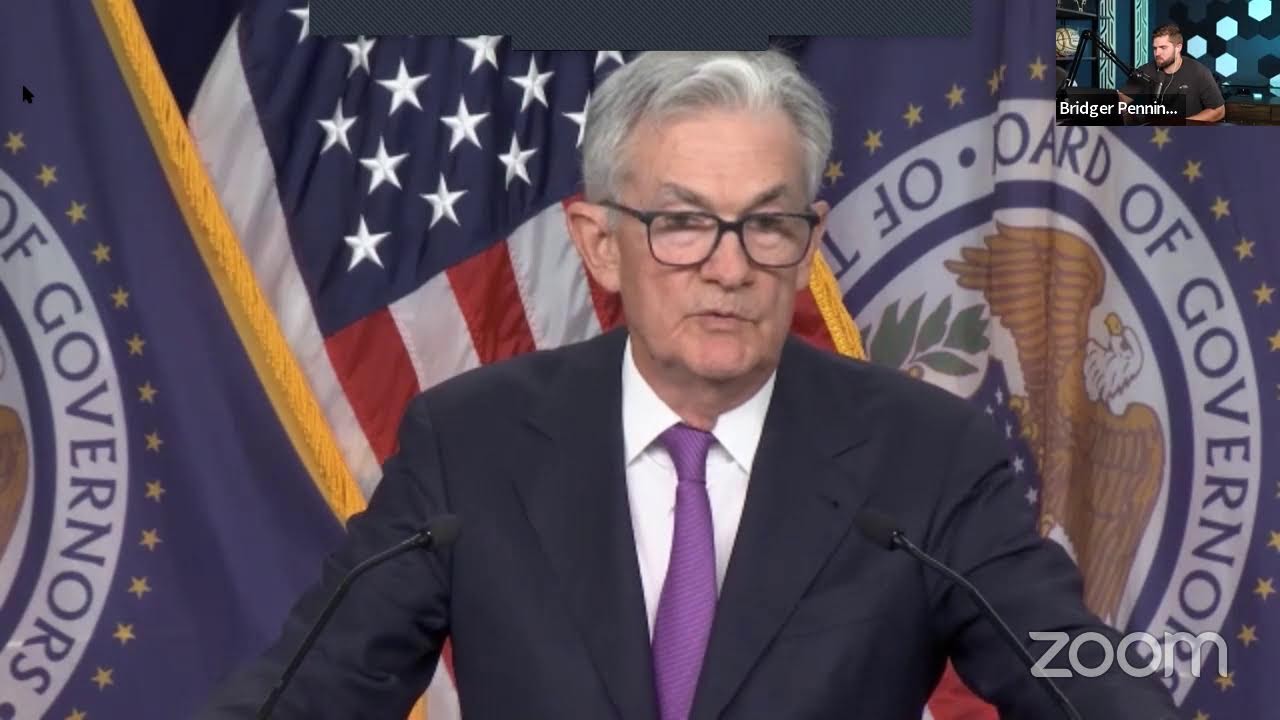
Bridger Pennington hosts a live stream of Jerome Powell's Federal Reserve announcement on September 21, 2023. The Fed held rates at 5.25-5.5% while Powell fielded questions from reporters including Nick Timiraos and Neil Irwin about inflation, the labor market, and commercial real estate.
Chapters
where you guys are calling in from. Say hello so you guys can meet each other. I know people that are live in from Discord. Welcome in, you guys. We are going to patch in YouTube as well, but they will not be live on Zoom. So my Discord people, you're the only ones live on Zoom that I can see your actual Q&A, which is kind of nice. So welcome in, you guys. Comment down below where you're calling in from so you guys can meet each other. Now, we're going to share screen for a second here and just show you what they just announced, actually. So we're going to go here. This actually just came through from the Federal Reserve. So this is their statement that he will then read, and then we will listen to the Q&A as well. So this just came out just a few minutes ago. So Federal Reserve issues FOMC statement, September 20th, 2023. Recent indicators suggest that economic activity has been expanding at a solid pace. Job gains have slowed in recent months but remain strong, and unemployment rate has remained low. That one's the interesting one. They keep touching on that one. Inflation remains elevated. I'm curious what they're going to ask and talk about with the unemployment rate. Hasn't gone up. I mean, they've raised rates now to 5.25%, and the unemployment rate's just the same. The US banking system is sound and resilient. Okay? I've had a lot of comments about the banking system. Anyways, I question that. They said this weeks before the previous banking failures we had in the spring. Tighter credit conditions for households and businesses are likely to weigh on economic activity, hiring, and inflation. The extent of these effects remains uncertain. The committee remains highly attentive to inflation risks. The committee seeks to achieve a maximum employment inflation rate of 2% over the long run. In support of these goals, they decide— the committee decided to maintain the target range of federal funds rates from 5.25% to 5.5%. Um, the committee will continue to assess additional information and its implications. So they are holding rates, just so everyone's aware. That's what that means. They are holding rates. Um, And bring— if you can help me with the waiting room behind the scenes too, that'd be great while I'm reading here. Uh, the committee will— I already let them in, but just Hit me on that. In determining the extent of additional policy firming that may be appropriate to return to a 2% over time, the committee will take into account the cumulative tightening of monetary policy and the lags with the monetary policy effects economic activity and inflation and economic financial developments. In addition, the committee will continue to reduce its holdings of— so it's going to reduce its holdings of Treasury securities and agency debt and agency mortgage-backed securities. Interesting. Okay, so it's going to reduce its holding as described in the previously announced plans. The committee is strongly committed to returning inflation to a 2% objective. In assessing the appropriate stance of monetary policy, the committee will continue to monitor the implications of incoming information. We're going to adjust stance. We don't really know. We'll see how the information comes in, voted on by all of them.
Okay?
So that's the press release. Jerome Powell will lead us, but again, I'm curious what their whole statement will be and questions, especially on jobs. So the last 7 of 7 jobs reports have been revised down, which is kind of crazy. Okay? 7 of 7, they have come in over the jobs report, and then later have had to come back and say, oh, we actually overstated our jobs report. If it was really a true, like, ah, we messed up, 50% of the time it would be they overstated it, 50% they understated it. But the last 7 of 7, they have overstated the jobs reports. Now, if you actually dig into the jobs reports, and right here, we're going to be going live in here in just a second. We got just about 10 minutes left and they'll be live here. So, um, and actually drop in the chat, um, we can talk about a few different interesting develops right now in commercial real estate and single-family real estate. Kind of interesting. But the last 7 of 7 jobs reports have been revised down. Now it's interesting if you actually come and look up the jobs reports, um, they, uh, I know we have this huge job gain. Most of it has been driven by second or part-time jobs. Now, my analysis of this is, they're like, yeah, we had 550,000 job growth, or 300,000 job growth. If you look at the full-time job growth versus the part-time job growth, it's way disproportionate over the last year. Meaning a lot of people, I don't know whether they just want a part-time job, but I'm guessing the rising of costs is making them— maybe they're driving for Uber, and they're also doing DoorDash, and they're also working a part-time gig. Yeah, the gig economy, Charles. Yeah, exactly. And so, one person is holding 3 jobs, when in reality, if it was a good economy, they would be holding 1 job, 1 full-time job, but now they have to hold 3 jobs. And yes, it makes your job numbers look good, but it doesn't help the actual underlying economy. Now, I could be totally wrong on this, but when I read into the data, that's just what I'm seeing. Let's see if I can even pull it up. I'm going to pull up the labor statistics here. Let's see if— It's funny, every time I try to pull stuff up though live, I forgot to have this up in front of me. It, uh, it's always tough. There's a little bit of pressure when you got hundreds of people watching you on the, on the call. Let's see if I can find it. Um, yeah, in the chat though, all my entrepreneur friends are pulling 3 gigs at a time.
Exactly.
It's having a major effect on our data. Yeah, I totally agree. I think, um, the data is skewed. So I know, Jerome, they keep pointing to this, this, this robust job market. Um, now in the Down to earth, I've been talking to a number of entrepreneurs. Obviously, we help fund managers. So people that are in our Discord, you guys are all there because most people want to start a fund, or most of our Discord members already run funds. That's who's in our Discord. And it's funny, I was talking to a private equity manager just a few weeks ago, and he manages hundreds of restaurants. He goes, Bridger, everyone I know is getting decimated right now. And I'm like, what do you mean? He goes, small business owners. He goes, restaurants. We are laying off people in droves. We are closing stores. shutting down. And the average store for us, as far as retail, we are seeing about a negative 25% to 30% in revenue this year, negative 30%. Now, for some people that might be like, oh, well, that's just bad. It's okay. They'll come back. No, that's detrimental. Because if you take away 30% from the top line, what happens is that's all of your excess margin. And now they're actually probably operating at a loss. That's 30% of top line. So, for example, he was walking me through a restaurant, for example. We have a bunch of fixed costs. So, just to run the store, let's call it $60,000 of fixed costs. Then we start selling. Then we have variable costs. We don't break even until we hit $120,000 a month on this certain restaurant. Now, our restaurant pulls in, let's call it $140,000 or $150,000 in revenue. If we take a 30% loss on our revenue. That's a minus $45,000. That brings us down from, let's call it, $150,000 in revenue a month to $105,000. And our fixed plus variable was about $120,000 before we start hitting margin. So we are now operating at a loss. A 30% drop in revenue is massive for restaurants, for retailers. It is massive for a lot of these companies run at a very break-even Type of margin. And now, once you hit those goals, then the excess margin is massive. That's why they call it Black Friday. Black Friday is the moment. The reason it's black, it's when all these companies go into the black. That's when Walmart or Target or these Amazon, whoever the store is, that moment, they literally don't make— they lose money or break even for 11 months a year to allow 1 month a year to have excess margins. That's their whole business model. And if you take away 1/12 of their income, they then are not breaking even anymore. Does that kind of make sense? Russell's saying on here from our Discord, my logistics company is down 55% this year. Geez, that's wild, Russell. So, across the board, I talk to and I coach and help hundreds of entrepreneurs from around the country, and we are seeing this across the board. It's been a tough year for a lot of companies. Um, real-world, like, logistics companies, companies that are just down, just brick-and-mortar stores, have seen huge dips in revenue, um, or have flatlined. And it's starting to take a real effect on the economy. Um, now I know they're gonna— we're gonna hop on in just a few minutes here and listen from Jerome, um, about how job growth is so amazing and how they're just killing it. But, um, it, it makes me think that, I don't know, just The underlying economy just isn't there. Now, something interesting, sorry, shifting gears, we now have oil prices drastically increasing right now. So let's actually look up, heading to about $100 a barrel pretty quickly right now. pull up a different chart here. Let's go to charts. So oil right now, Russia has cut production, so has OPEC, in hopes to drive up prices. Last price right here of US crude is about $90. I mean, we have seen a massive uptick in crude. Here's kind of our dollar sense through August. I mean, we were at around $80 a barrel, right now around $91. Oil looks like it is heading— I read a whole article today from Wall Street Journal, heading to $100 a barrel. with nothing stopping it, because of production costs, because our economy is so energy dependent on oil, which is pretty interesting. So, with all this being said, I'm curious to hear what Jerome Powell has to say in just a few minutes about our economy. Now, taking a different stance here, and kind of a totally different angle on this, is me and my dad are actually dropping a book soon called Dollars, Gold, and Bitcoin, which is pretty fun. We just submitted the final manuscript. We're getting all the final stuff done. I think I have the COVID here right on my screen. Oh yeah, right here. So you guys can— we're going to have some fun with all this. So the Dollars, Gold, and Bitcoin, we talk about this whole currency war that's going on right now. And yes, in our opinion is, the Fed is— we know they're trying to take down inflation and job growth and all their mandates, but really their biggest mandate is to protect the US dollar. That's their biggest mandate, is the greatest export the world has ever seen is US dollars. And the number one goal of the Federal Reserve is to protect our greatest export. And so, that means making a really strong dollar. So, if I come back here, I know everyone loves the comments, the dollar's dead, the dollar's dying, the dollar's whatever. The dollar's been killing it, even with record inflation. Record inflation. We're breaking records left and right with inflation. The dollar. Let me pull this up and look at it today. Here's the chart. Here's the dollar index. Now, because it all comes back to, compared to what? You don't like the US dollar. That's fine. But compared to what? Compared to the yen, it's doing pretty well. Compared to Bitcoins, it's doing pretty well. Compared to the euro, it's doing pretty well. The dollar just jumped a ton with holding rates here. Now, I'm going to jump back a little bit. We're going to go percentage chart here. What would be your guess in the last 3 years? Is the dollar flat? Is it up or is it down? Drop in the comments. Last 3 years percentage change, is the dollar up, flat, or down? The last 3 years. Right here, I'm going to click on this 3-year chart right here. Drop in the chat. Come on, real quick. What do you guys think? Flat, up, or down? Now, some of you guys in my Discord, you guys know where I'm going with this. The dollar has been crushing it, crushing it. Look at this, up 13.2% in the last 3 years. The Fed is defying gravity, and they keep doing it over and over and over again. They're actually playing a pretty darn good game. 13— who would've guessed that? We've printed more money was like 30% of all US dollars were printed in 2020, 2021. You would guess we'd have a huge inflation problem, which would then devalue our currency. The opposite has happened. We have had, yes, we've had high inflation, so real costs of goods have gone up, but currencies compared to other currencies, that's what the DXY is, we've actually done phenomenal, because it always comes back to compared to what. And so, the Fed, I know their mandates, but they are Playing a massive game right now. They are helping the U.S. dollar, the greatest export of all time, do this. Now, with that, Brigham, you're going to share screen for me. Let's hop over to the Jerome Powell's going to go live here in one minute. We'll listen to Jerome Powell and we'll see what we got here. And I love the comments here. Up, up, up. Yeah, other other groups are just as bad. You know, so. Anyways, kind of crazy. Let me know if sound is coming through as well, and if it's not working, let me know.
Everyone's—
I put on my, I put on my Federal Reserve shirt today.
Here we go.
I think you're good, Brigham. I don't think you have sound yet. I'm actually curious. For a while, I've wanted to be in these, these rooms. But if you guys had a question to ask Jerome Powell today, what question would you ask?
Curious.
Drop in the chat.
Good afternoon, everyone. My colleagues and I remain squarely focused on our dual mandate to promote maximum employment and stable prices.
Sound is good. Okay, thanks.
Pausing. Price stability. Without price stability, the economy does not work for anyone. In particular, without price stability, we will not achieve a sustained period of strong labor market conditions that benefit all. Since early last year, the FOMC has significantly tightened the stance of monetary policy. We've raised our policy interest rate by 5.25 percentage points and have continued to reduce our securities holdings at a brisk pace. We've covered a lot of ground, and the full effects of our tightening have yet to be felt. Today, we decided to leave our policy interest rate unchanged and to continue to reduce our securities holdings. Looking ahead, we're in a position to proceed carefully in determining the extent of additional policy firming that may be appropriate. Our decisions will be based on our ongoing assessments of the incoming data and the evolving outlook and risks. I will have more to say about monetary policy after briefly reviewing economic developments. Recent indicators suggest that economic activity has been expanding at a solid pace, and so far this year, growth in real GDP has come in above expectations. Recent readings on consumer spending have been particularly robust. Activity in the housing sector has picked up somewhat, though it remains well below levels of a year ago, largely reflecting higher mortgage rates.
Oh, click.
Appear to be weighing on business fixed investment. In our Summary of Economic Projections, or SEP, Committee participants revised up their assessments of real GDP growth, with the median for this year now at 2.1%. Participants expect growth to cool, with the median projection falling to 1.5% next year. The labor market remains tight, but supply and demand conditions continue to come into better balance. Over the past 3 months, payroll job gains averaged 150,000. 50,000 jobs per month, a strong pace that is nevertheless well below that seen earlier in the year. The unemployment rate ticked up in August but remains low at 3.8%. The labor force participation rate has moved up since late last year, particularly for individuals aged 25 to 54 years. Nominal wage growth has shown some signs of easing. And job vacancies have declined so far this year. Although the jobs-to-workers gap has narrowed, labor demand still exceeds the supply of available workers. FOMC participants expect the rebalancing in the labor market to continue, easing upward pressures on inflation. The median unemployment rate projection in the SEP rises from 3.8% at the end of this year to 4.1% over the next 2 years. Inflation remains well above our longer-run goal of 2%. Other data— we estimate— inflation remains well above our longer-run goal of 2%. Other data— we estimate 4% over the 12 months ending in August and that, excluding the volatile food and energy categories, Core PCE prices rose 3.9%. Inflation has moderated somewhat since the middle of last year, and longer-term inflation expectations appear to remain well anchored, as reflected in a broad range of surveys of households, businesses, and forecasters, as well as measures from financial markets. Nevertheless, the progress— the process of getting inflation sustainably down to 2% 2% has a long way to go. The median projection in the SEP for total PCE inflation is 3.3% this year, falls to 2.5% next year, and reaches 2% in 2026. The Fed's monetary policy actions are guided by our mandate to promote maximum employment and stable prices for the American people. My colleagues and I are acutely aware We recognize that high inflation imposes significant hardship as it erodes purchasing power, especially for those least able to meet the higher costs of essentials like food, housing, and transportation. We are highly attentive to the risks that high inflation poses to both sides of our mandate, and we are strongly committed to returning inflation to our 2% objective. As I noted earlier, since early last year, we have raised our policy rate We see the current stance of monetary policy as restrictive, putting downward pressure on economic activity, hiring, and inflation. Target range for the federal funds rate at 5¼ to 5½% and to continue the process of significantly reducing our securities holdings. We are committed to achieving and sustaining a stance of monetary policy that is sufficiently restrictive to bring inflation down to our 2% goal over time. In our SEP, FOMC participants wrote down their individual assessments of an appropriate path for the federal funds rate based on what each participant judges to be the most likely. Sorry, the most likely scenario going forward. If the economy evolves as projected, the median participant projects that the appropriate level of the federal funds rate will be 5.6% at the end of this year, 5.1% at the end of 2024, and 3.9% at the end of 2025. Compared with our June Summary of Economic Projections, the median projection is unrevised for the end of this year, The median projection is for inflation to remain modestly below 2% for the next year but has moved up by 0.5 percentage point at the end of the next 2 years. These prediction— projections, of course, are not a Committee decision or plan. If the economy does not evolve as projected, the path of policy will adjust as appropriate to foster our maximum employment and price stability goals. We will continue to make our decisions meeting by meeting based on the totality of the incoming data Given how far we have come, we are in a position to proceed carefully as we assess the incoming data and the evolving outlook and risks. Real interest rates now are well above mainstream estimates of the neutral policy rate, but we are mindful of the inherent uncertainties in precisely gauging the stance of policy. We're prepared to raise rates further if appropriate, but we are not rushing to do so. And we intend to hold policy at a restrictive level until we're confident that inflation is moving down sustainably toward our objective. In determining the extent of additional policy firming that may be appropriate to return inflation to 2% over time, the Committee will take into account the cumulative tightening of monetary policy, the lags with which monetary policy affects economic activity and inflation, and economic and financial developments. We remain committed to bringing inflation back down to our 2% goal and to keeping longer-term inflation expectations well anchored. Reduced— restoring price stability is essential to set the stage for achieving maximum employment and stable prices over the longer run. To conclude, we understand that our actions affect communities, families, and businesses across the country. Everything we do is in service to our public mission. We at the Fed will do everything we can to achieve our maximum employment and price stability goals. Thank you, and I look forward to your questions.
Thank you. Colby Smith with the Financial Times. What makes the Committee inclined to think that the fed funds rate at this level is not yet sufficiently restrictive, especially when officials are forecasting a slightly more benign inflation outlook for this year? There's noted uncertainty about policy lags. Headwinds have emerged from the looming government shutdown. The end of federal childcare funding, resumption of student debt payments, things of that nature.
So I guess I would characterize the situation a little bit differently. So we decided to maintain the target range for the federal funds rate where it is at 5.25 to 5.5 percent while continuing to reduce our securities holdings. And we say we're committed to achieving and sustaining a stance of monetary policy that sufficiently restric We have said that we will be sufficiently restrictive to bring down inflation to 2% over time. We said that. But the fact that we decided to maintain the policy rate at this meeting doesn't mean that we've decided that we have or have not at this time reached that stance of monetary policy that we're seeking. If you looked at the SEP, as you obviously will have done, you will see that a majority of participants believe that we will— that it will be appropriate for us to raise rates one more time in the 2 remaining meetings this year. Others believe that we have already reached that. So it's something where we're— we're not making a decision by deciding to— about that question by deciding to just maintain the rate and await further data.
So right now, it's still an open question about sufficiently restrictive? You're not saying today that we've reached this level.
We're not saying— yeah, no, no. Clearly, we are just— what we decided to do is maintain the policy rate and await further data. We want to see convincing evidence, really, that we have reached the appropriate level. And, you know, we're seeing progress, and we welcome that. But, you know, we need to see more progress before we'll be willing to reach that conclusion.
And just on the 2024 projections, What's behind that shallower path for interest rate cuts and the need for real rates to be 50 basis points higher?
Right. So I would say it this way.
Always getting a lot of questions.
First of all, interest rates— real interest rates are positive now. They're meaningfully positive. And that's a good thing. We need policy to be restrictive so that we can get inflation down to target.
Okay.
And we need— we're going to need that to remain to be the case for some time. So I think, you know, remember that the— of course, the SEP is not a plan that is negotiated or discussed really as a plan. It's accumulation, really. And what you see are the medians. It's accumulation of individual forecasts from 19 people, and then what you're seeing are the medians. So I wouldn't want to, you know, bestow upon it the idea that it's really a plan. But what it reflects, though, is that economic activity has been stronger than we expected, stronger than I think everyone expected. And so what you're seeing is, this is what people believe, as of now, will be appropriate to achieve what we're looking to achieve, which is progress toward our inflation goal, as you see in the SEP.
So we'll see that on that target, they didn't have, for 2024, rate decreases, right? I mean, they maybe had one rate decrease, but they held it pretty good.
Rachel Siegel from The Washington Post. Thanks for taking our question. How would you characterize the debate around another hike or holding steady? Is it discussion around lag times, fear of too much slowing, too little slowing? Could you walk us through what this disagreement was about at the meeting?
Yeah.
So the proposal at the meeting was to— was to maintain our current policy stance. And I think there was obviously unanimous support for that. But this, of course, is an SEP meeting. And so people write down what they think. And you've got— you have some— you saw, I think, 7 wrote down no hike at this meeting or between now and the end of the year. And I think 12 wrote down another single hike in one of the next 2 meetings that we have between the end of the year. So it wasn't like we were arguing over that. People just stating their positions. And really what people are saying is, let's see how the data come in. You know, we want to see— you know what we want to see. We want to see that these good inflation readings that we've been seeing for the last 3 months, we want to see that it's more than just 3 months.
Right.
Interesting. Also, one may— you know, majority of people voting for one more hike before the end of the year.
The last one that we received was a good example of what we do want to see. It was a combination of, you know, across a broad range of indicators, continuing rebalancing of the labor market. So those are the two things. Those are our two mandate variables, and that's the progress that we want to see. But I think people, they want to be convinced. You know, they want to be careful not to jump to a conclusion really one way or the other, but just be convinced that the data, you know, support that conclusion. And that's why, given how far we've come and how quickly we've come, we're actually in a position to be able to proceed carefully as we assess the incoming data. But, yeah, the incoming data—
I mean, if we had a banking crunch, that would be pretty interesting.
And in your world, what would— I know nothing has been decided yet, but what would one more hike at the end of the year do to the economy or to inflation? And on the other side, what would no hike do, if you could sort of game that out for us?
All right. Waste of a question.
You know, you can make the argument that one hike one way or the other won't matter. But, for us, we're trying— we've— obviously, as a group, it's a pretty tight club. Cluster of where we think that policy stance might be. But we're always going to be learning.
Yeah, pretty interesting. Now, we have about 30% of the U.S. Treasury debt being refinanced next year, in the first half of next year. So we'll see what they end up doing.
So we don't really know until— and that's why, again, we're in a position to proceed carefully at this point. A year ago, we proceeded pretty quickly to get rates up. Now, we're fairly close, we think, to where we need to get. It's just a question of reaching the right stance. I wouldn't attribute huge importance to one hike in macroeconomic terms. Nonetheless, you know, we need—
Back to our discussion on the dollar index. So you're seeing Europe, China lowering rates already, other countries wanting to lower as well, and the U.S. holding firm and even raising rates will create a Stronger dollar for that DXY. If people are considering leaving the U.S. dollar, what that means is appropriate. Yeah, it's like cool. Yeah, go trade oil in other dollars than the petrodollar, but you'll want to use the U.S. dollar because the best reserve currency is the best hold of value.
See you next time, CNBC. Mr. Chairman, I want to return to Colbert's question here. What is it saying about the committee's view of the inflation dynamic in in the economy that you achieve the same forecast inflation rate for next year but need another half a point of the funds rate on it? Does it tell you that— does it tell us that the Committee believes inflation to be more persistent, requires more medicine effectively? And I guess a related question is, if you're going to project a funds rate above the longer-run rate for 4 years in a row, at what point do we start to think, hey, maybe the longer rate or the neutral rate is actually higher? Thank you.
So, good question. It's going to take 4 or 5 years to get back.
Rather than pointing to a sense of inflation having become more persistent, I wouldn't think that's not— we've seen inflation be more persistent over the course of the past year, but I wouldn't say that's something that's appeared in the recent data. It's more about Stronger economic activity, I would say. So if I had to attribute one thing, again, we're we're picking medians here and trying to attribute one explanation. But I think broadly, stronger economic activity means means rates. We have to do more with rates, and that's what that that's what that meaning is is telling you.
Oh, come on.
In terms of what the neutral rate can be, you know, we know it by its works. We only—
Hold on.
You think it's the stream now?
Come on, Jerome. Come back to us. Come back to us, Jerome.
That the neutral rate has risen. You do see people— you don't see the median moving, but you do see people raising their estimates of the neutral rate. And it's certainly plausible that the neutral rate is higher than the longer-run rate. Remember, what we write down in the SEP is the longer-run rate. It is certainly possible that, you know, that the neutral rate at this moment is higher than that. That's part of the explanation for why the economy has been more resilient than expected.
Yeah, decent question. I guess if the average is 2, we've got to be under 2 to get back to 2, right?
So you've said several times that the economy needed a period of below-trend growth to get inflation consistently back to 2%. You kind of get that in 2024 a little bit, 1.5%. Is this a touch below what's the estimate of potential? So the fact that you're getting so much done at so much less cost, does that represent a change in how you think inflation works, a change in how you think the economy works, a change in the mix of supply healing versus demand destruction that's necessary to achieve this?
Yes, of course it is a— it is a good thing that we've seen now meaningful rebalancing in the labor market. Without an increase in unemployment. And that's, that's because we're seeing that rebalancing in other places— in, for example, job openings and in the jobs-worker gap. You're also seeing supply-side things. So, so that's happening. Um, I would say, though, we still— I still think, and I think broadly people still think, that there'll have to be some softening in the labor market. That can come through more supply, as we've seen as well. Also, remember, the natural rate, we think, is, is coming down, which is a supply-side thing, so that the, the gap between any given unemployment rate that's lower than that and the natural rate comes down. That's a way for supply— that's a way for the labor market to achieve a better balance. So all of those things are happening. You're right, in, in the, in the median forecast, we don't see a big increase in unemployment. We do see an increase And but that's— that really is just playing forward the trends that we've been seeing. That is not guaranteed. There may come a time when unemployment goes up more than—
Yeah, we've talked about before, really what we've been seeing, the labor market is—
Higher on—
Few numbers. It doesn't seem correct.
Just to boil that down for a second, you know, we've gone from a very narrow path to a soft landing to something different. Would you call the soft landing now a baseline? Expectation?
No, no, I would not do that. I would just say— what would I say about that? I've always thought that the soft landing was a plausible outcome, that there was a path, really, to a soft landing. I've thought that, and I've said that since we lifted off. It's also possible that the path has narrowed, and it's widened, apparently. Ultimately, it may— this may be decided by factors that are outside our control at the end of the day. But I do think it's— I do think it's possible. And, you know, I also think, you know, this is why we are in a position to move carefully again, that we will restore price stability. We know that we have to do that. And we know the public depends on us doing that. And we know that we have to do it so that we can achieve the kind of labor market that we all want to achieve, which is an extended period, sustained period of strong labor market conditions that benefit all. We know that. The fact that we've come this far lets us really proceed carefully, as I keep saying. So I think, you know, that's the end we're trying to achieve. I wouldn't want to handicap the likelihood of it, though. It's not up to me to do that.
Interesting. Factors out of their control. I wonder what that means.
Nick Timiraos of The Wall Street Journal.
It's everything in the Fed's control.
Chair Powell, both you and Vice Chair Williams have indicated that sufficiently restrictive will be judged on a real rather than nominal basis, implying some scope for nominal rate cuts next year, provided further compelling evidence that price pressures will continue to subside. Is the FOMC focused on targeting a real level of policy restriction? And can you explain what would constitute enough evidence that will allow the FOMC to normalize the nominal stance of policy while keeping real policy settings sufficiently restrictive?
I mean, yes, we understand that it's a real rate that will matter and that it needs to be sufficiently restrictive. And, again, I would say, you know, sufficiently restrictive only when you see it. It's not something you can arrive at with confidence in a model or in various estimates, you know. And so what are we seeing? We're seeing, you know, through a combination of the, you know, the unwinding of the pandemic-related demand and supply distortions and monetary policy's work in suppressing demand or alleviating very high demand, the combination of those 2 things is actually working. You're seeing, you know, inflation coming down. It's principally now in goods, also in housing services. You begin to see effects of it in nonhousing services as well. So I think we think that that is working. And I think what, you know, as we've said, we want to reach that— we want to reach something that we're confident gets us to that level. And I think confidence grows Comes from seeing you know enough data that you feel like yes, okay, this feels like we can we can for now decide that this is the right level and just agree to stay here. We're not permanently deciding not to go higher, but but we would let's say if we get to that level, and then the question is how long do you stay at that level? And that's a whole other set of questions. For now, the question is trying to find that level where we think we can stay there, and we haven't we haven't got. To a point of confidence about that yet, where we think we can stay there, and we haven't. We haven't gotten to a point of confidence about that yet.
Inflation projection for this year, and even then it seems possible.
Interesting.
So not oh, inflation could come in even lower than the median at 3.7 percent. Would you see a case to raise rates still if it turned out that you were going to achieve the same real rate this year because the decline in inflation proceeds somewhat better than? than you currently anticipate?
The decision that we make at, you know, at each meeting and certainly at the last 2 meetings this year, it's going to depend on the totality of all the data. So the inflation data, the labor market data, the growth data.
All the data at the time.
So it's an interesting question, though. I mean, the CPI number is just a trailing 12 number, right? So they look at that, oh, inflation is down, but it's just the trailing 12 months of inflation. Back to the real amount of inflation for a good or service that we've seen. So I'm not drumbeating to say we're going to— We're going to wait until the time when it's right to make the right decision. But he asked a very interesting question of, well, real inflation is, you know, X, and how are you guys calculating that in over your, you know, 3- or 4-year timeline? Pretty interesting.
Jeanna.
Thanks, Chair Powell. Following up on Nick's question, actually, John Williams, the New York Fed President, obviously, has said things to me the effect of next year as we see inflation kind of again to Nick's point as we see inflation coming down we're going to need to reduce interest rates to make sure that we're not squeezing the economy harder and harder over time. And I wonder if that's basically the logic that you apply. You know, is that how you think about it? And then I also wonder in the last press conference you said something to the effect of, you know, it's a full year out. Those discussions and people interpreted that to mean that You didn't see a possibility of a rate cut in the first half of next year. And I wonder if that was what you meant by that or whether, you know, how you—
He's not going to answer that question. He's just going to say, we're going to take it with the data we get.
When I answer these questions about hypotheticals about cutting, I'm never intending to send a signal about that.
He's not going to answer that.
I'm just answering them as the question is expressed. So, please, I wouldn't want to be taken that way. Sorry, the first question was that, Helen? Yeah, so we're— as we go into next year, That's the question we'll be asking, is, you know, taking into account the same question.
We'll assess the data as a waste of a question.
Everything we know about monetary policy, the time will come at some point, and I'm not saying when, that it's appropriate to cut. Part of that may be that real rates are rising because inflation is coming down. Part of it just may be that it'll be all the factors that we see in the economy.
And you know that time they ask him like 15 times, when do you think you'll cut? And he's just he's just not going to answer that question.
And so they keep asking estimates of what that might be. And you know there's you know there's so much uncertainty around that. When we in the moment will do what we think makes sense. No one will look back at this and say, hey, we made a plan.
Ask about the election. You're going to cut going into the election for 2024 to help your chances of staying Chairman Powell. That's what I would ask.
Thanks so much, Chair Powell. Neil Irwin with Axios. I wonder, how do you think about the question of whether the strong GDP growth that we've been seeing is driven by excess demand versus supply-side factors— productivity, labor force growth? And, relatedly, if GDP keeps coming in hot, even in the absence of an inflation resurgence, would that on its own be a reason to consider more tightening?
So, on your first question, I mean, we're looking at GDP very, very carefully to try to understand, really, what's the direction of it, what's driving it. And it's a lot of consumer spending. You know, it's been— the consumer has been very robust in spending. So that is— you know, that's how we're looking at it. Sorry, your second question was?
GDP stays hot, without inflation?
So I think the question will be— GDP is not a mandate, right? Maximum employment and price stability are the mandates. The question will be, is the level— is GDP— is the heat that we see in GDP, is it really a threat to our ability to get back to 2% inflation? That's going to be the question. It's not a question about GDP on its own. It's, you know, you're expecting to see this improvement, you know, continued rebalancing in the labor market and inflation moving back down to 2% in a sustainable way. We have to have confidence in that. And, you know, we'd be looking at GDP just, just to the extent that it threatens one or both of those.
Victoria.
Hi, Victoria Guida with Politico. There are multiple external factors that are playing out right now. We see rising oil prices. We see autoworkers striking. There's the looming, very real possibility of a government shutdown. And I was just wondering, for each of those things, could you talk about how you're thinking about how that might affect the course for the Fed and the economy?
So there is a long list, and you hit some of them. But, you know, it's the strike, it's government shutdown, resumption of student loan payments, higher long-term rates. Oil price shock. You know, you can— there are a lot of things that you can, you can look at. And, you know, so what we try to do is assess all of them and handicap all of them. And ultimately, though, there's so much uncertainty around, around these things. I mean, to start with the strike, first of all, we absolutely don't comment on the strike as— we have no view on the strike one way or the other. But we do have to make an assessment of its economic effects to do our jobs. So, you know, the strike for the auto workers in Michigan, uncertain. It will depend. The economic effects, it could affect— you look, we've looked back at history, could affect economic output, hiring, and inflation. But that's really going to depend on how broad it is and how long it's sustained for. And then it also depends on how quickly production can make up for lost production. So none of those things are known right now. It's very, very hard to know. So you just have to leave that uncertain. I'm not certain, and we'll be learning, I think, over the course of the next intermeeting period— course of the next intermeeting period— course of the next intermeeting period— course of the next intermeeting period. I can't comment on that.
We're kind of looped.
It hasn't traditionally had much of a macroeconomic effect. You know, energy prices being higher, that is a significant thing. Energy prices being up can affect spending. Over time, a sustained period of higher energy prices can affect consumer expectations about inflation. We tend to look through short-term volatility and look at core inflation. But so the question is, how long are higher prices sustained? We have to take those macroeconomic effects into account as well. Those are some of them. I'm not sure if I hit them all. But, I mean, ultimately, you know, you're—
No real comment. Come on, Jerome, give us some meat. —appears to have significant Curious about gas and oil.
That's, that's what we start with. And we— but we do have this collection of risks that you mentioned.
Oil on pace to be $100 a barrel.
Craig Torres from Bloomberg News. I was a little surprised, Chair Powell, to hear you say that a soft landing is not a primary objective. This economy is seeing added supply in a way that could create long-term inflation stability. We have prime-age labor force participation moving up. People can add skills. Workers want to work. We have a boom in manufacturing, construction. We've had a decent spate of homebuilding. And since inflation's coming down with strong GDP growth, we may have higher productivity, all of which are good for the Fed's longer-run target of low inflation. And if we lose that in a recession, aren't we opting for the awful hysteresis that we had in 2010. So are you taking this into account as you pursue policy?
Thank you.
To begin, a soft landing is a primary objective, and I did not say otherwise. I mean, that's, that's what we've been trying to achieve for all this time.
He didn't say that, though. He said it's not one of their primary objectives, price stability and job growth.
The worst thing we can do is to fail to restore price stability. Because the record is clear on that. If you don't restore price stability, inflation comes back, and you go through— you can have a long period where the economy is just very uncertain, and it'll affect growth. It'll affect all kinds of things. It can be a miserable period to have inflation constantly coming back and the Fed coming in and having to tighten again and again. So the best thing we can do for everyone, we believe, is to restore price stability. I think now, today, we actually, you know, we have the ability to be careful at this point and move carefully, and that's what we're planning to do. So we fully appreciate that, you know, the benefits of being able to continue what we see already, which is rebalancing in the labor market and inflation coming down without seeing, you know, an important large increase in unemployment, which has been typical of other tightening cycles.
cycles. So—
Hi, thank you. Chris Rugaber at Associated Press. When you look at the disinflation that has taken place so far, do you see it mostly as a result of what some economists are calling the low-hanging fruit, such as the unwinding of supply chain snarls and other pandemic disruptions, or is it more about a broad inflation—
disinflationary So if I understood your question, it's— I would say it this way. I think we knew from the time— from before when we lifted off, but certainly by the time we lifted, we knew that bringing inflation back down was going to take, as I call it, the unwinding of these distortions to both supply and demand.
Right.
And that's going to take time. That happened because of the pandemic and the response. So that unwinding was going to be important. In addition—
I've got to hop in another call real quick. I'm going to put the reins over to Lincoln for a second. I might be back in just a few minutes.
By cooling demand off and just in general, a lot better aligning supply with demand. So those 2 forces were always going to be important. I think it's very hard to pull them apart. They work together. I do think both of them are at work now, and I think they're at work In a way that shows you the progress that we that we are seeing.
In the Fed meeting, huh?
Michael McKee from Bloomberg Television and Radio. What would justify that last move? Because the median forecast is for lower inflation, and well, forecasts are highly uncertain. Given all the known unknowns that you face. How much confidence do you have? Can investors have, or the American people have, in your forecasts?
Well, forecasts are highly uncertain. Forecasting is very difficult. Forecasters are a humble lot with much to be humble about. But to get to your question, though, what's happened is growth has come in stronger, right? Stronger than expected, and that's required higher rates. Unemployment. You know, you also see that the the ultimate unemployment rate is not as high, but that that's really because of what we've been seeing in the labor market. We've seen more and more progress in the labor market without seeing significantly higher unemployment. So we're continuing that trend. In terms of inflation, you are seeing the last three readings are are very very good readings. It's only three readings. You know, we were well aware that we need to see more than three. 3 readings. But if you look at June, July, and August, you're looking at, you know, really significant declines in core inflation, largely in the goods sector, also to some extent in housing services, and just a little in nonhousing services. Those are the 3 buckets. Headline inflation, of course, has come way down, largely due to lower energy prices, some of which is now reversing. So I think people should know that economic forecasting is is very difficult, and these are highly uncertain forecasts. But these are, these are our forecasts. They're, you know, they're, they're, they're— we have very high-quality people working on these forecasts, and I think they stand up well against other forecasters. But just the nature of the businesses, the economy is very difficult to forecast.
Given the forecast that you have, what justified not moving today, and what could justify moving in So it's funny.
So it's funny if you think—
let's see, do I need to mute this? So it's funny, about a month ago, Bridger and I had a conversation.
Wow.
Bridger and I had a conversation where we were talking about whether the markets were going to stay steady or if they were going to crash. He had this big bearish case on why everything was going to fall apart. And I was like, dude, everything is going to be just fine. Markets, they take time to work themselves out. After these, any sort of rate hikes or events, there's a reactionary period where you have to give the economy time to respond to these types of things. And I think that's where— I haven't been listening to this whole call, but I think that's where Jerome Powell is coming from. I don't think he wants to overcorrect and cause a cataclysmic event in the environment. He's getting pressure from all ends right now, you know, to keep rates lower from anyone in real estate to any sort of private creditor out there. Right. Because, like, honestly, a lot of real estate portfolios, a lot of business portfolios, like, they are at a tipping point. And if he does continue to raise, like, things are going to start to break. And some argue that's really good for the economy and I think Jerome's in a spot where, and, you know, as a Fed chair, he's just wanting to see how these historical rate hikes play out and if anything else is going to break with what he's already done. So I think, I think rates are going to stay flat. I mean, if we see crazy CPI numbers creep back up, then yeah, maybe there'll be another hike. But I think most likely You know, he's just— it's more of like a wait-and-see. It's a big wait-and-see right now.
Just monthly, right? You can look at just monthly readings and see what the increase was from the prior month. So you're right, when you go back 3, 6, and 12 months, you get base factors, but we can adjust for that. In terms of not getting data, you know, again, we don't comment on government shutdowns. It's possible, if there is a government shutdown and it lasts through through the next meeting, then it's possible we wouldn't be getting some of the data that we would ordinarily get, and we, you know, we would just have to deal with that. And I don't know— it's hard for me to say in advance how that would affect that meeting. It would depend on all kinds of factors that I don't know about now, but it's certainly a reality that that's a possibility. But would you feel more comfortable on the base effects that, as those kind of fall out of the equation the next couple of readings by November, would you feel more comfortable at that point? You know, yes. I mean, if you're looking— if we can tell how much inflation has gone up in a given month, right? And, you know, that's what we're looking at. And month by month, what's the reading? And, you know, I think— I think what we're really looking at is there's a tendency to look at, you know, shorter and shorter Great comment, Corey. Maturities, but they're incredibly volatile and they can be misleading. That's why we look at 12-month. But I think in this situation where it looks like we've had a bit of a turn in inflation starting in June, we're also looking at 6 months and even 3 months, but really 6-month inflation. So you're looking at it over that period and over longer periods. That's the right way to go. And we don't need to be in a hurry in getting to a conclusion about what to do. We can let the data evolve. So, Edward.
Thanks for the question, Chair Powell. Edward Lawrence with Fox Business. So I want to focus back in on oil prices.
We're seeing oil prices, as you mentioned, move up, and that's pushing the price of gas.
How does that factor into your decision to raise rates or not? I think it's important to note that, you know, there's a lot of projections out there that people say, oh, you know, rates are going to just, you know, that they're going to be cut back next year, right? Everyone's saying that. Everyone's saying, oh yeah, 2024, there's there's gonna you know they're gonna go back to where they were. And I say bullshit. I do not think that is going to happen at all. I think rates are going to be higher for longer, and that I think they are here to stay. And I think that businesses are going to be forced to adapt to energy goes up, you know, a higher rate environment. And I still think I think without additional rate increases. I think a lot of businesses are going to break. I don't know if Bridger has the same opinion, but their war chests are running out. I mean, I think the markets are going to do fine. But if anything, just real estate portfolios are going belly up. I don't think it's going to force the economy to crash or anything. And I don't think Again, I don't think the Fed wants to trigger that. I don't think they want to be forced to cut rates because of something that they did. I think they would rather be on the more cautious side of things. And let's be a little more reactionary to how everything instead of anticipating. Because you'll see a lot of these commentators and he says the same thing every freaking meeting. They're like, well, we're projected or trending or XYZ. It's all forecasting. You know, he says, look, honestly, they don't even take forecasts into account. I think most of the time it's just what do we have today and what have we had historically? And I think that's ultimately where they make most of their decisions.
They're not at troublingly high levels. They're just kind of moving back up to what was typical in the pre-pandemic era.
Hi, Jean Young with M&I Market News. Yields along the Treasury curve have risen to their highest in years. What is the Fed's view about what's been driving that increase in recent weeks, and how much of it can be attributed to macro explanations and how much to technical factors? Thank you.
So you're right. You know, rates have moved up significantly. I think it's always hard to say precisely, Most people do a common decomposition of the increase, and they'll— the view will be, it's not mostly about inflation expectations; it's mostly about other things, you know, either term premium or real yields. And it's hard to be precise about this. Of course, everyone's got models that will give you a very precise answer, but they give you different answers. So— but, essentially, they're moving up because— it's not because of inflation; is probably— it'll probably have something to do with stronger growth. I would say more supply of Treasuries. You know, the common explanations that you hear in the markets kind of make sense.
Kyle Campbell, American Banker. Thank you for taking the questions. Just 2 on housing. You've said slower shelter— cost growth is in the pipeline and will reflect in inflation readings as new leases are signed. But there's also some questions out there about the way housing costs are measured, particularly the use of rental equivalents, which are estimates from homeowners about what their homes would rent for if they were in the rental market. So my question is, how much of the effort to tame inflation, both as it's measured and felt by the broader public, hinges on housing supply? And then, as far as a constrained housing supply being sort of exacerbated by this sort of lock-in effect of mortgages being higher now than they were at their recent historic lows, how is that going to impact future thinking about taking interest rates to that lower bound in the future?
So, on the supply point, of course, supply is very important over time in setting house prices. Prices and, and for that matter rents. And so, and supply is kind of structurally constrained. But in terms of where inflation's going in the near term though, as, as you obviously know, a lot of it is, is leases that are running off and then being re-signed or re-leased at a level that's, that's, um, not as— not— it won't be that much higher. It would have a year ago, it would much higher than it was a year before. Now it may be below or at the same level. So as those leases are rolling over, we're seeing what we expect, which is measured housing services inflation coming down. Your second question was the lock-in. Answer a question there affecting things really.
Is that going to affect your decisions to potentially bring So how concerned are you about rates down to their lower bound in the future sort of creating that sort of bubble of buying and then a lock-in that sort of stagnates the housing market?
I think we look at the— I would look at the lock-in— the idea being that people are in very low mortgage— very low-rate mortgages— and its role in our future decisions in a future tight— in a future loosening cycle Cut rates. That's I think we'd be looking at what the you know fundamentally what what rates does the economy need? And you know in in an emergency like the pandemic or during the to support the economy. So I wouldn't I wouldn't think that that that would be a Okay, I'll answer this question because he did not.
Um, well, he— so he's— the banker's asking about, you know, hey, how much do you take into housing, you know, consideration, uh, into, you know, pricing rates? And, uh, I think it's, it's honestly a reactionary factor. Like, I— again, I don't think if they're for— if people are having problems right now, I don't, I don't think it's a, it's a high contribution factor. I think that's where, you know, we see the emergence of American bureaucratic systems that come in and plug holes, which honestly, I kind of hate because they just put these Band-Aids and honestly exacerbate the problem a little bit, in my opinion. Obviously, this is entirely subjective, in my opinion.
But it's a good thing that the economy is strong.
It's a good thing. I think before the Fed would weigh in, like have home prices critically weigh into the decision of raising or lowering rates. I think we would see the emergence of different government programs that would support first-time homebuyers or people, you know, assuming their old mortgages or, you know, things of that nature. I think that would come first before we see, you know, the Fed make its rate decision off of that. Honestly, I think that the Fed gets more Pressure from larger commercial real estate, and you know that's who they're rubbing shoulders with. They're not rubbing shoulders with the American consumer who's you know got a three percent interest rate on their home, and you know you know so is forcing a problem of that they can't buy a new house or upsize because otherwise they're going to be paying more. Like I don't think that's really their primary need, but they have all these banks and firms and. Pensions that are howling at him. And I think he probably weighs into consideration those more than from a residential real estate perspective.
One of the factors in the economic resilience to date appears to be a lesser degree of rate sensitivity than in the past. Obviously, we've talked about households with long fixed-rate mortgages, also companies that refinanced before last year. What is your thinking about the efficacy of rates and how that's changed? And then related to that, how do you think about the distributional consequences in the sense that if you're a relatively wealthy household with a long fixed-rate mortgage, the past year has not been all that tough with rates going up, whereas if you're relying on your credit card for supporting your consumption, in fact, times are getting a lot tougher a lot more quickly?
Thanks.
So why— I guess it's fair to say that the economy has been stronger than many expected, given what's been happening with interest rates. Why is that? Many candidate explanations. Possibly a number of them make sense. One is just that household balance sheets and business balance sheets have been stronger than we had understood. And so that that spending is held up and that kind of thing. We're not sure about that. The savings rate for consumers has come down a lot. The question is whether that's sustainable. That could be. It could just mean that that the date of effect is is is later. It could also be that for other reasons the neutral rate of interest is is higher for for for various reasons. We don't know that. It could also just be that. That policy hasn't been restrictive enough for long enough.
And Edward, I see your comment here. I love that.
Candidate explanations. We have to—
I think they're just going to wait and see. Sorry, I can't talk with these things. I think they're just going to wait and see. It's still a very strong labor market. I think you're right though. Like, rates are going crazy. It's obviously real inflation is a lot higher than what they're projecting and something's got to give. But I think that over the course of— personally, I think we'll start to see this inflation and disinflation start to— On your second represent itself through the already current rate hike. And yeah, maybe potentially one additional more would do it. But yeah, my point— yeah, I don't honestly anticipate too much higher. Otherwise, again, I think they force, you know, a breaking of the back. Yes. But you're sure your guys' thoughts are on here?
Punitive.
Yes. And so the point I would make there is that we're trying to get inflation back down. The people who are most hurt by inflation are the people who are on a fixed income. If you're a person who spends all of your income— you don't really have any meaningful savings; you spend all your income on the basics of life— clothing, food, transportation, heating, the basics— and prices go up by 5, 6, 7%, you're in trouble right away, whereas even middle-class people, people have some savings and some ability to absorb that. So it is for those people, as much as for anybody, that we need to restore price stability. And we want to do it as quickly as possible. Obviously, we would like to do that— we'd like the current trend to continue, which is that we're making progress without seeing the kind of increase in unemployment that we've seen in past things. But you're right, though. When we raise rates, People who are, you know, who are living on credit cards and borrowing are going to feel that more. They are. And, of course, people with lots of savings also have a much lower marginal propensity to consume, and so they're not going to— it's not going to affect them as much.
Let's go to Greg Robb for the last question.
What do you guys think about all this? Do you think it was appropriate to leave rates the same? You know, and Edward's comment, were they— should they have raised it more? What do you guys think?
You can tell that the Fed has been surveying nonprofits and community groups about the economic health of low-income Americans, moderate-income Americans. I have 2 questions about this. Are you going to use that data to maybe come up with sort of like a quarterly survey of those groups, like the Senior Loan Officer Survey? And from your— and also, the second question is, from your recent look— Readings of these surveys, how are low and moderate Americans doing? Is there this thing where like the GDP is strong because of wealthy Americans kind of driving things? And just want to get your sense of the health of that sector.
Thank you. So I don't know about the quarterly survey. That's an idea we can we can take away and think about. In terms of how low and moderate Americans, you know, they clearly were suffering. From high inflation. I think, during the pandemic, the government transfers that happened were very meaningful. And, you know, if you know, the surveys that we take showed that— so that low- and moderate-income people were actually in very, very strong financial condition. I think, now, it's a very hot labor market, and you're seeing high nominal wages, and you're starting to see real wages are now positive by most— By most measures, so I think overall households are in good shape. Surveys are a different thing. So surveys are showing dissatisfaction, and I think a lot of that is just people hate inflation, hate it, and that that causes people to say the economy is terrible. But at the same time, they're spending money. Their behavior is is not exactly what you would expect from the surveys. That's kind of a. a guess at what the answer might be. But I think there's a lot of good things happening on household balance sheets and certainly in the labor market and with wages. The biggest wage increases having gone to relatively low-wage jobs and now inflation coming down, you're seeing real wages, which is a good thing. Thanks very much.
All right. Wrapping it up. So, yeah, I mean, look, ultimately, it goes back— You know, to inflation and the unemployment rate in all of this. And I think some people try to speculate on all these other, you know, factors that come into play and are trying to get him to commit that, oh, this industry or this, like outside of— I think he core looks at inflation and unemployment. And then otherwise it's going to be entirely reactionary. So, obviously, if we had a similar housing collapse like we'd had in '08, then the Fed's going to be reactionary to that and they're going to raise rates, or sorry, and they're going to cut rates and try and juice the economy. But outside of those numbers, I think, again, their core objectives are just unemployment and inflation. So, we can talk about the health of the consumer all we want and that people are hurting. And yeah, I think different demographics are always going to struggle regardless.
Right?
There's a consequence to keeping rates low. There's a consequence to raising them, and they have huge ramifications in different sectors. But I think if you really want to know where the Fed's going and what they're thinking, just look at those 2 indicators. And again, I think those are the most promising, and everything else is just fluff unless there's like something crazy, a collapse or of that sort. But yeah, Yeah, hopefully you guys enjoyed today's conversation. I think these are always so fun to watch. I was in another meeting, so I wasn't able to be watching it, but glad I was able to come on and catch the tail end. Thank you guys for joining and have a wonderful week, wonderful month, and we'll see you guys next time. Thank you.
More from Bridger

The AI stack is trying to consolidate to a winner take all, do you think it'll stay fractionalized


Before you launch a fund, triple check your fund attorney actually filed everything.








Different view on housing affordability and the fed raising rates not lowering rates