Live Fund Workshop
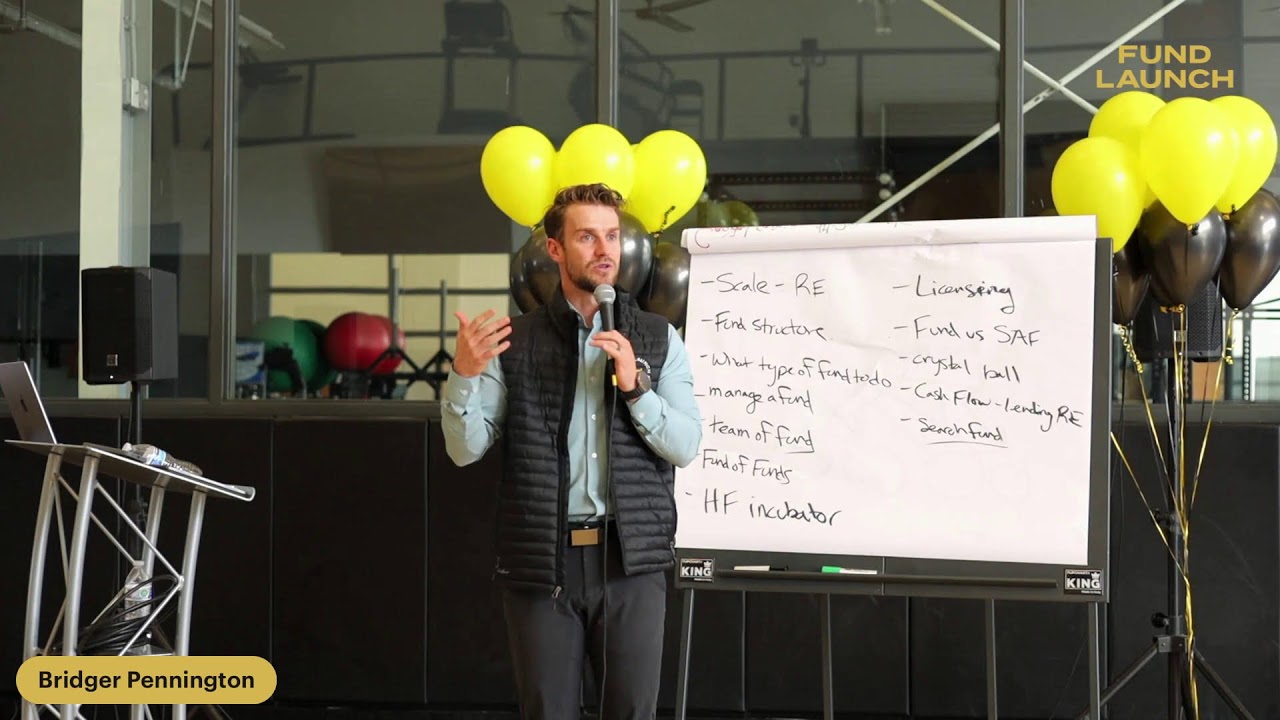
Bridger Pennington and Lincoln Archibald walk founders through launching an investment fund, from legal setup to operating costs. A lean launch runs $10-12k, while a lawyer-heavy approach costs $400-500k. Their incubator, Black Card, bundles legal, coaching, and software for $20-45k.
Chapters
All right, all right, all right, y'all grab a seat. We'll get rolling today. Welcome in, welcome in. Let's get this mic figured out. Welcome to Free Fun Friday. Yeah, good to have you all here. You can clap it up for all y'all making it. Good job. We got, we got Eric here from Vegas. Woke up at 1 AM, drove just straight from Vegas to be here, and one speeding ticket in Juab County. Yep, those guys are sticklers over there. Here we are. And can you guys help me get some more cord on this? I can't move. I don't want to pull it all down. Anybody beat that? Anybody beat Eric? Came from a further location? Last guy we had, last time we had a guy flying from Atlanta to be here. We had another guy looking to fly in from Toronto. So, anybody else though? Everyone else Utah? Okay, sweet. Southern Idaho, okay, out of state, there you go. Left at 5:30, yeah. I'm in Idaho. Yeah, that's awesome. Welcome in, good to have you guys here. So today, to set the groundwork, so what we're gonna do today, you're like, what are we doing here in this, you know, basketball court? What we're gonna do, we've done— we did one last month, people loved it, and we said let's do another one. So the way we want to run this, we've— I get a lot of people that ask me for help on their funds. If they DM Bridger, can you help me with my funds? We have a full company here, Fund Launch, that helps people launch investment funds. We've launched hundreds of funds. over the last few years is what we do day in and day out. We like launch funds. We have a full incubator program. We have courses and stuff and videos online and stuff. We just, we help a full, and I'll talk more about this, a whole gamut of people launch funds. A lot of people ask me, Bridger, can you help me with my fund? And so we just said, you know what, just come to the office. Let's just do like one day a month. Just come by. We'll whiteboard stuff out. We can brainstorm. We can do all stuff. So we threw one last month called, we just called it Free Fund Friday. Most people will charge To do a workshop like this, people will charge thousands of dollars sometimes to come by and do a workshop, and I was like, let's just do it for free. Our mission at Fund Launch is to democratize Wall Street. I want more people to understand this game. I run 2 funds right now. It's been an amazing vehicle to be in. I want more people to understand what this game is. So I was like, just come to the office. You guys are here. It's awesome. Good to have you all here. I wanna make today pretty interactive. You guys came, you were there last time?
Yeah.
Yeah, you were there last time. I wanna make it pretty interactive. I want this to be very beneficial. You guys cool with that?
Yeah.
So, psychologists tell us that if you show up to an event like this, and you just— you guys help me. Oh, thank you so much. If you just show up and listen, you will remember about 0% long-term today. If you show up and take notes, you will remember about 2 to 5% long-term. If you use your body and voice, and you like work together, you'll remember about 50%. 15 to 17% long-term. So I'm gonna invite y'all, introvert, extrovert, whoever you are, to like engage. Does that sound good? I'm gonna have a lot of time.
We're gonna meet.
You have some really— I actually, I know a number of you guys in this room. You have some really great people already in this room. So I want you guys to meet one another, talk. We're gonna share. I'm gonna invite you guys to like participate. Does that sound good? You guys cool if we lock in? Okay, I love it. We'll talk about funds and have a great time today. As a little preamble, it's actually— let's just do this and I'll get things queued up. If you can, stand up for me. I'm actually gonna have you guys maybe move forward a little bit, and you guys move forward as well. I want you to stand up, get in groups of 3, and I want you to answer the question. So sorry, I'm having you guys move and think for a second. So move forward a little bit. Get in groups of 3 people, and I want you guys to just meet one another, say hello, and then talk. Why did you come today? What are you looking to get out of today? Like, why did you show up? What are you trying to learn or get out of? Like, why would you come today, this morning? Does that sound good?
Yeah.
So grab a group of 3, say hello, get talking. And get going. Just find a group. You can be in a 4 group. That's fine. Yeah, come join a group of 4. Welcome. That's all right. Yeah, yeah, yeah. OK, keep switching. Make sure everyone gets a chance to talk. 45 more seconds. We'll wrap it up here. If you're just walking in, grab— come grab a spot. We're talking, why'd you come today? Introduce yourself. You guys can meet one another. Why'd you show up today? Why'd you show up? All right, start wrapping up. Make your way back to your seats here. 20 seconds. Start wrapping it up. Wrap it up.
All right.
All right, grab a seat, grab a seat. Come forward if you can. Grab a seat, grab a seat. All right, thank y'all. Like I said, I'm gonna— come on back, come on back. Come on back. Okay, pretty fun. Good to see y'all, welcome in. Just shout out for me, why'd you guys show up today? Anybody wanna share, just quickly, doesn't have to be long? Why show up today, what were you hoping to get out of today? We can make a little list here too. What were some things that you were like, man, I'd love to talk about that? Scale? Let me, I'll write some of these down.
Scale.
Wait, real quick, scale in what sense? Scale in what sense? So, scale in particular to multifamily. Cool. So, in real estate multifamily.
Okay.
Sorry. And Eric, you had something? Fund structure.
Cool.
So, yeah. How does a fund work? How do you structure one? Very cool. What else? So, what, like, which direction to go from for in specific to like which fund to do?
Cool.
So, what type of fund to do? Like how to manage a fund? Like how to manage a fund? How to actually run one in the day-to-day? Like how to— very cool. I love it.
The team?
The team? Yeah, how to put together a team? Team in a fund? Very cool. What else? What else would you like to see? We're making a good list here. Yeah, go ahead. Using a fund to fund another. Another project or another fund?
Another fund.
Okay, so like a fund of funds, maybe? Fund of funds. And how does that work? Perfect, I love it. What else? Incubator, like a hedge fund incubator? Very cool. I'm gonna make— I'll just keep going down here. I'll put hedge fund. I know my handwriting is phenomenal. Can you guys even read that? We know what it means, right? We're all here, we know what it means. Sorry, I cut somebody off. Somebody else was saying something.
Yeah.
Licensing. I love it. Licensing, and then also fund versus syndication.
Yeah.
Oh, between those 2. Cool. Okay, we can do both.
Yeah.
We're calling it to a single asset fund. Kind of the— we're changing the vernacular a little bit. Syndication, there's so many different types of syndications. We're calling it more a single asset fund. So, one deal at a time versus like multiple deals at a time. I love it. Good list. What else? Yeah.
Crystal ball.
My crystal ball. Oh, it's often broken. It's usually very broken, but I can— I'll share, dude. I love sharing. If you follow me, I'm like, I'll share what I think, and then it's like always wrong. But no, just kidding. We have had a few good calls though. We've had some good calls on where we think your meetings are moving, and it's actually interesting to watch where right now with tariffs, whole international trade right now, the world is on fire economically. So where is that gonna lead? But crystal ball. Anything else? Anything else we're missing here? Yeah.
Mm-hmm.
Yep, I love it. I'm just going to put— I'll put cash flow in regards to lending on real estate, correct?
Okay.
Cool, we got a good list here. Anything else? Probably a lot more. Anything else come to mind? Like, man, I'd love to get that out today. Pretty good list. By the way, we'll hit some of these as I go. We'll probably check some off and then we'll go Q&A, whatever. Welcome in, good to have you here. We'll have some good times. Sound good? Search fund? We can put it on here. Yeah, throw it on. How does a search fund work? What even is a search fund? You know, how's that all work? I love it. Okay, like I said earlier, today I want to make this pretty interactive. This is a workshop. This is not here for me to just talk about something. I want to make this really interactive. We're gonna bring in Lincoln in a few minutes, my business partner with Funnel Launch Partners and Funnel Launch. We'll talk about it. Very good. Excellent. Well, I got the iPad here. We can just talk for hours. Sound good? You guys cool? Okay. Thank you all for participating and coming in. We're gonna— I'm gonna share a little bit groundwork on like funds, why funds, It might answer a few of these questions, and then we'll probably open it up for more some topic stuff. We'll just dive into certain topics that are useful to you guys. Sound good? And I might have you guys share. I'm gonna have you guys take notes. I probably will have you guys take notes and write down stuff, and maybe even build out something for your fund as well. Sound good? Decent plan for today? We'll try to wrap up by, for sure, noon, maybe even earlier, and we can just bleed out into Q&A. I can hang out, answer questions, whatever. Sound good? Cool. Okay, let me share. You guys can see my screen, obviously.
Here we go.
Awesome.
So let's talk about funds. Let's talk about where the world is right now, actually. So obviously, the last time we did this meeting, it was a week before Liberation Day, April 2nd, and I brought it up on the screen. Do you remember this? I was like, do you guys know what's happening next Wednesday? And everyone's like, no, I have no clue. And I'm like, it's Liberation Day. It's April 2nd. Like, no one knew this was coming. I'm like, dude, Trump has been tweeting about this for a month. And then lo and behold, Liberation Day hit and markets, I mean, have swung like crazy. So we obviously, we saw some of the biggest drops down In recent history, right? In the market. Furthermore, we've seen huge swings in the bond market. So if you guys saw April 9th when they put those Chinese tariffs on, there was major swings. So the 3 days before bond yields. So yields with bond prices are directly correlated. So the more bonds sell, the higher the yields are, and the more bond people buy bonds, the yields go down. Okay, they're directly correlated. They're like tied together. So we saw the weekend before a lot of people buying bonds. Okay, so yields were dropping and they were dropping at a major rate. I mean, bond market is pretty steady market. It was swinging drastically down. 3 days later, right, right as they hit China, we saw the, the exact opposite happen. Major selling of U.S. bonds, which you would theorize maybe China was dumping. They're the second largest holder of Treasuries on planet Earth, dumping their Treasuries. April 2nd to kind of punch back the United States. So we saw this April 9th, uh, Treasury yields. Now we're just theorizing, we don't really know. It could have been Warren Buffett as well. Warren Buffett holds— sitting on like $304 billion of Treasuries right now. He could be dumping as well Treasuries to get back into the market and buy in. We don't know. We will know probably in a month or two what actually happened because they have to report on their filings. So it's been some wild swings. That day was the day that Trump then tweeted in the morning, today is a good day to buy. Do you guys remember this? Crazy day, dude. This is like the craziest day of my entire life. He's like, it's a good time to buy. And I'm like looking at the market. The market's like sold off like crazy. I was up at like midnight watching. I was looking at charts and stuff. I was like, this is weird. Like, what is going on? And then the next morning he tweets and then like, what is 11:30 AM? He goes, we're putting a 90-day pause on tariffs, right? We had like the biggest single-day gain since 2008, which was crazy. Anyways, it was pretty fun. Our Black Card group, which is our internal group of fund managers, we were all talking and chatting about this. It was very interesting to watch all this move, all this movement. So We've had that. Now the market's kind of been up and down. We've had a few good rally days. The gold market has added roughly $12.5, $13 trillion in the last 18 months, which is bonkers. Gold was about a $12 trillion market cap. Now it's like $25 trillion, roughly. These are rough numbers. A lot of that money has been sucked out of equity markets and bond markets and has just fled to gold. We will see Right now, it's you know rumored eighty countries are negotiating with the White House on trade deals. I'm hopeful that things go well. We got Trump, obviously Howard Lutnick and Scott Besant, very smart individuals working on it. Scott Besant was arguably one of the best hedge fund macro traders of all time. He's like in that category. He was one of he was with Drunken Miller and Soros when they broke the Bank of England back in the nineties. He was like the analyst that helped them do that. And he's now our new Treasury Secretary. So very sharp dude. These guys are sharp. You know, when people say, I said this before, when people are like, they're so stupid. They don't know what they're doing. You ever heard people say that? Like, Jerome Powell, such an idiot. Biden is such an idiot. What, like, people say this. Trump's such an idiot. I go, I think idiot's the wrong term. These are the people who run the greatest superpower the world's ever seen. Left or right. They're not stupid. They're not stupid individuals. Now, they might tell you one thing and do something else. They might sound stupid on the teleprompter or whatever, but watch what they're doing. The actual behind-the-scenes game is very interesting. Now, they might be misguided, they might be evil, those are fine words to use, but like, oh, they just don't know what they're doing. I'm in Lehi, Utah, I know, I know how to do it. It's like, really? You know? Twitter Joe. So, I always go to the next, I operate under the assumption that people are very smart. I operate the assumption that countries and these individuals running the world superpowers are pretty smart individuals. There's a reason they're there. Uh, so what are the moves they're making and why are they saying it this way? Why is Jerome Powell doing X? Why is, uh, Janet Yellen, the previous administration, doing Y? What's the end game? What are they playing towards? My dad and me, my brother, wrote a book called Dollars, Gold, and Bitcoin. Talks about market manipulations happened over the last 2 decades. We've had Barclays back in 2007 got fined $300 million for manipulating the LIBOR price. Um, we had, uh, my dad, he's like, he looked up in 2018, there was roughly $13 trillion trading at zero or negative interest rates. He's like, I don't even know what a negative interest rate is, right? And he started looking at this, and then it grew into 20— and I'm getting the numbers a little bit wrong— 2019, 2020, 2021. It just grew, this number of zero or negative interest rates. He's like, he has a— he's like, I have a friend in Denmark. To give you an example of what a negative interest rate is, He's like, I have a friend in Denmark. His— he had an adjustable rate mortgage. You know how they adjust up and down? His mortgage went negative. The bank was paying him $25 a month to have a mortgage. That's a negative interest rate. You know, you buy a bond and you get a yield, like you get a 4%, 5%. A negative interest rate is I'm buying a bond and you just hold the money. And I'll pay you a fee for holding the money. It's very interesting. It's a strange world. We've, we've seen a lot of these strange things happen. So how do you make sense of a world that we're living in, right? So, um, welcome, and you guys can come grab a seat if you'd like. Uh, it's a very interesting place to be in. Then you go forward, Janet Yellen, right, and the Biden administration spending a trillion dollars every 100 days. I mean, we've seen major inflation around the globe. Now what's interesting is we've seen inflation in the United States The rest of the world has seen inflation as well. They're also, and it's worse than us, right? They're printing just as much money as we are. So you're like, man, the whole world is printing currency in a huge way. You know, Trump administration tried to slow them down, but they really haven't. I mean, M2, which is the global money supply, has just been on a rocket ship the last little bit. Generally speaking, when M2 money supply goes up, global spending, that money has to find a home somewhere. Generally speaking, it flows into assets. And those assets in nominal terms go up. In real terms, it's, you know, the same, but like inflation adjusted the same. But in nominal terms, things go up like gold, like Bitcoin, like real estate, like equities, like, you know, pretty much anything. Because there's just more dollars to go around. Does that make sense? This is why it's pretty fun to be a fund manager in today's world. There's a lot of dollars being created every day flowing into all the assets that you guys are looking to purchase or buy or be in. Just by the nature of the market we are in, those assets will probably just go up in value over time anyways. Now, can you find alpha? Can you find a risk-adjusted rate of return for those assets as well and build on top of that? It's a pretty fun space to be in. You can aggregate capital together to go buy those assets, get more of those assets in an inflationary environment. It's a pretty Pretty cool place to be. So welcome to Free Fun Friday. I mean, this is a, this is a very timely thing to be a part of. Being a fund manager in this environment is extremely fun. It's, it is awesome. So, um, is that making sense? Any comments? Yeah, you had a question. Yeah. Yep. Use this microphone real quick so people can hear you. I was all over Europe in summer of 2022. After all of our inflation was happening, and we thought our inflation here was bad. But I went to Turkey, and and they were their inflation was 75% a year. In Greece, it was 65% per year, and it was just like they were they were hurting, and it was just crazy. I was just sharing that. Well, yeah, thank you. It's it's we think it's just the United States. This is not in the United States. It is it is all over the globe right now. And it— people are trying to slow it down, and we've increased rates, but the European Central Bank just cut rates. We'll see if Jerome Powell cuts rates. There's about— markets are pricing in about an 88% chance he doesn't cut rates in the next meeting in 2 weeks. So we will see what happens. But it's, um, anyways, pretty interesting time right now with what's going on macroly around the world. And for a— if you think a little bit longer term, in terms of 3 years, 5 years, 10 years, 15 years, where does this lead? We could be going through Sorry, you guys are getting me talking here. I'm just gonna keep going. The, uh, they're calling it a Bretton Woods maybe 2.0 that might be happening right now. Do you guys know the Bretton Woods Agreement? So, 1944, after— at the near the end of World War II, uh, 44 countries from around the world flew into Bretton Woods, Connecticut, and they essentially reorganized the world trade. It's called the Bretton Woods Agreement. And essentially what happened from that agreement, the United States was the only country left on earth with a navy. And what we said was, hey, we have a Navy. We will protect all of your shipping lanes. So, we will protect everybody. We will become essentially— everyone's like, why is the US the world police? It's because we agreed to be the world police back at the Bretton Woods Agreement. And after that, we said, we will protect all of your shipping lanes as long as you trade with us. And everyone's like, do we have to pay? Like, what's the catch? Like, the catch is if you can use our currency, the dollar, that would be phenomenal. And then over time, it got more assertive that, hey, you just use our currency. We'll protect all of your shipping lanes. We'll pay for a navy. A navy is one of the most expensive things a country can buy. It's extremely expensive to have a navy. We have 11 supercarriers right now that have 2 nuclear engines on them. They can go for like 100 years and not stop. I mean, our aircraft carriers are crazy. A cool fact about aircraft carriers, and I'm getting on little threads here, but one aircraft carrier by itself Would be the 3rd most powerful air force in the world. Number 1 is the United States Air Force. Number 2 is China. Number 3 is one aircraft carrier from the United States. Okay? So, when we park an aircraft carrier off of Israel, the Gaza Strip, right? We just parked our brand new Ford-class carrier. It's like the 3rd most powerful air force in the world just parked off your coast. And everything goes, oh, shoot, like, this is serious. When we park one in the Red Sea, we park one in the South China Sea. You can kind of— sometimes they tell you where these aircraft carriers are. It's a big deal when we move our carrier fleets. And when an aircraft carrier moves, by the way, it goes with 15 other ships. It's like 2 battle destroyers or submarines. It's like a full aircraft carrier. What's it called? A strike group, I believe, that all flows together. It's crazy. We decide we do that. We pay for that because people use our currency, right? That was the Bretton Woods Agreement. If you've studied like the Fourth Turning, Ray Dalio, they always talk about these 80-year cycles. We're hitting that right now. There's a chance they're calling it the Mar-a-Lago Accords that could be going on right now. We will see what I'm hopeful it comes out well, but roughly 80 countries right now are negotiating with the United States for new trade agreements around the world to kind of reset a new world order of trade. Now I don't know; we can just theorize right now. It could be tariffs, it could be not tariffs, it could be us versus China. There's a lot of theories out there on how this will work. I don't know. We can just theorize here, but that is um. What could be emerging here in the next 90 days? I mean, this is monumental stuff that's going on now. There's a chance they just de-escalate, doesn't go out. But from where it's from, what at least I'm studying, it feels like there could be this. I mean, a massive new shift in the world order of trade, and we're living through it right now. Generally speaking, every time we've had one of these world order of trade shifts, the next you know these next decade following, next two decades following is usually booms. Absolute booms for certain countries that benefit from those trade agreements. I would assume the United States would probably end up favorable after this trade agreement, but who knows? We'll see. We're the largest economy in the world. We're the consumer of the entire world. You know, so far we're doing pretty well still. I know there's been a decline in the United States, but you know, where else are you gonna go? You're gonna go work with China? You know, they just canceled all IP law and copyright law. Probably not, you know, and so I'm hopeful. All that being said, we're sitting in an amazing opportunity. 2025 is a crazy time to be alive and to play in this game. Is that feeling good? Yeah? All right, I went a little too long on that, but we'll dive in. Okay, today's, we're gonna talk about funds. We'll go fast. I'm gonna set a little groundwork here for funds, how funds work, how they're built, and then I would love to, we're gonna talk about these. I'm gonna bring Lincoln on stage to talk about, anybody wanna talk about capital raising today too? We're gonna talk about capital raising. We'll have a fun time with that. Sound good? Yeah, if you're with me, say yes.
Yes.
Alright, let's do it. Okay, real quick, so you know who I'm talking, who's me in 60 seconds. You're like, who is this guy on stage? Just real briefly, just so you know I know what I'm talking about. I started 2 funds in college with Blackbridge Holdings. Some of you guys know my story, I'll tell it very briefly. My dad, I had no clue, had any money. I went to college, I started 6 businesses my first 2 years of college. I went to BYU. And, we grew up in a normal, nothing bad, but just a normal household. My dad just drove a car with a dent in the door. My dad, he comes to me and he says, Bridger, you're kinda like a chicken with your head cut off. Go talk to my business partner, this guy could really help you out. And I'm like, okay. So I drive over here into these hills up here, there's a beautiful huge mansion. I pull up to this mansion, it's gorgeous. It's got, he's got a basketball court in the basement, pool in the backyard, cars, the whole deal, right? I pull up, I knock on this guy's door, I go meet with him. It's a To make big house. a long story short, we sit down and I go, how did you get all of this? Like, how'd you do this? He goes, we run investment funds. At the time, they're managing $8.5 billion of real estate. This is like 5, I don't know, what is this, 8 years ago, 9 years ago? And I was like, wow. To put that in perspective, Grant, you guys know Grant Cardone, Cardone Capital? At the time, that's 2 times bigger than Cardone Capital was then. Today, I think they're near, my dad and him is now retired, but I think they're near $50 billion. They're 10 times bigger. They're 10x Grant Cardone is the size of their funds.
Wow.
Okay, which is just crazy. So I meet with this guy, I'm like, hey, can you be my mentor? Can you teach me? He goes, dude, go talk to your dad. Your dad knows way more about this than I do. I said, no, my dad's kind of broke, you know, he drives a car, you're in this nice house, I want to learn from you. And he goes, Bridger, sorry to break it to you, but me and your dad make about the same amount of money. And my chin drops to the floor, I was like, huh? Like, come again? He goes, yeah, me and your dad are pretty much equal business partners in this. I left the dude's house, I went straight to my dad's house, I was like, Dad, what the heck? Like, why haven't we been able to— like, we don't go on vacation for like 4 years at a time because it's too expensive, and yet you're managing billions of dollars in these funds. Like, what's going on? You know? Anyways, he kind of laughs and says, yeah, my business partner likes to spend his money. I like to save my money, and, you know, I'm more conservative. But yeah, we run these big funds. So, he started teaching me about funds. So, I would go to his house every Sunday night. We'd talk about funds, teach, you know, he'd chat me about funds. In college at BYU, I had an opportunity as an internship And I saw where we could launch a fund for this company and finance their clients that were coming through this business. That was a great idea. I took it to my dad, we built this whole thing out. I was super excited. We got it all launched, we're ready to go. And I'm like, crap, now I gotta go raise money. Like, who am I gonna find money from? And I thought, I'll go pitch my dad.
Duh.
Like, he doesn't spend his money on cars or vacations or boats or anything. Like, my dad's probably got millions of dollars saved away. I'll go pitch him. So I went and pitched my dad for money. Some of you guys have heard the story before, but I'll keep saying it because here we are. I pitched my dad for money. I sit down and I say, Dad, how would you like to be our first investor into our fund? He kind of smiles and laughs and says, if I invest in your fund, I would ruin the experience of you raising money on your own. This is a crutch that you'll never be able to recover from, and if I do this, you will, you know, this will put you on a bad, you know, route in the future. And so anyways, he says no. I went out, hit the streets. I talked to everybody I knew. I raised a whopping $49,500 for my first fund. So teeny fund. I was 22 years old. But it was enough to get started. We launched this first little fund called Blackbridge Holdings. I got a 64% return to my first investors, which is good. So good amount of return, but really small fund. We then dovetailed that into a second fund. That second fund I ran for 3 and a half years. We raised and deployed millions of dollars over the next 3 years. And the small debt vehicle did extremely well. Our cash-on-cash returns were 62%, 47%, and 36% cash-on-cash return to our investors, which was awesome. We then had a competitor come and buy us out with BlackBridge Holdings. I run a company called FundLaunch briefly, and then I'll skip that for a second. I currently run 2 funds right now. Ugly Unicorn is a blockchain investment fund. We do a lot with crypto. We manage about $25 million in crypto assets. We've done extremely well there. And so this is an old slide. I got to update it here. And then GP stakes, we run a company called Fund Launch Partners. We just raised a $30 million close. We raised about $20 million of that in the last 60 days. So I'm gonna have Lincoln come in a minute and talk through that capital raise and how they raised all that money here just right now. They're raising it and they're in Lehi, Utah. How do they do that right now of equity that they've raised that'll allow us to do probably get up to maybe $100, $150 million of AUM under that? under that brand. So that's pretty cool. We're now investing into funds that come out of Fund Launch. So during all this, people started to ask myself, my dad, my brother— my brother's an investment funds attorney— how do you guys do funds? What are funds like? What does this look like? So we started making content online that dovetailed into a course, and now we have a full incubator, uh, called Black Card. So we, we have about— what is it, 1,200 people in Black Card right now? Something like that. We have 1,200 people going through our incubator in Black Card. Black Card's not cheap. It's $20,000 to maybe $45,000. We incubate, we bring in, we have 8 different law firms, we have pitch deck designers, we have 15 coaches that like help you go and launch your fund. We have a full software CRM that you use. We've launched roughly 300 funds in the last few years through Black Card. So, that's what we've done with FundLaunch. Does that sound good? Give you a little reason why I feel like I have somewhat authority to talk on the subject. We've done a number of funds. We've all done them unconventionally. I didn't go to Harvard. I didn't go to Ivy League schools. None of us did. We kind of did this the untraditional path, and now we've helped a lot of people do the same thing. Sound good? Okay, so why funds? We live in interesting times. I talked about that a second ago. I love, I love this quote: watch what people do, not what they say they do. There's a lot of people online. If you look at these kind of people— Grant Cardone, Cody Sanchez— maybe you've seen some of these people. Tai Lopez, Pace Morby. Do you guys know what they all have in common? They're big audiences. Okay, they're online, they're influencers, they're teaching something online. The other commonality, they're all starting funds. A lot of these online influencers, they teach you how to do website building or whatever, and in the background they're running funds. I know this because they call me like, hey, how do I do a fund? I'm like, okay, let's build it out. A lot of them are building funds. Right here, Grant Cardone, he's a sales trainer for years, now runs $4 billion Cardone Capital. Cody Sanchez, Contrary Thinker, she's doing private equity buying small businesses. Have you seen her online? Pace Morby, I just was with him a few weeks ago. We were together with him. He's raising a $100 million fund right now. He's the seller finance guy, right? He's raising a $100 million fund. And then finally, Tai Lopez, he raised his fund before they bought Pier 1 Imports, RadioShack, kind of crashed and burned, to be honest, their fund, if you followed them. But anyways, the point stands that they're running funds. Alex and Leila Hormozi, they actually bought our program. What— this is before they were famous. We went to Bear Lake, went boating with them. They came to Utah, we hung out with them. And then they blew up. I haven't talked to them since they've blown up, but we were friends before that. And, and what are they doing right now? Private equity. They're buying businesses. This is what all these people online that are teaching, they all are ending up in this fund. I was with Russell Brunson a few months ago. He is on an acquisition spree right now. They've bought a number of businesses right now through ClickFunnels, and they're acquiring businesses at mass. This is the route that a lot of successful people are going is into this fund space. Is this making sense? Yeah, okay, I'm gonna go kind of speed up and go fast and we'll get some of these questions, sound good? We'll go fast and slow. So, they're all starting funds. This is kind of this path that they are on. Now, there's a common thread that a lot of them go and a lot of us I think can go on and we'll use this framework for a while, is you test with your own money. So maybe let's take like trading, like you're trading options. A lot of guys test with their own money. They then syndicate or do like a hedge fund incubator. We're gonna talk about that in a minute with a small group of money, and then a fund would be doing it with a big group of money and doing this over and over and over again. Okay, that's kind of the progression that most people go on. Not all, but most. You can jump into this, you know, you can jump to a fund or jump to a syndicate, but most people go on this kind of progression. Um, now we already hit this. These are a few guys that we've helped do this. So our last investor, this is Jason, said he got $51 million. This takes us to $60 million of our $100 million raise in Texas. This is Heather. They— she found a couple different people doing private credit, $15 million in a private credit fund. You can see right there, if you can kind of see that. Excuse me, it's kind of small. This is Kaloa. This actually— he's in Utah. He has been up here to the Hilton campus. If you see right here, they're building a $500 million campus. They bought a $100 million deal in Park City. Huge commercial space. Hello, he actually spoke at our event last year. Awesome dude here in Utah. The Waldorf up there, if you've been to that hotel, that's his hotel they bought through a fund that we helped them structure and put together. So we know a little bit about what we're talking about with in regards to fund. This is my family. It's my beautiful wife and son Jonah. So my goal today is you why you should consider launching a fund, and then we're going to talk through actually mechanics and why you're doing this. Now you can be there's two different types of people that do this. Raise a hand real quick. Who's more a— who's a business owner? And then there's investors that are investors that want to scale. Who'd be more like the business owner side? Who like currently runs a business? Okay. And then who's more the investor side? Like you, you know, and maybe you can say you're a little bit of both. You can do 2 hands if you'd like. Cool. I like it. This is for either group. We help both groups who want to scale. I'll give you a few examples of ideas, kind of get your brain spinning, and then we'll do some breakout stuff. We'll talk a little bit more. So, oh shoot, I was gonna get through here in a second. Let me, I'll jump, I'll come back to this in a second. So, we had a guy in our group, he was flipping 4 houses a year. We set up a fund with him, the next year he flipped 72 homes. I like sharing this example because it shows how many of you guys are in real estate? How many people in real estate in here? Okay, a few. Let me ask you this question. So, he was flipping 4 houses a year, doing well. The average house flip makes $64,000, $65,000 per flip. So he's making about $200,000 a year flipping houses. Professional house flipper, done this for years. He calls us up, he's like, what if I did a fund? What would that look like? So we structured it together, we put it on paper, we built this whole thing out. The next year he flipped 72 homes, okay? Scaled quite drastically as you can see here. But I'll ask you a question. House flippers or real estate people, if you had a fund behind you, do you think you would close faster or slower? Pretty obvious, probably faster, right? That's an obvious question. Do you think banks would give you better or worse interest rates? Probably better. You're a repeat client, right? They'll probably give you better rates. Do you think you would, per house flip, do you think your cost per flip would go up or down?
Down.
Down, economies of scale. You're— because you can have the same paint guy, Go to every house and paint all the houses. He's probably going to give you a volume discount. The same carpet person. Oh yeah, you know what, you're going to do 10 houses? Yeah, you know what, we'll drop your fees. So you get an average cost per flip goes down. We could keep doing this, but if you follow along, so someone that runs a fund— so sorry, I'll take you back for a second. Anybody bid on a property before and someone's outbid you and you look at it and you're like, they overpaid? Anybody said this before?
Yeah.
I've done this a number of times. I was bidding on a duplex like years ago and somebody outbid me and I'm like, ah, they overpaid. They don't know. Because I've got my spreadsheet and I've got my pro forma and my pro forma says I can pay $472,000 with, you know, hard money and whatever financing and they want— they're paying $580,000, like another $100,000 over. I mean, it was a big jump. This is back when like the market was really hot. And I was like, they're going to lose their shorts. You guys have done this before, right? Maybe they're not playing the same game that me and you are playing. Maybe on their pro forma, they have lower cost of debt. Their debt's cheaper. They get lower cost to do the flip, right? Because they get a volume discount. Furthermore, when you have a portfolio of homes, 72 homes, could you bundle that portfolio together and sell it as a portfolio to somebody else for a multiple?
Yes.
So, right now, if I jump back, we are seeing this at scale. We are seeing a number of funds take over the world. Some of you guys, I've shared this before, but in 2021, 1 in 7 homes was purchased by Wall Street. 2022, 1 in 5 homes. 2023, it was 1 in 3 homes purchased by Wall Street. You know, where are all these cash buyers coming from?
They're not. Funds.
Big funds. There's a handful of funds taking over the world right now. If you see BlackRock, State Street, and Vanguard combined manage roughly $22 to $25 trillion. They are the largest shareholders on, I think, 475 of the Fortune 500 companies. I mean, it's bonkers. What's the job of a CEO? Increase and return shareholder value. That's the number one job. If you're Tim Cook, the number one job is increase in return shareholder value. And when your largest shareholder Vanguard calls you up or BlackRock and says you need to push an ESG agenda, guess what you do? You push an ESG agenda. This is what BlackRock did back in 2011, I believe. And every Fortune 500 company all of a sudden had ESG initiatives. You guys remember this? Out of nowhere, everyone— how did all these companies all of a sudden everyone's doing all these ESG initiatives? It's because their largest shareholders demanded it. They run the world. And then in 2021, I believe, BlackRock came out and said, well, that was kind of a mistake. It didn't work as intended. People did all these loopholes and we're getting out. Like, the intention was good, but the actual execution was pretty bad on ESG, which is environmental, social, and governance initiatives within companies. It's pretty interesting about who runs the world. If you look at industries that are consolidated, TV news, food production, We're starting to see more industries getting consolidated here. So car washes, dentists, food franchises, real estate, social media accounts. We are living in a world of consolidation right now. Many social media accounts me and you follow are owned by the same people. I'll give you a few examples. Michael Bloomberg, when he ran for president in 2020, do you know they bought like 50 to 100 social media accounts? They just left them, but they bought, they actually bought these meme, they were meme accounts, most of them, they were buying meme accounts. And just, hey, you should keep running your means, but then slip in some pro-Michael Bloomberg propaganda to your people. There's rumored right now, we'll see if it's true, MrBeast sold to Disney for like $8.5 billion. This was like last year. Then they came out and said it wasn't true. It is true, it's not true, there's been whistleblowers, we don't really know, but that's the stuff we do know. These are an independent YouTube channel rumored that it's owned by Disney. Interesting. And actually, if I go forward, you can look at the media giants. We think we're watching TV and media from different people. It's generally the same groups that control pretty much everything me and you think. Disney actually bought 21st Century Fox. So it's actually the 5 media giants control every brand me and you kind of see. Here's food and food production. Mass consolidation happening right now. Here's car companies. Here's the brands that are all controlled pretty much by the same groups. It's kind of, I'm going through this fast, but kind of freaky how many of these, like, who would have thought Maserati is the, and Alfa Romeo is the same company that makes Ram, Jeep, Dodge, and Chrysler? It's the same company, it's FCA. It's kind of weird, huh? Your Jeep and Maserati are from the same company. Kind of weird, huh? There's mass consolidation going on, so how do we play in this game? There's been a major rise of retail investors, the actual people. I think that's why we need more people to launch funds. This is, this is why I preach this, why I do a Free Fund Friday. I believe more of us need to understand the fund game, how to play in this, how to understand whether you're gonna invest in these funds or maybe launch your own funds, how this game actually works. Now you might say, well, Bridger, you're part of the problem, you're helping people launch funds. Maybe I am. But, uh, I'm, I'm not okay with 3 funds taking over the world. I am okay with 10,000 independent funds all competing against each other and competing, making a competitive marketplace. Does that make sense? I'm okay with that. I'm not okay with State Street, Vanguard, and BlackRock running the whole world. Does that make sense? Where you're gonna own nothing and be happy if you follow the World Economic Forum, right? Which, Klaus Schwab, that's kind of weird this week, right?
Any room?
I don't know.
I don't know. I get that. I got to go down the conspiracy. If you guys know the World Economic Forum, Klaus Schwab, he's like the head of that for what, decades? The Pope dies Monday and then Klaus Schwab just resigns like hours later. No press tour, no speech. He just submitted an article like, I've resigned.
I don't know.
That's freaky, dude. I don't know what's going on. And I'd love to Here, like I don't know, get down that rabbit hole.
But we'll see.
Anybody? Anybody have any rabbit hole on that coordinates with the end of the world and all the Illuminati and all these different groups that all work together? Yeah, you can use this.
Anyway, I was just reading it last night.
I mean.
Supposedly the Pope dying was the last seal that needed to happen for all that, and then Klaus Schwab stepped down to usher in the New World Order that he's been trying to do for decades. So how much of that is true?
Don't know, but interesting. Well, we'll see.
I don't know.
Go watch some Alex Jones if you want. I'm sure he's got it all figured out. He really does though, actually. To give Alex Jones credit though, man, the The dude has hit— he's missed on some, but man, he's hit on a couple, you know, really well. You had a hand up? Yeah, yeah, yep. Not even buying just small, it means that this is just giants buying giants.
Yep.
It's kind of scary, honestly. Like, is there going to be these 3 How do we play in the game of mass consolidations going on right now? Yeah, you're in a small fraction of the industry.
Yep.
I love it. Let's actually talk about it right now. That's kind of dovetailing into what we're doing. Um, great question. Yeah. Quantum computing.
Yeah, there's—
well, there's— it's a dynamic game, right? There's multiple things happening together. So you mentioned the divergence of technologies. We have Roughly, you can number them, but, uh, 10 emerging technologies right now that are all converging together at the same time. You mentioned AI, quantum computing, blockchain, robotics, 5G. You can go through like the, um, 3D printing, all taking effect. Bioengineering, yes, biotech. It's— and it's crazy, and they're all helping one another, and it's creating a new world order as well. And then we have a new world— people trying to create a new world order here, and then consolidation happening all at the same time with mass money printing. And obviously Trump, which I mentioned in the beginning, was, they're renegotiating world trade right now. Okay, so we have this very dynamic game that we are playing in. How do we play in this game? How do we survive? The first thing I'll say is, learn some of, at least if you can, the rules of the game, or how they're playing the game. How do I think a little bit bigger and differently? I'll actually share an example for a second. Let's talk about this. My business owners, okay? I talked to a guy, and I'm gonna hit on your question here. So, I had a friend call me up. He has a gun store. Gun store business calls me up. He's like, Bridger, I want to buy out my competitors. Like, how does this work? He goes, should I raise? I'm like, well, you got a couple options. You could raise equity, kind of like Shark Tank. You could like, you know, 20% of my business, I'll raise $1 million, and we'll go buy the competitors. You could bring in debt. You could bring like an SBA loan. You could bring in other bank financing. You could do like a seller financing. Or I said another option is you start up a fund. I think I'm on my next slide. Oh, it's not here. A fund on the outside here that buys out your competitor businesses and rolls them together and then contracts your original gun business to help manage the stores because you're good at managing the gun stores, right? And so, I'll go here for a second. You guys that are in business, His gun store is here. So, I'll put GS for gun store, okay? We're going to start an outside fund. He also owns the fund with investors. Investors put money in. He just runs his gun store. His gun store does about $10 million a year. Just leave it as is. It's good. Don't mess with it. Start an outside business. A fund, you raise whatever money you need. We then— let's see if I can— okay, you know, I'm gonna go a little bit slower with the markers. I don't want to mess up my whole shirt here. Alright, so he takes the fund. We're gonna buy the 3 or 4 competitor businesses. We're gonna do M&A activity. These businesses are now owned by the fund, okay? At the end of the year, money flows back to the fund and maybe do a distribution or dividend to the investors on how that runs. But I said— You're good at running gun stores, right? The fund is going to contract you for a fee to help us run the gun stores. You know, staff them, employment, supply chain. And you can put your branding on all these stores. So now in a certain— I won't tell you where he's at, but the region of the United States, it looks like he has a complete monopoly on the market. Now, they're owned by different groups, but he puts his branding, he runs the stores effectively, he now owns and controls that whole market. Is this making sense? John D. Rockefeller, right? Own nothing, control everything. If you're wondering, how do people play, like, at a bigger game? Like, how does this work? That's one way it works. Let me share another example, actually from Rockefeller. I'm reading his book right now, 38 Letters to His Son. Have you guys ever read this book before?
No.
John D. Rockefeller wrote 38 letters to his son, John, and they compiled it to a book called 38 Letters from John D. Rockefeller to His Son. It is phenomenal. If you guys don't know, John D. Rockefeller was the original oil tycoon in the United States, became the richest man in the world, one of the richest people to ever live. And I'll tell you 2 stories, this is a side note. He tells in one of the letters, like, his origin story. He goes, he grew up poor, and a photographer came to school, one day to photograph all the kids. And they all went out, they were so excited to see this photographer, they all came out. This is John D. Rockefeller telling his son, he's like, they— and he goes, this photo I have is the most prized possession that I own. And this is like the richest man in the world, right? He's saying this photo he has when he's a kid is the most prized possession ever. He goes, let me tell you the story of what happened. So, the kids all line up, the photographer has them all there and says, you know what? This one kid in the front, John, John is your name?
Yeah.
Your clothes are too ragged and tattered. Can you step out of the photo and we'll get a picture of the rest of the students? They make him stand out and he watches his fellow schoolmates get a picture. And he said in that moment, he's like, I determined I would be the richest man on earth. And he goes, I don't have any— I have no hard feelings. I wasn't sad for myself. I just set a determination. This will never happen again. I'm not going to feel sorry for myself. I'm not going to pity myself. I'm going to go make it happen. And he goes, I still have that photo of my schoolmates, and he's like, I love my schoolmates, they were my best friends. I have it on my desk today, like 50 years later, I love that picture, 'cause it set me on a course in my life where I would go, like, take over the world. Isn't that kinda crazy? That's like his villain origin story, from John D. Rockefeller, like 100 years ago, it's just like crazy, right? So, let me share an example, I talked to a guy yesterday about this same thing. So, he was in the HVAC business, So, he's like, I run HVAC companies. And he kept— I was on a podcast, he's like, hey, should I go buy these businesses? Like, what should I do? And like, is it a good investment? And I'm like, well, maybe, I don't know. And he goes, well, a lot of guys are doing this, this is a cool thing, it's a fractured industry. Have you heard of this before? Like, a lot of people right now are buying these boring businesses. I was like, yeah, it could be good. But I said, make sure you're thinking through the second and tertiary effects of entering this market. He's like, what do you mean? And I go, well, for example, you're in a fractured market, which could be good for you, meaning there's old systems, you could update things, you can do stuff. However, if you don't try to play bigger in this market, someone else will. To your point, like, what do you do if something's being consolidated? I said, if you took a playbook out of John D. Rockefeller, and in his letters he talks about this, he had a competitor in Pennsylvania. that started doing oil drilling, making refinery in Pennsylvania, and he's in Ohio, was his headquarters, and they're all selling to New York, okay? And this competitor comes, he goes to the competitor, he offers him money to buy his company, the competitor says no. He offers him more money, competitor says no. He says, fine. John D. Rockefeller goes and buys up a strip of land between Pennsylvania and New York, like hundreds of miles from farmers, overpays all these farmers to buy a strip of land so that he can block the pipeline from his competitor. Does this make sense? Competitor finds a way around it, found a loophole, got his— still got his pipeline through. He's like, crap. So then he calls the railroads because his buddies all run the railroad companies. Like, hey, I'll pay you, don't let him cross any of your lines because I need to be supplying to New York. And the railroads— he had already— his competitor had already talked to the railroads and already had a deal with him. He's like, sorry, we can't cross this deal. He goes— so then he like, he's like, man, he's like taking defeat. And this guy's starting to sell now to New York and is taking market share from John D. Rockefeller. So Rockefeller says, well, fine, I'm gonna go to his, I guess it's like barrel supplier, like the huge drums that they hold oil in. He goes, I'm gonna go to that supplier, I'm gonna place the largest purchase order this supplier's ever seen, and I need it delivered in an unreasonable amount of time. So he goes to the supplier, he says, I'm gonna place whatever X number of barrels order, and I need you to take care of me as your number one, you know, I'm the biggest guy in the country, you need to take care of me, and what happened was he canceled all the orders for everybody else, including his competitor. So he's like, that was step 1, I wanted to starve him out of his barrel supply. Step number 2, he goes, I went to New York and I undercut my costs of oil down to a loss. We ran at a loss for months so that all of his customers would come buy from us, and we bled him out until the point that he was ready to sell and we bought his company. Now that sounds brutal, right? Let me give you an updated example. Jeff Bezos. Do you guys know the company, I'll come back to this in a second, AWS. You guys heard of AWS? AWS, Amazon Web Services, launched in 2005, '06, '07, somewhere in there. Cloud computing pretty much runs the internet today. I mean, AWS, pretty much most of the internet runs on AWS, all the backend servers here. Does this make sense?
Yeah.
Jeff Bezos has a famous quote that says, your margin is my opportunity. When they entered the market of AWS, guess what they did? They built these massive data centers, huge. I'm talking billions of dollars of capital investment on CapEx. They built these data centers and he goes, let's call it margins. You know, somebody's getting a, you know, 5 cents on the dollar margin and we were gonna launch and get 3 or 4 or 5 cents. We went to negative 2 cents. on the margin. And what we did, we ran at a loss on purpose for 2, 3, 4, 5 years with AWS.
Why?
So that every customer on Earth would use AWS. We'd bleed out every competitor— sorry, every customer on Earth would use AWS. Every competitor would be bled out, and then we could raise prices later. That's how AWS launched. So, I went back to HVAC, I said, you know, you're going to buy this nice little HVAC company nearby, it's awesome, maybe it's going to run well. What if someone comes to town, a bigger group that has a fund behind them, and says, hey, we're entering the Lehi, Utah market, we're going to go buy up a bunch of groups, and we're going to run them at a loss for 18 months so that you go bankrupt, or you can just sell to us. You're in a tight spot. They have more capital, they can bleed you out and literally run and take market share from you. And I just said, you're in a fractured industry right now, it is being, it's getting more and more consolidated. This is the game they are playing, whether you like it or not, that's the game that's being played. So you need to figure out if you can, do you wanna play that game, do you wanna leave this market, what do you wanna do? And he's like, oh, I've never thought that way, and I'm like, That the secondary and tertiary effects of just buying an HVAC company, that's where it leads. Now, I said it might not happen. Your market's very fractured. There's a lot of HVAC companies. It's a big country, so who knows? You could be fine for 7, 10, 15, 20 years. That might not happen, but eventually it probably will happen, and you can do it or somebody else can do it and take over market share. Is this making sense? And he was like, oh dang. And I was like, okay, so what do you want to do? He's like, let's build a fund. I'm like, okay, let's build a fund. Let's make sure you actually like approach this the right way. It comes from a, actually I'll just draw it here, an amazing concept that I love called Red Ocean, Blue Ocean Strategy. You guys heard of this before? A book called Play Bigger. I'll draw it out briefly for you. We actually, me and Jen, we met the author of Play Bigger, right? He came to that event we were at. So, Play Bigger, phenomenal book, talks about the same concept. There are red oceans and blue oceans. Red and blue. Red and blue. I guess you can see the colors unless you're colorblind. I don't have to draw red and blue. So, he goes, what if I told you in tech, 74% of market share goes to one company? In every— these are categories. So, a red ocean would be a category. Goes to one company. Everyone else fights for the scraps. He goes, take Google for example. Google is a category king of their red ocean, which is internet search. They dominate, it's like 92% of internet search goes on Google. Microsoft launched Bing, you guys remember Bing? Okay, this is Microsoft, this is not, this isn't any, this is Microsoft. They have spent roughly $11 billion on Bing since 2011 launching it. That's a lot of money. Big company, big user base. They can put on all their Windows S. They're going to come take market share from Google, right? Today, you guys know the market share of Bing? Less than four percent, three percent, like that. It's like Google still because it's they're the dominant category king. It's very hard to displace a category king once they're the category king. So the question is, what is the second largest search engine in the world? Can you guys see this, by the way? Is it like behind the stand? I can move it forward. What's the second largest search engine in the world? Nope, not Safari. Not YouTube. Yeah, it's YouTube. Sorry, not YouTube. I was gonna say not Yahoo. It's YouTube. YouTube, and this is before Google bought them. YouTube became the second largest search in the world. Why? Because they were different. They didn't build a me too something better. They built something different in a new category, video search. And they blew up and then Google ended up buying them. They dominate, guess what? 90% of video is on YouTube. There's Vimeo, these other little Wistia, there's other little ones, they all fight for the little teeny market share and this has now become a red ocean. Is this kind of making sense? Don't do something better, do something different. Create a new category. So the 2 great books, Play Bigger, And Blue Ocean Strategy talks about this concept when you're building and constructing a brand. So like back to HVAC, I was like, dude, I would try to build a new category within HVAC, something different. Now I'm like, but if you can't do that, maybe it's a business you can't do it, I would try to be the biggest one then. If it's a fraction, just be the one who has a fund behind you who goes and buys. Okay, last question as we finish this. What is the now emerging blue ocean That's threatening Google this market share. ChatGPT. That is the new blue ocean. It's becoming red very quickly right now of AI search. The biggest threat to Google right now is not Bing. They own YouTube. It is ChatGPT. It's ChatGPT. And now they've launched Gemini and all these other ones because they're trying to now play in that game because they know the market share of just internet search right now is being sucked into these new blue oceans. Grok, yeah, there's all these other ones that are emerging, but that's the threat to Google right now. People are going to go search on Grok rather than suturing in goo because it's so much more useful. Isn't that interesting? Make something different, not something better. Kind of cool, yeah? Okay, how are we looking on time here?
Oh, perfect.
Oh, there's Lincoln. Okay, I'm gonna bring up Lincoln in just a second here. Let's do this. Is this useful, by the way? Kind of been good so far? Okay, a few more examples of this, just people playing bigger. Stock traders, we help a lot. And the last thing I'm gonna share, and then we'll— and I want to have you guys think about this for a second. We'll probably write a few things down, and then I'm gonna get Lincoln on stage. You might ask the question, well, can we even play in this game? Emerging fund managers, here's a few stats. for emerging fund managers that I pulled here. Emerging— this is from Prequin Research. Emerging fund managers, these are small fund managers like us, okay? We're maybe even micro fund managers, but emerging new fund managers, they did some stats on versus old seasoned fund managers. 22 out of the last 28 years, emerging fund managers outperformed existing funds. Isn't that interesting?
Yeah.
It's like, can you play in this game? The answer is yes. I'll show you another example. Younger hedge funds performed seasoned managers by an average of 250 basis points by EVest Emerging Managers Report. Isn't that interesting? Now, why? It's somewhat because you're like, well, they're so seasoned. It's a lot harder to get returns when you're over $1 billion. To get a 22% return with $100 grand is much easier than getting a 22% return with $1.5 billion. Does that make sense? Because when you have smaller money, you can work in smaller, more fractured markets. You can work in, you know, places that aren't as efficient. When you get to bigger funds, you have to deploy huge slugs of capital. Getting that type of return profile is a lot harder. Does that make sense? Now, that being said, 41% of allocators won't invest in first-time funds. You see this chart here? So, 41 at the bottom will not invest in first-time funds. 10% will only invest in spin-offs only of like an existing fund. 16% will consider investing in first-time funds, and then 33% will invest in first-time funds. So, capital raising is kind of interesting for first-time funds. It's a lot harder. So, I'm gonna bring up Lincoln in a second here to talk about capital raising. They just raised roughly $30 million from launch partners. That's $30 million of equity raised, and now they can go buy, you know, that allows them to get a lot more AUM. So we'll bring him up in a second. What I want you guys to think about and maybe think through is that whole discussion on scale, right? We kind of hit, I think one of the questions was on scale for your business. Can we do this for a second? If you guys have something to write with, I asked you guys to play along at the beginning. If you can, maybe pull out a pen and paper. Think through your existing business on that whole conversation of scale, John D. Rockefeller, all that stuff. What is a way that you could grab more market share and/or position your company in a new market? Maybe you are in a competitive market, man. I got to pivot. How could you be something different, not just better? Does that make sense? Like you got the question kind of there. So brainstorm for a second. Open up a pen and paper. I'm gonna give you a let's call it two minutes. Just write down about your existing business or maybe the business you're getting into or what you want to start. How would you position yourself to be different? Because it's very hard to disrupt people that are different. And/or you say, well, I'm an HVAC guy, I'm not that different. How can I scale then? How can I go and buy market share and grab market share? Sound good? Okay, pen and paper, put your phone if you can. I asked you guys to play out at the beginning. So put your phone, don't check Twitter or the news, try to write down. 2 minutes, ready, set, go.
Go.
And Lincoln, let's get you queued up, up here. I'll play a little music for you. How could you position your company different? How could you plan more of a blue ocean? How could you take over maybe competitors or a market share of the market that you're currently in? Think from the perspective, if you had unlimited money, what would you do? That's another question. If I had $50 million, $80 million just sitting in an account right now, how would I position myself if the goal was to take market share? Answer that question. We'll give you one more minute here, and then we'll get started. All right, you guys got something? Give me like a head nod if you got something. Something good? I'll give you 20 more seconds here if you're still writing. Alright, let's do this for a second, actually. Okay, everyone look up at me. You guys here? Some of you guys met some people before. What I'm gonna do, let's have you stand up. Let's get in groups of 3, and I'm gonna have you share, if you're comfortable, share some of the stuff you wrote down, something that was interesting to you. Sound good? Meet the people around you. I'm gonna do this, person with the most facial hair goes first, alright? Sound good? Person with the most facial hair goes first. Share what you got, maybe introduce yourself for a second, share for, let's go a minute a person, pretty quick, but how you answered this question, how you would kind of take over, move into a blue ocean, you can take it as you want, sound good? Okay, stand up for me, maybe talk to somebody you haven't talked to yet, so stand up, stand up, get in groups of 3. Person with the most facial hair goes first, get in a group of 3, get going, say hello. People in the back, you're welcome to come join and grab a group. JB. Meet somebody here.
Yeah, absolutely. Welcome.
What's your name? Jeremy. Jeremy.
Sam.
Ben. Blue ocean versus red ocean. Essentially, one of my companies, we sell residential. It's a pretty big space. We actually have employees in it. But what they don't do is have an established process and system and staff that's dedicated to functioning on that process flow. It's not something that's natural in the industry. They have to manage this like a rep? All of the above. So the sales process, the filming process, like a CRM. Beyond CRMs, but yeah, essentially like a CRM. So the problem is that none of them have a solidified system like that. They all do paper contracts, but they're still performing. Okay, keep rotating, give everyone a chance to talk. Keep going, keep going. I'm actually— I'm working with the actual You have a little more facial hair than I do, so. Start wrapping up. 1 minute, 1 minute. So what's an example? All right, come on back, come on back. Start wrapping up. Grab a seat. Come on back, come on back. Grab a seat, grab a seat here. Grab a seat, grab a seat. Alright, come on back, come on back. Okay, come on back, come on back. Who had somebody share something pretty cool in their group? Any nominations over here? Yeah, so everyone's pointing over here. Are you okay, Sharon?
I'm good.
Stand up for us. Maybe come up. We got to— we'll use the mic so people on virtual can hear. So tell us your name real quick and what you shared.
My name is Sue, and I just shared that I am a criminal defense lawyer. I came from working for nonprofit and poor people. I launched— I've worked for the Utah Supreme Court. We launched the first state to allow non-lawyers and software to engage in the practice of law. And I didn't see anything that I liked. So I launched my own legal tech company, and pretty quickly it became apparent that an app wasn't going to be too competitive, too much in that blue ocean. So we are building AWS for AI, essentially. Right now, there's no place to deploy actual AI agents, and there's no AI agents to actually connect all your data to your benefit. So what we're building is A new platform, new base foundational tech. They'll basically put an AI bot in your data and give just a report to whatever professional is trying to help you. So sorry, I'm a little nervous. I didn't expect to be put on the spot.
Not well said.
So we have something different, but raising the foundational money to do this Foundational tech is hard to get investment in. I've also been approached because we're trying to do a matching piece to match the professional with the need, and we have a housing crisis in Utah. As you all know, it's expensive, and I've been approached by developers and real estate agents and landlords that want to actually develop affordable housing. So I'm here to learn how to do both the tech foundation and private equity as well as the real estate. fund for, and both have that technological base to use your personal data to your benefit, connect your data, and be able to just give the professional a limited amount of information to help you without taking control or ownership. So small data, blockchain, AWS for AI agents to really have a place to deploy them appropriately.
Very cool.
Is your—
are your agents going to be in the legal field?
I'm starting with legal.
Starting with legal, okay.
Because that's where I work.
Yep.
And also legal touches everything— financial data. Sorry. So I'm starting in legal because I'm a lawyer. I've practiced law for 15 years. I have not seen— 86% of Americans actually don't get any help with their legal issues, and we need to stop that. We need to actually increase access to legal assistance. And part of the issue is that legal touches everything. It's financial, it's medical, it's personal. If you're going to get a divorce, I'm going to ask you how old your kids are, where they go to school, where you work, what the equity in your home is like. It's going to be a really robust dataset and it's a lot of information to gather. So that's why lawyers are so expensive. So building tools like predictive drafting, AI context responder, the ability to go in and get the data and do that intake with avatar AI, right? And then I get that information. I do a draft petition, and I can help you actually match with a lawyer that's affordable for your need, as well as accessible and in your local region. So I'm all over it.
Thank you so much. Well put. Anybody over here have a good— something good that you wrote down? Maybe you wrote down or someone in your group wrote down? Anybody want to share? Yeah, come up here, Eric. Clap it for Eric, everybody.
How we doing? How we doing? So, uh, I've been a fitness trainer for the last, uh, 10 years now, and I see that, you know, uh, especially online, everybody has a podcast, everybody has social media. And, uh, really what I'm seeing is that the hardest thing that, you know, uh, I see with trainers that want to build their business online is that they are having struggles just you know, cutting through the noise. And my company, we recently just started a new media company helping other trainers, help them to get more clients, help them to build their business. So one thing that I thought too, as an expansion, as an idea, I'm actually going to the Licensing Expo in a couple weeks in Las Vegas. And, you know, I really liked what Pokémon Go did with getting people active, and I thought that that market is really up formed yet. So I said to myself, what if there was a way to really, you know, take that market share and, you know, start to license this intellectual property, this IP, and start to use it to create engaging content, especially on the fitness side, especially engaging people in health? I mean, we have a massive— talk about shortage in real estate or other areas— we have a massive shortage of medical professionals, people working in fitness. I could tell you less than 50% of schools in America even have a physical education program. So I see the intellectual property and the media side really being transformed to— because we all, we've all heard the podcasts, we've all heard it a thousand times, we don't want to be lectured. A lot of my clients, they don't want to be lectured. But if we can find more entertaining and engaging ways to create opportunity so that people are engaged with the content, people do want to get bit and more trainers can find the clients, I think that we can expand the fitness market, expand it on the media side, and then use intellectual property as a way to grow that market because that's something that really has not been expanded to its full capacity yet. So that's my, uh, that's my vision.
Clap it up, everybody.
Clap it up. Well done.
Thank you. Happy you're still awake too, driving in from, uh, 1 AM. 1 AM from LA. He drove in from Las Vegas this morning to be here, so pretty fun. I'm hanging in there. I love it. Thank y'all for sharing. We probably could spend more time doing this. I wanna make sure we get Lincoln on stage here in a second, so let me cue up Lincoln, my business partner here, and then we're gonna give him a huge round of applause, sound good? And I'll probably have you guys stand up, we'll just bring down the house for Lincoln, sound good? So Lincoln, my business partner here at Funnel Launch, and then we, at Funnel Launch, we had all these great clients coming out of Funnel Launch, and these amazing funds, and they, a lot of them wanted to partner with us. Bridger, Lincoln, can you guys partner with me? Do deals with me? We just said no forever. We're like, ah, we're just— no, it's your business, you go run it. And then one of these businesses, um, hit what, $400 million of AUM? And we're like, dang, he wanted to partner with us. And we were like, nah, we're good, you go do it. And we're like, dang, we're idiots, man. Like, why don't we help this guy? And so then we were like, well, what if we built a fund around here? And we started to explore GP stakes. GP stakes is where we would actually invest into these people's funds and actually take a part of their general partner as a stake, and we'd work with them and partner with them for that with their fund, if that makes sense. It's this new emerging hot asset class. We went to the Greenwich Economic Forum last year, and it was like the hot topic on Wall Street. What is GP stakes? How do GP stakes work? All these investment funds on Wall Street were trying to figure out how to invest in GP stakes, and we're like, we have the best pipeline on earth of fund managers coming up. And so this last year, Lincoln has worked incredibly hard, built Fund Launch Partners. They just closed roughly a $30 million fundraise, which will allow them to do 25, roughly 25 deals. Last year they did 6 deals. This year we're looking to do another 10 deals. Average deal commitments about $1 million. So last year we invested into roughly 6 funds with an average commitment about $1 million commitment into those funds. And so Lincoln is the guy running this, and we got Adam and a few other guys here as well. You can meet them all with Funnel Launch. So I wanted y'all, a few questions we got earlier was on capital raising. How do I build a firm? How do I capital raise in this environment? Lincoln just finished this right now. He's like in and kissed a lot of frogs to find a few frogs that I guess kissed him back. So with that, that's my little introduction for Lincoln. Lincoln's a phenomenal person. You guys will love hearing about this, and I want him to talk all about capital raising, give you guys real tactics for this. Does that sound good? Decent plan? So, if you can help me, I'm gonna try to keep the music. Hold on, see if this works.
Here we go, ready?
If you can, get on your feet and welcome to the stage, Mr. Lincoln Archibald! Wow, it worked, there we go. Good to see you, brother.
Thank you, thank you, thank you, thank you. Alright, you guys can sit down, enough pomp and circumstance here. No, look, as Bridger said, like, We just finished this fundraising journey. Fundraising, for any of you, if you have this grandiose expectation that it's a walk in the park, let me assure you that it's not. It is a lot of work, right? Don't underestimate that. Getting people to believe in you, believe in your ideas. Now, I guess for context, walking into this, just know that I, I did not have this fantastic network of individuals to go raise money from when launching this. I just didn't. I basically started from scratch. I didn't have an extensive track record in the strategy that we were pursuing either. I was really starting from ground zero, but we still managed to pull this off. I'll just walk you through the journey of building this fund and raising capital, and hopefully you can glean ideas and inspiration on how to apply it to your strategy. I mean, look, but for real, guys, I'm from Utah State University. That's where I went to school. There we go. Yeah, I'm from Shelley, Idaho. I worked on a potato farm from the ages of 10 to 18. You're not talking to this guy that went to the Ivy Leagues and had all these big, awesome connections. I really genuinely started from scratch. Look, I mean, the first thing about raising money is you've got to have a good product. You've got to have something that is investable. That is what we spend the majority of our time at FundLaunch working with people on. Do you actually have something that people want and people can see a line of sight to invest in? You have to have a no-brainer deal, especially when you don't have an extensive network of investors. track record and you haven't, you know, managed assets in that strategy before. So like, we went through several iterations of planning and preparation and, you know, of how to— of what this would look like. We went to market originally— like, there's this— let's see, you guys see the screen? Perfect. So I don't know if Bridger talked at all about the capital raising matrix, and if you have questions, just stop me. All right, I'm gonna run here. But just feel free to interrupt me if you have questions. But there's kind of— did you talk about this at all?
No.
Okay, so there's kind of these, you know, these different tiers. If you're raising like $0 to $10 million, let's call it $10 to $50 million, and then $50 to $500 million, right? There's different types of investors you go after based on your strategy. There is first like the high net worths, then there's the ultra high net worths, and then you've got like, you know, family offices, multifamily offices, fund of funds, Above that, you've got your institutional allocators. When starting out, we originally said, okay, we have all these managers to go invest in, this massive community fund launch. Originally, my first thought was, well, let's go raise $200 million, and let's go write anchor checks into 20 of these funds, about $10 million apiece, because I had a network Everyone has a network here. Let's see. Kind of in the high net worth. Your friends, families, fools that you all know that you're gonna go try to raise money from. But I was actually, I'd worked at JP Morgan. I had worked in industry a little bit. And so, I had some connections all the way up here. So, that's where I wanted to go raise from. And all I did is I put a pitch deck together. And that was the first step. Put a pitch deck together. go see if they like what I have. And they did not like what I had. They said, no, absolutely, like, we don't need another fund of funds. Like, there's already enough of this on the market, especially in emerging managers. Like, that just doesn't work. And we said, okay, like, scratch that idea. So we spent a lot of time iterating, you know, what, you know, this, the strategy, the thesis, right? What we're actually investing in. And so, we spent a lot of time then crafting what our fund looks like now, which is a $30 million GP seeding fund. We said, hey, we're gonna go after these micromanagers. Those that are raising between $10 to $50 million. We're gonna identify operators that know what they're doing. We're gonna work with them along the way. We're not just gonna be passive allocators. I started going to market. people said, okay, this is interesting. I started getting initial good feedback. It's like you go out there and you should just be asking for advice as much as possible from anyone and everyone as you're getting going and just say, what do you think about this? Is this something that you would invest in? Why or why not? Just iterate on your strategy. Anyhow, we felt confident enough that we had the right strategy, we had the right product. Let's go raise money. So that's what we'll talk about here. So, I mean, look, we— there's a couple ways to do funds. You can either— let's see, I'm gonna scroll down. There's like the institutional way to raise money, where if you look at this on a timeline perspective, like you go out and you raise money for 6, 12 months, and then you hold your You're closing, like your first close. Maybe you're trying to raise $100 million. You go out and you raise money until you have $50 million. Then you launch, right? Then you actually launch your fund, launch your strategy, and then you push towards a final close. You've already got $50 million in the door. You go raise money. You take down your first couple assets. But usually, you might do like one deal. in the middle here, and then you do your final close at $100 million if that's your target. Most people don't have institutional networks. You're not raising from institutional-grade allocators starting out. You're starting with $100,000 checks and $200,000 checks or $500,000 checks. What we— our thesis here at Fund Launch, I mean, we've worked with hundreds and hundreds of fund managers. Last year, guys, I underwrote almost 1,200 Fund 1s that I looked to invest in. The strategy that is more successful is just getting started. You don't need to have all of your money raised before you launch. You really just need enough money to do one deal. We started with Fund Launch Partners. Our first close was $1.2 million. This was March of last year. So about 12 months ago, you know, we, we put everything together. It takes a couple months to get structured, and, and, but we just launched, right? $1.2 million was not enough to do the entire take over the world strategy, right? But it was enough to get started. So we launched, and that was our first close. And then, because when you're, when you're launching a fund, You are selling the strategy, the asset class, and the sponsor. But when you're selling a deal, when you're syndicating money, just like on a deal-by-deal basis, you're just raising money for that one deal. So, it gets a lot easier when you have deals in your portfolio that you can now go point to, right? Instead of like, hey, here's our thesis. Here's this intangible strategy that we're going to go execute on. We got deals in the portfolio. We closed on our first 2 deals. Then we were able to go out and market those and leverage those to our second close. Our second close, I think, was about $3.8 million. This is a couple months later. In between then, lots of fun stories. Oh, we got a question.
Where did you get the investors from?
Great question. You usually are lining them up. in tandem, but it's more about it from a money-raising standpoint. You want to have— look, the hardest part about raising money is you have to create urgency. Investors need to— you have to get them to make a decision about whether they want to invest in you. If I go back to here, all of these guys, Let's see. You can change and influence their timeline. That's key to understand. Anyone that's smaller than an institutional allocator, you need to get— you just need to get to a no as quick as possible. Get them to say, no, I'm not interested, or get them to sign a subscription document. That is the objective, as quickly as possible. You can strongly influence that. You create these artificial timelines of they meet with you at the beginning of the month and you say, look, yeah, we're closing, our next close is the end of this month. And you have to have the integrity to say, look, if you don't invest in this close, we're not gonna let you into this fund. Or maybe we will, but maybe we're gonna give you preferred economics if you close before, you know, the end of the month. So it's all about creating urgency around getting dollars in. It's important to understand that these guys You cannot change their timeline. Institutional allocators, do not try and get them in the door and get them subscribed because, look, they've got a structured investment committee in place. They've got X amount of months of due diligence. They have a due process outlined. They have a committee overseeing their dollars that they have to follow. It's no point in trying to go and say, yeah, look, we're closing in a couple months. We want to push this. But with, you know, it's a delicate balance, you know, between creating this urgency but also being able to meet those deadlines, right? Because a lot of allocators— well, I won't go down that road. But, you know, you need to have integrity about what you're talking about. Okay. So, you know, first close, second close. You guys tracking so far on kind of this, the way that emerging managers should go and raise money. I mean, just funny stories. This first $1.2 million is really people I already knew. Friends, family, professors, people that I had pre-existing relationships with. That's where that $1.2 million. I had to go to second and third-degree networks to go from $1.2 million to $3.8 million. I found this at the Greenwich Economic Forum, actually. We met this financial advisor. who's like, who thought what we were doing is very interesting. He's like, oh, I've got this guy, and we were emailing back and forth, and I literally think I flew out to New York. Guys, I was on a plane almost every week last year. No joke. At least 4 times a month, if not more. You just need to— look, I believe, and everyone might raise capital differently. I'm just telling you what worked for me and how I did it. I believe that shaking someone's hand and meeting them in face-to-face is infinitely a higher conversion rate than meeting them over Zoom, right? And so I would always just, if I would meet somebody, if I would get introduced to somebody and I thought they were a legitimate allocator, I'd say like, great, I'm actually in New York next week. Not in New York next week, but I'm in New York next week. I've got a couple meetings. Could we grab dinner on, you know, this night? And so that's what happened with this guy Curtis. I got introduced to. This financial advisor told me, he's like, oh, this guy, he seeds funds all the time. He's a $10 to $20 million check. I looked him up online. He had seeded, he's probably deployed over $100 million, and he's a centimillionaire that's deployed into a number of emerging managers. I was stoked. I was elated. This is post-first close. I was like, I got this best lead in the world. Let's go close him up. Flew out to New York. I remember me and Adam, We're actually running around New York. I hopped on, we had a couple meetings that we were able to set up that day. I remember I was so stressed because on the train, I forgot to change out of my running shoes, and I was in a suit and running shoes. I just vividly remember that. I'm like, what the hell am I doing, man? Oh my gosh, going up to Greenwich to meet with this guy. We had this nice dinner. The dinner's going great. He's very interested in the strategy. He thinks what we're doing is—
It's awesome.
Phenomenal. And I get to the end where I'm like, okay, so, you know, Kurt, you know, how much money, you know, I can't remember exactly how I worded it, but I usually say, you know, how much money would you be looking to deploy in a strategy like this? And I was expecting $5, $10, $20 million because that's what all my research said. He said, no, I could, I could probably do $250K. And that may be good. Right, but my heart dropped at that dinner table. I had done a lot of work, a lot of research. I had, you know, I was, I thought this guy was just gonna close this up for us. This is in like April or April of last year, and I thought like, you know, game over. But he's like, yeah, I could, I could do $250K. This is interesting. But that's the reality of fundraising. Right? And so, I learned then, I'm like, okay, before, I mean, it's still probably— it definitely was worth it because this guy is a strategic LP. And I just had a call with him yesterday. He's very excited. He's helping out with due diligence. And he's already indicated that he wants to be a sizable LP on Fund 2. That's just kind of his strategy is start with a smaller check and then test out the operator manager and go from there. wasn't a waste of time, but it's just funny. You'll go through stuff all the time. You might think of— everyone overestimates their ability to raise money. Let me just be candid. You have a couple good connections. You think they're going to come through, and it's so funny. Usually, the people you were banking on coming in don't come in, and then there's these guys on the sidelines that end up coming in. The important factor is, You just got to be out there all day, every day, meeting as many people as possible, getting in as many rooms as possible. You know, you know, increasing top of funnel. All right. So, okay, so we got to our second close. But yes, I leveraged a couple deals out of urgency. And sorry, what was your name in the blue shirt?
Brian.
Brian. So it was Brian. Good question. I queued up, you know, another 2 deals for this closing and to, you know, kind of create that timeline closing. Now, I probably had enough capital because the way we structure our investments out of this first close to do it, but, and I started small. Like, I knew our target deal size was gonna be about $1 million, but I wasn't starting out that way. I was starting with, you know, about $250K deal size just because I hadn't raised that much money. You got to think about, you know, what if I don't raise more money? What is this portfolio gonna look like? Anyhow, We kept going. We had our 3rd close in December of— this is how fast things happen, okay? I worked the worst months to raise money, guys. July, August, and typically December. Wasn't the case for me, but typically December. July, August, and December, very tough. We held our, at the end of November, our 3rd close at about $8 million. So, and this, but mind you, it's not like I wasn't doing very much the entirety of all last year. I was having conversations all year round, right? And, you know, I'm, I'm, I'm starting, you know, I'm working all these different types of investors. I'm, I'm trying to just meet as many people here, meet as many people here, meet as many people here, and build those pipelines. And then There was this one guy that— how did I get in contact with him? A cold LinkedIn message. I reached out to him. His name's Todd. And I, as a way to better understand my market, I started a podcast called Funds That Won where I was just interviewing allocators simultaneously. And I invited Todd, this random guy. Didn't know anything about him, but family office, deploys money. I invited him to come on this podcast. He said yes. We developed a little bit of a relationship. He was talking about, after the call, about treasury accounts and whatnot. I can't remember. I followed up with him about something he said, and we hopped on another call and ended up presenting to him what we're working on. He said, maybe. I mean, it didn't take a lot of interest, but then we had an event out in Orlando I invited him to. We went to dinner. I mean, it was probably a 6-month-in-the-making lead, but he ended up coming in. I would say he was my first big investor. Adam, he was our first sizable investor at $1 million. It took months to work. I worked that relationship. The key point being, I didn't have these relationships going into this.
All right.
We landed Todd, and I always made a habit of incentivizing and asking people for referrals. He actually, on this simultaneous close, introduced us to another key player, a guy named Troy, who came in for $2 million on this close. That's what kind of helped make it up. that $8 million close, I started swimming upstream to these larger investors. That's something you've got to do. It's very tough to get sizable checks early. It's good to go and have a foundation of several million dollars, because that gives new investors confidence that, hey, there's people that believe in this guy. There's people that trust this guy. Every dollar raised gets easier and easier. Because you have more momentum and more traction. Sorry, is this— am I talking about good things here, Bridge? Is this helpful for you guys? Yeah? Okay. Do you have a question back there?
Well, Yeah.
Well, I mean, the first thing when you're new, regardless of your pedigree, if you're an emerging manager, you have the leverage of asking for advice from everyone. There's this common phrase, you ask for advice, you get money. You ask for money, you get advice. Like, go out and ask for advice from, like, literally anyone and everyone. And just, like, I see so many people that bullshit their way and try and look like this institutional, perfect, you have everything figured out type of profile on your first raise. But I really don't like that. I, you know, I look at all these people, you know, now I'm in the reverse position where people come ask me for money all the time. And I hate it when people are just not real. real, right? But if they acknowledge like, yeah, this is hard. I'm working my butt off and we're trying to figure it out. We think we've got an idea. What do you think about that? This is my plan. How do you react to that? It's important that you just don't blindly go in and ask for advice, but you present your thesis or, hey, this is what I'm working on. What do you think? It's genuine conversation where you're having them pick apart your strategy. strategy and momentum. I think that's the easiest way to start cultivating relationships. I think it's also important to know when to push them. With Todd, we had worked for 6 months. I knew it wasn't— I didn't have a good enough relationship with him to pressure, urgency, close him in at the end of the next month. You've got to know when to do that. Especially where we didn't have any mutual references or mutual contacts, Because look, people invest in people they know, like, and trust at the end of the day. You just got to know when to pull those different triggers, but great question.
Yeah?
Are we going back to our high school life?
Literally, yes. When I started, I took Every contact, almost every contact I had in my phone, put it on a spreadsheet. I thought back to all the previous jobs I'd had. Who had I worked with? Who do I think potentially has money? Called my childhood dentist. I called my current dentist. I called my current lawyer. I called anyone and everyone that I thought potentially had a spare dollar. You just have to get comfortable with nos. You don't take it personally. Like, because half of the time it's, you know, it's usually like a timing issue for most people. It's like, hey, this is really cool, but yeah, I'm not liquid. Don't, don't be devastated, right? Like, you know, just be like, okay, I'll follow up in X amount of time, right? Yeah.
Is it easier to convert people off of a list who already know you into people who—
Absolutely. Your highest likelihood of a close close is somebody that already knows, likes, and trusts you. Point stop. Usually, the second best person to know, to close, is first-tier networks of those individuals, but if you're able to build a good team and get more individuals in your playbook that you're leveraging that are now a part of your organization, that's what was the catalyst here for this fundraise. Is this guy is a heavy freaking hitter, okay? And everyone, everyone knew this guy's reputation. They knew, liked, and trusted him. And the fact that he was putting money into this made them feel way comfortable about putting money into this. And so we leveraged off the back there, and that led us to have a $20 million close at the end in January, okay? Because It wasn't just my reputation now. It's like, hey, look, this guy built a $6 billion fund. He's consistently a top decile PE manager, and he put in several million dollars. Look, there's real people in this fund. People are looking for social proof, credible social proof to invest in your business. Should you use their name first? Yeah, typically you want to. That's where you leverage advisors. You want to build advisors, board of advisors. There's a nice thing that if you're doing a structured fund, an investment committee. There's a hedge fund I'm looking at right now and they potentially are considering this deal that's honestly not a great deal. But a potential investor is the Harvard Endowment. That's a key piece of getting that investor in, is because now they get to flaunt and say, look, look at this social proof I have. You should definitely get permission, and usually want to incentivize those people. Is that what you were going to talk about, or what were you going to say? A huge key part of every one of those closings is we have deals we are closing on.
We had a massive amount of pipeline that we were like pending to finish off and get it analyzed. That was a huge value-add push in the timing of it to say we've got to close on this date. It has to be this date. We've got people waiting for checks on this date. You've got to be in and close on this date.
Yeah, I mean, that's part of like the urgency is real type thing. Good stuff. So, look, we then, I mean, look, this is over the period of a month, we went from $8 million to $20 million, okay? You know, because momentum, momentum is key in fundraising. Like, you need to wake up every week and say, what is my key momentum advice or momentum sticker that I'm gonna blast at the top of every email, that I'm gonna sing this song? Hey, we just closed this deal. Hey, we just You know, got this new advisor, right? As you're following up with people, because a lot of times you'll have that first conversation with them, they'll say they're interested, and then crickets, right? Like you don't— like you're not getting any more engagement from them. And I get— do you know how many emails I get every week where people say, hey Lincoln, wanted to follow up on this and see where you're at? Don't send that email, all right? I like— it makes me lose, legitimately lose respect for that individual. Genuinely. Like, but for the people that say, hey, Lincoln, just wanted to give you a quick update. We just landed this new key advisor. We just closed on this asset. We just raised more money. We just XYZ. Wanted to let you know as you're considering this opportunity. Right? Like, that's momentum. Right? And people do get FOMO. Right? So, on our final close, so what's so funny is Is there is this, there's this guy that I went and invited to our very first launch that I knew had, he was part of a team of a billionaire.
Okay.
And I wanted him to come in on our first close and I went and, you know, tried to get him on this webinar. He wasn't able to make it. After the first 3 times of following up with him, I kind of pulled back a little bit and said, hey, I want to respect your inbox. If this really isn't something that you're interested in, just let me know and I'll stop bugging you. He said, no, we'd be interested. It's just timing. It's just a matter of making this a priority. We've got all these things going on. That's the reality of it sometimes.
Right.
Like, if you're closing a deal, like, you're heads down, like, working on that. I'm that way sometimes where I don't even look at my email for like a week if I'm trying to close on an investment, right? And that's part of this industry. So anyhow, like, I followed up, I'm not even exaggerating, probably 30 times over the past year to this guy. And when we hit this point, I said, hey, we are closing this thing. This is legitimately, genuinely the last time for you to get in on this fund. We're wrapping this up, point stop. We're not gonna be raising another fund for several years. Would love to have you in if it makes sense. He finally, a year later, introduced me to the right guy, got on with the CIO, And this is a big family office. And by the way, so for this final close, getting to $20 to about $30 million, we had, I had been working some of these larger families forever. I had, I think, what did I have, Bridger? It was probably 8 families that were in talks with me.
Mm-hmm.
And check sizes of $5 to $10 million to close. close this out. I had 8 people. I was like, I just need one. I just gotta get one of these guys. These are people that were active in diligence with us, that were actively looking at the opportunity. Anyhow, this one guy that, 7 of the 8 didn't go through, but this one guy that I'd been following up with a year came in for $5 million. Then, we ended up raising more from Smaller checks, more ultra high net worths, high net worths. But that was kind of the journey of fundraising, right? Like, you know, you just, you just need to wake up every day and say, how am I gonna go get more leads this week, right? How am I gonna increase top of funnel? How am I gonna create momentum? How am I gonna create urgency? You know, to— and guess what? Like, I already have people that have, you know, said like, Let me know when you're launching fund 2. Let me know when the next thing. Because again, once you raise money, each subsequent dollar gets easier and easier to go out and raise. So you just got to know it's a battle at the beginning. But as long as your deals are good, your investments are good, you'll be on a great path.
What are some of the other channels that you tried?
I tried everything. I went to conferences. I hosted dinners. I paid a placement agent.
Walk through all the people that we tried to bring in to help us raise capital.
Oh my gosh. Look, so many. There are so many different partners that we potentially tried working with that everyone says they have money. They say they have relationships. They say they have networks. We structured a variety of deals with different groups. Now, you do have to be compliant. There is rules that you have to follow when raising money. That's key to know. That's something that we help people do is make sure that you're compliantly raising money because you do have the SEC looking over your shoulder. It's called transaction-based compensation that you need to be aware of. Or, you have to follow general solicitation guidelines. But, yeah, I mean, look, we, I don't even know, probably, there were, at any given time, there were probably 8 to 12 people that I thought were gonna help me raise money in some way, shape, or form.
Right.
Genuinely, we either paid them money or some sort of agreement in place, and most of them didn't. There's something important to know here is that as hard as you want to work, like the person that is going to be able to raise money for your strategy, the highest probable individual is you.
Right.
Like whoever has the highest stake in the business, right, if you are the majority partner in the business, like it's, you cannot be, you cannot not be a part of the fundraising process. process, right? You might be able to go get people to bring you leads to help close them and there's processes to follow there, but at some point, you have the highest conviction for whatever it is you're raising money in. And so, it's critical that you are still a part of that process and you can't— you just— and that was like a wake-up call that I had, I think, probably last summer, is I was trying to get other people to do it and then I just Said, look, I gotta— because I'm a nerd, guys. I'm a financial guy. I'm a spreadsheets, Excel, CFO personnel that likes numbers. That was not my cup of tea, but I had to step into those shoes just because it wasn't getting done otherwise. Maybe— look, again, everything here is my experience. Everyone has different experiences raising money. You may have a pre-existing relationship that walks in and gives you $30 million. Great for you. That was not the case for me. I was starting from literally zero and I had to create it. So yeah, I tried anything and everything. LinkedIn, outbounds, conferences, events, just all of it.
Did you like working with them?
We paid them $60,000. $20,000 and we did not raise a dollar from it. Part of it.
We looked at 20—
I looked at 20 to 50 placement agents and, you know, listen, I do believe, you know, this placement agent was highly recommended, highly reputable. We only engaged them— we engaged them in October and we cut them off in March.
March.
I strongly believe that of those 8 family offices I was working, I think 5 of them came from that group. Okay. So, it's like they, they were getting me in front of real people. But look, I just had the philosophy of I need to throw as many lines in the water as possible. And I need to generate as much interest if I'm ever gonna get this thing raised. So, but yeah, I didn't raise a dollar from it. Most of the money came from my personal efforts at the end of the day. That's what I'm saying. That was my experience. I do believe that if we were raising $100 million and had continued to work with this partner, they— because I was on a new— I was talking to a new family office almost weekly with that group. It was worth it, but it wasn't.
You've talked to us a lot about your journey, and I think we've learned a lot through your fundraising journey. But what was maybe a mistake that you made that you would do differently next time, or something you learned from in this journey that you'd do differently in the future?
Oh man. You know, I don't know if I'd change any of it. And the reason being is because where I sit is we come in and we partner and invest with emerging fund managers. And I literally tried almost everything you can. And now I have that experience that I can go and advise and work with our portfolio funds and helping— we're not a placement agent in any way, shape, or form, but we partner and invest with funds. And if I can advise them on their fundraising strategies, then that's a win for me. So I'm glad it would— I don't know if I— let's see, I'm grateful for that experience. Key mistakes, I don't know, is there anything big there, Bridge? I mean, look, make, you know, I guess something I'd say is, you know, make sure you have good contracts, right? There were, you know, clawbacks, vesting schedules, like, you know, definitely, you know, have good contracts, okay? And make sure you don't get taken advantage of. There's a lot of people that, you know, there's a lot of sharks out there. So, I think I had my wits about me just because I'd been in the Fund Launch ecosystem for a number of years. So, I think I was good there. One more question, then we're wrapping up.
Well, let's keep going questions. I just want to hit some of these other topics on the screen too.
Yeah.
I think, I don't know if everyone here knows somebody who tried to raise money or sell securities and then lost money and went to prison. But I know people who've done that. Yeah, I realize that there's a right way and a wrong way to do this. Can you kind of talk through just in the capital raising process on the front end how you set expectations? Hey, we want it, we want this return, but we can't guarantee this return.
Yeah, we might lose your money, whatever. Yeah, also, I'll be simple. There's a lot of rules you have to follow. I can't cover those all today, don't have enough time. But the biggest thing is fraud, right? Most of the time people don't lose money in investments, it's because those individuals are fraudulent and they are self-dealing and they are taking money off the table. You know, I mean, I— we like— don't— like, this is not investment advice, but I look at a lot of opportunities and I don't invest in things unless there's an annual audit. I don't invest in things unless there's a third-party administrator.
Okay.
You know, private— these are private markets, you know, private markets offerings. Yeah, like those are, those are huge, right? Make sure that there's third-party people that have oversight on accounts because the biggest reason like that why— yes, sometimes people lose money on executing, but that's like you have disclosures for that. You have— that's what your PPM and your LPA and all these docs are for. But most of the time people lose a lot of money is because of fraud, because the manager is dishonest. They don't have integrity and They get in a pinch and they start taking fund money and using it for other things. So, okay, you want to talk about some of these?
So I'm gonna keep linking up here for a sec and we'll probably stretch out. Yeah, on that question, just to add, it's okay— it's not okay, but you can lose money in a fund and you're not gonna go to jail. Like, it happens. Some funds just lose money, right? You have disclosures. You have disclosures, you have things like that. When you go to jail is when someone stole the money. Now, what happens when a fund loses money? Investors want to know what happened. And so, they'll do sometimes an investigation.
They'll say, did it—
was it— did we just make bad investments, or did we— the money was stolen? If we just made bad investments, well, shoot, that just didn't go well. And that's the nature of investing. But, if we— someone actually took the money and bought a something they weren't supposed to, or took it to Vegas, tried to gamble to get all the money back. That's why people go to jail. It's not like— I used to think before this, I was like, man, I think just one day someone's going to show up and just send us to jail because it's just you're in this industry. That's not the case. It's blatant fraud, waste, you know, and abuse of a certain thing. And so that's why Lincoln said third-party audits, crucial. All of our funds we do, and we invite auditors every year. We audit our entire funds every single year. We do third-party administrators. We have them come in and they manage all of our funds to have 2 sources of proof that we are honest. Like Lincoln said, I don't invest in anything that doesn't have a third-party audit or third-party disclosures there.
Yeah.
Let's do this. I want to hit— are you guys doing okay? I want to hit some of these, if that's all right. We had a bunch of topics. We're just going to go rapid-fire Q&A. We're going to go kind of fast. Me and Lincoln can answer. We have a few other people here. Does that sound okay? Would that be useful? Let's do this though. Stand up for a second. High-five 2 people around you. Yeah, just say hello to them. Give them a high five. Say what's up. Stretch out for a second, and then we'll hit some of these in like 20 seconds here. Just say hello. We'll get, uh, we'll get queued up. Stretch out for a second. There are bathrooms up the stairs right here. Our offices are all upstairs. If you need a bathroom, it's right over there, or through these doors right here, there's a bathroom. And then we're just gonna rapid-fire Q&A. We'll make sure we answer a bunch of these questions. Drinks in the back as well. 20 seconds, 30 seconds. Come on back.
30 seconds.
All right, come on back, come on back, come on back, come on back. Grab a seat. We're gonna go rapid fire here. We'll hit some questions and then we'll hang out after, but, uh, let's hit some of these. Grab a seat, grab a seat, come on back, come on back. Grab a seat, come on back, y'all, come on back. You guys can— we'll get going here. Yeah, we're gonna share a bunch of stuff. We're gonna go fast here. Alright, has this been good so far? Been useful, worth your time? Okay, if it hasn't been so far, let's hit some questions here. Sound good? Okay, let's make sure your things are answered. We've already checked off a number of these. Let's see, what should we dive into, Link? Did we cover all these? Yeah, any ones that stand out to you, like, man, I would love to get that, just shout them out. What would be something interesting, or if not on the list either. We'll start marking some of these off. What type of fund to do? Somebody threw that out there at the beginning. We had manage a fund, team on your fund, fund of funds, hedge fund incubator, licensing. Fund versus SAF crystal ball. I kind of talked about that already. Cash flow, we didn't talk about this yet. Or a search fund. We talked about scale.
Yeah. With the difference between like hedge, family office, VC, like why do they take those different classifications? Yep.
Okay, so look on the iPad here. Bam! Different types of funds. Like what are these? What are the definitions of these? So what is a fund? I'll go quick through this. A fund, all a fund is, is a pool. Oh wow. Okay, here we go. Let's try again. What is a fund? A fund is a pool of money. Investors are putting money into this pool. I'll put like investor right here. They're putting money into the pool. Fund managers, me and you. We're over here. We draw from that pool and we go make investments. When those investments make money, hopefully they're crushing it. The money flows back to the pool and gets split between the investors and the fund managers. It's like the oldest business model on earth. It's like, hey, we're going to go open up a blacksmith shop, put some money in. Whenever we make money, we'll split the returns. Like this is from like thousands of years ago. Okay, this isn't anything new. So we've helped people structure all these. So what's the difference then of a hedge fund, private equity, debt, real estate fund, venture capital fund. The difference is the assets they are buying, the investments. That's it. These are pretty much structured almost the same. It's kind of crazy. We work with all of them. So for example, a real estate fund is kind of simple. It's a pool of money that buys real estate. So what's a private equity fund then? It's a pool of money that buys private equity, private ownership in businesses. So they, instead of buying public business, they buy private businesses. A great example, Sycamore Partners on Wall Street. They bought Staples Department Store, Nine West Shoes. They bought Aeropostale last year. They're trying to buy Kohl's Department Store. That's a private equity firm at a large scale. Small private equity would go buy HVAC companies. You're buying private ownership. Okay, so what's a hedge fund? Instead of buying— it's a pool of money just like before. Instead of buying private companies, it buys public companies. It buys stocks, bonds, options, forex, crypto. But they're all kind of the same. I mean, there's nuances to each one, but they're structured pretty pretty much the same. Debt or what we'd call private credit. They— it's a pool of money, they lend money out, they do loans. Venture capital, they invest into early-stage startups. They're almost the same. They just classify themselves differently based on what they do. The last part of your question was like family offices. It's a pool of money from one family and it's that family's investments, right?
And usually they hire a management team to help make those investments Sorry, a multi-family office is where there's multiple families collectively putting money into a vehicle that are then deploying out of that vehicle.
Awesome question. We're gonna go— we're trying to— we've been told to try to go faster. We're gonna try to speed up questions here. Yeah, go ahead.
Find somebody to manage a fund that I'm involved in.
What's the best way to do that?
What are your best criteria in terms of looking for somebody to—
Like a partner?
How do I find a partner to help me manage the fund?
Yeah, an idea manager.
So, there's 3 distinct roles. This kind of answers this question. Something on here was about partners, team. There's 3 distinct roles in every fund. You guys see that okay? I call them your expert investor, your fund manager, and your money raiser. Pretty somewhat self-explanatory. Expert investor is very, very good at gyms or online influencing. whatever it is, or trading options or buying real estate or whatever it is. Fund manager, very, very good at like compliance, legal regulatory stuff, licenses, like how it runs, the fund runs. And then finally, money raiser. This person's, you know, very well connected, natural born salesperson, can raise money, pretty obvious there. So, these 3 roles. Now, it could be 3 people. This could be 20 people. It could be 2 people. In my fund, Dan Young, my partner, really, really good at crypto, incredible crypto person. I'm very good at fund management. And then we both raise money together. It's kind of how we work. Founders Partners has a different structure. We cover all 3 of these roles. So, the question is then how do I find those partners, right? How do I find them? I'll use a dating analogy. What's the easiest way to date a 10? You know, on a scale of 1 to 10, what's the easiest way to date a 10? Be a 10. Be a 10. The easiest way is to be a 10, right? 10s want to date 10s. 7s kind of date 7s. Now, sometimes a 6 will date a 10, and we make movies about it. We put Adam Sandler and he dates some supermodel and it's awesome. We love it, right? Because it's so unique, right? It's like, oh, that's awesome, right? But generally speaking, 10s want to date 10s. Business partners who are level 8, 9, 10 want to have business partners that are also—
10s.
Level eight, nine, and ten. And so sharpen your own axe, right? If you want to have a level ten partner, be a level ten. My partner Dan Young is on the board of Intel for last sixteen years, board of AMD for four and a half years for their gaming advisory council. Done hundreds of millions of dollars in sales. He's twice my age. Why did he want to partner with Bridger? Maybe I got maybe I'm a six that dated a ten. He's like a level ten entrepreneur. He's awesome. But I what I showed him. I had expertise in an area. I was a level 10 in an area that he knew nothing about, which was fund management. He knew a lot about crypto, a lot about investments, a lot about business, but he hadn't— he's like, man, I don't know how to do a fund. So, I was a level 10 in that category, partnered with him. You see this with companies that have like this young kid that's a really good coder. They're really good at coding. It's like, okay, well, he's a partner because we don't know how to do that. He's going to be our CTO, right? He has expertise. He or she has expertise in something we don't know about. So, that'd be a quick answer. That help? Is that helpful? So, we, like at Fund Launch, we go really, really deep on fund management. We go pretty deep as well on money raising. And expert investor, we kind of leave that up to you. We give frameworks and stuff around that. We, most people at Fund Launch, we kind of train and really, really help these 2. We kind of help here, but we, most people that come to us, they already have an idea. They already know. A lot of you already have ideas. Come to us, we'll help you figure out fund management, money raiser.
Where like your complementary skill sets are.
Try to get really, really good at that thing. I love it.
Yeah.
Sweet.
Keep going. Other questions? We're going to kind of go rapid fire here. What can we help you with? We can hit some of these too. But yeah, go ahead.
Not to really engage with non-accredited investors just because they're a lot of work. Is that still kind of your— starting out, like, that's all you know.
Like, How are you—
how would you—
Yeah, good question. So, should I engage with non-accredited investors or accredited? You want to take that? I've taken the last 3, you can take it, and there's a— I think there's a little framework I have here. Number 1, you can. I'll say too, you can do a Reg A fund, but just most don't because of certain reasons. I'll let Lincoln answer that.
Look, I'll be honest, some of the $200,000 investors in this fund are Way more work and a way bigger pain in my ass than the $2 million or $5 million investors. All right, and so the scale goes up, right? Like, uh, the smaller investors are just more work, you know. It's more of their money. They don't invest in that. They're calling you when they get their statements and saying, what the hell, you know, what's going on here, you know, my accounts, what does this mean, what does that mean, you know. And it's just a lot of work. And look, if you have to start there, great. I mean, your first fund was $60,000, a couple of $10,000 checks or something?
Yeah.
Yeah, I mean, but you gotta start somewhere. And so, but just know that it's usually the same amount of time and effort. So I would say not ideal, but if you're not able to get any larger investors, It's better to start with something, right? It's kind of that momentum. Get moving. Get dollars in the door. Get assets under management as quickly as possible, 'cause that's gonna scale.
These are the types of investors on the screen. So, if people don't know, there's non-accredited investor, then there's accredited. There's 2 tiers above, qualified client and qualified purchaser. You can see the net incomes. Essentially, what the SEC has said, if you're not a millionaire, you're an unsophisticated investor. Most funds don't raise from non-accredited or non-sophisticated investors because the SEC has made extra rules as well to raise from them. So, if you go raise from non-accredited investors, you have to over-disclose to them. You have to give them like triple, quadruple the information and requirements because they're— the SEC deems them, these are, you know, people that aren't millionaires yet. And they need to be really, like, think about a public company. It's a public, they can, non-accredited investors can buy public companies. You have to, they have to disclose so much stuff. When you raise from non-accredited investors, in some vehicles, you have to disclose a lot more to them. It's a lot more work. So, it's, they're harder to deal with and they're more work to like compliance and B filings and stuff. And so, most funds, both of our funds, we only raise from accredited investors or above.
Traction tracks, right?
Traction tracks. My new fund, we only raise from qualified purchasers. You have to have a $5 million net worth to invest in my fund.
I mean, like, tell the story about starting small.
But yeah, you can start. You can start small. You gotta start somewhere. There's Reg A, Reg CF funds. There's also Reg D funds you can raise from. Brent Mott raised $35 million from non-accredited investors, did really, really well with this. He disclosed the right way to them, made sure his lawyers were done the right way, and just got started. I think there's a lot of validity to that. Generally speaking, there's a lot of accredited investors. People ask that question like, well, my network, my uncles and cousins are non-accredited. It's like, there's actually a lot more accredited investors than you think. The average baby boomer is a millionaire in the United States. The average. I don't know if people know that. The average baby boomer is a millionaire in the United States. There's a lot of accredited investors walking around you every day. You just have no idea. There's a lot more people with money than, than you would think. Even in little old Utah right here, there's a ton. So yeah, we'll keep moving on. Did you have a comment? Yeah, yeah. I was wondering just on that, who verifies that and who's accountable for verifying that? Like, do they have to kind of— they have to show you, show you their bank account? Yeah, so how do you verify this? Good question. Under fund types, if you're a Reg D 506, which is the most common fund type, They self-verify. They actually check a box on your SubDox that just says, yeah, I'm an accredited investor. They check the box. The burden of proof is on them. So, they could lie. You don't know. It's not on them. But a lot of times, funds' minimum is like, hey, our minimum is $100,000 to join our fund. So, they got to have some money there. And now, on a Reg D 506, now the one thing on his, you cannot advertise these funds. This is, by the way, I would say 98% of private money in the world is raised through this, a Reg D 506 fund. They cannot advertise. That's why you don't see ads for Blackstone. You don't see ads for KKR. It's against the law for them to publicly advertise their funds. Isn't that interesting?
Yeah.
I'm talking trillions of dollars they raised. They literally can't advertise and they self-verify. It has to be done through word of mouth. There's a kind of a relatively new fund type, Reg D 506, which is here. We are both 506s. We can publicly advertise our funds, okay? So, we can publicly advertise but every investor that comes in has to be accredited and we have to verify that they're accredited. So, when they— someone joins my fund, I— they, generally speaking, we send them a little— we have their CPA or lawyer sign a document. Hey, Joe Smith over here is an accredited investor, and their CPA or financial advisor signs that, gives that to us, and we now verify that they're accredited investors. Does that make sense? Is that helpful? Cool, I like it. Cool, other questions? I'll let Lincoln take the next ones. What else? What else can we help you guys with? We can hit some of these too, but what would be useful for you guys right now? So, with the difference between a 506 and a , is there like, like I'm trying to raise a debt fund. So, as far as like licensing SEC or like securities licenses, is there requirements, differences between a and a as far as licensing?
Really, it's those things we just walked through. It's a fundraising function, not a strategy function. Yeah. So, really nothing crazy there. But we're not attorneys and this is not legal advice.
It's a real estate debt fund. So, pardon my—
So, there's other options.
There's other things that happen. So, how much are you looking to raise? A million to start. Okay. So, a million bucks. What happens? And so this is a big question. Like, do I need a license to run a fund? The answer is it depends. We're not legal people, but I'll just share you what I have learned for me. That's what I use for me.
Okay.
There are 3 different kind of buckets most funds fall into. You have the IA, which is investment advisor bucket. This is if you're under $150 million, you are at the state level. You would Potentially need a Series 65. Now, every state is different. So you're in Utah. I'm not sure Utah's laws for that specific sector, and they have different laws for hedge funds or venture or private credits. You have to look up Utah state law. I believe you're good. That's my belief, but I would go look it up that you don't need a license in the state of Utah to raise capital. The license you would need though is a Series 65. Okay, that's the license.
That's what it's called.
Now, once you hit over $150 million, you would become a registered investment advisor. You file with the SEC, and you would need a Series 65 as well to earn a fee for giving investment advice. You become an investment advisor is what it is. Like, just like your, you know, your brother-in-law that's like your investment advisor. It's the same license called the Series 65 is what you'd need there. Now, down below, if you're between $25 million and $150 million, you can file as an exempt reporting advisor. And you're under the SEC and you don't need a Series 65 here. That's what we actually both qualify for this, and we're not— we don't have licenses right now. Once we hit $150 million though, we'll have to become a registered investment advisor and get Series 65 licenses. So you're in the state of Utah, you may or may not need a 65. That would probably be the, the one license you would need. Now the one exception to this is if you're running a hedge fund and you're, you know, trading securities, putting leverage on securities.
Yeah.
CFTC has license. You want to talk about that?
Well, yeah, I mean, I don't want to dissuade anyone, but I would say the hardest vehicle to start is a— if you're trading commodities, like a hedge fund, because you're not only regulated by the SEC, but you're now regulated by the NFA and the national— and the CFTC, and there's a bunch of different licenses and regulations that you got to be aware of. So look, we've tried to You know, make this as simple as possible because it is intimidating and it does depend. And so, you know, that's what we've been doing for the past 5 years is trying to make this as simple as possible and, you know, to cater to everyone's scenario.
Is that useful? Is that helpful? Yeah, a little bit on licenses. The cool thing is though, like, a lot of funds can launch without a license. It's actually pretty cool. You actually can, you know, you now you still have to file. You have to file your notices and all. There's a bunch of stuff you have to file, but you actually don't need a license.
Yeah.
At a time, like, is it you focus on one fund and close that out after a series of years and then you start another one? Great question. The answer is yes. Yeah, you wanna hit that? Maybe draw the lifecycle of funds. Yeah, that'd be kind of cool. Well, is the iPad better? Do you guys like the whiteboard?
iPad fine? Okay, so like there's difference between open-ended funds and closed-ended funds. Funds and closed-ended funds. But let's see, let's get this a little bigger here. I'll try and go quick. Sorry if I'm pontificating a little too much. But look at an open-ended fund, you launch and it's basically there forever. So open-ended hedge funds, as long as you're managing money, you're running that vehicle. You might launch a new product or a new strategy. Whoops. This might be like an income-related strategy. This one might be like a stable yield-related strategy. Whatever the investors want. This might be— whoops, those are the same thing. This would be a growth-oriented vehicle that has higher risk. For us at Fund Launch Partners, we launched Fund 1. We're fully raised and now we're deploying.
That's awesome.
We're going to deploy that between this year and next year. And then, as soon as we're done deploying capital out of this vehicle, we're going to raise another— I mean, we're going to still manage these assets for about 6 to 10 years. But right here at about year 2, so we just had an offsite a couple weeks ago planning this, we're going to launch Fund 2. Where, you know, of the same strategy, But as soon as we're done deploying out of Fund 1, we're gonna be deploying out of Fund 2, right? But we have several other strategies that we have in mind, like that first one I talked about, the anchor vehicle, like a $200 million fund of funds that we might launch in here as well. But it's, it's a different product, right? So like, if you think about it like a business, you know, we'd launch a new product right here and then manage and operate that. That's how these businesses grow and scale is multiple products. There's some groups that just stay the same product for the rest of their tenure. Look, you can make a lot of money doing that and you can build a great business. Some people want to expand.
I'll keep drawing here for a sec. You have fun. You'll hear people like, we're on fun 7. You've ever heard people like, oh yeah, we're on fund 5, you know, venture fund 5. Generally, like Lincoln just shared, I'll move this out of the way. Um, it's on this to just draw this out, how this like looks. These are, let's call this a 10-year timeframe. You got fund 3. So we're, you know, we're in a capital raise part of the fund here. We raise, raise, raise, raise, raise, and then we close our final closing like we just talked about. We're now in a deployment phase of our fund.
Mm-hmm.
So we're deploying the fund. And then at the end, we're kind of, you know, disposing or exiting positions. So if you're like buying real estate, you raise the money, you're then in deployment, they kind of mesh here, you start deploying here, you're deploying, and then you start exiting these positions here. Does that make sense? As we're done with that, Fund 2 kicks off. And we are raising capital with Fund 2 at the same time that we're deploying Fund 1. Like these match up together here. And then we would hit a deployment period here, and then we have an exit period on Fund 2. And then, ta-da, we then, right as we're done here, we're opening up Fund 3. And so if you paint this out, what's going on is we're now running 3 funds at the exact same time. Fund—
if I—
let me draw this out real quick.
Yeah.
Yeah, sometimes you don't want to cross over assets because you want to be a true fiduciary. You want to do the best for your fund. So a lot of times Fund 1 is not buying the same assets as Fund 2. Oh, your investors. Yeah, yeah, these investors here are— if they have a good experience, they're like, oh yeah, we'll pile into Fund 3. And so at the same time that you're buying in Fund 3, You're deploying in fund 2 and you're exiting in fund 1. Does that make sense? You have a full team here. Most funds, they kind of say you don't really know how good a fund is really till fund 3. Most institutional investors wait till fund 3. That's where you make all your money. Really, fund 1 and fund 2 in most closed-end vehicles is— this is track record. This is even track record. And then by fund 3, this is where most funds like, that's where they take off.
They scale.
They scale like They've raised billions of dollars, they take off, they're taking over the world, because a lot of institutional investors go, well, we don't know if you're good yet, right? This is a long game. We talk about the game of funds, this is not a get-rich-quick scheme. This is a 10, 20, 30-year plan, but if you do it right, I mean, the Forbes 100 list, the number 1 asset class of billionaires is this. It's how most billionaires made their money, is right here. Number 2 is tech, number 3 is fashion. This right here is the number one vehicle most people made their money. Isn't that kind of cool?
Yeah.
Question? When you're raising the money and then you've closed it and you're deploying it, isn't there a money burn there?
Or how do you set that up so that you're not—
because a lot of funds have this money burn where they raise the money. How do you manage the cash flow timing, all that kind of stuff? Capital calls. Because you pulled all the money in, you're paying your preferred return on that money, but you haven't deployed it yet. Great question.
That's the key distinction. That's the key distinction is in most private market funds, you're not deploying all the money. So I've only called on my $30 million that we've raised. I've only called like $2.5 million, I think. And it's a drawdown fund. So As I deploy the capital, I issue what's called capital calls. I send out a notice to investors. We have one coming up. We're gonna call about another million dollars in about a week. I'm gonna send a notice to all of my investors and say, hey, based on your commitment, if you put in, I don't wanna do the math right now, or I can't do the math right now, but your—
7%.
Your 7% of your, million-dollar commitment. So you're sending us $70K, right, uh, into the door, um, you know, and then we're going to take that money and turn it around. So you're, you're continuously calling money in as you're deploying the capital, but you don't— I don't need all that money right now. I wouldn't— as you said, I don't have a place to put it.
I understand that. However, when you need that money and then all of a sudden their financial Their financial situation has changed and all of a sudden they're like, I can't, I know I committed for a million, but I'm not investing anymore, or I'm only doing $250,000. You put— the question is, people virtual, what do you do if people can't fulfill capital calls? So you're calling capital down and then people say, I can't make it. You put steep penalties. So this is what every big fund in the world does. There's big penalties. If you subscribe to my fund and miss a capital call, it's a 50% penalty. on everything you've committed. So, if you've committed $1 million and you miss a capital call, you have a penalty of $500,000 legally that you need to pay us, or you lose your whole investment in the fund. And you tell them that upfront. It's in the docs. It's in the docs, and you actually got to verbally say, hey, if you're going to commit $5 million, we're going to be doing capital calls. We plan to call 10% next month, another 10% next quarter. If you miss a capital call, it's a 50% penalty. Are you good for that? Yep, I'm good, Bridger. Okay, great. Let's do it. It's a big deal because, because if they miss a capital call and you can't close on a deal, it hurts your reputation. That's why you put such steep penalties. My dad's funds, it was a 50% penalty. They're a $50 billion fund. These are big funds do this.
Yeah.
Follow up on that.
50% on their entire commitment or the call itself?
On their commitment. So, it would be pretty much all the money you've now given. So, let's say most funds, like, they'll call a certain percent at the beginning. They call 5%. We call 5% just to lock everyone in. Make sure that, hey, if you don't fulfill on your next capital call—
Sorry. If you don't fulfill on your next capital call, that 5% is ours. Like, you lost it. Right?
If we wanted to, we could sue you for a 45%—
We could. Now, this is a reputation game. Right? And so, there are scenarios that happen when people hit liquidity, even at the institutional level, right? Where they hit a liquidity crunch and they say, hey guys, like, and usually that's like on a per-relationship basis, like, hey, I can't, if you are issuing a capital call, I can't deploy anything for the next 3 months. And they work something out, or maybe there's a penalty, maybe there's not. Because at the same time, if you burn that bridge, that bridge is burned. It's at the sole discretion of the general partner. What about secondary markets? Yeah, or you can sell. That's a great thing. Secondary. If you made a million-dollar commitment to a fund, there is this entire ecosystem of a secondary market. There's funds that all they do is they say, oh look, you have a million-dollar commitment in a fund. You need out? I'll come in and buy it for 80 cents on the dollar. I'll come in and I'll give you $800,000 and I'll take your position. Your other option is you lose half. You lose half. You can get out of this. It's either GP-led or LP-led secondaries.
There's a whole market for that.
Now, it's not the general partner's And look, with a $200,000 investor, that's— it's a lot harder, right? But with bigger money, it becomes actually a lot easier to get that replacement.
We had a guy 2 years ago, COVID, whatever. He had $1 million in our fund, needed out like right now. We said, well, it's a 50% penalty. We said, let's see what we can do though. We sent up— we, you know, asked around. Some— somebody came and bought his position for $900,000. It's 10% discount, and he was liquidated out, and then that new person took his position. Yeah, we did that last year. Okay, good questions. What else? Yeah, yeah.
We do asset-backed lending, so people are putting everything in. We're not calling for more usually. So, when they're committing in it, not in that situation, when they're committing to a million and you're calling for 10%, they're managing the other 90% themselves. They've just committed to it, right? You're not actually holding that money in management, or could you?
Well, I don't want the liability, right? So, why? Yeah. Why do we do capital calls? Well, you can earn 4.5% in a money market account and you're good. And I don't want to start the counter on my IRR clock because once I call that money, I'm now on the hook to like produce returns. Now, you're saying you call 100%. My fund's the same way. So, I call 100% day 1. We're a hedge fund, so we are in crypto. We call 100% day one, we just deploy that in the market. My dad ran a private, like, a hard money lending fund back in 2003, '04, and '05. They would call 100% of the capital day one, and they would just wait. Because hard money lending funds, private money lending, you got to have money to go like tomorrow. You can't wait 10 days for a capital call. So, what he would do, this is what kind of we'd say, he's like, he would just have a pile of cash sitting in his bank account. And someone would call him, John, I'm in a pinch. I need $3.8 million by Friday. Can you help me? He's like, yeah, I can help you. Okay, it's gonna be 4 points and 14% interest. And they're like, oh, you're a loan shark.
You're—
and he's like, I don't know. I've been sitting on cash for 4 months waiting for you to call me on a Wednesday, and you need money Friday. So up to you. And I got to pay my investors their pref and premiums and stuff. Because we've been just— we've been waiting for your phone call. So, what do you want to do? And they grovel, well, you don't take the deal. This is the deal though. And they would take the deal and they'd fund on Friday and they'd close, you know what I mean? So, that's how he ran his fund. Yeah, it's like, well, what other options do you have? So, that's how they ran their operation. And a lot of hard money lenders do that kind of thing. But you have called the capital and your clock has started. And you're sitting on cash just at zero or maybe a money market account waiting for someone to call. So.
Yeah.
Oh, it is noon. Okay. Let's break here. One more.
Yeah.
So typically it's like $250,000 to run a fund for a year, based on my estimates. But if you're doing like a hedge fund incubator, how small can you get that sunk cost?
You're saying operating costs to run a fund? So your estimate's about $250,000 a year to run a fund. What kind of fund? Hedge fund?
I want to start, so I just wondered how low can you get?
I don't think it costs that much. No, not at all. So, I— it's funny, you'll— if you go Google how much to run a fund, it depends on the fund, right? How much to start a fund. And now, that being said, like with Fund Launch, for example, if you go Google right now how much to launch a fund, Google will tell you $40,000 to about $80,000 just to launch, and then ongoing maintenance, $100,000, $250,000, $300,000. We've launched hundreds of funds. We've gotten pretty good at the process. We have the fund launch formula. I guess we can show here. The way we think about it, I'll go here. We run people through a pretty significant process on how funds are built. So number one, on the launch side, and I'll get to operating costs. When I go launch a fund, like our last fund, I know how funds work really well. Lawyers bill by the hour, right? So I call my lawyer, I'm like, hey, you bill by the hour? He's like, yeah, it's usually $40 grand to launch a fund. I'm like, hey, I've already figured it all out. Like, I know exactly what I want. Can you just build this for me? Oh, cool. Saves him a bunch of time. He launched our fund for like $10,000, $12,000. Pretty sweet, right? I have a friend did the opposite, spent roughly $400,000 or $500,000 launching his fund because he went to his lawyers first. They built him a fund. Then he's like, oh, I want to change something and then change this. And I learned this new thing and just change this and change this and change them. The lawyer's like, great, I'll bill you by the hour. Changed $400,000, $500,000 to launch this fund. Crazy, okay? Same kind of docs, right? These are big docs you're getting. So, that's on the launch side. Now, ongoing operations of the fund, like what are the costs associated with that, especially for a hedge fund? Our fund is a— I'll just share, I'll just share, we'll just share real world. My fund's a $10— well, sorry, when we launched it was $10 million. Now we're up to about $25 million, in that range. We spend crypto, so our insurance is much higher. Operating costs for security, we have a ton of security we pay for. Um, and then ongoing running the fund, I bet we spend $100,000 to $115,000 a year total. That's in a crypto fund, which is very like— we're paying triple because insurance doesn't want to insure us. You know, just everyone doesn't want to work with you when you're in crypto. Hopefully they will now. Now tell us about Fund Launch Partners.
Yeah, yeah, ours is very lean, right? Like, we look— we are Load cost is so important on a, on an emerging fund. Like, it can hurt you, right? If you're only managing, let's call it, $1 million to start and it's costing you $250K a year, that's a 25% hit before you're in the money, right? Like, you don't want that at all. Like, every point matters when you are starting out. And so that's why we've spent years, like, researching the most cost-effective, you know, service providers and solutions to get that load cost as low as possible. I mean, Adam would know the number better, but it's definitely ours— for our fund, it's well below $100,000, if not below $50,000 a year in operating costs, you know, to run that. So, and that's, that's, that's load cost on the investors. Now you have management fee on top of that.
Yeah.
Yeah, you can head out. Uh, I'll share too. So we— this fund launch form you see here with— clap it up for Lincoln, by the way. Clap it up for Lincoln. Well done. Um, he's running to a lunch right now with the, with the person. So we do a lot with like partners and getting the right people to make that cost effective. The thing that we do, we, we run this through a thing called Black Card is what we call it. Um, that's like our incubator launch funds. So we do this day in and day out. We have 8 different law firms. We have like I don't know, 25 service providers that we all negotiate discounts with them to work with them, etc. So, you guys are amazing. If I can, to wrap this day up, hopefully this was useful. I'll stay here for a few minutes. We got a few of my team members as well if you guys want to just talk and just chat more about funds. We help people like crazy launch funds. I try to do a lot of just free content and free stuff like today. Was today worth it? We're hopefully worth your time to come learn a few things. We probably— thank y'all. We probably will throw this— we're kind of thinking like once a month. So come back, bring friends. We'll do different topics each time. We'll kind of switch it up. Some of you guys came last time. We kind of— today was a little bit similar but a little bit different as well. We might keep switching up because I believe more people need to understand what funds are. And if you're like, Bridger, what's the catch? Like, what's the catch on this thing? The catch is I believe if I just teach enough free content like crazy and educate the masses, number one, just make the public population smarter on funds. Number 2, hopefully one day when you're ready to launch a fund, you'll give us a call. So our product is Black Card. It's $20,000 to $45,000. We do— it's a full everything. That's including your legal costs. That's including all the coaching, all the pitch deck design. You can see here, we do 4 events a year. We have asset class tracks. You join 1,200 other fund managers. We have a full academy. We have pitch deck design. We have a full backend software, Fund Launch 360, that manages your fund with you. And then we have legal, obviously legal and fund formation. We actually— the fund is built, everything to launch. And then post-launch, how do I run it? How do I— and we have a bunch of discounted partnerships like you could use for your incubator, for example, to go out and launch. It's kind of like having a full team like this with a coaching staff, account managers. We place interns into your fund if you want that. We have a legal team, softwares, everything inside your fund. So now this is not for everybody. I mean, it's for people that want to launch a fund. It's, you know, a significant cost, $20,000 $20,000 to $45,000 to launch. This is not for everybody. Most people that come and watch our free stuff, it's just like for free. Like, I just want to educate the masses. I want more people to understand funds. But in 3 years, 5 years, 10 years, when you're ready to launch a fund, give us a call. That's, that's kind of— that's the— if you're like, what's the pitch? That's— there's the pitch. There you go. I really believe in democratizing Wall Street. Like, I really believe we need more people to understand this game, to run good funds. We talked about fraudulent funds. We need more people to run good funds. Good funds that are compliant, that do audits, that like, are awesome. And by the way, all of you probably one day are going to invest into a fund. And maybe you'll invest in my fund, who knows? And I want you to know what to look for, what to see, ask questions about audits and team and fund structure. And hey, did you do that? Like, if you know what you're talking about, you can be a much smarter investor and make better decisions. And overall, we'll have a better ecosystem of funds in the, in the universe of funds. There you go. There's the, there's a little, there's the pitch. That sound good? I think we might need more people doing this. So if you can, as a thank you, if you had a good time today, by the way, I'll throw my— if you can tag us, if you take a picture or tag us on Instagram, that'd be a thank you. And maybe just say, hey, come to the next one. We're gonna try to get— maybe we'll— maybe, I don't know, we'll see if we can pack this whole house here in 6 months. We'll see how it goes. But my Instagram is @bridgerpennington. So bridger_pennington.
@bridgerpennington.
And then our other one is Fun Launch, just @FunLaunch. If you can just tag us, that would be the thank you for today if you had a good time. If you didn't have a good time, then don't do it, whatever, we're good, we're good. I'm okay, I'll recover, it'll be fine. We wanted to start doing these, like why not? It's just kind of fun, let's let people come by and talk about funds. So I'll hang out for a few minutes, we got a few of my team members here you can talk to as well, and you guys are amazing. Thanks all for coming today. See y'all later, bye-bye. Thank you.
More from Bridger

The AI stack is trying to consolidate to a winner take all, do you think it'll stay fractionalized


Before you launch a fund, triple check your fund attorney actually filed everything.








Different view on housing affordability and the fed raising rates not lowering rates