Real Fund Manager Reacts to Alex Hormozi: Should You Drop Out of School
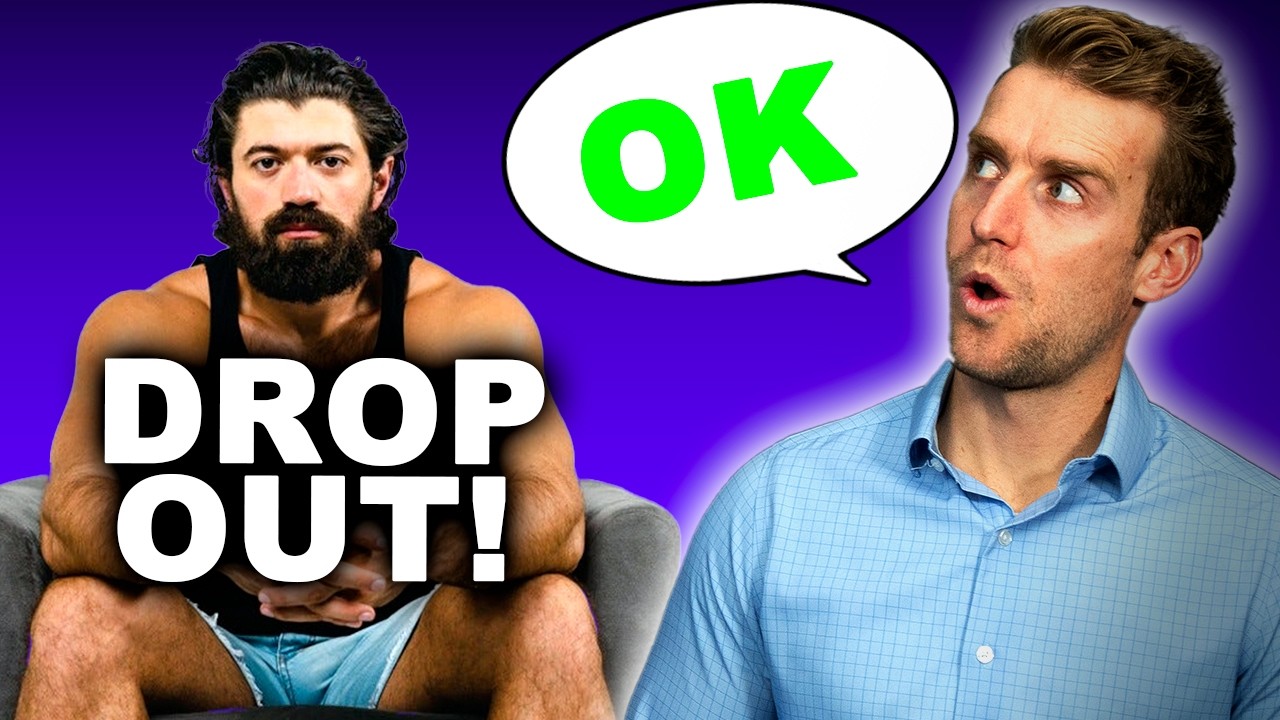
In this reaction video, fund manager Bridger Pennington discusses Alex Hormozi’s advice to college‑age viewers about whether to pursue a traditional four‑year degree or take alternative paths. Bridger, a college dropout himself, expands on Hormozi’s points, emphasizing opportunity cost, the value of income‑generating skills (especially sales), and the importance of real‑world experience such as gap‑year missions. He critiques the default expectation to attend college, highlights how university curricula can be ideologically biased, and argues for selective coursework, trade schools, and self‑education. The conversation also covers risk perception, the acceptability of failure while still in school, and the future relevance of sales and leadership skills in an AI‑driven economy. Throughout, Bridger shares personal anecdotes about his own education choices, mentorship with Hormozi, and practical steps for viewers to evaluate their own paths.
Chapters
This video is me breaking down Alex Hormozi's advice to college kids on what path they should take. I'm a college dropout myself. Let's roll the tape.
Was 18 years old. He was at this important decision in his life where he was deciding whether he was going to go to college. And I knew his parents. And it's kind of interesting because I sit halfway between his parents and him. So I kind of have both sides. He decided to enroll at Pepperdine. After a semester, he didn't really like it. And I think a lot of it was because it was just kind of expected that he go to college there.
You have plenty of time. There's no Rush. But I would tell someone, go do a month mission trip. Go do a service thing over in South America. Do something to serve other people. Get out of the United States and give a little bit of a gap. We'll keep watching what Alex says here, but I'll give a few more feedbacks in a minute.
I had developed a rapport with him and, you know, he used to work out with me at my home gym after school and whatnot. And so I was like, hey man, let's go for a walk. And I think we walked for about an hour and we just walked around the neighborhood. And I'm pretty sure that that conversation significantly shifted the trajectory of his life.
I'm someone who dropped out of school. I love school. After high school though, I think just going to school to go to school is not a great plan, especially like a Pepperdine where you're spending a lot of money on tuition.
The reason most people go to college is because that is what's expected. They don't think about the decision. They just do it because it feels like the next natural path.
Yeah, exactly what I just said. Like it's the next natural path. Oh, I should just go. I'm going to go spend $80,000 a year getting drunk. You can spend $8,000 a year and get drunk. Just go get drunk. Just don't spend $80,000 a year doing it.
Path that sustains thing for having kids and getting married and buying a house, but let's not get into that. He went from going to Pepperdine to dropping out. His friends, his family, his friends' parents started looking at him different. He was like the trouble child. He was like the, I don't know about him. 2 years later, he now has $250,000 saved up as a 20-year-old, makes $200,000 a year right now as a sales guy. What I want to do is break down the split in the road of 2 different lives that he could have lived, or that you could live, or Or that somebody that you know who's facing the decision could go through.
One of the big lessons that I love he's hitting on is the concept of opportunity cost. The missed opportunity. What's the cost of not making this decision? If you spend 4 years going to Pepperdine, you are missing out on the opportunity to make— this guy he shared was making $200,000 a year. So 2 times 4 would be $800,000 a year of opportunity cost that he missed out on. When you make a decision, you are closing out all the other doors as well. It is easy to get analysis paralysis. The phase of this is, well, I have so many options. I don't know what to do with any of them. Dating is a great example. I could, well, I could keep dating lots of girls or I could date one and marry one. And that means I can't date anybody else. Now, should we have kids? Should we build a family? We can have dual income together. We can share, do joint filings. We can do all sorts of stuff. These opportunities emerge once you get married. Same thing is true with business, sales jobs. As you make decisions, like they say, one door closes, other doors open. But you have to step through that door to move.
So it starts with— and this is me telling him this— I was like, what problem are you solving? He's like, well, I want to make money. So the question is, 4 years from now, if you have a degree and you lost the money and you lost the earning potential you had during those 4 years, is that you more able to generate income than an alternative you? Because what we have to analyze is not the cost of college, but the opportunity cost of going to college.
There he is getting into opportunity cost.
The opportunity cost is the loss of potential gain from other alternatives when one alternative is chosen. So when we choose to go to college—
I promise I'm blindly reacting to this. I just shared that. I guess we're preaching up the same storm here with me and Alex, but spot on of opportunity cost.
It's like, listen, man, if you want to make money, then you need income-generating skills. Do you think your philosophy degree, your sociology degree, your psychology degree, your economics degree even, which is still a little more useful, is going to give you actual skills to make money? He was like, I don't know.
It's so interesting with especially universities. I did not realize this picking a university when I went to school, how much universities vary in the way they teach and present and rewire your brain. You can look at this from a political spectrum. There are left-leaning and right-leaning schools that will drastically change how you perceive the world when you leave. And you got to make a decision. Do I want to go to a kind of a left school or right school? Most universities recently have become more left.
I can tell you ancient Chinese literature has never impacted my ability to make money. Aztec culture, don't know anything about it, but it's classes and they somehow fool kids into thinking that if they take this class, They're now somehow going to be more equipped to add value to the marketplace. If Alex were redoing the education—
My first year of school, I took pretty much zero generals. Most freshmen kind of take the same classes. Biology, Civ 1, Civ 2, American Heritage, writing. I said, why would I take those? I took a real estate class. I took an SEO class. I took a finance class. I took an accounting class. I took an online marketing class. My first year of school, I snuck into an MBA-level negotiations class. So as we talk about, you know, 2 paths, That's a total path. Think differently when you go to school. There are phenomenal classes at school. Just don't do the same old thing. So, you know, they do like an annual meeting with your counselor. So I sit down with my counselor and this is now I'm 2 years into school and she looks at me. And so I'm going into my— now going into my junior year. I'm going into my 3rd year of school and she's like, what have you been doing the last 2 years? And I'm like, I've been getting a phenomenal education. And she's like, well, on paper, You're like a freshman and if you guys know my story, I started 6 businesses my first year of school. At that time, I was running my fund. I was making over $100,000 a year in school.
Education system, the majors would be in accordance to the departments of a business. You'd have marketing and it would have the actual ways to market which is creating the materials of marketing and then how to distribute it. You'd have sales, how to get strangers to give you money. Delivery portion which would be either physical products delivery or services delivery which would be customer experience, customer success, or it'd be technical electrician, plumber, lawn mower, whatever it is. So then you have the actual technical component of the services delivered and then you have the supporting services which are like finance, HR, legal. Those would be the things that people should major in because those are the things that you're going to get hired to do.
It is bonkers. The education system. I would really think through before going to college. They especially some of these wacky universities, they are teaching and indoctrinating people in such strange ways that don't add value to a marketplace. I'd be very picky about the school. Not just the name on the wall, not the degree. There are, you know, there's also trade schools. There's also alternative education. Jordan Peterson has made an incredible university. I'd highlight him. Brought some incredible lecturers from around the world to his university. It's bonkers.
And the reason why I didn't drop out of college is because I was too scared to disappoint my father. If you're going to do it eventually, you might as well do it now. When I see the guys who are starting at 18, I'm like, man, I wish I'd started then rather than 23. I would have 5 more years. Zooming back out, I'm walking the street. We're talking together. And I told him this line. I said, the world doesn't need another 3-1 business degree from Pepperdine.
Boom! I love that quote. The world doesn't need another kid with another degree. Everyone has college degrees right now. I'll give a different example here. Summer sales is a big deal around here. There is pest control, alarm sales, solar sales that are massive. And every year they recruit tens of thousands of people around the country to go sell. They've probably knocked on your door before. A lot of them come from Utah. There's tons of universities in Utah that they go and recruit from, and they're trying to pull out 5,000 to 10,000, you know, reps a year to go knock doors all summer.
Okay?
This is the game, which is it's produced some phenomenal businesses in Utah. But I kept asking myself the question, which was this. Does the world need another door-to-door sales rep? How does that make Bridger, me, different than the 10,000 other college-aged, 22-year-old white males in this area that all sold summer sales last— how does that make my resume or my value prop to the world different? The answer is it doesn't, okay? Yes, it can teach you some sales skills. Yes, you can do some good things for you, and it's a good path for some people. For me, I sat there and said, I don't need as much sales skills because I had so many salespeople around me. I need to figure out these other skills of business that they don't have. that I could plug in a great sales org into and they could go sell my stuff for me.
This is what he brought up. He's like, well, what about like the social experience of college? I was like, so do you think that if you don't go to college, you're not going to be able to party with people who are your age? I was like, real talk. And he was like, well, like, kind of. If the problem to be solved is to socialize you, there are way more efficient ways to socialize.
So true. Don't go spend $80,000. He's probably gonna say it right now. $80,000 a year to socialize.
Spending $200,000 and not making income. You can work.
Exactly.
Make my objective for this period of time To have fun, then fucking work all day and then literally go out every single night and you'll end up debt-free with savings and have a hell of a crazy 4 stories. And that's fine if that's what you want to do. I was like, is that what you want to do? He's like, no. And I think at some point in the conversation he's like, I kind of want to do what you do. And I was like, well then you got to learn the skills that I had to start fucking 5 years older than you to start learning. Right? And the first thing was you had to learn how to sell. Let's just go down that path. If you're watching this and you're like, well, I don't like sales. I told you all the other departments that you could focus on. If you're like, you know what? I like being behind a camera. Then cool. What do you think behind a camera means in a business? Behind a camera means you're making content, you're making commercials. Pick one. That's what video is used for, right? If you're like, I like writing words, what do you think writing words are used for in business? They're used to sell or deliver. That's it. Or legal to protect people from selling and delivering.
Great frame around selling. And back to my story of summer sales is one very, very niche way to sell something. It's much different to sell on copy, on a camera or webinars. That's what I was getting at. We'll get back to Alex here.
He's like, I really like sales. Now, he happened to have liked sales. The blessing that he got was he had a mentor, which I'll say was me, I could see his personality. I was like, dude, I think you'd do well here. And he did like it and he did well. But if he was that camera guy and he really liked more of that stuff, or if he was really techie, I would have been like, dude, go start coding. And so all of like, you have this base skill and it's like, where do I want to apply it? If you're like, I don't know, you're never going to know because how would you know? You know, by starting and then you'll gain context to make—
I love that. You'll never— the concept of I'm going to follow my passions, I'll do what I'm passionate about. You don't know what you don't know. And that's why there's a lot of testing that goes on for all of us throughout our career to see what we are passionate about. And how many people in college do you know that are their 3rd year in college and still don't know what they're passionate about? And what's happening is graduation's coming soon and people are getting internships and getting job offers and they go, well, the classes I've taken, which are pretty minimal, I'm gonna pick something that I think is kind of cool. I like that professor and I'm gonna be in that rather than actually being in the real marketplace and seeing what they actually like. They go to supply chain management because that sounded so cool to be in supply chain management because they had a great professor and there's a cute girl in that class. And then They have a midlife crisis a couple years later and they go, why did I ever pick this path of life? Now they're a couple years removed and they go, what did I do with the last half a decade of my life? When actually they didn't actually go find the real data sets of what they're actually passionate about.
And I was like, then what are you gonna do? So he decided to drop out and he ended up going to sales and he was terrified. In the beginning, he sucked at sales because he had never done it before. Of course he would suck and of course you will suck too. Because you haven't done it. But how do you think you get good? You start by sucking and then you suck less. That's how it works.
People might be worried about, well, shoot, now he's on this path of sales. What if it doesn't work out? What if he didn't have a good experience with sales? Schools will always take your money. I had a great guy from Harvard come speak at our school. He came to the back of the room. I asked him about risk and about dropping out of school to start this business. And he's like, what do you mean risk? You know, your worst case scenario, you drop out of school. You lose all your money, you lose $5,000, whoop-de-doo, and you go live with your parents in the basement for 3 months to get back on your feet, who cares? You live in America, dude. That's not risk, right? Your upside is here and your risk is like right here. That's not risk. And then furthermore, he said, schools will always take your money. I sit on the board of a bunch of these schools. They're happy to take your money. People reward failure. And if we actually go fail and you fail hard, people like it and schools like that and they'll bring you back in. Generally speaking, you get back into school if you really want to.
You got to learn how to deal with people. You got to learn how to manage. You got to learn how to lead. You're like, that sounds like the soft stuff, and it is, but it's also how you're going to get promoted. It's how you get respect. It's how you gain influence. And you also realize that the technical thing that you're really good at is probably not the thing you're going to be doing in the business. You just got to know it well enough to teach it to somebody else. His parents came to me after, like, I talked to him, and they're like, Alex, can you please just sell me again on why he should be— you're, like, telling him to quit college? I was like, I'm not telling him to quit college. I'm telling him to make the best decision for where he wants to be in 4 years. I'm not telling him not to get educated. I'm telling him to get super educated in the thing that he wants to do.
Since dropping out of school, I've actually joined— me and Alex have been in different ones. I joined a group that was $24,000 a year. I joined another group that was $30,000 a year. I joined another group that was $150,000 a year for self-education. We actively buy courses, content, and actively educate. He doesn't mention in this video the emergence of AI. I think this is probably pre-AI this video came out. Many of the jobs that people are training for over 4 years, are going to be totally different in 4 years, and that's been the case for the last, what, 3 decades, and it's getting ever more quick right now. These skills of sales will not go away whether there's AI or not. The skill of all these— he talked about building and managing teams, having leadership, selling, the skill of fulfilling on a product, the skill around customer support and the supporting functions of fulfillment, and those will not be automated by AI, and/or if you can leverage AI in your businesses, it's an incredible time to be alive in this market cycle. I think the line that really hit when you said, and I'm paraphrasing it, it's socially acceptable to fail at entrepreneurship because you're still in school and you're using it as a crutch.
I think that was like, oh, that's it.
So I knew I needed to go all in.
Yeah, so you were dabbling on the side and you weren't succeeding at the entrepreneur thing, which is what you really wanted to do, and you were using college as a social Safety net to give yourself an excuse for why you weren't winning. Exactly. And so then you decided to go all in on it.
Then we went all in.
We did it. All right, say hi to Mosi. I'm in the closet. You're in the closet. Say hi to Mosi Nation.
What's up? That's awesome. That's just we ending that video. That was cool to see how that all wrapped up. Very good video from Home Mosi. Hopefully I added a couple good comments in here on my my journey. I'm 29 years old. We've had a incredible success at our age and Hormozi I think is 2 years older than me. He bought our course years ago and we've actually— we've talked a number of times me and Alex and I think that's great advice for someone looking at what path to take right now. There's never been a better time in the history of the world to be an entrepreneur than 2025.
More from Bridger



The AI stack is trying to consolidate to a winner take all, do you think it'll stay fractionalized


Before you launch a fund, triple check your fund attorney actually filed everything.





