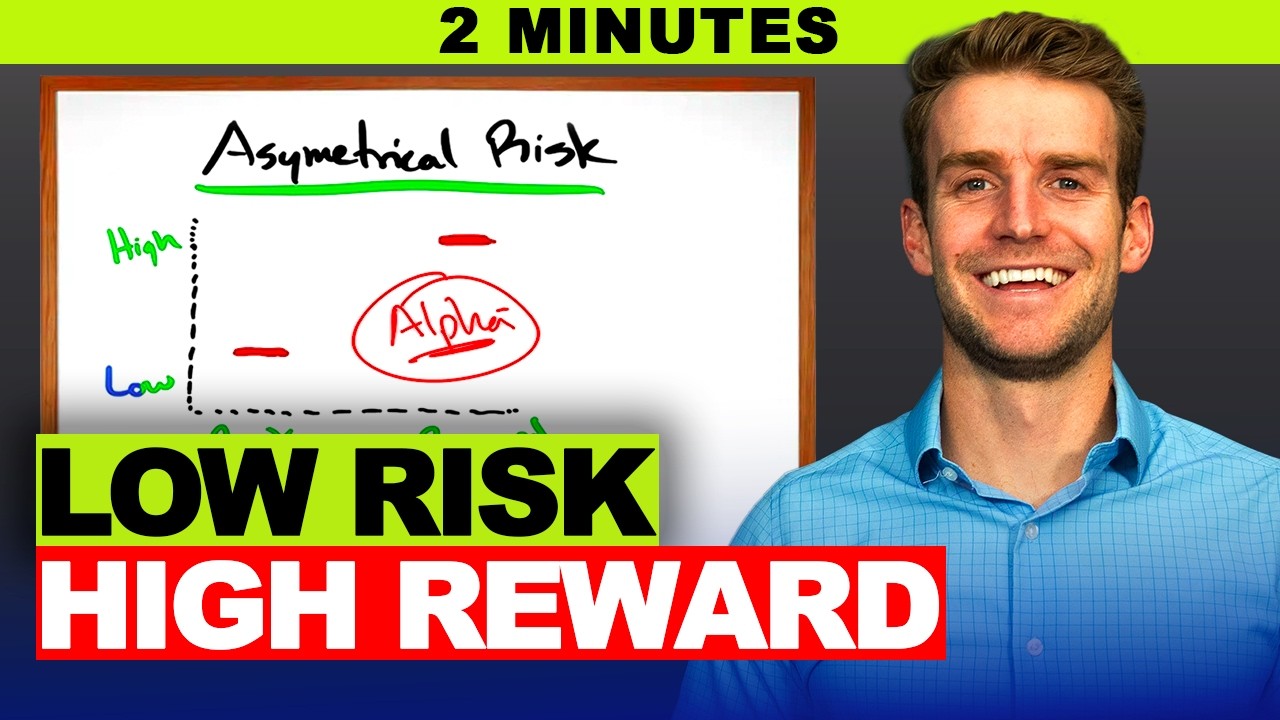
Bridger Pennington explains alpha as asymmetrical risk: investments with low risk and high reward. Ray Dalio recommends holding 10-15 uncorrelated assets to cut portfolio risk by 80%. A house-flipper with deep expertise or a startup backed by Jeff Bezos both capture this edge. Private markets offer more of these opportunities than public ones.
Chapters
What is asymmetrical risk and how do you create or find it in your fund or investment strategy? We're going to answer this question in 2 minutes or less. Now I'm Bridger Pennington, I'm the founder of Fund Launch. We've helped 300 funds launch. I currently run 2 investment funds right now that manage collectively about $50 million of AUM. Down to the iPad here. So when you talk about what is asymmetrical risk, a lot of us have probably heard this concept of low— you see my little graph here— low risk, low reward, High risk, high reward, right? You've probably heard that in investing in stocks. What asymmetrical risk is, we are trying to find something with relatively low risk and relatively high reward. And that gap there, this gap is called asymmetrical risk. This is what all fund managers are looking for. Some people term this as alpha as well, more of a loose term on the term of alpha. Okay, this is what we're looking for. Now you might say, This is impossible. Or how can you find that? Well, I was actually at the Greenwich Economic Forum a few weeks ago with Ray Dalio, the king himself. And Ray Dalio mentioned this. He goes, we try to find 10 to 15 uncorrelated assets. When we group them together, what we found is we can reduce our risk by 80% without losing our reward. What that is, is again, asymmetrical risk. Let me give you another example. This is actually very prevalent. Now, some markets, there's not as much asymmetrical risk. Some markets, there's lots of asymmetrical risk. For example, if Bridger, me, if I was going to go flip a house, the average house flip right now in America makes around $65,000. If you go buy like literally a house and flip it. Okay? That's the average return. I have a friend. He's flipped 300 homes in his lifetime. Okay? Incredible house flipper. When he goes and flips a house, because it's small, inefficient, fractured markets, on average, he's making a lot more than $65,000 per house flip. Because he has such great expertise in a certain field. If Bridger, you know, my family always makes fun of me. I'm not that handy of a guy. I'm sorry. I just hire people out to do stuff for me. I'm not very handy. If I went and flipped a house, it would be very risky. For this friend, it wouldn't be risky at all because he's done it so many times. Let me give you another example. Let's say we're starting a business together, me and you. OK? So we got Bridger and we got you and we're business partners and someone is looking to invest. OK. into this company and they're looking at a risk-reward profile. They're going, yeah, you know, let's say I'll use yellow here. They have medium risk and medium reward is kind of what they deem us as. But then we announce publicly Jeff Bezos is going to be our 3rd business partner and he's going to put all of his time and attention and energy into this business. If you're an investor, do you think the risk level goes up or down? I would argue probably down. Do you think the reward, the chance, the higher end tail of the reward goes up or down? Probably up. Just by adding one business partner, Jeff Bezos, one of the greatest entrepreneurs to ever live. We have now lowered our risk and increased our reward. We've created asymmetrical risk in our business. Okay? This— those are 2 simple examples of just people. But there's a lot of different ways that you can reduce risk and drive a better base or best-case scenario in your fund. When we're talking about the Fund Launch Formula here on other videos, we talk about the deal structure a lot and framing deals. That have asymmetrical risk. And yes, it is totally possible, especially in private and fractured, inefficient markets. You have less asymmetrical risk in public and liquid markets. You have more asymmetrical risk in fractured, smaller private markets. This is why— this is how fund managers make billions of dollars every year, is finding asymmetrical risk.