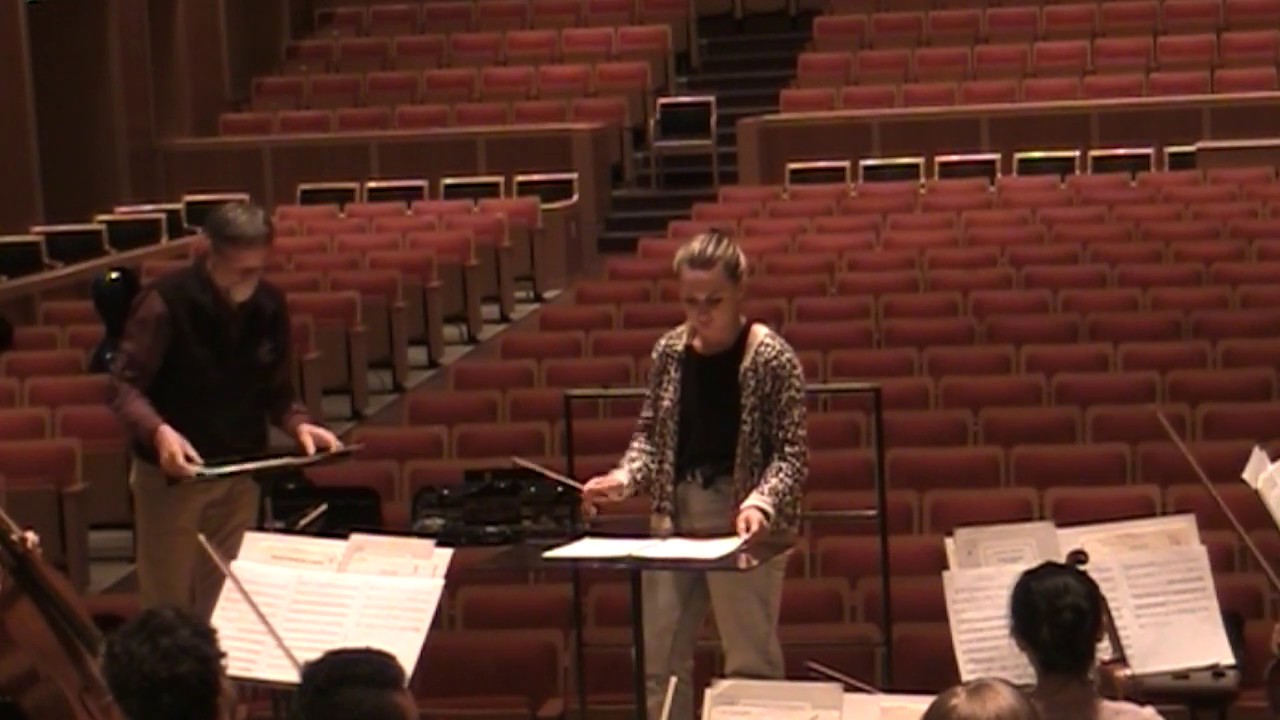
Gregory Youtz guides an ensemble through River Moon's climax, which "oozes" rather than explodes. The piece needs sustained loud percussion and innovative orchestration, including hammered dulcimer sounds and specific string techniques, to maintain energy through a gradual rise, peak, and fade that reflects yin-yang principles.
So let's stop there.
Yes, um, we don't have chimes.
No, and so she's playing the chime part on the glockenspiel.
Okay, right, because there's also Yes. Right, so it's missing some bells. Um, so just so you know why this sounds empty. Um, what's supposed to happen here— this is kind of an interesting thing about talking about Book 2— um, sometimes a climax is, um, a kind of a clear arrival, and you're there for a while, and then bam, it's over, and you know, you're on to something else. Sometimes a climax is It hits something, it gets bigger and bigger and bigger, and then what, it peaks and then it walks away? There are all kinds of ways of approaching a climax. In this piece, I was trying to do something— I've tried this in a number of ways in a number of different pieces. This is again a very Chinese thing where it's kind of like, you've all heard of yin and yang, you know, and yin and yang sort of cycle in and out of each other, mutually create and destroy each other over and over. The idea of the climax in this piece is that we sort of ooze into it, we reach the top, we realize, wow, this is pretty noisy, and then it just oozes on over the other side. So there is no bang, you know, there's no sort of arrival, there's no definite ending, it just kind of emerges and then it fades. And to pull this off, the percussion in particular, have to just keep wailing on those chimes and orchestra bells. Nice and big and loud. It's almost as if the bells of history are still ringing away while everybody else is fading, and you haven't gotten the memo, right? That battle is over, right? But you're still banging away. That's what sustains the energy, isn't it? So without those bells, we're not quite getting the effect. Okay, but but you know this is this is kind of a peculiarity of this moment in this. Which, you know, I again could write in a note to a conductor or something if there was a question about it. I think the tempo was still a little under, so I think we could keep that going. And this is one of those places I mentioned where I think if you felt that it was dragging, there just wasn't quite enough energy, particularly since you know there's no bang point. So you've got to somehow— and you know there's this long fadeaway with this bell, therefore you have to You have to achieve enough energy at the top to sustain the audience as this long sort of thing marches out the door. And so it's got to be loud enough, it's got to be energetic enough, and this is a place where I might suggest you pick up the tempo a little bit as you get towards the top of this energy curve. Okay?
I'm sorry.
It's supposed to be like that, and in fact, there's a— some of you have a little asterisk in your charts, and you're one of those, uh, Carmelo thing, or no, maybe not filling out. The other thing that I sometimes do is have, um, we could demonstrate here. You jingle this between the strings. Very good use of string. You jingle the band of links between a pair of strings. Of course, you can finger a double stop, and you just sort of jingle it like this. One of the things that I discovered in China that we just simply miss it in the West is hammered strings, right? The hammered dulcimer, which is a sound we know from folk music, but it's nowhere in the orchestra. And so I invented hammered Dulcimer for orchestra. It's kind of a very Chinese sound. They have like never dulcimer in China, and so you can get a whole section to do this. So sometimes when we've done this piece, we've done that full endo that way, and it's pretty cool, particularly right towards the end. It just sort of jingles its way out. The audience can't quite figure out what they're doing, but it's this cool sound. So the other thing is, in this section that we're just working on, E to the top, Sometimes it might be a good idea to add a little bit of horsehair to the bow, to the wood. So sort of on the side, give me a little bit of hair and a little bit of wood, and we get a little more pitch. So it also produces a little more sound. I would even suggest that maybe you start off with just a tick of the wood, and then gradually, as you feel like you're getting buried, add a little more horsehair so we get a little more sound. What's it like to Yeah, right.
Okay, has everyone listened to this piece entirely here, or is this people's first time going through it? Okay, then let's pick up from where we left off. Can we do 121?