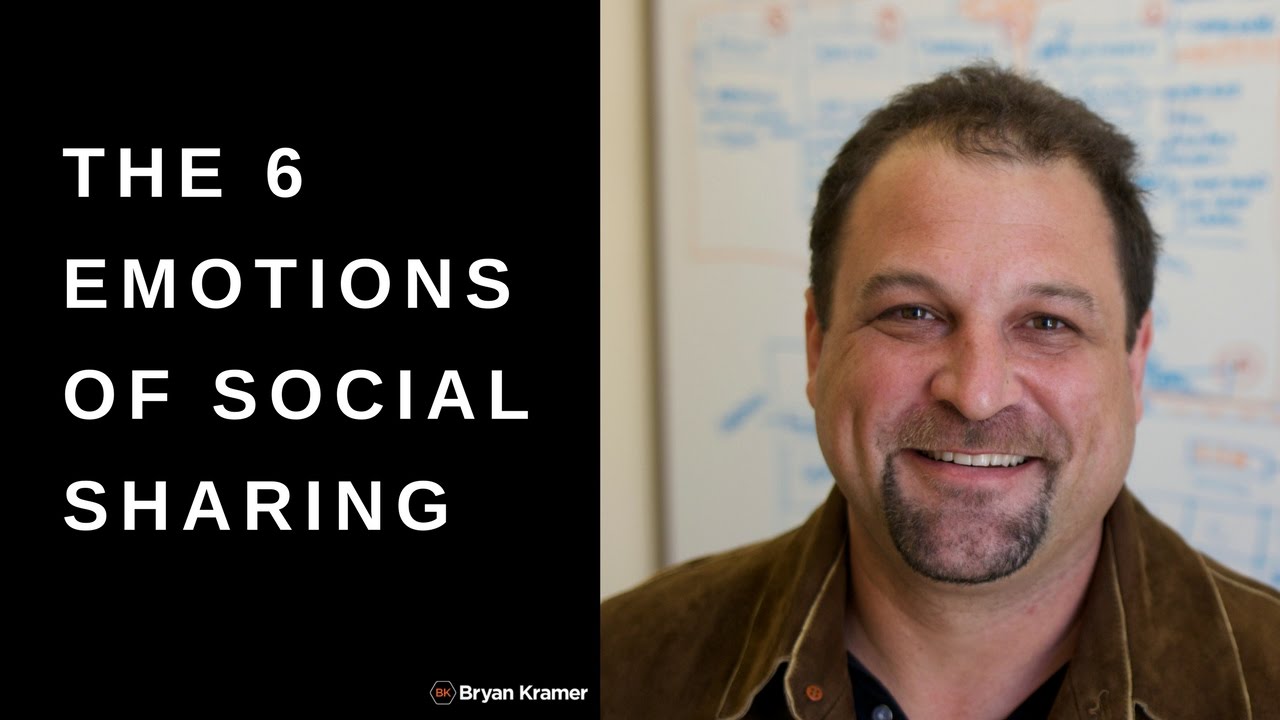
In this video, Bryan Kramer explains how emotions drive social media sharing and why marketers should align their content with six basic emotions identified by Paul Ekman—fear, anger, sadness, disgust, joy, and surprise. He argues that while emotions dominate online interaction, logic and data still shape how we present ideas. Each emotion is described with its psychological function, examples of how it appears on social platforms, and its impact on audience behavior. Kramer also discusses emotional mirroring and the 2012 Facebook emotional contagion experiment, showing that the tone of a newsfeed can shift users' moods. He concludes with practical advice to map these emotions onto content plans, use surprise strategically, and encourage viewers to engage, share, and subscribe.
Chapters
We live in a time when emotions are high because they're publicly shared and displayed in social media. In essence, we've opened up Pandora's box filled with emotions, both positive and negative, for all to see. And regardless of the sentiment of the emotions shared, sharing our feelings with each other builds connection, which equates to relationships. It's no wonder why social marketing has struck a chord. But if our society is emotionally run, why do we still primarily rely on logic to get everything done? Logic is the matchstick that gives us a platform to strike up opinions and conversations, which gives us creative input from the crowd. It's more rooted in fact and data, so perhaps as humans it makes us feel safe, backing up what we share to appear more believable. Certainly, if it weren't for research and data, we would live in one very opinionated society. While there is no definitive list of spectrums of emotions, one popular person from the emotional expert Paul Ekman contains 6 emotions including fear, anger, sadness, disgust, surprise, and joy. These 6 have been found in every society worldwide and have been shown to be identifiably by people regardless of upbringing, culture, or experience. All businesses, whether they are small, medium, or large, need to be aware of the following emotions they are evoking, as it has a direct reflection of the emotional response they want to evoke. In fact, I would suggest mapping these emotions to your content plan. Here are the 6 emotional styles of sharing applied to social. The first one is fear. The function of fear is to get us out of dangerous situations or into them. I know many people who are simply not on social media because they see social as an intrusion and fear the repercussions of being social. I predict that this will change over time as millennials grow up with a new set of social barriers moving forward. The second one is anger. Anger is emotional. It's an emotional response related to one's psychological interpretation of having been threatened. Some people are simply waiting on the sidelines to argue. Others take it farther, becoming haters or trolls. Anger is often one-sided unless it's accepted by both parties, in which case it's an endless quagmire of opinion slinging, often only ending by out-fatiguing the other person. The next one is sadness. This is an emotional pain associated with or characterized by feelings of disadvantage, Loss, despair, helplessness, and sorrow. As in our everyday lives, bad things happen to good people. These experiences are shared quite often and typically draw an amazing support system. There's solace in sharing our vulnerabilities and pain, and this can be quite healing if not made a crutch or part of one's social identity. The next one is disgust. Disgust is an emotional response of revulsion to something considered offensive or unpleasant. Social forms of disgust come in many flavors, oftentimes in the form of oversharing or not thinking through who is reading your content. And others simply don't care when they share or who they might hurt in sharing. As are the many decisions in life, we can take part in these discussions or simply move on. The next one is joy. The function of joy is to indicate what we've done or witnessed something that is enhancing to our well-being and to encourage us and others to aspire to greatness in the future. It's not an accident that Facebook built your profile as a timeline of your life to share with others all your joyful experiences. It feels great to share joyous occasions and make us feel good as humans. To see others experiencing joy. Surprise. The purpose of surprise is to indicate that something unexpected has occurred, to prepare us and those around us to deal with it. The element of surprise, when done right, can be a marketer's best tactic. I'll say it in one word: Apple. It's important that we also understand, as people running and representing brands, That when your emotional response resonates authentically, mirroring with those most likely who will take place. The act of mirroring anyone's body language is a way to bond and build understanding with other humans. It's a powerful tool that we use instinctively without even being aware of it. The most obvious forms of mirroring are yawning and smiling. When you see someone yawn, or if you see, see someone read the word yawn, you are likely to yawn immediately or during the next 30 seconds. This same concept has been proven to work online. An example of mirroring was reported by the AV Club in January of 2012, where Facebook adjusted its newsfeed algorithm for several hundred thousand users to see what you see in your newsfeed affects your emotional state as a part of a scientific study. The resulting paper was published to the Proceedings of the National Academy of Sciences, or PNAS, which found that people mirror the positive or negative emotions that their friends express in their posts, all without the aid of nonverbal cues like body language or tone of voice. Creepy, right? But still, the results are interesting. To pull this off, Facebook engineers tweaked what 600,000 users saw in their news feeds so they, so they saw more posts that expressed positive emotions while others saw more posts that conveyed negative feelings. The result? People actually responded in kind. Those who saw more positive posts responded more positively, while those who saw more negative posts responded with negative feelings of their own. The researchers, they called this an effect of emotional contagion because they purported to show that our friends' words on our Facebook newsfeed directly affected our own mood. You can check this out at Facebook Alters Algorithm for Emotional Research, and I've dropped a link below. So on a personal note, I think it's ironic that the very study that sought out to logically prove emotions affect human behavior and social actually caused more emotional reactions than that which it measured. Thank you guys so much for sharing this time with me. If you would like to leave me a comment or a question below, I would love it and I definitely will respond to you. Also, speaking of sharing emotions, please go ahead and click the share button and share this with your friends. I'd really appreciate that too. And last but not least, go ahead and subscribe as I post a new video once a week. Thank you so much for your willingness to watch this, and I'll see you again next week. Cheers.